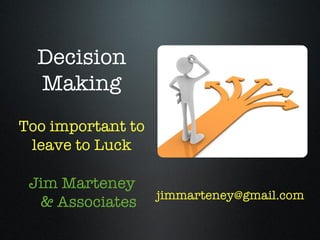



Decision
  Making
Too important to
 leave to Luck

 Jim Marteney
                   jimmarteney@gmail.com
  & Associates
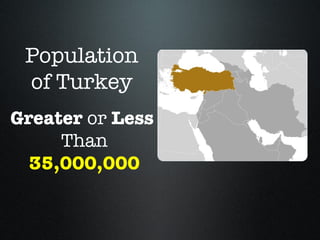
Population
 of Turkey
Greater or Less
     Than
  35,000,000
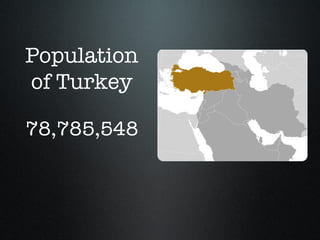
Population
of Turkey

78,785,548
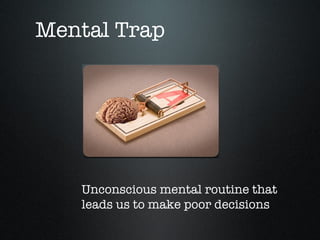
Mental Trap


   Unconscious mental routine that
   leads us to make poor decisions
Anchoring Trap
Initial impressions,
estimates, or data
anchor subsequent
thoughts and judgments.

      Mind gives disproportionate
      weight to the first
      information it receives.
Status Quo Trap
Sins of commision punished
more than sins of omission
We instinctively stay with
what seems familiar.
More alternatives, stronger status quo
We look for decisions that involve
the least change
People want to avoid, “rocking the boat”
Justify Past
Actions Trap
 more invested in the past,
 more difficult to change

           Don’t cultivate a
            fear of failure
               culture
Framing
  Trap

 The way a problem is worded or
     “framed” can profoundly
 influence the choices one makes
Framing
  Trap
 People are:

 risk averse when a problem is
 posed in terms of gains

 risk seeking when a problem is
 posed in terms of avoiding losses
Framing
  Trap
 Which would you choose?

   A sure gain of $3,000

   80% chance of winning $4,000
   and a 20% chance of winning
   nothing
Framing
  Trap
 Which would you choose?

   A sure loss of $3,000

   80% chance of losing $4,000
   and a 20% chance of losing
   nothing
Framing
  Trap
 Which production schedule
 would you choose after hearing
 that if you continue as you are,
 all 6,000 units will be lost?
Framing
  Trap
   Plan A sure production of
   2,000 units

   Plan B a one-third chance that
   6,000 units can be produced,
   two-thirds that no units can be
   produced.
Framing
  Trap

   Plan A sure production loss of
   4,000 units

   Plan B a one-third chance that
   6,000 units can be produced
Framing
  Trap


  “Bird in the hand,
   worth two in the
        bush.”
Critical Thinking


   Involves a persistent
   effort to examine any
  belief or supposed form
     of knowledge in the
    light of the evidence
       that supports it.
Critical Thinking


      Gives reasoned
     consideration to
  evidence, to contexts,
  to conceptualizations,
    to methods, and to
         criteria.
Critical Thinking


     Reaches factual or
  judgmental conclusions
       based on sound
   inferences drawn from
        unambiguous
        statements of
    knowledge and belief.
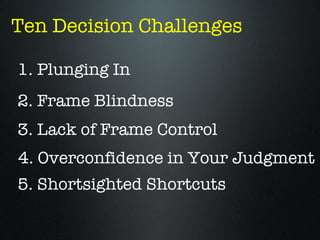
Ten Decision Challenges

1. Plunging In
2. Frame Blindness
3. Lack of Frame Control
4. Overconfidence in Your Judgment
5. Shortsighted Shortcuts
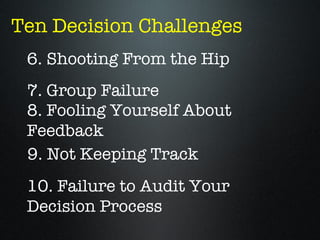
Ten Decision Challenges
 6. Shooting From the Hip
 7. Group Failure
 8. Fooling Yourself About
 Feedback
 9. Not Keeping Track
 10. Failure to Audit Your
 Decision Process
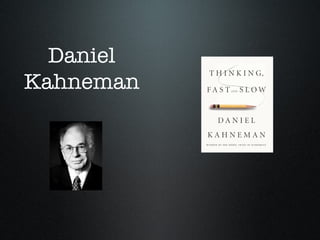
Daniel
Kahneman
Amos
Tversky
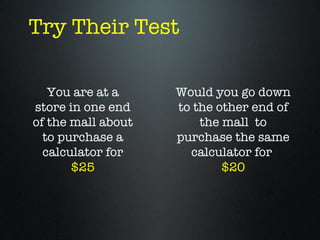
Try Their Test

   You are at a     Would you go down
store in one end    to the other end of
of the mall about       the mall to
  to purchase a     purchase the same
  calculator for      calculator for
       $25                  $20
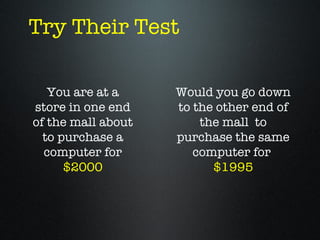
Try Their Test

   You are at a     Would you go down
store in one end    to the other end of
of the mall about       the mall to
  to purchase a     purchase the same
  computer for         computer for
      $2000               $1995
Lateral Thinking


         Edward Debono


      Story of evil money
    lender, debtor and his
      beautiful daughter
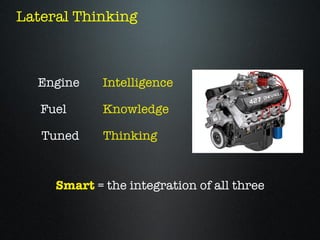
Lateral Thinking


  Engine     Intelligence

   Fuel      Knowledge

   Tuned     Thinking


     Smart = the integration of all three
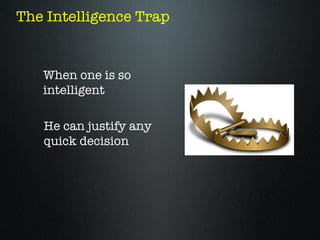
The Intelligence Trap


   When one is so
   intelligent

   He can justify any
   quick decision
Decision Making Skills

      Identify the Problem

      Ask the Key Questions

      Develop Alternatives

      Build a Consensus

      Lead a Supportive Group
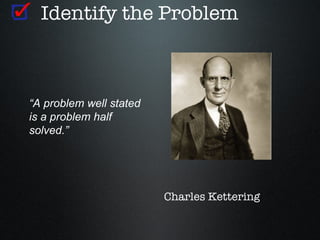
Identify the Problem


“A problem well stated
is a problem half
solved.”


                         Charles Kettering
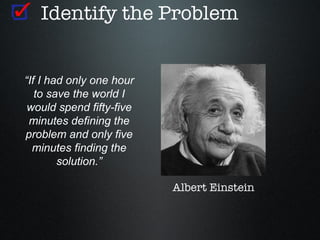
Identify the Problem


“If I had only one hour
   to save the world I
 would spend fifty-five
 minutes defining the
problem and only five
  minutes finding the
        solution.”

                          Albert Einstein
Identify the Problem
Difference Between


      Cause of a Problem


      Effect of a Problem
Identify the Problem
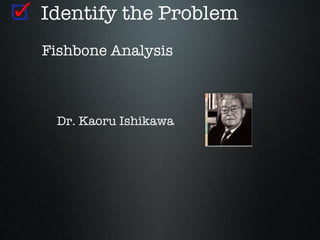
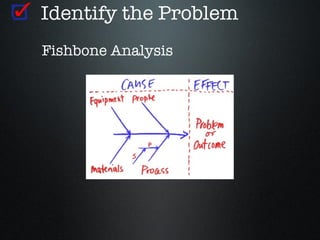
Fishbone Analysis


 Dr. Kaoru Ishikawa
Identify the Problem
Fishbone Analysis
Asking the Right Questions
 Is there a Problem?

 How Significant is the Problem?

 Structural or Attitudinal?

 Is there a Solution?

 Will the Solution Solve the Problem?

 What are the negative effects?

 Negative aspects outweigh the benefits?
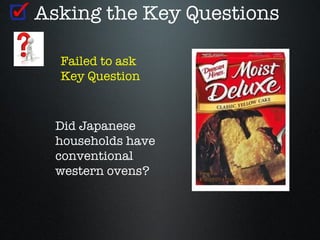
Asking the Key Questions

  Failed to ask
  Key Question


  Did Japanese
  households have
  conventional
  western ovens?
Develop Alternatives
  Two important steps


      Ideation


      Judgment
Develop Alternatives
Brainstorming


 Goal is Quantity

 No Criticism

 Build on Ideas
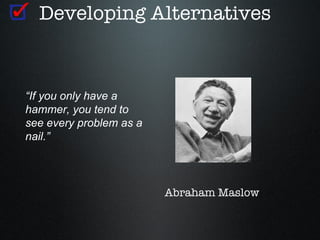
Developing Alternatives


“If you only have a
hammer, you tend to
see every problem as a
nail.”


                         Abraham Maslow
Analyze Alternatives


      Appraise Strengths


      Appraise Weaknesses
Build a Consensus

Where all Group Members


        at least partially agree


        are committed to the decision
Build a Consensus

    Avoid Arguing for
    Just your Opinion
    Avoid Win/Lose Situations
    Seek Differences of Opinion
    Use Group Pronouns

    Orient Towards Group Goal
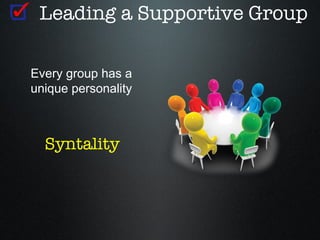
Leading a Supportive Group

Every group has a
unique personality


  Syntality
Leading a Supportive Group

Group strength from
effective merging of
participants
individual energy

  Synergy
Leading a Supportive Group

Two Challenges Managing Group Tension


  Groupthink

Abilene Paradox
Groupthink
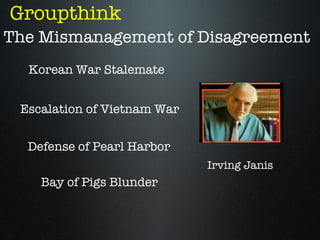
The Mismanagement of Disagreement
  Korean War Stalemate


 Escalation of Vietnam War


  Defense of Pearl Harbor
                             Irving Janis
    Bay of Pigs Blunder
Groupthink

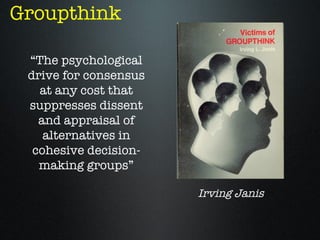
 “The psychological
 drive for consensus
   at any cost that
 suppresses dissent
   and appraisal of
    alternatives in
  cohesive decision-
   making groups”

                       Irving Janis
Groupthink


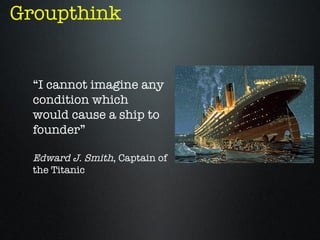
  “I cannot imagine any
  condition which
  would cause a ship to
  founder”

  Edward J. Smith, Captain of
  the Titanic
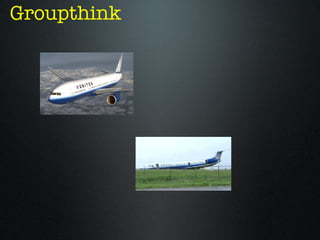
Groupthink
Groupthink
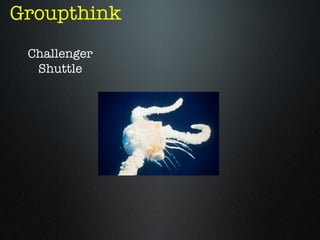
 Challenger
  Shuttle
Groupthink
 According to a scathing report
 released by the Senate Intelligence
 Committee, the United States went
 to war with Iraq on
 the basis of flawed intelligence
 assessments.

 The CIA analysts suffered a case of
 Groupthink that rendered them
 incapable of considering
 that Iraq might have dismantled
 its weapons programs.
        Senate Intelligence Committee July 10 2004
Groupthink
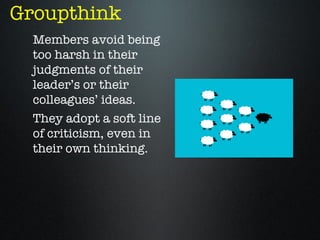
  Members avoid being
  too harsh in their
  judgments of their
  leader’s or their
  colleagues’ ideas.
  They adopt a soft line
  of criticism, even in
  their own thinking.
Groupthink

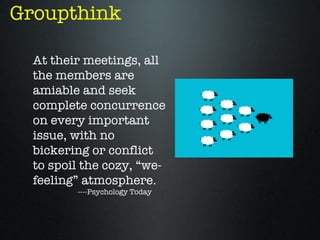
  At their meetings, all
  the members are
  amiable and seek
  complete concurrence
  on every important
  issue, with no
  bickering or conflict
  to spoil the cozy, “we-
  feeling” atmosphere.
         ----Psychology Today
Groupthink
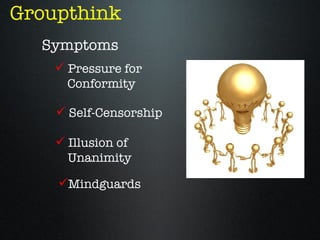
  Symptoms
     Pressure for
      Conformity

     Self-Censorship

     Illusion of
      Unanimity

    Mindguards
Groupthink
Negative Outcomes

     Examine Few Alternatives

      Not being critical of each other’s ideas

      Not examining early alternatives

      Not seeking expert opinion

      Gathering Information Selectively
      Not having contingency plans
Groupthink
   Avoiding

     Refrain from stating preference

     Encourage member’s objections

     Assign a Devil’s Advocate

     Seek expert input

     Call a “Second Chance Meeting”
     Split into Sub-groups
Groupthink


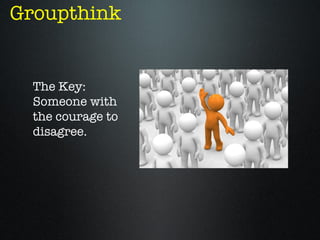
  The Key:
  Someone with
  the courage to
  disagree.
Abilene Paradox
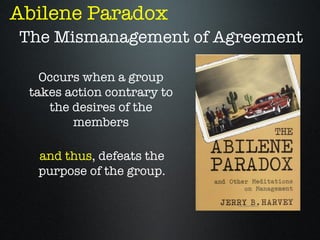
The Mismanagement of Agreement

   Occurs when a group
 takes action contrary to
    the desires of the
        members

  and thus, defeats the
  purpose of the group.
Abilene Paradox

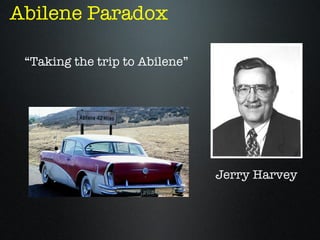
 “Taking the trip to Abilene”


                                Jerry Harvey
Group Climate
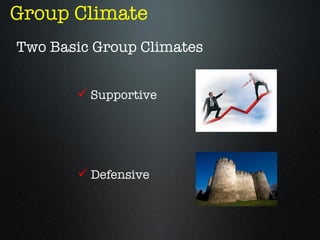
Two Basic Group Climates


        Supportive


        Defensive
Implement Alternative


There will always be resistance
Implement Alternative
Change has considerable
impact on the human mind.

  To the fearful, it is threatening because it
  means things may get worse.

  To the hopeful, it is encouraging
  because things may get better.

  To the confident, it is inspiring
  because the challenge exists to make
  things better.
Implement Alternative


 Obviously then, one's character
 and frame of mind determine how
 one relates to change.
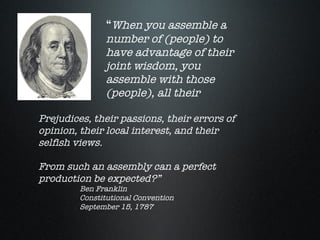
“When you assemble a
               number of (people) to
               have advantage of their
               joint wisdom, you
               assemble with those
               (people), all their

Prejudices, their passions, their errors of
opinion, their local interest, and their
selfish views.

From such an assembly can a perfect
production be expected?”
         Ben Franklin
         Constitutional Convention
         September 15, 1787
For more information, insights,
    or questions, contact:


         jimmarteney@gmail.com
Thank you, now go make
 some quality decisions.

Baxter Decision Making

  • 1.
    Decision Making Tooimportant to leave to Luck Jim Marteney jimmarteney@gmail.com & Associates
  • 2.
    Population of Turkey Greateror Less Than 35,000,000
  • 3.
  • 4.
    Mental Trap Unconscious mental routine that leads us to make poor decisions
  • 5.
    Anchoring Trap Initial impressions, estimates,or data anchor subsequent thoughts and judgments. Mind gives disproportionate weight to the first information it receives.
  • 6.
    Status Quo Trap Sinsof commision punished more than sins of omission We instinctively stay with what seems familiar. More alternatives, stronger status quo We look for decisions that involve the least change People want to avoid, “rocking the boat”
  • 7.
    Justify Past Actions Trap more invested in the past, more difficult to change Don’t cultivate a fear of failure culture
  • 8.
    Framing Trap The way a problem is worded or “framed” can profoundly influence the choices one makes
  • 9.
    Framing Trap People are: risk averse when a problem is posed in terms of gains risk seeking when a problem is posed in terms of avoiding losses
  • 10.
    Framing Trap Which would you choose? A sure gain of $3,000 80% chance of winning $4,000 and a 20% chance of winning nothing
  • 11.
    Framing Trap Which would you choose? A sure loss of $3,000 80% chance of losing $4,000 and a 20% chance of losing nothing
  • 12.
    Framing Trap Which production schedule would you choose after hearing that if you continue as you are, all 6,000 units will be lost?
  • 13.
    Framing Trap Plan A sure production of 2,000 units Plan B a one-third chance that 6,000 units can be produced, two-thirds that no units can be produced.
  • 14.
    Framing Trap Plan A sure production loss of 4,000 units Plan B a one-third chance that 6,000 units can be produced
  • 15.
    Framing Trap “Bird in the hand, worth two in the bush.”
  • 16.
    Critical Thinking Involves a persistent effort to examine any belief or supposed form of knowledge in the light of the evidence that supports it.
  • 17.
    Critical Thinking Gives reasoned consideration to evidence, to contexts, to conceptualizations, to methods, and to criteria.
  • 18.
    Critical Thinking Reaches factual or judgmental conclusions based on sound inferences drawn from unambiguous statements of knowledge and belief.
  • 19.
    Ten Decision Challenges 1.Plunging In 2. Frame Blindness 3. Lack of Frame Control 4. Overconfidence in Your Judgment 5. Shortsighted Shortcuts
  • 20.
    Ten Decision Challenges 6. Shooting From the Hip 7. Group Failure 8. Fooling Yourself About Feedback 9. Not Keeping Track 10. Failure to Audit Your Decision Process
  • 21.
  • 22.
  • 23.
    Try Their Test You are at a Would you go down store in one end to the other end of of the mall about the mall to to purchase a purchase the same calculator for calculator for $25 $20
  • 24.
    Try Their Test You are at a Would you go down store in one end to the other end of of the mall about the mall to to purchase a purchase the same computer for computer for $2000 $1995
  • 25.
    Lateral Thinking Edward Debono Story of evil money lender, debtor and his beautiful daughter
  • 26.
    Lateral Thinking Engine Intelligence Fuel Knowledge Tuned Thinking Smart = the integration of all three
  • 27.
    The Intelligence Trap When one is so intelligent He can justify any quick decision
  • 28.
    Decision Making Skills  Identify the Problem  Ask the Key Questions  Develop Alternatives  Build a Consensus  Lead a Supportive Group
  • 29.
    Identify the Problem “Aproblem well stated is a problem half solved.” Charles Kettering
  • 30.
    Identify the Problem “IfI had only one hour to save the world I would spend fifty-five minutes defining the problem and only five minutes finding the solution.” Albert Einstein
  • 31.
    Identify the Problem DifferenceBetween Cause of a Problem Effect of a Problem
  • 32.
    Identify the Problem FishboneAnalysis Dr. Kaoru Ishikawa
  • 33.
  • 34.
    Asking the RightQuestions  Is there a Problem?  How Significant is the Problem?  Structural or Attitudinal?  Is there a Solution?  Will the Solution Solve the Problem?  What are the negative effects?  Negative aspects outweigh the benefits?
  • 35.
    Asking the KeyQuestions Failed to ask Key Question Did Japanese households have conventional western ovens?
  • 36.
    Develop Alternatives Two important steps Ideation Judgment
  • 37.
    Develop Alternatives Brainstorming Goalis Quantity No Criticism Build on Ideas
  • 38.
    Developing Alternatives “If youonly have a hammer, you tend to see every problem as a nail.” Abraham Maslow
  • 39.
    Analyze Alternatives Appraise Strengths Appraise Weaknesses
  • 40.
    Build a Consensus Whereall Group Members at least partially agree are committed to the decision
  • 41.
    Build a Consensus Avoid Arguing for Just your Opinion Avoid Win/Lose Situations Seek Differences of Opinion Use Group Pronouns Orient Towards Group Goal
  • 42.
    Leading a SupportiveGroup Every group has a unique personality Syntality
  • 43.
    Leading a SupportiveGroup Group strength from effective merging of participants individual energy Synergy
  • 44.
    Leading a SupportiveGroup Two Challenges Managing Group Tension Groupthink Abilene Paradox
  • 45.
    Groupthink The Mismanagement ofDisagreement Korean War Stalemate Escalation of Vietnam War Defense of Pearl Harbor Irving Janis Bay of Pigs Blunder
  • 46.
    Groupthink “The psychological drive for consensus at any cost that suppresses dissent and appraisal of alternatives in cohesive decision- making groups” Irving Janis
  • 47.
    Groupthink “Icannot imagine any condition which would cause a ship to founder” Edward J. Smith, Captain of the Titanic
  • 48.
  • 49.
  • 50.
    Groupthink According toa scathing report released by the Senate Intelligence Committee, the United States went to war with Iraq on the basis of flawed intelligence assessments. The CIA analysts suffered a case of Groupthink that rendered them incapable of considering that Iraq might have dismantled its weapons programs. Senate Intelligence Committee July 10 2004
  • 51.
    Groupthink Membersavoid being too harsh in their judgments of their leader’s or their colleagues’ ideas. They adopt a soft line of criticism, even in their own thinking.
  • 52.
    Groupthink Attheir meetings, all the members are amiable and seek complete concurrence on every important issue, with no bickering or conflict to spoil the cozy, “we- feeling” atmosphere. ----Psychology Today
  • 53.
    Groupthink Symptoms  Pressure for Conformity  Self-Censorship  Illusion of Unanimity Mindguards
  • 54.
    Groupthink Negative Outcomes  Examine Few Alternatives  Not being critical of each other’s ideas  Not examining early alternatives  Not seeking expert opinion  Gathering Information Selectively  Not having contingency plans
  • 55.
    Groupthink Avoiding  Refrain from stating preference  Encourage member’s objections  Assign a Devil’s Advocate  Seek expert input  Call a “Second Chance Meeting”  Split into Sub-groups
  • 56.
    Groupthink TheKey: Someone with the courage to disagree.
  • 57.
    Abilene Paradox The Mismanagementof Agreement Occurs when a group takes action contrary to the desires of the members and thus, defeats the purpose of the group.
  • 58.
    Abilene Paradox “Takingthe trip to Abilene” Jerry Harvey
  • 59.
    Group Climate Two BasicGroup Climates  Supportive  Defensive
  • 60.
  • 61.
    Implement Alternative Change hasconsiderable impact on the human mind. To the fearful, it is threatening because it means things may get worse. To the hopeful, it is encouraging because things may get better. To the confident, it is inspiring because the challenge exists to make things better.
  • 62.
    Implement Alternative Obviouslythen, one's character and frame of mind determine how one relates to change.
  • 63.
    “When you assemblea number of (people) to have advantage of their joint wisdom, you assemble with those (people), all their Prejudices, their passions, their errors of opinion, their local interest, and their selfish views. From such an assembly can a perfect production be expected?” Ben Franklin Constitutional Convention September 15, 1787
  • 64.
    For more information,insights, or questions, contact: jimmarteney@gmail.com
  • 65.
    Thank you, nowgo make some quality decisions.