Nanotechnology based satellite
communication system
By
Periyanayaga kristy. A
M.Tech-Nanotechnology
Nanotechnology based satellite communication system
• Satellite Communication: it is an artificial satellite that relays and
amplifies through the use of a transponder, radio telecommunications
signals, between a source and a receiver.
• The use of artificial satellites to provide communication links
between various points on Earth.
• Satellite communications play a vital role in the global
telecommunications system.
• Approximately 2,000 artificial satellites orbiting Earth relay analog
and digital signals carrying voice, video, and data to and from one or
many locations worldwide.
Introduction
Nanotechnology based satellite communication system
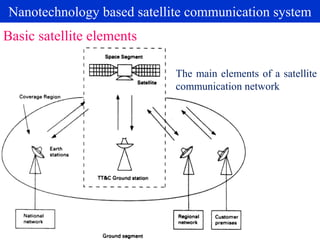
• Satellite communication system is comprised of two main
components, namely space segment and ground segment, as
illustrated in figure below.
• A basic satellite communication system consists of a space segment
serving a specific ground segment (Richharia, 1999).
• The satellite itself is also known as the space segment while the earth
stations will serve as the ground segment.
• The satellite is controlled and its performance is monitored by the
Telemetry Tracking and Command (TT&C) station.
Basic satellite elements
Nanotechnology based satellite communication system
The main elements of a satellite
communication network
Basic satellite elements
Nanotechnology based satellite communication system
• Communication can be established easily between all earth stations
located within the coverage region through the satellite.
• The primary role of a satellite is to relay electronic signals.
• When signals from the earth stations are received by the satellite, the
signals are processed, translated into another radio frequency and
retransmitted down towards another desired earth stations after
further amplification.
• Satellite relay can be two way, as in the case of a long distance phone
call, and point to multipoint, as in the case with television broadcasts.
Basic satellite elements
Nanotechnology based satellite communication system
• Communication systems in nano- and pico-satellites are
experiencing an extremely fast evolution.
• Early CubeSats carried simple beacon transmitters or could
downlink only a limited amount of data, most of the times only
for housekeeping purposes.
• In recent times the picture changed dramatically with several
scientific missions flying and even more proposed.
Nanosatellite communication system trends
Nanotechnology based satellite communication system
• This forced the nano-satellite designers to improve the
communication sub-system to accommodate the data throughput
required for current missions.
• Several commercial Earth observation systems are being designed as
well.
Nanosatellite communication system trends
Nanotechnology based satellite communication system
• S-band frequencies could be easier to obtain (again due to the
available spectrum) but hardware complexity can become an issue.
• Higher frequencies offer an easier access but the technical
complexity increases too:
• As an example, solid state amplifiers are easily available at “low
frequency” (VHF, UHF and S-band)
• And may also have a high efficiency (PAE from 50% to 80% are
available) while for higher frequencies (C-band or X-band)
• The efficiency usually drops down to 20% - 30%.
Frequency band selection
Nanotechnology based satellite communication system
• The use of higher frequencies than the common VHF/UHF bands
like S-Band or higher also implies other requirements on the
spacecraft design mainly on antenna, power system and AOCS
design.
• This sometimes is a limit (from the technical and / or economical
point of view) for some projects.
• This is one of the main reasons for the wide usage of the VHF / UHF
bands.
• Anyway, it must be noted, that the usage of S-band links is increasing
but mainly in under-development satellites.
Frequency band selection
Nanotechnology based satellite communication system
• Exactly as it was the case in the past for commercial micro- and
mini-satellites,
• The need for mission capabilities in nano-satellites requires
improvements in data downlink throughput,
• An efficient use of the available spectrum.
• Many mission still use a basic, low efficiency, radio-amateur based,
1200 bps AFSK link,
• But some missions are beginning to consider more advanced
modulation schemes like BPSK and QPSK (also using improvements
in COTS semiconductor components).
Modulation schemes
Nanotechnology based satellite communication system
• For downlink applications on VHF and UHF, downlink speeds
between 1200 and 9600 bps are considered, while downlinks on S-
Band would be expected to be able to implement data rates from 100
kbps to 1 Mbps and even higher (available as off-the-shelf
components).
• High order modulation schemes offer better spectrum efficiency but
increase the complexity of the link and, sometimes, they can increase
the risk of failure.
• QPSK begins to be used commonly in S-band but more complex
schemes (like 8PSK or 16APSK), which are common in satellite
broadcasting, are still not used for nano-satellites.
Modulation schemes
Nanotechnology based satellite communication system
• Bandwidth efficient modulations are needed especially when the
required bandwidth is wide and needs to be licensed (and paid).
• They have anyway a drawback that can limit their applicability to
nano-satellites: the higher the complexity, the higher the signal-to-
noise ratio they require.
• This is a big limitation in nano-satellites because most of them are
limited by the small surface that can be used for solar panels (as
compared, for example, to GEO satellites).
Modulation schemes
Nanotechnology based satellite communication system
• In general, as previously stated, the main link budget limit is usually
the complexity of the hardware, rather than the amount of data to be
transferred.
• Satisfactory results can be achieved with simple hardware. The more
complex the missions become (and so the most mature the
technology in this segment becomes) the more channel coding
schemes will be used to improve performances.
• Channel coding is sometimes also called FEC or Forward Error
Correction.
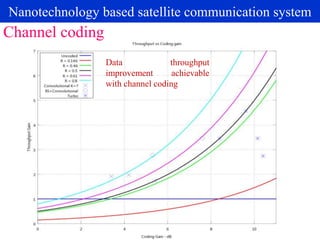
• As it can be seen in Figure, the use of channel coding can help
improving the data throughput.
Channel coding
Nanotechnology based satellite communication system
Data throughput
improvement achievable
with channel coding
Channel coding
Nanotechnology based satellite communication system
• The figure compares different coding schemes (coding gain can be
seen on the X axis, whilethroughput gain is on the Y axis): the
different solid lines show the hypothetical performances of codes
with different code rates.
• Practical implementations of different code families are presented
also as a comparison. For example, a convolutional code with
constraint length equal to 7 can provide a data throughput gain up to
2x (depending on the rate of the code).
• From the previous example it can be clearly seen that channel coding
can improve the link budget and it will start playing a significant role
as soon as missions will need to go beyond a conventional low speed
link.
Channel coding
Nanotechnology based satellite communication system
• As it was presented in the previous sections, we experienced a
performance increase in all the satellite to ground station link
building blocks.
• Anyway, this increase will not be enough for future missions and
further performance increases are expected leading to commercially
available solutions enabling advance missions.
• One of the main limiting factors to improve radio performances is the
limited power available on nano-satellites: due to the small satellite
size, only deployable panels can help improving the power budget
dramatically.
Future road map
Nanotechnology based satellite communication system
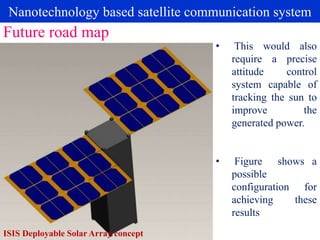
ISIS Deployable Solar Array concept
Future road map
• This would also
require a precise
attitude control
system capable of
tracking the sun to
improve the
generated power.
• Figure shows a
possible
configuration for
achieving these
results
Nanotechnology based satellite communication system
• For command uplinks in the VHF/UHF/L- and S-bands datarates up
to 9k6bps are expected.
• Higher datarates can be required is a full software upload is
envisaged, but this operation is anyway not common.
• For VHF/UHF telemetry downlinks up to 38k4 bps is feasible and for
S-band Payload downlink rates in excess of 1MBps and improved
satellite antennas are already appearing.
• Advanced modulation and coding techniques are considered to be the
key to better performance and improved spectral efficiency.
• SDR based radio ground segments allow ease of implementation and
flexibility.
Future road map
Nanotechnology based satellite communication system
• The is focused on the past and present trends in nano-satellites
communication systems.
• The analysis of the past trends can be used to estimate the future
performance growth, showing common trends with micro- and mini
satellites.
• This also focused on the transition between radioamateur legacy
hardware to modern software-based transmitting and receiving
systems.
• A road map for future developments was presented to show what a
satellite user could expect in the short term

Nanotechnology based satellite communication system

  • 1.
    Nanotechnology based satellite communicationsystem By Periyanayaga kristy. A M.Tech-Nanotechnology
  • 2.
    Nanotechnology based satellitecommunication system • Satellite Communication: it is an artificial satellite that relays and amplifies through the use of a transponder, radio telecommunications signals, between a source and a receiver. • The use of artificial satellites to provide communication links between various points on Earth. • Satellite communications play a vital role in the global telecommunications system. • Approximately 2,000 artificial satellites orbiting Earth relay analog and digital signals carrying voice, video, and data to and from one or many locations worldwide. Introduction
  • 3.
    Nanotechnology based satellitecommunication system • Satellite communication system is comprised of two main components, namely space segment and ground segment, as illustrated in figure below. • A basic satellite communication system consists of a space segment serving a specific ground segment (Richharia, 1999). • The satellite itself is also known as the space segment while the earth stations will serve as the ground segment. • The satellite is controlled and its performance is monitored by the Telemetry Tracking and Command (TT&C) station. Basic satellite elements
  • 4.
    Nanotechnology based satellitecommunication system The main elements of a satellite communication network Basic satellite elements
  • 5.
    Nanotechnology based satellitecommunication system • Communication can be established easily between all earth stations located within the coverage region through the satellite. • The primary role of a satellite is to relay electronic signals. • When signals from the earth stations are received by the satellite, the signals are processed, translated into another radio frequency and retransmitted down towards another desired earth stations after further amplification. • Satellite relay can be two way, as in the case of a long distance phone call, and point to multipoint, as in the case with television broadcasts. Basic satellite elements
  • 6.
    Nanotechnology based satellitecommunication system • Communication systems in nano- and pico-satellites are experiencing an extremely fast evolution. • Early CubeSats carried simple beacon transmitters or could downlink only a limited amount of data, most of the times only for housekeeping purposes. • In recent times the picture changed dramatically with several scientific missions flying and even more proposed. Nanosatellite communication system trends
  • 7.
    Nanotechnology based satellitecommunication system • This forced the nano-satellite designers to improve the communication sub-system to accommodate the data throughput required for current missions. • Several commercial Earth observation systems are being designed as well. Nanosatellite communication system trends
  • 8.
    Nanotechnology based satellitecommunication system • S-band frequencies could be easier to obtain (again due to the available spectrum) but hardware complexity can become an issue. • Higher frequencies offer an easier access but the technical complexity increases too: • As an example, solid state amplifiers are easily available at “low frequency” (VHF, UHF and S-band) • And may also have a high efficiency (PAE from 50% to 80% are available) while for higher frequencies (C-band or X-band) • The efficiency usually drops down to 20% - 30%. Frequency band selection
  • 9.
    Nanotechnology based satellitecommunication system • The use of higher frequencies than the common VHF/UHF bands like S-Band or higher also implies other requirements on the spacecraft design mainly on antenna, power system and AOCS design. • This sometimes is a limit (from the technical and / or economical point of view) for some projects. • This is one of the main reasons for the wide usage of the VHF / UHF bands. • Anyway, it must be noted, that the usage of S-band links is increasing but mainly in under-development satellites. Frequency band selection
  • 10.
    Nanotechnology based satellitecommunication system • Exactly as it was the case in the past for commercial micro- and mini-satellites, • The need for mission capabilities in nano-satellites requires improvements in data downlink throughput, • An efficient use of the available spectrum. • Many mission still use a basic, low efficiency, radio-amateur based, 1200 bps AFSK link, • But some missions are beginning to consider more advanced modulation schemes like BPSK and QPSK (also using improvements in COTS semiconductor components). Modulation schemes
  • 11.
    Nanotechnology based satellitecommunication system • For downlink applications on VHF and UHF, downlink speeds between 1200 and 9600 bps are considered, while downlinks on S- Band would be expected to be able to implement data rates from 100 kbps to 1 Mbps and even higher (available as off-the-shelf components). • High order modulation schemes offer better spectrum efficiency but increase the complexity of the link and, sometimes, they can increase the risk of failure. • QPSK begins to be used commonly in S-band but more complex schemes (like 8PSK or 16APSK), which are common in satellite broadcasting, are still not used for nano-satellites. Modulation schemes
  • 12.
    Nanotechnology based satellitecommunication system • Bandwidth efficient modulations are needed especially when the required bandwidth is wide and needs to be licensed (and paid). • They have anyway a drawback that can limit their applicability to nano-satellites: the higher the complexity, the higher the signal-to- noise ratio they require. • This is a big limitation in nano-satellites because most of them are limited by the small surface that can be used for solar panels (as compared, for example, to GEO satellites). Modulation schemes
  • 13.
    Nanotechnology based satellitecommunication system • In general, as previously stated, the main link budget limit is usually the complexity of the hardware, rather than the amount of data to be transferred. • Satisfactory results can be achieved with simple hardware. The more complex the missions become (and so the most mature the technology in this segment becomes) the more channel coding schemes will be used to improve performances. • Channel coding is sometimes also called FEC or Forward Error Correction. • As it can be seen in Figure, the use of channel coding can help improving the data throughput. Channel coding
  • 14.
    Nanotechnology based satellitecommunication system Data throughput improvement achievable with channel coding Channel coding
  • 15.
    Nanotechnology based satellitecommunication system • The figure compares different coding schemes (coding gain can be seen on the X axis, whilethroughput gain is on the Y axis): the different solid lines show the hypothetical performances of codes with different code rates. • Practical implementations of different code families are presented also as a comparison. For example, a convolutional code with constraint length equal to 7 can provide a data throughput gain up to 2x (depending on the rate of the code). • From the previous example it can be clearly seen that channel coding can improve the link budget and it will start playing a significant role as soon as missions will need to go beyond a conventional low speed link. Channel coding
  • 16.
    Nanotechnology based satellitecommunication system • As it was presented in the previous sections, we experienced a performance increase in all the satellite to ground station link building blocks. • Anyway, this increase will not be enough for future missions and further performance increases are expected leading to commercially available solutions enabling advance missions. • One of the main limiting factors to improve radio performances is the limited power available on nano-satellites: due to the small satellite size, only deployable panels can help improving the power budget dramatically. Future road map
  • 17.
    Nanotechnology based satellitecommunication system ISIS Deployable Solar Array concept Future road map • This would also require a precise attitude control system capable of tracking the sun to improve the generated power. • Figure shows a possible configuration for achieving these results
  • 18.
    Nanotechnology based satellitecommunication system • For command uplinks in the VHF/UHF/L- and S-bands datarates up to 9k6bps are expected. • Higher datarates can be required is a full software upload is envisaged, but this operation is anyway not common. • For VHF/UHF telemetry downlinks up to 38k4 bps is feasible and for S-band Payload downlink rates in excess of 1MBps and improved satellite antennas are already appearing. • Advanced modulation and coding techniques are considered to be the key to better performance and improved spectral efficiency. • SDR based radio ground segments allow ease of implementation and flexibility. Future road map
  • 19.
    Nanotechnology based satellitecommunication system • The is focused on the past and present trends in nano-satellites communication systems. • The analysis of the past trends can be used to estimate the future performance growth, showing common trends with micro- and mini satellites. • This also focused on the transition between radioamateur legacy hardware to modern software-based transmitting and receiving systems. • A road map for future developments was presented to show what a satellite user could expect in the short term