Department of Textile Engineering 
Project Title : 
Comparison of Batch to Batch Shade 
Variation Considering Parameters in Knit 
Dyeing
PREPARED BY ©right 
Name : MAZADUL HASAN SHESHIR 
ID: 2010000400008 
Batch: 13th Batch (Session 2009-2013) 
Department: Wet Processing Technology 
Email: mazadulhasan@yahoo.com (FB) 
Blog: www. Textilelab.blogspot.com 
Southeast University,Bangladesh 
Department of Textile Engineering
 Shade is the depth of color percentage. Shade 
is expressed in percentage of dye amount in 
unit weight of fabric. Shade matching 
depends on the accuracy of the man's eye. It 
is a visual process for this reason same shade 
may have difference comments from different 
person.
 It is the variation of shade or depth of color (hue) 
in same fabric roll or among different batches. In 
dyed fabric often shade variation is found. Shade 
variation may occur selvage to selvage, selvage 
to center of fabric width or one end of the fabric 
rolls to another end. 
 Shading or shade variation is considered as one 
big problem in fabric. A lot of orders are 
cancelled because of the shade variation between 
the batches. Though there is a tolerance is given 
or set , but it is too tough to maintain the exact 
same shade among all the batches. And here is 
the success of a Textile Engineer.
 In the area of textiles, the most widely 
employed method of applying colors is 
dyeing. Although dyeing process affected by 
many inside and outside parameters, it is a 
mature technology during several thousand 
years. Dyeing is still complicated today to 
fully understand and control dyeing which is 
more an art than a science. Besides, it is 
difficult to monitor but must be dealt with to 
obtain quality products by control various 
parameter.
 Machine parameters: 
 Temperature 
 Time 
 Pressure 
 Speed (r.p.m) 
 Stability of machine 
 Dosing 
 Liquor ratio 
 Rinsing
 Process parameters: 
 pH 
 Pressure 
 Time 
 Temperature 
 Liquor ratio 
 Water Hardness 
 Recipe 
 Fastness
 Chemical parameters: 
 Strength 
 Purity 
 Chemical composition 
 Country of origin 
 Environment 
 Material parameters: 
 Maturity of fiber 
 Count Variation 
 Foreign material 
 Yarn uniformity 
 Weave Plan 
 Fabrics faults
Dyeing is one of the sophisticated part of the 
textile production. There are so many reasons 
behind the batch to batch shade variation. They 
are given below: 
Preparation Stage: 
 Excessive Heat setting: Heat-setting has effect 
on dye bond formation on synthetic fiber. 
Uneven and excessive heat setting can cause 
shade variation. 
 Uneven pretreatment: Uneven, improper 
scouring & bleaching causes shade variation.
 Using Chemicals of different concentration: If 
concentration of input chemical is varied 
from one batch to another then shade 
variation is occurred. 
 Improper color dosing: Improper color dosing 
can cause shade variation. 
 Workers’ Negligence: Due to worker’s 
negligence, shade variation happens.
 Rope length & Cycle time: If rope length is 
same but cycle time is varied from one batch to 
another it may cause shade variation. For 
example, if cycle time of first batch is greater 
than the second batch results each portion of 
the loop will not get same time for exhaustion 
and fixation of dyestuff. So the dye penetration 
percentage becomes higher for first batch. 
 Reel speed: Reel speed changes with fabric 
GSM, loads per nozzle, cycle time etc. which 
has great effect on shade variation.
 Running time: Running time is another factor 
for batch to batch shade variation. Due to the 
variation of running time of different stage of 
dyeing, the action of same chemical/dyes, 
used in different batches also varied from one 
batch to another batch. This also may cause 
batch to batch shade variation. 
 Fluctuation in power & temperature: 
Fluctuation in power supply and temperature 
also responsible for variation.
 Dyes lot variation: Dyes strength, reactivity etc. 
properties can vary lot to lot even drum to drum 
that causes shade variation. 
 PH: Throughout overall dyeing process, pH has 
great impact on shade variation. In reactive 
dyeing, fixation pH is very much important to 
achieve uniform shade. Every dyestuff appears in 
different tone under different pH conditions. It 
has observed that, if pH of polyester dyeing is 
not within the range, shade will become 
yellowish, dull etc. 
 Improper neutralization: If neutralization is not 
done properly, residual alkali can affect dyeing as 
well as leads to shade variation.
 Soaping: According to the depth of shade; 
amount of soap, soaping time and temperature 
can change shade and can make shade variation. 
 Final cationic fixing operation: Fixation operation 
can cause shade variation in case of time, depth 
of shade. 
 Poor Lab-to-bulk Correlation: If in bulk 
production same liquor ratio, recipe, chemicals, 
process stages, runtime etc is not followed 
according to lab, there is much more 
opportunities to acquire shade variation as well 
as other process faults.
Finishing Stage: 
Not only the preparation and dyeing 
operations are important, final finishing 
operation also is very important to avoid batch-to- 
batch variation. 
 Softener quality: according to difference in 
softener quality, strength, nature, 
concentration, pH etc. shade variation can be 
noticed during finishing. 
 Unequal drying temperature: If drying 
temperature is not equal, shade variation 
happens.
 Follow the standard pretreatment procedure. 
 Standard dyes and chemicals need to be 
used. 
 Maintain the same liquor ratio 
 Try to maintain equal loop length, equal 
amount of material per nozzle. 
 Maintain the same dyeing cycle. 
 Maintain equal dosing time, runtime 
 Identical dyeing procedure should be 
followed for the same depth of the Shade.
 Make sure that the operators add the right bulk 
chemicals at the same time and temperature in 
the process. 
 Dyes and chemicals strength should be checked 
regularly. 
 The pH, hardness and sodium carbonate content 
of supply water should check daily. 
 Lab to bulk correlation should be maintained 
properly. 
 Equal finishing parameters (drying temperature, 
softener treatment, squeezing pressure etc.) 
should be maintained properly.
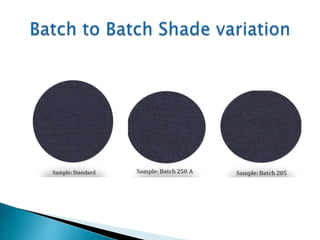
Batch to Batch shade variation

Batch to Batch shade variation

  • 1.
    Department of TextileEngineering Project Title : Comparison of Batch to Batch Shade Variation Considering Parameters in Knit Dyeing
  • 2.
    PREPARED BY ©right Name : MAZADUL HASAN SHESHIR ID: 2010000400008 Batch: 13th Batch (Session 2009-2013) Department: Wet Processing Technology Email: mazadulhasan@yahoo.com (FB) Blog: www. Textilelab.blogspot.com Southeast University,Bangladesh Department of Textile Engineering
  • 3.
     Shade isthe depth of color percentage. Shade is expressed in percentage of dye amount in unit weight of fabric. Shade matching depends on the accuracy of the man's eye. It is a visual process for this reason same shade may have difference comments from different person.
  • 4.
     It isthe variation of shade or depth of color (hue) in same fabric roll or among different batches. In dyed fabric often shade variation is found. Shade variation may occur selvage to selvage, selvage to center of fabric width or one end of the fabric rolls to another end.  Shading or shade variation is considered as one big problem in fabric. A lot of orders are cancelled because of the shade variation between the batches. Though there is a tolerance is given or set , but it is too tough to maintain the exact same shade among all the batches. And here is the success of a Textile Engineer.
  • 5.
     In thearea of textiles, the most widely employed method of applying colors is dyeing. Although dyeing process affected by many inside and outside parameters, it is a mature technology during several thousand years. Dyeing is still complicated today to fully understand and control dyeing which is more an art than a science. Besides, it is difficult to monitor but must be dealt with to obtain quality products by control various parameter.
  • 6.
     Machine parameters:  Temperature  Time  Pressure  Speed (r.p.m)  Stability of machine  Dosing  Liquor ratio  Rinsing
  • 7.
     Process parameters:  pH  Pressure  Time  Temperature  Liquor ratio  Water Hardness  Recipe  Fastness
  • 8.
     Chemical parameters:  Strength  Purity  Chemical composition  Country of origin  Environment  Material parameters:  Maturity of fiber  Count Variation  Foreign material  Yarn uniformity  Weave Plan  Fabrics faults
  • 10.
    Dyeing is oneof the sophisticated part of the textile production. There are so many reasons behind the batch to batch shade variation. They are given below: Preparation Stage:  Excessive Heat setting: Heat-setting has effect on dye bond formation on synthetic fiber. Uneven and excessive heat setting can cause shade variation.  Uneven pretreatment: Uneven, improper scouring & bleaching causes shade variation.
  • 11.
     Using Chemicalsof different concentration: If concentration of input chemical is varied from one batch to another then shade variation is occurred.  Improper color dosing: Improper color dosing can cause shade variation.  Workers’ Negligence: Due to worker’s negligence, shade variation happens.
  • 12.
     Rope length& Cycle time: If rope length is same but cycle time is varied from one batch to another it may cause shade variation. For example, if cycle time of first batch is greater than the second batch results each portion of the loop will not get same time for exhaustion and fixation of dyestuff. So the dye penetration percentage becomes higher for first batch.  Reel speed: Reel speed changes with fabric GSM, loads per nozzle, cycle time etc. which has great effect on shade variation.
  • 13.
     Running time:Running time is another factor for batch to batch shade variation. Due to the variation of running time of different stage of dyeing, the action of same chemical/dyes, used in different batches also varied from one batch to another batch. This also may cause batch to batch shade variation.  Fluctuation in power & temperature: Fluctuation in power supply and temperature also responsible for variation.
  • 14.
     Dyes lotvariation: Dyes strength, reactivity etc. properties can vary lot to lot even drum to drum that causes shade variation.  PH: Throughout overall dyeing process, pH has great impact on shade variation. In reactive dyeing, fixation pH is very much important to achieve uniform shade. Every dyestuff appears in different tone under different pH conditions. It has observed that, if pH of polyester dyeing is not within the range, shade will become yellowish, dull etc.  Improper neutralization: If neutralization is not done properly, residual alkali can affect dyeing as well as leads to shade variation.
  • 15.
     Soaping: Accordingto the depth of shade; amount of soap, soaping time and temperature can change shade and can make shade variation.  Final cationic fixing operation: Fixation operation can cause shade variation in case of time, depth of shade.  Poor Lab-to-bulk Correlation: If in bulk production same liquor ratio, recipe, chemicals, process stages, runtime etc is not followed according to lab, there is much more opportunities to acquire shade variation as well as other process faults.
  • 16.
    Finishing Stage: Notonly the preparation and dyeing operations are important, final finishing operation also is very important to avoid batch-to- batch variation.  Softener quality: according to difference in softener quality, strength, nature, concentration, pH etc. shade variation can be noticed during finishing.  Unequal drying temperature: If drying temperature is not equal, shade variation happens.
  • 17.
     Follow thestandard pretreatment procedure.  Standard dyes and chemicals need to be used.  Maintain the same liquor ratio  Try to maintain equal loop length, equal amount of material per nozzle.  Maintain the same dyeing cycle.  Maintain equal dosing time, runtime  Identical dyeing procedure should be followed for the same depth of the Shade.
  • 18.
     Make surethat the operators add the right bulk chemicals at the same time and temperature in the process.  Dyes and chemicals strength should be checked regularly.  The pH, hardness and sodium carbonate content of supply water should check daily.  Lab to bulk correlation should be maintained properly.  Equal finishing parameters (drying temperature, softener treatment, squeezing pressure etc.) should be maintained properly.