PRESENTATION
ON
DYEING PROBLEMS AND REMEDIES

 PRESENTED BY,
 FAHMIDA SULTANA;          ID#073-23-653
 SADDAM HOSSAIN BHUIYAN;   ID#073-23-626
 DIPAK KUMAR SARKER;       ID#073-23-568
 S.M.MOHIUDDIN;            ID#073-23-657
 SABBIR AHMED MAJUMDER;    ID#073-23-592
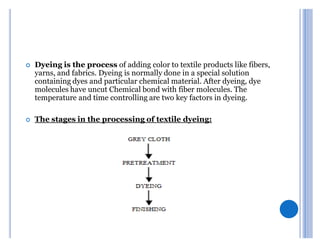
Dyeing is the process of adding color to textile products like fibers,
    yarns, and fabrics. Dyeing is normally done in a special solution
    containing dyes and particular chemical material. After dyeing, dye
    molecules have uncut Chemical bond with fiber molecules. The
    temperature and time controlling are two key factors in dyeing.

	   The stages in the processing of textile dyeing:
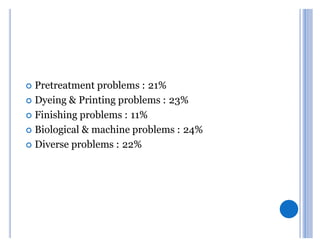
Pretreatment problems : 21%
	 Dyeing & Printing problems : 23%

	 Finishing problems : 11%

	 Biological & machine problems : 24%

	 Diverse problems : 22%
Pretreatment that is known accurate composition. The chemicals are
     used for pre-treatment of all fibers and are used for removing dirt, oil,
     fatty and waxy impurities. Moreover, these chemicals also act as a mild
     stain remover.
	    70% of the problems due to dyeing can be attributed to the
     preparatory pretreatment, because it is the first stage in dyeing
     processing. So, dyeing depends on its effectiveness and efficiency.
	    The dyeing process which follows pretreatment depends on a
     number of parameters like:
1.   Time
2.   Temperature
3.   Conc. of chemicals and auxiliaries selection
4.   pH of the process etc.
Pretreatment problems
 	   Poor absorbency.
 	   Catalytic damage/poor fluidity.
 	   Stains.
 	   Moire effect.
 	   Shade change from selvedge to selvedge.
 	   Shrinkage/distortion.
 	   Creasing/chafe marks.
 	   Handling.
 	   Inferior brightness/luster.
 	   Cloudy dyeing.
 	   Skitteriness.
 	   Pale areas.
 	   Dark spots.
 	   Rope marks.
Pretreatment remedies

 	 Use of specialty chemicals.
 	 Select suitable heat setting temperatures.

 	 Thorough relaxation of the material.

 	 Controlled tension and uniformity of batching
   during pretreatment.
 	 Checking for rough patches in the machine.

 	 Carry out lab tests.

 	 Carry out preliminary tests with material.

 	 Quality inspection before and after pretretment.
Dyeing problems
 1.   Unlevelness(due to dyeing conditions)
      ‡   Ending problems
      ‡   Cloudy dyeing
      ‡   Pale areas
 2.   Unlevelness(due to material)
      ‡   Barriness
 3.   Unlevelness(due to other reasons)
      ‡   Skitterness
      ‡   Listing
      ‡   Pale areas after dyeing
 4.   Reproducibility
      ‡   Deviation of shade
      ‡   Dyeing too pale
      ‡   Precipitates in the dye bath
      ‡   Change of shade
 5.   Fastness properties
      ‡   Unexpectedly poor light fastness
      ‡   Unexpectedly poor wet and rub fastness
 6.   Spots, marks
      ‡   Precipitates in the dye bath
      ‡   Singeing droplets
      ‡   Change of shade (e.g. blue spots in brilliant red shades)
      ‡   Dark spots
      ‡   Specks
      ‡   Dirt spots
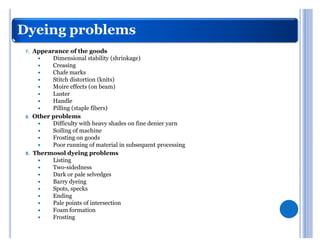
Dyeing problems
 7.   Appearance of the goods
       y    Dimensional stability (shrinkage)
       y    Creasing
       y    Chafe marks
       y    Stitch distortion (knits)
       y    Moire effects (on beam)
       y    Luster
       y    Handle
       y    Pilling (staple fibers)
 8.   Other problems
       y    Difficulty with heavy shades on fine denier yarn
       y    Soiling of machine
       y    Frosting on goods
       y    Poor running of material in subsequent processing
 9.   Thermosol dyeing problems
       y    Listing
       y    Two-sidedness
       y    Dark or pale selvedges
       y    Barry dyeing
       y    Spots, specks
       y    Ending
       y    Pale points of intersection
       y    Foam formation
       y    Frosting
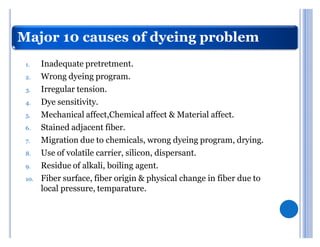
Major 10 causes of dyeing problem
 1.    Inadequate pretretment.
 2.    Wrong dyeing program.
 3.    Irregular tension.
 4.    Dye sensitivity.
 5.    Mechanical affect,Chemical affect & Material affect.
 6.    Stained adjacent fiber.
 7.    Migration due to chemicals, wrong dyeing program, drying.
 8.    Use of volatile carrier, silicon, dispersant.
 9.    Residue of alkali, boiling agent.
 10.   Fiber surface, fiber origin & physical change in fiber due to
       local pressure, temparature.
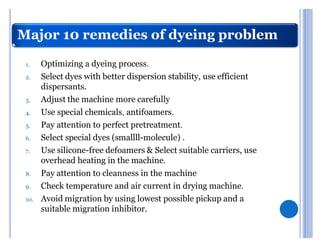
Major 10 remedies of dyeing problem

 1.    Optimizing a dyeing process.
 2.    Select dyes with better dispersion stability, use efficient
       dispersants.
 3.    Adjust the machine more carefully
 4.    Use special chemicals, antifoamers.
 5.    Pay attention to perfect pretreatment.
 6.    Select special dyes (smallll-molecule) .
 7.    Use silicone-free defoamers & Select suitable carriers, use
       overhead heating in the machine.
 8.    Pay attention to cleanness in the machine
 9.    Check temperature and air current in drying machine.
 10.   Avoid migration by using lowest possible pickup and a
       suitable migration inhibitor.
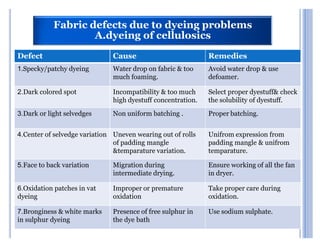
Fabric defects due to dyeing problems
                    A.dyeing of cellulosics
Defect                         Cause                          Remedies
1.Specky/patchy dyeing         Water drop on fabric & too     Avoid water drop & use
                               much foaming.                  defoamer.

2.Dark colored spot            Incompatibility & too much     Select proper dyestuff& check
                               high dyestuff concentration.   the solubility of dyestuff.
3.Dark or light selvedges      Non uniform batching .         Proper batching.


4.Center of selvedge variation Uneven wearing out of rolls    Unifrom expression from
                               of padding mangle              padding mangle & unifrom
                               &temparature variation.        temparature.

5.Face to back variation       Migration during               Ensure working of all the fan
                               intermediate drying.           in dryer.

6.Oxidation patches in vat     Improper or premature          Take proper care during
dyeing                         oxidation                      oxidation.

7.Bronginess & white marks     Presence of free sulphur in    Use sodium sulphate.
in sulphur dyeing              the dye bath
Fabric defects due to dyeing problems
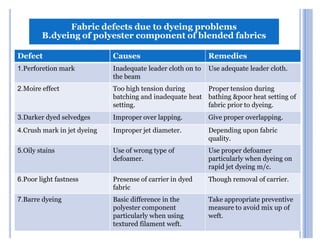
        B.dyeing of polyester component of blended fabrics

Defect                       Causes                          Remedies
1.Perforetion mark           Inadequate leader cloth on to   Use adequate leader cloth.
                             the beam
2.Moire effect               Too high tension during      Proper tension during
                             batching and inadequate heat bathing &poor heat setting of
                             setting.                     fabric prior to dyeing.
3.Darker dyed selvedges      Improper over lapping.          Give proper overlapping.
4.Crush mark in jet dyeing   Improper jet diameter.          Depending upon fabric
                                                             quality.
5.Oily stains                Use of wrong type of            Use proper defoamer
                             defoamer.                       particularly when dyeing on
                                                             rapid jet dyeing m/c.
6.Poor light fastness        Presense of carrier in dyed     Though removal of carrier.
                             fabric
7.Barre dyeing               Basic difference in the         Take appropriate preventive
                             polyester component             measure to avoid mix up of
                             particularly when using         weft.
                             textured filament weft.
Yarn defects due to dyeing problems
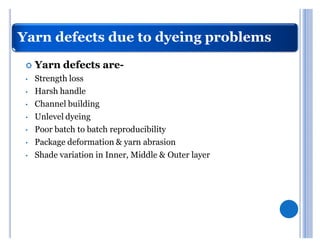
 	   Yarn defects are-
 ‡   Strength loss
 ‡   Harsh handle
 ‡   Channel building
 ‡   Unlevel dyeing
 ‡   Poor batch to batch reproducibility
 ‡   Package deformation & yarn abrasion
 ‡   Shade variation in Inner, Middle & Outer layer
Yarn defects due to dyeing problems

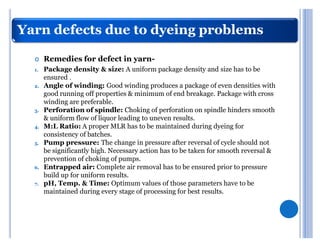
  	    Remedies for defect in yarn-
  1.   Package density & size: A uniform package density and size has to be
       ensured .
  2.   Angle of winding: Good winding produces a package of even densities with
       good running off properties & minimum of end breakage. Package with cross
       winding are preferable.
  3.   Perforation of spindle: Choking of perforation on spindle hinders smooth
       & uniform flow of liquor leading to uneven results.
  4.   M:L Ratio: A proper MLR has to be maintained during dyeing for
       consistency of batches.
  5.   Pump pressure: The change in pressure after reversal of cycle should not
       be significantly high. Necessary action has to be taken for smooth reversal &
       prevention of choking of pumps.
  6.   Entrapped air: Complete air removal has to be ensured prior to pressure
       build up for uniform results.
  7.   pH, Temp. & Time: Optimum values of those parameters have to be
       maintained during every stage of processing for best results.
5 tips for remedies of dyeing problem

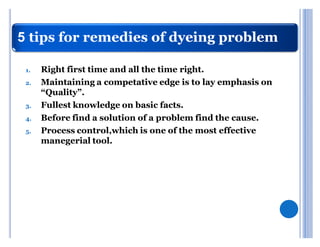
 1.   Right first time and all the time right.
 2.   Maintaining a competative edge is to lay emphasis on
      ³Quality´.
 3.   Fullest knowledge on basic facts.
 4.   Before find a solution of a problem find the cause.
 5.   Process control,which is one of the most effective
      manegerial tool.
THANK YOU

55978325 dyeing-problem-ppt

  • 1.
    PRESENTATION ON DYEING PROBLEMS ANDREMEDIES PRESENTED BY, FAHMIDA SULTANA; ID#073-23-653 SADDAM HOSSAIN BHUIYAN; ID#073-23-626 DIPAK KUMAR SARKER; ID#073-23-568 S.M.MOHIUDDIN; ID#073-23-657 SABBIR AHMED MAJUMDER; ID#073-23-592
  • 2.
    Dyeing is theprocess of adding color to textile products like fibers, yarns, and fabrics. Dyeing is normally done in a special solution containing dyes and particular chemical material. After dyeing, dye molecules have uncut Chemical bond with fiber molecules. The temperature and time controlling are two key factors in dyeing. The stages in the processing of textile dyeing:
  • 3.
    Pretreatment problems :21% Dyeing & Printing problems : 23% Finishing problems : 11% Biological & machine problems : 24% Diverse problems : 22%
  • 4.
    Pretreatment that isknown accurate composition. The chemicals are used for pre-treatment of all fibers and are used for removing dirt, oil, fatty and waxy impurities. Moreover, these chemicals also act as a mild stain remover. 70% of the problems due to dyeing can be attributed to the preparatory pretreatment, because it is the first stage in dyeing processing. So, dyeing depends on its effectiveness and efficiency. The dyeing process which follows pretreatment depends on a number of parameters like: 1. Time 2. Temperature 3. Conc. of chemicals and auxiliaries selection 4. pH of the process etc.
  • 5.
    Pretreatment problems Poor absorbency. Catalytic damage/poor fluidity. Stains. Moire effect. Shade change from selvedge to selvedge. Shrinkage/distortion. Creasing/chafe marks. Handling. Inferior brightness/luster. Cloudy dyeing. Skitteriness. Pale areas. Dark spots. Rope marks.
  • 6.
    Pretreatment remedies Use of specialty chemicals. Select suitable heat setting temperatures. Thorough relaxation of the material. Controlled tension and uniformity of batching during pretreatment. Checking for rough patches in the machine. Carry out lab tests. Carry out preliminary tests with material. Quality inspection before and after pretretment.
  • 7.
    Dyeing problems 1. Unlevelness(due to dyeing conditions) ‡ Ending problems ‡ Cloudy dyeing ‡ Pale areas 2. Unlevelness(due to material) ‡ Barriness 3. Unlevelness(due to other reasons) ‡ Skitterness ‡ Listing ‡ Pale areas after dyeing 4. Reproducibility ‡ Deviation of shade ‡ Dyeing too pale ‡ Precipitates in the dye bath ‡ Change of shade 5. Fastness properties ‡ Unexpectedly poor light fastness ‡ Unexpectedly poor wet and rub fastness 6. Spots, marks ‡ Precipitates in the dye bath ‡ Singeing droplets ‡ Change of shade (e.g. blue spots in brilliant red shades) ‡ Dark spots ‡ Specks ‡ Dirt spots
  • 8.
    Dyeing problems 7. Appearance of the goods y Dimensional stability (shrinkage) y Creasing y Chafe marks y Stitch distortion (knits) y Moire effects (on beam) y Luster y Handle y Pilling (staple fibers) 8. Other problems y Difficulty with heavy shades on fine denier yarn y Soiling of machine y Frosting on goods y Poor running of material in subsequent processing 9. Thermosol dyeing problems y Listing y Two-sidedness y Dark or pale selvedges y Barry dyeing y Spots, specks y Ending y Pale points of intersection y Foam formation y Frosting
  • 9.
    Major 10 causesof dyeing problem 1. Inadequate pretretment. 2. Wrong dyeing program. 3. Irregular tension. 4. Dye sensitivity. 5. Mechanical affect,Chemical affect & Material affect. 6. Stained adjacent fiber. 7. Migration due to chemicals, wrong dyeing program, drying. 8. Use of volatile carrier, silicon, dispersant. 9. Residue of alkali, boiling agent. 10. Fiber surface, fiber origin & physical change in fiber due to local pressure, temparature.
  • 10.
    Major 10 remediesof dyeing problem 1. Optimizing a dyeing process. 2. Select dyes with better dispersion stability, use efficient dispersants. 3. Adjust the machine more carefully 4. Use special chemicals, antifoamers. 5. Pay attention to perfect pretreatment. 6. Select special dyes (smallll-molecule) . 7. Use silicone-free defoamers & Select suitable carriers, use overhead heating in the machine. 8. Pay attention to cleanness in the machine 9. Check temperature and air current in drying machine. 10. Avoid migration by using lowest possible pickup and a suitable migration inhibitor.
  • 11.
    Fabric defects dueto dyeing problems A.dyeing of cellulosics Defect Cause Remedies 1.Specky/patchy dyeing Water drop on fabric & too Avoid water drop & use much foaming. defoamer. 2.Dark colored spot Incompatibility & too much Select proper dyestuff& check high dyestuff concentration. the solubility of dyestuff. 3.Dark or light selvedges Non uniform batching . Proper batching. 4.Center of selvedge variation Uneven wearing out of rolls Unifrom expression from of padding mangle padding mangle & unifrom &temparature variation. temparature. 5.Face to back variation Migration during Ensure working of all the fan intermediate drying. in dryer. 6.Oxidation patches in vat Improper or premature Take proper care during dyeing oxidation oxidation. 7.Bronginess & white marks Presence of free sulphur in Use sodium sulphate. in sulphur dyeing the dye bath
  • 12.
    Fabric defects dueto dyeing problems B.dyeing of polyester component of blended fabrics Defect Causes Remedies 1.Perforetion mark Inadequate leader cloth on to Use adequate leader cloth. the beam 2.Moire effect Too high tension during Proper tension during batching and inadequate heat bathing &poor heat setting of setting. fabric prior to dyeing. 3.Darker dyed selvedges Improper over lapping. Give proper overlapping. 4.Crush mark in jet dyeing Improper jet diameter. Depending upon fabric quality. 5.Oily stains Use of wrong type of Use proper defoamer defoamer. particularly when dyeing on rapid jet dyeing m/c. 6.Poor light fastness Presense of carrier in dyed Though removal of carrier. fabric 7.Barre dyeing Basic difference in the Take appropriate preventive polyester component measure to avoid mix up of particularly when using weft. textured filament weft.
  • 13.
    Yarn defects dueto dyeing problems Yarn defects are- ‡ Strength loss ‡ Harsh handle ‡ Channel building ‡ Unlevel dyeing ‡ Poor batch to batch reproducibility ‡ Package deformation & yarn abrasion ‡ Shade variation in Inner, Middle & Outer layer
  • 14.
    Yarn defects dueto dyeing problems Remedies for defect in yarn- 1. Package density & size: A uniform package density and size has to be ensured . 2. Angle of winding: Good winding produces a package of even densities with good running off properties & minimum of end breakage. Package with cross winding are preferable. 3. Perforation of spindle: Choking of perforation on spindle hinders smooth & uniform flow of liquor leading to uneven results. 4. M:L Ratio: A proper MLR has to be maintained during dyeing for consistency of batches. 5. Pump pressure: The change in pressure after reversal of cycle should not be significantly high. Necessary action has to be taken for smooth reversal & prevention of choking of pumps. 6. Entrapped air: Complete air removal has to be ensured prior to pressure build up for uniform results. 7. pH, Temp. & Time: Optimum values of those parameters have to be maintained during every stage of processing for best results.
  • 15.
    5 tips forremedies of dyeing problem 1. Right first time and all the time right. 2. Maintaining a competative edge is to lay emphasis on ³Quality´. 3. Fullest knowledge on basic facts. 4. Before find a solution of a problem find the cause. 5. Process control,which is one of the most effective manegerial tool.
  • 16.