Southeast University
KNIT
DYEING
YARN
DYEING
WOVEN
DYEING
Prepared By : Mazadul Hasan sheshir
ID: 2010000400008
13th
Batch (session 2009-2013)
Department : Wet Processing Technology
Email: mazadulhasan@yahoo.com
Blog : www. Textilelab.blogspot.com (visit)
Southeast University
Department Of Textile Engineering
I/A 251,252 Tejgaon Dhaka Bangladesh
Prepared By :
Faults in Dyeing SectorFaults in Dyeing Sector
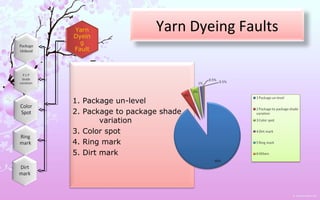
Yarn Dyeing Faults
1. Package un-level
2. Package to package shade
variation
3. Color spot
4. Ring mark
5. Dirt mark
Yarn
Dyein
g
Fault
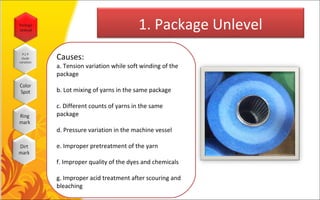
1. Package Unlevel
Causes:
a. Tension variation while soft winding of the
package
b. Lot mixing of yarns in the same package
c. Different counts of yarns in the same
package
d. Pressure variation in the machine vessel
e. Improper pretreatment of the yarn
f. Improper quality of the dyes and chemicals
g. Improper acid treatment after scouring and
bleaching
2. Package to Package shade variation
Causes:
a. Improper setting of yarn packages in the machine
b. Lot mixing of the packages
c. Count variation of packages
Causes:
a. Improper setting of yarn packages in the machine
b. Lot mixing of the packages
c. Count variation of packages
Packag
e
Unlevel
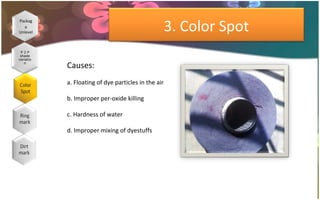
3. Color Spot
Causes:
a. Floating of dye particles in the air
b. Improper per-oxide killing
c. Hardness of water
d. Improper mixing of dyestuffs
Packag
e
Unlevel
P 2 P
shade
variatio
n
5. Ring Mark
Causes:
a. Improper drying of the packages
b. Improper peroxide killing
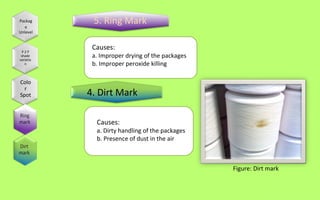
4. Dirt Mark
Causes:
a. Dirty handling of the packages
b. Presence of dust in the air
Figure: Dirt mark
Packag
e
Unlevel
P 2 P
shade
variatio
n
Colo
r
Spot
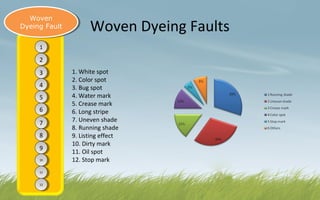
Woven Dyeing Faults
1. White spot
2. Color spot
3. Bug spot
4. Water mark
5. Crease mark
6. Long stripe
7. Uneven shade
8. Running shade
9. Listing effect
10. Dirty mark
11. Oil spot
12. Stop mark
Woven
Dyeing Fault
Woven
Dyeing Fault
11
22
33
44
55
66
77
88
99
1010
1111
1212
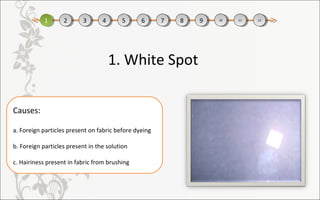
Causes:
a. Foreign particles present on fabric before dyeing
b. Foreign particles present in the solution
c. Hairiness present in fabric from brushing
1. White Spot
11 22 33 44 55 66 77 88 99 1010 1111 1212
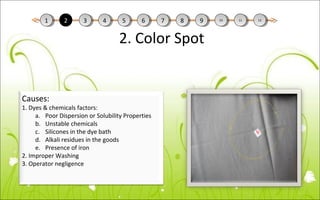
2. Color Spot
Causes:
1. Dyes & chemicals factors:
a. Poor Dispersion or Solubility Properties
b. Unstable chemicals
c. Silicones in the dye bath
d. Alkali residues in the goods
e. Presence of iron
2. Improper Washing
3. Operator negligence
11 2 33 44 55 66 77 88 99 1010 1111 1212
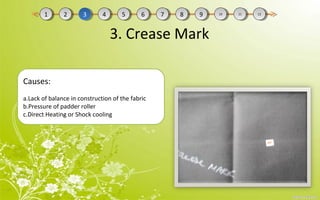
3. Crease Mark
Causes:
a.Lack of balance in construction of the fabric
b.Pressure of padder roller
c.Direct Heating or Shock cooling
11 22 33 44 55 66 77 88 99 1010 1111 1212
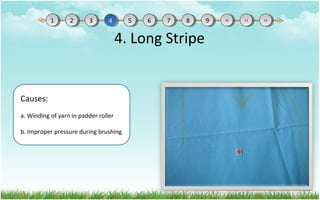
4. Long Stripe
Causes:
a. Winding of yarn in padder roller
b. Improper pressure during brushing
11 22 33 44 55 66 77 88 99 1010 1111 1212
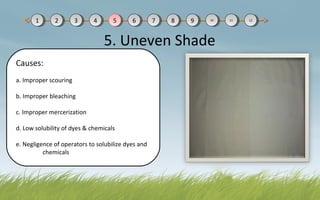
5. Uneven Shade
Causes:
a. Improper scouring
b. Improper bleaching
c. Improper mercerization
d. Low solubility of dyes & chemicals
e. Negligence of operators to solubilize dyes and
chemicals
11 22 33 44 55 66 77 88 99 1010 1111 1212
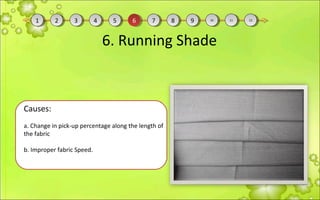
6. Running Shade
Causes:
a. Change in pick-up percentage along the length of
the fabric
b. Improper fabric Speed.
11 22 33 44 55 66 77 88 99 1010 1111 1212
7. Listing Effect
Causes:
a. Improper padder pressure in different zones of padder roller (left, middle & right zone).
b. Worn out squeeze roller.
11 22 33 44 55 66 77 88 99 1010 1111 1212
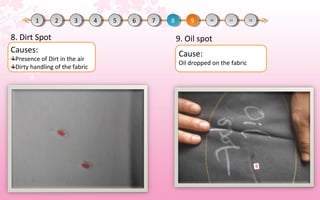
8. Dirt Spot 9. Oil spot
Cause:
Oil dropped on the fabric
11 22 33 44 55 66 77 88 99 1010 1111 1212
Causes:
Presence of Dirt in the air
Dirty handling of the fabric
12. Stop mark
Cause:
Stopping of machine unexpectedly during processing.
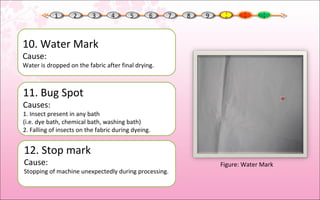
Figure: Water Mark
11 22 33 44 55 66 77 88 99
1
0
1
1
1
2
11. Bug Spot
Causes:
1. Insect present in any bath
(i.e. dye bath, chemical bath, washing bath)
2. Falling of insects on the fabric during dyeing.
10. Water Mark
Cause:
Water is dropped on the fabric after final drying.
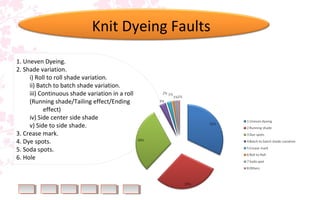
1. Uneven Dyeing.
2. Shade variation.
i) Roll to roll shade variation.
ii) Batch to batch shade variation.
iii) Continuous shade variation in a roll
(Running shade/Tailing effect/Ending
effect)
iv) Side center side shade
v) Side to side shade.
3. Crease mark.
4. Dye spots.
5. Soda spots.
6. Hole
Knit Dyeing Faults
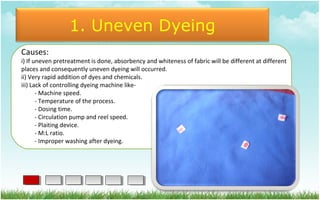
1. Uneven Dyeing
Causes:
i) If uneven pretreatment is done, absorbency and whiteness of fabric will be different at different
places and consequently uneven dyeing will occurred.
ii) Very rapid addition of dyes and chemicals.
iii) Lack of controlling dyeing machine like-
- Machine speed.
- Temperature of the process.
- Dosing time.
- Circulation pump and reel speed.
- Plaiting device.
- M:L ratio.
- Improper washing after dyeing.
Causes:
- Machine over-loading.
- Running at lower nozzle pressure
- High bath draining temperature
- Improper cycle time
- Improper length of rope
2. Shade Variation
2.1. Roll to roll shade variation
Causes:
i) Not equal rope length in each chamber. Then cycle time will vary if reel speed will same and shade variation
occur.
ii) Not equal flow speed in each nozzle. Then cycle time will vary if length of each roll will same and shade variation
occur.
2.2. Batch to Batch shade variation
Causes:
i) Different batches are pretreated in different machines.
ii) Fabric of different batches has different dye affinity.
iii) Liquor ratio, cycle time, dye lot, chemicals, dyeing procedure, temperature are different for each batch.
iv) Low quality water especially PH, hardness and sodium carbonate content.
2.3 Running shade
Causes:
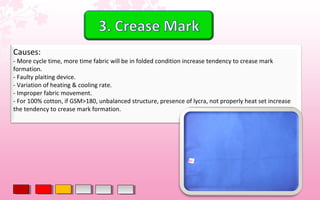
- More cycle time, more time fabric will be in folded condition increase tendency to crease mark
formation.
- Faulty plaiting device.
- Variation of heating & cooling rate.
- Improper fabric movement.
- For 100% cotton, if GSM>180, unbalanced structure, presence of lycra, not properly heat set increase
the tendency to crease mark formation.
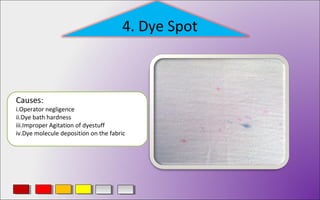
4. Dye Spot
Causes:
i.Operator negligence
ii.Dye bath hardness
iii.Improper Agitation of dyestuff
iv.Dye molecule deposition on the fabric
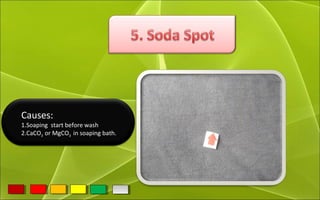
Causes:
1.Soaping start before wash
2.CaCO3 or MgCO3 in soaping bath.
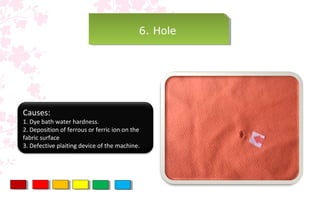
6. Hole6. Hole
Causes:
1. Dye bath water hardness.
2. Deposition of ferrous or ferric ion on the
fabric surface
3. Defective plaiting device of the machine.
Problem of dyeing
a. Problem of shade matching
Causes:
1. Dye factor
2. Process factor
3. Machine factor
4. Man factor
b. Fastness problem
Properties of Dyes & Chemicals affect fastness.
c. Hand feel problem
1. Yarn Manufacturing Technology
Link : http://www.facebook.com/pages/Yarn-Manufacturing-Technology/485014954866808
2. Fabric Manufacturing Technology
Link : http://www.facebook.com/pages/Fabric-Manufacturing-Technology/459520217425605
3. Garments Manufacturing Technology
Link : http://www.facebook.com/pages/Garments-Manufacturing-Technology/472364799463126
3. Wet processing Technology
Link : http://www.facebook.com/pages/Wet-Processing-Technology-Dyeing-/468645219825404
4. Fashion-Design-and-Technology
Link : http://www.facebook.com/pages/Fashion-Design-and-Technology/587655294583875?ref=ts&fref=ts
My Facebook Textile related Pages
http://www.textilelab.blogspot.com (Visit )

Survey on dyeing faults

  • 1.
  • 2.
    Prepared By :Mazadul Hasan sheshir ID: 2010000400008 13th Batch (session 2009-2013) Department : Wet Processing Technology Email: mazadulhasan@yahoo.com Blog : www. Textilelab.blogspot.com (visit) Southeast University Department Of Textile Engineering I/A 251,252 Tejgaon Dhaka Bangladesh Prepared By :
  • 3.
    Faults in DyeingSectorFaults in Dyeing Sector
  • 4.
    Yarn Dyeing Faults 1.Package un-level 2. Package to package shade variation 3. Color spot 4. Ring mark 5. Dirt mark Yarn Dyein g Fault
  • 5.
    1. Package Unlevel Causes: a.Tension variation while soft winding of the package b. Lot mixing of yarns in the same package c. Different counts of yarns in the same package d. Pressure variation in the machine vessel e. Improper pretreatment of the yarn f. Improper quality of the dyes and chemicals g. Improper acid treatment after scouring and bleaching
  • 6.
    2. Package toPackage shade variation Causes: a. Improper setting of yarn packages in the machine b. Lot mixing of the packages c. Count variation of packages Causes: a. Improper setting of yarn packages in the machine b. Lot mixing of the packages c. Count variation of packages Packag e Unlevel
  • 7.
    3. Color Spot Causes: a.Floating of dye particles in the air b. Improper per-oxide killing c. Hardness of water d. Improper mixing of dyestuffs Packag e Unlevel P 2 P shade variatio n
  • 8.
    5. Ring Mark Causes: a.Improper drying of the packages b. Improper peroxide killing 4. Dirt Mark Causes: a. Dirty handling of the packages b. Presence of dust in the air Figure: Dirt mark Packag e Unlevel P 2 P shade variatio n Colo r Spot
  • 9.
    Woven Dyeing Faults 1.White spot 2. Color spot 3. Bug spot 4. Water mark 5. Crease mark 6. Long stripe 7. Uneven shade 8. Running shade 9. Listing effect 10. Dirty mark 11. Oil spot 12. Stop mark Woven Dyeing Fault Woven Dyeing Fault 11 22 33 44 55 66 77 88 99 1010 1111 1212
  • 10.
    Causes: a. Foreign particlespresent on fabric before dyeing b. Foreign particles present in the solution c. Hairiness present in fabric from brushing 1. White Spot 11 22 33 44 55 66 77 88 99 1010 1111 1212
  • 11.
    2. Color Spot Causes: 1.Dyes & chemicals factors: a. Poor Dispersion or Solubility Properties b. Unstable chemicals c. Silicones in the dye bath d. Alkali residues in the goods e. Presence of iron 2. Improper Washing 3. Operator negligence 11 2 33 44 55 66 77 88 99 1010 1111 1212
  • 12.
    3. Crease Mark Causes: a.Lackof balance in construction of the fabric b.Pressure of padder roller c.Direct Heating or Shock cooling 11 22 33 44 55 66 77 88 99 1010 1111 1212
  • 13.
    4. Long Stripe Causes: a.Winding of yarn in padder roller b. Improper pressure during brushing 11 22 33 44 55 66 77 88 99 1010 1111 1212
  • 14.
    5. Uneven Shade Causes: a.Improper scouring b. Improper bleaching c. Improper mercerization d. Low solubility of dyes & chemicals e. Negligence of operators to solubilize dyes and chemicals 11 22 33 44 55 66 77 88 99 1010 1111 1212
  • 15.
    6. Running Shade Causes: a.Change in pick-up percentage along the length of the fabric b. Improper fabric Speed. 11 22 33 44 55 66 77 88 99 1010 1111 1212
  • 16.
    7. Listing Effect Causes: a.Improper padder pressure in different zones of padder roller (left, middle & right zone). b. Worn out squeeze roller. 11 22 33 44 55 66 77 88 99 1010 1111 1212
  • 17.
    8. Dirt Spot9. Oil spot Cause: Oil dropped on the fabric 11 22 33 44 55 66 77 88 99 1010 1111 1212 Causes: Presence of Dirt in the air Dirty handling of the fabric
  • 18.
    12. Stop mark Cause: Stoppingof machine unexpectedly during processing. Figure: Water Mark 11 22 33 44 55 66 77 88 99 1 0 1 1 1 2 11. Bug Spot Causes: 1. Insect present in any bath (i.e. dye bath, chemical bath, washing bath) 2. Falling of insects on the fabric during dyeing. 10. Water Mark Cause: Water is dropped on the fabric after final drying.
  • 19.
    1. Uneven Dyeing. 2.Shade variation. i) Roll to roll shade variation. ii) Batch to batch shade variation. iii) Continuous shade variation in a roll (Running shade/Tailing effect/Ending effect) iv) Side center side shade v) Side to side shade. 3. Crease mark. 4. Dye spots. 5. Soda spots. 6. Hole Knit Dyeing Faults
  • 20.
    1. Uneven Dyeing Causes: i)If uneven pretreatment is done, absorbency and whiteness of fabric will be different at different places and consequently uneven dyeing will occurred. ii) Very rapid addition of dyes and chemicals. iii) Lack of controlling dyeing machine like- - Machine speed. - Temperature of the process. - Dosing time. - Circulation pump and reel speed. - Plaiting device. - M:L ratio. - Improper washing after dyeing.
  • 21.
    Causes: - Machine over-loading. -Running at lower nozzle pressure - High bath draining temperature - Improper cycle time - Improper length of rope 2. Shade Variation 2.1. Roll to roll shade variation Causes: i) Not equal rope length in each chamber. Then cycle time will vary if reel speed will same and shade variation occur. ii) Not equal flow speed in each nozzle. Then cycle time will vary if length of each roll will same and shade variation occur. 2.2. Batch to Batch shade variation Causes: i) Different batches are pretreated in different machines. ii) Fabric of different batches has different dye affinity. iii) Liquor ratio, cycle time, dye lot, chemicals, dyeing procedure, temperature are different for each batch. iv) Low quality water especially PH, hardness and sodium carbonate content. 2.3 Running shade
  • 22.
    Causes: - More cycletime, more time fabric will be in folded condition increase tendency to crease mark formation. - Faulty plaiting device. - Variation of heating & cooling rate. - Improper fabric movement. - For 100% cotton, if GSM>180, unbalanced structure, presence of lycra, not properly heat set increase the tendency to crease mark formation.
  • 23.
    4. Dye Spot Causes: i.Operatornegligence ii.Dye bath hardness iii.Improper Agitation of dyestuff iv.Dye molecule deposition on the fabric
  • 24.
    Causes: 1.Soaping start beforewash 2.CaCO3 or MgCO3 in soaping bath.
  • 25.
    6. Hole6. Hole Causes: 1.Dye bath water hardness. 2. Deposition of ferrous or ferric ion on the fabric surface 3. Defective plaiting device of the machine.
  • 26.
    Problem of dyeing a.Problem of shade matching Causes: 1. Dye factor 2. Process factor 3. Machine factor 4. Man factor b. Fastness problem Properties of Dyes & Chemicals affect fastness. c. Hand feel problem
  • 28.
    1. Yarn ManufacturingTechnology Link : http://www.facebook.com/pages/Yarn-Manufacturing-Technology/485014954866808 2. Fabric Manufacturing Technology Link : http://www.facebook.com/pages/Fabric-Manufacturing-Technology/459520217425605 3. Garments Manufacturing Technology Link : http://www.facebook.com/pages/Garments-Manufacturing-Technology/472364799463126 3. Wet processing Technology Link : http://www.facebook.com/pages/Wet-Processing-Technology-Dyeing-/468645219825404 4. Fashion-Design-and-Technology Link : http://www.facebook.com/pages/Fashion-Design-and-Technology/587655294583875?ref=ts&fref=ts My Facebook Textile related Pages http://www.textilelab.blogspot.com (Visit )