1
2
Out lines
Introduction
Diference between cotton and kapok
Structure
Processing of Kapok
 Properties
Chemical Composition of Kapok
End uses
Conclusion
4
INTRODUCTION
What is kapok:
A fine, fibrous substance like cotton that grows
around the seeds of the ceiba tree, used as stuffing
for cushions, soft toys etc.
Also known as silk cotton or java cotton.
Found:
Africa and central America.
5
Kapok production available in East Pakistan is
estimated roughly at 10 million pound .
It estimated in a survy of 1943-44, according to
information received from United States
Agriculture.
About 2.25 million pound of kapok within country
mainly filling pillows , cushion , and quilts.
The remaining 7.75 to 8.0 million pound are
available for export.
Fibre type : Natural
Fibre length : .7 inch to 1 inch
Fibre size : Mic 2.02
6
Kapok mill:
Chittagong, processing capacity of about 200 tons
Thick:
They can be 19 feet (5.8 meters) thick.
Diameter:
Trunks can often be up to 3 m (9.8 ft) in diameter
above the extensive buttress roots.
Seed oil:
A vegetable oil can be pressed from the seeds. The
oil has a yellow colour and a pleasant, mild odour
and taste
7
8
Diference between:
Kapok:
A Silky fiber obtained
from the silk-cotton
tree used insulation
and stffing for pilows
mattresses etc.
Cotton:
Cotton is a soft,
fluffy staple fiber at
grows in a boll, or
protective case. It is
almost pure
celluose.
9
 Common Name:
Kapok Tree, Cotton Tree, Suma'ma
 Family:
Malvaceae
 Botanical name:
ceiba pentandra
 Soil:
Medium (loamy) and heavy (clay) soils and
prefers well-drained soil. It cannot grow in the
shade. It prefers dry or moist soil.
10
 Elevation:
A plant of the moist tropics, where it is found at
elevations up to 1,200 metres.
 Temprature :
where annual day time temperatures are within the
range 17 - 38 °c, but can tolerate 12 - 40 °c.
 Rain fall:
It prefers a mean annual rainfall in the range 1,500 -
2,500mm, but tolerates 750 - 5,700mm. It can
tolerate a dry season from 0 - 6 months long.
11
 pH:
Prefers a pH in the range 5.5 - 6.5, tolerating
5 - 7.5.
 Economical life:
The economical life of the plants is about 60
years.
 Flowering:
The fruits ripen 80 - 100 days after
flowering.The month of Novmber-Decmber.
12
 Yielding:
Single tree can bear 300 - 400 pods a
year, yielding up to 20 kilos of fibre from about the
age of 5 for over 50 years.
 Germination:
Germination may continue for 3 - 4 months.
 Variety:
MN-1, SS-23, SS-29, Togo-B
 Picking :
Harvesting time is March-April
13
14
Processing of Kapok
16
Harvesting
The ripe unopened pods are normally harvested by
knocking them off the tree, but they can also be cut
from the tree or harvested when they fall to the
ground .
17
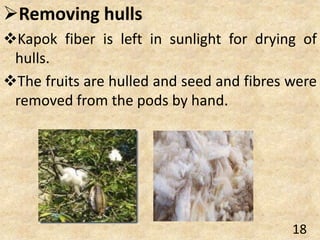
Removing hulls
Kapok fiber is left in sunlight for drying of
hulls.
The fruits are hulled and seed and fibres were
removed from the pods by hand.
18
Removing seeds
The seeds lie loose in the floss and, with the help of
some beating they fall to the bottom of the
container where they are easily separated.
19
Drying
Kapok fibre is dried under the sun for 3 to 5
hours for complete drying.
20
Bailing and packing
Kapok fibers are then packed in the form of
bales.
Bale size approximately 50 kg to 100 kg.
21
PROPERTIES
1. Appearance :
Kapok fibres are lustrous, yellowish
brown and made of a mix of lignin and cellulose.
2. Fineness :
0.4-0.7 denier
3. Tenacity :
1.4-1.74 gram/denier
4. Elongation at break :
1.8-4.23
22
PROPERTIES
1. Appearance :
Kapok fibres are lustrous,
yellowish brown and made of a mix of lignin
and cellulose.
2. Fineness :
0.4-0.7 denier
3. Tenacity :
1.4-1.74 gram/denier
4. Elongation at break :
1.8-4.23
5. Absorbency:
The hydrophobic characteristics of the
kapok fibre could be attributed to its waxy surface
while its large percent of lumen contributed to its
excellent oil absorbency and retention capacity.
6. Thermal behavior of kapok:
The heat retention of kapok was
better than that of other fibres due to the static
immobile air held in the large lumen region of
kapok.
7. Light weight:
8 times lighter than cotton by volume.
23
8. Effect of Acids:
Kapok shows good resistance to
alkalis and it is not damaged by alkali.
9. Effect of Alkalis:
Kapok shows good resistance to
alkalis and it is not damaged by alkali.
10. Effect of Microorganisms:
Because of lignin
micro organism shows no effect.
24
Chemical Composition of Kapok:
64% cellulose, 13% lignin and 23% pentose.
Advantages:
• Light weight,
• Hydrophobic,
• Comfortable,
• Thermal insulator and,
• Bio degradable
25
CONTI……
Dis advantages:
• The fibres are fragile and break easily
• Not suitable for weaving or spinning
• Irritant to lungs and needs extra care during
work
• Highly inflammable.
26
End uses
o Mattress/Pillow stuffing Clothing
o Life-saving equipment
27
Conclusion
 The conventional end uses of kapok include
mattress/pillow stuffing, and thermal
insulation.
 The market for kapok in these traditional
uses has declined considerably over the past
30 years, due to the developments in
synthetic materials, such as foamed plastics,
which have almost replaced kapok in most of
its traditional end uses.
28
CONTI……
 In addition to its potential use as
clothing material, the fabric is being
considered for suitability as
polymeric materials such as
polyester and phenolic resins.
29
References
www.mayanodyssey.com
www.tis-gdv.com
www.drwren.com/ Peru Journals
www.wikipedia.com
30
31

kopak

  • 1.
  • 2.
  • 3.
    Out lines Introduction Diference betweencotton and kapok Structure Processing of Kapok  Properties Chemical Composition of Kapok End uses Conclusion 4
  • 4.
    INTRODUCTION What is kapok: Afine, fibrous substance like cotton that grows around the seeds of the ceiba tree, used as stuffing for cushions, soft toys etc. Also known as silk cotton or java cotton. Found: Africa and central America. 5
  • 5.
    Kapok production availablein East Pakistan is estimated roughly at 10 million pound . It estimated in a survy of 1943-44, according to information received from United States Agriculture. About 2.25 million pound of kapok within country mainly filling pillows , cushion , and quilts. The remaining 7.75 to 8.0 million pound are available for export. Fibre type : Natural Fibre length : .7 inch to 1 inch Fibre size : Mic 2.02 6
  • 6.
    Kapok mill: Chittagong, processingcapacity of about 200 tons Thick: They can be 19 feet (5.8 meters) thick. Diameter: Trunks can often be up to 3 m (9.8 ft) in diameter above the extensive buttress roots. Seed oil: A vegetable oil can be pressed from the seeds. The oil has a yellow colour and a pleasant, mild odour and taste 7
  • 7.
  • 8.
    Diference between: Kapok: A Silkyfiber obtained from the silk-cotton tree used insulation and stffing for pilows mattresses etc. Cotton: Cotton is a soft, fluffy staple fiber at grows in a boll, or protective case. It is almost pure celluose. 9
  • 9.
     Common Name: KapokTree, Cotton Tree, Suma'ma  Family: Malvaceae  Botanical name: ceiba pentandra  Soil: Medium (loamy) and heavy (clay) soils and prefers well-drained soil. It cannot grow in the shade. It prefers dry or moist soil. 10
  • 10.
     Elevation: A plantof the moist tropics, where it is found at elevations up to 1,200 metres.  Temprature : where annual day time temperatures are within the range 17 - 38 °c, but can tolerate 12 - 40 °c.  Rain fall: It prefers a mean annual rainfall in the range 1,500 - 2,500mm, but tolerates 750 - 5,700mm. It can tolerate a dry season from 0 - 6 months long. 11
  • 11.
     pH: Prefers apH in the range 5.5 - 6.5, tolerating 5 - 7.5.  Economical life: The economical life of the plants is about 60 years.  Flowering: The fruits ripen 80 - 100 days after flowering.The month of Novmber-Decmber. 12
  • 12.
     Yielding: Single treecan bear 300 - 400 pods a year, yielding up to 20 kilos of fibre from about the age of 5 for over 50 years.  Germination: Germination may continue for 3 - 4 months.  Variety: MN-1, SS-23, SS-29, Togo-B  Picking : Harvesting time is March-April 13
  • 13.
  • 14.
  • 15.
    Harvesting The ripe unopenedpods are normally harvested by knocking them off the tree, but they can also be cut from the tree or harvested when they fall to the ground . 17
  • 16.
    Removing hulls Kapok fiberis left in sunlight for drying of hulls. The fruits are hulled and seed and fibres were removed from the pods by hand. 18
  • 17.
    Removing seeds The seedslie loose in the floss and, with the help of some beating they fall to the bottom of the container where they are easily separated. 19
  • 18.
    Drying Kapok fibre isdried under the sun for 3 to 5 hours for complete drying. 20
  • 19.
    Bailing and packing Kapokfibers are then packed in the form of bales. Bale size approximately 50 kg to 100 kg. 21
  • 20.
    PROPERTIES 1. Appearance : Kapokfibres are lustrous, yellowish brown and made of a mix of lignin and cellulose. 2. Fineness : 0.4-0.7 denier 3. Tenacity : 1.4-1.74 gram/denier 4. Elongation at break : 1.8-4.23 22 PROPERTIES 1. Appearance : Kapok fibres are lustrous, yellowish brown and made of a mix of lignin and cellulose. 2. Fineness : 0.4-0.7 denier 3. Tenacity : 1.4-1.74 gram/denier 4. Elongation at break : 1.8-4.23
  • 21.
    5. Absorbency: The hydrophobiccharacteristics of the kapok fibre could be attributed to its waxy surface while its large percent of lumen contributed to its excellent oil absorbency and retention capacity. 6. Thermal behavior of kapok: The heat retention of kapok was better than that of other fibres due to the static immobile air held in the large lumen region of kapok. 7. Light weight: 8 times lighter than cotton by volume. 23
  • 22.
    8. Effect ofAcids: Kapok shows good resistance to alkalis and it is not damaged by alkali. 9. Effect of Alkalis: Kapok shows good resistance to alkalis and it is not damaged by alkali. 10. Effect of Microorganisms: Because of lignin micro organism shows no effect. 24
  • 23.
    Chemical Composition ofKapok: 64% cellulose, 13% lignin and 23% pentose. Advantages: • Light weight, • Hydrophobic, • Comfortable, • Thermal insulator and, • Bio degradable 25
  • 24.
    CONTI…… Dis advantages: • Thefibres are fragile and break easily • Not suitable for weaving or spinning • Irritant to lungs and needs extra care during work • Highly inflammable. 26
  • 25.
    End uses o Mattress/Pillowstuffing Clothing o Life-saving equipment 27
  • 26.
    Conclusion  The conventionalend uses of kapok include mattress/pillow stuffing, and thermal insulation.  The market for kapok in these traditional uses has declined considerably over the past 30 years, due to the developments in synthetic materials, such as foamed plastics, which have almost replaced kapok in most of its traditional end uses. 28
  • 27.
    CONTI……  In additionto its potential use as clothing material, the fabric is being considered for suitability as polymeric materials such as polyester and phenolic resins. 29
  • 28.
  • 29.
  • 30.