CHAPTER ONE
LECTURE 1 ON
INTRODUCTION TO TEXTILE FIBERS
BAHIR DAR UNIVERSITY (EiTEX)
By: Bademaw Abate(Lecturer)
Introduction
A textile is flexible material consisting of network of natural
or artificial fiber often referred to as thread or yarn.
fibers is defined as unit of matter characterized by
flexibility, fineness, and a high ratio of length to thickness.
Fabric refers to any material made through weaving,
knitting, crocheting, or bonding .
Apparel is anything that one puts on ones body. Clothing,
shoes, hats, globes, & scarves are example of apparel items
Definition of Fiber and Textile fibers
 Fiber:
 It is defined as one of the delicate, hair portions of the tissues
of a plant or animal or other substances that are very small in
diameter in relation to there length.
 A fiber is a material which is several hundred times as long as
its thick.
 Fibres have been defined by the Textile Institute as units of
matter characterized by :
 flexibility,
 fineness
 high ratio of length to thickness.
Cont…
 Other characteristics might be added, if the fibre is to be of any
use for general textile purposes, a sufficiently high temperature
stability and a certain minimum strength and moderate
extensibility.
 The characteristic dimensions of fibres are the basis of their use
and need to be stressed:
 individual fibres (or elements of a continuous filament) weigh only
a few micrograms
their length/width ratio is at least 1000:1
 It is the basic structural element of textile products.
 It is a smallest textile component which is microscopic hair like
substance that may be manmade or natural.
Textile Fiber:
 Textile fiber has some characteristics which differ between fiber to Textile
fiber.
 Textile fiber can be spun into a yarn or made into a fabric by various
methods including weaving, knitting, braiding, felting, and twisting.
 The essential requirements for fibers to be spun into yarn include a length of
at least 5 millimeters, flexibility, cohesiveness, and sufficient strength.
 Other important properties include elasticity, fineness, uniformity,
durability, and luster.
 Banana fiber is one kind of fiber but it is not a textile fiber. Because it can
not fill up the above properties. So we can say that all fiber are not textile
fiber.
Cont…
 ordinary textile fibres must be, at least partly, elastic up to breaking
extensions between 5 and 50%.
 This is an unusual intermediate range of extensibility, since glasses
and crystalline solids are less extensible, whereas rubbers are much
more extensible.
 all textile fibers are partially oriented, linear polymers.
 A remarkable fact is that almost all the general textile fibre market is
met by six polymer types:
 the natural polymers,
 cellulose and proteins,
 the synthetic (manufactured) polymers, polyamide, polyester, polyolefin
and vinyl (including acrylic).
Essential properties Textile Fibers
 Basic Textile Fiber Properties
 There are several primary properties necessary for a polymeric
material to make an adequate fiber.
 Certain other fiber properties increase its value and desirability in
its intended end-use but are not necessary properties essential to
make a fiber. Such secondary properties include :
 moisture absorption characteristics,
 fiber resiliency, abrasion resistance,
 density,
 luster,
 chemical resistance,
 thermal characteristics,
 flammability.
CONT..
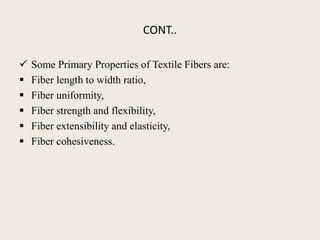
 Some Primary Properties of Textile Fibers are:
 Fiber length to width ratio,
 Fiber uniformity,
 Fiber strength and flexibility,
 Fiber extensibility and elasticity,
 Fiber cohesiveness.
CONT.
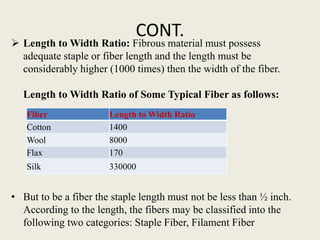
 Length to Width Ratio: Fibrous material must possess
adequate staple or fiber length and the length must be
considerably higher (1000 times) then the width of the fiber.
Length to Width Ratio of Some Typical Fiber as follows:
• But to be a fiber the staple length must not be less than ½ inch.
According to the length, the fibers may be classified into the
following two categories: Staple Fiber, Filament Fiber
Fiber Length to Width Ratio
Cotton 1400
Wool 8000
Flax 170
Silk 330000
Cont…
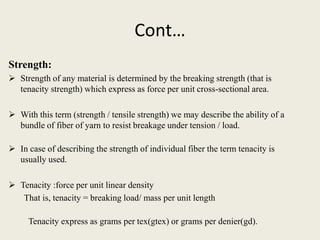
Strength:
 Strength of any material is determined by the breaking strength (that is
tenacity strength) which express as force per unit cross-sectional area.
 With this term (strength / tensile strength) we may describe the ability of a
bundle of fiber of yarn to resist breakage under tension / load.
 In case of describing the strength of individual fiber the term tenacity is
usually used.
 Tenacity :force per unit linear density
That is, tenacity = breaking load/ mass per unit length
Tenacity express as grams per tex(gtex) or grams per denier(gd).
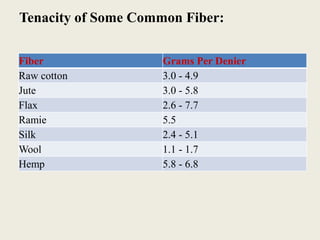
Tenacity of Some Common Fiber:
Fiber Grams Per Denier
Raw cotton 3.0 - 4.9
Jute 3.0 - 5.8
Flax 2.6 - 7.7
Ramie 5.5
Silk 2.4 - 5.1
Wool 1.1 - 1.7
Hemp 5.8 - 6.8
Cont…
Flexibility:
 It is one of the essential property of textile fiber.
 The fibers should be sufficient by poliable, then only it can be wrapped around
another fiber during spinning.
 Many substance in nature resemble fibrous forms but they are note pratical
fibers as they are stiff and brittle.
Cohesiveness:
 It may also be termed as spinning quality of fiber.
 It is the property of an individual fiber by virtue of which the fibers are hold
on to one another when the fibers are spun into yarns.
Cont….
Uniformity:
 It may describe the similarities in length of fiber which are
spun into yarn.
 To make a good quality yarn, it is important that the fibers must
be similar in length and width in spinning quality and in
flexibility .
 There is no problem in producing uniform manmade fibers but
for natural fiber uniformity is difficult to achieve.
 So for natural fiber it is essential to blend many batches in
order to manufacture good quality yarn and fabrics.
Cont….
Elastic Recovery:
 Elastic recovery is the percent to return from elongation towards its
original length.
 If a fiber returns to its original length from a specified amount of
attenuation, it is said to have 100% elastic recovery at x-percent
elongation.
 Elastic recovery is expressed as percentage.
 The elasticity or elastic recovery of a fiber is determined by several
aspects like what type of load is applied and how many times it is
held in the stretched position.
CLASSIFICATION OF FIBRES
 The history of
Traces of natural fibers have been located to ancient
civilizations all over the globe.
 For many thousand years, the usage of fiber was limited by
natural fibers such as flax, cotton, silk, wool and plant fibres
for different applications.
 Fibers can be divided into natural fibres and man-made or
chemical fibres.
 Flax is considered to be the oldest and the most used natural
fibre since ancient times.
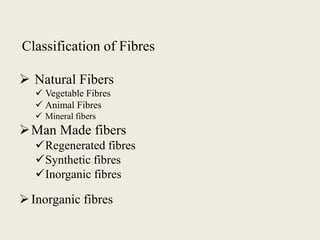
Classification of Fibres
 Natural Fibers
 Vegetable Fibres
 Animal Fibres
 Mineral fibers
Man Made fibers
Regenerated fibres
Synthetic fibres
Inorganic fibres
Inorganic fibres
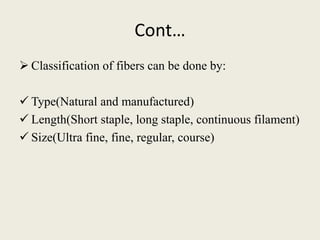
Cont…
 Classification of fibers can be done by:
 Type(Natural and manufactured)
 Length(Short staple, long staple, continuous filament)
 Size(Ultra fine, fine, regular, course)
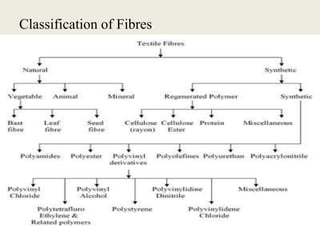
Classification of Fibres
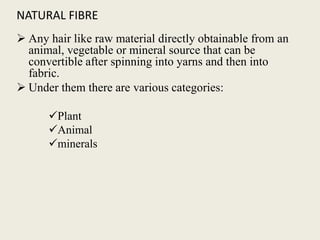
NATURAL FIBRE
 Any hair like raw material directly obtainable from an
animal, vegetable or mineral source that can be
convertible after spinning into yarns and then into
fabric.
 Under them there are various categories:
Plant
Animal
minerals
Vegetable fibers
They can be further on classified as:
 fibre occurring on the seed(raw cotton, java cotton)
 phloem fiber (flax, ramie ,hemp, jute)
 tendon fibre from stem or leaves (manila hemp, sisal hemp etc)
 fibre occurring around the trunk (hemp palm)
 fibre of fruit/ nut shells(coconut fibre – Coir) cotton and linen
are the most important among them.
Cont…..
 Bast fibres
 Low Lignin content – Linen or Flax (raw and bleached)
and Ramie
 High Lignin content – Jute, Hemp
Cotton
 Cotton is a soft fibre that grows around the seeds of the
cotton plant .
 cotton fibre grows in the seed pod or boll of the cotton plant .
each fibre is a single elongated cell that is flat twisted and
ribbon like with a wide inner hollow (lumen).
Composition
 90% cellulose,6% moisture and the remainder fats and
impurities.
 the outer surface is covered with a protective wax like
coating which gives fibre an adhesive quality.
PROPERTIES
It has 8% moisture regain
 The cellulose is arranged in a way that gives cotton unique properties
of strength, durability, and absorbency.
 it is fresh , crisp , comfortable ,absorbent , flexible, has no pilling
problems and has good resistance to alkalis.
 it has poor wrinkle resistance, shrinkage, poor acid resistance , less
abrasion resistance , susceptible to damage by moths and mildew, need
slots of maintenance and stains are difficult to remove.
 its fibre length ranges from ½ inches to 2inches
 it has 10%increase in strength when wet.
 it has a flat twisted tube shape.
KAPOK FIBRE
 Kapok fiber is a silky cotton-like substance that surrounds the
seeds in the pods of the ceiba tree.
Properties
 It can support as much as 30times its own weight in water
and loses only 10 percent of buoyancy over a 30-day
period.
 It is eight times lighter than cotton
 it is extremely used as a thermal-insulator.
 it is also lightweight, non-allergic, non-toxic, resistant to rot
and odorless.
 since it is inelastic and too fragile, itcan't be spun.
 it has outstanding characteristics of lightness, impermeability,
thermal-isolation and eco- naturality
BAST FIBRE
Bast fibre or skin fibre is fibre collected from the Phloem
(the bast surrounding the stem of a certain plant
Properties
 The bast fibres have often higher tensile strength than other
kinds, and ropes, yarn, paper, composites and burlap.
 A special property of bast fibers are that the fiber at that
point represents a weak point.
 They are obtained by the process called retting
JUTE FIBRE
 Jute is one of the cheapest natural fibres and is second only to cotton in
amount produced and variety fibres are composed primarily of the plant
cellulose and lignin .
Properties
 Jute is a long, soft, shiny vegetable fibre that can be spun into coarse, strong
 It is a lingo -cellulosic fibre that is partially a textile fibre and partially wood.
 The plant grows up to a height of 2.5m and its fibre length is about 2m.
 it is generally used in geo textiles.
 it has a good resistance to microorganisms and insects.
 it has low wet strength, low elongation and inexpensive to reduce
RAMIE FIBRE
Ramie is one of the oldest fibre crops, having
been used for.
Properties
Ramie requires chemical processing to de-gum
the fibre.
it is fine absorbent ,quick drying fibre, is slightly
stiff and possesses high natural lustre.
its plant height is 2.5m and its strength is eight
times more than cotton.
HEMP FIBRE
 Depending on the processing used to remove the fiber
from the stem, the hemp naturally maybe creamy white,
brown, gray, black or green.
Properties
 it is yellowish brown fibre
 Hemp fibers can be 3 to 15 feet long, running the length
of the plant.
 Characteristics of hemp fibre are its superior strength and
durability, resistance to ultraviolet light and mold,
comfort and good absorbency
COIR FIBRE
• Fibre mechanically extracted from dry mature coconut
husk after soaking.
• It is long, hard and strong fib rebut with lower softness,
lower water absorption capacity, and shorter life than
long retted fibre.
ANIMAL FIBRES
Animal fibers are natural fibers that consist largely
of proteins such as silk, hair/fur, wool and feathers.
 The most commonly used type of animal fiber is
 Hair Fibres (Staple) ;Wool, Specialty hair fibres
 Secretion Fibres(Filament) , Silk, Spider Silk(Insect fibre)
SILK FIBRE
silk is a natural fiber that can be woven into textiles. It
is obtained from the cocoon of the silk worm larva, in
the process known as sericulture
 Properties
 It’s a fine continuous strand unwound from the
cocoon of a moth caterpillar known as the silkworm.
 it is the longest and thinnest natural filament fibre
with the longest filament around 3000yards.
 it is relatively lustrous ,smooth, lightweight, strong
and elastic.
 it is essentially composed of protein fibre and is
naturally a white coloured fiber.
Types of silk
 Domestic silk-
Mulberry silk : This is a white to
yellow colored silk. It is fine and issued mainly for apparel.
Wild silk-
Mug silk : This is a golden yellow coloured silk .It is obtained
from these mi-domesticated silkworm ,which feeds on the
aromatic leaves of Somand Soalu plants.
Eri silk : This is got from the domesticated silkworm. It feeds
mainly on castor leaves.
Tussar silk : Tussar Silk, also known as Kosa Silk, is valued for
its purity and texture. Kosa Silk is drawn from cocoons
especially grown on Arjun,
WOOL
Wool is the fiber derived from the fur of animals principal
properties
 it has the highest moisture regain i.e., 14%.
 it exhibits felting property and is easy to spin
 due to crimp present in it, it has heat in stored within
the length of the fibre is around 3-15 inches.
Cont…
 there are two types of wool namely clipped or fleece
wool taken from live sheep and pulled wool removed
from sheep already dead.
 merino wool is the best grade of wool.
 In addition to clothing, wool has been used as
carpeting, felt, wool insulation
MINERAL FIBRE
 Asbestos is the only natural mineral fibre obtained from
varieties of rocks.
properties
 It is fibrous form of silicate of magnesium and calcium
containing iron and aluminum and other minerals.
 It is acid proof, flame proof and rust proof.
 Its particles are carcinogenic and hence its use is restricted.
MAN MADE
Regenerated Fibres
Cellulosic– Cotton linters and wood pulp
Viscose rayon, Cupra-ammonium, Cellulose
Acetate (secondary and triacetate), Polynosic,
High Wet Modulus (HWM)
Protein– Casein fibre from milk Groundnut
Fibre, Zein fibre Azlon fibre from corn and
Natural man made fibre
(A) Cellulosic fibres
 Cellulose is one of many polymers found in nature.
 Wood, paper, and cotton all contain cellulose. Cellulose
is an excellent fiber.
 Cellulose is made of repeat units of the monomer
glucose.
 The three types of regenerated cellulosic fibres are
rayon, acetate and triacetate which are derived from the
cell walls of short cotton fibres called linters.
 Paper for instance is almost pure cellulose
Cont…
B) Non Cellulosic Man made fibres:
Protein:
• Azlon Fibre from Soya and Corn Casein of
Milk Ground nut
• From other Sources:
• Mineral: Glass, Ceramic and Graphite Metallic
Fibres: By mining and refining of metals like silver,
gold, aluminum and steel.
• Rubber Fibres: Sap tapped from the rubber tree.
• Fibre forming polymer is either natural or synthetic)
RAYON
Rayon is a manufactured regenerated cellulosic fiber.
 it is the first man made fibre .
 it has a serrated round shape with smooth surface.
 it loses 30-50% of its strength when it is wet.
 Rayon is produced from naturally occurring polymers and
therefore it is not as cellulosic fiber.
 The fiber is sold as artificial silk
 there are two principal varieties of rayon namely viscose and
cupra ammonium rayon.
ACETATE
 A manufactured fiber in which the fiber forming substance is cellulose
acetate.
 Acetate is derived from cellulose by reacting purified cellulose from wood
pulp with acetic acid and acetic anhydride in the presence of sulfuric acid.
Acetate Fiber Characteristics
 Luxurious feel and appearance
 Wide range of colors and lusters
 Excellent drapability and softness
 Relatively fast drying
 Shrink, moth and mildew resistant
 Special dyes have been developed for acetate since it does not accept
dyes ordinarily used for cotton and rayon.
Man made Synthetic Fibres
 Polyamides-Nylon 66, Nylon 610, Nylon 6 etc
 Polyester-Terylene, Terene, Dacron etc.
 Polyvinyl derivatives
 Polyvinylchloride
 Polyvinylchloride acetate
 Polyvinylchloride –Acrylonitrile
 Polyacrilonitrile
 Polyvinyl alcohol
 Polystyrene and Copolymers
 Polyvinylide Chloride and Copolymers
 Polyolefins
 Polyethylene
 Polypropylene
MAN MADE SYNTHETIC FIBRE
• POLYESTER, NYLONARAMID,
ACRYLICMODACRYLIC,
• SPANDEX, OLEFIN, VINYONSARAN,
NYTRILTEFLON / FLUOROCARBONALGINATE :
• Minor fibre made of a jelly like calcium alginate derived
from certain forms of sea weed used as scaffolding in such
fabrics as surgical dressings which can be ;Polyester, Nylon
, Natural rubber .
POLYESTER
 Polyester is a category of polymers which contain theester functional
group in their main c
 The term "polyester" is most commonly used to refer to polyethylene
terephthalate (PET).
 it has a high melting temperature
 it can be dyed with only disperse dyes
 they are thermoplastic, have good strength and are hydrophobic
 the fibre has a rod like shape with a smooth surface.
 it is lustrous and its hand is crisp.
 it has excellent resiliency and is the best wash and wear fabric.
NYLON
 Nylon is one of the most common polymers used as
A fiber.
 There are several forms of nylon depending up on
chemical synthesis such as nylon 4, 6, 6.6, 6.10,
6.12,8,10 and 11.
 Nylon is found in clothing all the time, but also in
other places, in the form of a thermoplastic material.
Cont…
 Nylons are also called polyamides, because of the
characteristic amide groups in the backbone chain.
 These amide groups are very polar and are linked with
each other with hydrogen bonds.
 nylon is a regular and symmetrical fibre with crystalline
regions and make fibers.
 the fibre has a smooth rod like shape with a smooth
surface
Cont…
 Natural rubber is essentially a polymer of isoprene units, a
hydrocarbon dienemonomer.
 Synthetic rubber can be made as a polymer of prene or various
other monomers
 The material properties of natural rubber make it an elastomer
.
 Rubber exhibits unique physical and chemical properties.
 Rubber's stress-strain behavior exhibits the Mullins effect, the
Payne effect and is often model her elastic.
Inorganic Fibres
 Glass– Silica sand, lime stone and other minerals
 Ceramic – Alumina, Silica and Graphite fibres –
Carbon
 Metallic fibres-Aluminium, silver, gold and stainless
steel
GLASS FIBRE
 It is also known as Fiberglass that is a material made from
extremely fine fibers of glass. Glass fiber is formed when thin
silica-based or other formulation glass extruded into many fibers
with small textile processing
 it has a high degree of viscosity
 The basis of textile grade glass fibers issilica, SiO
 In its pure form it exists as a polymer
 In order to induce crystallization, it must be heated to te
con
 The rest type of glass use for fiber was soda-lime
glass or A glass which
 By trapping air within them, blocks of glass
fiber make is used as a reinforcing agent for many
polymer products.
 it has a good thermal insulation, with at thermal
conductivity of 0.05 W/m
 Because glass has anamorphous structure, its
properties are the s
 Humidity is an important factor in
the tensile adsorbed, and can worsen microscopic
crack defects, and lessen tenacity.
 It has no effect on exposure to sun light even after
extended periods
METALLIC FIBRES
 Metallic fibers are manufactured fibers composed
of metal, plastic-coated metal, metal-Gold and silver
have been used since yarns for fabric decoration.
 More recently, aluminum yarns, aluminized nylon
yarns have replaced glass.
 They are made through laminating process.
 Coated metallic filaments help to minimize tarnishing.
 When suitable adhesives and films are used, they are not
affected by salt water, chlorinated water in swimming pools
or climatic conditions.
 If possible anything made with metallic fibers should be
dry-cleaned.
 Ironing can be problematic because the heat from the iron,
especially at high temperatures, can melt the fibers.
 They are used mainly for decorative purpose.
Thank you

Textile Fiber ppt by B.A

  • 1.
    CHAPTER ONE LECTURE 1ON INTRODUCTION TO TEXTILE FIBERS BAHIR DAR UNIVERSITY (EiTEX) By: Bademaw Abate(Lecturer)
  • 2.
    Introduction A textile isflexible material consisting of network of natural or artificial fiber often referred to as thread or yarn. fibers is defined as unit of matter characterized by flexibility, fineness, and a high ratio of length to thickness. Fabric refers to any material made through weaving, knitting, crocheting, or bonding . Apparel is anything that one puts on ones body. Clothing, shoes, hats, globes, & scarves are example of apparel items
  • 3.
    Definition of Fiberand Textile fibers  Fiber:  It is defined as one of the delicate, hair portions of the tissues of a plant or animal or other substances that are very small in diameter in relation to there length.  A fiber is a material which is several hundred times as long as its thick.  Fibres have been defined by the Textile Institute as units of matter characterized by :  flexibility,  fineness  high ratio of length to thickness.
  • 4.
    Cont…  Other characteristicsmight be added, if the fibre is to be of any use for general textile purposes, a sufficiently high temperature stability and a certain minimum strength and moderate extensibility.  The characteristic dimensions of fibres are the basis of their use and need to be stressed:  individual fibres (or elements of a continuous filament) weigh only a few micrograms their length/width ratio is at least 1000:1  It is the basic structural element of textile products.  It is a smallest textile component which is microscopic hair like substance that may be manmade or natural.
  • 5.
    Textile Fiber:  Textilefiber has some characteristics which differ between fiber to Textile fiber.  Textile fiber can be spun into a yarn or made into a fabric by various methods including weaving, knitting, braiding, felting, and twisting.  The essential requirements for fibers to be spun into yarn include a length of at least 5 millimeters, flexibility, cohesiveness, and sufficient strength.  Other important properties include elasticity, fineness, uniformity, durability, and luster.  Banana fiber is one kind of fiber but it is not a textile fiber. Because it can not fill up the above properties. So we can say that all fiber are not textile fiber.
  • 6.
    Cont…  ordinary textilefibres must be, at least partly, elastic up to breaking extensions between 5 and 50%.  This is an unusual intermediate range of extensibility, since glasses and crystalline solids are less extensible, whereas rubbers are much more extensible.  all textile fibers are partially oriented, linear polymers.  A remarkable fact is that almost all the general textile fibre market is met by six polymer types:  the natural polymers,  cellulose and proteins,  the synthetic (manufactured) polymers, polyamide, polyester, polyolefin and vinyl (including acrylic).
  • 7.
    Essential properties TextileFibers  Basic Textile Fiber Properties  There are several primary properties necessary for a polymeric material to make an adequate fiber.  Certain other fiber properties increase its value and desirability in its intended end-use but are not necessary properties essential to make a fiber. Such secondary properties include :  moisture absorption characteristics,  fiber resiliency, abrasion resistance,  density,  luster,  chemical resistance,  thermal characteristics,  flammability.
  • 8.
    CONT..  Some PrimaryProperties of Textile Fibers are:  Fiber length to width ratio,  Fiber uniformity,  Fiber strength and flexibility,  Fiber extensibility and elasticity,  Fiber cohesiveness.
  • 9.
    CONT.  Length toWidth Ratio: Fibrous material must possess adequate staple or fiber length and the length must be considerably higher (1000 times) then the width of the fiber. Length to Width Ratio of Some Typical Fiber as follows: • But to be a fiber the staple length must not be less than ½ inch. According to the length, the fibers may be classified into the following two categories: Staple Fiber, Filament Fiber Fiber Length to Width Ratio Cotton 1400 Wool 8000 Flax 170 Silk 330000
  • 10.
    Cont… Strength:  Strength ofany material is determined by the breaking strength (that is tenacity strength) which express as force per unit cross-sectional area.  With this term (strength / tensile strength) we may describe the ability of a bundle of fiber of yarn to resist breakage under tension / load.  In case of describing the strength of individual fiber the term tenacity is usually used.  Tenacity :force per unit linear density That is, tenacity = breaking load/ mass per unit length Tenacity express as grams per tex(gtex) or grams per denier(gd).
  • 11.
    Tenacity of SomeCommon Fiber: Fiber Grams Per Denier Raw cotton 3.0 - 4.9 Jute 3.0 - 5.8 Flax 2.6 - 7.7 Ramie 5.5 Silk 2.4 - 5.1 Wool 1.1 - 1.7 Hemp 5.8 - 6.8
  • 12.
    Cont… Flexibility:  It isone of the essential property of textile fiber.  The fibers should be sufficient by poliable, then only it can be wrapped around another fiber during spinning.  Many substance in nature resemble fibrous forms but they are note pratical fibers as they are stiff and brittle. Cohesiveness:  It may also be termed as spinning quality of fiber.  It is the property of an individual fiber by virtue of which the fibers are hold on to one another when the fibers are spun into yarns.
  • 13.
    Cont…. Uniformity:  It maydescribe the similarities in length of fiber which are spun into yarn.  To make a good quality yarn, it is important that the fibers must be similar in length and width in spinning quality and in flexibility .  There is no problem in producing uniform manmade fibers but for natural fiber uniformity is difficult to achieve.  So for natural fiber it is essential to blend many batches in order to manufacture good quality yarn and fabrics.
  • 14.
    Cont…. Elastic Recovery:  Elasticrecovery is the percent to return from elongation towards its original length.  If a fiber returns to its original length from a specified amount of attenuation, it is said to have 100% elastic recovery at x-percent elongation.  Elastic recovery is expressed as percentage.  The elasticity or elastic recovery of a fiber is determined by several aspects like what type of load is applied and how many times it is held in the stretched position.
  • 15.
    CLASSIFICATION OF FIBRES The history of Traces of natural fibers have been located to ancient civilizations all over the globe.  For many thousand years, the usage of fiber was limited by natural fibers such as flax, cotton, silk, wool and plant fibres for different applications.  Fibers can be divided into natural fibres and man-made or chemical fibres.  Flax is considered to be the oldest and the most used natural fibre since ancient times.
  • 16.
    Classification of Fibres Natural Fibers  Vegetable Fibres  Animal Fibres  Mineral fibers Man Made fibers Regenerated fibres Synthetic fibres Inorganic fibres Inorganic fibres
  • 17.
    Cont…  Classification offibers can be done by:  Type(Natural and manufactured)  Length(Short staple, long staple, continuous filament)  Size(Ultra fine, fine, regular, course)
  • 18.
  • 19.
    NATURAL FIBRE  Anyhair like raw material directly obtainable from an animal, vegetable or mineral source that can be convertible after spinning into yarns and then into fabric.  Under them there are various categories: Plant Animal minerals
  • 20.
    Vegetable fibers They canbe further on classified as:  fibre occurring on the seed(raw cotton, java cotton)  phloem fiber (flax, ramie ,hemp, jute)  tendon fibre from stem or leaves (manila hemp, sisal hemp etc)  fibre occurring around the trunk (hemp palm)  fibre of fruit/ nut shells(coconut fibre – Coir) cotton and linen are the most important among them.
  • 21.
    Cont…..  Bast fibres Low Lignin content – Linen or Flax (raw and bleached) and Ramie  High Lignin content – Jute, Hemp
  • 22.
    Cotton  Cotton isa soft fibre that grows around the seeds of the cotton plant .  cotton fibre grows in the seed pod or boll of the cotton plant . each fibre is a single elongated cell that is flat twisted and ribbon like with a wide inner hollow (lumen). Composition  90% cellulose,6% moisture and the remainder fats and impurities.  the outer surface is covered with a protective wax like coating which gives fibre an adhesive quality.
  • 23.
    PROPERTIES It has 8%moisture regain  The cellulose is arranged in a way that gives cotton unique properties of strength, durability, and absorbency.  it is fresh , crisp , comfortable ,absorbent , flexible, has no pilling problems and has good resistance to alkalis.  it has poor wrinkle resistance, shrinkage, poor acid resistance , less abrasion resistance , susceptible to damage by moths and mildew, need slots of maintenance and stains are difficult to remove.  its fibre length ranges from ½ inches to 2inches  it has 10%increase in strength when wet.  it has a flat twisted tube shape.
  • 24.
    KAPOK FIBRE  Kapokfiber is a silky cotton-like substance that surrounds the seeds in the pods of the ceiba tree. Properties  It can support as much as 30times its own weight in water and loses only 10 percent of buoyancy over a 30-day period.  It is eight times lighter than cotton  it is extremely used as a thermal-insulator.  it is also lightweight, non-allergic, non-toxic, resistant to rot and odorless.  since it is inelastic and too fragile, itcan't be spun.  it has outstanding characteristics of lightness, impermeability, thermal-isolation and eco- naturality
  • 25.
    BAST FIBRE Bast fibreor skin fibre is fibre collected from the Phloem (the bast surrounding the stem of a certain plant Properties  The bast fibres have often higher tensile strength than other kinds, and ropes, yarn, paper, composites and burlap.  A special property of bast fibers are that the fiber at that point represents a weak point.  They are obtained by the process called retting
  • 26.
    JUTE FIBRE  Juteis one of the cheapest natural fibres and is second only to cotton in amount produced and variety fibres are composed primarily of the plant cellulose and lignin . Properties  Jute is a long, soft, shiny vegetable fibre that can be spun into coarse, strong  It is a lingo -cellulosic fibre that is partially a textile fibre and partially wood.  The plant grows up to a height of 2.5m and its fibre length is about 2m.  it is generally used in geo textiles.  it has a good resistance to microorganisms and insects.  it has low wet strength, low elongation and inexpensive to reduce
  • 27.
    RAMIE FIBRE Ramie isone of the oldest fibre crops, having been used for. Properties Ramie requires chemical processing to de-gum the fibre. it is fine absorbent ,quick drying fibre, is slightly stiff and possesses high natural lustre. its plant height is 2.5m and its strength is eight times more than cotton.
  • 28.
    HEMP FIBRE  Dependingon the processing used to remove the fiber from the stem, the hemp naturally maybe creamy white, brown, gray, black or green. Properties  it is yellowish brown fibre  Hemp fibers can be 3 to 15 feet long, running the length of the plant.  Characteristics of hemp fibre are its superior strength and durability, resistance to ultraviolet light and mold, comfort and good absorbency
  • 29.
    COIR FIBRE • Fibremechanically extracted from dry mature coconut husk after soaking. • It is long, hard and strong fib rebut with lower softness, lower water absorption capacity, and shorter life than long retted fibre.
  • 30.
    ANIMAL FIBRES Animal fibersare natural fibers that consist largely of proteins such as silk, hair/fur, wool and feathers.  The most commonly used type of animal fiber is  Hair Fibres (Staple) ;Wool, Specialty hair fibres  Secretion Fibres(Filament) , Silk, Spider Silk(Insect fibre)
  • 31.
    SILK FIBRE silk isa natural fiber that can be woven into textiles. It is obtained from the cocoon of the silk worm larva, in the process known as sericulture  Properties  It’s a fine continuous strand unwound from the cocoon of a moth caterpillar known as the silkworm.  it is the longest and thinnest natural filament fibre with the longest filament around 3000yards.  it is relatively lustrous ,smooth, lightweight, strong and elastic.  it is essentially composed of protein fibre and is naturally a white coloured fiber.
  • 32.
    Types of silk Domestic silk- Mulberry silk : This is a white to yellow colored silk. It is fine and issued mainly for apparel. Wild silk- Mug silk : This is a golden yellow coloured silk .It is obtained from these mi-domesticated silkworm ,which feeds on the aromatic leaves of Somand Soalu plants. Eri silk : This is got from the domesticated silkworm. It feeds mainly on castor leaves. Tussar silk : Tussar Silk, also known as Kosa Silk, is valued for its purity and texture. Kosa Silk is drawn from cocoons especially grown on Arjun,
  • 33.
    WOOL Wool is thefiber derived from the fur of animals principal properties  it has the highest moisture regain i.e., 14%.  it exhibits felting property and is easy to spin  due to crimp present in it, it has heat in stored within the length of the fibre is around 3-15 inches.
  • 34.
    Cont…  there aretwo types of wool namely clipped or fleece wool taken from live sheep and pulled wool removed from sheep already dead.  merino wool is the best grade of wool.  In addition to clothing, wool has been used as carpeting, felt, wool insulation
  • 35.
    MINERAL FIBRE  Asbestosis the only natural mineral fibre obtained from varieties of rocks. properties  It is fibrous form of silicate of magnesium and calcium containing iron and aluminum and other minerals.  It is acid proof, flame proof and rust proof.  Its particles are carcinogenic and hence its use is restricted.
  • 36.
    MAN MADE Regenerated Fibres Cellulosic–Cotton linters and wood pulp Viscose rayon, Cupra-ammonium, Cellulose Acetate (secondary and triacetate), Polynosic, High Wet Modulus (HWM) Protein– Casein fibre from milk Groundnut Fibre, Zein fibre Azlon fibre from corn and
  • 37.
    Natural man madefibre (A) Cellulosic fibres  Cellulose is one of many polymers found in nature.  Wood, paper, and cotton all contain cellulose. Cellulose is an excellent fiber.  Cellulose is made of repeat units of the monomer glucose.  The three types of regenerated cellulosic fibres are rayon, acetate and triacetate which are derived from the cell walls of short cotton fibres called linters.  Paper for instance is almost pure cellulose
  • 38.
    Cont… B) Non CellulosicMan made fibres: Protein: • Azlon Fibre from Soya and Corn Casein of Milk Ground nut • From other Sources: • Mineral: Glass, Ceramic and Graphite Metallic Fibres: By mining and refining of metals like silver, gold, aluminum and steel. • Rubber Fibres: Sap tapped from the rubber tree. • Fibre forming polymer is either natural or synthetic)
  • 39.
    RAYON Rayon is amanufactured regenerated cellulosic fiber.  it is the first man made fibre .  it has a serrated round shape with smooth surface.  it loses 30-50% of its strength when it is wet.  Rayon is produced from naturally occurring polymers and therefore it is not as cellulosic fiber.  The fiber is sold as artificial silk  there are two principal varieties of rayon namely viscose and cupra ammonium rayon.
  • 40.
    ACETATE  A manufacturedfiber in which the fiber forming substance is cellulose acetate.  Acetate is derived from cellulose by reacting purified cellulose from wood pulp with acetic acid and acetic anhydride in the presence of sulfuric acid. Acetate Fiber Characteristics  Luxurious feel and appearance  Wide range of colors and lusters  Excellent drapability and softness  Relatively fast drying  Shrink, moth and mildew resistant  Special dyes have been developed for acetate since it does not accept dyes ordinarily used for cotton and rayon.
  • 41.
    Man made SyntheticFibres  Polyamides-Nylon 66, Nylon 610, Nylon 6 etc  Polyester-Terylene, Terene, Dacron etc.  Polyvinyl derivatives  Polyvinylchloride  Polyvinylchloride acetate  Polyvinylchloride –Acrylonitrile  Polyacrilonitrile  Polyvinyl alcohol  Polystyrene and Copolymers  Polyvinylide Chloride and Copolymers  Polyolefins  Polyethylene  Polypropylene
  • 42.
    MAN MADE SYNTHETICFIBRE • POLYESTER, NYLONARAMID, ACRYLICMODACRYLIC, • SPANDEX, OLEFIN, VINYONSARAN, NYTRILTEFLON / FLUOROCARBONALGINATE : • Minor fibre made of a jelly like calcium alginate derived from certain forms of sea weed used as scaffolding in such fabrics as surgical dressings which can be ;Polyester, Nylon , Natural rubber .
  • 43.
    POLYESTER  Polyester isa category of polymers which contain theester functional group in their main c  The term "polyester" is most commonly used to refer to polyethylene terephthalate (PET).  it has a high melting temperature  it can be dyed with only disperse dyes  they are thermoplastic, have good strength and are hydrophobic  the fibre has a rod like shape with a smooth surface.  it is lustrous and its hand is crisp.  it has excellent resiliency and is the best wash and wear fabric.
  • 44.
    NYLON  Nylon isone of the most common polymers used as A fiber.  There are several forms of nylon depending up on chemical synthesis such as nylon 4, 6, 6.6, 6.10, 6.12,8,10 and 11.  Nylon is found in clothing all the time, but also in other places, in the form of a thermoplastic material.
  • 45.
    Cont…  Nylons arealso called polyamides, because of the characteristic amide groups in the backbone chain.  These amide groups are very polar and are linked with each other with hydrogen bonds.  nylon is a regular and symmetrical fibre with crystalline regions and make fibers.  the fibre has a smooth rod like shape with a smooth surface
  • 46.
    Cont…  Natural rubberis essentially a polymer of isoprene units, a hydrocarbon dienemonomer.  Synthetic rubber can be made as a polymer of prene or various other monomers  The material properties of natural rubber make it an elastomer .  Rubber exhibits unique physical and chemical properties.  Rubber's stress-strain behavior exhibits the Mullins effect, the Payne effect and is often model her elastic.
  • 47.
    Inorganic Fibres  Glass–Silica sand, lime stone and other minerals  Ceramic – Alumina, Silica and Graphite fibres – Carbon  Metallic fibres-Aluminium, silver, gold and stainless steel
  • 48.
    GLASS FIBRE  Itis also known as Fiberglass that is a material made from extremely fine fibers of glass. Glass fiber is formed when thin silica-based or other formulation glass extruded into many fibers with small textile processing  it has a high degree of viscosity  The basis of textile grade glass fibers issilica, SiO  In its pure form it exists as a polymer  In order to induce crystallization, it must be heated to te
  • 49.
    con  The resttype of glass use for fiber was soda-lime glass or A glass which  By trapping air within them, blocks of glass fiber make is used as a reinforcing agent for many polymer products.  it has a good thermal insulation, with at thermal conductivity of 0.05 W/m
  • 50.
     Because glasshas anamorphous structure, its properties are the s  Humidity is an important factor in the tensile adsorbed, and can worsen microscopic crack defects, and lessen tenacity.  It has no effect on exposure to sun light even after extended periods
  • 51.
    METALLIC FIBRES  Metallicfibers are manufactured fibers composed of metal, plastic-coated metal, metal-Gold and silver have been used since yarns for fabric decoration.  More recently, aluminum yarns, aluminized nylon yarns have replaced glass.  They are made through laminating process.  Coated metallic filaments help to minimize tarnishing.
  • 52.
     When suitableadhesives and films are used, they are not affected by salt water, chlorinated water in swimming pools or climatic conditions.  If possible anything made with metallic fibers should be dry-cleaned.  Ironing can be problematic because the heat from the iron, especially at high temperatures, can melt the fibers.  They are used mainly for decorative purpose.
  • 53.