BOE TRAINING
Developing a Basis of Estimate is an art and a science
1
Why High Quality BoE’s?
 Minimizes negotiation losses from contract award
through close out.
 Ensures credible and defensible BoE’s that pass the
rigor of government audit.
 Demonstrates integrity of our work to our
customers.
 The contract process requires Estimators and
Functional Managers to sign a contractual
instrument during the estimation process and that
is the BoE.
2
Roles And Responsibilities for BoE’s
 Program Manager has overall responsibility to
ensure that estimators prepare BoE’s that meet
expectations and with sufficient quality that
 Defines preparation schedule
 Coordinates resource assignments
 Ensures consistency in preparation and compliance with
RFP, SOW and other internal/external requirements
 Adheres to the proposal process
 Post award, Program Manager has overall
responsibility for BoE’s used in CFSR.
3
Roles And Responsibilities For BoE’s
 Estimator prepares resource estimate that
 Documents BoE in BoE template
 Mobilizes other resources (i.e. MC, Procurement) in data
gathering requirements
 Ensures TINA training is taken and BoE’s meet TINA
expectations
 Functional Manager reviews and approves BoE for
TINA compliance, ensures that the resource estimate
and BoE is consistent with technical approach
 Lead Pricer/Pricing Analyst includes BoE document in
cost volume, ensures that a BoE exists for all resource
estimates and that BoE is consistent with other
estimating documents received for price preparation
4
Common Defects in the BoE Process
 BoE’s for some estimates simply don’t exist
 Either a lack of process knowledge or pure disregard
 Large proportion of BoE rationale documented as
Engineering Judgment or Experience
 Missing description of thought process or methodologies
and insufficient breakdown of hours
 Reference to historical actuals with no supporting
documentation
 Numbers do not agree. Math doesn’t add up.
 Descriptions do not reflect the full scope of the BoE
5
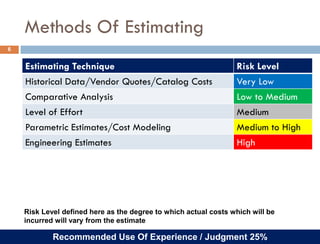
Methods Of Estimating
Risk Level defined here as the degree to which actual costs which will be
incurred will vary from the estimate
Recommended Use Of Experience / Judgment 25%
Estimating Technique Risk Level
Historical Data/Vendor Quotes/Catalog Costs Very Low
Comparative Analysis Low to Medium
Level of Effort Medium
Parametric Estimates/Cost Modeling Medium to High
Engineering Estimates High
6
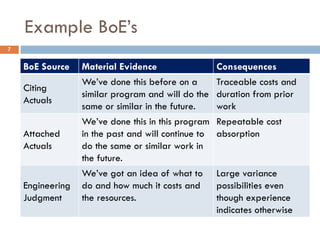
Example BoE’s
BoE Source Material Evidence Consequences
Citing
Actuals
We’ve done this before on a
similar program and will do the
same or similar in the future.
Traceable costs and
duration from prior
work
Attached
Actuals
We’ve done this in this program
in the past and will continue to
do the same or similar work in
the future.
Repeatable cost
absorption
Engineering
Judgment
We’ve got an idea of what to
do and how much it costs and
the resources.
Large variance
possibilities even
though experience
indicates otherwise
7
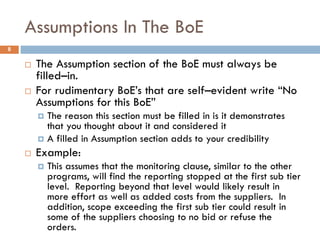
Assumptions In The BoE
 The Assumption section of the BoE must always be
filled–in.
 For rudimentary BoE’s that are self–evident write “No
Assumptions for this BoE”
 The reason this section must be filled in is it demonstrates
that you thought about it and considered it
 A filled in Assumption section adds to your credibility
 Example:
 This assumes that the monitoring clause, similar to the other
programs, will find the reporting stopped at the first sub tier
level. Reporting beyond that level would likely result in
more effort as well as added costs from the suppliers. In
addition, scope exceeding the first sub tier could result in
some of the suppliers choosing to no bid or refuse the
orders.
8
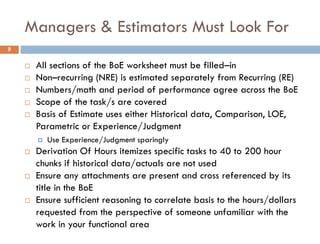
Managers & Estimators Must Look For
 All sections of the BoE worksheet must be filled–in
 Non–recurring (NRE) is estimated separately from Recurring (RE)
 Numbers/math and period of performance agree across the BoE
 Scope of the task/s are covered
 Basis of Estimate uses either Historical data, Comparison, LOE,
Parametric or Experience/Judgment
 Use Experience/Judgment sparingly
 Derivation Of Hours itemizes specific tasks to 40 to 200 hour
chunks if historical data/actuals are not used
 Ensure any attachments are present and cross referenced by its
title in the BoE
 Ensure sufficient reasoning to correlate basis to the hours/dollars
requested from the perspective of someone unfamiliar with the
work in your functional area
9
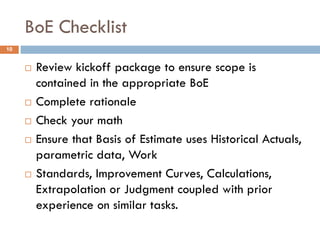
BoE Checklist
 Review kickoff package to ensure scope is
contained in the appropriate BoE
 Complete rationale
 Check your math
 Ensure that Basis of Estimate uses Historical Actuals,
parametric data, Work
 Standards, Improvement Curves, Calculations,
Extrapolation or Judgment coupled with prior
experience on similar tasks.
10
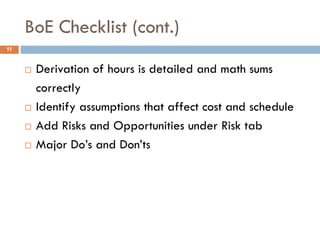
BoE Checklist (cont.)
 Derivation of hours is detailed and math sums
correctly
 Identify assumptions that affect cost and schedule
 Add Risks and Opportunities under Risk tab
 Major Do’s and Don’ts
11
BoE Checklist – Major Do’s
 Rationale must have clear and concise
documentation in support of the estimate.
 Spread hours by year and month.
 Use actuals or historical data as a basis of
estimate when appropriate.
 If actuals are being used as a part of the quote,
make sure they are included in the proposal
submittal.
 Always document your assumptions.
 Set the parameters for which your estimates are
valid for.
12
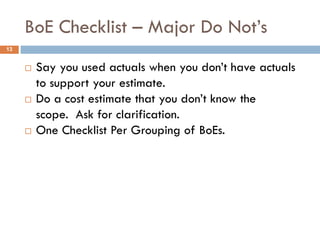
BoE Checklist – Major Do Not’s
 Say you used actuals when you don’t have actuals
to support your estimate.
 Do a cost estimate that you don’t know the
scope. Ask for clarification.
 One Checklist Per Grouping of BoEs.
13
BoE Checklist
 All sections are filled–in
 Non–recurring (NRE) is estimated separately from Recurring (RE)
 Numbers/math and period of performance agree across the BoE
 Scope of all tasks is adequately covered
 Basis of Estimate uses either Historical data, Comparison, LOE,
Parametric or Experience/Judgment
 Derivation Of Hours itemizes specific tasks to 40 to 200 hour
chunks if historical data/actuals is not used
 Ensure any attachments are present and cross referenced by its
title in the BoE
 Ensure sufficient reasoning to correlate basis to the hours/dollars
requested from the perspective of someone unfamiliar with the
work in your functional area
 Assure assumptions are listed or reason stated for “No
Assumptions”
 Period of Performance is accurate on every BoE sheet
14
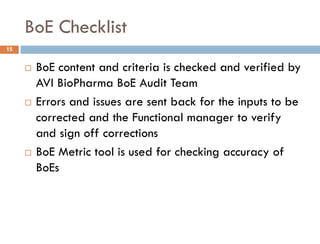
BoE Checklist
 BoE content and criteria is checked and verified by
AVI BioPharma BoE Audit Team
 Errors and issues are sent back for the inputs to be
corrected and the Functional manager to verify
and sign off corrections
 BoE Metric tool is used for checking accuracy of
BoEs
15
BoE Audit
 The BoEs will be audited prior to our submission to
our customer
 Deficiencies will be returned to the author for
corrections
 ALL BoEs should be reviewed and approved by a
functional or department manager prior to the
audit process
 All BoEs will be audited to the following 9 criteria
 You are Responsible for Compliant BoEs
16
9 Criteria for Good BoE Audit
1. Clear Description of What is Being Estimated
 Specific reference is made to the origin of work
requirements (e.g. customer or internal SOW
document and paragraph, CLIN #, etc.), along with a
summary as it pertains to the BoE scope of work.
 A clear description of the scope of work included; task
description of work clearly illustrates knowledge of
task at hand.
 Recurring and non–recurring costs are segregated
17
9 Criteria for Good BoE Audit
2. Source Data is Valid and Recoverable
 Historical Data – the most current data is used; data is
uniquely identified and dated; scope of work reflected by
historical data is identified and historical data is included
as directed.
 Vendor/supplier quotes are valid (valid dates, clear
identification of part number, quantity, pricing, provided by
a supplier legal representative).
 Any cost models used are adequately supported with
current historical data, have been tested good, have
adequate documentation, have been approved by
engineering management for use.
 All data is appropriately archived and available for
detailed review or auditing.
18
9 Criteria for Good BoE Audit
3. Estimate Rationale is Logical, Complete, and
Reasonable
 Logic can be easily followed.
 If using historical data, comparative analysis included
for
 similarities and differences of all significant aspects;
analysis is objective wherever possible.
 Summary description given of Estimating Method(s) /
Technique(s) used and why they were used.
 If using judgment, explanation included of why
historical data is not available.
19
9 Criteria for Good BoE Audit
4. Estimate is Tied to a Period of Performance
 Estimate includes adequate information to be able to
spread the cost over time.
 Agrees with schedule for when the estimated work will
be performed.
 Total resources spread for task match calculation
totals.
20
9 Criteria for Good BoE Audit
5. Calculations are Accurate
 Calculations are in logical order and are explicit.
 No math errors.
 Units are clear.
 Subtotals entered as appropriate.
21
9 Criteria for Good BoE Audit
Travel not part of BoEs.
6. Material and Supplier Services Bill Of Material
(BOM) is Included
 BOM is provided, organized, and has all required
information including quantity factors, analyses.
 Supplier quotes included when necessary.
7. Estimate Totals are Clear, Identify Specific
Resource Types
 Totals are provided in proper location of BoE.
 Totals are provided by specific resource types and by
site ERP resource code
22
9 Criteria for Good BoE Audit
8. Complete, Organized, Traceable and Presentable
 BoE is completed as required.
 WBS used to organize estimates/BoEs;
 BoE is organized in a logical flow; references
 to other BoE areas can be easily found.
 Summary information is traceable to supporting
information.
 One WBS to one BoE; BoE can have multiple SOW
references.
 Spelling and grammar is correct.
 Information is not left out; no redundant or extra data
added.
 Proper BoE format used.
 No embedded files.
23
9 Criteria for Good BoE Audit
9. BoE has Functional Approval
 Appropriate review and approval obtained.
 A "yes" here indicates that, for the FPY Review, BoEs
have been "Reviewed" by a cognizant functional
manager and deemed to meet the BoE Criteria. This
is a requirement for entry into the FPY Review.
 Subsequent "Approval" of all final BoE artifacts by a
functional director or delegate is required prior to
submittal. The approval indicates that BoEs are
complete, the BoE Criteria are met, and that BoEs are
ready for submission in the proposal.
24
BoE Audit Reiterated
 The BoEs will be audited prior to our submission to
our customer
 Deficiencies will be returned to the author for
corrections
 ALL BoEs should be reviewed and approved by a
functional or department manager prior to the
audit process
 All BoEs will be audited to the above 9 criteria
25

Basis of Estimate Processes

  • 1.
    BOE TRAINING Developing aBasis of Estimate is an art and a science 1
  • 2.
    Why High QualityBoE’s?  Minimizes negotiation losses from contract award through close out.  Ensures credible and defensible BoE’s that pass the rigor of government audit.  Demonstrates integrity of our work to our customers.  The contract process requires Estimators and Functional Managers to sign a contractual instrument during the estimation process and that is the BoE. 2
  • 3.
    Roles And Responsibilitiesfor BoE’s  Program Manager has overall responsibility to ensure that estimators prepare BoE’s that meet expectations and with sufficient quality that  Defines preparation schedule  Coordinates resource assignments  Ensures consistency in preparation and compliance with RFP, SOW and other internal/external requirements  Adheres to the proposal process  Post award, Program Manager has overall responsibility for BoE’s used in CFSR. 3
  • 4.
    Roles And ResponsibilitiesFor BoE’s  Estimator prepares resource estimate that  Documents BoE in BoE template  Mobilizes other resources (i.e. MC, Procurement) in data gathering requirements  Ensures TINA training is taken and BoE’s meet TINA expectations  Functional Manager reviews and approves BoE for TINA compliance, ensures that the resource estimate and BoE is consistent with technical approach  Lead Pricer/Pricing Analyst includes BoE document in cost volume, ensures that a BoE exists for all resource estimates and that BoE is consistent with other estimating documents received for price preparation 4
  • 5.
    Common Defects inthe BoE Process  BoE’s for some estimates simply don’t exist  Either a lack of process knowledge or pure disregard  Large proportion of BoE rationale documented as Engineering Judgment or Experience  Missing description of thought process or methodologies and insufficient breakdown of hours  Reference to historical actuals with no supporting documentation  Numbers do not agree. Math doesn’t add up.  Descriptions do not reflect the full scope of the BoE 5
  • 6.
    Methods Of Estimating RiskLevel defined here as the degree to which actual costs which will be incurred will vary from the estimate Recommended Use Of Experience / Judgment 25% Estimating Technique Risk Level Historical Data/Vendor Quotes/Catalog Costs Very Low Comparative Analysis Low to Medium Level of Effort Medium Parametric Estimates/Cost Modeling Medium to High Engineering Estimates High 6
  • 7.
    Example BoE’s BoE SourceMaterial Evidence Consequences Citing Actuals We’ve done this before on a similar program and will do the same or similar in the future. Traceable costs and duration from prior work Attached Actuals We’ve done this in this program in the past and will continue to do the same or similar work in the future. Repeatable cost absorption Engineering Judgment We’ve got an idea of what to do and how much it costs and the resources. Large variance possibilities even though experience indicates otherwise 7
  • 8.
    Assumptions In TheBoE  The Assumption section of the BoE must always be filled–in.  For rudimentary BoE’s that are self–evident write “No Assumptions for this BoE”  The reason this section must be filled in is it demonstrates that you thought about it and considered it  A filled in Assumption section adds to your credibility  Example:  This assumes that the monitoring clause, similar to the other programs, will find the reporting stopped at the first sub tier level. Reporting beyond that level would likely result in more effort as well as added costs from the suppliers. In addition, scope exceeding the first sub tier could result in some of the suppliers choosing to no bid or refuse the orders. 8
  • 9.
    Managers & EstimatorsMust Look For  All sections of the BoE worksheet must be filled–in  Non–recurring (NRE) is estimated separately from Recurring (RE)  Numbers/math and period of performance agree across the BoE  Scope of the task/s are covered  Basis of Estimate uses either Historical data, Comparison, LOE, Parametric or Experience/Judgment  Use Experience/Judgment sparingly  Derivation Of Hours itemizes specific tasks to 40 to 200 hour chunks if historical data/actuals are not used  Ensure any attachments are present and cross referenced by its title in the BoE  Ensure sufficient reasoning to correlate basis to the hours/dollars requested from the perspective of someone unfamiliar with the work in your functional area 9
  • 10.
    BoE Checklist  Reviewkickoff package to ensure scope is contained in the appropriate BoE  Complete rationale  Check your math  Ensure that Basis of Estimate uses Historical Actuals, parametric data, Work  Standards, Improvement Curves, Calculations, Extrapolation or Judgment coupled with prior experience on similar tasks. 10
  • 11.
    BoE Checklist (cont.) Derivation of hours is detailed and math sums correctly  Identify assumptions that affect cost and schedule  Add Risks and Opportunities under Risk tab  Major Do’s and Don’ts 11
  • 12.
    BoE Checklist –Major Do’s  Rationale must have clear and concise documentation in support of the estimate.  Spread hours by year and month.  Use actuals or historical data as a basis of estimate when appropriate.  If actuals are being used as a part of the quote, make sure they are included in the proposal submittal.  Always document your assumptions.  Set the parameters for which your estimates are valid for. 12
  • 13.
    BoE Checklist –Major Do Not’s  Say you used actuals when you don’t have actuals to support your estimate.  Do a cost estimate that you don’t know the scope. Ask for clarification.  One Checklist Per Grouping of BoEs. 13
  • 14.
    BoE Checklist  Allsections are filled–in  Non–recurring (NRE) is estimated separately from Recurring (RE)  Numbers/math and period of performance agree across the BoE  Scope of all tasks is adequately covered  Basis of Estimate uses either Historical data, Comparison, LOE, Parametric or Experience/Judgment  Derivation Of Hours itemizes specific tasks to 40 to 200 hour chunks if historical data/actuals is not used  Ensure any attachments are present and cross referenced by its title in the BoE  Ensure sufficient reasoning to correlate basis to the hours/dollars requested from the perspective of someone unfamiliar with the work in your functional area  Assure assumptions are listed or reason stated for “No Assumptions”  Period of Performance is accurate on every BoE sheet 14
  • 15.
    BoE Checklist  BoEcontent and criteria is checked and verified by AVI BioPharma BoE Audit Team  Errors and issues are sent back for the inputs to be corrected and the Functional manager to verify and sign off corrections  BoE Metric tool is used for checking accuracy of BoEs 15
  • 16.
    BoE Audit  TheBoEs will be audited prior to our submission to our customer  Deficiencies will be returned to the author for corrections  ALL BoEs should be reviewed and approved by a functional or department manager prior to the audit process  All BoEs will be audited to the following 9 criteria  You are Responsible for Compliant BoEs 16
  • 17.
    9 Criteria forGood BoE Audit 1. Clear Description of What is Being Estimated  Specific reference is made to the origin of work requirements (e.g. customer or internal SOW document and paragraph, CLIN #, etc.), along with a summary as it pertains to the BoE scope of work.  A clear description of the scope of work included; task description of work clearly illustrates knowledge of task at hand.  Recurring and non–recurring costs are segregated 17
  • 18.
    9 Criteria forGood BoE Audit 2. Source Data is Valid and Recoverable  Historical Data – the most current data is used; data is uniquely identified and dated; scope of work reflected by historical data is identified and historical data is included as directed.  Vendor/supplier quotes are valid (valid dates, clear identification of part number, quantity, pricing, provided by a supplier legal representative).  Any cost models used are adequately supported with current historical data, have been tested good, have adequate documentation, have been approved by engineering management for use.  All data is appropriately archived and available for detailed review or auditing. 18
  • 19.
    9 Criteria forGood BoE Audit 3. Estimate Rationale is Logical, Complete, and Reasonable  Logic can be easily followed.  If using historical data, comparative analysis included for  similarities and differences of all significant aspects; analysis is objective wherever possible.  Summary description given of Estimating Method(s) / Technique(s) used and why they were used.  If using judgment, explanation included of why historical data is not available. 19
  • 20.
    9 Criteria forGood BoE Audit 4. Estimate is Tied to a Period of Performance  Estimate includes adequate information to be able to spread the cost over time.  Agrees with schedule for when the estimated work will be performed.  Total resources spread for task match calculation totals. 20
  • 21.
    9 Criteria forGood BoE Audit 5. Calculations are Accurate  Calculations are in logical order and are explicit.  No math errors.  Units are clear.  Subtotals entered as appropriate. 21
  • 22.
    9 Criteria forGood BoE Audit Travel not part of BoEs. 6. Material and Supplier Services Bill Of Material (BOM) is Included  BOM is provided, organized, and has all required information including quantity factors, analyses.  Supplier quotes included when necessary. 7. Estimate Totals are Clear, Identify Specific Resource Types  Totals are provided in proper location of BoE.  Totals are provided by specific resource types and by site ERP resource code 22
  • 23.
    9 Criteria forGood BoE Audit 8. Complete, Organized, Traceable and Presentable  BoE is completed as required.  WBS used to organize estimates/BoEs;  BoE is organized in a logical flow; references  to other BoE areas can be easily found.  Summary information is traceable to supporting information.  One WBS to one BoE; BoE can have multiple SOW references.  Spelling and grammar is correct.  Information is not left out; no redundant or extra data added.  Proper BoE format used.  No embedded files. 23
  • 24.
    9 Criteria forGood BoE Audit 9. BoE has Functional Approval  Appropriate review and approval obtained.  A "yes" here indicates that, for the FPY Review, BoEs have been "Reviewed" by a cognizant functional manager and deemed to meet the BoE Criteria. This is a requirement for entry into the FPY Review.  Subsequent "Approval" of all final BoE artifacts by a functional director or delegate is required prior to submittal. The approval indicates that BoEs are complete, the BoE Criteria are met, and that BoEs are ready for submission in the proposal. 24
  • 25.
    BoE Audit Reiterated The BoEs will be audited prior to our submission to our customer  Deficiencies will be returned to the author for corrections  ALL BoEs should be reviewed and approved by a functional or department manager prior to the audit process  All BoEs will be audited to the above 9 criteria 25