Dr. Jain T. Kallarakkal MD, FRCP, DM
St Mary’s Hospital, Thodupuzha
History
 GRUENTZIG first performed
Coronary angioplasty in
1977
 1986 – First stainless steel stent inserted
in human artery
Clinical Factors That can Influence The
outcome of PCI
 Diabetes mellitus
 Chronic kidney disease
 Completeness of revascularization
 LV systolic dysfunction
 Previous CABG
 Ability to comply with and tolerate DAPT
Pre-Procedural Considerations
 Contrast induced AKI
 Anaphylactic reactions
 High dose statins
 Evaluation of bleeding risk
 Evaluation of GFR
Radiation Safety
 Patients radiation exposure is reduced as
possible
 Operators radiation exposure is reduced
as possible
Vascular Access
 Radial
 Femoral
Guide Catheters
Functions
 Support for device advancement
 Conduit for device and wire transport
 Vehicle for contrast injection
 Measurement of Pressure
Parts of Guide Catheter
Selection of Guide Catheter
Guide selection depends on the size of the
ascending aorta, location and orientation of the
ostia to be cannulated, degree of tortuosity and
calcification of the coronary artery segment
proximal to the target area
Side hole catheters are useful where the pressure
gets frequently damped as in RCA interventions,
CTO interventions or left main interventions
Commonly Used Guides
 Judkins, Amplatz, and Extraback up guides
 Multipurpose for RCA bypass or a high left
main (LM) takeoff
 LIMA catheter for right and left coronary
bypass graft
Judkins Guide Catheters: Left and
Right
Judkins Guide Catheter
 Engage the LM ostium without much
manipulation
 Engages the artery unless thwarted by the
operator
 For most of the patients, a 3.5 cm Judkins left
guide usually fits well
 For superiorly directed LAD or narrow aortic root
– smaller guide
 Horizontal or wide aortic root - JL with long
secondary curve (size 5 or 6)
Amplatz Guide
Amplatz Guide
 Offers firm platform for advancement of device
 Tip points slightly downward - higher danger of
ostial injury causing dissection
 Selection of the proper size is essential
 For RCA ostium which is very high – left Amplatz
guide may be used to engage the right ostium
Long Tip Catheters
 Incude Voda, XB, EBU
 Gives coaxial intubation, better support and
stability, precise control and manipulation
 Relatively better in advancement of devices,
decreases the loss of supportive forces
Extra Back Up Guide
Extra Back Up Guide
 Long tip forms a fairly straight line with the LM
axis or the proximal ostial RCA
 Tip in the coronary artery is not easily displaced
 Provide a very stable platform
Multipurpose Guide
Multipurpose Guide
 Straight with a single minor bend at the tip
 Ideal for RCA bypass graft or a high left main
(LM) takeoff
Tips to Remember
 Aspirate the guide once it is inserted into the
ascending aorta
 Look for back flow to avoid air embolism
 Flush frequently
 Watch the tip when withdrawal of the device
especially with ostial or proximal plaques
 Watch the blood pressure curve for dampening
 During injection, keep the tip of the syringe
pointed down
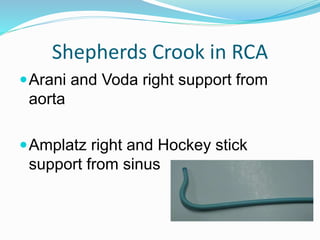
Shepherds Crook in RCA
Arani and Voda right support from
aorta
Amplatz right and Hockey stick
support from sinus
SVG and LIMA interventions
 Usually JR
 For abnormal positions and take offs MP or AL1
 Internal mammary artery – IMA catheter , LCB
 IMA Catheter is designed for both Right and left
Internal Mammary arteries
Choice in Radial Interventions
 Left coronary artery: down size JL by 0.5 Judkins
left , Amplatz left , Multipurpose , EBU, IKARI left,
El Gamal
 Right coronary artery: Judkins right, Amplatz
right, Amplatz left, Multipurpose, IKARI right, El
Gamal
Guide Wires
 Used to reach far end of the vessel
 Rail the devices into coronaries
 Give access to the lesion
 Helps to cross the lesion atraumatically
 Provides support for interventional devices
Features of Guide Wire
 Torque control
 Trackability
 Flexibility
 Visibility
 Support
 Crossing
Other Features
 Core material affects the flexibility, support, steering
and trackability
 Keeps the diameter at .014 inch
 Visibility of the wire tip is provided by platinum coils
 Hydrophobic coatings are silicone based coatings
Classifications
 Based on Tip Flexibility
• Floppy - Hi torque balance middle weight, Hi
torque balance, Choice floppy
• Intermediate - Hi torque intermediate, Choice
intermediate
• Standard – Shinobi, Boston Scientific
Classifications
 Based on coating
• Hydrophilic - CholCETM PT Floppy
• Hydrophobic - Asahi soft
 Based on Device support
• Light - Hi torque balance
• Moderate - Hi torque balance middle Weight
• Extra support - Hi torque whisper, Choice
Commonly Used Guide Wires
 ATW/ATW Marker
 BMW / BMW Universal
 Zinger
 Cougar XT
 Asahi Light / Medium / Asahi Standard / Asahi
Prowater Flex / Asahi Sion Blue
 Choice Floppy
 LugeS
 Forte Floppy
 Runthrough NS
 Galeo
Guide Wire Selection
 Depends on vessel anatomy
 Lesion morphology
 Devices to be used
 Operator's choice
Balloon Catheters
 The ability of a balloon material to increase in
size or stretch as the pressure is increased
 Nominal pressure - The amount of pressure
required to inflate the balloon to its labeled
diameter
 Rated burst pressure - The pressure level a
balloon is designed to accept without rupture
 Deflation – changing from nominal configuration
to wrapped
Types
 Semi compliant Balloons
Better flexibility & trackability
Better cross and recross performance
Limited durability
Increased diameter and longitudinal growth variance
Limited dilatation force
Types
 Non compliant balloons
Low growth as pressure increases
Designed for dilatation of calcified or
resistant lesions
Coronary Stents
 DES is an alternative to BMS to reduce
restenosis
 Preferred in left main disease, small vessels, in
stent restenosis, bifurcation lesions, long lesions,
muliple lesions, SVG lesions and in diabetic
patients
 BMS is preferred in patients who cannot tolerate
DAPT, anticipated surgery and those with high
risk of bleeding
UA/NSTEMI: Choice of Strategy
 Patients with refractory angina, electrical or
hemodynamic instebility
 Elevated risk of clinical events
 Troponin positive patients
PCI in STEMI
 Primary PCI
 Heart failure
 Cardiogenic shock
 Failed fibrinolysis
 Elective procedure after successful fibrinolysis
Adjunctive Diagnostic Devices
 FFR
 IVUS
 OCT
 Cutting balloon angioplasty
 Aspiration thrombectomy
 Rotablator
 Distal embolic protection devices
 Hemodynamic support devices
Aspirin in PCI
 81-325 mg before PCI if on aspirin therapy
 Non enteric coated aspirin 325 mg if not on
aspirin
 81 mg – 100 mg / day to be continued indefinitely
P2Y12 Inhibitors and DAPT
 In patients after BMS implantation, P2Y12 inhibitor
therapy (clopidogrel) should be given for a minimum
of 1 month
 In patients with DES implantation, P2Y12 inhibitor
therapy (clopidogrel) should be given for at least 6
months
 In patients with NSTEMI / STEMI treated with DAPT
after BMS or DES implantation, P2Y12 inhibitor
therapy (clopidogrel, prasugrel, or ticagrelor) should
be given for at least 12 months.
P2Y12 Inhibitors and DAPT
 In patients with NSTEMI / STEMI treated with
DAPT after coronary stent implantation, it is
reasonable to use ticagrelor in preference to
clopidogrel for maintenance therapy
 In patients with NSTEMI / STEMI treated with
DAPT after coronary stent implantation who are
not at high risk for bleeding complications and
who do not have a history of stroke or TIA, it is
reasonable to choose prasugrel over clopidogrel
for maintenance therapy.
P2Y12 Inhibitors and DAPT
 Prasugrel should not be administered to patients
with a prior history of stroke or TIA
 In patients with NSTEMI / STEMI treated with
DAPT after DES implantation who develop a
high risk of bleeding, are at high risk of severe
bleeding complication or develop significant overt
bleeding, discontinuation of P2Y12 inhibitor
therapy after 6 months may be reasonable
GP IIb/IIIa Inhibitor Therapy
 Early potent anti platelet therapy
 Adjunctive use improves outcome
 May improve flow
 Safe
No Reflow Pharmacological Therapy
 Gp llb / llla inhibitors
 Adenosine
 Nitrates
 Verapamil
 Diltiazem
 Sodiun nitroprusside
 Nikorandil
Steps Involved in PCI
 Insertion of radial / femoral sheath
 Administration of heparin / bivalrudin
 Engagement of coronary ostium using guide
catheter
 Crossing of lesion using guide wire and parking it
as distal as possible
 Pre-dilatation of lesion
 Deployment of stent
 Post dilate the stent
 Removal of balloon, guide wire, guide catheter
and sheath
Thank you

Coronary angioplasty : simplified

  • 1.
    Dr. Jain T.Kallarakkal MD, FRCP, DM St Mary’s Hospital, Thodupuzha
  • 2.
    History  GRUENTZIG firstperformed Coronary angioplasty in 1977  1986 – First stainless steel stent inserted in human artery
  • 3.
    Clinical Factors Thatcan Influence The outcome of PCI  Diabetes mellitus  Chronic kidney disease  Completeness of revascularization  LV systolic dysfunction  Previous CABG  Ability to comply with and tolerate DAPT
  • 4.
    Pre-Procedural Considerations  Contrastinduced AKI  Anaphylactic reactions  High dose statins  Evaluation of bleeding risk  Evaluation of GFR
  • 5.
    Radiation Safety  Patientsradiation exposure is reduced as possible  Operators radiation exposure is reduced as possible
  • 6.
  • 7.
    Guide Catheters Functions  Supportfor device advancement  Conduit for device and wire transport  Vehicle for contrast injection  Measurement of Pressure
  • 8.
  • 9.
    Selection of GuideCatheter Guide selection depends on the size of the ascending aorta, location and orientation of the ostia to be cannulated, degree of tortuosity and calcification of the coronary artery segment proximal to the target area Side hole catheters are useful where the pressure gets frequently damped as in RCA interventions, CTO interventions or left main interventions
  • 10.
    Commonly Used Guides Judkins, Amplatz, and Extraback up guides  Multipurpose for RCA bypass or a high left main (LM) takeoff  LIMA catheter for right and left coronary bypass graft
  • 11.
  • 12.
    Judkins Guide Catheter Engage the LM ostium without much manipulation  Engages the artery unless thwarted by the operator  For most of the patients, a 3.5 cm Judkins left guide usually fits well  For superiorly directed LAD or narrow aortic root – smaller guide  Horizontal or wide aortic root - JL with long secondary curve (size 5 or 6)
  • 13.
  • 14.
    Amplatz Guide  Offersfirm platform for advancement of device  Tip points slightly downward - higher danger of ostial injury causing dissection  Selection of the proper size is essential  For RCA ostium which is very high – left Amplatz guide may be used to engage the right ostium
  • 15.
    Long Tip Catheters Incude Voda, XB, EBU  Gives coaxial intubation, better support and stability, precise control and manipulation  Relatively better in advancement of devices, decreases the loss of supportive forces
  • 16.
  • 17.
    Extra Back UpGuide  Long tip forms a fairly straight line with the LM axis or the proximal ostial RCA  Tip in the coronary artery is not easily displaced  Provide a very stable platform
  • 18.
  • 19.
    Multipurpose Guide  Straightwith a single minor bend at the tip  Ideal for RCA bypass graft or a high left main (LM) takeoff
  • 20.
    Tips to Remember Aspirate the guide once it is inserted into the ascending aorta  Look for back flow to avoid air embolism  Flush frequently  Watch the tip when withdrawal of the device especially with ostial or proximal plaques  Watch the blood pressure curve for dampening  During injection, keep the tip of the syringe pointed down
  • 21.
    Shepherds Crook inRCA Arani and Voda right support from aorta Amplatz right and Hockey stick support from sinus
  • 22.
    SVG and LIMAinterventions  Usually JR  For abnormal positions and take offs MP or AL1  Internal mammary artery – IMA catheter , LCB  IMA Catheter is designed for both Right and left Internal Mammary arteries
  • 23.
    Choice in RadialInterventions  Left coronary artery: down size JL by 0.5 Judkins left , Amplatz left , Multipurpose , EBU, IKARI left, El Gamal  Right coronary artery: Judkins right, Amplatz right, Amplatz left, Multipurpose, IKARI right, El Gamal
  • 24.
    Guide Wires  Usedto reach far end of the vessel  Rail the devices into coronaries  Give access to the lesion  Helps to cross the lesion atraumatically  Provides support for interventional devices
  • 25.
    Features of GuideWire  Torque control  Trackability  Flexibility  Visibility  Support  Crossing
  • 26.
    Other Features  Corematerial affects the flexibility, support, steering and trackability  Keeps the diameter at .014 inch  Visibility of the wire tip is provided by platinum coils  Hydrophobic coatings are silicone based coatings
  • 27.
    Classifications  Based onTip Flexibility • Floppy - Hi torque balance middle weight, Hi torque balance, Choice floppy • Intermediate - Hi torque intermediate, Choice intermediate • Standard – Shinobi, Boston Scientific
  • 28.
    Classifications  Based oncoating • Hydrophilic - CholCETM PT Floppy • Hydrophobic - Asahi soft  Based on Device support • Light - Hi torque balance • Moderate - Hi torque balance middle Weight • Extra support - Hi torque whisper, Choice
  • 29.
    Commonly Used GuideWires  ATW/ATW Marker  BMW / BMW Universal  Zinger  Cougar XT  Asahi Light / Medium / Asahi Standard / Asahi Prowater Flex / Asahi Sion Blue  Choice Floppy  LugeS  Forte Floppy  Runthrough NS  Galeo
  • 30.
    Guide Wire Selection Depends on vessel anatomy  Lesion morphology  Devices to be used  Operator's choice
  • 31.
    Balloon Catheters  Theability of a balloon material to increase in size or stretch as the pressure is increased  Nominal pressure - The amount of pressure required to inflate the balloon to its labeled diameter  Rated burst pressure - The pressure level a balloon is designed to accept without rupture  Deflation – changing from nominal configuration to wrapped
  • 32.
    Types  Semi compliantBalloons Better flexibility & trackability Better cross and recross performance Limited durability Increased diameter and longitudinal growth variance Limited dilatation force
  • 33.
    Types  Non compliantballoons Low growth as pressure increases Designed for dilatation of calcified or resistant lesions
  • 34.
    Coronary Stents  DESis an alternative to BMS to reduce restenosis  Preferred in left main disease, small vessels, in stent restenosis, bifurcation lesions, long lesions, muliple lesions, SVG lesions and in diabetic patients  BMS is preferred in patients who cannot tolerate DAPT, anticipated surgery and those with high risk of bleeding
  • 35.
    UA/NSTEMI: Choice ofStrategy  Patients with refractory angina, electrical or hemodynamic instebility  Elevated risk of clinical events  Troponin positive patients
  • 36.
    PCI in STEMI Primary PCI  Heart failure  Cardiogenic shock  Failed fibrinolysis  Elective procedure after successful fibrinolysis
  • 37.
    Adjunctive Diagnostic Devices FFR  IVUS  OCT  Cutting balloon angioplasty  Aspiration thrombectomy  Rotablator  Distal embolic protection devices  Hemodynamic support devices
  • 38.
    Aspirin in PCI 81-325 mg before PCI if on aspirin therapy  Non enteric coated aspirin 325 mg if not on aspirin  81 mg – 100 mg / day to be continued indefinitely
  • 39.
    P2Y12 Inhibitors andDAPT  In patients after BMS implantation, P2Y12 inhibitor therapy (clopidogrel) should be given for a minimum of 1 month  In patients with DES implantation, P2Y12 inhibitor therapy (clopidogrel) should be given for at least 6 months  In patients with NSTEMI / STEMI treated with DAPT after BMS or DES implantation, P2Y12 inhibitor therapy (clopidogrel, prasugrel, or ticagrelor) should be given for at least 12 months.
  • 40.
    P2Y12 Inhibitors andDAPT  In patients with NSTEMI / STEMI treated with DAPT after coronary stent implantation, it is reasonable to use ticagrelor in preference to clopidogrel for maintenance therapy  In patients with NSTEMI / STEMI treated with DAPT after coronary stent implantation who are not at high risk for bleeding complications and who do not have a history of stroke or TIA, it is reasonable to choose prasugrel over clopidogrel for maintenance therapy.
  • 41.
    P2Y12 Inhibitors andDAPT  Prasugrel should not be administered to patients with a prior history of stroke or TIA  In patients with NSTEMI / STEMI treated with DAPT after DES implantation who develop a high risk of bleeding, are at high risk of severe bleeding complication or develop significant overt bleeding, discontinuation of P2Y12 inhibitor therapy after 6 months may be reasonable
  • 42.
    GP IIb/IIIa InhibitorTherapy  Early potent anti platelet therapy  Adjunctive use improves outcome  May improve flow  Safe
  • 43.
    No Reflow PharmacologicalTherapy  Gp llb / llla inhibitors  Adenosine  Nitrates  Verapamil  Diltiazem  Sodiun nitroprusside  Nikorandil
  • 44.
    Steps Involved inPCI  Insertion of radial / femoral sheath  Administration of heparin / bivalrudin  Engagement of coronary ostium using guide catheter  Crossing of lesion using guide wire and parking it as distal as possible  Pre-dilatation of lesion  Deployment of stent  Post dilate the stent  Removal of balloon, guide wire, guide catheter and sheath
  • 45.