LESSON 40 Principles 1.  Abbreviated Words—in Families    Many long words may be abbreviated in shorthand by dropping the endings. This device is also used in longhand, as  Jan.  for January. The extent to which you use this device will depend on your familiarity with the words and with the subject matter of the dictation.
When in doubt, write it out! The ending of a word is not dropped when a special shorthand word ending has been provided, such as –lity, in  ability. Notice how many words written with this abbreviating device fall naturally into families of similar endings.
-quent consequent,   subsequent  eloquent, consequences    eloquence consequently   subsequently  frequent -tribute tribute   contribute   distribute attribute contributed   distributor attributes contribution   distribution
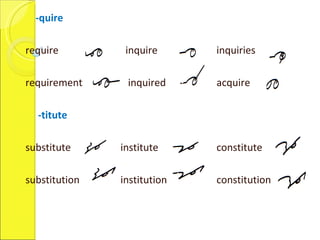
-quire require   inquire inquiries requirement   inquired acquire -titute substitute institute constitute substitution institution constitution
-titude aptitude gratitude latitude -ology psychology   sociology apology psychological   sociology apologies
PUNCTUATION PRACTICE.,  introductory A comma is used to separate a subordinate introductory clause from a following main clause. You have already studied the application of this rule to subordinate clauses introduced by  if, as,  and  when.  Here are examples of subordinate clauses introduced by other subordinate conjunctions.
Although the price is high,  I believe we should purchase the land. Before you leave,  please stop in to see me. Unless we hear from you,  we must cancel your subscription. While I am eager to finish the work,  I do not believe we should compromise its quality. A comma is also used after introductory words or phrases such as  furthermore, on the contrary,  and for  instance.
Furthermore,  the letter contained a typographical error. On the contrary,  you are to be commended for your effort. For instance,  the company was late with its last payment. Each time a subordinate introductory word, phrase or clause other than one beginning with  if, as,  or  when,  it will be indicated thus in shorthand: Note: If the subordinate clause or other introductory expression follows the main clause, the comma is usually not necessary. I am enclosing an envelope for your convenience in sending me your answer.
LESSON 41 Principles 1.  Abbreviated Words—in Families (Continued) - graph photograph   stenographer   paragraph photographic   autographed   paragraphed photographically   typographical  telegraphing
2.  Abbreviated Words—Not in Families  The ending may be omitted from long words even though they do not fall into a family. anniversary significant, reluctant,   significance   reluctance memorandum  statistic privilege convenient, statistics privileged convenience equivalent statistical privileges
3.  Word Beginning Trans-  The word beginning  trans-  is  represented by a disjoined  t. Spell:  trans-m-e-t, transmit transmit transport translation transact transportation transit transaction transfer transistor
LESSON 42 RECALL There are no new shorthand devices for you to learn in Lesson 42. However, Lesson 42 does contain an Accuracy Practice, a review of word beginnings and endings you have studied thus far, and a Reading and Writing Practice. Accuracy Practice 1. My   Lie   Fight
To write these combinations accurately: a. Join the broken circle in the same way that you would join an a circle, but turn the end inside the circle. b. Before turning the end of the circle inside, be sure that the stroke touches the stroke to which the l is  joined. c.  Avoid making a point at the places indicated by  arrows. Practice Drill My, night, sight, line, mile
2 .  Ow  Oi To write these combinations accurately: a. Keep the hooks deep and narrow. b. Place the circle outside the hooks as indicated by the dotted lines. Practice Drill Out, now, doubt, scout, toy, soil, annoy
3.  Ith   Nt, Nd  Mt, Md To write these combinations accurately: a. Slant the strokes as indicated by the dotted lines. b. Start these strokes to the right and upward.
Practice Drill There are, and will, empty, health, lined, ashamed. Compare: Hint, heard, tamed, detailed.
4.  Recall Chart  There are 90 word beginnings and    endings in the following chart. Can you read them in 5 minutes or less? WORD BEGGININGS AND ENDINGS
 
Lesson 43 Principles 1.  Word Beginning  Mis-  The word beginning  mis-  is represented by  m-s. Spell:  mistake, mis-t-a-k mistake    misplaced   misunderstand misconception  mislaid   misunderstood misprint misapprehension  mystery
2.  Word Beginning Super-  The world beginning  super-  is    represented by a disjoined right  s.  Spell:   supervise, super-v-i-s supervise superintendent   superior supervisor superhuman   superb supervision  superimpose   supersede
3.  U Represented by OO  The  oo  hook may be used after  n   and  m  to represent the sound of  u , as in  music. Spell:  music, m-oo-s-e-k music  musical   municipal mutual   communicate   continue manuscript  monument    discontinue
4.  PUNCTUATION PRACTICE, conjunction A comma is used to separate two independent clauses that are joined by one of the following conjunctions:  and, but, or, for, nor. An independent clause (sometimes called a main or a principal clause) is one that has a subject and a predicate and that could stand alone as a complete sentence.
We have nine students in the organization,  but  only six of them can attend the meeting. The first independent clause is: We have nine students in the organization. And the second independent clause is: Only six of them can attend the meeting.
Both clauses could stand as separate sentences, with a period after each.  Because the thoughts of the two clauses are closely related, however, the clauses were joined to form one sentence.  Because of two independent clauses are connected by conjunction  but,  a comma is used between them and is placed before the conjunction.
Lesson 44 Principles 1.  Word Beginning Self-   The word beginning  self-  is  represented by a disjoined left  s. Spell:  self-made, self-m-a-d self-made  self-addressed   selfish self-control self-improvement   selfishness self-reliance self-explanatory   unselfishly
2.  Word Beginning Circum-  The word beginning  circum-  is  also represented by a disjoined left  s. Spell:  circumstance, circum-s-ten-s circumstance   circumstances   circumstantial
3.  Word Ending –ification  The word ending  –ification  is  represented by a disjoined  f. Spell:  ratification, r-a-t-ification ratification   notification   modification classification    gratification   qualifications justification    identification   specifications
4.  PUNCTUATION PRACTICE, and ommitted When two or more consecutive adjectives modify the same noun, they are separated by commas. Enclosed is a  stamped, self-addresses  envelope. However, the comma is not used if the first adjective modifies the combined ideas of the second adjective of the noun. The suit is made of  beautiful blue  material.
Note:   You can quickly determine whether to insert a comma  between two consecutive adjectives by mentally placing  and  between them.  If the sentence makes good sense with  and  inserted between the adjectives, then the comma is  used. For example, the first sentence would make good sense if it read: Enclosed is a  stamped, self-addresses  envelope.
Lesson 45 Principles 1.  Word Ending –hood   The word ending – hood  is  represented by a disjoined  d. Spell:  neighborhood, n-a-b-r-hood neighborhood    boyhood  likelihood childhood   girlhood   parenthood
2.  Word Ending –ward The word ending – ward  is  represented by a disjoined  d. Spell:  onward, o-n-ward onward    outward   rewarding backward    upward   forward afterward   inward   forwarded
3.  UI   Ui  is represented by  oo  when it precedes a forward   or upward stroke. Spell:  result, re-s-ul-t result   consultant   cultured   consult    ultimately   culminate Insult   multitude  simultaneous
4.  Quantities and Amounts Here are a few more helpful abbreviations for quantities and amounts. 600   $  5,000,000,000 several hundred $600   a dollar 5 pounds $8,000,000  a million   8 feet Observe that the  n  for  hundred  is written under the figure as a positive distinction form  million,  in which the  m  is written  beside the figure.
5.  SPELLING FAMILIES  silent e dropped before -ing An effective device to improve your ability to  spell is to study words in related groups, or spelling problem. To get the most benefit from these spelling families,  practice them in this way: 1.  Spell each word aloud, pausing slightly after each syllable. 2.  Write the word once in longhand, spelling it aloud as you  write it.
Words in Which Silent E Is Dropped Before –ing chal-leng-ing mak-ing   sav-ing hav-ing man-u-fac-tur-ing   stim-u-lat-ing hous-ing pre-par-ing   su-per-vis-ing in-creas-ing re-ceiv-ing   typ-ing
Lesson 46 Principles 1.  Word Ending -gram  The word ending  –gram  is    represented by a disjoined  gay. Spell:  telegram, t-e-l-gram telegram    monogram   programs diagram   monogrammed   programmer
2.  Word Beginning Electric-  The word beginning  electric-  is  represented by a disjoined  el. Spell:  electrical, electric-l electric    electrically   electric wire electrical   electric typewriter  electric motor
3 .  Word Beginning Electr-  The word beginning  electr-  is    represented by a disjoined  el. Spell:  electronic, electr-n-e-k electronic  electrician electricity
4.  Compounds Most compound words are formed simply by joining the outlines for the words that make up  the compound.  In some words, however, it is desirable to modify the outline for one of the  words in order to obtain an easier joining. anyhow  someone   within anywhere worthwhile   withstand thereupon however*   notwithstanding * The dot may be omitted in however
5.  Intersection   Intersection, or the writing of one  shorthand character through another, is  sometimes useful for special phrases.  This principle may be used when constant  repetition of certain combinations of words   in your dictation makes it clearly  worthwhile to form special outlines for them.   a.m.   vice versa   p.m.  Chamber of Commerce
6.  SIMILAR WORDS DRILL it’s   Contraction for  it is. It’s  not necessary to bring all your books to class. its  Possessive form of  it. You will be pleased with  its  efficiency.
Lesson 47 Principles 1.  Geographical Expressions and Names In geographical expressions and proper names,  the ending  –burg  is represented by  b;  the ending  –ville, by  v;  the ending  –ington,  by a disjoined  ten  blend; the ending  –ingham,  by a disjoined  m.
-burg Spell:  Harrisburg, h-a-r-e-s-burg Harrisburg Pittsburg Hamburg -ville Spell:  Nashville, n-a-ish-ville Nashville Jacksonville Evansville
- ington Spell:  Washington, w-a-ish-ington Washington Wilmington   Harrington - ingham Spell:  Framingham Framingham Buckingham   Cunningham
2.  GRAMMAR CHECKUP   Most business executives have a good command of the  English language; some rarely make an error in grammar.  There are times, when even the best dictators will inadvertently use a plural verb with a singular noun or use the objective case when they should use the nominative.  They usually know better, but in concentrating intently on expressing a thought or idea, they occasionally suffer a grammatical lapse. Subject and Verb A verb must agree with its subject in number. Our president  is on  vacation.
The  receipts are being  processed  now. The inclusion of a phrase such as  in addition to, as well as,  or  along with  after the subject does not affect the number of the verb.  If the subject is singular, use a singular verb; if the subject is plural, use a plural verb. Our  president,  as well as the treasurer,  is on  vacation. The  receipts,  along with the invoice,  are being  processed  now.
Lesson 48 RECALL In Lesson 47, you studied the last of the new shorthand devices of Gregg shorthand.  In this lesson, you will find an Accuracy Practice, a Recall Chart that reviews word-building principles of Gregg Shorthand, and a Reading and Writing Practice.
Accuracy Practice 1.  Def To write this stroke accurately: a.  Make it large, almost the full height of your notebook line. b.  Make it narrow. c.  Start and finish the stroke on the same level of writing, as  indicated by the dotted line. Practice Drill Divide, definite, defeat, devote, differ, endeavor
2 .  Ith    Ten Tem To write these strokes accurately: a.  Slant the strokes as indicated by the dotted lines. b.  Make the beginning of the curves deep. c.  Make the tem large, the ith small, and the ten about half the size of the tem. Practice Drill In the, in time, tender, teeth, detain, medium.
3.  Recall Chart This chart contains illustrations of word-   building and phrasing principles of Gregg Shorthand. WORDS
 
Lesson 49 Lesson 49 provides a review of the shorthand principles  you studied in chapter 1.
1.  BRIEF FORMS, DERIVATIVES, AND PHRASES  1. 2. 3. 4. 1. Am, in-not, it-at, a-an, will-well, are-hour-our, have, Mr., I. 2. Willing, wills, ours, increase, invite, indeed. 3. But, with, of, Mrs., you-your, can, that, the, is-his. 4. I will, I will not, in that, in the, with the, of the, I am, I have.
Lesson 50 The practice material in Lesson 50 concentrates on the principles you studied in Chapter 2.
1.  BRIEF FORMS, DERIVATIVES, AND PHRASES  1. 2. 3. 4. 1. Be-by, begin, became, beneath, for, before, would, there  (their), therefore. 2. This, good, goods, they, which, them, and, when. 3. From, should, could, send, sending, were, after, street. 4. I would, for the, this is, they are, to, them, from the, I have  been, I have not been able.
Lesson 51 The lesson reviews the principles you studied in Chapter 3.
1.  BRIEF FORMS, DERIVATIVES, AND PHRASES  1. 2. 3. 4. 1. Glad, work, yesterday, circular, order, soon, thank, enclose. 2. Was, value, one (won), than, what, about, thing-think,  business, doctor. 3. Short, gladly, sooner, enclosed, valuable, manufacturer,  elsewhere. 4. Thank you for, I was, I will be glad, what was, about this,  everyone, next year, this morning.
Lesson 52 The lesson concentrates on the principles presented in  Chapter 4.
1.  BRIEF FORMS, DERIVATIVES, AND PHRASES  1. 2. 3. 4. 1. Present, presently, part, partly, advertise, Ms., immediately,  opportunities. 2. Advantage, advantages, suggest, suggestions, several, out, outlet,  ever-every, very. 3. Time, timed, acknowledge, general, questions, organize, organization, over.. 4. To present, very important, at this time, to question, over the, over that, over them.
Lesson 53 The lesson reviews the principles you studied in Chapter 5.
1.  BRIEF FORMS, DERIVATIVES, AND PHRASES  1. 2. 3. 4. 1. Difficult, envelope, progress, satisfy-satisfactory, state, request, success,  under, wish. 2. Particular, probable, regular, speak, subject, regard, newspaper, opinion, idea. 3. Responsible, worth, public, publish-publication, ordinary, experience, usual,  world. 4. Recognition, probably, extraordinary, to progress, to speak, to publish, under  the, under that.
Lesson 54 The practice material in Lesson 54 concentrates on the principles you studied in Chapter 6.
1.  BRIEF FORMS, DERIVATIVES, AND PHRASES  1. 2. 3. 1. Never, quantity, executive, throughout, object, govern, correspond- correspondence. 2. Quantities, executives, objects, objective, governor, government. 3. Corresponding, corresponded, correspondent, nevertheless, to  govern, to correspond.
Lesson 55 In Lesson 49 you will review intensively the shorthand principles you studied in chapter 7.
1.  BRIEF FORMS, DERIVATIVES, AND PHRASES  1. 2. 3. 1. Particularly, timely, partly, presently, gladly, probably, immediately,  generally,  ordinarily. 2. Governor, speaker, organizer, manufacturer, partner, outer. 3. To publish, to speak, to progress, to part, to present, to value, to be,  to have.
Lesson 56   The practice material in Lesson 56 concentrates on the principles you studied in Chapter 8.
1.  BRIEF FORMS, DERIVATIVES, AND PHRASES  1. 2. 3. 4. 1.  Acknowledgement, statements, government, apartment, advertisement,  department. 2.  Ever, wherever, whenever, whatever, valuable, workable, questionable,  understandable. 3.  Business, businesses, morning, mornings, manufacture, manufactured. 4. In the world, business world, very important, very well, very much, one time, this time.
APPENDICES
STATES The abbreviations in parentheses are those  recommended by the Postal Service. Alabama [AL]   Maryland [MD]   Texas [TX] Alaska [AK]   Massachusetts [MA]   Utah [UT] Arizona [AZ]   Michigan [MI]   Vermont [VT] Arkansas [AR]   Minnesota [MN]  Virginia [VA] California [CA]   Mississippi [MS]   Washington [WA] Colorado [CO]   Missouri [MO]   West Virginia [WV] Connecticut [CT]   Montana [MT]   Wisconsin [WI]
Delaware [DE] Nebraska [NE]   Wisconsin [WI]  Florida [FL] Nevada [NV] Georgia [GA] New Hampshire [NH] Hawaii [HI] New Jersey [NJ] Idaho [ID] New Mexico [NM] Illinois [IL] New York [NY] Indiana [IN] North Carolina [NC] Iowa [IA] North Dakota [ND]
South Carolina [SC] Ohio [OH] South Dakota [SD] Oklahoma [OK] Tennessee [TN] Oregon [OR] Texas [TX] Pennsylvania [PA] Kansas [KS] Rhode Island [RI] Kentucky [KY] South Carolina [SC] Louisiana [LA] South Dakota [SD] Maine [ME] Tennessee [TN]
SELECTED CITIES OF THE UNITED STATES Akron   Las Vegas   Tulsa Albany   Lincoln   Washington Anchorage   Little Rock     Wichita Atlanta   Los Angeles     Wilmington Baltimore   Louisville Baron rouge   Memphis Birmingham   Miami  Boston   Milwaukee
Bridgeport Minneapolis Buffalo Montpelier Cambridge Nashville Camden Newark Charleston New Orleans Charlotte   New York Chattanooga Norfolk Cheyenne Oakland Chicago Oklahoma City
Cincinnati Omaha Cleveland Philadelphia Columbia Phoenix Cleveland Pittsburgh Columbia Portland Columbus Providence Dallas Richmond Dayton Rochester
Denver Sacramento Des Moines St. Louis Detroit St. Paul El Paso Salt Lake City Fairbanks San Antonio Fargo San Diego Fort Worth San Francisco Grand Rapids Seattle
Hartford Shreveport Honolulu   Springfield Houston Syracuse Indianapolis Tacoma Jacksonville Tallahassee Jersey City Tampa Kansas City Toledo Knoxville     Trenton Laramie Tucson
COMMON GEOGRAPHICAL ABBREVIATIONS America   England   Canada American   English   Canadian United States   Great Britain   Puerto Rico
THE METRIC SYSTEM   meter  liter  gram kilo-   1,000 hekto-  100 deka-   10 deci-   1/10 centi-  1/100 milli-  1/1,000 micro-  1/1,000,000 nano-  1/1,000,000,000
ADDITIONAL METRIC MEASUREMENTS celsius   kilowatt   microsecond centigrade   kilowatt-hour  millampere cubic centimeter  megabit  millibar kilobit   megahertz   millifarad kilocalorie   megaton   millihenry
kilocycle    megawatt     millimicrosecond kilohertz   megohm   millivolt kiloton   micromicron   milliwatt kilovolt   micron   nanosecond
BRIEF FORMS OF GREGG SHORTHAND IN ORDER OF PRESENTATION
 
T H A N K   Y O U ! ! !
 

Basic Shorthand Part 3 boa

  • 1.
    LESSON 40 Principles1. Abbreviated Words—in Families Many long words may be abbreviated in shorthand by dropping the endings. This device is also used in longhand, as Jan. for January. The extent to which you use this device will depend on your familiarity with the words and with the subject matter of the dictation.
  • 2.
    When in doubt,write it out! The ending of a word is not dropped when a special shorthand word ending has been provided, such as –lity, in ability. Notice how many words written with this abbreviating device fall naturally into families of similar endings.
  • 3.
    -quent consequent, subsequent eloquent, consequences eloquence consequently subsequently frequent -tribute tribute contribute distribute attribute contributed distributor attributes contribution distribution
  • 4.
    -quire require inquire inquiries requirement inquired acquire -titute substitute institute constitute substitution institution constitution
  • 5.
    -titude aptitude gratitudelatitude -ology psychology sociology apology psychological sociology apologies
  • 6.
    PUNCTUATION PRACTICE., introductory A comma is used to separate a subordinate introductory clause from a following main clause. You have already studied the application of this rule to subordinate clauses introduced by if, as, and when. Here are examples of subordinate clauses introduced by other subordinate conjunctions.
  • 7.
    Although the priceis high, I believe we should purchase the land. Before you leave, please stop in to see me. Unless we hear from you, we must cancel your subscription. While I am eager to finish the work, I do not believe we should compromise its quality. A comma is also used after introductory words or phrases such as furthermore, on the contrary, and for instance.
  • 8.
    Furthermore, theletter contained a typographical error. On the contrary, you are to be commended for your effort. For instance, the company was late with its last payment. Each time a subordinate introductory word, phrase or clause other than one beginning with if, as, or when, it will be indicated thus in shorthand: Note: If the subordinate clause or other introductory expression follows the main clause, the comma is usually not necessary. I am enclosing an envelope for your convenience in sending me your answer.
  • 9.
    LESSON 41 Principles1. Abbreviated Words—in Families (Continued) - graph photograph stenographer paragraph photographic autographed paragraphed photographically typographical telegraphing
  • 10.
    2. AbbreviatedWords—Not in Families The ending may be omitted from long words even though they do not fall into a family. anniversary significant, reluctant, significance reluctance memorandum statistic privilege convenient, statistics privileged convenience equivalent statistical privileges
  • 11.
    3. WordBeginning Trans- The word beginning trans- is represented by a disjoined t. Spell: trans-m-e-t, transmit transmit transport translation transact transportation transit transaction transfer transistor
  • 12.
    LESSON 42 RECALLThere are no new shorthand devices for you to learn in Lesson 42. However, Lesson 42 does contain an Accuracy Practice, a review of word beginnings and endings you have studied thus far, and a Reading and Writing Practice. Accuracy Practice 1. My Lie Fight
  • 13.
    To write thesecombinations accurately: a. Join the broken circle in the same way that you would join an a circle, but turn the end inside the circle. b. Before turning the end of the circle inside, be sure that the stroke touches the stroke to which the l is joined. c. Avoid making a point at the places indicated by arrows. Practice Drill My, night, sight, line, mile
  • 14.
    2 . Ow Oi To write these combinations accurately: a. Keep the hooks deep and narrow. b. Place the circle outside the hooks as indicated by the dotted lines. Practice Drill Out, now, doubt, scout, toy, soil, annoy
  • 15.
    3. Ith Nt, Nd Mt, Md To write these combinations accurately: a. Slant the strokes as indicated by the dotted lines. b. Start these strokes to the right and upward.
  • 16.
    Practice Drill Thereare, and will, empty, health, lined, ashamed. Compare: Hint, heard, tamed, detailed.
  • 17.
    4. RecallChart There are 90 word beginnings and endings in the following chart. Can you read them in 5 minutes or less? WORD BEGGININGS AND ENDINGS
  • 18.
  • 19.
    Lesson 43 Principles1. Word Beginning Mis- The word beginning mis- is represented by m-s. Spell: mistake, mis-t-a-k mistake misplaced misunderstand misconception mislaid misunderstood misprint misapprehension mystery
  • 20.
    2. WordBeginning Super- The world beginning super- is represented by a disjoined right s. Spell: supervise, super-v-i-s supervise superintendent superior supervisor superhuman superb supervision superimpose supersede
  • 21.
    3. URepresented by OO The oo hook may be used after n and m to represent the sound of u , as in music. Spell: music, m-oo-s-e-k music musical municipal mutual communicate continue manuscript monument discontinue
  • 22.
    4. PUNCTUATIONPRACTICE, conjunction A comma is used to separate two independent clauses that are joined by one of the following conjunctions: and, but, or, for, nor. An independent clause (sometimes called a main or a principal clause) is one that has a subject and a predicate and that could stand alone as a complete sentence.
  • 23.
    We have ninestudents in the organization, but only six of them can attend the meeting. The first independent clause is: We have nine students in the organization. And the second independent clause is: Only six of them can attend the meeting.
  • 24.
    Both clauses couldstand as separate sentences, with a period after each. Because the thoughts of the two clauses are closely related, however, the clauses were joined to form one sentence. Because of two independent clauses are connected by conjunction but, a comma is used between them and is placed before the conjunction.
  • 25.
    Lesson 44 Principles1. Word Beginning Self- The word beginning self- is represented by a disjoined left s. Spell: self-made, self-m-a-d self-made self-addressed selfish self-control self-improvement selfishness self-reliance self-explanatory unselfishly
  • 26.
    2. WordBeginning Circum- The word beginning circum- is also represented by a disjoined left s. Spell: circumstance, circum-s-ten-s circumstance circumstances circumstantial
  • 27.
    3. WordEnding –ification The word ending –ification is represented by a disjoined f. Spell: ratification, r-a-t-ification ratification notification modification classification gratification qualifications justification identification specifications
  • 28.
    4. PUNCTUATIONPRACTICE, and ommitted When two or more consecutive adjectives modify the same noun, they are separated by commas. Enclosed is a stamped, self-addresses envelope. However, the comma is not used if the first adjective modifies the combined ideas of the second adjective of the noun. The suit is made of beautiful blue material.
  • 29.
    Note: You can quickly determine whether to insert a comma between two consecutive adjectives by mentally placing and between them. If the sentence makes good sense with and inserted between the adjectives, then the comma is used. For example, the first sentence would make good sense if it read: Enclosed is a stamped, self-addresses envelope.
  • 30.
    Lesson 45 Principles1. Word Ending –hood The word ending – hood is represented by a disjoined d. Spell: neighborhood, n-a-b-r-hood neighborhood boyhood likelihood childhood girlhood parenthood
  • 31.
    2. WordEnding –ward The word ending – ward is represented by a disjoined d. Spell: onward, o-n-ward onward outward rewarding backward upward forward afterward inward forwarded
  • 32.
    3. UI Ui is represented by oo when it precedes a forward or upward stroke. Spell: result, re-s-ul-t result consultant cultured consult ultimately culminate Insult multitude simultaneous
  • 33.
    4. Quantitiesand Amounts Here are a few more helpful abbreviations for quantities and amounts. 600 $ 5,000,000,000 several hundred $600 a dollar 5 pounds $8,000,000 a million 8 feet Observe that the n for hundred is written under the figure as a positive distinction form million, in which the m is written beside the figure.
  • 34.
    5. SPELLINGFAMILIES silent e dropped before -ing An effective device to improve your ability to spell is to study words in related groups, or spelling problem. To get the most benefit from these spelling families, practice them in this way: 1. Spell each word aloud, pausing slightly after each syllable. 2. Write the word once in longhand, spelling it aloud as you write it.
  • 35.
    Words in WhichSilent E Is Dropped Before –ing chal-leng-ing mak-ing sav-ing hav-ing man-u-fac-tur-ing stim-u-lat-ing hous-ing pre-par-ing su-per-vis-ing in-creas-ing re-ceiv-ing typ-ing
  • 36.
    Lesson 46 Principles1. Word Ending -gram The word ending –gram is represented by a disjoined gay. Spell: telegram, t-e-l-gram telegram monogram programs diagram monogrammed programmer
  • 37.
    2. WordBeginning Electric- The word beginning electric- is represented by a disjoined el. Spell: electrical, electric-l electric electrically electric wire electrical electric typewriter electric motor
  • 38.
    3 . Word Beginning Electr- The word beginning electr- is represented by a disjoined el. Spell: electronic, electr-n-e-k electronic electrician electricity
  • 39.
    4. CompoundsMost compound words are formed simply by joining the outlines for the words that make up the compound. In some words, however, it is desirable to modify the outline for one of the words in order to obtain an easier joining. anyhow someone within anywhere worthwhile withstand thereupon however* notwithstanding * The dot may be omitted in however
  • 40.
    5. Intersection Intersection, or the writing of one shorthand character through another, is sometimes useful for special phrases. This principle may be used when constant repetition of certain combinations of words in your dictation makes it clearly worthwhile to form special outlines for them. a.m. vice versa p.m. Chamber of Commerce
  • 41.
    6. SIMILARWORDS DRILL it’s Contraction for it is. It’s not necessary to bring all your books to class. its Possessive form of it. You will be pleased with its efficiency.
  • 42.
    Lesson 47 Principles1. Geographical Expressions and Names In geographical expressions and proper names, the ending –burg is represented by b; the ending –ville, by v; the ending –ington, by a disjoined ten blend; the ending –ingham, by a disjoined m.
  • 43.
    -burg Spell: Harrisburg, h-a-r-e-s-burg Harrisburg Pittsburg Hamburg -ville Spell: Nashville, n-a-ish-ville Nashville Jacksonville Evansville
  • 44.
    - ington Spell: Washington, w-a-ish-ington Washington Wilmington Harrington - ingham Spell: Framingham Framingham Buckingham Cunningham
  • 45.
    2. GRAMMARCHECKUP Most business executives have a good command of the English language; some rarely make an error in grammar. There are times, when even the best dictators will inadvertently use a plural verb with a singular noun or use the objective case when they should use the nominative. They usually know better, but in concentrating intently on expressing a thought or idea, they occasionally suffer a grammatical lapse. Subject and Verb A verb must agree with its subject in number. Our president is on vacation.
  • 46.
    The receiptsare being processed now. The inclusion of a phrase such as in addition to, as well as, or along with after the subject does not affect the number of the verb. If the subject is singular, use a singular verb; if the subject is plural, use a plural verb. Our president, as well as the treasurer, is on vacation. The receipts, along with the invoice, are being processed now.
  • 47.
    Lesson 48 RECALLIn Lesson 47, you studied the last of the new shorthand devices of Gregg shorthand. In this lesson, you will find an Accuracy Practice, a Recall Chart that reviews word-building principles of Gregg Shorthand, and a Reading and Writing Practice.
  • 48.
    Accuracy Practice 1. Def To write this stroke accurately: a. Make it large, almost the full height of your notebook line. b. Make it narrow. c. Start and finish the stroke on the same level of writing, as indicated by the dotted line. Practice Drill Divide, definite, defeat, devote, differ, endeavor
  • 49.
    2 . Ith Ten Tem To write these strokes accurately: a. Slant the strokes as indicated by the dotted lines. b. Make the beginning of the curves deep. c. Make the tem large, the ith small, and the ten about half the size of the tem. Practice Drill In the, in time, tender, teeth, detain, medium.
  • 50.
    3. RecallChart This chart contains illustrations of word- building and phrasing principles of Gregg Shorthand. WORDS
  • 51.
  • 52.
    Lesson 49 Lesson49 provides a review of the shorthand principles you studied in chapter 1.
  • 53.
    1. BRIEFFORMS, DERIVATIVES, AND PHRASES 1. 2. 3. 4. 1. Am, in-not, it-at, a-an, will-well, are-hour-our, have, Mr., I. 2. Willing, wills, ours, increase, invite, indeed. 3. But, with, of, Mrs., you-your, can, that, the, is-his. 4. I will, I will not, in that, in the, with the, of the, I am, I have.
  • 54.
    Lesson 50 Thepractice material in Lesson 50 concentrates on the principles you studied in Chapter 2.
  • 55.
    1. BRIEFFORMS, DERIVATIVES, AND PHRASES 1. 2. 3. 4. 1. Be-by, begin, became, beneath, for, before, would, there (their), therefore. 2. This, good, goods, they, which, them, and, when. 3. From, should, could, send, sending, were, after, street. 4. I would, for the, this is, they are, to, them, from the, I have been, I have not been able.
  • 56.
    Lesson 51 Thelesson reviews the principles you studied in Chapter 3.
  • 57.
    1. BRIEFFORMS, DERIVATIVES, AND PHRASES 1. 2. 3. 4. 1. Glad, work, yesterday, circular, order, soon, thank, enclose. 2. Was, value, one (won), than, what, about, thing-think, business, doctor. 3. Short, gladly, sooner, enclosed, valuable, manufacturer, elsewhere. 4. Thank you for, I was, I will be glad, what was, about this, everyone, next year, this morning.
  • 58.
    Lesson 52 Thelesson concentrates on the principles presented in Chapter 4.
  • 59.
    1. BRIEFFORMS, DERIVATIVES, AND PHRASES 1. 2. 3. 4. 1. Present, presently, part, partly, advertise, Ms., immediately, opportunities. 2. Advantage, advantages, suggest, suggestions, several, out, outlet, ever-every, very. 3. Time, timed, acknowledge, general, questions, organize, organization, over.. 4. To present, very important, at this time, to question, over the, over that, over them.
  • 60.
    Lesson 53 Thelesson reviews the principles you studied in Chapter 5.
  • 61.
    1. BRIEFFORMS, DERIVATIVES, AND PHRASES 1. 2. 3. 4. 1. Difficult, envelope, progress, satisfy-satisfactory, state, request, success, under, wish. 2. Particular, probable, regular, speak, subject, regard, newspaper, opinion, idea. 3. Responsible, worth, public, publish-publication, ordinary, experience, usual, world. 4. Recognition, probably, extraordinary, to progress, to speak, to publish, under the, under that.
  • 62.
    Lesson 54 Thepractice material in Lesson 54 concentrates on the principles you studied in Chapter 6.
  • 63.
    1. BRIEFFORMS, DERIVATIVES, AND PHRASES 1. 2. 3. 1. Never, quantity, executive, throughout, object, govern, correspond- correspondence. 2. Quantities, executives, objects, objective, governor, government. 3. Corresponding, corresponded, correspondent, nevertheless, to govern, to correspond.
  • 64.
    Lesson 55 InLesson 49 you will review intensively the shorthand principles you studied in chapter 7.
  • 65.
    1. BRIEFFORMS, DERIVATIVES, AND PHRASES 1. 2. 3. 1. Particularly, timely, partly, presently, gladly, probably, immediately, generally, ordinarily. 2. Governor, speaker, organizer, manufacturer, partner, outer. 3. To publish, to speak, to progress, to part, to present, to value, to be, to have.
  • 66.
    Lesson 56 The practice material in Lesson 56 concentrates on the principles you studied in Chapter 8.
  • 67.
    1. BRIEFFORMS, DERIVATIVES, AND PHRASES 1. 2. 3. 4. 1. Acknowledgement, statements, government, apartment, advertisement, department. 2. Ever, wherever, whenever, whatever, valuable, workable, questionable, understandable. 3. Business, businesses, morning, mornings, manufacture, manufactured. 4. In the world, business world, very important, very well, very much, one time, this time.
  • 68.
  • 69.
    STATES The abbreviationsin parentheses are those recommended by the Postal Service. Alabama [AL] Maryland [MD] Texas [TX] Alaska [AK] Massachusetts [MA] Utah [UT] Arizona [AZ] Michigan [MI] Vermont [VT] Arkansas [AR] Minnesota [MN] Virginia [VA] California [CA] Mississippi [MS] Washington [WA] Colorado [CO] Missouri [MO] West Virginia [WV] Connecticut [CT] Montana [MT] Wisconsin [WI]
  • 70.
    Delaware [DE] Nebraska[NE] Wisconsin [WI] Florida [FL] Nevada [NV] Georgia [GA] New Hampshire [NH] Hawaii [HI] New Jersey [NJ] Idaho [ID] New Mexico [NM] Illinois [IL] New York [NY] Indiana [IN] North Carolina [NC] Iowa [IA] North Dakota [ND]
  • 71.
    South Carolina [SC]Ohio [OH] South Dakota [SD] Oklahoma [OK] Tennessee [TN] Oregon [OR] Texas [TX] Pennsylvania [PA] Kansas [KS] Rhode Island [RI] Kentucky [KY] South Carolina [SC] Louisiana [LA] South Dakota [SD] Maine [ME] Tennessee [TN]
  • 72.
    SELECTED CITIES OFTHE UNITED STATES Akron Las Vegas Tulsa Albany Lincoln Washington Anchorage Little Rock Wichita Atlanta Los Angeles Wilmington Baltimore Louisville Baron rouge Memphis Birmingham Miami Boston Milwaukee
  • 73.
    Bridgeport Minneapolis BuffaloMontpelier Cambridge Nashville Camden Newark Charleston New Orleans Charlotte New York Chattanooga Norfolk Cheyenne Oakland Chicago Oklahoma City
  • 74.
    Cincinnati Omaha ClevelandPhiladelphia Columbia Phoenix Cleveland Pittsburgh Columbia Portland Columbus Providence Dallas Richmond Dayton Rochester
  • 75.
    Denver Sacramento DesMoines St. Louis Detroit St. Paul El Paso Salt Lake City Fairbanks San Antonio Fargo San Diego Fort Worth San Francisco Grand Rapids Seattle
  • 76.
    Hartford Shreveport Honolulu Springfield Houston Syracuse Indianapolis Tacoma Jacksonville Tallahassee Jersey City Tampa Kansas City Toledo Knoxville Trenton Laramie Tucson
  • 77.
    COMMON GEOGRAPHICAL ABBREVIATIONSAmerica England Canada American English Canadian United States Great Britain Puerto Rico
  • 78.
    THE METRIC SYSTEM meter liter gram kilo- 1,000 hekto- 100 deka- 10 deci- 1/10 centi- 1/100 milli- 1/1,000 micro- 1/1,000,000 nano- 1/1,000,000,000
  • 79.
    ADDITIONAL METRIC MEASUREMENTScelsius kilowatt microsecond centigrade kilowatt-hour millampere cubic centimeter megabit millibar kilobit megahertz millifarad kilocalorie megaton millihenry
  • 80.
    kilocycle megawatt millimicrosecond kilohertz megohm millivolt kiloton micromicron milliwatt kilovolt micron nanosecond
  • 81.
    BRIEF FORMS OFGREGG SHORTHAND IN ORDER OF PRESENTATION
  • 82.
  • 83.
    T H AN K Y O U ! ! !
  • 84.