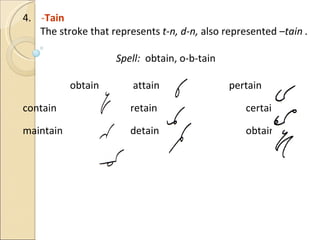
4.  - Tain   The stroke that represents  t-n,   d-n,  also represented  –tain .  Spell:  obtain, o-b-tain obtain attain pertain contain    retain certainly maintain   detain obtainable
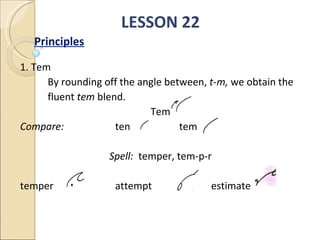
LESSON 22 Principles 1. Tem  By rounding off the angle between,  t-m,  we obtain the fluent  tem  blend. Tem Compare:  ten tem Spell:  temper, tem-p-r temper attempt estimate
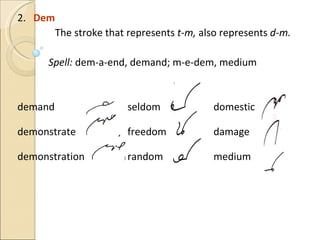
2.  Dem   The stroke that represents  t-m,  also represents  d-m. Spell:  dem-a-end, demand; m-e-dem, medium demand    seldom   domestic demonstrate   freedom   damage demonstration   random   medium
3.  Business Abbreviations  Here are additional salutations and closings often used in business letters. Dear Mrs. Dear Miss Cordially yours Dear Mr. Dear Ms. Yours sincerely 4.  Useful Phrases  With the  ten  and  tem  blends, we can form three very  useful phrases. to know to me to make
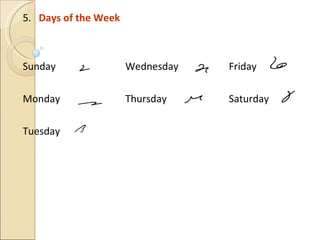
5.  Days of the Week Sunday   Wednesday     Friday Monday   Thursday   Saturday Tuesday
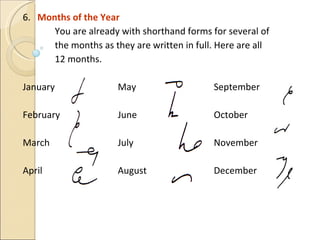
6.  Months of the Year  You are already with shorthand forms for several of  the months as they are written in full. Here are all  12 months. January May September February June October March July November April August December
LESSON 23 Principles 1 .  Brief Forms  After this group, you have only four more groups to learn. acknowledge     time     organize general   question   over The outline for over is written above the following shorthand  stroke. It is also used as a prefix form, as in: oversight   overdo   overcame
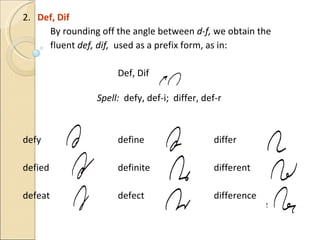
2.  Def, Dif  By rounding off the angle between  d-f,  we obtain the  fluent  def, dif,  used as a prefix form, as in:   Def, Dif Spell:  defy, def-i;  differ, def-r defy   define differ defied definite different defeat defect difference
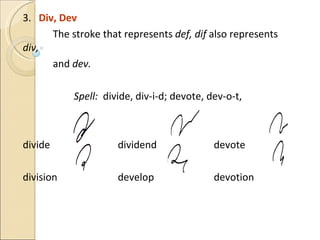
3.  Div, Dev  The stroke that represents  def, dif  also represents  div,   and  dev.  Spell:  divide, div-i-d; devote, dev-o-t,  divide dividend devote division develop devotion
4.  Ea, Ia  The sounds of  ea,  as in  create,  and  ia,  as in  piano,  are represented by a large circle with a dot placed within it. Spell:  create, k-r-eah-t create appropriate   piano area appreciate   brilliant recreation aviation   initiate
LESSON 24 RECALL In Lesson 24 you will have no new shorthand devices to learn; you will have a little time to “digest” the devices that you studied in previous lessons.
Accuracy Practice The speed and accuracy with which you will be able to transcribe your shorthand notes will depend on how well you write them. If you follow the suggestions given in this lesson when you work with each Accuracy Practice, you will soon find that you can read your own notes with greater ease and facility. So that you may have a clear picture of the proper shapes of the shorthand strokes that you are studying, enlarged models of the alphabetic characters and of the typical joinings are given, together with a short explanation of the things that you should keep in mind as you practice.
To get the most out of each Accuracy Practice, follow this simple procedure: A. Read the explanations carefully. B. Study the model to see the application of each explanation. C. Write the first outline in the Practice Drill. D. Compare what you have written with the enlarged model. E. Write three or four more copies of the outline, trying to  improve your outline with each writing. F. Repeat this procedure with the remaining outlines in the  Practice Drill.
R L K G To write these strokes accurately: A. Start and finish each one on the same level of writing. B. Make the beginning of the curve in r and l deep. Make the end of the curve in k and g deep. C. Make the large l and g considerably longer than r and k. Practice Drill Are-our-hour, will-well, can, good  Air, lay, ache, gate
2.  K-r R-k G-l To write  these combinations accurately: A. Make the curves rather flat. B.  Make the combinations  kr  and  rk  somewhat shorter, than  the combined length of r and k when written separately. C. Make the combinations gl somewhat shorter than the  combined length of g and l when written separately . Practice Drill Cream, crate, maker, mark, dark Gleam, glean, glare, eagle
Lesson 25 Principles 1.  Brief forms envelope state   success difficult   satisfy,    wish   satisfactory progress   request   under
The outline for under is written above the following  shorthand stroke. It is also used as a prefix form, as in: underneath   undertake   undermine 2.  Cities and Status  To your works as a secretary, you will frequently  have occasion to write geographical expressions.  Here are few important cities and states  Cities New York Boston   Los Angeles Chicago   Philadelphia   St. Louis
States Michigan   Massachusetts   Missouri Illinois    Pennsylvania  California 3.  Useful Business Phrases  The following phrases are used in business so  frequently that special forms have been provided for them. as soon as   to do  let us as soon as possible  of course   I hope
Lesson 26 Principles 1.  Long ī and a Following Vowel  Any vowel following long  ī  is represented by a  small circle within a large circle. Compare:  signs    science  trial
Spell:  trial, t-r-  ī-  ah-l trial   drier   compliance dial   client  reliance prior   quiet   appliances
2.  Word Beginning En-, Un-  The word beginnings en-, un- are represented by  n.   En- Spell :  enjoy, en-j-oi enjoy    engagement endanger engrave  engine   encourage  endeavor   enlarge   encouragement
Un- Spell :  until, un-t-e-l until   unfair   unfilled  unless     unpaid   unreasonable undue   uncertain  undoubtedly
3.  In-, En-, Un- Followed by a Vowel  When in-, en-, un- are followed by a vowel, they are written in full. innovation enact   unable 4.  Useful Business Phrases  Here are six more frequently used business phrases. more than to us   your order we hope   let me   you ordered
Lesson 27 Principles 1.  Brief forms  After you have learned the following brief forms, you will have only two or more groups to go! particular speak   newspaper probable subject   opinion regular regard   idea
2 .  Ng  The sound of  ng,  as in  sing,  is written Compare:  seen sing Spell:  sing, s-e-ing sing bring   length sang rang   strength song wrong   single
3.  Ngk   The sound of  ngk,  as in  sink,  is written Compare:  seem sink Spell:  rank, r-a-ink rank   drink   uncle frank    shrink   banquet bank   ink   anxious
4.  Omission of Vowel Proceeding –tion  When t, d, n, or m is followed by –ition or –ation, the circle is omitted. addition quotation permission edition combination commission notation reputation estimation
Lesson 28 Principles 1.  Ah, Aw  A dot is used for  a  in words that begin  ah  and  aw. Spell:  ahead, a-h-e-d; away, a-oo-a ahead awaken awoke away awakened award
2.  X   The letter  x  is represented by an  s  written with  a slight backward slant. Compare:  miss mix   fees fix  Spell:  tax, t-a-ex; taxes, t-a-exes tax relax   indexes taxes   relaxes   approximate box   relaxation   complex
3.  Omission of Short U  In the body of a word, the sound of short  u,  as in  fun,  is omitted before  n, m,  or a straight down stroke. Before N fun done lunch begun son (sun) front Before M sum (some) come income
summer become   column Before a Straight Downstroke rush   touch judged brushed much   budget
Lesson 29 Principles 1.  Brief Forms responsible   publish    usual   publication worth   ordinary   world public   experience   recognize
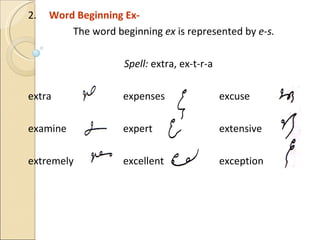
2.  Word Beginning Ex-  The word beginning  ex  is represented by  e-s.  Spell:  extra, ex-t-r-a extra expenses excuse examine expert extensive extremely excellent exception
3.  Word Beginning Ex-   The word ending  –full  is represented by  f. Spell:  careful, k-a-r-ful careful   useful   helpful doubtful thoughtful   helpfully grateful beautiful   helpfulness
4.  Word Endings –cal, -cle  The word endings  –cal, -cle  are represented by a  disjoined  k. Spell:  chemical, k-e-m-ical chemical   logical   technical medical   political  physically identical    typical   articles
Lesson 30 RECALL There are no new shorthand strokes or principles in Lesson 30. In this lesson you will find an Accuracy Practice to the curved strokes of Gregg Shorthand, a Recall Chart. Accuracy Practice To get the most benefit from the Accuracy Practice, follow the following:
1.   B   V   P   F   S To write these strokes accurately: A. Give them approximately the slant indicated by the dotted lines. B. Make the curve deep at the beginning of v, f, comma s; make the curve deep at the end of b, p, left s. Practice Drill Pay, spare, business, bears, stairs, sphere, leaves, briefs
2.  P-r P-l B-r B-l To write these combinations accurately A. Write each without a pause between the first and second  letter of each combination. B. Watch your proportions carefully.
Practice Drill Pray, press, prim, please, plan, place, plea Brim, bread, bridge, blame, bless, blast F-r   F-l
To write the combinations accurately: Write them with one sweep of the pen, with no stop between the f and the r or l. Practice Drill Free, freeze, frame, flee, flame, flap 4.  Recall Chart  This chart contains all the brief forms  and phrases presented in Chapter 5 and  illustrations  of the word-building principles you studied in Chapters 1 through 5.
BRIEF FORMS, DERIVATIVES, AND PHRASES
WORDS
LESSON 31 Principles 1.Brief Forms   This is the last group of brief forms you will learned. never   throughout govern quantity   object   correspond,   correspondence executive   character
2. Word Ending –ure  The word ending  –ure  is represented by  r . Spell:  f-a-l-r, failure failure   feature nature future   featured natural 3. Word Ending –ual  The word ending  –ual  is represented by  l. Spell:  a-k-t-l, actual actual   schedule   equal gradual   scheduled   equally
PUNCTUATION PRACTICE  .  , parenthetical A word or a phrase or a clause that is used parenthetically (that is, one not necessary to the grammatical completeness of the sentence) should be set off by commas. If the parenthetical expression occurs at the end of the sentence, only one comma is necessary. There is, of course, a small application fee. Never hesitate to let us know, Mr. Smith, when our organization can help you. We will be happy to serve you, Mrs. Martinez. Each time a parenthetical expression occurs, it will be indicated thus in the shorthand:
LESSON 32 Principles 1.  Word Ending –ily  The word –ily is represented by a narrow loop. Compare:  steady steadily readily    temporarily   family easily hastily families Observe the special joining of s in families. This joining helps form an outline that is easily read.
2.  Word Beginning al-  The word beginning  al-  is represented by the shorthand letter  o . Spell:  all-t-r, alter alter altogether also altered almost almanac
3.  Word Beginning Dis-, Des-  The word beginnings  dis-, des-  are represented by  d-s. Spell:  dis-k-oo-s, discuss; dis-k-r-i-b, describe Dis- Discuss   discourage distance discover   dismiss   dispose  Des- describe despite   desperate description destination    destroy
PUNCTUATION PRACTICE  .  , apposition An expression in apposition (that is, a word or a phrase or a clause that identifies or explain another word or term) should be set off by commas. When the expression in apposition occurs at the end of a sentence, only one comma is necessary. My employer, Mrs. Mildred H. O’Brien, is out of town. The book, Human Relations, is now for safe. The meeting is scheduled for Wednesday, June 23. Each time an expression in apposition appears, it will be indicated in the shorthand:
LESSON 33 Principles 1.  Word Beginnings For-, Fore-  The  word beginnings  for-,  fore-  are represented by  f. Spell:  for-gay-et, forget forget   form   forerunner forgive   inform   forlorn effort   information   for ever
Observe: 1. The  f  is joined with an angle to  r  or  l , as in  forerunner and forlorn, to indicate that it  represents a word beginning.   2. The  f  is disjoined if the following character is a  vowel, as in forever. 2.  Word Beginning Fur-  The word beginning  fur-  is also represented by  f. Spell:  fur-n-ish, furnish furnish  furniture   further furnished   furnace   furthermore
3.  Ago in Phrases  In expressions of time,  ago  is represented by  gay. days ago   years ago   several days ago weeks ago   months ago   few days ago PUNCTUATION PRACTICE  .  , series When the last member of a series of three or more items is preceded by  and  or  or,  place a comma before the conjunction as well as between the other items. I need a desk, a chair, and a table I saw Kay on July 18, on July 19, and July 30.
I need someone to take dictation, to answer the telephone, and to greet callers. Note: Some authorities prefer to omit the comma before the conjunction. In your shorthand books, however, the comma will be inserted before the conjunction. Each time a series occurs, it will be indicated thus in the shorthand :
LESSON 34 Principles 1.  Want in Phrases  In phrases,  want  is represented by the  nt   blend. I want   I wanted  if you want you want   he wants do you want
2.  Ort  The  r  is omitted in the sound  ort. Spell:  re-p-o-t, report report quart sort export quarterly portable 3. R Omitted in –ern, -erm  The  r  is omitted in the combination  tern, term, thern, therm, dern.   Spell:  t-e-n, turn turn term southern
return   termed   thermometer western   determined  modern 4. Md  By rounding off the angle between  m-d,  we obtain the fluent  md  blend. Md Compare:  blame   blamed  Spell:  b-l-a-emd, blamed tamed   named   confirmed
claimed seemed framed 5.  Mt  The stroke that represents  md  also represents  mt.   Spell:  p-r-o-emt, prompt prompt promptly empty
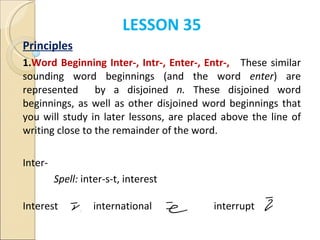
LESSON 35 Principles 1. Word Beginning Inter-, Intr-, Enter-, Entr-,  These similar sounding word beginnings (and the word  enter ) are represented  by a disjoined  n.  These disjoined word beginnings, as well as other disjoined word beginnings that you will study in later lessons, are placed above the line of writing close to the remainder of the word. Inter- Spell:  inter-s-t, interest Interest   international  interrupt
interview interval internal Intr- Spell:  intro-d-oo-s, introduce introduce intruder intricate Enter- Spell:  enter-ing, entering entering entertain enterprise entered   entertainment   enterprising
Entr- Spell:  enter-n-s, entrance entrance entrances entrant 2.  Word Ending –ings  The word ending  –ings  is represented by a disjoined left s. Spell:  s-a-v-ings savings  furnishing   proceedings openings  earnings   hearings
3.  Omission of Words in Phrases  It is often to omit one or more unimportant words in a shorthand phrase.  In the phrase  one of the,  for example. The word  of  is omitted; we write  one the.  When transcribing, the stenographer would insert  of,  as the phrase would make no sense without that word. one of the  some of the  many of the  one of them up to date in the future some of our in the world two or threes
LESSON 36 Principles of Joining 1.  The word endings  –ure  and  –ual   are represented by  r  and  l  except when those endings are preceded by a downstroke. nature   procedure   creature annual   gradual     equal but pressure treasure  ensure
casual visual visually Accuracy Practice 2.  O   On    Sho   Non To write these combinations accurately: a. Keep the o hook narrow, being sure that the beginning and end are on the same level of writing as indicated by the dotted line. b. Keep the o in on and sho parallel with the consonant, as indicated by the dotted line. c. Make the beginning of the o in non retrace the end of the first n. d. Avoid a point at the curved part indicated by the arrows.
Practice Drill Of, know, low, own, home, known, moan, shown 3.  OO Noo Noom To write these combinations accurately: a. Keep the oo hook narrow and deep. b. Keep the beginning and end of the hook on the same  level of writing. c. In noo and noom, keep the hook parallel with the straight line that precedes it.
d. In noon, retrace the beginning of the m on the bottom of the oo hook. e. Avoid a point at the places indicated by arrows. Practice Drill You, yours truly, you would, to, do, noon, moon, renew 4. Hard   Hailed
To write these combinations accurately: a. Give the end of the r and the end of the l a lift upward. b. Do not lift the end too soon, or the strokes may resemble the  nd, md  combinations. Practice Drill Neared, feared, cheered, dared, hold, sold, bold
LESSON 37 Principles 1.  Word Ending –ingly  The word ending  –ingly  is  represented by a disjoined e circle. Spell:  knowingly, n-o-ingly knowingly   increasingly  seemingly accordingly surprisingly  exceedingly
2.  Word Beginning Im-   The word beginning im- is  represented by  m.  Spell:  impose, im-p-o-s impose   import   improvement impossible   impartial   impression
3.  Word Beginning Em-  The word beginning  em-  is also  represented by  m . Spell:  employ, em-p-l-oi employ   emphasis empire employment   emphasize embarrass
4.  Im-, Em-, Followed by a Vowel    When  im-, em-,  are followed by a vowel, they are  written in full. immodest immortal  emotional
5.  Omission of Minor Vowel  When two vowel sounds come together, the minor vowel may be omitted. serious period situate obvious ideal situated various theory situation
PUNCTUATION PRACTICE., if clause  An error sometimes made by the beginning transcriber is failing to make a complete sentence. In many cases the incomplete sentence is a dependent or subordinate introductory clause starting with a word such as  if, when,  or  as.  The clause is deceiving because it would be a complete sentence if it were not introduced by one of these words. This type of clause requires another clause to complete the thought.
The dependent or subordinate introductory clause signals the coming of the main clause by means of a subordinate conjunction. The commonest subordinating conjunctions are if, as and when. Other subordinating conjunctions include  though, although, whether, unless, because, since, while, where, after, whenever, until  and  before.
In this lesson you will consider only those clauses introduced by if. A subordinate clause introduced by if and followed by a main clause is separated from the main clause by a comma. If you complete the lesson,  you may leave. If you would like to have one of our representatives call you,  please let us know. Each time a subordinate clause beginning with  if , it will be indicated thus in shorthand:
LESSON 38 Principles 1.  Word Ending –ship  The word ending  –ship  is represented by a disjoined  ish. Spell:  friendship, f-r-e-end-ship friendship   membership   scholarships hardship   ownership   relationships
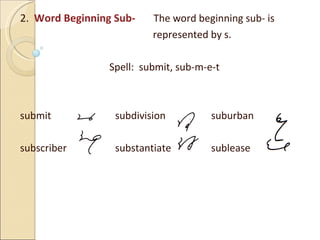
2.  Word Beginning Sub-  The word beginning sub- is  represented by s. Spell:  submit, sub-m-e-t submit subdivision suburban subscriber substantiate sublease
3.  Word Ending –ulate  The word ending –ulate is  represented by a disjoined oo hook. Spell:  regulate, r-e-gay-ulate regulate formulates calculates congratulate speculate calculator
4.  Word Beginning –ulation  The word ending –ulation is  represented by oo-shun. Spell:  regulation, r-e-gay-ulation regulation population   stipulation accumulation insulation   congratulations
5.  Word Ending –rity   The word ending –rity (and a preceding vowel) is represented by a disjoined r. Spell:  charity, chay-rity,  charity prosperity authorities majority sincerity securities maturity minority integrity
PUNCTUATION PRACTICE., as clause A subordinate clause introduced by as and followed by the main clause is separated from the main clause by a comma. As you can see, most of the work is finished. As you probably know, Ms. Jane Ortega was made president of the company. Each time a subordinate clause beginning with  as,  it will be indicated thus in the shorthand:
LESSON 39 Principles 1.  Word Ending –lity  The word ending  –lity  (and a preceding  vowel) is represented by a disjoined  l. Spell:  ability, a-b-i-lity ability locality   qualities personality reliability   responsibilities
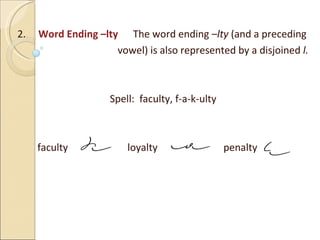
2.  Word Ending –lty  The word ending  –lty  (and a preceding vowel) is also represented by a disjoined  l. Spell:  faculty, f-a-k-ulty faculty   loyalty   penalty
3.  Word Ending –self  The word ending  –self  is represented  by  s. Spell:  herself, h-e-r-self,  herself   itself   myself  himself   yourself   oneself
4.  Word Ending –selves   The word ending  –selves  is  represented by  ses. Spell:  themselves, them-selves,  themselves   ourselves   yourselves
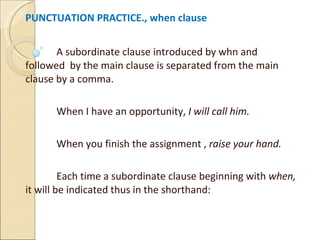
PUNCTUATION PRACTICE., when clause A subordinate clause introduced by whn and followed  by the main clause is separated from the main clause by a comma. When I have an opportunity,  I will call him. When you finish the assignment ,  raise your hand. Each time a subordinate clause beginning with  when,  it will be indicated thus in the shorthand:

Basic Shorthand Part 2 boa

  • 1.
    4. -Tain The stroke that represents t-n, d-n, also represented –tain . Spell: obtain, o-b-tain obtain attain pertain contain retain certainly maintain detain obtainable
  • 2.
    LESSON 22 Principles1. Tem By rounding off the angle between, t-m, we obtain the fluent tem blend. Tem Compare: ten tem Spell: temper, tem-p-r temper attempt estimate
  • 3.
    2. Dem The stroke that represents t-m, also represents d-m. Spell: dem-a-end, demand; m-e-dem, medium demand seldom domestic demonstrate freedom damage demonstration random medium
  • 4.
    3. BusinessAbbreviations Here are additional salutations and closings often used in business letters. Dear Mrs. Dear Miss Cordially yours Dear Mr. Dear Ms. Yours sincerely 4. Useful Phrases With the ten and tem blends, we can form three very useful phrases. to know to me to make
  • 5.
    5. Daysof the Week Sunday Wednesday Friday Monday Thursday Saturday Tuesday
  • 6.
    6. Monthsof the Year You are already with shorthand forms for several of the months as they are written in full. Here are all 12 months. January May September February June October March July November April August December
  • 7.
    LESSON 23 Principles1 . Brief Forms After this group, you have only four more groups to learn. acknowledge time organize general question over The outline for over is written above the following shorthand stroke. It is also used as a prefix form, as in: oversight overdo overcame
  • 8.
    2. Def,Dif By rounding off the angle between d-f, we obtain the fluent def, dif, used as a prefix form, as in: Def, Dif Spell: defy, def-i; differ, def-r defy define differ defied definite different defeat defect difference
  • 9.
    3. Div,Dev The stroke that represents def, dif also represents div, and dev. Spell: divide, div-i-d; devote, dev-o-t, divide dividend devote division develop devotion
  • 10.
    4. Ea,Ia The sounds of ea, as in create, and ia, as in piano, are represented by a large circle with a dot placed within it. Spell: create, k-r-eah-t create appropriate piano area appreciate brilliant recreation aviation initiate
  • 11.
    LESSON 24 RECALLIn Lesson 24 you will have no new shorthand devices to learn; you will have a little time to “digest” the devices that you studied in previous lessons.
  • 12.
    Accuracy Practice Thespeed and accuracy with which you will be able to transcribe your shorthand notes will depend on how well you write them. If you follow the suggestions given in this lesson when you work with each Accuracy Practice, you will soon find that you can read your own notes with greater ease and facility. So that you may have a clear picture of the proper shapes of the shorthand strokes that you are studying, enlarged models of the alphabetic characters and of the typical joinings are given, together with a short explanation of the things that you should keep in mind as you practice.
  • 13.
    To get themost out of each Accuracy Practice, follow this simple procedure: A. Read the explanations carefully. B. Study the model to see the application of each explanation. C. Write the first outline in the Practice Drill. D. Compare what you have written with the enlarged model. E. Write three or four more copies of the outline, trying to improve your outline with each writing. F. Repeat this procedure with the remaining outlines in the Practice Drill.
  • 14.
    R L KG To write these strokes accurately: A. Start and finish each one on the same level of writing. B. Make the beginning of the curve in r and l deep. Make the end of the curve in k and g deep. C. Make the large l and g considerably longer than r and k. Practice Drill Are-our-hour, will-well, can, good Air, lay, ache, gate
  • 15.
    2. K-rR-k G-l To write these combinations accurately: A. Make the curves rather flat. B. Make the combinations kr and rk somewhat shorter, than the combined length of r and k when written separately. C. Make the combinations gl somewhat shorter than the combined length of g and l when written separately . Practice Drill Cream, crate, maker, mark, dark Gleam, glean, glare, eagle
  • 16.
    Lesson 25 Principles1. Brief forms envelope state success difficult satisfy, wish satisfactory progress request under
  • 17.
    The outline forunder is written above the following shorthand stroke. It is also used as a prefix form, as in: underneath undertake undermine 2. Cities and Status To your works as a secretary, you will frequently have occasion to write geographical expressions. Here are few important cities and states Cities New York Boston Los Angeles Chicago Philadelphia St. Louis
  • 18.
    States Michigan Massachusetts Missouri Illinois Pennsylvania California 3. Useful Business Phrases The following phrases are used in business so frequently that special forms have been provided for them. as soon as to do let us as soon as possible of course I hope
  • 19.
    Lesson 26 Principles1. Long ī and a Following Vowel Any vowel following long ī is represented by a small circle within a large circle. Compare: signs science trial
  • 20.
    Spell: trial,t-r- ī- ah-l trial drier compliance dial client reliance prior quiet appliances
  • 21.
    2. WordBeginning En-, Un- The word beginnings en-, un- are represented by n. En- Spell : enjoy, en-j-oi enjoy engagement endanger engrave engine encourage endeavor enlarge encouragement
  • 22.
    Un- Spell : until, un-t-e-l until unfair unfilled unless unpaid unreasonable undue uncertain undoubtedly
  • 23.
    3. In-,En-, Un- Followed by a Vowel When in-, en-, un- are followed by a vowel, they are written in full. innovation enact unable 4. Useful Business Phrases Here are six more frequently used business phrases. more than to us your order we hope let me you ordered
  • 24.
    Lesson 27 Principles1. Brief forms After you have learned the following brief forms, you will have only two or more groups to go! particular speak newspaper probable subject opinion regular regard idea
  • 25.
    2 . Ng The sound of ng, as in sing, is written Compare: seen sing Spell: sing, s-e-ing sing bring length sang rang strength song wrong single
  • 26.
    3. Ngk The sound of ngk, as in sink, is written Compare: seem sink Spell: rank, r-a-ink rank drink uncle frank shrink banquet bank ink anxious
  • 27.
    4. Omissionof Vowel Proceeding –tion When t, d, n, or m is followed by –ition or –ation, the circle is omitted. addition quotation permission edition combination commission notation reputation estimation
  • 28.
    Lesson 28 Principles1. Ah, Aw A dot is used for a in words that begin ah and aw. Spell: ahead, a-h-e-d; away, a-oo-a ahead awaken awoke away awakened award
  • 29.
    2. X The letter x is represented by an s written with a slight backward slant. Compare: miss mix fees fix Spell: tax, t-a-ex; taxes, t-a-exes tax relax indexes taxes relaxes approximate box relaxation complex
  • 30.
    3. Omissionof Short U In the body of a word, the sound of short u, as in fun, is omitted before n, m, or a straight down stroke. Before N fun done lunch begun son (sun) front Before M sum (some) come income
  • 31.
    summer become column Before a Straight Downstroke rush touch judged brushed much budget
  • 32.
    Lesson 29 Principles1. Brief Forms responsible publish usual publication worth ordinary world public experience recognize
  • 33.
    2. WordBeginning Ex- The word beginning ex is represented by e-s. Spell: extra, ex-t-r-a extra expenses excuse examine expert extensive extremely excellent exception
  • 34.
    3. WordBeginning Ex- The word ending –full is represented by f. Spell: careful, k-a-r-ful careful useful helpful doubtful thoughtful helpfully grateful beautiful helpfulness
  • 35.
    4. WordEndings –cal, -cle The word endings –cal, -cle are represented by a disjoined k. Spell: chemical, k-e-m-ical chemical logical technical medical political physically identical typical articles
  • 36.
    Lesson 30 RECALLThere are no new shorthand strokes or principles in Lesson 30. In this lesson you will find an Accuracy Practice to the curved strokes of Gregg Shorthand, a Recall Chart. Accuracy Practice To get the most benefit from the Accuracy Practice, follow the following:
  • 37.
    1. B V P F S To write these strokes accurately: A. Give them approximately the slant indicated by the dotted lines. B. Make the curve deep at the beginning of v, f, comma s; make the curve deep at the end of b, p, left s. Practice Drill Pay, spare, business, bears, stairs, sphere, leaves, briefs
  • 38.
    2. P-rP-l B-r B-l To write these combinations accurately A. Write each without a pause between the first and second letter of each combination. B. Watch your proportions carefully.
  • 39.
    Practice Drill Pray,press, prim, please, plan, place, plea Brim, bread, bridge, blame, bless, blast F-r F-l
  • 40.
    To write thecombinations accurately: Write them with one sweep of the pen, with no stop between the f and the r or l. Practice Drill Free, freeze, frame, flee, flame, flap 4. Recall Chart This chart contains all the brief forms and phrases presented in Chapter 5 and illustrations of the word-building principles you studied in Chapters 1 through 5.
  • 41.
  • 42.
  • 43.
    LESSON 31 Principles1.Brief Forms This is the last group of brief forms you will learned. never throughout govern quantity object correspond, correspondence executive character
  • 44.
    2. Word Ending–ure The word ending –ure is represented by r . Spell: f-a-l-r, failure failure feature nature future featured natural 3. Word Ending –ual The word ending –ual is represented by l. Spell: a-k-t-l, actual actual schedule equal gradual scheduled equally
  • 45.
    PUNCTUATION PRACTICE . , parenthetical A word or a phrase or a clause that is used parenthetically (that is, one not necessary to the grammatical completeness of the sentence) should be set off by commas. If the parenthetical expression occurs at the end of the sentence, only one comma is necessary. There is, of course, a small application fee. Never hesitate to let us know, Mr. Smith, when our organization can help you. We will be happy to serve you, Mrs. Martinez. Each time a parenthetical expression occurs, it will be indicated thus in the shorthand:
  • 46.
    LESSON 32 Principles1. Word Ending –ily The word –ily is represented by a narrow loop. Compare: steady steadily readily temporarily family easily hastily families Observe the special joining of s in families. This joining helps form an outline that is easily read.
  • 47.
    2. WordBeginning al- The word beginning al- is represented by the shorthand letter o . Spell: all-t-r, alter alter altogether also altered almost almanac
  • 48.
    3. WordBeginning Dis-, Des- The word beginnings dis-, des- are represented by d-s. Spell: dis-k-oo-s, discuss; dis-k-r-i-b, describe Dis- Discuss discourage distance discover dismiss dispose Des- describe despite desperate description destination destroy
  • 49.
    PUNCTUATION PRACTICE . , apposition An expression in apposition (that is, a word or a phrase or a clause that identifies or explain another word or term) should be set off by commas. When the expression in apposition occurs at the end of a sentence, only one comma is necessary. My employer, Mrs. Mildred H. O’Brien, is out of town. The book, Human Relations, is now for safe. The meeting is scheduled for Wednesday, June 23. Each time an expression in apposition appears, it will be indicated in the shorthand:
  • 50.
    LESSON 33 Principles1. Word Beginnings For-, Fore- The word beginnings for-, fore- are represented by f. Spell: for-gay-et, forget forget form forerunner forgive inform forlorn effort information for ever
  • 51.
    Observe: 1. The f is joined with an angle to r or l , as in forerunner and forlorn, to indicate that it represents a word beginning. 2. The f is disjoined if the following character is a vowel, as in forever. 2. Word Beginning Fur- The word beginning fur- is also represented by f. Spell: fur-n-ish, furnish furnish furniture further furnished furnace furthermore
  • 52.
    3. Agoin Phrases In expressions of time, ago is represented by gay. days ago years ago several days ago weeks ago months ago few days ago PUNCTUATION PRACTICE . , series When the last member of a series of three or more items is preceded by and or or, place a comma before the conjunction as well as between the other items. I need a desk, a chair, and a table I saw Kay on July 18, on July 19, and July 30.
  • 53.
    I need someoneto take dictation, to answer the telephone, and to greet callers. Note: Some authorities prefer to omit the comma before the conjunction. In your shorthand books, however, the comma will be inserted before the conjunction. Each time a series occurs, it will be indicated thus in the shorthand :
  • 54.
    LESSON 34 Principles1. Want in Phrases In phrases, want is represented by the nt blend. I want I wanted if you want you want he wants do you want
  • 55.
    2. Ort The r is omitted in the sound ort. Spell: re-p-o-t, report report quart sort export quarterly portable 3. R Omitted in –ern, -erm The r is omitted in the combination tern, term, thern, therm, dern. Spell: t-e-n, turn turn term southern
  • 56.
    return termed thermometer western determined modern 4. Md By rounding off the angle between m-d, we obtain the fluent md blend. Md Compare: blame blamed Spell: b-l-a-emd, blamed tamed named confirmed
  • 57.
    claimed seemed framed5. Mt The stroke that represents md also represents mt. Spell: p-r-o-emt, prompt prompt promptly empty
  • 58.
    LESSON 35 Principles1. Word Beginning Inter-, Intr-, Enter-, Entr-, These similar sounding word beginnings (and the word enter ) are represented by a disjoined n. These disjoined word beginnings, as well as other disjoined word beginnings that you will study in later lessons, are placed above the line of writing close to the remainder of the word. Inter- Spell: inter-s-t, interest Interest international interrupt
  • 59.
    interview interval internalIntr- Spell: intro-d-oo-s, introduce introduce intruder intricate Enter- Spell: enter-ing, entering entering entertain enterprise entered entertainment enterprising
  • 60.
    Entr- Spell: enter-n-s, entrance entrance entrances entrant 2. Word Ending –ings The word ending –ings is represented by a disjoined left s. Spell: s-a-v-ings savings furnishing proceedings openings earnings hearings
  • 61.
    3. Omissionof Words in Phrases It is often to omit one or more unimportant words in a shorthand phrase. In the phrase one of the, for example. The word of is omitted; we write one the. When transcribing, the stenographer would insert of, as the phrase would make no sense without that word. one of the some of the many of the one of them up to date in the future some of our in the world two or threes
  • 62.
    LESSON 36 Principlesof Joining 1. The word endings –ure and –ual are represented by r and l except when those endings are preceded by a downstroke. nature procedure creature annual gradual equal but pressure treasure ensure
  • 63.
    casual visual visuallyAccuracy Practice 2. O On Sho Non To write these combinations accurately: a. Keep the o hook narrow, being sure that the beginning and end are on the same level of writing as indicated by the dotted line. b. Keep the o in on and sho parallel with the consonant, as indicated by the dotted line. c. Make the beginning of the o in non retrace the end of the first n. d. Avoid a point at the curved part indicated by the arrows.
  • 64.
    Practice Drill Of,know, low, own, home, known, moan, shown 3. OO Noo Noom To write these combinations accurately: a. Keep the oo hook narrow and deep. b. Keep the beginning and end of the hook on the same level of writing. c. In noo and noom, keep the hook parallel with the straight line that precedes it.
  • 65.
    d. In noon,retrace the beginning of the m on the bottom of the oo hook. e. Avoid a point at the places indicated by arrows. Practice Drill You, yours truly, you would, to, do, noon, moon, renew 4. Hard Hailed
  • 66.
    To write thesecombinations accurately: a. Give the end of the r and the end of the l a lift upward. b. Do not lift the end too soon, or the strokes may resemble the nd, md combinations. Practice Drill Neared, feared, cheered, dared, hold, sold, bold
  • 67.
    LESSON 37 Principles1. Word Ending –ingly The word ending –ingly is represented by a disjoined e circle. Spell: knowingly, n-o-ingly knowingly increasingly seemingly accordingly surprisingly exceedingly
  • 68.
    2. WordBeginning Im- The word beginning im- is represented by m. Spell: impose, im-p-o-s impose import improvement impossible impartial impression
  • 69.
    3. WordBeginning Em- The word beginning em- is also represented by m . Spell: employ, em-p-l-oi employ emphasis empire employment emphasize embarrass
  • 70.
    4. Im-,Em-, Followed by a Vowel When im-, em-, are followed by a vowel, they are written in full. immodest immortal emotional
  • 71.
    5. Omissionof Minor Vowel When two vowel sounds come together, the minor vowel may be omitted. serious period situate obvious ideal situated various theory situation
  • 72.
    PUNCTUATION PRACTICE., ifclause An error sometimes made by the beginning transcriber is failing to make a complete sentence. In many cases the incomplete sentence is a dependent or subordinate introductory clause starting with a word such as if, when, or as. The clause is deceiving because it would be a complete sentence if it were not introduced by one of these words. This type of clause requires another clause to complete the thought.
  • 73.
    The dependent orsubordinate introductory clause signals the coming of the main clause by means of a subordinate conjunction. The commonest subordinating conjunctions are if, as and when. Other subordinating conjunctions include though, although, whether, unless, because, since, while, where, after, whenever, until and before.
  • 74.
    In this lessonyou will consider only those clauses introduced by if. A subordinate clause introduced by if and followed by a main clause is separated from the main clause by a comma. If you complete the lesson, you may leave. If you would like to have one of our representatives call you, please let us know. Each time a subordinate clause beginning with if , it will be indicated thus in shorthand:
  • 75.
    LESSON 38 Principles1. Word Ending –ship The word ending –ship is represented by a disjoined ish. Spell: friendship, f-r-e-end-ship friendship membership scholarships hardship ownership relationships
  • 76.
    2. WordBeginning Sub- The word beginning sub- is represented by s. Spell: submit, sub-m-e-t submit subdivision suburban subscriber substantiate sublease
  • 77.
    3. WordEnding –ulate The word ending –ulate is represented by a disjoined oo hook. Spell: regulate, r-e-gay-ulate regulate formulates calculates congratulate speculate calculator
  • 78.
    4. WordBeginning –ulation The word ending –ulation is represented by oo-shun. Spell: regulation, r-e-gay-ulation regulation population stipulation accumulation insulation congratulations
  • 79.
    5. WordEnding –rity The word ending –rity (and a preceding vowel) is represented by a disjoined r. Spell: charity, chay-rity, charity prosperity authorities majority sincerity securities maturity minority integrity
  • 80.
    PUNCTUATION PRACTICE., asclause A subordinate clause introduced by as and followed by the main clause is separated from the main clause by a comma. As you can see, most of the work is finished. As you probably know, Ms. Jane Ortega was made president of the company. Each time a subordinate clause beginning with as, it will be indicated thus in the shorthand:
  • 81.
    LESSON 39 Principles1. Word Ending –lity The word ending –lity (and a preceding vowel) is represented by a disjoined l. Spell: ability, a-b-i-lity ability locality qualities personality reliability responsibilities
  • 82.
    2. WordEnding –lty The word ending –lty (and a preceding vowel) is also represented by a disjoined l. Spell: faculty, f-a-k-ulty faculty loyalty penalty
  • 83.
    3. WordEnding –self The word ending –self is represented by s. Spell: herself, h-e-r-self, herself itself myself himself yourself oneself
  • 84.
    4. WordEnding –selves The word ending –selves is represented by ses. Spell: themselves, them-selves, themselves ourselves yourselves
  • 85.
    PUNCTUATION PRACTICE., whenclause A subordinate clause introduced by whn and followed by the main clause is separated from the main clause by a comma. When I have an opportunity, I will call him. When you finish the assignment , raise your hand. Each time a subordinate clause beginning with when, it will be indicated thus in the shorthand: