   Syed Ammar Abbas

   Muhammad Bilal

   Maria Niaz

   Sumera Rajput
   Key #1: Put the reader first
 Write to Express not Impress
 Communication = understanding
 Use words readers can picture
 Tie in to the reader’s experience
 Key   #2: Use simple words and short
    sentences

TIPS :
   Avoid wordy prepositional phrases
     In the amount of (for)
     In order to (to)
     Due to the fact that (because)
     In the event that (if)
     During the time that (when, while)
 Key   #3: Write with verbs and nouns

  Usethe active voice
  When it is okay to use passive voice
   EXAMPLE:

   The company (S) sells (V) insurance (O).
   Not: Insurance is sold by the company.

   The construction crew repaired the road.
   Not: The road was repaired by the construction company.

   Tests showed the new material did not wear well.
   Not: When tests were run, it was discovered that good wear is not
    exhibited by the new material.
 Key   #4: Format document to improve
    readability

     Use lists, bullets, charts, tables, indents, italics, bolds,
      headings and subheadings
     The 100-word rule


   Plan, organize, write
   Keep sentence length in mind while writing your essay and
    try to incorporate variety. If your writing contains areas
    where there are several short sentences, look to combine
    some of them. If some of the sentences are too long, look
    to shorten them by separating the independent clauses.
    Doing this will make any writing better and easier to read
   Short sentences:
    The easiest way to make sentences longer is by using conjunctions, the
    most common of which are coordinating conjunctions. Conjunctions can be
    used to connect independent clauses, dependent clauses, and/or other
    phrases together. Too many short sentences can hurt an essay. It can
    make the writing seem choppy.


EXAMPLE:
   Example: My grades continue to suffer. I am not studying as much as I
    should. I hope to pass. I am not sure I will.
   Example revised through subordination: My grades continue to suffer
    because I am not studying as much as I should. Even though I hope to
    pass, I am not sure that I will.
    Long Sentences:

    The easiest way to fix a passage containing too
     many long sentences is to break some of the
     sentences up to create multiple sentences.
1.      active vs. passive voice:

       the subject performs the action rather than having the action
        performed on them
       creates energy
       usually uses fewer words
       watch your verbs!

     Voice provides your writing with distinctiveness and a sense of flavor, which may--
        or may not--give your audience a desire to continue reading your work. For
        example, active voice gives your writing authority and a closer connection to
        your audience, because you're talking directly to them. Passive voice also
        allows you to talk to your audience, but in a bland, indirect way without
        conviction. Therefore, for stronger, more authoritative voice in your writing,
        you must know how to fix passive voice.
   Active VS Passive :

The active form of the aforementioned example has a SVO (Subject Verb
  Object) structure: "The man" (S), "helped" (V), "the girl" (O). All active
  sentences follow this pattern, except for those that exchange the object for
  an adverb or a complement. Passive sentences, on the other hand, are a
  little more complicated. Since the sentence is switched around, one would
  assume that a passive sentence would go Object - Verb - Subject.
  However, the original object becomes the subject, so this is not possible.
  Instead, a new term is used to refer to the original object ("the man"), and it
  is known as an agent. Therefore, the sequence for a passive sentence
  becomes as follows: "The girl" (subject), "was helped" (verb), "by the man"
  (agent) -".
2. Pacing :

   balancing "long" and short sentences
   run-on vs. choppy
   a key - read the story aloud
   (the verbal reading may help with informality as well)
3. Transitions:
   shifting to the next idea
   a new paragraph?
   connecting what's next with what came before
   (seamlessness)
   dialogue - a way of alternating quotes (from different speakers)
4. Story Structures
   Inverted Pyramid the norm

   Subject heading links

   for when a story contains more than one topic
   for when the reader may want related info before continuing on
   can be placed outside or inside the story
   if outside, usually above (a preview)
   if inside, usually within the first paragraph
   Deadlines:
        “The time by which a news report must be
    submitted.”

   a key - if a follow-up, a summary lead helps the reader get up to
    speed(can't assume the reader read the original story)

   After the story is written (and before when possible) be thinking about
    audio, video, related stories etc.
    1. Conciseness in Sentences

a.   Eliminate Redundant Words and Phrases
b.   Eliminate Unnecessary Words
c.   Focus on the "Real Subject"
d.   Focus on the "Real" Verb
e.   Avoid "All-Purpose" Nouns.
f.   Use the Positive
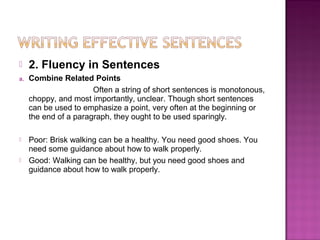
    2. Fluency in Sentences
a.   Combine Related Points
                       Often a string of short sentences is monotonous,
     choppy, and most importantly, unclear. Though short sentences
     can be used to emphasize a point, very often at the beginning or
     the end of a paragraph, they ought to be used sparingly.

    Poor: Brisk walking can be a healthy. You need good shoes. You
     need some guidance about how to walk properly.
    Good: Walking can be healthy, but you need good shoes and
     guidance about how to walk properly.
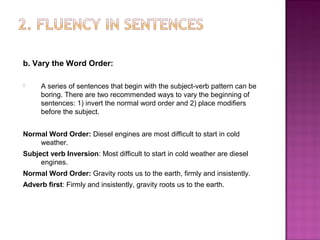
b. Vary the Word Order:

     A series of sentences that begin with the subject-verb pattern can be
      boring. There are two recommended ways to vary the beginning of
      sentences: 1) invert the normal word order and 2) place modifiers
      before the subject.


Normal Word Order: Diesel engines are most difficult to start in cold
    weather.
Subject verb Inversion: Most difficult to start in cold weather are diesel
     engines.
Normal Word Order: Gravity roots us to the earth, firmly and insistently.
Adverb first: Firmly and insistently, gravity roots us to the earth.
3. Make Sentence Clear:

a.   Avoid Misplaced or Dangling Modifiers :
                          A misplaced modifier obscure meaning, because the
     modifier is placed too far away from the words it modifies. On occasion,
     misplaced modifiers can be not only puzzling, but comical.

b.   Make Pronouns Clear:
                        Pronouns--this, that , he, she, it, his, their, they--take the
     place of nouns in sentences. For clarity, it is essential that the writer identify
     the noun to which the pronoun refers. If the referent is not clear, the reader
     can easily misread the passage or at least, become temporarily confused.
Reviving up you writing

Reviving up you writing

  • 2.
    Syed Ammar Abbas  Muhammad Bilal  Maria Niaz  Sumera Rajput
  • 3.
    Key #1: Put the reader first  Write to Express not Impress  Communication = understanding  Use words readers can picture  Tie in to the reader’s experience
  • 4.
     Key #2: Use simple words and short sentences TIPS :  Avoid wordy prepositional phrases  In the amount of (for)  In order to (to)  Due to the fact that (because)  In the event that (if)  During the time that (when, while)
  • 5.
     Key #3: Write with verbs and nouns  Usethe active voice  When it is okay to use passive voice
  • 6.
    EXAMPLE:  The company (S) sells (V) insurance (O).  Not: Insurance is sold by the company.  The construction crew repaired the road.  Not: The road was repaired by the construction company.  Tests showed the new material did not wear well.  Not: When tests were run, it was discovered that good wear is not exhibited by the new material.
  • 7.
     Key #4: Format document to improve readability  Use lists, bullets, charts, tables, indents, italics, bolds, headings and subheadings  The 100-word rule  Plan, organize, write
  • 8.
    Keep sentence length in mind while writing your essay and try to incorporate variety. If your writing contains areas where there are several short sentences, look to combine some of them. If some of the sentences are too long, look to shorten them by separating the independent clauses. Doing this will make any writing better and easier to read
  • 9.
    Short sentences: The easiest way to make sentences longer is by using conjunctions, the most common of which are coordinating conjunctions. Conjunctions can be used to connect independent clauses, dependent clauses, and/or other phrases together. Too many short sentences can hurt an essay. It can make the writing seem choppy. EXAMPLE:  Example: My grades continue to suffer. I am not studying as much as I should. I hope to pass. I am not sure I will.  Example revised through subordination: My grades continue to suffer because I am not studying as much as I should. Even though I hope to pass, I am not sure that I will.
  • 10.
    Long Sentences: The easiest way to fix a passage containing too many long sentences is to break some of the sentences up to create multiple sentences.
  • 11.
    1. active vs. passive voice:  the subject performs the action rather than having the action performed on them  creates energy  usually uses fewer words  watch your verbs! Voice provides your writing with distinctiveness and a sense of flavor, which may-- or may not--give your audience a desire to continue reading your work. For example, active voice gives your writing authority and a closer connection to your audience, because you're talking directly to them. Passive voice also allows you to talk to your audience, but in a bland, indirect way without conviction. Therefore, for stronger, more authoritative voice in your writing, you must know how to fix passive voice.
  • 12.
    Active VS Passive : The active form of the aforementioned example has a SVO (Subject Verb Object) structure: "The man" (S), "helped" (V), "the girl" (O). All active sentences follow this pattern, except for those that exchange the object for an adverb or a complement. Passive sentences, on the other hand, are a little more complicated. Since the sentence is switched around, one would assume that a passive sentence would go Object - Verb - Subject. However, the original object becomes the subject, so this is not possible. Instead, a new term is used to refer to the original object ("the man"), and it is known as an agent. Therefore, the sequence for a passive sentence becomes as follows: "The girl" (subject), "was helped" (verb), "by the man" (agent) -".
  • 13.
    2. Pacing :  balancing "long" and short sentences  run-on vs. choppy  a key - read the story aloud  (the verbal reading may help with informality as well)
  • 14.
    3. Transitions:  shifting to the next idea  a new paragraph?  connecting what's next with what came before  (seamlessness)  dialogue - a way of alternating quotes (from different speakers)
  • 15.
    4. Story Structures  Inverted Pyramid the norm  Subject heading links  for when a story contains more than one topic  for when the reader may want related info before continuing on  can be placed outside or inside the story  if outside, usually above (a preview)  if inside, usually within the first paragraph
  • 16.
    Deadlines: “The time by which a news report must be submitted.”  a key - if a follow-up, a summary lead helps the reader get up to speed(can't assume the reader read the original story)  After the story is written (and before when possible) be thinking about audio, video, related stories etc.
  • 17.
    1. Conciseness in Sentences a. Eliminate Redundant Words and Phrases b. Eliminate Unnecessary Words c. Focus on the "Real Subject" d. Focus on the "Real" Verb e. Avoid "All-Purpose" Nouns. f. Use the Positive
  • 18.
    2. Fluency in Sentences a. Combine Related Points Often a string of short sentences is monotonous, choppy, and most importantly, unclear. Though short sentences can be used to emphasize a point, very often at the beginning or the end of a paragraph, they ought to be used sparingly.  Poor: Brisk walking can be a healthy. You need good shoes. You need some guidance about how to walk properly.  Good: Walking can be healthy, but you need good shoes and guidance about how to walk properly.
  • 19.
    b. Vary theWord Order:  A series of sentences that begin with the subject-verb pattern can be boring. There are two recommended ways to vary the beginning of sentences: 1) invert the normal word order and 2) place modifiers before the subject. Normal Word Order: Diesel engines are most difficult to start in cold weather. Subject verb Inversion: Most difficult to start in cold weather are diesel engines. Normal Word Order: Gravity roots us to the earth, firmly and insistently. Adverb first: Firmly and insistently, gravity roots us to the earth.
  • 20.
    3. Make SentenceClear: a. Avoid Misplaced or Dangling Modifiers : A misplaced modifier obscure meaning, because the modifier is placed too far away from the words it modifies. On occasion, misplaced modifiers can be not only puzzling, but comical. b. Make Pronouns Clear: Pronouns--this, that , he, she, it, his, their, they--take the place of nouns in sentences. For clarity, it is essential that the writer identify the noun to which the pronoun refers. If the referent is not clear, the reader can easily misread the passage or at least, become temporarily confused.