Volume One SERIES 90
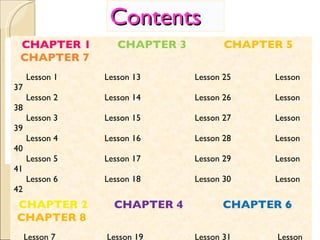
Contents CHAPTER 1   CHAPTER 3   CHAPTER 5   CHAPTER 7 Lesson 1  Lesson 13  Lesson 25  Lesson 37 Lesson 2  Lesson 14  Lesson 26  Lesson 38  Lesson 3  Lesson 15  Lesson 27  Lesson 39 Lesson 4  Lesson 16  Lesson 28  Lesson 40   Lesson 5  Lesson 17  Lesson 29  Lesson 41 Lesson 6  Lesson 18  Lesson 30  Lesson 42 CHAPTER 2   CHAPTER 4   CHAPTER 6   CHAPTER 8 Lesson 7  Lesson 19  Lesson 31  Lesson 43  Lesson 8  Lesson 20  Lesson 32  Lesson 44 Lesson 9  Lesson 21  Lesson 33  Lesson 45 Lesson 10  Lesson 22  Lesson 34  Lesson 46 Lesson 11  Lesson 23  Lesson 35  Lesson 47 Lesson 12  Lesson 24  Lesson 36  Lesson 48
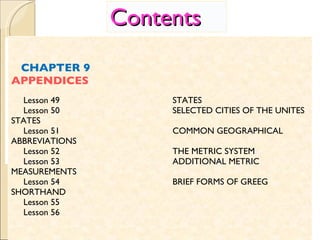
Contents CHAPTER 9   APPENDICES     Lesson 49  STATES Lesson 50  SELECTED CITIES OF THE UNITES STATES Lesson 51  COMMON GEOGRAPHICAL ABBREVIATIONS Lesson 52  THE METRIC SYSTEM Lesson 53  ADDITIONAL METRIC MEASUREMENTS Lesson 54  BRIEF FORMS OF GREEG SHORTHAND Lesson 55 Lesson 56
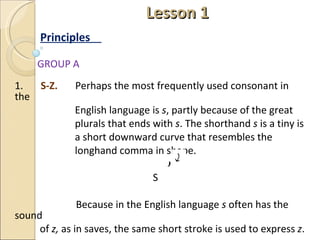
  Lesson 1 Principles  GROUP A 1.  S-Z.  Perhaps the most frequently used consonant in the  English language is  s , partly because of the great  plurals that ends with  s . The shorthand  s  is a tiny is a short downward curve that resembles the  longhand comma in shape. S    Because in the English language  s  often has the sound  of  z,  as in saves, the same short stroke is used to express  z .
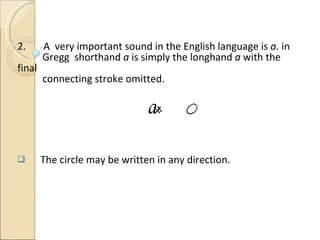
2.  A  very important sound in the English language is  a.  in   Gregg  shorthand  a  is simply the longhand  a  with the final    connecting stroke omitted. The circle may be written in any direction.
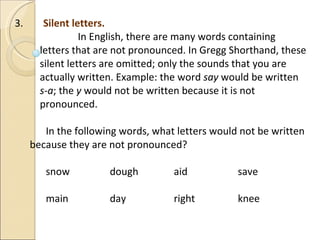
3.  Silent letters.  In English, there are many words containing letters that are not pronounced. In Gregg Shorthand, these  silent letters are omitted; only the sounds that you are actually written. Example: the word  say  would be written  s-a ; the  y  would not be written because it is not pronounced.  In the following words, what letters would not be written because they are not pronounced? snow dough aid save main day right knee
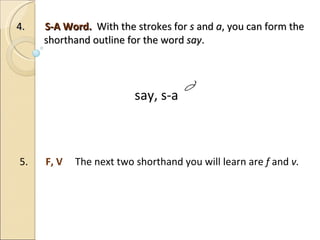
4.  S-A Word.  With the strokes for  s  and  a , you can form the    shorthand outline for the word  say .         say, s-a 5.  F, V  The next two shorthand you will learn are  f  and  v.
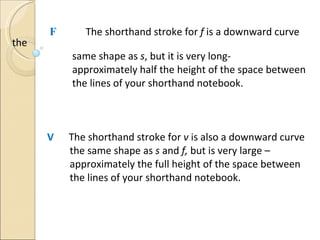
F  The shorthand stroke for  f  is a downward curve the  same shape as  s , but it is very long-  approximately half the height of the space between  the lines of your shorthand notebook. V  The shorthand stroke for  v  is also a downward curve  the same shape as  s  and  f,  but is very large –  approximately the full height of the space between  the lines of your shorthand notebook.
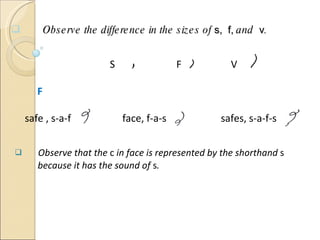
Observe the difference in the sizes of  s,  f,  and  v . S   F    V F safe , s-a-f   face, f-a-s   safes, s-a-f-s Observe that the  c  in face is represented by the shorthand  s  because it has the sound of  s .
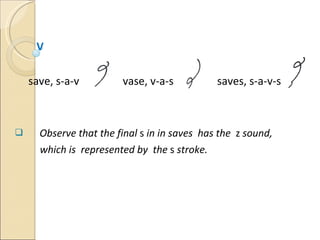
V save, s-a-v  vase, v-a-s  saves, s-a-v-s Observe that the final  s  in in saves  has the  z  sound, which is  represented by  the  s  stroke.
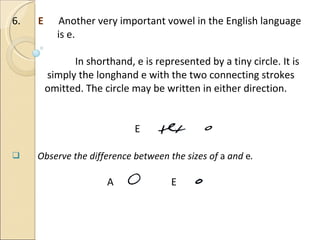
6.  E   Another very important vowel in the English language  is e.  In shorthand, e is represented by a tiny circle. It is simply the longhand e with the two connecting strokes omitted. The circle may be written in either direction.   E Observe the difference between the sizes of  a  and  e . A E
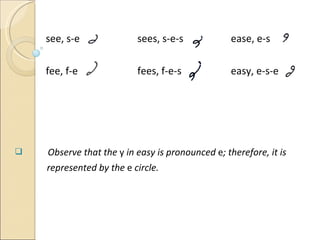
see, s-e   sees, s-e-s   ease, e-s fee, f-e    fees, f-e-s   easy, e-s-e Observe that the  y  in easy is pronounced  e ; therefore, it is  represented by the  e  circle.
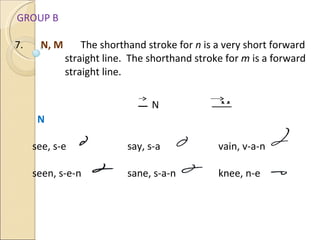
GROUP B 7.  N, M  The shorthand stroke for  n  is a very short forward  straight line.  The shorthand stroke for  m  is a forward  straight line.   N   M N see, s-e   say, s-a   vain, v-a-n seen, s-e-n   sane, s-a-n    knee, n-e
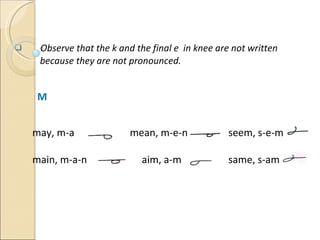
Observe that the k and the final e  in knee are not written  because they are not pronounced. M  may, m-a   mean, m-e-n   seem, s-e-m main, m-a-n  aim, a-m   same, s-am
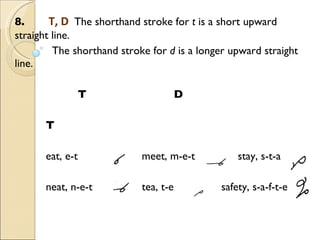
8.   T, D  The shorthand stroke for  t  is a short upward straight line.    The shorthand stroke for  d  is a longer upward straight line. T D T eat, e-t  meet, m-e-t stay, s-t-a neat, n-e-t tea, t-e   safety, s-a-f-t-e
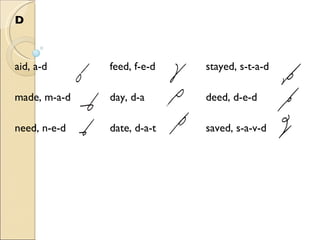
D aid, a-d feed, f-e-d stayed, s-t-a-d made, m-a-d day, d-a deed, d-e-d need, n-e-d date, d-a-t saved, s-a-v-d
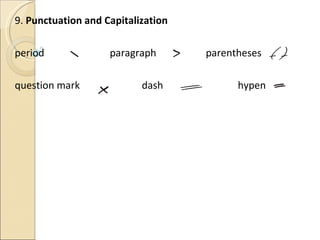
9.  Punctuation and Capitalization period paragraph parentheses question mark dash hypen
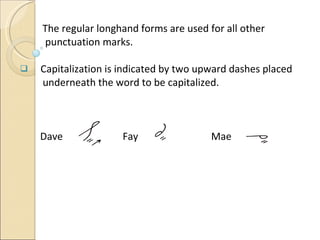
The regular longhand forms are used for all other  punctuation marks.  Capitalization is indicated by two upward dashes placed  underneath the word to be capitalized. Dave   Fay Mae
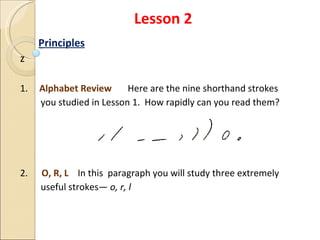
Lesson 2 Principles z 1.  Alphabet Review  Here are the nine shorthand strokes  you studied in Lesson 1.  How rapidly can you read them? 2.  O, R, L  In this  paragraph you will study three extremely  useful strokes—  o, r, l
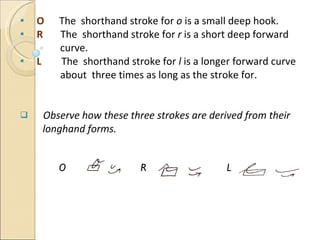
O  The  shorthand stroke for  o  is a small deep hook. R  The  shorthand stroke for  r  is a short deep forward  curve. L  The  shorthand stroke for  l  is a longer forward curve  about  three times as long as the stroke for. Observe how these three strokes are derived from their  longhand forms. O  R  L  Previous   Next
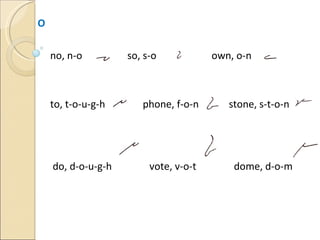
O no, n-o  so, s-o  own, o-n  to, t-o-u-g-h  phone, f-o-n  stone, s-t-o-n  do, d-o-u-g-h  vote, v-o-t  dome, d-o-m
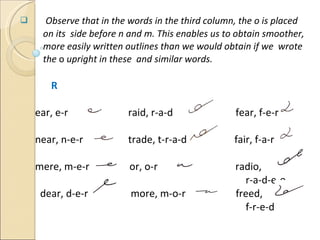
Observe that in the words in the third column, the o is placed on its  side before n and m. This enables us to obtain smoother,  more easily written outlines than we would obtain if we  wrote  the  o  upright in these  and similar words. R ear, e-r  raid, r-a-d  fear, f-e-r  near, n-e-r  trade, t-r-a-d  fair, f-a-r  mere, m-e-r  or, o-r  radio,    r-a-d-e-o  dear, d-e-r  more, m-o-r  freed,    f-r-e-d  Previous   Next
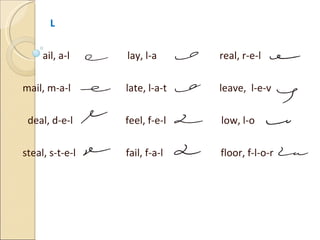
L ail, a-l  lay, l-a  real, r-e-l mail, m-a-l  late, l-a-t  leave,  l-e-v deal, d-e-l  feel, f-e-l  low, l-o  steal, s-t-e-l  fail, f-a-l  floor, f-l-o-r
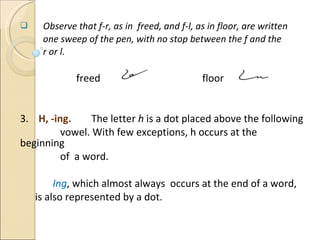
Observe that f-r, as in  freed, and f-l, as in floor, are written  one sweep of the pen, with no stop between the f and the r or l.   freed    floor 3.  H, -ing.  The letter  h  is a dot placed above the following  vowel. With few exceptions, h occurs at the beginning  of  a word.   Ing , which almost always  occurs at the end of a word,  is also represented by a dot. Previous  Next
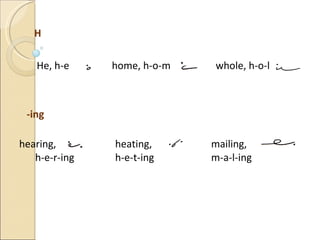
H He, h-e  home, h-o-m  whole, h-o-l -ing hearing,    heating,    mailing, h-e-r-ing h-e-t-ing   m-a-l-ing
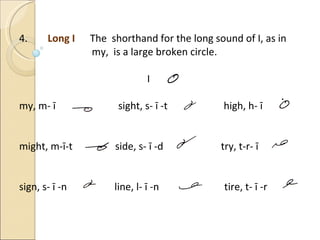
4.  Long I  The  shorthand for the long sound of I, as in  my,  is a large broken circle. I  my, m- ī    sight, s- ī -t    high, h- ī might, m-ī-t  side, s- ī -d  try, t-r- ī sign, s- ī -n  line, l- ī -n   tire, t- ī -r  Previous   Next
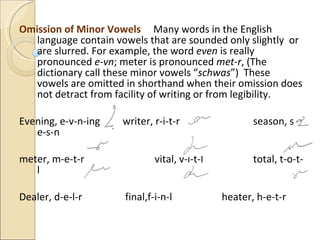
Omission of Minor Vowels  Many words in the English  language contain vowels that are sounded only slightly  or are slurred. For example, the word  even  is really pronounced  e-vn ; meter is pronounced  met-r , (The dictionary call these minor vowels “ schwas ”)  These vowels are omitted in shorthand when their omission does not detract from facility of writing or from legibility.  Evening, e-v-n-ing   writer, r-i-t-r   season, s-e-s-n meter, m-e-t-r   vital, v-i-t-l   total, t-o-t-l Dealer, d-e-l-r   final,f-i-n-l   heater, h-e-t-r 5 Previous   Next
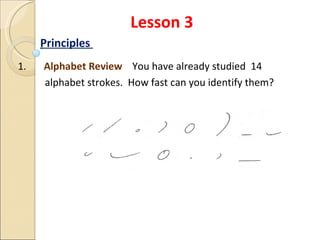
Lesson 3 Principles  1.  Alphabet Review  You have already studied  14  alphabet strokes.  How fast can you identify them?
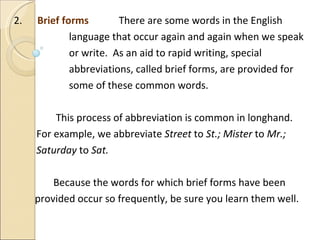
2.  Brief forms  There are some words in the English  language that occur again and again when we speak  or write.  As an aid to rapid writing, special  abbreviations, called brief forms, are provided for  some of these common words.   This process of abbreviation is common in longhand. For example, we abbreviate  Street  to  St.; Mister  to  Mr.; Saturday  to  Sat.   Because the words for which brief forms have been    provided occur so frequently, be sure you learn them well.
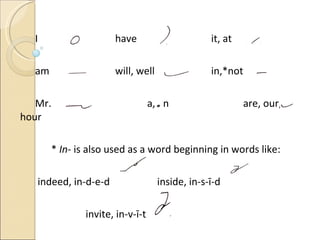
I have it, at am  will, well in,*not Mr. a, an are, our, hour *  In - is also used as a word beginning in words like: indeed, in-d-e-d    inside, in-s-ī-d   invite, in-v-ī-t
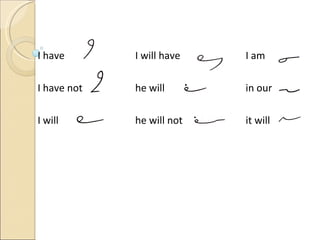
Did you observe that some shorthand outlines have two or  more meanings such as the shorthand forms  for  are, our,  hour ;  will, well ?  You will have no problem selecting the correct  meaning of a brief form when it appears in a sentence.  The sense, or context, will give you the answer.  3.  Phrasing   The use of brief forms for common words  enables you to save time.  Another device for saving writing time is called “ phrasing ,” or the writing of two  or more shorthand outlines together.  Here are a  number of phrases built with the brief forms you have  studied.
I have   I will have  I am I have not    he will  in our I will    he will not  it will
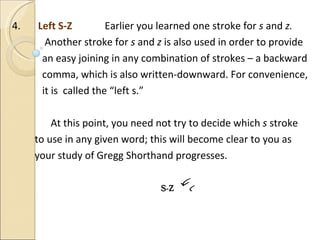
4.  Left S-Z  Earlier you learned one stroke for  s  and  z.  Another stroke for  s  and  z  is also used in order to provide  an easy joining in any combination of strokes – a backward comma, which is also written-downward. For convenience, it is  called the “left s.”   At this point, you need not try to decide which  s  stroke to use in any given word; this will become clear to you as  your study of Gregg Shorthand progresses.
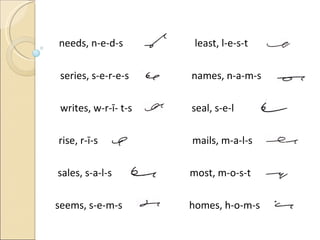
  needs, n-e-d-s   least, l-e-s-t series, s-e-r-e-s  names, n-a-m-s  writes, w-r-ī- t-s   seal, s-e-l   rise, r-ī-s   mails, m-a-l-s sales, s-a-l-s   most, m-o-s-t seems, s-e-m-s    homes, h-o-m-s
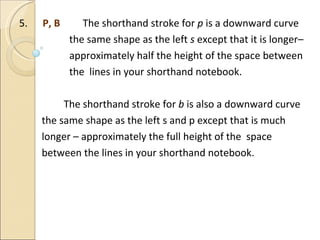
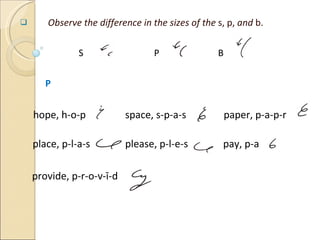
5.  P, B  The shorthand stroke for  p  is a downward curve  the same shape as the left  s  except that it is longer–  approximately half the height of the space between the  lines in your shorthand notebook.   The shorthand stroke for  b  is also a downward curve the same shape as the left s and p except that is much longer – approximately the full height of the  space  between the lines in your shorthand notebook.
Observe the difference in the sizes of the  s, p,  and  b.   S    P   B P hope, h-o-p   space, s-p-a-s   paper, p-a-p-r  place, p-l-a-s    please, p-l-e-s  pay, p-a  provide, p-r-o-v-ī-d
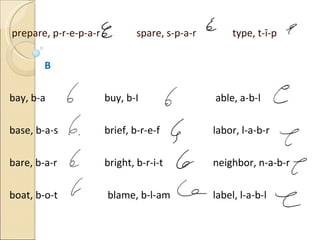
prepare, p-r-e-p-a-r spare, s-p-a-r type, t-ī-p B bay, b-a buy, b-I   able, a-b-l base, b-a-s  brief, b-r-e-f   labor, l-a-b-r bare, b-a-r bright, b-r-i-t   neighbor, n-a-b-r boat, b-o-t   blame, b-l-am  label, l-a-b-l
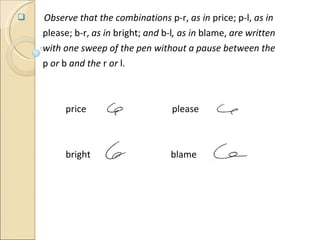
Observe that the combinations  p-r,  as in  price; p-l,  as in  please; b-r,  as in  bright;  and  b-l , as in  blame,  are written  with one sweep of the pen without a pause between the  p  or  b  and the  r  or  l. price   please bright  blame
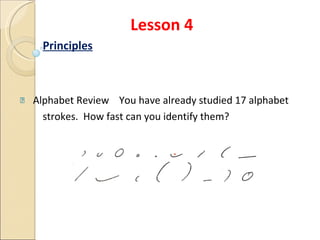
Lesson 4 Principles Alphabet Review  You have already studied 17 alphabet  strokes.  How fast can you identify them?
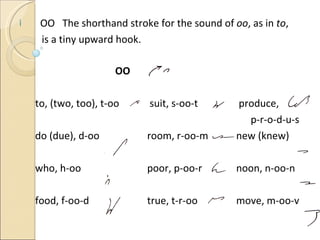
OO  The shorthand stroke for the sound of  oo , as in  to ,  is a tiny upward hook. OO to, (two, too), t-oo  suit, s-oo-t   produce,   p-r-o-d-u-s do (due), d-oo room, r-oo-m   new (knew) who, h-oo poor, p-oo-r   noon, n-oo-n food, f-oo-d true, t-r-oo   move, m-oo-v
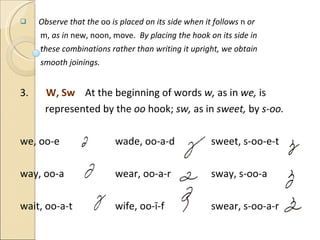
Observe that the  oo  is placed on its side when it follows  n  or m,  as in  new, noon, move.  By placing the hook on its side in  these combinations rather than writing it upright, we obtain  smooth joinings. 3.  W, Sw  At the beginning of words  w,  as in  we,  is  represented by the  oo  hook;  sw,  as in  sweet,  by  s-oo. we, oo-e wade, oo-a-d sweet, s-oo-e-t way, oo-a wear, oo-a-r sway, s-oo-a wait, oo-a-t wife, oo- ī-f swear, s-oo-a-r
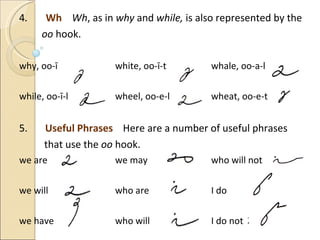
4 .  Wh   Wh , as in  why  and  while,  is also represented by the oo  hook. why, oo-ī white, oo-ī-t whale, oo-a-l while, oo-ī-l wheel, oo-e-l wheat, oo-e-t 5.  Useful Phrases  Here are a number of useful phrases that use the  oo  hook. we are we may who will not we will who are I do we have who will I do not
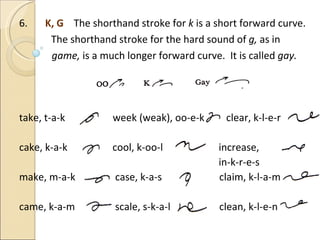
6.  K, G  The shorthand stroke for  k  is a short forward curve. The shorthand stroke for the hard sound of  g,  as in  game,  is a much longer forward curve.  It is called  gay. take, t-a-k  week (weak), oo-e-k   clear, k-l-e-r cake, k-a-k  cool, k-oo-l   increase,   in-k-r-e-s make, m-a-k case, k-a-s   claim, k-l-a-m came, k-a-m scale, s-k-a-l   clean, k-l-e-n
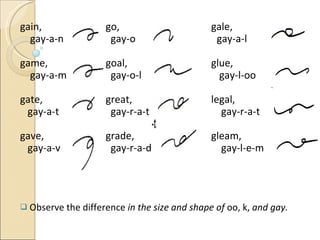
gain,    go,  gale,  gay-a-n   gay-o   gay-a-l game,    goal,  glue,  gay-a-m   gay-o-l   gay-l-oo  gate,    great,  legal,  gay-a-t   gay-r-a-t   gay-r-a-t gave,    grade,  gleam,  gay-a-v    gay-r-a-d    gay-l-e-m Observe the difference  in the size and shape of  oo, k,  and gay.
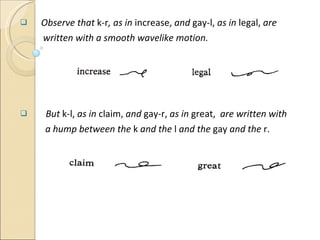
Observe that  k-r , as in  increase,  and  gay-l,  as in  legal,  are  written with a smooth wavelike motion. But  k-l,  as in  claim,  and  gay-r,  as in  great,  are written with  a hump between the  k  and the  l  and the  gay  and the  r.
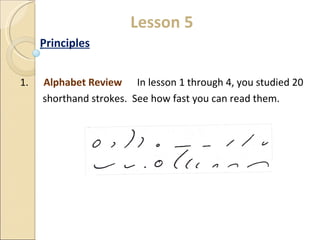
Lesson 5 Principles 1.  Alphabet Review  In lesson 1 through 4, you studied 20 shorthand strokes.  See how fast you can read them.
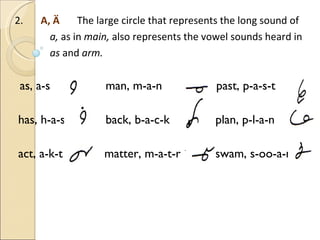
2.  A, Ä  The large circle that represents the long sound of  a,  as in  main,  also represents the vowel sounds heard in  as  and  arm. as, a-s  man, m-a-n   past, p-a-s-t has, h-a-s   back, b-a-c-k   plan, p-l-a-n act, a-k-t  matter, m-a-t-r  swam, s-oo-a-m
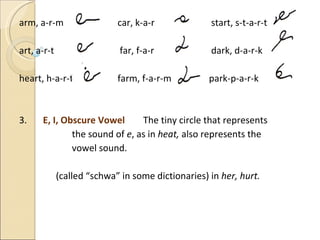
arm, a-r-m   car, k-a-r start, s-t-a-r-t art, a-r-t   far, f-a-r dark, d-a-r-k heart, h-a-r-t   farm, f-a-r-m   park-p-a-r-k 3.  E, I, Obscure Vowel  The tiny circle that represents the sound of  e , as in  heat,  also represents the  vowel sound. (called “schwa” in some dictionaries) in  her, hurt.
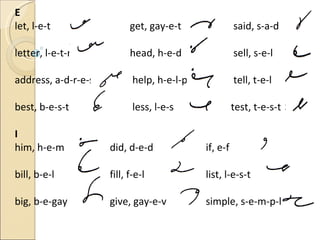
E let, l-e-t   get, gay-e-t   said, s-a-d letter, l-e-t-r   head, h-e-d   sell, s-e-l address, a-d-r-e-s   help, h-e-l-p   tell, t-e-l best, b-e-s-t   less, l-e-s   test, t-e-s-t I him, h-e-m did, d-e-d if, e-f bill, b-e-l fill, f-e-l list, l-e-s-t big, b-e-gay give, gay-e-v simple, s-e-m-p-l
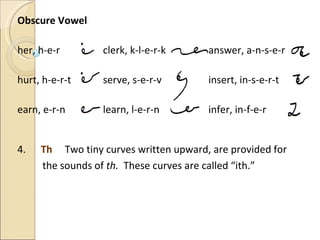
Obscure Vowel her, h-e-r   clerk, k-l-e-r-k answer, a-n-s-e-r hurt, h-e-r-t   serve, s-e-r-v insert, in-s-e-r-t earn, e-r-n   learn, l-e-r-n infer, in-f-e-r 4.  Th   Two tiny curves written upward, are provided for the sounds of  th.  These curves are called “ith.”
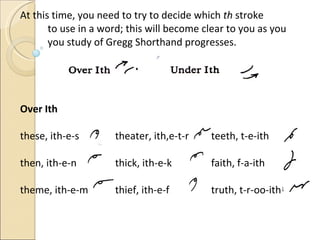
At this time, you need to try to decide which  th  stroke to use in a word; this will become clear to you as you you study of Gregg Shorthand progresses. Over Ith these, ith-e-s theater, ith,e-t-r teeth, t-e-ith then, ith-e-n thick, ith-e-k faith, f-a-ith theme, ith-e-m thief, ith-e-f truth, t-r-oo-ith                           Next          Previous
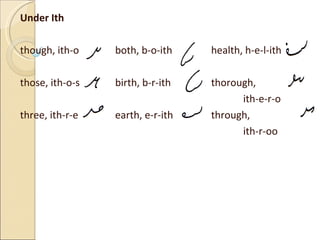
Under Ith though, ith-o both, b-o-ith health, h-e-l-ith those, ith-o-s birth, b-r-ith thorough, ith-e-r-o three, ith-r-e earth, e-r-ith through, ith-r-oo
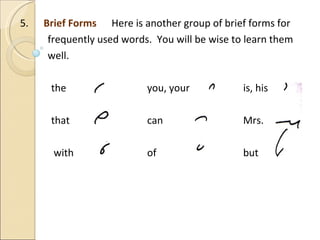
5.  Brief Forms  Here is another group of brief forms for frequently used words.  You will be wise to learn them well. the you, your is, his that can Mrs.   with of but
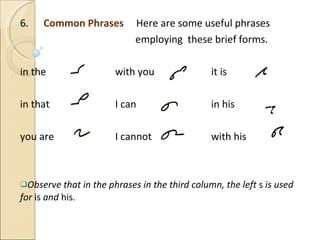
6.  Common Phrases  Here are some useful phrases  employing  these brief forms. in the with you it is in that I can in his you are I cannot with his Observe that in the phrases in the third column, the left  s  is used for  is  and  his.
Lesson 6 RECALL Lesson 6 is a “breather”; it contains no new shorthand principles for you to learn.  In this lesson, you will find an Alphabet Review, a simple explanation of the principles that govern the joining of the strokes you have studied, a recall chart.
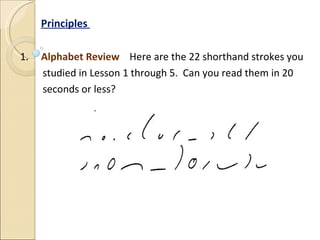
Principles  1.  Alphabet Review  Here are the 22 shorthand strokes you studied in Lesson 1 through 5.  Can you read them in 20 seconds or less?
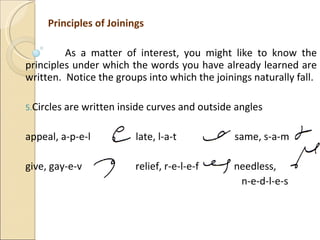
Principles of Joinings As a matter of interest, you might like to know the principles under which the words you have already learned are written.  Notice the groups into which the joinings naturally fall. Circles are written inside curves and outside angles appeal, a-p-e-l  late, l-a-t   same, s-a-m give, gay-e-v   relief, r-e-l-e-f   needless,   n-e-d-l-e-s
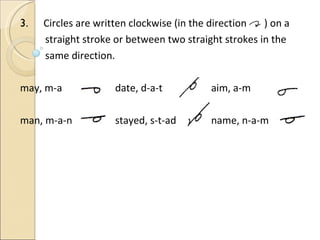
3 .  Circles are written clockwise (in the direction  ) on a  straight stroke or between two straight strokes in the  same direction. may, m-a date, d-a-t aim, a-m man, m-a-n stayed, s-t-ad name, n-a-m
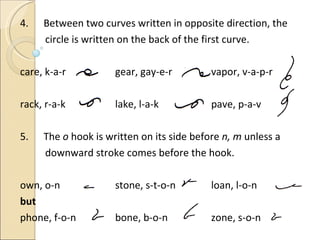
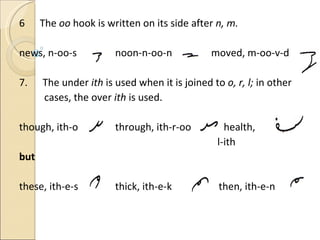
4.  Between two curves written in opposite direction, the circle is written on the back of the first curve. care, k-a-r gear, gay-e-r vapor, v-a-p-r rack, r-a-k lake, l-a-k pave, p-a-v 5.  The  o  hook is written on its side before  n, m  unless a downward stroke comes before the hook. own, o-n stone, s-t-o-n loan, l-o-n but phone, f-o-n bone, b-o-n zone, s-o-n
6  The  oo  hook is written on its side after  n, m. news, n-oo-s noon-n-oo-n moved, m-oo-v-d 7.  The under  ith  is used when it is joined to  o, r, l;  in other cases, the over  ith  is used. though, ith-o through, ith-r-oo   health,    h-e-l-ith but these, ith-e-s thick, ith-e-k   then, ith-e-n
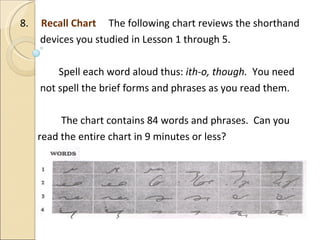
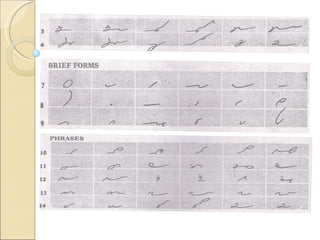
8.  Recall Chart  The following chart reviews the shorthand devices you studied in Lesson 1 through 5.   Spell each word aloud thus:  ith-o, though.  You need not spell the brief forms and phrases as you read them.   The chart contains 84 words and phrases.  Can you  read the entire chart in 9 minutes or less? N
 
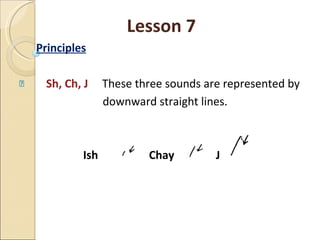
Lesson 7 Principles Sh, Ch, J  These three sounds are represented by   downward straight lines.   Ish  Chay   J
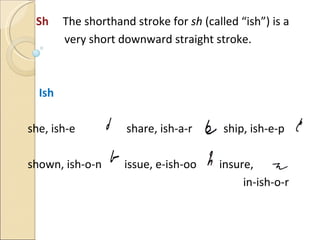
Sh  The shorthand stroke for  sh  (called “ish”) is a  very short downward straight stroke. Ish she, ish-e   share, ish-a-r  ship, ish-e-p shown, ish-o-n  issue, e-ish-oo  insure,  in-ish-o-r
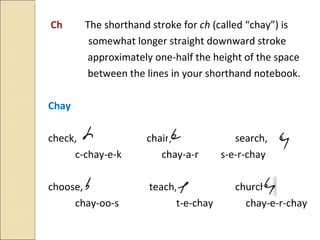
Ch   The shorthand stroke for  ch  (called “chay”) is  somewhat longer straight downward stroke    approximately one-half the height of the space    between the lines in your shorthand notebook. Chay check,    chair,  search, c-chay-e-k  chay-a-r   s-e-r-chay choose,   teach, church, chay-oo-s   t-e-chay  chay-e-r-chay
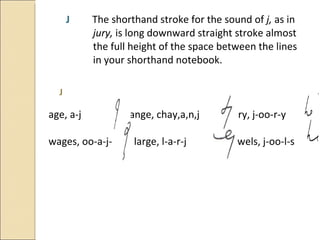
J  The shorthand stroke for the sound of  j,  as in    jury,  is long downward straight stroke almost    the full height of the space between the lines   in your shorthand notebook. J age, a-j  change, chay,a,n,j  jury, j-oo-r-y wages, oo-a-j-s  large, l-a-r-j  jewels, j-oo-l-s
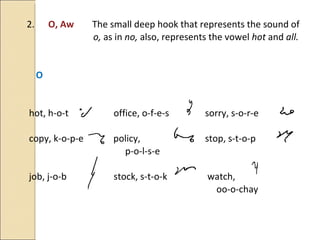
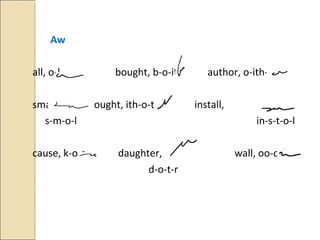
2.  O, Aw  The small deep hook that represents the sound of  o,  as in  no,  also, represents the vowel  hot  and  all. O hot, h-o-t   office, o-f-e-s   sorry, s-o-r-e copy, k-o-p-e  policy,    stop, s-t-o-p   p-o-l-s-e job, j-o-b   stock, s-t-o-k   watch,  oo-o-chay
Aw all, o-l  bought, b-o-ith   author, o-ith-r small,    thought, ith-o-t  install, s-m-o-l in-s-t-o-l cause, k-o-s  daughter,   wall, oo-o-l   d-o-t-r
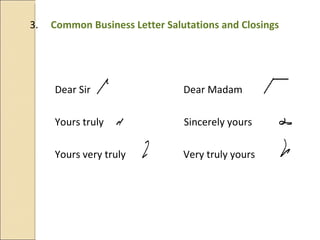
3.   Common Business Letter Salutations and Closings Dear Sir   Dear Madam Yours truly  Sincerely yours Yours very truly  Very truly yours
Note:    Although the expressions  Dear Sir, Dear Madam,  and  Yours truly   are considered too impersonal by letter-writing experts, they are still used by  many dictations.  Therefore, special abbreviations have been provided for them.
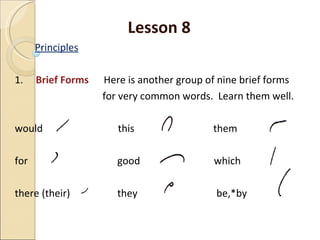
Lesson 8 Principles 1.  Brief Forms   Here is another group of nine brief forms for very common words.  Learn them well. would   this   them for   good   which there (their)   they   be,*by
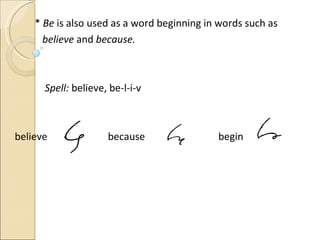
*  Be  is also used as a word beginning in words such as  believe  and  because. Spell:  believe,   be-l-i-v believe   because   begin
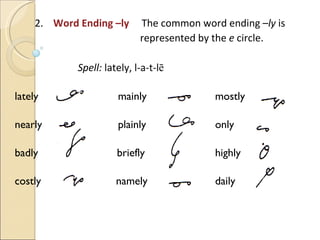
2.  Word Ending –ly   The common word ending – ly  is represented by the  e  circle. Spell:  lately, l-a-t-l ē lately   mainly   mostly nearly   plainly   only badly   briefly   highly costly   namely   daily
Observe that in   highly  the small circle for  –ly   is written  inside the large circle; that in  daily,  it is added to the side  of the  d  after the  a  has been written.
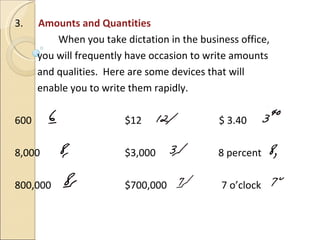
3.  Amounts and Quantities    When you take dictation in the business office,  you will frequently have occasion to write amounts and qualities.  Here are some devices that will  enable you to write them rapidly. 600   $12   $ 3.40 8,000   $3,000   8 percent 800,000   $700,000   7 o’clock
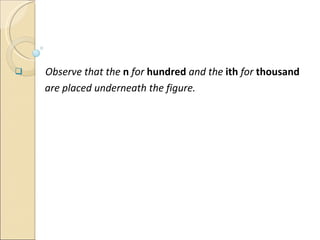
Observe that the  n  for  hundred  and the  ith  for  thousand   are placed underneath the figure.
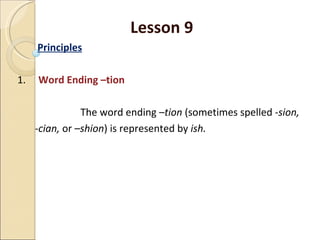
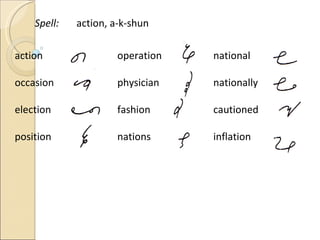
Lesson 9 Principles 1.  Word Ending –tion  The word ending  –tion  (sometimes spelled - sion,  -cian,  or  –shion ) is represented by  ish.
Spell:  action, a-k-shun action   operation   national occasion   physician   nationally election   fashion   cautioned position    nations   inflation
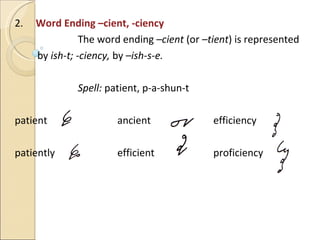
2.  Word Ending –cient, -ciency The word ending  –cient  (or  –tient ) is represented  by  ish-t; -ciency,  by  –ish-s-e. Spell:  patient, p-a-shun-t patient   ancient   efficiency patiently   efficient   proficiency
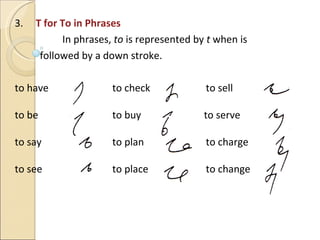
3.  T for To in Phrases In phrases,  to  is represented by  t  when is  followed by a down stroke. to have  to check to sell to be  to buy   to serve to say  to plan to charge to see  to place to change
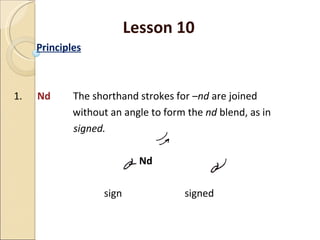
Lesson 10 Principles 1.  Nd  The shorthand strokes for  –nd  are joined   without an angle to form the  nd  blend, as in   signed. Nd sign  signed
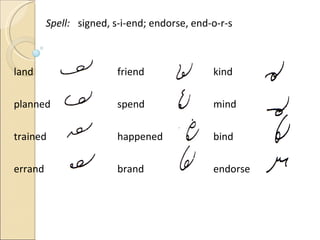
Spell: signed, s-i-end; endorse, end-o-r-s land   friend   kind planned   spend   mind trained   happened   bind errand   brand   endorse
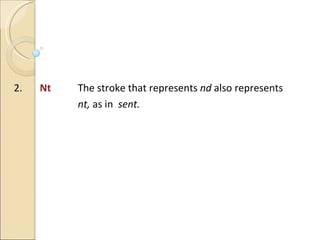
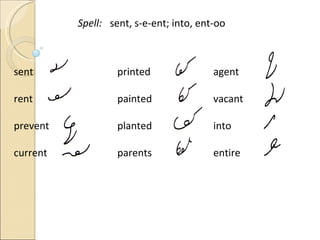
2.  Nt The stroke that represents  nd  also represents nt,  as in  sent.
Spell: sent, s-e-ent; into, ent-oo sent   printed   agent rent   painted   vacant prevent    planted   into current    parents   entire
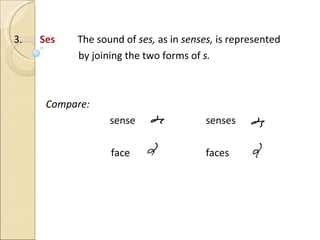
3.  Ses   The sound of  ses,  as in  senses,  is represented   by joining the two forms of  s. Compare: sense senses   face faces
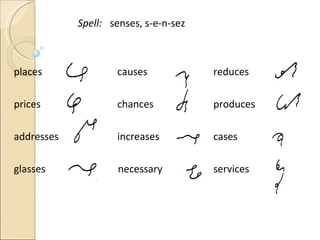
Spell: senses, s-e-n-sez places    causes   reduces prices   chances   produces addresses   increases   cases glasses   necessary   services
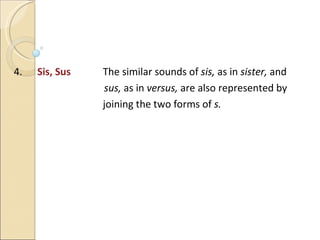
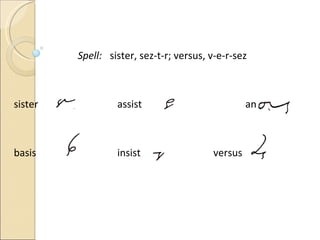
4.  Sis, Sus   The similar sounds of  sis,  as in  sister,  and sus,  as in  versus,  are also represented by   joining the two forms of  s.
Spell: sister, sez-t-r; versus, v-e-r-sez sister   assist   analysis basis   insist   versus
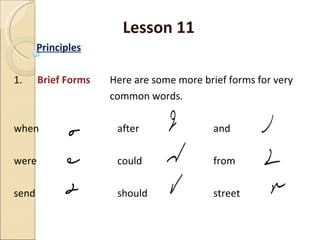
Lesson 11 Principles 1.  Brief Forms Here are some more brief forms for very common words. when   after   and were   could   from send    should   street
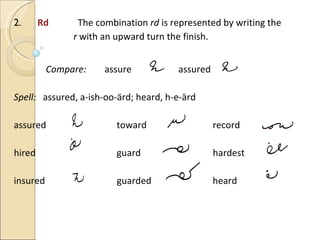
2 .    Rd   The combination  rd  is represented by writing the  r  with an upward turn the finish. Compare:  assure     assured Spell:  assured, a-ish-oo-ärd; heard, h-e-ärd assured     toward   record hired    guard   hardest insured   guarded   heard
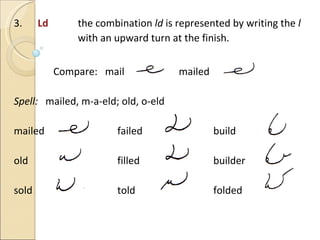
3.   Ld  the combination  ld  is represented by writing the  l with an upward turn at the finish.   Compare:  mail   mailed Spell:   mailed, m-a-eld; old, o-eld mailed   failed   build old   filled   builder sold   told   folded
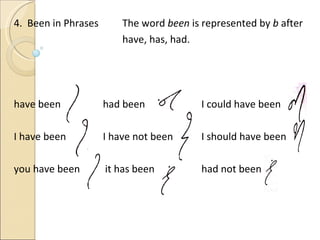
4.  Been in Phrases   The word  been  is represented by  b  after   have, has, had. have been   had been   I could have been  I have been   I have not been   I should have been you have been  it has been   had not been
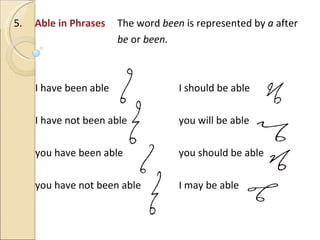
5.  Able in Phrases   The word  been  is represented by  a  after   be  or  been. I have been able   I should be able I have not been able   you will be able you have been able   you should be able you have not been able   I may be able
Lesson 12 RECALL Lesson 12 is another “breather”; it presents no new devices for you to learn.  It reviews the shorthand strokes you learned in previous lessons.
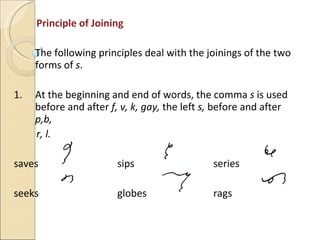
Principle of Joining  The following principles deal with the joinings of the two forms of  s . 1. At the beginning and end of words, the comma  s  is used before and after  f, v, k, gay,  the left  s,  before and after  p,b, r, l. saves    sips   series seeks    globes   rags
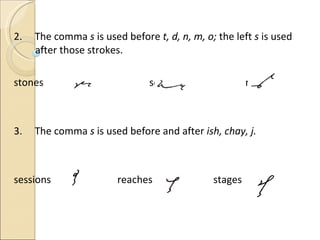
2.  The comma  s  is used before  t, d, n, m, o;  the left  s  is used after those strokes. stones    solos   needs 3.  The comma  s  is used before and after  ish, chay, j. sessions    reaches   stages
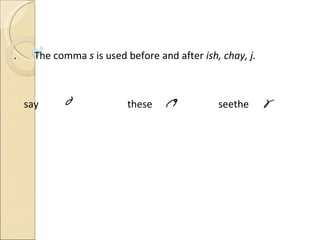
.  The comma  s  is used before and after  ish, chay, j. say   these   seethe
5.   Gregg Shorthand is equally legible whether it is written on ruled or unruled paper; consequently, you need not worry about the exact placement of your outlines on the printed lines n your notebook.  The main purpose of the printed lines in your notebook is to keep you from wandering uphill and downhill as you write. However, so that all outlines may be uniformly placed in the shorthand books from which you study, this general rule has been followed.
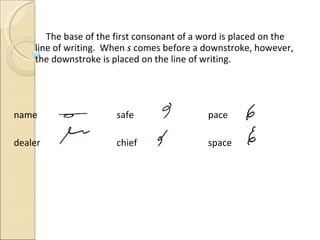
The base of the first consonant of a word is placed on the  line of writing.  When  s  comes before a downstroke, however, the downstroke is placed on the line of writing. name   safe    pace dealer    chief  space
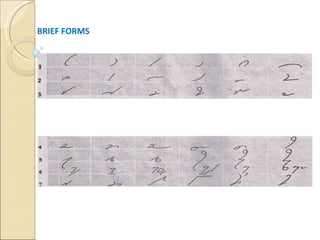
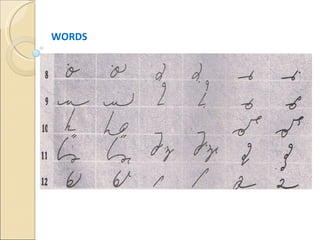
6.  Recall Chart  The following chart contains the brief forms  presented in Chapter 2 and illustrations of  the shorthand principles you studied in Chapters 1 and 2.  Can you read the chart in 6 minutes or less?
BRIEF FORMS PHRASES AND AMOUNTS End
WORDS
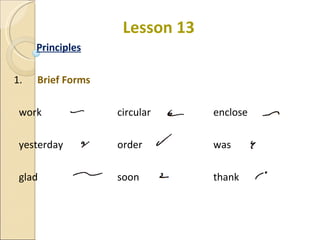
Lesson 13 Principles 1.  Brief Forms work    circular   enclose yesterday   order   was glad   soon   thank
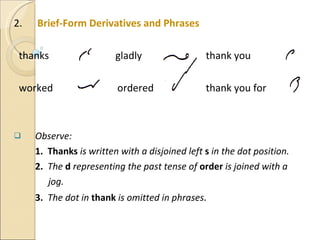
2.  Brief-Form Derivatives and Phrases thanks   gladly  thank you worked   ordered thank you for Observe:  1.  Thanks  is written with a disjoined left  s  in the dot position. 2.  The   d  representing the past tense of  order  is joined with a  jog. 3.  The dot in  thank  is omitted in phrases .
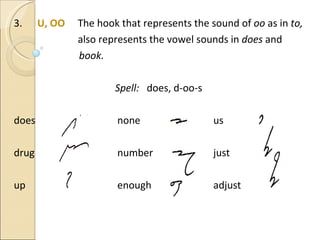
3.  U, OO The hook that represents the sound of  oo  as in  to, also represents the vowel sounds in  does  and  book. Spell:  does, d-oo-s does   none   us drug   number   just up   enough   adjust
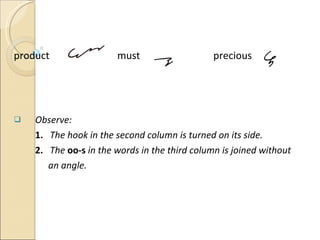
product   must   precious Observe: 1.  The hook in the second column is turned on its side. 2.   The  oo-s  in the words in the third column is joined without  an angle.
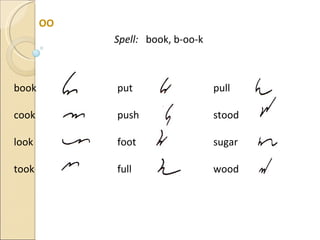
OO Spell:  book, b-oo-k book   put   pull cook    push   stood look    foot   sugar took   full   wood
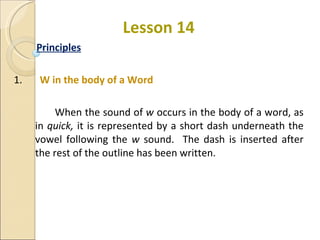
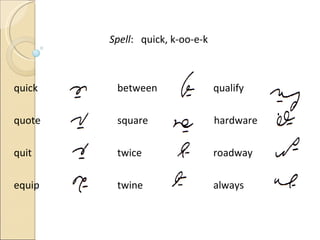
Lesson 14 Principles 1.  W in the body of a Word   When the sound of  w  occurs in the body of a word, as in  quick,  it is represented by a short dash underneath the vowel following the  w  sound.  The dash is inserted after the rest of the outline has been written.
Spell :  quick, k-oo-e-k quick    between   qualify quote   square   hardware quit    twice   roadway equip    twine   always
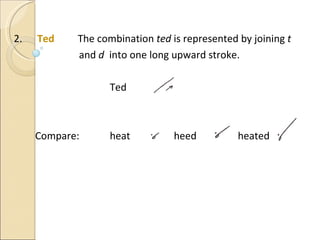
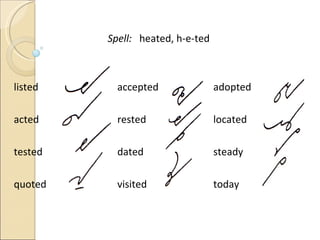
2.  Ted The combination  ted  is represented by joining  t  and  d  into one long upward stroke. Ted Compare: heat heed heated
Spell:   heated, h-e-ted listed     accepted   adopted acted    rested   located tested   dated   steady quoted    visited   today
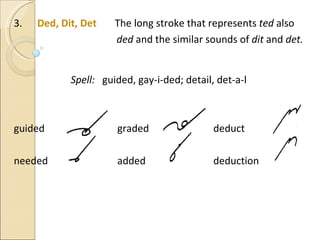
3.   Ded, Dit, Det   The long stroke that represents  ted  also  ded  and the similar sounds of  dit  and  det. Spell:  guided, gay-i-ded; detail, det-a-l guided    graded   deduct needed    added   deduction
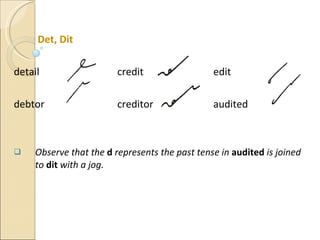
  Det, Dit detail    credit   edit debtor   creditor   audited Observe that the  d  represents the past tense in  audited  is joined to  dit  with a jog.
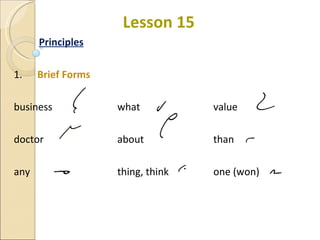
Lesson 15 Principles 1.  Brief Forms business   what   value doctor   about   than any     thing, think   one (won)
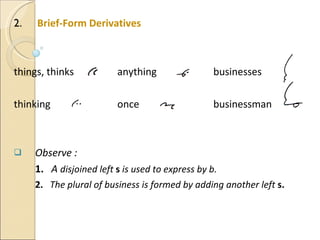
2 .  Brief-Form Derivatives things, thinks   anything   businesses thinking   once   businessman Observe : 1.   A  disjoined left  s  is used to express by b. 2.   The plural of business is formed by adding another left  s.
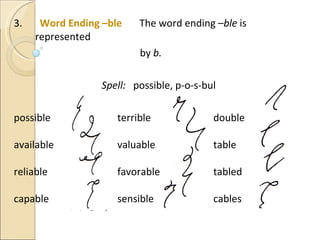
3.  Word Ending –ble  The word ending – ble  is represented   by  b. Spell:  possible, p-o-s-bul possible    terrible   double available   valuable   table reliable   favorable   tabled capable   sensible   cables
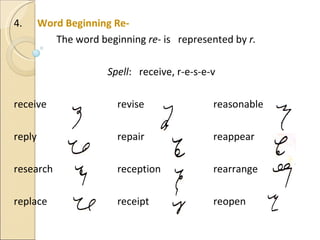
4.  Word Beginning Re-  The word beginning  re-  is  represented by  r. Spell :  receive, r-e-s-e-v receive    revise   reasonable reply   repair   reappear research   reception   rearrange replace    receipt   reopen
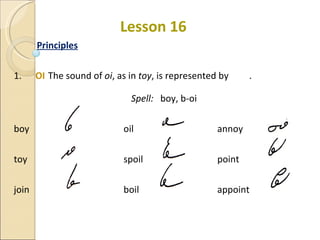
Lesson 16 Principles 1.  OI  The sound of  oi , as in  toy , is represented by  . Spell:  boy, b-oi boy   oil     annoy toy   spoil   point join     boil   appoint
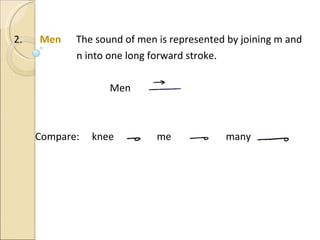
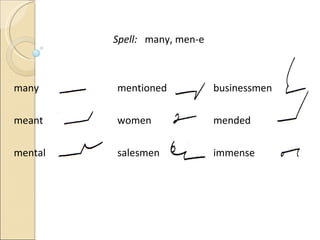
2.  Men   The sound of men is represented by joining m and  n into one long forward stroke. Men Compare:  knee   me   many
Spell:  many, men-e many   mentioned   businessmen meant   women   mended mental    salesmen   immense
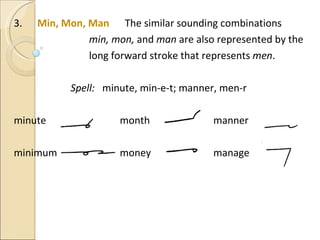
3.  Min, Mon, Man   The similar sounding combinations  min, mon,  and  man  are also represented by the  long forward stroke that represents  men . Spell:  minute, min-e-t; manner, men-r minute   month   manner minimum   money   manage
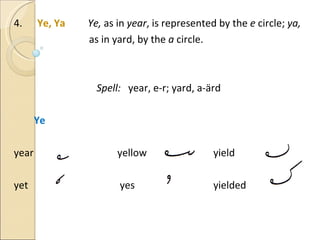
4.  Ye, Ya   Ye,  as in  year , is represented by the  e  circle;  ya,  as in yard, by the  a  circle. Spell:  year, e-r; yard, a-ärd Ye year     yellow   yield yet   yes     yielded
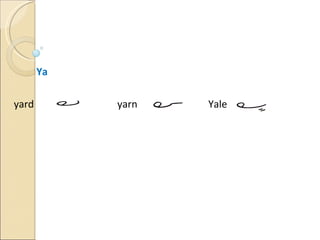
Ya yard   yarn    Yale
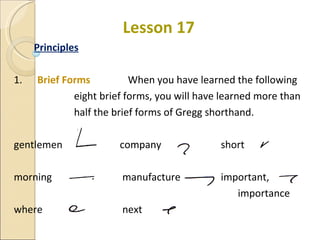
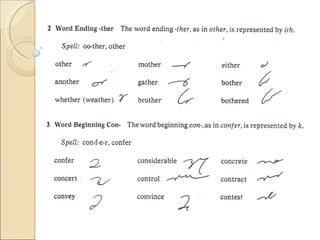
Lesson 17 Principles 1.   Brief Forms  When you have learned the following  eight brief forms, you will have learned more than  half the brief forms of Gregg shorthand. gentlemen    company   short morning   manufacture   important, importance where   next
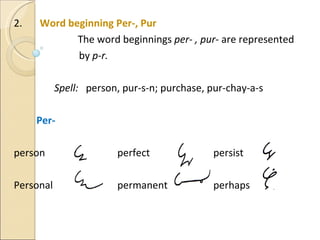
2.  Word beginning Per-, Pur The word beginnings  per- , pur-  are represented  by  p-r. Spell:  person, pur-s-n; purchase, pur-chay-a-s Per- person   perfect   persist Personal   permanent   perhaps
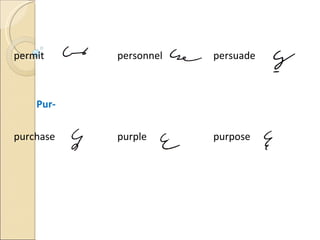
permit   personnel   persuade Pur- purchase   purple   purpose
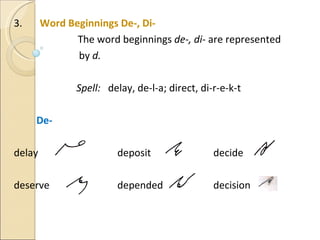
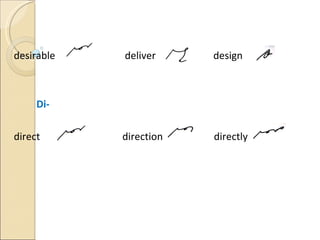
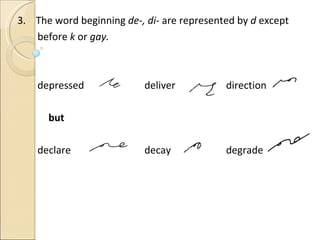
3.  Word Beginnings De-, Di- The word beginnings  de-, di-  are represented  by  d. Spell:  delay, de-l-a; direct, di-r-e-k-t De- delay   deposit   decide deserve   depended   decision
desirable   deliver   design Di- direct   direction   directly
Lesson 18 RECALL Lesson 18 is another “breather”.  It contains no new shorthand devices for you to learn.  In this lesson, you will find: 1.  several principles of joining, 2.  a recall chart, and 3.  a Reading and Writing practice that you will find interesting and informative.
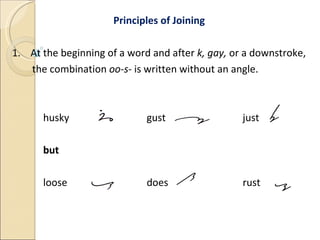
Principles of Joining 1.  At the beginning of a word and after  k, gay,  or a downstroke, the combination  oo-s-  is written without an angle. husky   gust   just but loose   does   rust
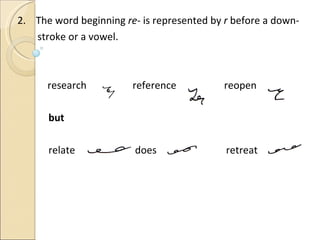
2.  The word beginning  re-  is represented by  r  before a down- stroke or a vowel. research   reference   reopen but relate     does   retreat
3.  The word beginning  de-, di-  are represented by  d  except before  k  or  gay. depressed deliver   direction but declare   decay   degrade
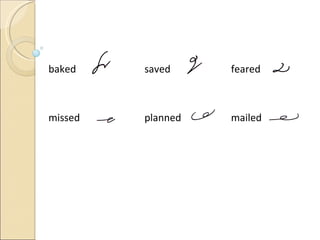
4.   As you have perhaps already noticed from your study of  Lesson 1 through 17, the past tense of a verb is formed by adding the stroke for the sound that is heard in the past tense.  In some words, the past tense has the sound of  t,  as in  baked;  in others, it has the sound of  d,  as in  saved.   In some words, the past tense is incorporated in a  blend, as in  planned, feared, mailed.
baked saved   feared missed planned   mailed
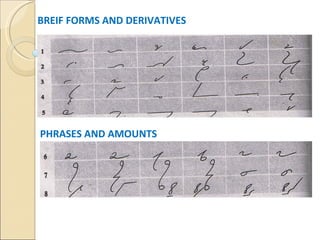
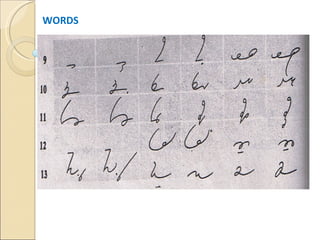
5.  Recall Chart   The following chart reviews the brief forms of Chapter 3 as well as the shorthand devices   you studied in Chapters 1, 2, and 3. The chart contains 96 words and phrases.  Can you read it in 8 minutes or less?
BREIF FORMS AND DERIVATIVES PHRASES AND AMOUNTS
WORDS
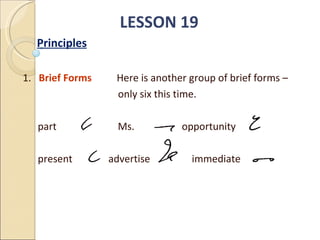
LESSON 19 Principles 1.  Brief Forms  Here is another group of brief forms –  only six this time. part Ms. opportunity present   advertise   immediate
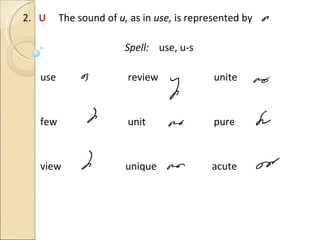
2.  U   The sound of  u,  as in  use,  is represented by  Spell:  use, u-s use   review unite few   unit pure view   unique   acute
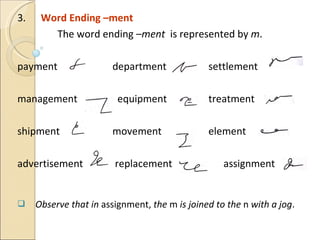
3.  Word Ending –ment The word ending  –ment  is represented by  m .  payment department settlement management   equipment treatment  shipment movement element advertisement  replacement   assignment Observe that in  assignment,  the  m  is joined to the  n  with a jog .
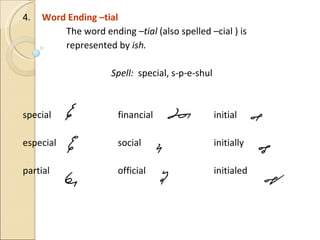
4.  Word Ending –tial  The word ending  –tial  (also spelled –cial ) is represented by  ish.  Spell:  special, s-p-e-shul special    financial initial especial social initially partial official initialed
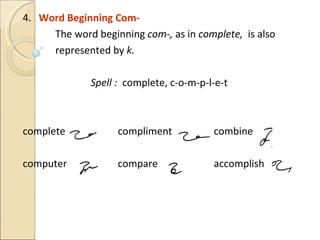
4.  Word Beginning Com-  The word beginning  com-,  as in  complete,  is also  represented by  k.  Spell :  complete, c-o-m-p-l-e-t complete compliment combine computer compare accomplish
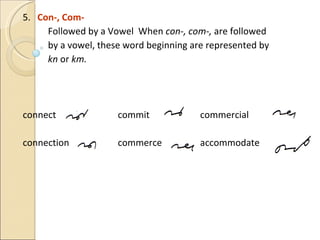
5.  Con-, Com- Followed by a Vowel  When  con-, com-,  are followed  by a vowel, these word beginning are represented by kn  or  km. connect commit   commercial connection commerce   accommodate
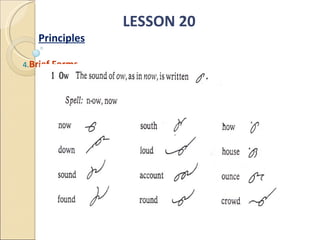
LESSON 20 Principles Brief Forms
 
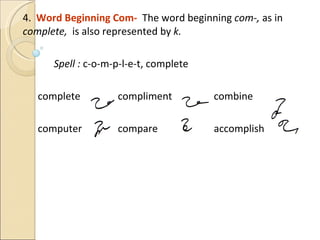
4.  Word Beginning Com-  The word beginning  com-,  as in  complete,  is also represented by  k.  Spell :  c-o-m-p-l-e-t, complete complete compliment combine computer compare accomplish
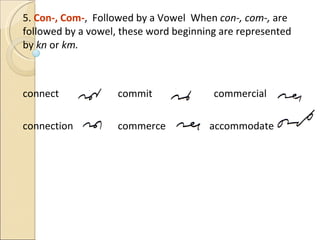
5.  Con-, Com- ,  Followed by a Vowel  When  con-, com-,  are followed by a vowel, these word beginning are represented by  kn  or  km. connect commit commercial connection commerce   accommodate
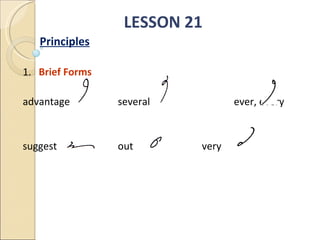
LESSON 21 Principles 1.  Brief Forms advantage several   ever, every suggest out   very
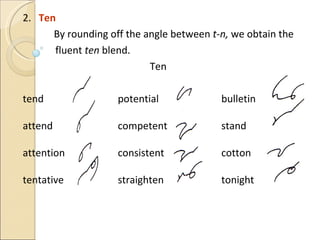
2.  Ten   By rounding off the angle between  t-n,  we obtain the  fluent  ten  blend. Ten tend  potential   bulletin attend competent   stand attention consistent   cotton tentative straighten   tonight
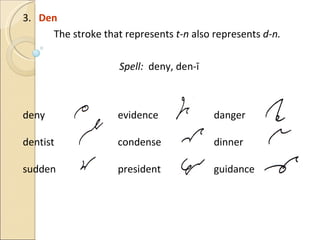
3.  Den   The stroke that represents  t-n  also represents  d-n.  Spell:  deny, den-ī deny   evidence danger dentist condense dinner sudden president guidance

Basic Shorthand P 1 boa

  • 1.
  • 2.
    Contents CHAPTER 1 CHAPTER 3 CHAPTER 5 CHAPTER 7 Lesson 1 Lesson 13 Lesson 25 Lesson 37 Lesson 2 Lesson 14 Lesson 26 Lesson 38 Lesson 3 Lesson 15 Lesson 27 Lesson 39 Lesson 4 Lesson 16 Lesson 28 Lesson 40 Lesson 5 Lesson 17 Lesson 29 Lesson 41 Lesson 6 Lesson 18 Lesson 30 Lesson 42 CHAPTER 2 CHAPTER 4 CHAPTER 6 CHAPTER 8 Lesson 7 Lesson 19 Lesson 31 Lesson 43 Lesson 8 Lesson 20 Lesson 32 Lesson 44 Lesson 9 Lesson 21 Lesson 33 Lesson 45 Lesson 10 Lesson 22 Lesson 34 Lesson 46 Lesson 11 Lesson 23 Lesson 35 Lesson 47 Lesson 12 Lesson 24 Lesson 36 Lesson 48
  • 3.
    Contents CHAPTER 9 APPENDICES Lesson 49 STATES Lesson 50 SELECTED CITIES OF THE UNITES STATES Lesson 51 COMMON GEOGRAPHICAL ABBREVIATIONS Lesson 52 THE METRIC SYSTEM Lesson 53 ADDITIONAL METRIC MEASUREMENTS Lesson 54 BRIEF FORMS OF GREEG SHORTHAND Lesson 55 Lesson 56
  • 4.
    Lesson1 Principles GROUP A 1. S-Z. Perhaps the most frequently used consonant in the English language is s , partly because of the great plurals that ends with s . The shorthand s is a tiny is a short downward curve that resembles the longhand comma in shape. S Because in the English language s often has the sound of z, as in saves, the same short stroke is used to express z .
  • 5.
    2. A very important sound in the English language is a. in Gregg shorthand a is simply the longhand a with the final connecting stroke omitted. The circle may be written in any direction.
  • 6.
    3. Silentletters. In English, there are many words containing letters that are not pronounced. In Gregg Shorthand, these silent letters are omitted; only the sounds that you are actually written. Example: the word say would be written s-a ; the y would not be written because it is not pronounced. In the following words, what letters would not be written because they are not pronounced? snow dough aid save main day right knee
  • 7.
    4. S-AWord. With the strokes for s and a , you can form the shorthand outline for the word say . say, s-a 5. F, V The next two shorthand you will learn are f and v.
  • 8.
    F Theshorthand stroke for f is a downward curve the same shape as s , but it is very long- approximately half the height of the space between the lines of your shorthand notebook. V The shorthand stroke for v is also a downward curve the same shape as s and f, but is very large – approximately the full height of the space between the lines of your shorthand notebook.
  • 9.
    Observe the differencein the sizes of s, f, and v . S F V F safe , s-a-f face, f-a-s safes, s-a-f-s Observe that the c in face is represented by the shorthand s because it has the sound of s .
  • 10.
    V save, s-a-v vase, v-a-s saves, s-a-v-s Observe that the final s in in saves has the z sound, which is represented by the s stroke.
  • 11.
    6. E Another very important vowel in the English language is e. In shorthand, e is represented by a tiny circle. It is simply the longhand e with the two connecting strokes omitted. The circle may be written in either direction. E Observe the difference between the sizes of a and e . A E
  • 12.
    see, s-e sees, s-e-s ease, e-s fee, f-e fees, f-e-s easy, e-s-e Observe that the y in easy is pronounced e ; therefore, it is represented by the e circle.
  • 13.
    GROUP B 7. N, M The shorthand stroke for n is a very short forward straight line. The shorthand stroke for m is a forward straight line. N M N see, s-e say, s-a vain, v-a-n seen, s-e-n sane, s-a-n knee, n-e
  • 14.
    Observe that thek and the final e in knee are not written because they are not pronounced. M may, m-a mean, m-e-n seem, s-e-m main, m-a-n aim, a-m same, s-am
  • 15.
    8. T, D The shorthand stroke for t is a short upward straight line. The shorthand stroke for d is a longer upward straight line. T D T eat, e-t meet, m-e-t stay, s-t-a neat, n-e-t tea, t-e safety, s-a-f-t-e
  • 16.
    D aid, a-dfeed, f-e-d stayed, s-t-a-d made, m-a-d day, d-a deed, d-e-d need, n-e-d date, d-a-t saved, s-a-v-d
  • 17.
    9. Punctuationand Capitalization period paragraph parentheses question mark dash hypen
  • 18.
    The regular longhandforms are used for all other punctuation marks. Capitalization is indicated by two upward dashes placed underneath the word to be capitalized. Dave Fay Mae
  • 19.
    Lesson 2 Principlesz 1. Alphabet Review Here are the nine shorthand strokes you studied in Lesson 1. How rapidly can you read them? 2. O, R, L In this paragraph you will study three extremely useful strokes— o, r, l
  • 20.
    O The shorthand stroke for o is a small deep hook. R The shorthand stroke for r is a short deep forward curve. L The shorthand stroke for l is a longer forward curve about three times as long as the stroke for. Observe how these three strokes are derived from their longhand forms. O R L Previous Next
  • 21.
    O no, n-o so, s-o own, o-n to, t-o-u-g-h phone, f-o-n stone, s-t-o-n do, d-o-u-g-h vote, v-o-t dome, d-o-m
  • 22.
    Observe that inthe words in the third column, the o is placed on its side before n and m. This enables us to obtain smoother, more easily written outlines than we would obtain if we wrote the o upright in these and similar words. R ear, e-r raid, r-a-d fear, f-e-r near, n-e-r trade, t-r-a-d fair, f-a-r mere, m-e-r or, o-r radio, r-a-d-e-o dear, d-e-r more, m-o-r freed, f-r-e-d Previous Next
  • 23.
    L ail, a-l lay, l-a real, r-e-l mail, m-a-l late, l-a-t leave, l-e-v deal, d-e-l feel, f-e-l low, l-o steal, s-t-e-l fail, f-a-l floor, f-l-o-r
  • 24.
    Observe that f-r,as in freed, and f-l, as in floor, are written one sweep of the pen, with no stop between the f and the r or l. freed floor 3. H, -ing. The letter h is a dot placed above the following vowel. With few exceptions, h occurs at the beginning of a word. Ing , which almost always occurs at the end of a word, is also represented by a dot. Previous Next
  • 25.
    H He, h-e home, h-o-m whole, h-o-l -ing hearing, heating, mailing, h-e-r-ing h-e-t-ing m-a-l-ing
  • 26.
    4. LongI The shorthand for the long sound of I, as in my, is a large broken circle. I my, m- ī sight, s- ī -t high, h- ī might, m-ī-t side, s- ī -d try, t-r- ī sign, s- ī -n line, l- ī -n tire, t- ī -r Previous Next
  • 27.
    Omission of MinorVowels Many words in the English language contain vowels that are sounded only slightly or are slurred. For example, the word even is really pronounced e-vn ; meter is pronounced met-r , (The dictionary call these minor vowels “ schwas ”) These vowels are omitted in shorthand when their omission does not detract from facility of writing or from legibility. Evening, e-v-n-ing writer, r-i-t-r season, s-e-s-n meter, m-e-t-r vital, v-i-t-l total, t-o-t-l Dealer, d-e-l-r final,f-i-n-l heater, h-e-t-r 5 Previous Next
  • 28.
    Lesson 3 Principles 1. Alphabet Review You have already studied 14 alphabet strokes. How fast can you identify them?
  • 29.
    2. Briefforms There are some words in the English language that occur again and again when we speak or write. As an aid to rapid writing, special abbreviations, called brief forms, are provided for some of these common words. This process of abbreviation is common in longhand. For example, we abbreviate Street to St.; Mister to Mr.; Saturday to Sat. Because the words for which brief forms have been provided occur so frequently, be sure you learn them well.
  • 30.
    I have it,at am will, well in,*not Mr. a, an are, our, hour * In - is also used as a word beginning in words like: indeed, in-d-e-d inside, in-s-ī-d invite, in-v-ī-t
  • 31.
    Did you observethat some shorthand outlines have two or more meanings such as the shorthand forms for are, our, hour ; will, well ? You will have no problem selecting the correct meaning of a brief form when it appears in a sentence. The sense, or context, will give you the answer. 3. Phrasing The use of brief forms for common words enables you to save time. Another device for saving writing time is called “ phrasing ,” or the writing of two or more shorthand outlines together. Here are a number of phrases built with the brief forms you have studied.
  • 32.
    I have I will have I am I have not he will in our I will he will not it will
  • 33.
    4. LeftS-Z Earlier you learned one stroke for s and z. Another stroke for s and z is also used in order to provide an easy joining in any combination of strokes – a backward comma, which is also written-downward. For convenience, it is called the “left s.” At this point, you need not try to decide which s stroke to use in any given word; this will become clear to you as your study of Gregg Shorthand progresses.
  • 34.
    needs,n-e-d-s least, l-e-s-t series, s-e-r-e-s names, n-a-m-s writes, w-r-ī- t-s seal, s-e-l rise, r-ī-s mails, m-a-l-s sales, s-a-l-s most, m-o-s-t seems, s-e-m-s homes, h-o-m-s
  • 35.
    5. P,B The shorthand stroke for p is a downward curve the same shape as the left s except that it is longer– approximately half the height of the space between the lines in your shorthand notebook. The shorthand stroke for b is also a downward curve the same shape as the left s and p except that is much longer – approximately the full height of the space between the lines in your shorthand notebook.
  • 36.
    Observe the differencein the sizes of the s, p, and b. S P B P hope, h-o-p space, s-p-a-s paper, p-a-p-r place, p-l-a-s please, p-l-e-s pay, p-a provide, p-r-o-v-ī-d
  • 37.
    prepare, p-r-e-p-a-r spare,s-p-a-r type, t-ī-p B bay, b-a buy, b-I able, a-b-l base, b-a-s brief, b-r-e-f labor, l-a-b-r bare, b-a-r bright, b-r-i-t neighbor, n-a-b-r boat, b-o-t blame, b-l-am label, l-a-b-l
  • 38.
    Observe that thecombinations p-r, as in price; p-l, as in please; b-r, as in bright; and b-l , as in blame, are written with one sweep of the pen without a pause between the p or b and the r or l. price please bright blame
  • 39.
    Lesson 4 PrinciplesAlphabet Review You have already studied 17 alphabet strokes. How fast can you identify them?
  • 40.
    OO Theshorthand stroke for the sound of oo , as in to , is a tiny upward hook. OO to, (two, too), t-oo suit, s-oo-t produce, p-r-o-d-u-s do (due), d-oo room, r-oo-m new (knew) who, h-oo poor, p-oo-r noon, n-oo-n food, f-oo-d true, t-r-oo move, m-oo-v
  • 41.
    Observe that the oo is placed on its side when it follows n or m, as in new, noon, move. By placing the hook on its side in these combinations rather than writing it upright, we obtain smooth joinings. 3. W, Sw At the beginning of words w, as in we, is represented by the oo hook; sw, as in sweet, by s-oo. we, oo-e wade, oo-a-d sweet, s-oo-e-t way, oo-a wear, oo-a-r sway, s-oo-a wait, oo-a-t wife, oo- ī-f swear, s-oo-a-r
  • 42.
    4 . Wh Wh , as in why and while, is also represented by the oo hook. why, oo-ī white, oo-ī-t whale, oo-a-l while, oo-ī-l wheel, oo-e-l wheat, oo-e-t 5. Useful Phrases Here are a number of useful phrases that use the oo hook. we are we may who will not we will who are I do we have who will I do not
  • 43.
    6. K,G The shorthand stroke for k is a short forward curve. The shorthand stroke for the hard sound of g, as in game, is a much longer forward curve. It is called gay. take, t-a-k week (weak), oo-e-k clear, k-l-e-r cake, k-a-k cool, k-oo-l increase, in-k-r-e-s make, m-a-k case, k-a-s claim, k-l-a-m came, k-a-m scale, s-k-a-l clean, k-l-e-n
  • 44.
    gain, go, gale, gay-a-n gay-o gay-a-l game, goal, glue, gay-a-m gay-o-l gay-l-oo gate, great, legal, gay-a-t gay-r-a-t gay-r-a-t gave, grade, gleam, gay-a-v gay-r-a-d gay-l-e-m Observe the difference in the size and shape of oo, k, and gay.
  • 45.
    Observe that k-r , as in increase, and gay-l, as in legal, are written with a smooth wavelike motion. But k-l, as in claim, and gay-r, as in great, are written with a hump between the k and the l and the gay and the r.
  • 46.
    Lesson 5 Principles1. Alphabet Review In lesson 1 through 4, you studied 20 shorthand strokes. See how fast you can read them.
  • 47.
    2. A,Ä The large circle that represents the long sound of a, as in main, also represents the vowel sounds heard in as and arm. as, a-s man, m-a-n past, p-a-s-t has, h-a-s back, b-a-c-k plan, p-l-a-n act, a-k-t matter, m-a-t-r swam, s-oo-a-m
  • 48.
    arm, a-r-m car, k-a-r start, s-t-a-r-t art, a-r-t far, f-a-r dark, d-a-r-k heart, h-a-r-t farm, f-a-r-m park-p-a-r-k 3. E, I, Obscure Vowel The tiny circle that represents the sound of e , as in heat, also represents the vowel sound. (called “schwa” in some dictionaries) in her, hurt.
  • 49.
    E let, l-e-t get, gay-e-t said, s-a-d letter, l-e-t-r head, h-e-d sell, s-e-l address, a-d-r-e-s help, h-e-l-p tell, t-e-l best, b-e-s-t less, l-e-s test, t-e-s-t I him, h-e-m did, d-e-d if, e-f bill, b-e-l fill, f-e-l list, l-e-s-t big, b-e-gay give, gay-e-v simple, s-e-m-p-l
  • 50.
    Obscure Vowel her,h-e-r clerk, k-l-e-r-k answer, a-n-s-e-r hurt, h-e-r-t serve, s-e-r-v insert, in-s-e-r-t earn, e-r-n learn, l-e-r-n infer, in-f-e-r 4. Th Two tiny curves written upward, are provided for the sounds of th. These curves are called “ith.”
  • 51.
    At this time,you need to try to decide which th stroke to use in a word; this will become clear to you as you you study of Gregg Shorthand progresses. Over Ith these, ith-e-s theater, ith,e-t-r teeth, t-e-ith then, ith-e-n thick, ith-e-k faith, f-a-ith theme, ith-e-m thief, ith-e-f truth, t-r-oo-ith Next Previous
  • 52.
    Under Ith though,ith-o both, b-o-ith health, h-e-l-ith those, ith-o-s birth, b-r-ith thorough, ith-e-r-o three, ith-r-e earth, e-r-ith through, ith-r-oo
  • 53.
    5. BriefForms Here is another group of brief forms for frequently used words. You will be wise to learn them well. the you, your is, his that can Mrs. with of but
  • 54.
    6. CommonPhrases Here are some useful phrases employing these brief forms. in the with you it is in that I can in his you are I cannot with his Observe that in the phrases in the third column, the left s is used for is and his.
  • 55.
    Lesson 6 RECALLLesson 6 is a “breather”; it contains no new shorthand principles for you to learn. In this lesson, you will find an Alphabet Review, a simple explanation of the principles that govern the joining of the strokes you have studied, a recall chart.
  • 56.
    Principles 1. Alphabet Review Here are the 22 shorthand strokes you studied in Lesson 1 through 5. Can you read them in 20 seconds or less?
  • 57.
    Principles of JoiningsAs a matter of interest, you might like to know the principles under which the words you have already learned are written. Notice the groups into which the joinings naturally fall. Circles are written inside curves and outside angles appeal, a-p-e-l late, l-a-t same, s-a-m give, gay-e-v relief, r-e-l-e-f needless, n-e-d-l-e-s
  • 58.
    3 . Circles are written clockwise (in the direction ) on a straight stroke or between two straight strokes in the same direction. may, m-a date, d-a-t aim, a-m man, m-a-n stayed, s-t-ad name, n-a-m
  • 59.
    4. Betweentwo curves written in opposite direction, the circle is written on the back of the first curve. care, k-a-r gear, gay-e-r vapor, v-a-p-r rack, r-a-k lake, l-a-k pave, p-a-v 5. The o hook is written on its side before n, m unless a downward stroke comes before the hook. own, o-n stone, s-t-o-n loan, l-o-n but phone, f-o-n bone, b-o-n zone, s-o-n
  • 60.
    6 The oo hook is written on its side after n, m. news, n-oo-s noon-n-oo-n moved, m-oo-v-d 7. The under ith is used when it is joined to o, r, l; in other cases, the over ith is used. though, ith-o through, ith-r-oo health, h-e-l-ith but these, ith-e-s thick, ith-e-k then, ith-e-n
  • 61.
    8. RecallChart The following chart reviews the shorthand devices you studied in Lesson 1 through 5. Spell each word aloud thus: ith-o, though. You need not spell the brief forms and phrases as you read them. The chart contains 84 words and phrases. Can you read the entire chart in 9 minutes or less? N
  • 62.
  • 63.
    Lesson 7 PrinciplesSh, Ch, J These three sounds are represented by downward straight lines. Ish Chay J
  • 64.
    Sh Theshorthand stroke for sh (called “ish”) is a very short downward straight stroke. Ish she, ish-e share, ish-a-r ship, ish-e-p shown, ish-o-n issue, e-ish-oo insure, in-ish-o-r
  • 65.
    Ch The shorthand stroke for ch (called “chay”) is somewhat longer straight downward stroke approximately one-half the height of the space between the lines in your shorthand notebook. Chay check, chair, search, c-chay-e-k chay-a-r s-e-r-chay choose, teach, church, chay-oo-s t-e-chay chay-e-r-chay
  • 66.
    J Theshorthand stroke for the sound of j, as in jury, is long downward straight stroke almost the full height of the space between the lines in your shorthand notebook. J age, a-j change, chay,a,n,j jury, j-oo-r-y wages, oo-a-j-s large, l-a-r-j jewels, j-oo-l-s
  • 67.
    2. O,Aw The small deep hook that represents the sound of o, as in no, also, represents the vowel hot and all. O hot, h-o-t office, o-f-e-s sorry, s-o-r-e copy, k-o-p-e policy, stop, s-t-o-p p-o-l-s-e job, j-o-b stock, s-t-o-k watch, oo-o-chay
  • 68.
    Aw all, o-l bought, b-o-ith author, o-ith-r small, thought, ith-o-t install, s-m-o-l in-s-t-o-l cause, k-o-s daughter, wall, oo-o-l d-o-t-r
  • 69.
    3. Common Business Letter Salutations and Closings Dear Sir Dear Madam Yours truly Sincerely yours Yours very truly Very truly yours
  • 70.
    Note: Although the expressions Dear Sir, Dear Madam, and Yours truly are considered too impersonal by letter-writing experts, they are still used by many dictations. Therefore, special abbreviations have been provided for them.
  • 71.
    Lesson 8 Principles1. Brief Forms Here is another group of nine brief forms for very common words. Learn them well. would this them for good which there (their) they be,*by
  • 72.
    * Be is also used as a word beginning in words such as believe and because. Spell: believe, be-l-i-v believe because begin
  • 73.
    2. WordEnding –ly The common word ending – ly is represented by the e circle. Spell: lately, l-a-t-l ē lately mainly mostly nearly plainly only badly briefly highly costly namely daily
  • 74.
    Observe that in highly the small circle for –ly is written inside the large circle; that in daily, it is added to the side of the d after the a has been written.
  • 75.
    3. Amountsand Quantities When you take dictation in the business office, you will frequently have occasion to write amounts and qualities. Here are some devices that will enable you to write them rapidly. 600 $12 $ 3.40 8,000 $3,000 8 percent 800,000 $700,000 7 o’clock
  • 76.
    Observe that the n for hundred and the ith for thousand are placed underneath the figure.
  • 77.
    Lesson 9 Principles1. Word Ending –tion The word ending –tion (sometimes spelled - sion, -cian, or –shion ) is represented by ish.
  • 78.
    Spell: action,a-k-shun action operation national occasion physician nationally election fashion cautioned position nations inflation
  • 79.
    2. WordEnding –cient, -ciency The word ending –cient (or –tient ) is represented by ish-t; -ciency, by –ish-s-e. Spell: patient, p-a-shun-t patient ancient efficiency patiently efficient proficiency
  • 80.
    3. Tfor To in Phrases In phrases, to is represented by t when is followed by a down stroke. to have to check to sell to be to buy to serve to say to plan to charge to see to place to change
  • 81.
    Lesson 10 Principles1. Nd The shorthand strokes for –nd are joined without an angle to form the nd blend, as in signed. Nd sign signed
  • 82.
    Spell: signed, s-i-end;endorse, end-o-r-s land friend kind planned spend mind trained happened bind errand brand endorse
  • 83.
    2. NtThe stroke that represents nd also represents nt, as in sent.
  • 84.
    Spell: sent, s-e-ent;into, ent-oo sent printed agent rent painted vacant prevent planted into current parents entire
  • 85.
    3. Ses The sound of ses, as in senses, is represented by joining the two forms of s. Compare: sense senses face faces
  • 86.
    Spell: senses, s-e-n-sezplaces causes reduces prices chances produces addresses increases cases glasses necessary services
  • 87.
    4. Sis,Sus The similar sounds of sis, as in sister, and sus, as in versus, are also represented by joining the two forms of s.
  • 88.
    Spell: sister, sez-t-r;versus, v-e-r-sez sister assist analysis basis insist versus
  • 89.
    Lesson 11 Principles1. Brief Forms Here are some more brief forms for very common words. when after and were could from send should street
  • 90.
    2 . Rd The combination rd is represented by writing the r with an upward turn the finish. Compare: assure assured Spell: assured, a-ish-oo-ärd; heard, h-e-ärd assured toward record hired guard hardest insured guarded heard
  • 91.
    3. Ld the combination ld is represented by writing the l with an upward turn at the finish. Compare: mail mailed Spell: mailed, m-a-eld; old, o-eld mailed failed build old filled builder sold told folded
  • 92.
    4. Beenin Phrases The word been is represented by b after have, has, had. have been had been I could have been I have been I have not been I should have been you have been it has been had not been
  • 93.
    5. Ablein Phrases The word been is represented by a after be or been. I have been able I should be able I have not been able you will be able you have been able you should be able you have not been able I may be able
  • 94.
    Lesson 12 RECALLLesson 12 is another “breather”; it presents no new devices for you to learn. It reviews the shorthand strokes you learned in previous lessons.
  • 95.
    Principle of Joining The following principles deal with the joinings of the two forms of s . 1. At the beginning and end of words, the comma s is used before and after f, v, k, gay, the left s, before and after p,b, r, l. saves sips series seeks globes rags
  • 96.
    2. Thecomma s is used before t, d, n, m, o; the left s is used after those strokes. stones solos needs 3. The comma s is used before and after ish, chay, j. sessions reaches stages
  • 97.
    . Thecomma s is used before and after ish, chay, j. say these seethe
  • 98.
    5. Gregg Shorthand is equally legible whether it is written on ruled or unruled paper; consequently, you need not worry about the exact placement of your outlines on the printed lines n your notebook. The main purpose of the printed lines in your notebook is to keep you from wandering uphill and downhill as you write. However, so that all outlines may be uniformly placed in the shorthand books from which you study, this general rule has been followed.
  • 99.
    The base ofthe first consonant of a word is placed on the line of writing. When s comes before a downstroke, however, the downstroke is placed on the line of writing. name safe pace dealer chief space
  • 100.
    6. RecallChart The following chart contains the brief forms presented in Chapter 2 and illustrations of the shorthand principles you studied in Chapters 1 and 2. Can you read the chart in 6 minutes or less?
  • 101.
    BRIEF FORMS PHRASESAND AMOUNTS End
  • 102.
  • 103.
    Lesson 13 Principles1. Brief Forms work circular enclose yesterday order was glad soon thank
  • 104.
    2. Brief-FormDerivatives and Phrases thanks gladly thank you worked ordered thank you for Observe: 1. Thanks is written with a disjoined left s in the dot position. 2. The d representing the past tense of order is joined with a jog. 3. The dot in thank is omitted in phrases .
  • 105.
    3. U,OO The hook that represents the sound of oo as in to, also represents the vowel sounds in does and book. Spell: does, d-oo-s does none us drug number just up enough adjust
  • 106.
    product must precious Observe: 1. The hook in the second column is turned on its side. 2. The oo-s in the words in the third column is joined without an angle.
  • 107.
    OO Spell: book, b-oo-k book put pull cook push stood look foot sugar took full wood
  • 108.
    Lesson 14 Principles1. W in the body of a Word When the sound of w occurs in the body of a word, as in quick, it is represented by a short dash underneath the vowel following the w sound. The dash is inserted after the rest of the outline has been written.
  • 109.
    Spell : quick, k-oo-e-k quick between qualify quote square hardware quit twice roadway equip twine always
  • 110.
    2. TedThe combination ted is represented by joining t and d into one long upward stroke. Ted Compare: heat heed heated
  • 111.
    Spell: heated, h-e-ted listed accepted adopted acted rested located tested dated steady quoted visited today
  • 112.
    3. Ded, Dit, Det The long stroke that represents ted also ded and the similar sounds of dit and det. Spell: guided, gay-i-ded; detail, det-a-l guided graded deduct needed added deduction
  • 113.
    Det,Dit detail credit edit debtor creditor audited Observe that the d represents the past tense in audited is joined to dit with a jog.
  • 114.
    Lesson 15 Principles1. Brief Forms business what value doctor about than any thing, think one (won)
  • 115.
    2 . Brief-Form Derivatives things, thinks anything businesses thinking once businessman Observe : 1. A disjoined left s is used to express by b. 2. The plural of business is formed by adding another left s.
  • 116.
    3. WordEnding –ble The word ending – ble is represented by b. Spell: possible, p-o-s-bul possible terrible double available valuable table reliable favorable tabled capable sensible cables
  • 117.
    4. WordBeginning Re- The word beginning re- is represented by r. Spell : receive, r-e-s-e-v receive revise reasonable reply repair reappear research reception rearrange replace receipt reopen
  • 118.
    Lesson 16 Principles1. OI The sound of oi , as in toy , is represented by . Spell: boy, b-oi boy oil annoy toy spoil point join boil appoint
  • 119.
    2. Men The sound of men is represented by joining m and n into one long forward stroke. Men Compare: knee me many
  • 120.
    Spell: many,men-e many mentioned businessmen meant women mended mental salesmen immense
  • 121.
    3. Min,Mon, Man The similar sounding combinations min, mon, and man are also represented by the long forward stroke that represents men . Spell: minute, min-e-t; manner, men-r minute month manner minimum money manage
  • 122.
    4. Ye,Ya Ye, as in year , is represented by the e circle; ya, as in yard, by the a circle. Spell: year, e-r; yard, a-ärd Ye year yellow yield yet yes yielded
  • 123.
    Ya yard yarn Yale
  • 124.
    Lesson 17 Principles1. Brief Forms When you have learned the following eight brief forms, you will have learned more than half the brief forms of Gregg shorthand. gentlemen company short morning manufacture important, importance where next
  • 125.
    2. Wordbeginning Per-, Pur The word beginnings per- , pur- are represented by p-r. Spell: person, pur-s-n; purchase, pur-chay-a-s Per- person perfect persist Personal permanent perhaps
  • 126.
    permit personnel persuade Pur- purchase purple purpose
  • 127.
    3. WordBeginnings De-, Di- The word beginnings de-, di- are represented by d. Spell: delay, de-l-a; direct, di-r-e-k-t De- delay deposit decide deserve depended decision
  • 128.
    desirable deliver design Di- direct direction directly
  • 129.
    Lesson 18 RECALLLesson 18 is another “breather”. It contains no new shorthand devices for you to learn. In this lesson, you will find: 1. several principles of joining, 2. a recall chart, and 3. a Reading and Writing practice that you will find interesting and informative.
  • 130.
    Principles of Joining1. At the beginning of a word and after k, gay, or a downstroke, the combination oo-s- is written without an angle. husky gust just but loose does rust
  • 131.
    2. Theword beginning re- is represented by r before a down- stroke or a vowel. research reference reopen but relate does retreat
  • 132.
    3. Theword beginning de-, di- are represented by d except before k or gay. depressed deliver direction but declare decay degrade
  • 133.
    4. As you have perhaps already noticed from your study of Lesson 1 through 17, the past tense of a verb is formed by adding the stroke for the sound that is heard in the past tense. In some words, the past tense has the sound of t, as in baked; in others, it has the sound of d, as in saved. In some words, the past tense is incorporated in a blend, as in planned, feared, mailed.
  • 134.
    baked saved feared missed planned mailed
  • 135.
    5. RecallChart The following chart reviews the brief forms of Chapter 3 as well as the shorthand devices you studied in Chapters 1, 2, and 3. The chart contains 96 words and phrases. Can you read it in 8 minutes or less?
  • 136.
    BREIF FORMS ANDDERIVATIVES PHRASES AND AMOUNTS
  • 137.
  • 138.
    LESSON 19 Principles1. Brief Forms Here is another group of brief forms – only six this time. part Ms. opportunity present advertise immediate
  • 139.
    2. U The sound of u, as in use, is represented by Spell: use, u-s use review unite few unit pure view unique acute
  • 140.
    3. WordEnding –ment The word ending –ment is represented by m . payment department settlement management equipment treatment shipment movement element advertisement replacement assignment Observe that in assignment, the m is joined to the n with a jog .
  • 141.
    4. WordEnding –tial The word ending –tial (also spelled –cial ) is represented by ish. Spell: special, s-p-e-shul special financial initial especial social initially partial official initialed
  • 142.
    4. WordBeginning Com- The word beginning com-, as in complete, is also represented by k. Spell : complete, c-o-m-p-l-e-t complete compliment combine computer compare accomplish
  • 143.
    5. Con-,Com- Followed by a Vowel When con-, com-, are followed by a vowel, these word beginning are represented by kn or km. connect commit commercial connection commerce accommodate
  • 144.
  • 145.
  • 146.
    4. WordBeginning Com- The word beginning com-, as in complete, is also represented by k. Spell : c-o-m-p-l-e-t, complete complete compliment combine computer compare accomplish
  • 147.
    5. Con-,Com- , Followed by a Vowel When con-, com-, are followed by a vowel, these word beginning are represented by kn or km. connect commit commercial connection commerce accommodate
  • 148.
    LESSON 21 Principles1. Brief Forms advantage several ever, every suggest out very
  • 149.
    2. Ten By rounding off the angle between t-n, we obtain the fluent ten blend. Ten tend potential bulletin attend competent stand attention consistent cotton tentative straighten tonight
  • 150.
    3. Den The stroke that represents t-n also represents d-n. Spell: deny, den-ī deny evidence danger dentist condense dinner sudden president guidance