Introduction to Electro Pneumatics
Contents :-
1. What is Electro-Pneumatics : a definition
2. Electro-Pneumatic Signal Control system
3. Electro-Pneumatics Basic control components
4. Application Example
Introduction to Electro Pneumatics
WikiAnswers.com wrote,
Pneumatics is a method to transfer energy from one point to another
using actuators which are driven by fluids under pressure.
Pneumatics restricts itself to gaseous fluids while hydraulics uses
liquids to transfer the energy.
The transferring of energy in pneumatics such as pumping air into a
pneumatic cylinder must be controlled.
You can control the pressure by manually opening a valve,
automatically by detecting its pressure, or by sending an electrical
signal. The control of pneumatic components by electrical
impulses is known as electro-pneumatics.
1.1 Definition of Electro-Pneumatics
Introduction to Electro Pneumatics
Both pneumatic & electro-pneumatic controllers have
a pneumatic power section. In an electro-pneumatics
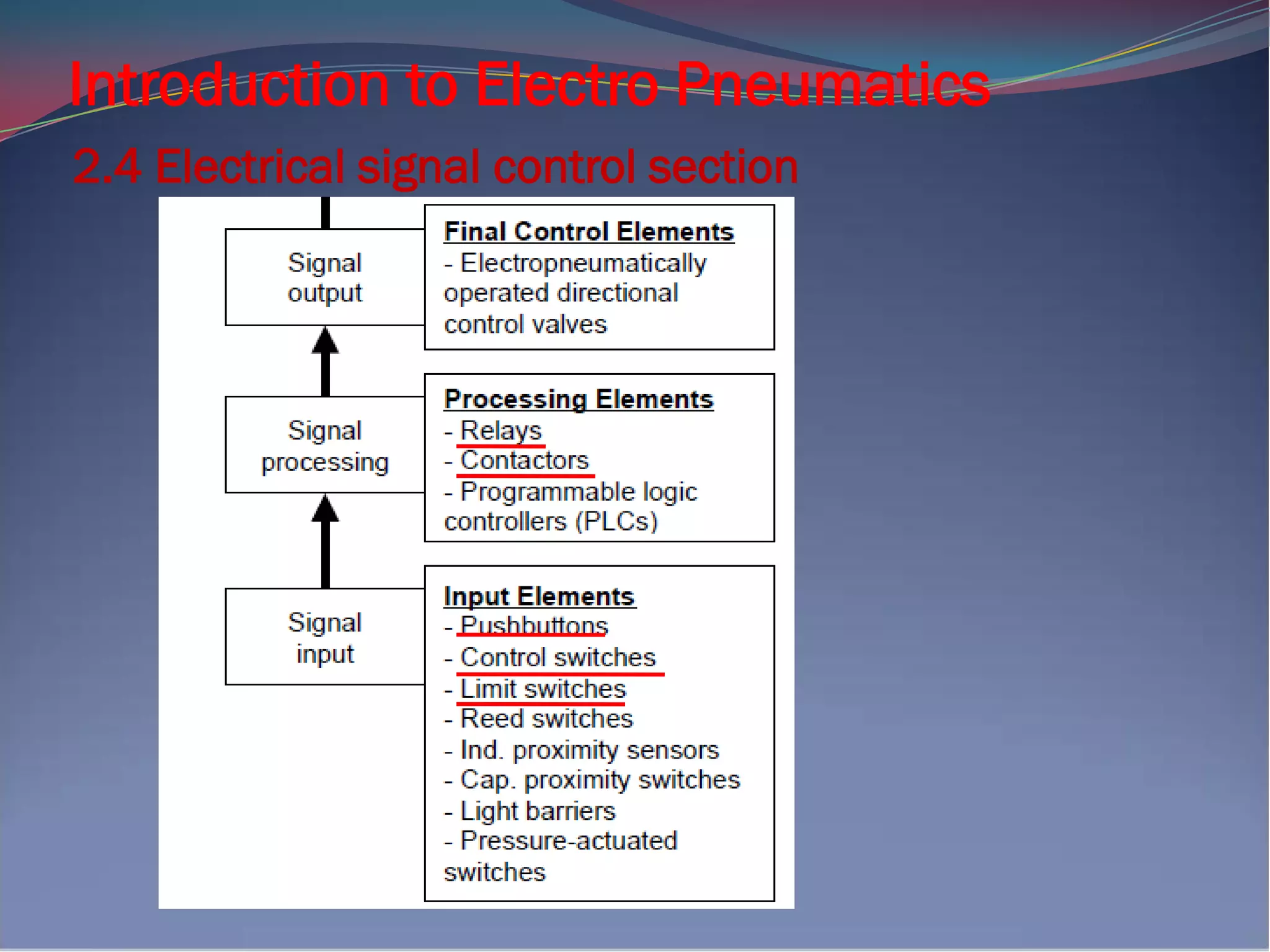
control, the signal control section is made up of a
electrical components, such as electrical input
buttons, proximity switches, relays, or a
programmable logic controller (PLC).
Source : Electropneumatics – A basic, G Prede, D Scholz
Question 1 :
What is your definition for Electro-Pneumatics?
_____________________________________
_____________________________________
[3 marks]
1.2 Other Definition of Electro-Pneumatics
Introduction to Electro Pneumatics
Definition :
 Electro-pneumatic term is defined from the words of
electro which means electrical and pneumatic which
means air pressure.
 The electro-pneumatics equipments and system is
an integration of electrical and mechanical
components with compressed air source.
 Electro pneumatic is a pneumatic control system
where air pressure and direction of valve are
controlled by an electrical current.
1.3 Our Definition of Electro-Pneumatics
Introduction to Electro Pneumatics
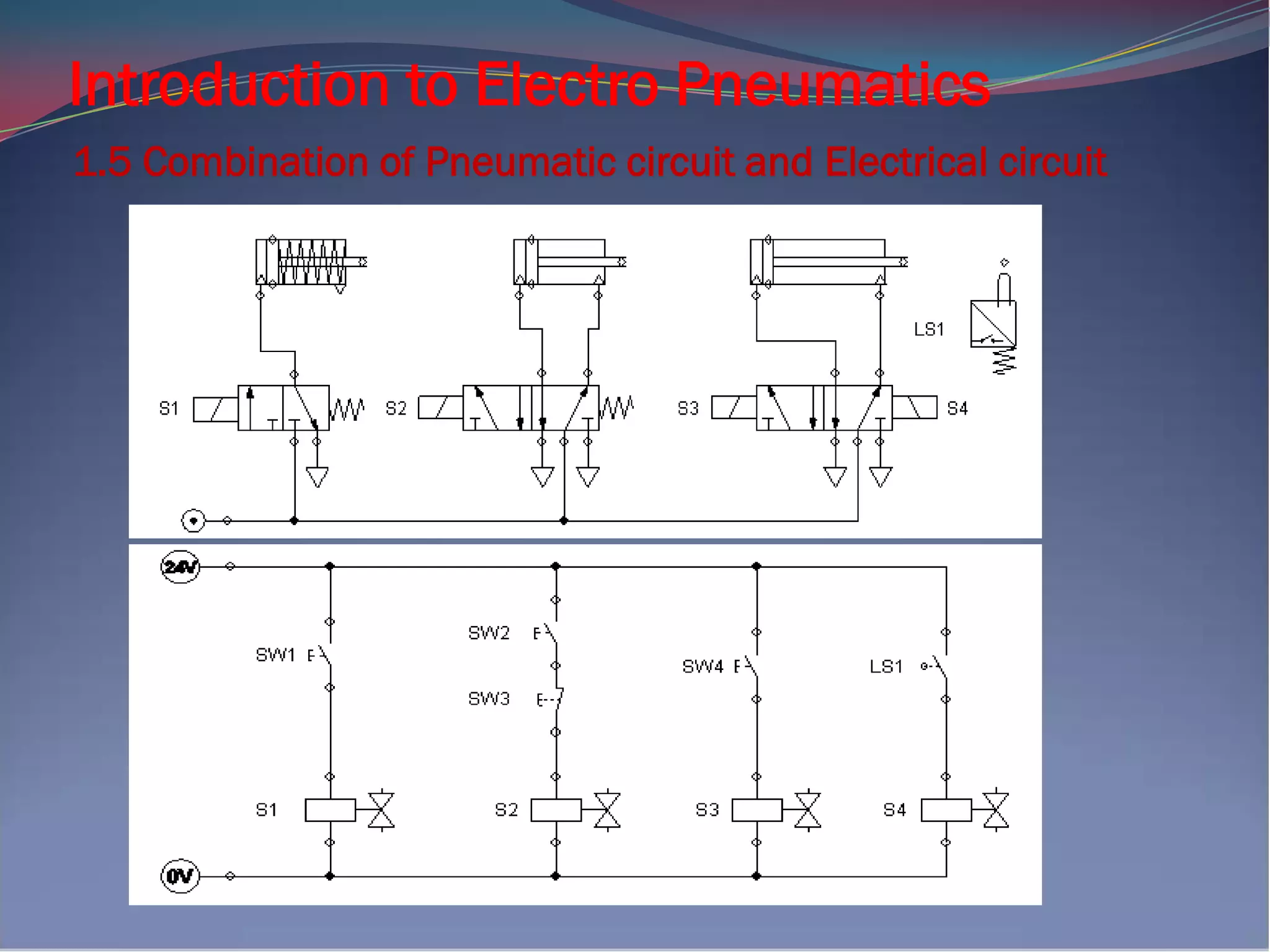
 Electro pneumatic is integration of two control circuit
1. Pneumatic Circuit
2. Electrical Circuit
1.4 Electro-Pneumatics’ circuit
Introduction to Electro Pneumatics
(a)
Pneumatic circuit
Introduction to Electro Pneumatics
(b)
Electrical circuit
Introduction to Electro Pneumatics
1.5 Combination of Pneumatic circuit and Electrical circuit
Introduction to Electro Pneumatics
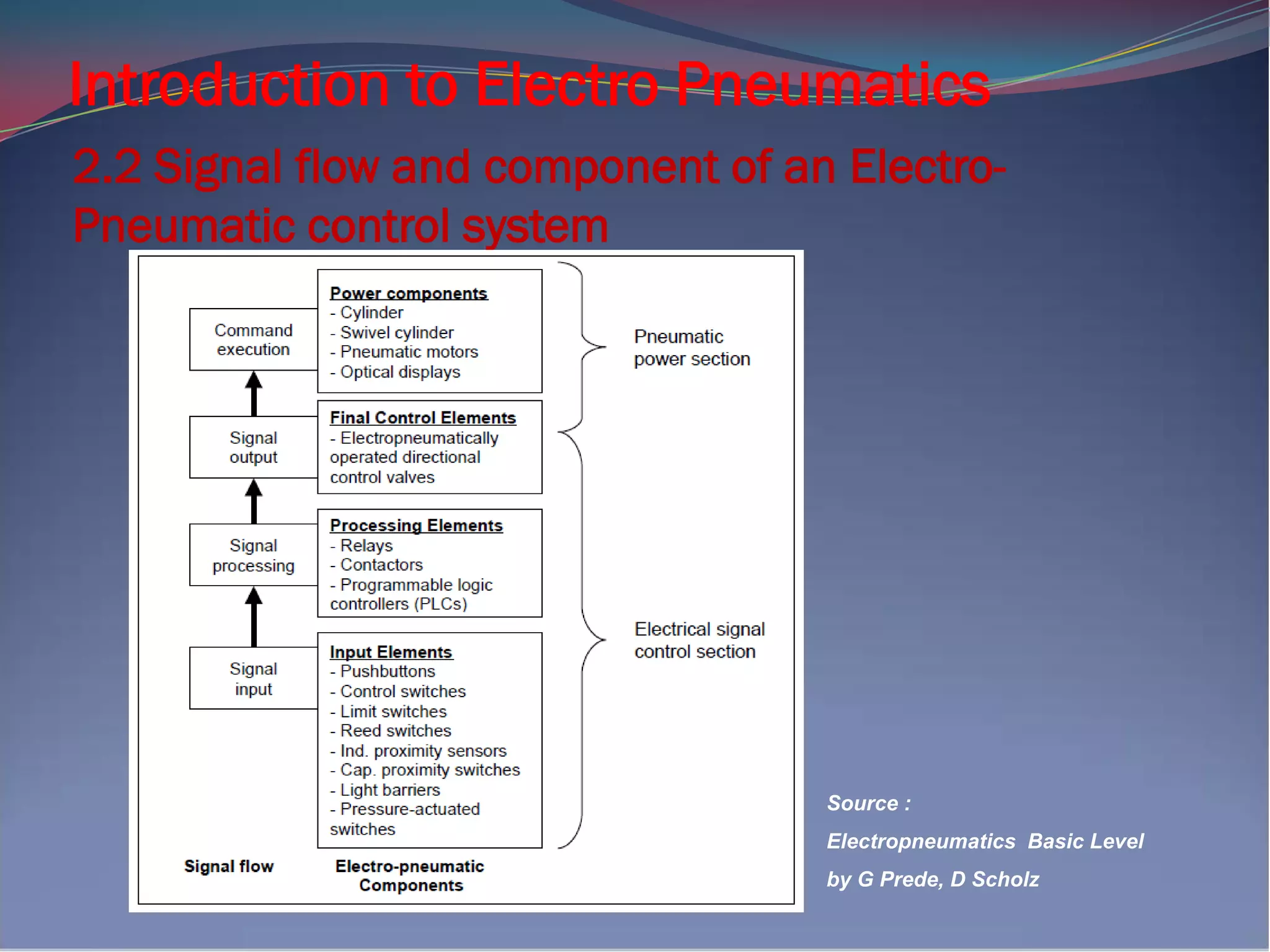
2.1 A Background – Basic Control system
Command
Execution
Signal
Output
Signal
Processing
Signal
Input
Power component
Final Control element
Processing element
Input element
Introduction to Electro Pneumatics
2.2 Signal flow and component of an Electro-
Pneumatic control system
Source :
Electropneumatics Basic Level
by G Prede, D Scholz
Introduction to Electro Pneumatics
2.3 Pneumatic power section
Directional control valves form the interface
between the signal control section (electrical) and
the pneumatic power section in an Electro-
pneumatic system.
Introduction to Electro Pneumatics
2.4 Electrical signal control section
Introduction to Electro Pneumatics
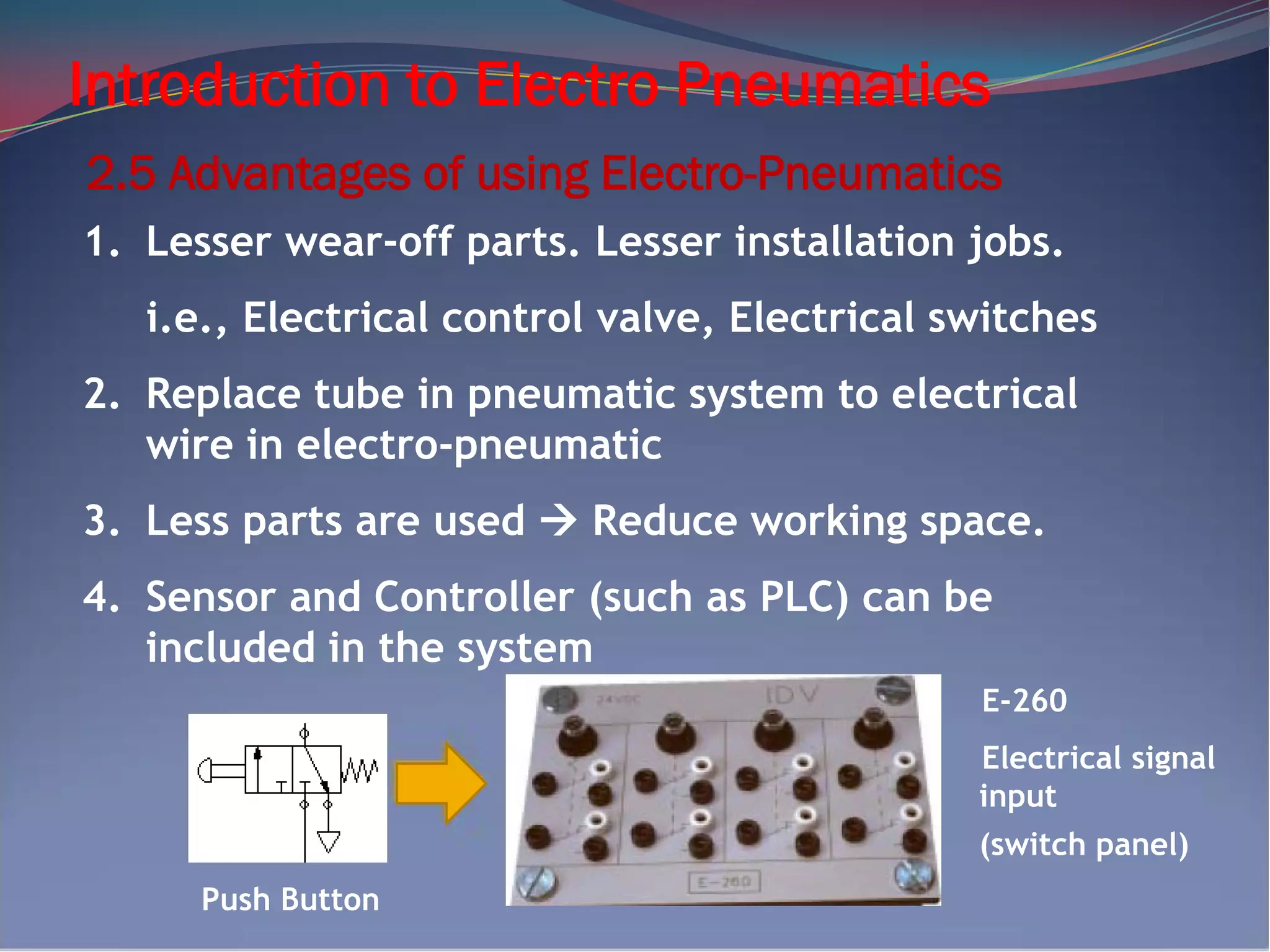
1. Lesser wear-off parts. Lesser installation jobs.
i.e., Electrical control valve, Electrical switches
2. Replace tube in pneumatic system to electrical
wire in electro-pneumatic
3. Less parts are used  Reduce working space.
4. Sensor and Controller (such as PLC) can be
included in the system
2.5 Advantages of using Electro-Pneumatics
Push Button
E-260
Electrical signal
input
(switch panel)
Introduction to Electro Pneumatics
Question :
List-up (at least) 2 advantages and 2 disadvantages
of Pneumatic system.
2.3 Assignment 1
Introduction to Electro Pneumatics
Question :
By using suitable pneumatic circuit, show
pneumatic component classification.
Source: 2009 Sem2 DNT241 Final exam question
This year final exam Question(?)
List-up 4 component classifications in Electro-
pneumatic control system and give 2 example for
each component.
3.0 Introduction to Electro-pneumatic control
component
Introduction to Electro Pneumatics
Switches :
There are 3 types of electrical switches used in
design Electro-pneumatic circuit.
1. Normally Open switch
2. Normally Close switch
3. Multiple contact switches
Sensors :
1. Mechanical Position sensor (Limit switch)
2. Proximity sensor
3. Reed switch
3.1 Input Element component
Introduction to Electro Pneumatics
3.2 Switching Contact and type of actuation
Introduction to Electro Pneumatics
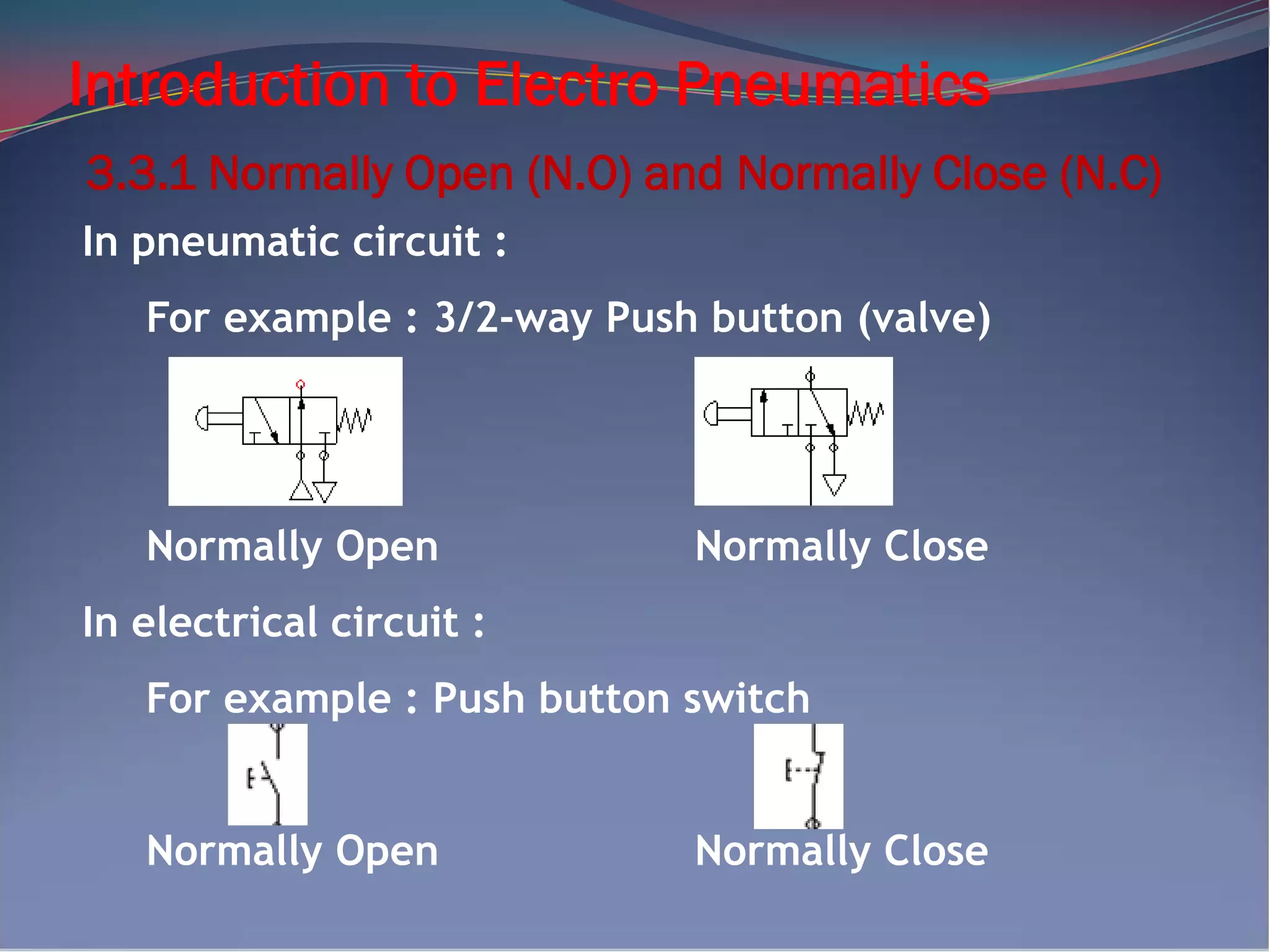
3.3.1 Normally Open (N.O) and Normally Close (N.C)
In pneumatic circuit :
For example : 3/2-way Push button (valve)
Normally Open Normally Close
In electrical circuit :
For example : Push button switch
Normally Open Normally Close
Introduction to Electro Pneumatics
3.3.2 Normally Open (N.O) and Normally Close (N.C)
Introduction to Electro Pneumatics
3.4 Mechanical Position sensor
(Pneumatic)
3/2-way N.C valve with roller (Limit switch)
(Electro-Pneumatic)
Mechanical Position sensor (Limit switch)
Introduction to Electro Pneumatics
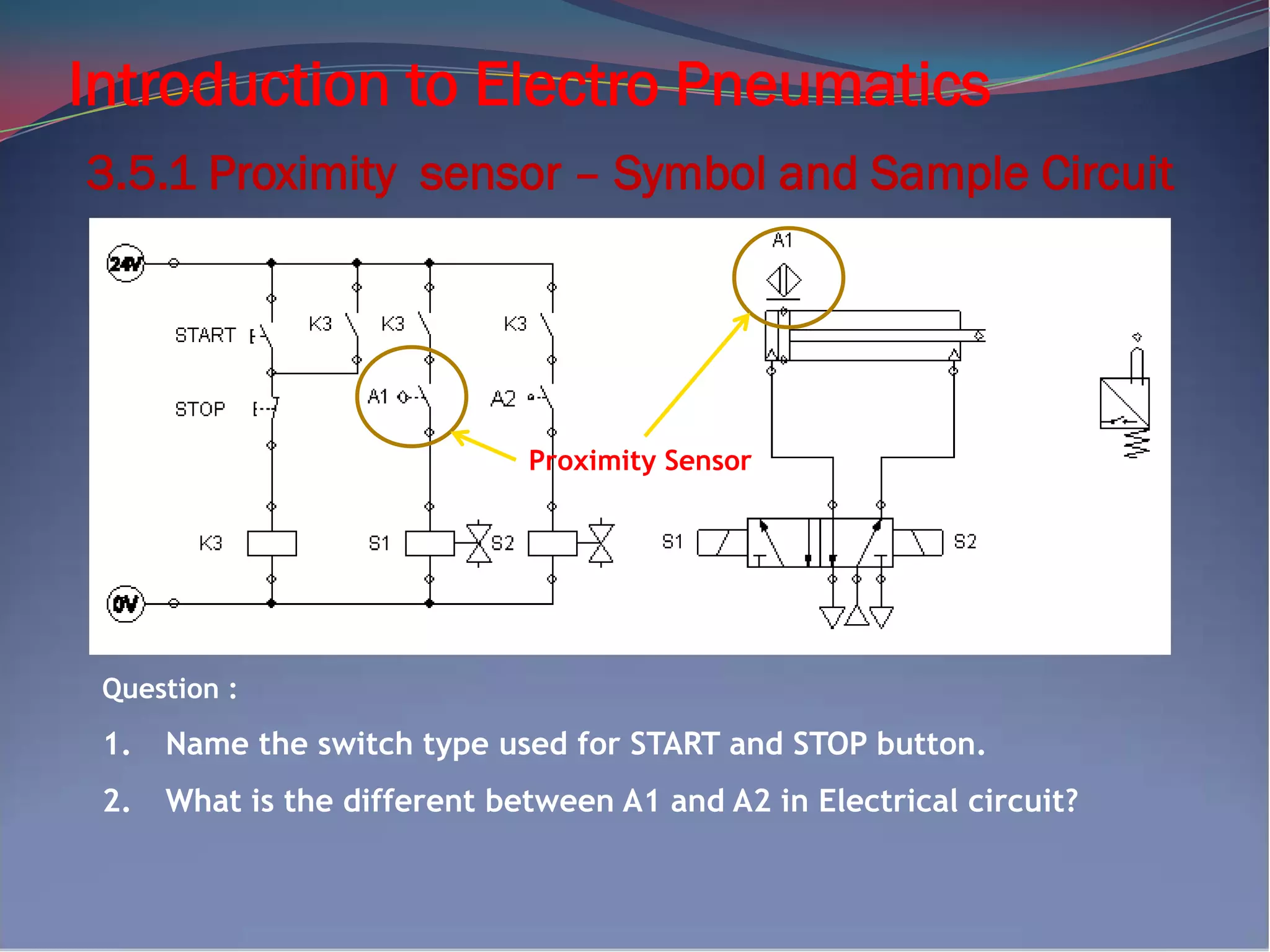
 Proximity sensor contain a transistor which
conducts and switches (trigger ON) when something
comes near to the sensors.
 Some of the proximity sensor only work with steel
material components - Inductive proximity sensor
3.5 Proximity sensor
Introduction to Electro Pneumatics
Question :
1. Name the switch type used for START and STOP button.
2. What is the different between A1 and A2 in Electrical circuit?
3.5.1 Proximity sensor – Symbol and Sample Circuit
Proximity Sensor
Introduction to Electro Pneumatics
 Reed switch is one of the sensor which is operated
by the magnetic field.
 Usually fit directly onto cylinder with clips.
 The piston of the cylinder has a magnet built into it
and when the piston comes close to the reed
switch, the contact is close (ON).
3.6 Reed switch
Introduction to Electro Pneumatics
 Relay is an electrically actuated switch, contains a coil
and a contactor switch or multiples contactors.
 When power is applied to relay coil, the core
magnetizes, drawing the contact assembly in.
 This will change the state of all the contacts in the relay
(i.e., N.O contact becomes closed or N.C contact
becomes open).
 Relay uses small amount of power to control switching
(advantage). The voltage applied to the coil doesn’t
have to be the same as that in control circuit.
 Relay is used to allow low voltage control systems to
switch large current/ high voltage
(function / advantage)
3.7 Processing element - Relay
Introduction to Electro Pneumatics
3.7.1 Sample circuit
Coil
When Toggle switch 1S3 is pressed, power is applied to
Relay (K1) coil which result to the all contactors in relay
change their state (open  close or close  open).
Solenoid valve 1Y1 activate to ON
E-140
Contactor
Introduction to Electro Pneumatics
3.7.2 N.O and N.C wire connection
Normally Close (N.C)
Example : Pin 21  22
Normally Open (N.O)
Example : Pin 41  44
Introduction to Electro Pneumatics
3.7.3 Animation (Relay OFF)
Source : UniKL Electro-Pneumatic Lecture Note, 2008
Introduction to Electro Pneumatics
3.7.4 Animation (Relay ON)
Introduction to Electro Pneumatics
3.7.5 More about Relays
 Relay has a few functions as a safety device:
1. The high voltage output (i.e. 240V) can be switched ON
through a contactor using relay with low voltage (i.e.
24V) supplied to a coil.
2. The high current output can be switched ON through a
contactor using relay with low current supplied to a coil.
3. Functioned as Safety control circuit for emergency
power cut-off (EMERGENCY START and STOP button)
to the whole circuit.
Use in automation process  Switching more than one
outputs simultaneously using relay with a coil and multiple
contactors.
To control ON and OFF of various outputs sequences using
several Relay.
Introduction to Electro Pneumatics
 Solenoid valve is an electro-mechanical device that
built-in with a coil (solenoid) and a pneumatic
Directional control valve.
 Solenoid actuated Directional control valve (DCV)
convert electrical signals to pneumatic signals.
 They are used to start, to stop and/or to change
the direction of air flow.
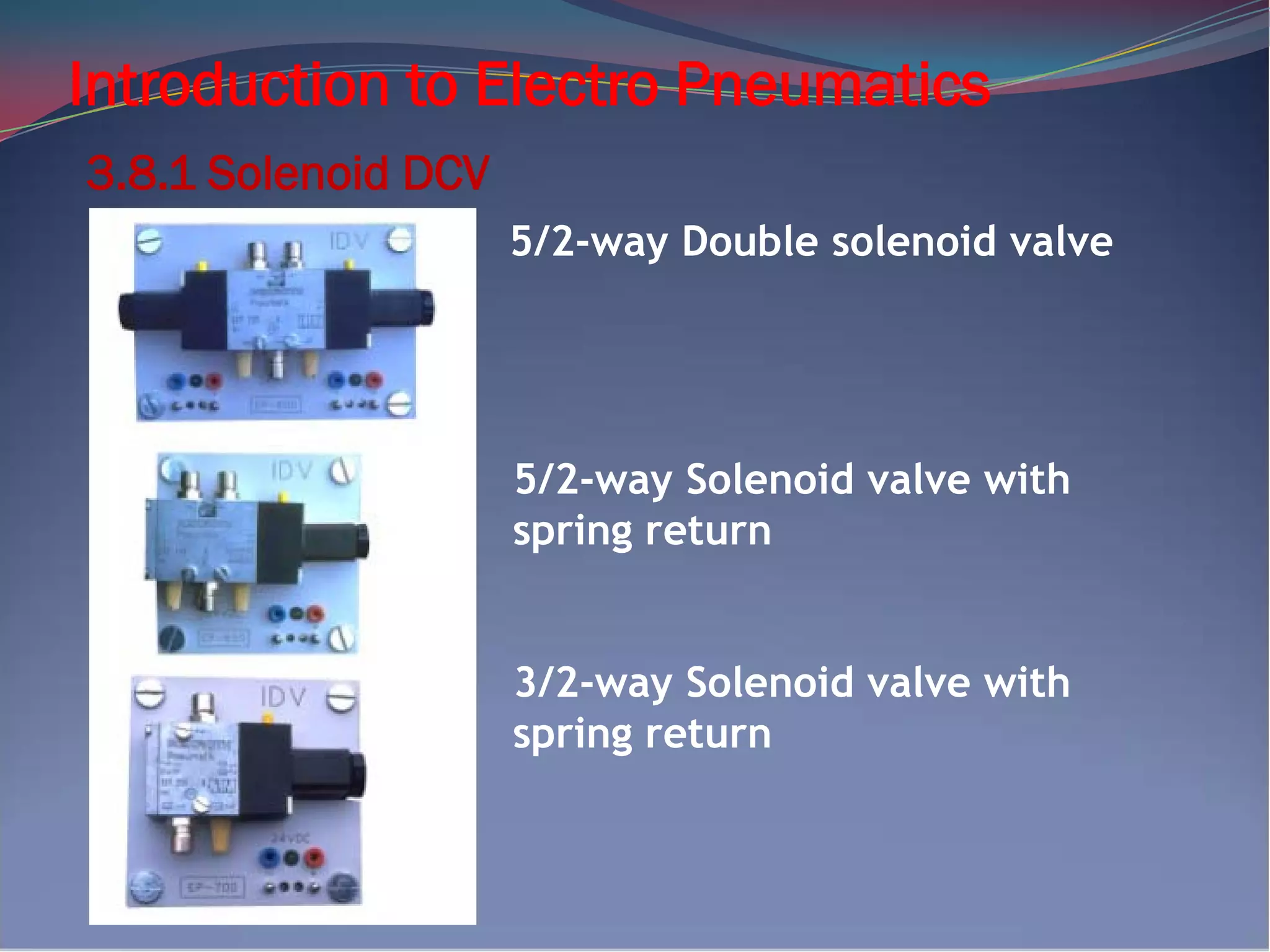
 There 3 main types of solenoid valve.
1. 3/2-way Solenoid valve with spring return
2. 5/2-way Solenoid valve with spring return
3. 5/2-way Double solenoid valve
3.8 Final control element – Solenoid DCV
Introduction to Electro Pneumatics
5/2-way Solenoid valve with
spring return
3/2-way Solenoid valve with
spring return
3.8.1 Solenoid DCV
5/2-way Double solenoid valve
Introduction to Electro Pneumatics
3.8.2 Symbol and sample circuit
(Pneumatic)
Pilot actuated 5/2-way Directional control valve
(Electro-Pneumatic)
Solenoid actuated 5/2-way Directional control valve
Pneumatic Power Component --- cylinder
Final Control element --- Solenoid valve
Introduction to Electro Pneumatics
3.8.3 Symbol in Electrical circuit
When Pushbutton switch (SW1) is pressed, power is
applied to Solenoid S1 which then change the electrical
signal to pneumatic signal and allow air flow to cylinder
A (single acting with spring return) for rod to extend.
Solenoid
Introduction to Electro Pneumatics
3.8.4 Sample Circuit connection
Red cable is connection
from 24V line.
Blue cable is connection to
GND (0 V).
Introduction to Electro Pneumatics
3.8.5 Solenoid - Structure
Source : UTeM Chapter 4 --- ElectroPneumatic
Introduction to Electro Pneumatics
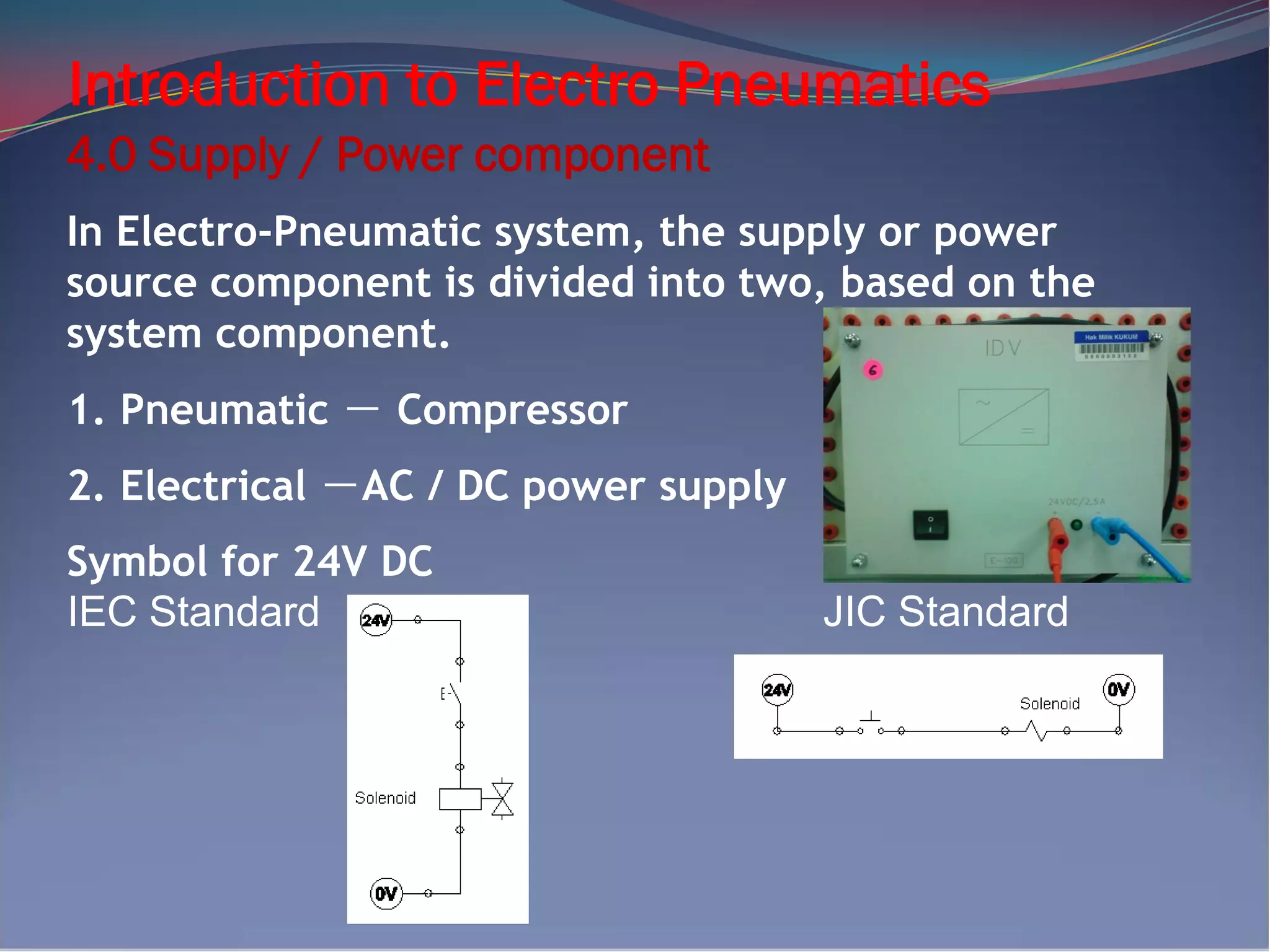
4.0 Supply / Power component
In Electro-Pneumatic system, the supply or power
source component is divided into two, based on the
system component.
1. Pneumatic - Compressor
2. Electrical -AC / DC power supply
Symbol for 24V DC
IEC Standard JIC Standard
Introduction to Electro Pneumatics
4.1 Self-Latching concept
Self-latching will enable the automation system to run in automatic
mode after the START button is pressed and the system repeats until
STOP button is pressed.
The advantage of having self-latching in the system is that it can be
used as power switching and emergency button.
START
STOP
Self-latching
circuit
Introduction to Electro Pneumatics
4.2 Electro-Pneumatic Application
In this section, we will learn some of the actual
application for Electro-pneumatic system.
1. Single-acting cylinder (with spring return)
2. Double-acting cylinder (1 unit)
3. Double-acting cylinder (2 units)
Based on the system / operation given, the students
should capable to :
a) Understand the system’s operation and draw /
sketch Displacement-step diagram
b) Design Pneumatic circuit and Electrical circuit for
the system.
Introduction to Electro Pneumatics
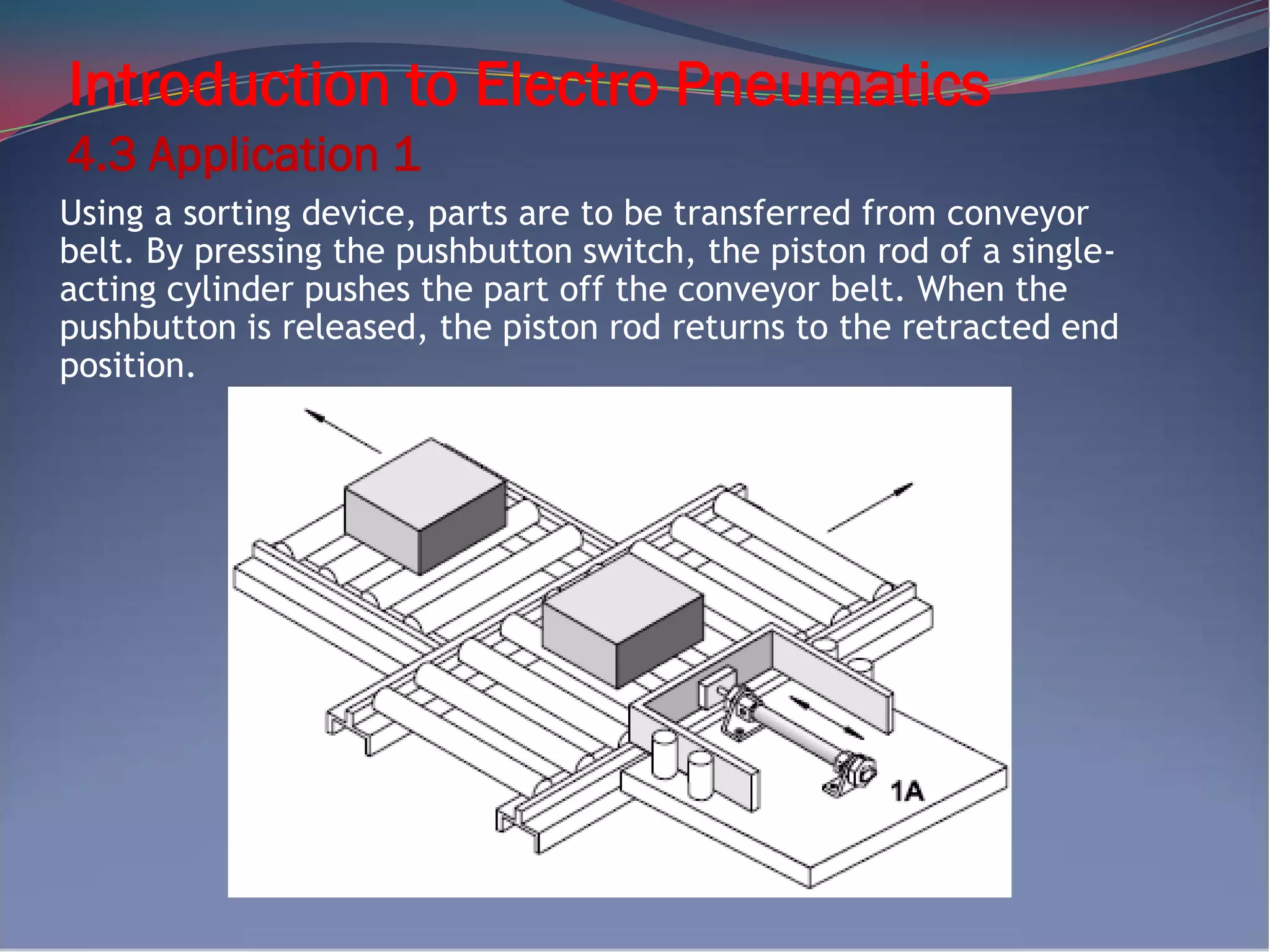
4.3 Application 1
Using a sorting device, parts are to be transferred from conveyor
belt. By pressing the pushbutton switch, the piston rod of a single-
acting cylinder pushes the part off the conveyor belt. When the
pushbutton is released, the piston rod returns to the retracted end
position.
Introduction to Electro Pneumatics
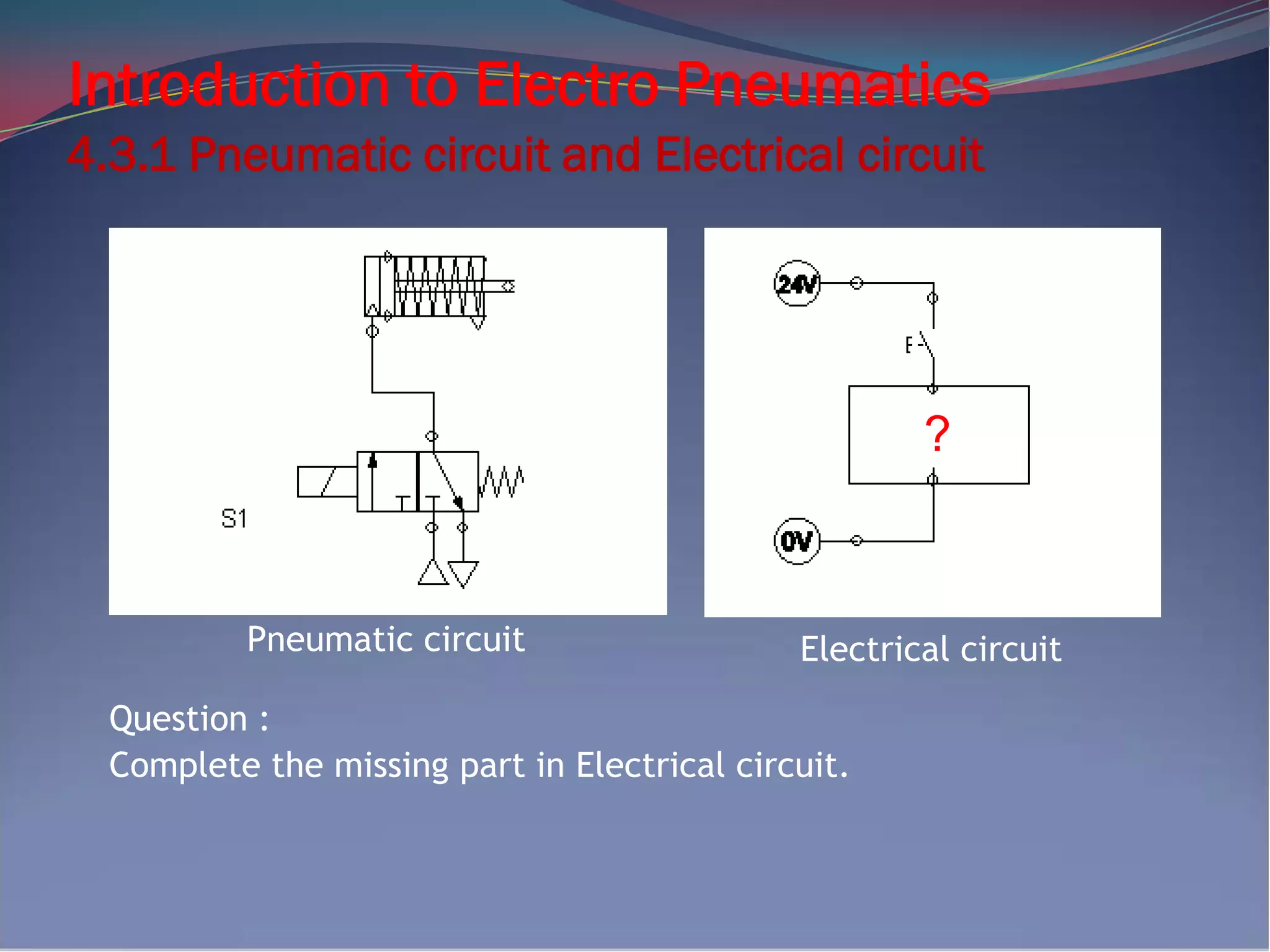
4.3.1 Pneumatic circuit and Electrical circuit
Question :
Complete the missing part in Electrical circuit.
Pneumatic circuit Electrical circuit
?
Introduction to Electro Pneumatics
4.4 Application 2
Wooden planks are to be pushed along from a gravity feed magazine
to a clamping device. By pressing a pushbutton switch one plank is
pushed by the slide out of the gravity feed magazine. After the slide
has reached the forward end position it is returned to its start
position.
Introduction to Electro Pneumatics
4.4.1 Pneumatic circuit
Question :
Please design complete Electrical circuit to control above pneumatic
circuit.
Introduction to Electro Pneumatics
4.5 Application 3
Using a transfer station blocks are to be transferred from a magazine to a
processing station.
The blocks are pushed out of the magazine by cylinder A and transferred to
the processing station by cylinder B. The piston rod of cylinder A may only
return when the piston rod of cylinder B has reached the retracted end
position. The magazine is monitored by means of limit switches. If there
are no more blocks in the magazine, it is not possible to start the cycle.
This is indicated by means of push button to act as a sensor. The control is
to be operated in single cycle.
Cylinder A
Cylinder B
Introduction to Electro Pneumatics
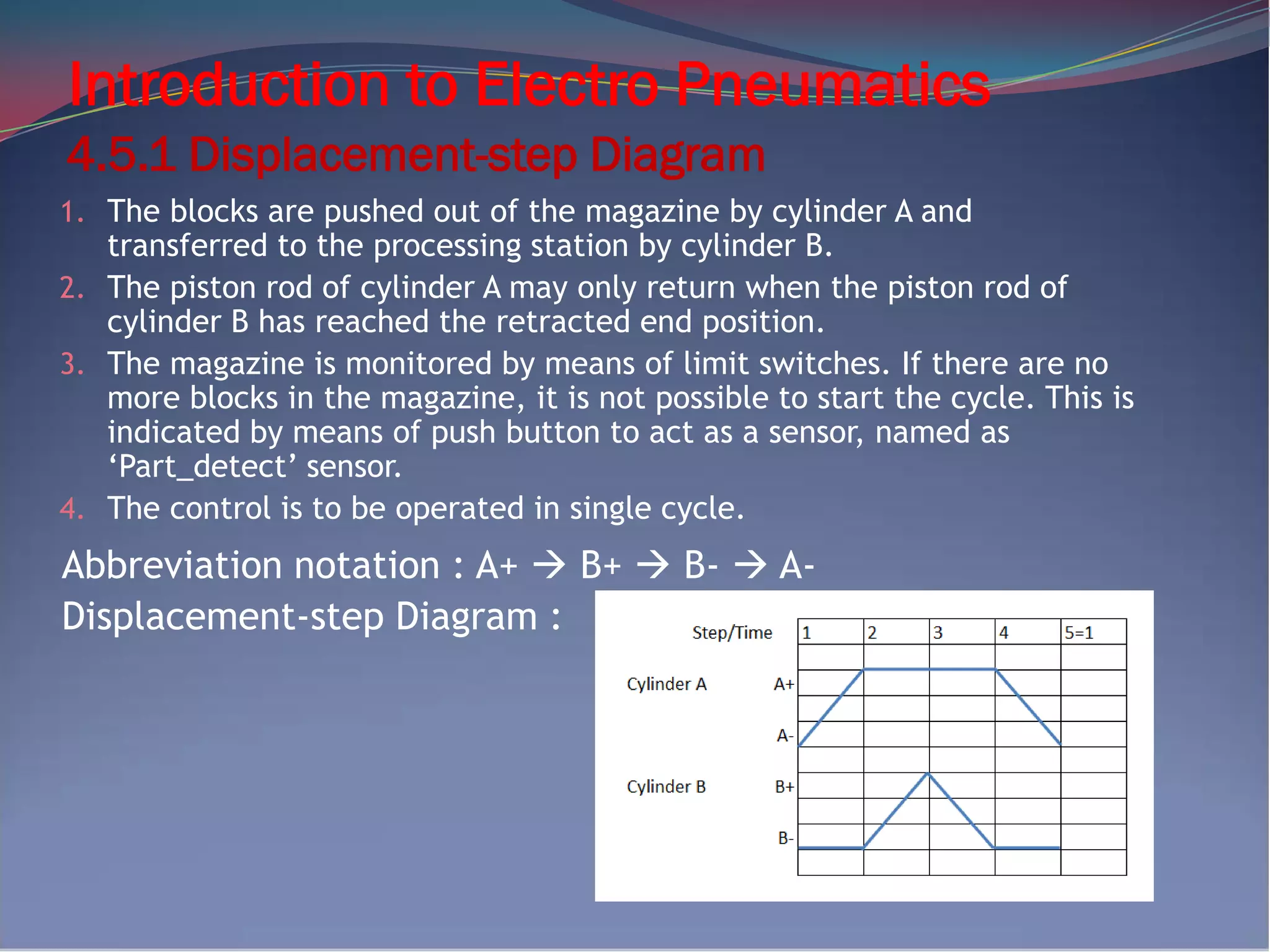
4.5.1 Displacement-step Diagram
1. The blocks are pushed out of the magazine by cylinder A and
transferred to the processing station by cylinder B.
2. The piston rod of cylinder A may only return when the piston rod of
cylinder B has reached the retracted end position.
3. The magazine is monitored by means of limit switches. If there are no
more blocks in the magazine, it is not possible to start the cycle. This is
indicated by means of push button to act as a sensor, named as
‘Part_detect’ sensor.
4. The control is to be operated in single cycle.
Abbreviation notation : A+  B+  B-  A-
Displacement-step Diagram :
Introduction to Electro Pneumatics
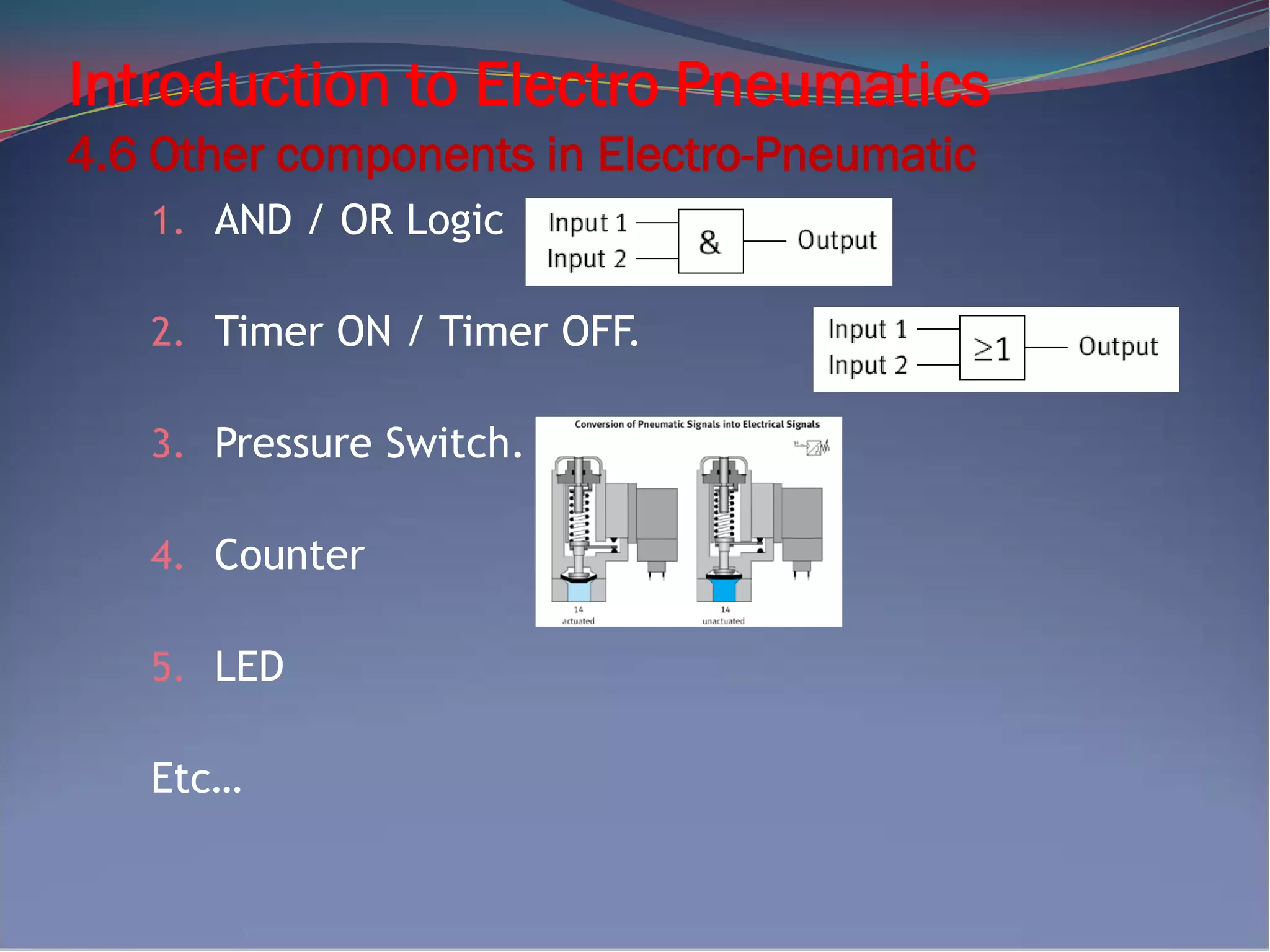
4.6 Other components in Electro-Pneumatic
1. AND / OR Logic
2. Timer ON / Timer OFF.
3. Pressure Switch.
4. Counter
5. LED
Etc…
Introduction to Electro Pneumatics
We should be :
1. Understand what has been called as Electro-
Pneumatics and can simply describe it.
2. Understand the 5 main components in Electro-
pneumatic control system
3. Understand the name and symbol of each
component and how its working in the electrical
circuit (function).
4. Understand on how to design Pneumatic and
Electrical circuit based on the given applications.
5. Can demonstrate the theories learning in class to
practical.
5.0 What has been learned in this session?
Introduction to Electro Pneumatics
Application 1
6.0 Answer
Application 2
Introduction to Electro Pneumatics
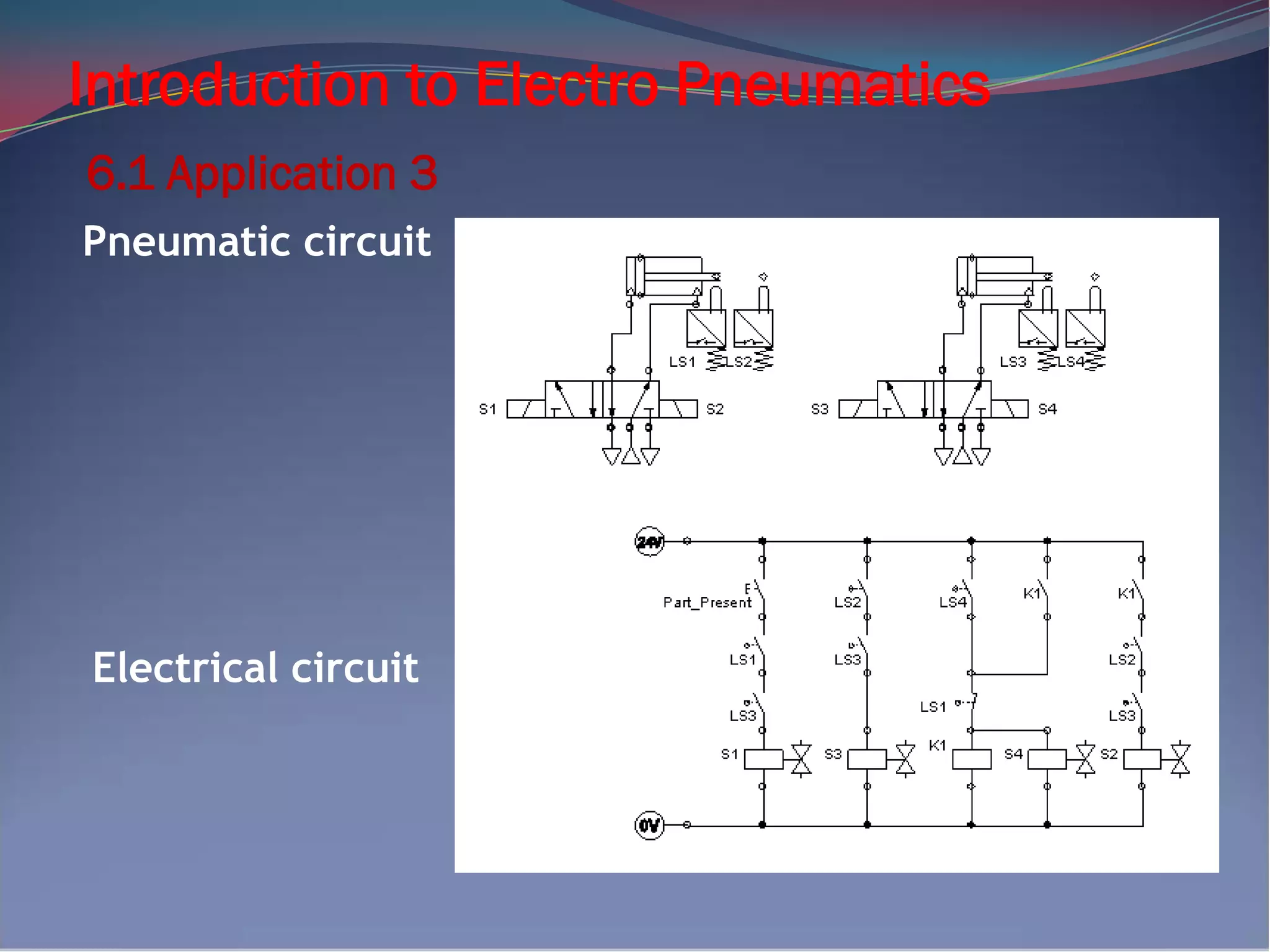
Pneumatic circuit
6.1 Application 3
Electrical circuit
Introduction to Electro Pneumatics
Pneumatic circuit
6.2 Include Self-latching circuit
Electrical circuit

165000503 electro-pneumatic

  • 1.
    Introduction to ElectroPneumatics Contents :- 1. What is Electro-Pneumatics : a definition 2. Electro-Pneumatic Signal Control system 3. Electro-Pneumatics Basic control components 4. Application Example
  • 2.
    Introduction to ElectroPneumatics WikiAnswers.com wrote, Pneumatics is a method to transfer energy from one point to another using actuators which are driven by fluids under pressure. Pneumatics restricts itself to gaseous fluids while hydraulics uses liquids to transfer the energy. The transferring of energy in pneumatics such as pumping air into a pneumatic cylinder must be controlled. You can control the pressure by manually opening a valve, automatically by detecting its pressure, or by sending an electrical signal. The control of pneumatic components by electrical impulses is known as electro-pneumatics. 1.1 Definition of Electro-Pneumatics
  • 3.
    Introduction to ElectroPneumatics Both pneumatic & electro-pneumatic controllers have a pneumatic power section. In an electro-pneumatics control, the signal control section is made up of a electrical components, such as electrical input buttons, proximity switches, relays, or a programmable logic controller (PLC). Source : Electropneumatics – A basic, G Prede, D Scholz Question 1 : What is your definition for Electro-Pneumatics? _____________________________________ _____________________________________ [3 marks] 1.2 Other Definition of Electro-Pneumatics
  • 4.
    Introduction to ElectroPneumatics Definition :  Electro-pneumatic term is defined from the words of electro which means electrical and pneumatic which means air pressure.  The electro-pneumatics equipments and system is an integration of electrical and mechanical components with compressed air source.  Electro pneumatic is a pneumatic control system where air pressure and direction of valve are controlled by an electrical current. 1.3 Our Definition of Electro-Pneumatics
  • 5.
    Introduction to ElectroPneumatics  Electro pneumatic is integration of two control circuit 1. Pneumatic Circuit 2. Electrical Circuit 1.4 Electro-Pneumatics’ circuit
  • 6.
    Introduction to ElectroPneumatics (a) Pneumatic circuit
  • 7.
    Introduction to ElectroPneumatics (b) Electrical circuit
  • 8.
    Introduction to ElectroPneumatics 1.5 Combination of Pneumatic circuit and Electrical circuit
  • 9.
    Introduction to ElectroPneumatics 2.1 A Background – Basic Control system Command Execution Signal Output Signal Processing Signal Input Power component Final Control element Processing element Input element
  • 10.
    Introduction to ElectroPneumatics 2.2 Signal flow and component of an Electro- Pneumatic control system Source : Electropneumatics Basic Level by G Prede, D Scholz
  • 11.
    Introduction to ElectroPneumatics 2.3 Pneumatic power section Directional control valves form the interface between the signal control section (electrical) and the pneumatic power section in an Electro- pneumatic system.
  • 12.
    Introduction to ElectroPneumatics 2.4 Electrical signal control section
  • 13.
    Introduction to ElectroPneumatics 1. Lesser wear-off parts. Lesser installation jobs. i.e., Electrical control valve, Electrical switches 2. Replace tube in pneumatic system to electrical wire in electro-pneumatic 3. Less parts are used  Reduce working space. 4. Sensor and Controller (such as PLC) can be included in the system 2.5 Advantages of using Electro-Pneumatics Push Button E-260 Electrical signal input (switch panel)
  • 14.
    Introduction to ElectroPneumatics Question : List-up (at least) 2 advantages and 2 disadvantages of Pneumatic system. 2.3 Assignment 1
  • 15.
    Introduction to ElectroPneumatics Question : By using suitable pneumatic circuit, show pneumatic component classification. Source: 2009 Sem2 DNT241 Final exam question This year final exam Question(?) List-up 4 component classifications in Electro- pneumatic control system and give 2 example for each component. 3.0 Introduction to Electro-pneumatic control component
  • 16.
    Introduction to ElectroPneumatics Switches : There are 3 types of electrical switches used in design Electro-pneumatic circuit. 1. Normally Open switch 2. Normally Close switch 3. Multiple contact switches Sensors : 1. Mechanical Position sensor (Limit switch) 2. Proximity sensor 3. Reed switch 3.1 Input Element component
  • 17.
    Introduction to ElectroPneumatics 3.2 Switching Contact and type of actuation
  • 18.
    Introduction to ElectroPneumatics 3.3.1 Normally Open (N.O) and Normally Close (N.C) In pneumatic circuit : For example : 3/2-way Push button (valve) Normally Open Normally Close In electrical circuit : For example : Push button switch Normally Open Normally Close
  • 19.
    Introduction to ElectroPneumatics 3.3.2 Normally Open (N.O) and Normally Close (N.C)
  • 20.
    Introduction to ElectroPneumatics 3.4 Mechanical Position sensor (Pneumatic) 3/2-way N.C valve with roller (Limit switch) (Electro-Pneumatic) Mechanical Position sensor (Limit switch)
  • 21.
    Introduction to ElectroPneumatics  Proximity sensor contain a transistor which conducts and switches (trigger ON) when something comes near to the sensors.  Some of the proximity sensor only work with steel material components - Inductive proximity sensor 3.5 Proximity sensor
  • 22.
    Introduction to ElectroPneumatics Question : 1. Name the switch type used for START and STOP button. 2. What is the different between A1 and A2 in Electrical circuit? 3.5.1 Proximity sensor – Symbol and Sample Circuit Proximity Sensor
  • 23.
    Introduction to ElectroPneumatics  Reed switch is one of the sensor which is operated by the magnetic field.  Usually fit directly onto cylinder with clips.  The piston of the cylinder has a magnet built into it and when the piston comes close to the reed switch, the contact is close (ON). 3.6 Reed switch
  • 24.
    Introduction to ElectroPneumatics  Relay is an electrically actuated switch, contains a coil and a contactor switch or multiples contactors.  When power is applied to relay coil, the core magnetizes, drawing the contact assembly in.  This will change the state of all the contacts in the relay (i.e., N.O contact becomes closed or N.C contact becomes open).  Relay uses small amount of power to control switching (advantage). The voltage applied to the coil doesn’t have to be the same as that in control circuit.  Relay is used to allow low voltage control systems to switch large current/ high voltage (function / advantage) 3.7 Processing element - Relay
  • 25.
    Introduction to ElectroPneumatics 3.7.1 Sample circuit Coil When Toggle switch 1S3 is pressed, power is applied to Relay (K1) coil which result to the all contactors in relay change their state (open  close or close  open). Solenoid valve 1Y1 activate to ON E-140 Contactor
  • 26.
    Introduction to ElectroPneumatics 3.7.2 N.O and N.C wire connection Normally Close (N.C) Example : Pin 21  22 Normally Open (N.O) Example : Pin 41  44
  • 27.
    Introduction to ElectroPneumatics 3.7.3 Animation (Relay OFF) Source : UniKL Electro-Pneumatic Lecture Note, 2008
  • 28.
    Introduction to ElectroPneumatics 3.7.4 Animation (Relay ON)
  • 29.
    Introduction to ElectroPneumatics 3.7.5 More about Relays  Relay has a few functions as a safety device: 1. The high voltage output (i.e. 240V) can be switched ON through a contactor using relay with low voltage (i.e. 24V) supplied to a coil. 2. The high current output can be switched ON through a contactor using relay with low current supplied to a coil. 3. Functioned as Safety control circuit for emergency power cut-off (EMERGENCY START and STOP button) to the whole circuit. Use in automation process  Switching more than one outputs simultaneously using relay with a coil and multiple contactors. To control ON and OFF of various outputs sequences using several Relay.
  • 30.
    Introduction to ElectroPneumatics  Solenoid valve is an electro-mechanical device that built-in with a coil (solenoid) and a pneumatic Directional control valve.  Solenoid actuated Directional control valve (DCV) convert electrical signals to pneumatic signals.  They are used to start, to stop and/or to change the direction of air flow.  There 3 main types of solenoid valve. 1. 3/2-way Solenoid valve with spring return 2. 5/2-way Solenoid valve with spring return 3. 5/2-way Double solenoid valve 3.8 Final control element – Solenoid DCV
  • 31.
    Introduction to ElectroPneumatics 5/2-way Solenoid valve with spring return 3/2-way Solenoid valve with spring return 3.8.1 Solenoid DCV 5/2-way Double solenoid valve
  • 32.
    Introduction to ElectroPneumatics 3.8.2 Symbol and sample circuit (Pneumatic) Pilot actuated 5/2-way Directional control valve (Electro-Pneumatic) Solenoid actuated 5/2-way Directional control valve Pneumatic Power Component --- cylinder Final Control element --- Solenoid valve
  • 33.
    Introduction to ElectroPneumatics 3.8.3 Symbol in Electrical circuit When Pushbutton switch (SW1) is pressed, power is applied to Solenoid S1 which then change the electrical signal to pneumatic signal and allow air flow to cylinder A (single acting with spring return) for rod to extend. Solenoid
  • 34.
    Introduction to ElectroPneumatics 3.8.4 Sample Circuit connection Red cable is connection from 24V line. Blue cable is connection to GND (0 V).
  • 35.
    Introduction to ElectroPneumatics 3.8.5 Solenoid - Structure Source : UTeM Chapter 4 --- ElectroPneumatic
  • 36.
    Introduction to ElectroPneumatics 4.0 Supply / Power component In Electro-Pneumatic system, the supply or power source component is divided into two, based on the system component. 1. Pneumatic - Compressor 2. Electrical -AC / DC power supply Symbol for 24V DC IEC Standard JIC Standard
  • 37.
    Introduction to ElectroPneumatics 4.1 Self-Latching concept Self-latching will enable the automation system to run in automatic mode after the START button is pressed and the system repeats until STOP button is pressed. The advantage of having self-latching in the system is that it can be used as power switching and emergency button. START STOP Self-latching circuit
  • 38.
    Introduction to ElectroPneumatics 4.2 Electro-Pneumatic Application In this section, we will learn some of the actual application for Electro-pneumatic system. 1. Single-acting cylinder (with spring return) 2. Double-acting cylinder (1 unit) 3. Double-acting cylinder (2 units) Based on the system / operation given, the students should capable to : a) Understand the system’s operation and draw / sketch Displacement-step diagram b) Design Pneumatic circuit and Electrical circuit for the system.
  • 39.
    Introduction to ElectroPneumatics 4.3 Application 1 Using a sorting device, parts are to be transferred from conveyor belt. By pressing the pushbutton switch, the piston rod of a single- acting cylinder pushes the part off the conveyor belt. When the pushbutton is released, the piston rod returns to the retracted end position.
  • 40.
    Introduction to ElectroPneumatics 4.3.1 Pneumatic circuit and Electrical circuit Question : Complete the missing part in Electrical circuit. Pneumatic circuit Electrical circuit ?
  • 41.
    Introduction to ElectroPneumatics 4.4 Application 2 Wooden planks are to be pushed along from a gravity feed magazine to a clamping device. By pressing a pushbutton switch one plank is pushed by the slide out of the gravity feed magazine. After the slide has reached the forward end position it is returned to its start position.
  • 42.
    Introduction to ElectroPneumatics 4.4.1 Pneumatic circuit Question : Please design complete Electrical circuit to control above pneumatic circuit.
  • 43.
    Introduction to ElectroPneumatics 4.5 Application 3 Using a transfer station blocks are to be transferred from a magazine to a processing station. The blocks are pushed out of the magazine by cylinder A and transferred to the processing station by cylinder B. The piston rod of cylinder A may only return when the piston rod of cylinder B has reached the retracted end position. The magazine is monitored by means of limit switches. If there are no more blocks in the magazine, it is not possible to start the cycle. This is indicated by means of push button to act as a sensor. The control is to be operated in single cycle. Cylinder A Cylinder B
  • 44.
    Introduction to ElectroPneumatics 4.5.1 Displacement-step Diagram 1. The blocks are pushed out of the magazine by cylinder A and transferred to the processing station by cylinder B. 2. The piston rod of cylinder A may only return when the piston rod of cylinder B has reached the retracted end position. 3. The magazine is monitored by means of limit switches. If there are no more blocks in the magazine, it is not possible to start the cycle. This is indicated by means of push button to act as a sensor, named as ‘Part_detect’ sensor. 4. The control is to be operated in single cycle. Abbreviation notation : A+  B+  B-  A- Displacement-step Diagram :
  • 45.
    Introduction to ElectroPneumatics 4.6 Other components in Electro-Pneumatic 1. AND / OR Logic 2. Timer ON / Timer OFF. 3. Pressure Switch. 4. Counter 5. LED Etc…
  • 46.
    Introduction to ElectroPneumatics We should be : 1. Understand what has been called as Electro- Pneumatics and can simply describe it. 2. Understand the 5 main components in Electro- pneumatic control system 3. Understand the name and symbol of each component and how its working in the electrical circuit (function). 4. Understand on how to design Pneumatic and Electrical circuit based on the given applications. 5. Can demonstrate the theories learning in class to practical. 5.0 What has been learned in this session?
  • 47.
    Introduction to ElectroPneumatics Application 1 6.0 Answer Application 2
  • 48.
    Introduction to ElectroPneumatics Pneumatic circuit 6.1 Application 3 Electrical circuit
  • 49.
    Introduction to ElectroPneumatics Pneumatic circuit 6.2 Include Self-latching circuit Electrical circuit