1
Experiment No: 2
Name: Development of multiple actuator circuits in Co-ordinated motion
In the case of multiple cylinder circuits, a clear definition of the problem is important. The
representation of the desired motion of all actuators is described using the displacement-step
diagram. The special conditions for the start of the sequence must also be defined.
If the motion diagram and auxiliary conditions have been clearly defined, drawing of the
circuit diagram can commence. The circuit diagram should be designed according to that not
overlapped occur between (or among) them.
In order for a circuit to operate, it is essential to avoid overlapping signals. By an
overlapping signal, we understand signals applied simultaneously at the two control ports of a
double pilot valve. The following valves can be used to eliminate signal overlap: roller lever
valves with idle return or toggle lever valves, time delay valves, reversing valves or
sequencers.
To provide a better understanding of the methods, some examples are given for the use of
roller lever valves with idle return and reversing valves.
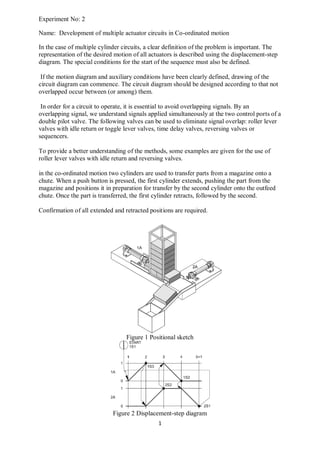
in the co-ordinated motion two cylinders are used to transfer parts from a magazine onto a
chute. When a push button is pressed, the first cylinder extends, pushing the part from the
magazine and positions it in preparation for transfer by the second cylinder onto the outfeed
chute. Once the part is transferred, the first cylinder retracts, followed by the second.
Confirmation of all extended and retracted positions are required.
Figure 1 Positional sketch
Figure 2 Displacement-step diagram
2
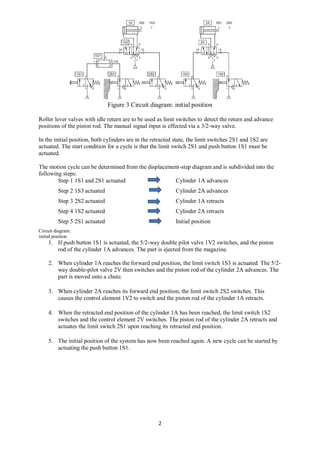
Figure 3 Circuit diagram: initial position
Roller lever valves with idle return are to be used as limit switches to detect the return and advance
positions of the piston rod. The manual signal input is effected via a 3/2-way valve.
In the initial position, both cylinders are in the retracted state, the limit switches 2S1 and 1S2 are
actuated. The start condition for a cycle is that the limit switch 2S1 and push button 1S1 must be
actuated.
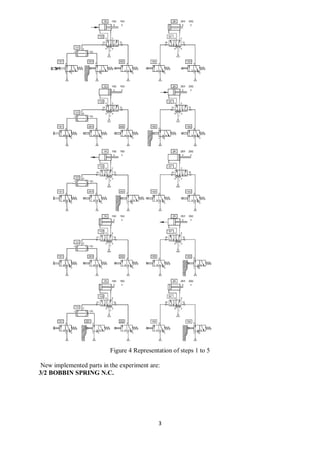
The motion cycle can be determined from the displacement-step diagram and is subdivided into the
following steps:
Step 1 1S1 and 2S1 actuated Cylinder 1A advances
Step 2 1S3 actuated Cylinder 2A advances
Step 3 2S2 actuated Cylinder 1A retracts
Step 4 1S2 actuated Cylinder 2A retracts
Step 5 2S1 actuated Initial position
Circuit diagram:
initial position
1. If push button 1S1 is actuated, the 5/2-way double pilot valve 1V2 switches, and the piston
rod of the cylinder 1A advances. The part is ejected from the magazine.
2. When cylinder 1A reaches the forward end position, the limit switch 1S3 is actuated. The 5/2-
way double-pilot valve 2V then switches and the piston rod of the cylinder 2A advances. The
part is moved onto a chute.
3. When cylinder 2A reaches its forward end position, the limit switch 2S2 switches. This
causes the control element 1V2 to switch and the piston rod of the cylinder 1A retracts.
4. When the retracted end position of the cylinder 1A has been reached, the limit switch 1S2
switches and the control element 2V switches. The piston rod of the cylinder 2A retracts and
actuates the limit switch 2S1 upon reaching its retracted end position.
5. The initial position of the system has now been reached again. A new cycle can be started by
actuating the push button 1S1.
3
Figure 4 Representation of steps 1 to 5
New implemented parts in the experiment are:
3/2 BOBBIN SPRING N.C.
4
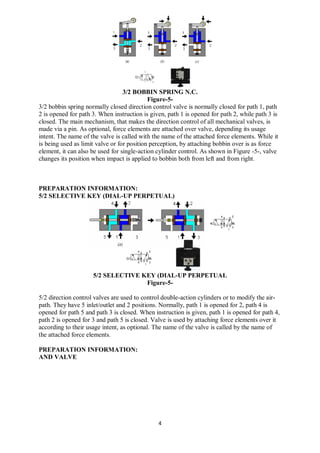
3/2 BOBBIN SPRING N.C.
Figure-5-
3/2 bobbin spring normally closed direction control valve is normally closed for path 1, path
2 is opened for path 3. When instruction is given, path 1 is opened for path 2, while path 3 is
closed. The main mechanism, that makes the direction control of all mechanical valves, is
made via a pin. As optional, force elements are attached over valve, depending its usage
intent. The name of the valve is called with the name of the attached force elements. While it
is being used as limit valve or for position perception, by attaching bobbin over is as force
element, it can also be used for single-action cylinder control. As shown in Figure -5-, valve
changes its position when impact is applied to bobbin both from left and from right.
PREPARATION INFORMATION:
5/2 SELECTIVE KEY (DIAL-UP PERPETUAL)
5/2 SELECTIVE KEY (DIAL-UP PERPETUAL
Figure-5-
5/2 direction control valves are used to control double-action cylinders or to modify the air-
path. They have 5 inlet/outlet and 2 positions. Normally, path 1 is opened for 2, path 4 is
opened for path 5 and path 3 is closed. When instruction is given, path 1 is opened for path 4,
path 2 is opened for 3 and path 5 is closed. Valve is used by attaching force elements over it
according to their usage intent, as optional. The name of the valve is called by the name of
the attached force elements.
PREPARATION INFORMATION:
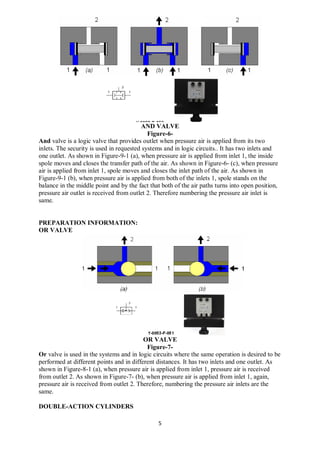
AND VALVE
5
AND VALVE
Figure-6-
And valve is a logic valve that provides outlet when pressure air is applied from its two
inlets. The security is used in requested systems and in logic circuits.. It has two inlets and
one outlet. As shown in Figure-9-1 (a), when pressure air is applied from inlet 1, the inside
spole moves and closes the transfer path of the air. As shown in Figure-6- (c), when pressure
air is applied from inlet 1, spole moves and closes the inlet path of the air. As shown in
Figure-9-1 (b), when pressure air is applied from both of the inlets 1, spole stands on the
balance in the middle point and by the fact that both of the air paths turns into open position,
pressure air outlet is received from outlet 2. Therefore numbering the pressure air inlet is
same.
PREPARATION INFORMATION:
OR VALVE
OR VALVE
Figure-7-
Or valve is used in the systems and in logic circuits where the same operation is desired to be
performed at different points and in different distances. It has two inlets and one outlet. As
shown in Figure-8-1 (a), when pressure air is applied from inlet 1, pressure air is received
from outlet 2. As shown in Figure-7- (b), when pressure air is applied from inlet 1, again,
pressure air is received from outlet 2. Therefore, numbering the pressure air inlets are the
same.
DOUBLE-ACTION CYLINDERS
6
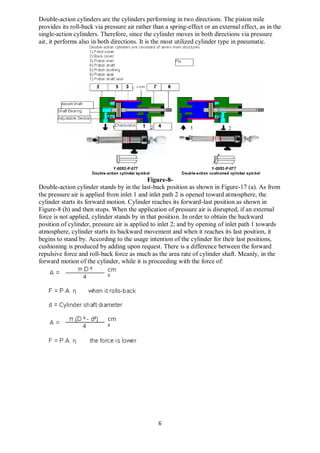
Double-action cylinders are the cylinders performing in two directions. The piston mile
provides its roll-back via pressure air rather than a spring-effect or an external effect, as in the
single-action cylinders. Therefore, since the cylinder moves in both directions via pressure
air, it performs also in both directions. It is the most utilized cylinder type in pneumatic.
Figure-8-
Double-action cylinder stands by in the last-back position as shown in Figure-17 (a). As from
the pressure air is applied from inlet 1 and inlet path 2 is opened toward atmosphere, the
cylinder starts its forward motion. Cylinder reaches its forward-last position as shown in
Figure-8 (b) and then stops. When the application of pressure air is disrupted, if an external
force is not applied, cylinder stands by in that position. In order to obtain the backward
position of cylinder, pressure air is applied to inlet 2; and by opening of inlet path 1 towards
atmosphere, cylinder starts its backward movement and when it reaches its last position, it
begins to stand by. According to the usage intention of the cylinder for their last positions,
cushioning is produced by adding upon request. There is a difference between the forward
repulsive force and roll-back force as much as the area rate of cylinder shaft. Meanly, in the
forward motion of the cylinder, while it is proceeding with the force of:

Experiment No 2.control.pdf

  • 1.
    1 Experiment No: 2 Name:Development of multiple actuator circuits in Co-ordinated motion In the case of multiple cylinder circuits, a clear definition of the problem is important. The representation of the desired motion of all actuators is described using the displacement-step diagram. The special conditions for the start of the sequence must also be defined. If the motion diagram and auxiliary conditions have been clearly defined, drawing of the circuit diagram can commence. The circuit diagram should be designed according to that not overlapped occur between (or among) them. In order for a circuit to operate, it is essential to avoid overlapping signals. By an overlapping signal, we understand signals applied simultaneously at the two control ports of a double pilot valve. The following valves can be used to eliminate signal overlap: roller lever valves with idle return or toggle lever valves, time delay valves, reversing valves or sequencers. To provide a better understanding of the methods, some examples are given for the use of roller lever valves with idle return and reversing valves. in the co-ordinated motion two cylinders are used to transfer parts from a magazine onto a chute. When a push button is pressed, the first cylinder extends, pushing the part from the magazine and positions it in preparation for transfer by the second cylinder onto the outfeed chute. Once the part is transferred, the first cylinder retracts, followed by the second. Confirmation of all extended and retracted positions are required. Figure 1 Positional sketch Figure 2 Displacement-step diagram
  • 2.
    2 Figure 3 Circuitdiagram: initial position Roller lever valves with idle return are to be used as limit switches to detect the return and advance positions of the piston rod. The manual signal input is effected via a 3/2-way valve. In the initial position, both cylinders are in the retracted state, the limit switches 2S1 and 1S2 are actuated. The start condition for a cycle is that the limit switch 2S1 and push button 1S1 must be actuated. The motion cycle can be determined from the displacement-step diagram and is subdivided into the following steps: Step 1 1S1 and 2S1 actuated Cylinder 1A advances Step 2 1S3 actuated Cylinder 2A advances Step 3 2S2 actuated Cylinder 1A retracts Step 4 1S2 actuated Cylinder 2A retracts Step 5 2S1 actuated Initial position Circuit diagram: initial position 1. If push button 1S1 is actuated, the 5/2-way double pilot valve 1V2 switches, and the piston rod of the cylinder 1A advances. The part is ejected from the magazine. 2. When cylinder 1A reaches the forward end position, the limit switch 1S3 is actuated. The 5/2- way double-pilot valve 2V then switches and the piston rod of the cylinder 2A advances. The part is moved onto a chute. 3. When cylinder 2A reaches its forward end position, the limit switch 2S2 switches. This causes the control element 1V2 to switch and the piston rod of the cylinder 1A retracts. 4. When the retracted end position of the cylinder 1A has been reached, the limit switch 1S2 switches and the control element 2V switches. The piston rod of the cylinder 2A retracts and actuates the limit switch 2S1 upon reaching its retracted end position. 5. The initial position of the system has now been reached again. A new cycle can be started by actuating the push button 1S1.
  • 3.
    3 Figure 4 Representationof steps 1 to 5 New implemented parts in the experiment are: 3/2 BOBBIN SPRING N.C.
  • 4.
    4 3/2 BOBBIN SPRINGN.C. Figure-5- 3/2 bobbin spring normally closed direction control valve is normally closed for path 1, path 2 is opened for path 3. When instruction is given, path 1 is opened for path 2, while path 3 is closed. The main mechanism, that makes the direction control of all mechanical valves, is made via a pin. As optional, force elements are attached over valve, depending its usage intent. The name of the valve is called with the name of the attached force elements. While it is being used as limit valve or for position perception, by attaching bobbin over is as force element, it can also be used for single-action cylinder control. As shown in Figure -5-, valve changes its position when impact is applied to bobbin both from left and from right. PREPARATION INFORMATION: 5/2 SELECTIVE KEY (DIAL-UP PERPETUAL) 5/2 SELECTIVE KEY (DIAL-UP PERPETUAL Figure-5- 5/2 direction control valves are used to control double-action cylinders or to modify the air- path. They have 5 inlet/outlet and 2 positions. Normally, path 1 is opened for 2, path 4 is opened for path 5 and path 3 is closed. When instruction is given, path 1 is opened for path 4, path 2 is opened for 3 and path 5 is closed. Valve is used by attaching force elements over it according to their usage intent, as optional. The name of the valve is called by the name of the attached force elements. PREPARATION INFORMATION: AND VALVE
  • 5.
    5 AND VALVE Figure-6- And valveis a logic valve that provides outlet when pressure air is applied from its two inlets. The security is used in requested systems and in logic circuits.. It has two inlets and one outlet. As shown in Figure-9-1 (a), when pressure air is applied from inlet 1, the inside spole moves and closes the transfer path of the air. As shown in Figure-6- (c), when pressure air is applied from inlet 1, spole moves and closes the inlet path of the air. As shown in Figure-9-1 (b), when pressure air is applied from both of the inlets 1, spole stands on the balance in the middle point and by the fact that both of the air paths turns into open position, pressure air outlet is received from outlet 2. Therefore numbering the pressure air inlet is same. PREPARATION INFORMATION: OR VALVE OR VALVE Figure-7- Or valve is used in the systems and in logic circuits where the same operation is desired to be performed at different points and in different distances. It has two inlets and one outlet. As shown in Figure-8-1 (a), when pressure air is applied from inlet 1, pressure air is received from outlet 2. As shown in Figure-7- (b), when pressure air is applied from inlet 1, again, pressure air is received from outlet 2. Therefore, numbering the pressure air inlets are the same. DOUBLE-ACTION CYLINDERS
  • 6.
    6 Double-action cylinders arethe cylinders performing in two directions. The piston mile provides its roll-back via pressure air rather than a spring-effect or an external effect, as in the single-action cylinders. Therefore, since the cylinder moves in both directions via pressure air, it performs also in both directions. It is the most utilized cylinder type in pneumatic. Figure-8- Double-action cylinder stands by in the last-back position as shown in Figure-17 (a). As from the pressure air is applied from inlet 1 and inlet path 2 is opened toward atmosphere, the cylinder starts its forward motion. Cylinder reaches its forward-last position as shown in Figure-8 (b) and then stops. When the application of pressure air is disrupted, if an external force is not applied, cylinder stands by in that position. In order to obtain the backward position of cylinder, pressure air is applied to inlet 2; and by opening of inlet path 1 towards atmosphere, cylinder starts its backward movement and when it reaches its last position, it begins to stand by. According to the usage intention of the cylinder for their last positions, cushioning is produced by adding upon request. There is a difference between the forward repulsive force and roll-back force as much as the area rate of cylinder shaft. Meanly, in the forward motion of the cylinder, while it is proceeding with the force of: