HEMATOLOGY/
HEMATOPOIESIS
Introduction
HEMATOLOGY
Introduction
• Study of blood & its components
• Window of rest of body
BLOOD
Raison d’etre
• Delivery of nutrients
– Oxygen
– Food
– Vitamins
• Removal of wastes
– Carbon dioxide
– Nitrogenous wastes
– Cellular toxins
• Repair of its conduit
• Protection versus invading microorganisms
• Multiple cellular & acellular elements
HEMATOLOGY
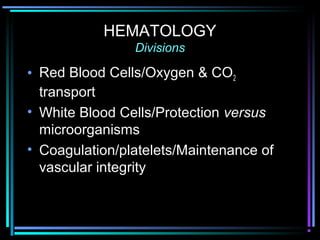
Divisions
• Red Blood Cells/Oxygen & CO2
transport
• White Blood Cells/Protection versus
microorganisms
• Coagulation/platelets/Maintenance of
vascular integrity
HEMATOLOGY
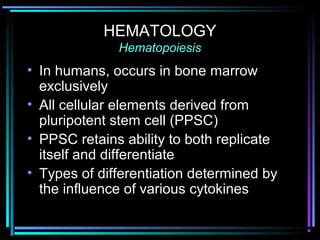
Hematopoiesis
• In humans, occurs in bone marrow
exclusively
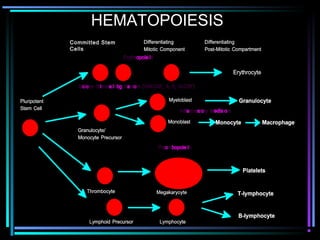
• All cellular elements derived from
pluripotent stem cell (PPSC)
• PPSC retains ability to both replicate
itself and differentiate
• Types of differentiation determined by
the influence of various cytokines
HEMATOPOIESIS
Committed Stem
Cells
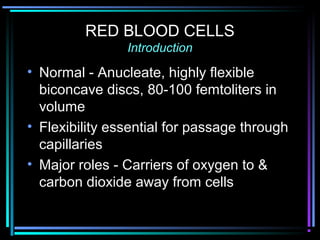
RED BLOOD CELLS
Introduction
• Normal - Anucleate, highly flexible
biconcave discs, 80-100 femtoliters in
volume
• Flexibility essential for passage through
capillaries
• Major roles - Carriers of oxygen to &
carbon dioxide away from cells
ERYTHROPOIETIN
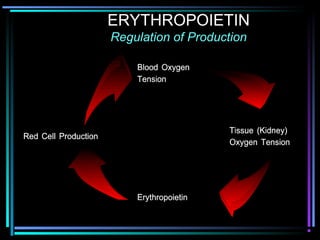
• Cytokine - Produced in the kidney
• Necessary for erythroid proliferation and
differentiation
• Absence results in apoptosis
(programmed cell death) of erythroid
committed cells
• Anemia of renal failure 2° to lack of
EPO
ERYTHROPOIETIN
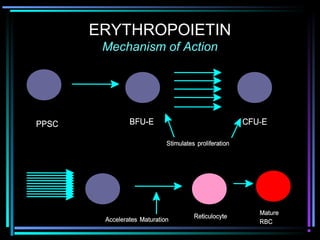
Mechanism of Action
ERYTHROPOIETIN
Mechanism of Action
• Binds specifically to Erythropoietin
Receptor
• Transmembrane protein; cytokine
receptor superfamily
• Binding leads to dimerization of
receptor
• Dimerization activates tyrosine kinase
activity
ERYTHROPOIETIN
Mechanism of Action
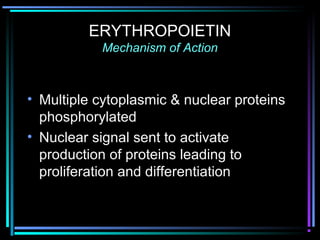
• Multiple cytoplasmic & nuclear proteins
phosphorylated
• Nuclear signal sent to activate
production of proteins leading to
proliferation and differentiation
ERYTHROPOIETIN
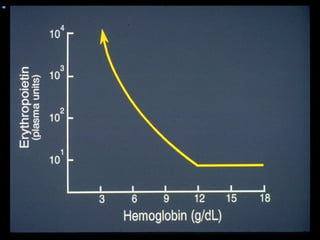
Regulation of Production
Erythropoietin
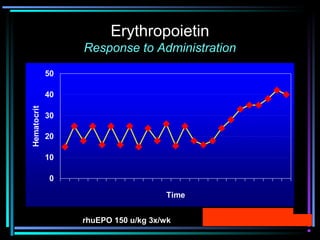
Response to Administration
0
10
20
30
40
50
Time
Hematocrit
rhuEPO 150 u/kg 3x/wk
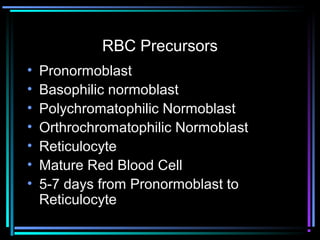
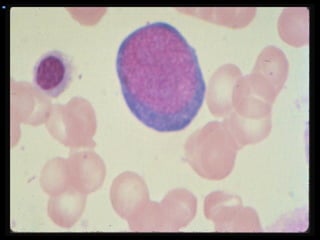
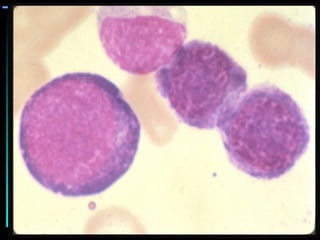
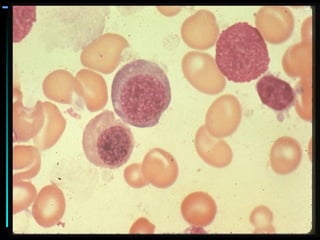
RBC Precursors
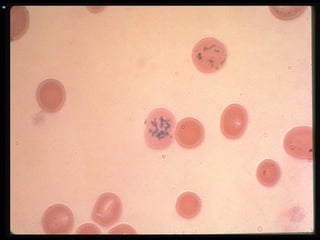
• Pronormoblast
• Basophilic normoblast
• Polychromatophilic Normoblast
• Orthrochromatophilic Normoblast
• Reticulocyte
• Mature Red Blood Cell
• 5-7 days from Pronormoblast to
Reticulocyte
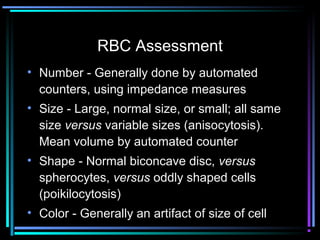
RBC Assessment
• Number - Generally done by automated
counters, using impedance measures
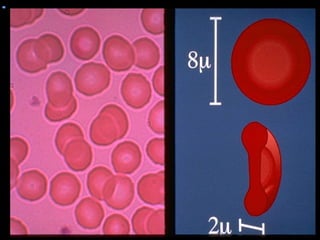
• Size - Large, normal size, or small; all same
size versus variable sizes (anisocytosis).
Mean volume by automated counter
• Shape - Normal biconcave disc, versus
spherocytes, versus oddly shaped cells
(poikilocytosis)
• Color - Generally an artifact of size of cell
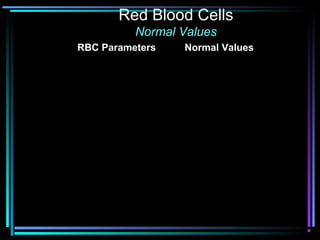
Red Blood Cells
Normal Values
RBC Parameters Normal Values
Hematocrit
Females 35-47%
Males 40-52%
Hemoglobin
Females 12.0-16.0 gm/dl
Males 13.5-17.5 gm/dl
MCV 80-100 fl
Reticulocyte Count 0.2-2.0%
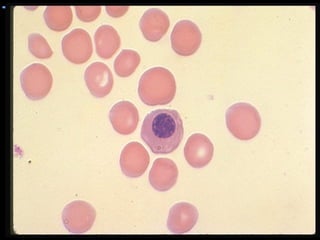
RETICULOCYTE
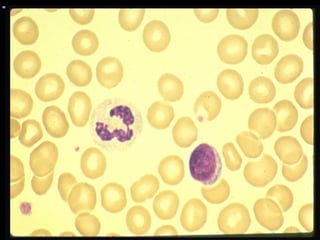
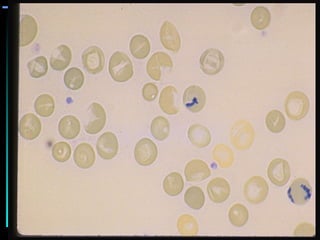
• Young red blood cell; still have small amounts
of RNA present in them
• Tend to stain somewhat bluer than mature
RBC’s on Wright stain (polychromatophilic)
• Slightly larger than mature RBC
• Undergo removal of RNA on passing through
spleen, in 1st day of life
• Can be detected using supravital stain
• Important marker of RBC production
RETICULOCYTE COUNT
Absolute Value
• = Retic % x RBC Count
– eg 0.01 x 5,000,000 = 50,000
• Normal up to 100,000
• More accurate way to assess body’s
response to anemia
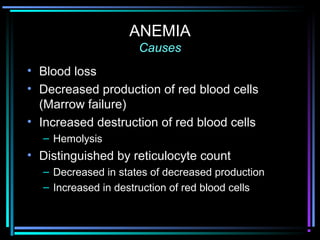
ANEMIA
Causes
• Blood loss
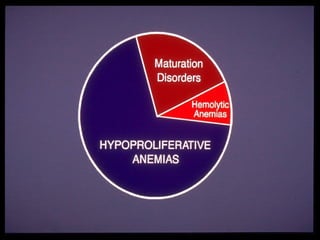
• Decreased production of red blood cells
(Marrow failure)
• Increased destruction of red blood cells
– Hemolysis
• Distinguished by reticulocyte count
– Decreased in states of decreased production
– Increased in destruction of red blood cells
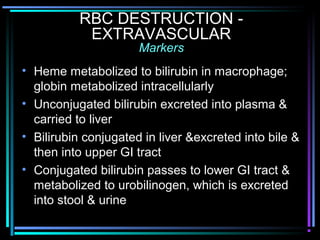
RBC DESTRUCTION -
EXTRAVASCULAR
Markers
• Heme metabolized to bilirubin in macrophage;
globin metabolized intracellularly
• Unconjugated bilirubin excreted into plasma &
carried to liver
• Bilirubin conjugated in liver &excreted into bile &
then into upper GI tract
• Conjugated bilirubin passes to lower GI tract &
metabolized to urobilinogen, which is excreted
into stool & urine
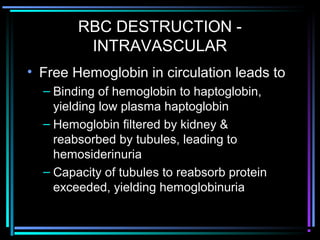
RBC DESTRUCTION -
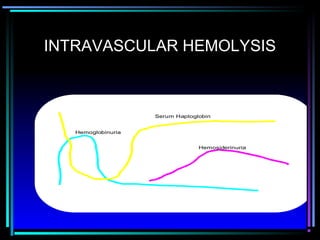
INTRAVASCULAR
• Free Hemoglobin in circulation leads to
– Binding of hemoglobin to haptoglobin,
yielding low plasma haptoglobin
– Hemoglobin filtered by kidney &
reabsorbed by tubules, leading to
hemosiderinuria
– Capacity of tubules to reabsorb protein
exceeded, yielding hemoglobinuria
INTRAVASCULAR HEMOLYSIS
Serum Haptoglobin
Hemosiderinuria
Hemoglobinuria
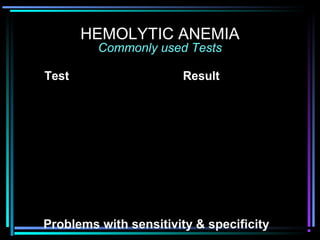
HEMOLYTIC ANEMIA
Commonly used Tests
Test Result
Reticulocyte Count Increased
Unconjugated Bilirubin Increased
Lactate Dehydrogenase Increased
Haptoglobin Decreased
Urine Hemoglobin Present
Urine Hemosiderin Present
Problems with sensitivity & specificity

Introduction to hematology

  • 1.
  • 2.
    HEMATOLOGY Introduction • Study ofblood & its components • Window of rest of body
  • 3.
    BLOOD Raison d’etre • Deliveryof nutrients – Oxygen – Food – Vitamins • Removal of wastes – Carbon dioxide – Nitrogenous wastes – Cellular toxins • Repair of its conduit • Protection versus invading microorganisms • Multiple cellular & acellular elements
  • 4.
    HEMATOLOGY Divisions • Red BloodCells/Oxygen & CO2 transport • White Blood Cells/Protection versus microorganisms • Coagulation/platelets/Maintenance of vascular integrity
  • 5.
    HEMATOLOGY Hematopoiesis • In humans,occurs in bone marrow exclusively • All cellular elements derived from pluripotent stem cell (PPSC) • PPSC retains ability to both replicate itself and differentiate • Types of differentiation determined by the influence of various cytokines
  • 6.
  • 7.
    RED BLOOD CELLS Introduction •Normal - Anucleate, highly flexible biconcave discs, 80-100 femtoliters in volume • Flexibility essential for passage through capillaries • Major roles - Carriers of oxygen to & carbon dioxide away from cells
  • 9.
    ERYTHROPOIETIN • Cytokine -Produced in the kidney • Necessary for erythroid proliferation and differentiation • Absence results in apoptosis (programmed cell death) of erythroid committed cells • Anemia of renal failure 2° to lack of EPO
  • 10.
  • 11.
    ERYTHROPOIETIN Mechanism of Action •Binds specifically to Erythropoietin Receptor • Transmembrane protein; cytokine receptor superfamily • Binding leads to dimerization of receptor • Dimerization activates tyrosine kinase activity
  • 12.
    ERYTHROPOIETIN Mechanism of Action •Multiple cytoplasmic & nuclear proteins phosphorylated • Nuclear signal sent to activate production of proteins leading to proliferation and differentiation
  • 13.
  • 15.
  • 16.
    RBC Precursors • Pronormoblast •Basophilic normoblast • Polychromatophilic Normoblast • Orthrochromatophilic Normoblast • Reticulocyte • Mature Red Blood Cell • 5-7 days from Pronormoblast to Reticulocyte
  • 22.
    RBC Assessment • Number- Generally done by automated counters, using impedance measures • Size - Large, normal size, or small; all same size versus variable sizes (anisocytosis). Mean volume by automated counter • Shape - Normal biconcave disc, versus spherocytes, versus oddly shaped cells (poikilocytosis) • Color - Generally an artifact of size of cell
  • 24.
    Red Blood Cells NormalValues RBC Parameters Normal Values Hematocrit Females 35-47% Males 40-52% Hemoglobin Females 12.0-16.0 gm/dl Males 13.5-17.5 gm/dl MCV 80-100 fl Reticulocyte Count 0.2-2.0%
  • 25.
    RETICULOCYTE • Young redblood cell; still have small amounts of RNA present in them • Tend to stain somewhat bluer than mature RBC’s on Wright stain (polychromatophilic) • Slightly larger than mature RBC • Undergo removal of RNA on passing through spleen, in 1st day of life • Can be detected using supravital stain • Important marker of RBC production
  • 27.
    RETICULOCYTE COUNT Absolute Value •= Retic % x RBC Count – eg 0.01 x 5,000,000 = 50,000 • Normal up to 100,000 • More accurate way to assess body’s response to anemia
  • 28.
    ANEMIA Causes • Blood loss •Decreased production of red blood cells (Marrow failure) • Increased destruction of red blood cells – Hemolysis • Distinguished by reticulocyte count – Decreased in states of decreased production – Increased in destruction of red blood cells
  • 30.
    RBC DESTRUCTION - EXTRAVASCULAR Markers •Heme metabolized to bilirubin in macrophage; globin metabolized intracellularly • Unconjugated bilirubin excreted into plasma & carried to liver • Bilirubin conjugated in liver &excreted into bile & then into upper GI tract • Conjugated bilirubin passes to lower GI tract & metabolized to urobilinogen, which is excreted into stool & urine
  • 31.
    RBC DESTRUCTION - INTRAVASCULAR •Free Hemoglobin in circulation leads to – Binding of hemoglobin to haptoglobin, yielding low plasma haptoglobin – Hemoglobin filtered by kidney & reabsorbed by tubules, leading to hemosiderinuria – Capacity of tubules to reabsorb protein exceeded, yielding hemoglobinuria
  • 32.
  • 33.
    HEMOLYTIC ANEMIA Commonly usedTests Test Result Reticulocyte Count Increased Unconjugated Bilirubin Increased Lactate Dehydrogenase Increased Haptoglobin Decreased Urine Hemoglobin Present Urine Hemosiderin Present Problems with sensitivity & specificity