Department of Electronics and Communication Engineering, MIT, Manipal
Department of Electronics and Communication Engineering, MIT, Manipal 2
1
ECE 1001 : BASIC ELECTRONICS
Department of Electronics and Communication Engineering, MIT, Manipal
Part – I : Analog Electronics
1
CHAPTER-1: DIODES AND APPLICATONS
Reference:
Robert L. Boylestad, Louis Nashelsky, Electronic Devices &
Circuit Theory, 11th Edition, PHI, 2012
Department of Electronics and Communication Engineering, MIT, Manipal
Module – 1 : Diodes
Learning outcomes
At the end of this module, students will be able to:
 Explain the operation of PN junction diode under different biasing
condition.
 Draw the I-V characteristic of diode and differentiate between ideal and
practical diodes
 Explain the concept of static and dynamic resistance of the diode.
 Explain various breakdown phenomenon observed in diodes.
 Describe the working of Zener diode and its I-V characteristic.
 Explain the operation of diode as capacitor.
3
Department of Electronics and Communication Engineering, MIT, Manipal
Department of Electronics and Communication Engineering, MIT, Manipal 2
Review
 Basic of Semiconductors
 Doping in Semiconductors
Department of Electronics and Communication Engineering, MIT, Manipal
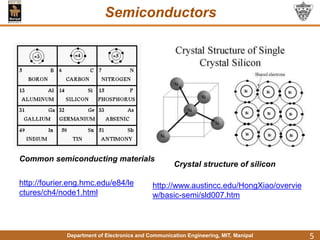
Semiconductors
5
Common semiconducting materials
Crystal structure of silicon
http://fourier.eng.hmc.edu/e84/le
ctures/ch4/node1.html
http://www.austincc.edu/HongXiao/overvie
w/basic-semi/sld007.htm
Department of Electronics and Communication Engineering, MIT, Manipal
Doping in Semiconductors
6
Schematic of a silicon crystal lattice doped with impurities to
produce n-type and p-type semiconductor material.
[http://www.pveducation.org/pvcdrom/pn-junction/dopingl].
Department of Electronics and Communication Engineering, MIT, Manipal
Self test
7
1.Why silicon is preferred over germanium for
semiconductor devices?
2.List different elemental and compound semiconductors.
Department of Electronics and Communication Engineering, MIT, Manipal
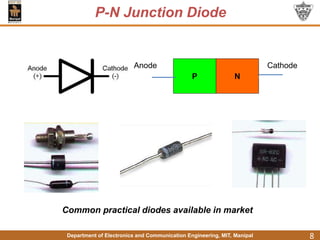
P-N Junction Diode
8
P N
Anode Cathode
Common practical diodes available in market
Department of Electronics and Communication Engineering, MIT, Manipal
P-N Junction Diode- conti…
9
Used in numerous applications
• Switch,
• Rectifier,
• Regulator,
• Voltage multiplier,
• Clipping,
• Clamping, etc.
Department of Electronics and Communication Engineering, MIT, Manipal
P-N Junction Diode under biasing
10
P-N junction (a) in contact (b) formation of depletion region
[http://www.imagesco.com/articles/photovoltaic/photovoltaic-pg3.html].
Department of Electronics and Communication Engineering, MIT, Manipal
P-N Junction Diode under biasing condition
11
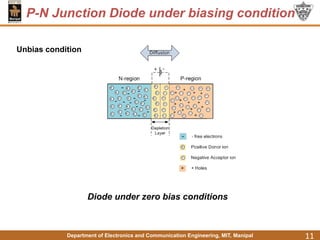
Unbias condition
Diode under zero bias conditions
Department of Electronics and Communication Engineering, MIT, Manipal 12
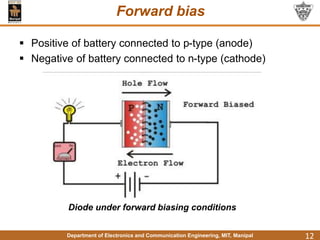
Forward bias
 Positive of battery connected to p-type (anode)
 Negative of battery connected to n-type (cathode)
Diode under forward biasing conditions
Department of Electronics and Communication Engineering, MIT, Manipal 13
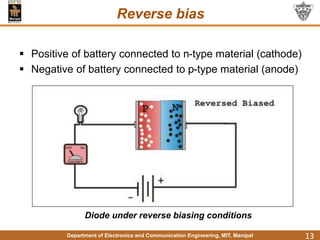
Reverse bias
 Positive of battery connected to n-type material (cathode)
 Negative of battery connected to p-type material (anode)
Diode under reverse biasing conditions
Department of Electronics and Communication Engineering, MIT, Manipal
Self test
14
1. The arrow direction in the diode symbol indicates
a. Direction of electron flow.
b. Direction of hole flow (Direction of conventional current)
c. Opposite to the direction of hole flow
d. None of the above
2. When the diode is forward biased, it is equivalent to
a. An off switch b. An On switch
c. A high resistance d. None of the above
.
Department of Electronics and Communication Engineering, MIT, Manipal
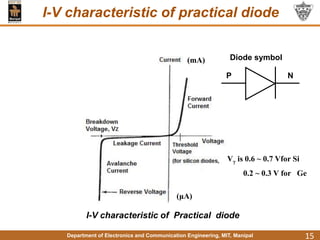
I-V characteristic of practical diode
15
P N
Diode symbol
Vγ is 0.6 ~ 0.7 Vfor Si
0.2 ~ 0.3 V for Ge
(mA)
(μA)
I-V characteristic of Practical diode
Department of Electronics and Communication Engineering, MIT, Manipal
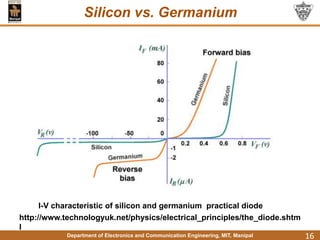
Silicon vs. Germanium
16
I-V characteristic of silicon and germanium practical diode
http://www.technologyuk.net/physics/electrical_principles/the_diode.shtm
l
Department of Electronics and Communication Engineering, MIT, Manipal
Breakdown phenomenon in diodes
17
Two breakdown mechanisms:
• Avalanche breakdown :
• Occurs in Lightly doped diodes,
• Occurs at high reverse Voltage.
• Zener Breakdown:
• Occurs in heavily doped diodes.
• at lower reverse bias voltages.
Department of Electronics and Communication Engineering, MIT, Manipal 18
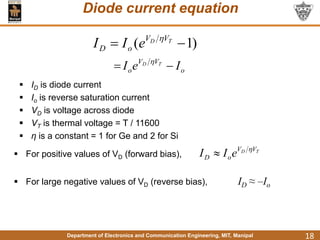
Diode current equation
 ID is diode current
 Io is reverse saturation current
 VD is voltage across diode
 VT is thermal voltage = T / 11600
 η is a constant = 1 for Ge and 2 for Si
)
1
( 
 T
D V
V
o
D e
I
I 
o
V
V
o I
e
I T
D

 
 For positive values of VD (forward bias),
 For large negative values of VD (reverse bias), ID ≈ –Io
T
D V
V
o
D e
I
I 

Department of Electronics and Communication Engineering, MIT, Manipal
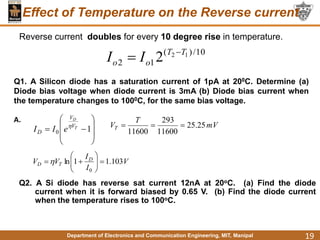
Effect of Temperature on the Reverse current
19
10
/
)
(
1
2
1
2
2 T
T
o
o I
I 

Q1. A Silicon diode has a saturation current of 1pA at 200C. Determine (a)
Diode bias voltage when diode current is 3mA (b) Diode bias current when
the temperature changes to 1000C, for the same bias voltage.
A.









 1
0
T
D
V
V
D e
I
I  mV
T
VT 25
.
25
11600
293
11600



V
I
I
V
V D
T
D 103
.
1
1
ln
0











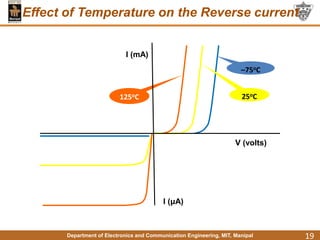
Reverse current doubles for every 10 degree rise in temperature.
Q2. A Si diode has reverse sat current 12nA at 20oC. (a) Find the diode
current when it is forward biased by 0.65 V. (b) Find the diode current
when the temperature rises to 100oC.
Department of Electronics and Communication Engineering, MIT, Manipal
Effect of Temperature on the Reverse current
19
I (mA)
V (volts)
I (μA)
–75oC
25oC
125oC
Department of Electronics and Communication Engineering, MIT, Manipal
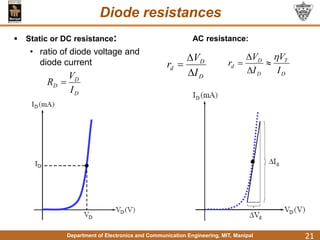
Diode resistances
21
 Static or DC resistance:
• ratio of diode voltage and
diode current
D
D
D
I
V
R 
AC resistance:
D
D
d
I
V
r



D
T
D
D
d
I
V
I
V
r





Department of Electronics and Communication Engineering, MIT, Manipal
Department of Electronics
and Communication
Engineering,
Manipal Institute of
Diode resistances
Two types of resistances are defined for a diode :
 Static or DC resistance:
• It is simply the ratio of diode voltage and diode current
• Lower the current through the diode, higher the DC
resistance level
• The dc resistance at the knee and below will be greater than
the resistance at the linear section of characteristics
• The dc resistance in the reverse bias region will naturally
be quite high
RD=VD/ID
Department of Electronics and Communication Engineering, MIT, Manipal
Department of Electronics
and Communication
Engineering,
Manipal Institute of
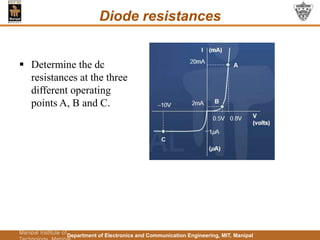
Diode resistances
 Determine the dc
resistances at the three
different operating
points A, B and C.
Department of Electronics and Communication Engineering, MIT, Manipal
Department of Electronics
and Communication
Engineering,
Manipal Institute of
Diode resistances
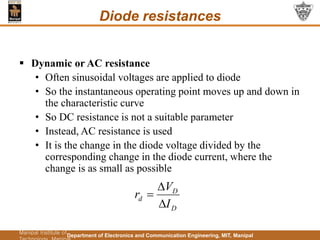
 Dynamic or AC resistance
• Often sinusoidal voltages are applied to diode
• So the instantaneous operating point moves up and down in
the characteristic curve
• So DC resistance is not a suitable parameter
• Instead, AC resistance is used
• It is the change in the diode voltage divided by the
corresponding change in the diode current, where the
change is as small as possible
D
D
d
I
V
r



Department of Electronics and Communication Engineering, MIT, Manipal
Department of Electronics
and Communication
Engineering,
Manipal Institute of
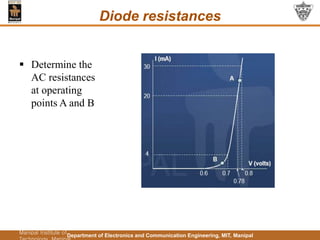
Diode resistances
 Determine the
AC resistances
at operating
points A and B
Department of Electronics and Communication Engineering, MIT, Manipal
Department of Electronics
and Communication
Engineering,
Manipal Institute of
Diode resistances
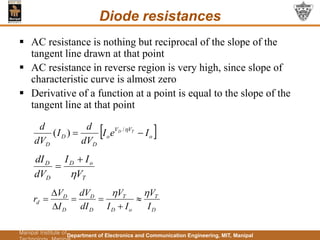
 AC resistance is nothing but reciprocal of the slope of the
tangent line drawn at that point
 AC resistance in reverse region is very high, since slope of
characteristic curve is almost zero
 Derivative of a function at a point is equal to the slope of the
tangent line at that point
 
o
V
V
o
D
D
D
I
e
I
dV
d
I
dV
d T
D

 
/
)
(
T
o
D
D
D
V
I
I
dV
dI



D
T
o
D
T
D
D
D
D
d
I
V
I
I
V
dI
dV
I
V
r









Department of Electronics and Communication Engineering, MIT, Manipal
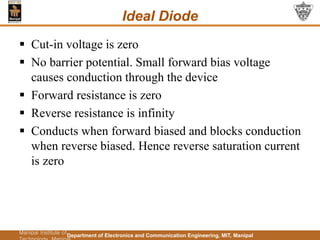
Ideal Diode
 Cut-in voltage is zero
 No barrier potential. Small forward bias voltage
causes conduction through the device
 Forward resistance is zero
 Reverse resistance is infinity
 Conducts when forward biased and blocks conduction
when reverse biased. Hence reverse saturation current
is zero
Department of Electronics
and Communication
Engineering,
Manipal Institute of
Department of Electronics and Communication Engineering, MIT, Manipal
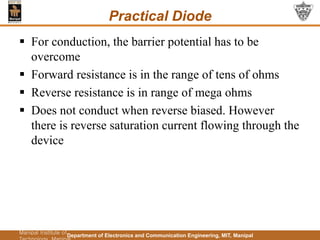
Practical Diode
 For conduction, the barrier potential has to be
overcome
 Forward resistance is in the range of tens of ohms
 Reverse resistance is in range of mega ohms
 Does not conduct when reverse biased. However
there is reverse saturation current flowing through the
device
Department of Electronics
and Communication
Engineering,
Manipal Institute of
Department of Electronics and Communication Engineering, MIT, Manipal
Ideal diode : I-V characteristics
29
I-V characteristic of Ideal diode and ideal models
[http://conceptselectronics.com/diodes/diode-equivalent-models/].
Department of Electronics and Communication Engineering, MIT, Manipal
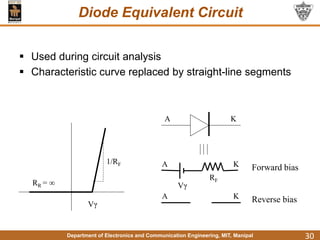
Diode Equivalent Circuit
30
 Used during circuit analysis
 Characteristic curve replaced by straight-line segments
Forward bias
Reverse bias
Vγ
RF
A K
A K
A K
Vγ
1/RF
RR = 
Department of Electronics and Communication Engineering, MIT, Manipal
Diode Equivalent Circuit
31
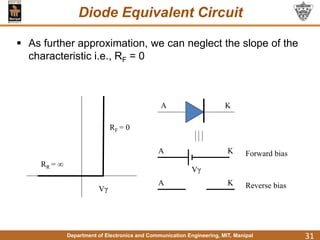
 As further approximation, we can neglect the slope of the
characteristic i.e., RF = 0
Vγ
A K
A K
A K
Forward bias
Reverse bias
Vγ
RR = 
RF = 0
Department of Electronics and Communication Engineering, MIT, Manipal
Diode Equivalent Circuit
32
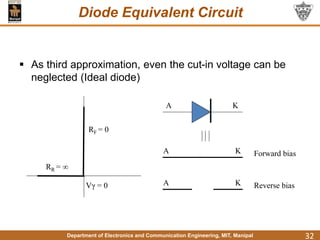
 As third approximation, even the cut-in voltage can be
neglected (Ideal diode)
Forward bias
Reverse bias
A K
A K
A K
Vγ = 0
RR = 
RF = 0
Department of Electronics and Communication Engineering, MIT, Manipal
Department of Electronics
and Communication
Engineering,
Manipal Institute of
Tutorials
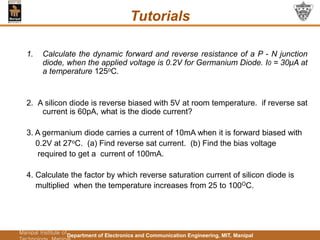
1. Calculate the dynamic forward and reverse resistance of a P - N junction
diode, when the applied voltage is 0.2V for Germanium Diode. I0 = 30μA at
a temperature 125oC.
2. A silicon diode is reverse biased with 5V at room temperature. if reverse sat
current is 60pA, what is the diode current?
3. A germanium diode carries a current of 10mA when it is forward biased with
0.2V at 27oC. (a) Find reverse sat current. (b) Find the bias voltage
required to get a current of 100mA.
4. Calculate the factor by which reverse saturation current of silicon diode is
multiplied when the temperature increases from 25 to 100OC.
Department of Electronics and Communication Engineering, MIT, Manipal
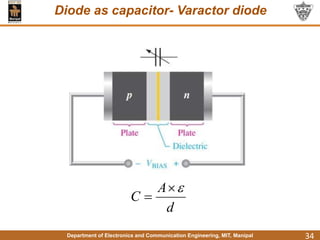
Diode as capacitor- Varactor diode
34
d
A
C



Department of Electronics and Communication Engineering, MIT, Manipal
Self test
1. The break-point voltage of Si diode is
a. 0.2V b. 0.7V c. 0.8V d. 1.0V
2. Why would you use silicon diodes instead of
germanium diodes?
35
Department of Electronics and Communication Engineering, MIT, Manipal
Breakdown phenomenon in diodes
36
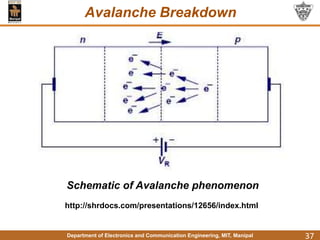
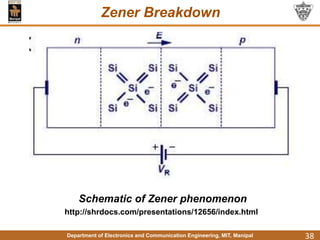
Two breakdown mechanisms:
• Avalanche breakdown :
• Occurs in Lightly doped diodes,
• Occurs at high reverse Voltage.
• Zener Breakdown:
• Occurs in heavily doped diodes.
• at lower reverse bias voltages.
Department of Electronics and Communication Engineering, MIT, Manipal
Avalanche Breakdown
37
Schematic of Avalanche phenomenon
http://shrdocs.com/presentations/12656/index.html
Department of Electronics and Communication Engineering, MIT, Manipal
Zener Breakdown
38
Schematic of Zener phenomenon
http://shrdocs.com/presentations/12656/index.html
Department of Electronics and Communication Engineering, MIT, Manipal
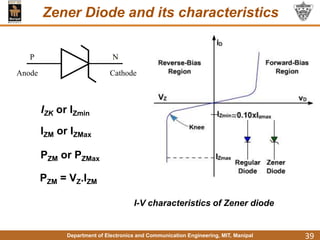
Zener Diode and its characteristics
39
Anode Cathode
P N
I-V characteristics of Zener diode
P N
IZK or IZmin
IZM or IZMax
PZM or PZMax
PZM = VZ.IZM
Department of Electronics and Communication Engineering, MIT, Manipal
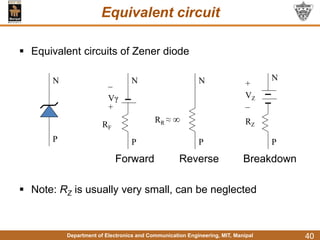
Equivalent circuit
40
Vγ
RF
RR ≈  RZ
VZ
–
+ –
+
N
P
N N N
P P P
 Equivalent circuits of Zener diode
Forward Reverse Breakdown
 Note: RZ is usually very small, can be neglected
Department of Electronics and Communication Engineering, MIT, Manipal
Self test
41
1. Explain the principle of PIN diode.
2.What is the difference between PN diode and Schottky diode.
3.Which type of diode exhibits negative resistance and why?
4. Which of the following is not an essential element of a dc
power supply
a. Rectifier
b. Filter
c. Voltage regulator
d. Voltage amplifier
Department of Electronics and Communication Engineering, MIT, Manipal
Self test
42
5. What is true about the breakdown voltage in a Zener diode?
a. It decreases when current increases.
b. It destroys the diode.
c. It equals the current times the resistance.
d. It is approximately constant
6. Which of these is the best description of a Zener diode?
a. It is a rectifier diode.
b. It is a constant voltage device.
c. It is a constant current device.
d. It works in the forward region.
Department of Electronics and Communication Engineering, MIT, Manipal
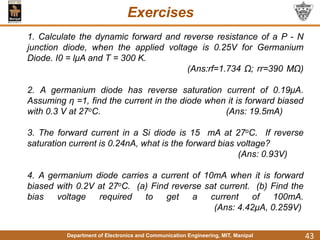
Exercises
43
1. Calculate the dynamic forward and reverse resistance of a P - N
junction diode, when the applied voltage is 0.25V for Germanium
Diode. I0 = lμA and T = 300 K.
(Ans:rf=1.734 Ω; rr=390 MΩ)
2. A germanium diode has reverse saturation current of 0.19μA.
Assuming η =1, find the current in the diode when it is forward biased
with 0.3 V at 27oC. (Ans: 19.5mA)
3. The forward current in a Si diode is 15 mA at 27oC. If reverse
saturation current is 0.24nA, what is the forward bias voltage?
(Ans: 0.93V)
4. A germanium diode carries a current of 10mA when it is forward
biased with 0.2V at 27oC. (a) Find reverse sat current. (b) Find the
bias voltage required to get a current of 100mA.
(Ans: 4.42μA, 0.259V)

Basic engineering electronics -Module 1_Diode.ppt

  • 1.
    Department of Electronicsand Communication Engineering, MIT, Manipal Department of Electronics and Communication Engineering, MIT, Manipal 2 1 ECE 1001 : BASIC ELECTRONICS
  • 2.
    Department of Electronicsand Communication Engineering, MIT, Manipal Part – I : Analog Electronics 1 CHAPTER-1: DIODES AND APPLICATONS Reference: Robert L. Boylestad, Louis Nashelsky, Electronic Devices & Circuit Theory, 11th Edition, PHI, 2012
  • 3.
    Department of Electronicsand Communication Engineering, MIT, Manipal Module – 1 : Diodes Learning outcomes At the end of this module, students will be able to:  Explain the operation of PN junction diode under different biasing condition.  Draw the I-V characteristic of diode and differentiate between ideal and practical diodes  Explain the concept of static and dynamic resistance of the diode.  Explain various breakdown phenomenon observed in diodes.  Describe the working of Zener diode and its I-V characteristic.  Explain the operation of diode as capacitor. 3
  • 4.
    Department of Electronicsand Communication Engineering, MIT, Manipal Department of Electronics and Communication Engineering, MIT, Manipal 2 Review  Basic of Semiconductors  Doping in Semiconductors
  • 5.
    Department of Electronicsand Communication Engineering, MIT, Manipal Semiconductors 5 Common semiconducting materials Crystal structure of silicon http://fourier.eng.hmc.edu/e84/le ctures/ch4/node1.html http://www.austincc.edu/HongXiao/overvie w/basic-semi/sld007.htm
  • 6.
    Department of Electronicsand Communication Engineering, MIT, Manipal Doping in Semiconductors 6 Schematic of a silicon crystal lattice doped with impurities to produce n-type and p-type semiconductor material. [http://www.pveducation.org/pvcdrom/pn-junction/dopingl].
  • 7.
    Department of Electronicsand Communication Engineering, MIT, Manipal Self test 7 1.Why silicon is preferred over germanium for semiconductor devices? 2.List different elemental and compound semiconductors.
  • 8.
    Department of Electronicsand Communication Engineering, MIT, Manipal P-N Junction Diode 8 P N Anode Cathode Common practical diodes available in market
  • 9.
    Department of Electronicsand Communication Engineering, MIT, Manipal P-N Junction Diode- conti… 9 Used in numerous applications • Switch, • Rectifier, • Regulator, • Voltage multiplier, • Clipping, • Clamping, etc.
  • 10.
    Department of Electronicsand Communication Engineering, MIT, Manipal P-N Junction Diode under biasing 10 P-N junction (a) in contact (b) formation of depletion region [http://www.imagesco.com/articles/photovoltaic/photovoltaic-pg3.html].
  • 11.
    Department of Electronicsand Communication Engineering, MIT, Manipal P-N Junction Diode under biasing condition 11 Unbias condition Diode under zero bias conditions
  • 12.
    Department of Electronicsand Communication Engineering, MIT, Manipal 12 Forward bias  Positive of battery connected to p-type (anode)  Negative of battery connected to n-type (cathode) Diode under forward biasing conditions
  • 13.
    Department of Electronicsand Communication Engineering, MIT, Manipal 13 Reverse bias  Positive of battery connected to n-type material (cathode)  Negative of battery connected to p-type material (anode) Diode under reverse biasing conditions
  • 14.
    Department of Electronicsand Communication Engineering, MIT, Manipal Self test 14 1. The arrow direction in the diode symbol indicates a. Direction of electron flow. b. Direction of hole flow (Direction of conventional current) c. Opposite to the direction of hole flow d. None of the above 2. When the diode is forward biased, it is equivalent to a. An off switch b. An On switch c. A high resistance d. None of the above .
  • 15.
    Department of Electronicsand Communication Engineering, MIT, Manipal I-V characteristic of practical diode 15 P N Diode symbol Vγ is 0.6 ~ 0.7 Vfor Si 0.2 ~ 0.3 V for Ge (mA) (μA) I-V characteristic of Practical diode
  • 16.
    Department of Electronicsand Communication Engineering, MIT, Manipal Silicon vs. Germanium 16 I-V characteristic of silicon and germanium practical diode http://www.technologyuk.net/physics/electrical_principles/the_diode.shtm l
  • 17.
    Department of Electronicsand Communication Engineering, MIT, Manipal Breakdown phenomenon in diodes 17 Two breakdown mechanisms: • Avalanche breakdown : • Occurs in Lightly doped diodes, • Occurs at high reverse Voltage. • Zener Breakdown: • Occurs in heavily doped diodes. • at lower reverse bias voltages.
  • 18.
    Department of Electronicsand Communication Engineering, MIT, Manipal 18 Diode current equation  ID is diode current  Io is reverse saturation current  VD is voltage across diode  VT is thermal voltage = T / 11600  η is a constant = 1 for Ge and 2 for Si ) 1 (   T D V V o D e I I  o V V o I e I T D     For positive values of VD (forward bias),  For large negative values of VD (reverse bias), ID ≈ –Io T D V V o D e I I  
  • 19.
    Department of Electronicsand Communication Engineering, MIT, Manipal Effect of Temperature on the Reverse current 19 10 / ) ( 1 2 1 2 2 T T o o I I   Q1. A Silicon diode has a saturation current of 1pA at 200C. Determine (a) Diode bias voltage when diode current is 3mA (b) Diode bias current when the temperature changes to 1000C, for the same bias voltage. A.           1 0 T D V V D e I I  mV T VT 25 . 25 11600 293 11600    V I I V V D T D 103 . 1 1 ln 0            Reverse current doubles for every 10 degree rise in temperature. Q2. A Si diode has reverse sat current 12nA at 20oC. (a) Find the diode current when it is forward biased by 0.65 V. (b) Find the diode current when the temperature rises to 100oC.
  • 20.
    Department of Electronicsand Communication Engineering, MIT, Manipal Effect of Temperature on the Reverse current 19 I (mA) V (volts) I (μA) –75oC 25oC 125oC
  • 21.
    Department of Electronicsand Communication Engineering, MIT, Manipal Diode resistances 21  Static or DC resistance: • ratio of diode voltage and diode current D D D I V R  AC resistance: D D d I V r    D T D D d I V I V r     
  • 22.
    Department of Electronicsand Communication Engineering, MIT, Manipal Department of Electronics and Communication Engineering, Manipal Institute of Diode resistances Two types of resistances are defined for a diode :  Static or DC resistance: • It is simply the ratio of diode voltage and diode current • Lower the current through the diode, higher the DC resistance level • The dc resistance at the knee and below will be greater than the resistance at the linear section of characteristics • The dc resistance in the reverse bias region will naturally be quite high RD=VD/ID
  • 23.
    Department of Electronicsand Communication Engineering, MIT, Manipal Department of Electronics and Communication Engineering, Manipal Institute of Diode resistances  Determine the dc resistances at the three different operating points A, B and C.
  • 24.
    Department of Electronicsand Communication Engineering, MIT, Manipal Department of Electronics and Communication Engineering, Manipal Institute of Diode resistances  Dynamic or AC resistance • Often sinusoidal voltages are applied to diode • So the instantaneous operating point moves up and down in the characteristic curve • So DC resistance is not a suitable parameter • Instead, AC resistance is used • It is the change in the diode voltage divided by the corresponding change in the diode current, where the change is as small as possible D D d I V r   
  • 25.
    Department of Electronicsand Communication Engineering, MIT, Manipal Department of Electronics and Communication Engineering, Manipal Institute of Diode resistances  Determine the AC resistances at operating points A and B
  • 26.
    Department of Electronicsand Communication Engineering, MIT, Manipal Department of Electronics and Communication Engineering, Manipal Institute of Diode resistances  AC resistance is nothing but reciprocal of the slope of the tangent line drawn at that point  AC resistance in reverse region is very high, since slope of characteristic curve is almost zero  Derivative of a function at a point is equal to the slope of the tangent line at that point   o V V o D D D I e I dV d I dV d T D    / ) ( T o D D D V I I dV dI    D T o D T D D D D d I V I I V dI dV I V r         
  • 27.
    Department of Electronicsand Communication Engineering, MIT, Manipal Ideal Diode  Cut-in voltage is zero  No barrier potential. Small forward bias voltage causes conduction through the device  Forward resistance is zero  Reverse resistance is infinity  Conducts when forward biased and blocks conduction when reverse biased. Hence reverse saturation current is zero Department of Electronics and Communication Engineering, Manipal Institute of
  • 28.
    Department of Electronicsand Communication Engineering, MIT, Manipal Practical Diode  For conduction, the barrier potential has to be overcome  Forward resistance is in the range of tens of ohms  Reverse resistance is in range of mega ohms  Does not conduct when reverse biased. However there is reverse saturation current flowing through the device Department of Electronics and Communication Engineering, Manipal Institute of
  • 29.
    Department of Electronicsand Communication Engineering, MIT, Manipal Ideal diode : I-V characteristics 29 I-V characteristic of Ideal diode and ideal models [http://conceptselectronics.com/diodes/diode-equivalent-models/].
  • 30.
    Department of Electronicsand Communication Engineering, MIT, Manipal Diode Equivalent Circuit 30  Used during circuit analysis  Characteristic curve replaced by straight-line segments Forward bias Reverse bias Vγ RF A K A K A K Vγ 1/RF RR = 
  • 31.
    Department of Electronicsand Communication Engineering, MIT, Manipal Diode Equivalent Circuit 31  As further approximation, we can neglect the slope of the characteristic i.e., RF = 0 Vγ A K A K A K Forward bias Reverse bias Vγ RR =  RF = 0
  • 32.
    Department of Electronicsand Communication Engineering, MIT, Manipal Diode Equivalent Circuit 32  As third approximation, even the cut-in voltage can be neglected (Ideal diode) Forward bias Reverse bias A K A K A K Vγ = 0 RR =  RF = 0
  • 33.
    Department of Electronicsand Communication Engineering, MIT, Manipal Department of Electronics and Communication Engineering, Manipal Institute of Tutorials 1. Calculate the dynamic forward and reverse resistance of a P - N junction diode, when the applied voltage is 0.2V for Germanium Diode. I0 = 30μA at a temperature 125oC. 2. A silicon diode is reverse biased with 5V at room temperature. if reverse sat current is 60pA, what is the diode current? 3. A germanium diode carries a current of 10mA when it is forward biased with 0.2V at 27oC. (a) Find reverse sat current. (b) Find the bias voltage required to get a current of 100mA. 4. Calculate the factor by which reverse saturation current of silicon diode is multiplied when the temperature increases from 25 to 100OC.
  • 34.
    Department of Electronicsand Communication Engineering, MIT, Manipal Diode as capacitor- Varactor diode 34 d A C   
  • 35.
    Department of Electronicsand Communication Engineering, MIT, Manipal Self test 1. The break-point voltage of Si diode is a. 0.2V b. 0.7V c. 0.8V d. 1.0V 2. Why would you use silicon diodes instead of germanium diodes? 35
  • 36.
    Department of Electronicsand Communication Engineering, MIT, Manipal Breakdown phenomenon in diodes 36 Two breakdown mechanisms: • Avalanche breakdown : • Occurs in Lightly doped diodes, • Occurs at high reverse Voltage. • Zener Breakdown: • Occurs in heavily doped diodes. • at lower reverse bias voltages.
  • 37.
    Department of Electronicsand Communication Engineering, MIT, Manipal Avalanche Breakdown 37 Schematic of Avalanche phenomenon http://shrdocs.com/presentations/12656/index.html
  • 38.
    Department of Electronicsand Communication Engineering, MIT, Manipal Zener Breakdown 38 Schematic of Zener phenomenon http://shrdocs.com/presentations/12656/index.html
  • 39.
    Department of Electronicsand Communication Engineering, MIT, Manipal Zener Diode and its characteristics 39 Anode Cathode P N I-V characteristics of Zener diode P N IZK or IZmin IZM or IZMax PZM or PZMax PZM = VZ.IZM
  • 40.
    Department of Electronicsand Communication Engineering, MIT, Manipal Equivalent circuit 40 Vγ RF RR ≈  RZ VZ – + – + N P N N N P P P  Equivalent circuits of Zener diode Forward Reverse Breakdown  Note: RZ is usually very small, can be neglected
  • 41.
    Department of Electronicsand Communication Engineering, MIT, Manipal Self test 41 1. Explain the principle of PIN diode. 2.What is the difference between PN diode and Schottky diode. 3.Which type of diode exhibits negative resistance and why? 4. Which of the following is not an essential element of a dc power supply a. Rectifier b. Filter c. Voltage regulator d. Voltage amplifier
  • 42.
    Department of Electronicsand Communication Engineering, MIT, Manipal Self test 42 5. What is true about the breakdown voltage in a Zener diode? a. It decreases when current increases. b. It destroys the diode. c. It equals the current times the resistance. d. It is approximately constant 6. Which of these is the best description of a Zener diode? a. It is a rectifier diode. b. It is a constant voltage device. c. It is a constant current device. d. It works in the forward region.
  • 43.
    Department of Electronicsand Communication Engineering, MIT, Manipal Exercises 43 1. Calculate the dynamic forward and reverse resistance of a P - N junction diode, when the applied voltage is 0.25V for Germanium Diode. I0 = lμA and T = 300 K. (Ans:rf=1.734 Ω; rr=390 MΩ) 2. A germanium diode has reverse saturation current of 0.19μA. Assuming η =1, find the current in the diode when it is forward biased with 0.3 V at 27oC. (Ans: 19.5mA) 3. The forward current in a Si diode is 15 mA at 27oC. If reverse saturation current is 0.24nA, what is the forward bias voltage? (Ans: 0.93V) 4. A germanium diode carries a current of 10mA when it is forward biased with 0.2V at 27oC. (a) Find reverse sat current. (b) Find the bias voltage required to get a current of 100mA. (Ans: 4.42μA, 0.259V)