Applied Electronics ፩
Lecture Note ፪
By Getinet A.
Email: getinetasimare@gmail.com
getnasm@dtu.edu.et
Debre Tabor University
Gafat Institute of Technology
Department of Electrical and Computer Engineering
1/1/2024
Slide by: Getinet A. (MSc)
1
Semiconductor diodes and their
application
 The ideal diode or perfect diode is a two terminal device,
which completely allows to flow the electric current without any
loss under forward bias and completely blocks the electric
current with infinite loss under reverse bias.
 Ideal diodes actually do not exist. However, the V-I
characteristics of ideal diodes is used to study the diode
circuits. In other words, it is used to study the quality of a real
diode by comparing it with the ideal diode.
 It is actually not possible to design a real diode, which
behaves exactly like an ideal diode. However, a well-designed
diode behaves almost like a perfect diode or ideal diode.
Ideal diode
1/1/2024
Slide by: Getinet A. (MSc)
2
… Cont’d …
 Ideal diode consists of two terminals: positive terminal and
negative terminal. The positive end or positive terminal of the
diode is called anode and the negative end or negative
terminal of the diode is called cathode. The electric current
always flow from anode or positive terminal to the cathode or
negative terminal.
 If the positive terminal of the battery is connected to the p-type
semiconductor and the negative terminal of the battery is
connected to the n-type semiconductor, the diode is said to be
forward biased.
 On the other hand, if the positive terminal of the battery is
connected to the n-type semiconductor and the negative
terminal of the battery is connected to the p-type
1/1/2024
Slide by: Getinet A. (MSc)
3
… Cont’d …
 Under forward biased condition, ideal diode acts as a perfect conductor
with zero resistance whereas under reverse biased condition, it acts as a
perfect insulator with infinite resistance.
 In other words, ideal diodes acts as closed circuit or short circuit under
forward biased condition and acts as an open circuit or open switch
under reverse biased condition.
 Ideal diodes does not have depletion region or junction barrier, which
resist the flow of electric current. Hence, ideal diode has no voltage drop
or voltage loss.
Fig 1: Diode symbols
1/1/2024
Slide by: Getinet A. (MSc)
4
Forward and reverse characteristics of ideal diode
 The Forward and reverse characteristics of ideal diode under
forward and reverse biased condition is shown in the below
figure.
 If the forward voltage or positive voltage (VF) (p terminal
connected to p-side and n terminal connected to n-side)
applied on the diode is equal to zero or greater than zero, the
forward electric current (IF) in the ideal diode increases
infinitely.
 On the other hand, if the reverse voltage or negative
voltage (VR) (p terminal connected to n-side and n-terminal
connected to p-side) applied on the diode is less than zero, no
forward electric current (IF) and reverse electric
current (I ) flows in the ideal diode.
1/1/2024
Slide by: Getinet A. (MSc)
5
… Cont’d …
Fig 2: V-I characteristics of ideal Diode
1/1/2024
Slide by: Getinet A. (MSc)
6
Diode models
The Ideal Diode Mode
 When the diode is forward-biased, it ideally acts like a closed
(on) switch, as shown in Fig 3. When the diode is reverse-
biased, it ideally acts like an open (off) switch, as shown in
part (b).
 The barrier potential, the forward dynamic resistance, and the
reverse current are all neglected.
 In Fig 3c, the ideal V-I characteristic curve graphically depicts
the ideal diode operation.
1/1/2024
Slide by: Getinet A. (MSc)
7
Fig 3: Ideal diode
model
1/1/2024
Slide by: Getinet A. (MSc)
8
The Practical Diode Model
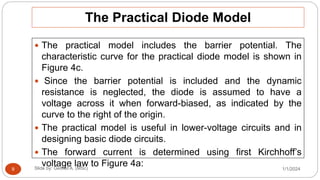
 The practical model includes the barrier potential. The
characteristic curve for the practical diode model is shown in
Figure 4c.
 Since the barrier potential is included and the dynamic
resistance is neglected, the diode is assumed to have a
voltage across it when forward-biased, as indicated by the
curve to the right of the origin.
 The practical model is useful in lower-voltage circuits and in
designing basic diode circuits.
 The forward current is determined using first Kirchhoff’s
voltage law to Figure 4a: 1/1/2024
Slide by: Getinet A. (MSc)
9
… Cont’d …
𝑉𝐵𝑖𝑎𝑠 − 𝑉𝐹 − 𝑉𝑅𝐿𝑖𝑚𝑖𝑡
= 0
𝑉𝑅𝐿𝑖𝑚𝑖𝑡
= 𝐼𝐹𝑅𝐿𝑖𝑚𝑖𝑡
Substituting and solving for 𝐼𝐹
𝐼𝐹 =
𝑉𝐵𝑖𝑎𝑠 − 𝑉𝐹
𝑅𝐿𝑖𝑚𝑖𝑡
The diode is assumed to have zero reverse current, 𝑉𝐹 =0.7V , 𝑉𝐵𝑖𝑎𝑠 = 𝑉𝑅, 𝐼𝑅 = 0A
Fig 4: Practical diode model
1/1/2024
Slide by: Getinet A. (MSc)
10
The Complete Diode Model
 The complete model of a diode includes the barrier potential,
the small forward dynamic resistance ( 𝑟𝑑 ) and the large
internal reverse resistance (́𝑟𝑅).
 The reverse resistance is taken into account because it
provides a path for the reverse current, which is included in
this diode model.
Fig 5: Complete diode model
1/1/2024
Slide by: Getinet A. (MSc)
11
Example 1:
 (a) Determine the forward voltage and forward current for the
diode in
Figure 6(a) for each of ideal and practical diode models. Also,
find the voltage across the limiting resistor in each case.
 (b) Determine the reverse voltage and reverse current for the
diode in
Figure 6(b) for each of the diode models. Also, find the voltage
across the limiting resistor in each case. Assume IR = 1μA.
Fig
6:
1/1/2024
Slide by: Getinet A. (MSc)
12
1/1/2024
Slide by: Getinet A. (MSc)
13
Diode Resistance
 As the operating point of a diode moves from one region to another the
resistance of the
diode will also change due to the nonlinear shape of the characteristic
curve.
 The application of a dc voltage to a circuit containing a semiconductor
diode will result in
an operating point on the characteristic curve that will not change with
time.
 The resistance of the diode at the operating point can be found simply by
finding the corresponding levels of VD and ID as shown in Fig. 7 and
applying the following equation:
𝑅𝐷 =
𝑉𝐷
𝐼𝐷
 The resistance levels in the reverse-bias region will naturally be quite
DC or static resistance
1/1/2024
Slide by: Getinet A. (MSc)
14
… Cont’d …
 In general, therefore, the higher the current through a diode,
the lower is the dc resistance level.
 Typically, the dc resistance of a diode in the active (most
utilized) will range from about 10 V to 80 V.
Fig. 7: Determining the dc resistance of a diode at a particular
operating point
1/1/2024
Slide by: Getinet A. (MSc)
15
Example
 Determine the dc resistance levels for the diode of Fig. 8 at
a. ID = 2 mA (low level)
b. ID = 20 mA (high level)
c. VD = 10 V (reverse-biased)
Fig. 8: Example
1/1/2024
Slide by: Getinet A. (MSc)
16
AC or dynamic resistance
 The dc resistance of a diode is independent of the shape
of the characteristic in the region surrounding the point of
interest.
 If a sinusoidal rather than a dc input is applied, the situation
will change completely.
 The varying input will move the instantaneous operating point
up and down a region of the characteristics and thus defines a
specific change in current and voltage as shown in Fig. 9.
 With no applied varying signal, the point of operation would be
the Q-point appearing on Fig. 9, determined by the applied dc
levels. The designation Q-point is derived from the word
quiescent, which means “still or unvarying.”
1/1/2024
Slide by: Getinet A. (MSc)
17
Fig. 9: Defining the dynamic or ac resistance.
Fig.10: Determining the
ac resistance at a Q-
point
1/1/2024
Slide by: Getinet A. (MSc)
18
… Cont’d …
 A straight line drawn tangent to the curve through the Q-point as
shown in Fig. 10 will define a particular change in voltage and
current that can be used to determine the ac or dynamic resistance
for this region of the diode characteristics.
 An effort should be made to keep the change in voltage and
current as small as possible and equidistant to either side of the Q-
point.
𝑟𝑑 =
∆𝑉𝐷
∆𝐼𝐷
 In general, therefore, the lower the Q-point of operation (smaller
current or lower voltage), the higher is the ac resistance.
 Q point or the operating point of a device, also known as a bias point,
or quiescent point is the steady-state DC voltage or current at a specified
terminal of an active device such as a diode or transistor with no input
1/1/2024
Slide by: Getinet A. (MSc)
19
Example
𝐹𝑜𝑟 𝑡ℎ𝑒 𝑐ℎ𝑎𝑟𝑎𝑐𝑡𝑒𝑟𝑖𝑠𝑡𝑖𝑐𝑠 𝑜𝑓 𝐹𝑖𝑔. 11:
𝑎. 𝐷𝑒𝑡𝑒𝑟𝑚𝑖𝑛𝑒 𝑡ℎ𝑒 𝑎𝑐 𝑟𝑒𝑠𝑖𝑠𝑡𝑎𝑛𝑐𝑒 𝑎𝑡 𝐼𝐷 = 2 𝑚𝐴.
𝑏. 𝐷𝑒𝑡𝑒𝑟𝑚𝑖𝑛𝑒 𝑡ℎ𝑒 𝑎𝑐 𝑟𝑒𝑠𝑖𝑠𝑡𝑎𝑛𝑐𝑒 𝑎𝑡 𝐼𝐷 = 25 𝑚𝐴.
𝑐. 𝐶𝑜𝑚𝑝𝑎𝑟𝑒 𝑡ℎ𝑒 𝑟𝑒𝑠𝑢𝑙𝑡𝑠 𝑜𝑓 𝑝𝑎𝑟𝑡𝑠 𝑎 𝑎𝑛𝑑 𝑏
𝑡𝑜 𝑡ℎ𝑒 𝑑𝑐 𝑟𝑒𝑠𝑖𝑠𝑡𝑎𝑛𝑐𝑒𝑠 𝑎𝑡 𝑒𝑎𝑐ℎ 𝑐𝑢𝑟𝑟𝑒𝑛𝑡 𝑙𝑒𝑣𝑒𝑙.
Fig. 11: Example
1/1/2024
Slide by: Getinet A. (MSc)
20
1/1/2024
Slide by: Getinet A. (MSc)
21
… Cont’d …
 We have found the dynamic resistance graphically, but there is a basic
definition in differential calculus that states:
 The derivative of a function at a point is equal to the slope of the
tangent line drawn at that point.
 If we find the derivative of the general equation 𝐼𝐷 = 𝐼𝑠 𝑒
𝑉𝐷
𝑛𝑉𝑇 − 1 for the
semiconductor diode with respect to the applied forward bias and then
invert the result, we will have an equation for the dynamic or ac
resistance in that region.
𝑑
𝑑𝑉𝑑
𝐼𝐷 =
𝑑
𝑑𝑉𝑑
𝐼𝑠 𝑒
𝑉𝐷
𝑛𝑉𝑇 − 1 and
𝑑𝐼𝐷
𝑑𝑉𝐷
=
1
𝑛𝑉𝑇
(𝐼𝐷 + 𝐼𝑆)
after we apply differential calculus. In general, ID = Is in the vertical-slope section of
the characteristics and
𝑑𝐼𝐷
𝑑𝑉𝐷
≅
𝐼𝐷
𝑛𝑉𝑇 1/1/2024
Slide by: Getinet A. (MSc)
22
… Cont’d …
 Now the AC resistance becomes:
𝑑𝑉𝐷
𝑑𝐼𝐷
= 𝑟𝑑 =
𝑛𝑉𝑇
𝐼𝐷
𝑎𝑠𝑢𝑚𝑒 𝑛 = 1,
 If the input signal is sufficiently large to produce a broad swing such
as indicated in Fig. 12, the resistance associated with the device for
this region is called the average ac resistance.
 The average ac resistance is, by definition, the resistance
determined by a straight
line drawn between the two intersections established by the
maximum and minimum values of input voltage.
Average AC Resistance
1/1/2024
Slide by: Getinet A. (MSc)
23
 For the situation indicated in the figure
Fig.12: Determining the average ac resistance between indicated limits
1/1/2024
Slide by: Getinet A. (MSc)
24
Table: Resistance Levels
1/1/2024
Slide by: Getinet A. (MSc)
25
Diodes Applications
 They are used for isolating signals from a supply. For example,
one of the major uses of diodes is to remove negative signals
from AC current. This is known as signal demodulation. This
function is basically used in radios as a filtering system in
order to extract radio signals from a carrier wave.
 Before taking a look at various applications of diodes, let us
quickly take a peek at a small list of common applications of
diodes.
 and many more. Now let us understand each of these
applications of diodes in more detail.
• Reverse Current Protection Circuits
• In Logic Gates
• Voltage Multipliers
• Rectifiers
• Clipper Circuits
• Clamping
Circuits
1/1/2024
Slide by: Getinet A. (MSc)
26
Rectifiers
 A power supply is an essential part of each electronic system
from the simplest to the most complex.
 A basic block diagram of the complete power supply is shown
in Fig 7.
 The transformer changes ac voltages based on the turns ratio
between the primary and secondary.
 The rectifier converts the ac input voltage to dc voltage.
 The filter eliminates the fluctuations in the rectified voltage
and produces a relatively smooth dc voltage.
 The regulator is a circuit that maintains a constant dc voltage
for variations in the input line voltage or in the load.
1/1/2024
Slide by: Getinet A. (MSc)
27
Fig 13: Power supply
1/1/2024
Slide by: Getinet A. (MSc)
28
… Cont’d …
 Because of their ability to conduct current in one direction and
block current in the other direction, diodes are used in circuits
called rectifiers that convert ac voltage into dc voltage.
 Rectifiers are found in all dc power supplies that operate from
an ac voltage
source. When connected with ac voltage, diode only allows
half cycle passing through it and hence convert ac into dc.
 The basic types of these rectifier circuits are half wave, full
wave center tapped and full bridge rectifiers.
 A single or combination of four diodes is used in most of the
power conversion applications.
1/1/2024
Slide by: Getinet A. (MSc)
29
Fig 14: Rectifier Circuit
1/1/2024
Slide by: Getinet A. (MSc)
30
… Cont’d …
• During the positive half cycle of the input supply, anode is made
positive with respect to cathode. So, the diode gets forward biased.
This results in the current to flow to the load. Since the load is
resistive, the voltage across the load resistor will be same as the
supply voltage i.e., the input sinusoidal voltage will appear at the load
(only the positive cycle). And the load current flow is proportional to
the voltage applied.
• During the negative half-cycle of the input sinusoidal wave, anode is
made negative with respect to cathode. So, the diode gets reverse
biased. Hence, no current flows to the load. The circuit becomes open
circuit and no voltage appears across the load.
• Both voltage and current at the load side are of one polarity means
the output voltage is pulsating DC. Often, this rectification circuit has a
capacitor that is connected across the load to produce steady and
1/1/2024
Slide by: Getinet A. (MSc)
31
Average Value of the Half-Wave Output
Voltage
 The average value of the half-wave rectified output voltage is
the value you would measure on a dc voltmeter.
 This equation shows that VAVG is approximately 31.8% of Vp
for a half-wave rectified voltage.
𝑉
𝑎𝑣𝑔 =
𝑉𝑝
𝜋
 Vp is the peak value of the voltage.
Fig. 15: Average value of the half-wave
rectified signal
1/1/2024
Slide by: Getinet A. (MSc)
32
Effect of the Barrier Potential on the Half-Wave Rectifier
Output
 In the previous discussion, the diode was considered ideal. When
the practical diode model is used with the barrier potential of 0.7 V
taken into account, this is what happens.
 During the positive half-cycle, the input voltage must overcome the
barrier potential before the diode becomes forward-biased. This
results in a half-wave output with a peak value that is 0.7 V less
than the peak value of the input.
Vp(out) = Vp(in) - 0.7 V
Fig. 16: The effect of the barrier potential on the half-wave rectified output voltage is
to reduce the peak value of the input by about 0.7 V
1/1/2024
Slide by: Getinet A. (MSc)
33
… Cont’d …
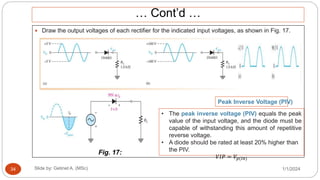
 Draw the output voltages of each rectifier for the indicated input voltages, as shown in Fig. 17.
Fig. 17:
Peak Inverse Voltage (PIV)
• The peak inverse voltage (PIV) equals the peak
value of the input voltage, and the diode must be
capable of withstanding this amount of repetitive
reverse voltage.
• A diode should be rated at least 20% higher than
the PIV.
𝑉𝐼𝑃 = 𝑉𝑝(𝑖𝑛)
1/1/2024
Slide by: Getinet A. (MSc)
34
Full wave rectifiers
 Although half-wave rectifiers have some applications, the full-
wave rectifier is the most commonly used type in dc power
supplies.
 A full-wave rectifier allows unidirectional (one-way) current
through the load during the entire of the input cycle, whereas a
halfwave rectifier allows current through the load only during
one-half of the cycle.
 The output voltage have twice the input frequency.
𝑉
𝑎𝑣𝑔 =
2𝑉𝑝
𝜋
is approximately 63. 7% of Vp.
Fig. 18: Full wave Rectifier
1/1/2024
Slide by: Getinet A. (MSc)
35
Transformer Coupling
 Transformer coupling provides two advantages.
 First, it allows the source voltage to be stepped down as
needed.
 Second, the ac source is electrically isolated from the rectifier,
thus preventing a shock hazard in the secondary circuit.
Fig. 19: Half-wave rectifier with transformer coupled input voltage.
• The amount that the voltage is stepped
down is determined by the turns ratio of
the
transformer.
• The secondary voltage of a transformer
equals the turns ratio, n, times the primary
voltage.
𝑉
𝑠𝑒𝑐 = 𝑛𝑉𝑖𝑛 𝑛 =
𝑁2
𝑁1
1/1/2024
Slide by: Getinet A. (MSc)
36
Example:
 Determine the peak value of the output voltage for fig. 20 if the turn ratio
is 0.5.
Fig. 20:
1/1/2024
Slide by: Getinet A. (MSc)
37
Center-Tapped Full-Wave Rectifier Operation
 A center-tapped rectifier is a type of full-wave rectifier that uses two
diodes connected to the secondary of a center-tapped transformer, as
shown in Figure 21.
 The input voltage is coupled through the transformer to the center-tapped
secondary.
 Half of the total secondary voltage appears between the center tap and
each end of the secondary winding as shown.
Fig. 21: A center-tapped full-wave rectifier
This condition forward-biases diode D1 and reverse-
biases diode D2. The current path is through D1 and the
load resistor RL, as indicated. For a negative half-cycle of
the input voltage, the voltage polarities on the secondary
are as shown in
Figure 22(b). This condition reverse-biases D1 and
forward-biases D2.
The current path is through D2 and RL, as indicated.
Because the output current during both the positive and
negative portions of the input cycle is in the same
direction through the load, the output voltage developed
across the load resistor is a full-wave rectified dc voltage,
as shown.
1/1/2024
Slide by: Getinet A. (MSc)
38
 Fig. 22: Basic operation of a center-tapped full-wave rectifier. Note that the current
through the load resistor is in the same direction during the entire input cycle, so the
output voltage always has the same polarity.
1/1/2024
Slide by: Getinet A. (MSc)
39
Bridge Full-Wave Rectifier Operation
.
• The bridge rectifier uses four
diodes connected as shown in
Figure 23. When the input cycle
is positive as in part (a), diodes
D1 and D2 are forward-biased
and conduct current in the
direction shown.
• A voltage is developed across RL
that looks like the positive half of
the input cycle. During this time,
diodes D3 and D4 are reverse-
biased.
Fig. 23: Operation of a bridge
rectifier
𝑉𝑝(𝑜𝑢𝑡) = 𝑉𝑝(𝑠𝑒𝑐)
𝑉𝑝(𝑜𝑢𝑡) = 𝑉𝑝(𝑠𝑒𝑐) − 1.4
1/1/2024
Slide by: Getinet A. (MSc)
40
Example:
 Determine the peak output voltage for the bridge rectifier in Figure 24.
 Assuming the practical model, what PIV rating is required for the diodes? The
transformer is specified to have a 12 V rms secondary voltage for the standard 120 V
across the primary.
Fig. 24:
1/1/2024
Slide by: Getinet A. (MSc)
41
Diode Limiters
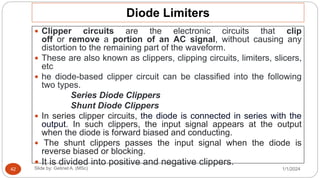
 Clipper circuits are the electronic circuits that clip
off or remove a portion of an AC signal, without causing any
distortion to the remaining part of the waveform.
 These are also known as clippers, clipping circuits, limiters, slicers,
etc
 he diode-based clipper circuit can be classified into the following
two types.
Series Diode Clippers
Shunt Diode Clippers
 In series clipper circuits, the diode is connected in series with the
output. In such clippers, the input signal appears at the output
when the diode is forward biased and conducting.
 The shunt clippers passes the input signal when the diode is
reverse biased or blocking.
 It is divided into positive and negative clippers.
1/1/2024
Slide by: Getinet A. (MSc)
42
Series Positive Clippers
 Series positive clippers remove or clips the positive half of the
waveform. In a series positive clipper, the diode is in reverse
biased and in series with the output as shown in the figure
below.
1/1/2024
Slide by: Getinet A. (MSc)
43
Series Positive Clippers with Bias
 The biasing in the clippers circuit is used to clip a portion of the half
cycle and not the whole halve. Therefore, a series positive clipper
with biasing which can be positive or negative is used for producing
the desired waveforms.
 In such a positive clipper circuit, the positive of the battery is
connected to the P side of the diode as shown in the figure below.
1/1/2024
Slide by: Getinet A. (MSc)
44
Negative Bias
 The battery in the negative biased series positive clipper is
connected in reverse with the diode as shown in the figure
below.
1/1/2024
Slide by: Getinet A. (MSc)
45
Series Negative Clippers
 The series negative clipper circuit clips the negative half of the
input cycle. its circuit diagram is given below.
1/1/2024
Slide by: Getinet A. (MSc)
46
Series Negative Clippers with Bias
 The series negative clipper is biased with either positive or
negative voltage battery to modify the waveform instead of
clipping the whole negative half.
1/1/2024
Slide by: Getinet A. (MSc)
47
Shunt Clippers
 In shunt clippers, the diode is connected in parallel with the
output. The input signal appears the output when the diode is
blocking as opposed to the series clippers.
 The shunt clippers can also be divided into positive and
negative clippers.
Shunt Positive Clippers:
Shunt Negative Clippers:
1/1/2024
Slide by: Getinet A. (MSc)
48
… Cont’d …
 Point A is limited to +0.7V when the input voltage exceeds this
value (Figure 18(a)).
 If the diode is turned around, as in Figure 18(b), the negative
part of the input voltage is clipped off. When the diode is
forward-biased during the negative part of the input voltage,
point A is held at -0.7V by the diode drop.
 The desired amount of limitation can be attained by a power
supply or voltage divider. The amount clipped can be adjusted
with different levels of VBIAS.
 The peak output voltage across RL is determine by the
following equation:
𝑉𝑜𝑢𝑡 =
𝑅𝐿
𝑅𝐿 + 𝑅1
𝑉𝑖𝑛
1/1/2024
Slide by: Getinet A. (MSc)
49
Fig.25: Examples of diode limiters (clippers).
1/1/2024
Slide by: Getinet A. (MSc)
50
Shunt Positive Clippers
 The shunt positive clipper clips the positive half cycle of the input
waveform. The circuit diagram of the shunt positive clipper is given
below.
 During the positive half cycle, the diode is forward biased as the
voltage at point A is greater than point B. so the diode conducts the
input signal and there is no voltage difference at the output.
1/1/2024
Slide by: Getinet A. (MSc)
51
 During the negative half-cycle, the voltage polarity of the input
signal at points A and B reverses and the diode becomes
reverse biased. Therefore, the diode blocks the input signal
and the signal voltage appears across the diode that is taken
as the output of the clipper.
 In such a way, the shunt positive clippers, clips or remove,
the positive half of the input cycle and allow the negative half
cycle.
Shunt Positive Clippers with Bias
 The biasing is done by using another fixed voltage source
such as a battery inside the circuit to modify the waveform
furthermore. The voltage source can be connected in either
positive or negative biasing. 1/1/2024
Slide by: Getinet A. (MSc)
52
Positive Bias
 During the positive half cycle, the diode is forward biased due
to the input voltage. but it is reversed biased due to the battery
voltage.
 The sum of both voltages will decide the state of the diode. If
the input voltage is greater than the battery voltage, the diode
will be forward biased otherwise it will remain in reverse bias.
1/1/2024
Slide by: Getinet A. (MSc)
53
Negative Bias
 During the positive half cycle, the diode is forward biased for
both input signal and battery voltage. Therefore, the diode
conducts for the whole cycle and only the battery voltage
appears at the output.
1/1/2024
Slide by: Getinet A. (MSc)
54
Shunt Negative Clippers
 The shunt negative clipper clips the negative half of the input
waveform.
1/1/2024
Slide by: Getinet A. (MSc)
55
Example
 What would you expect to see displayed on an oscilloscope
connected across RL in the limiter shown in following Figure.
 The diode is forward-biased and conducts when the input
voltage goes below
-0.7V. So, for the negative limiter, determine the peak output
voltage across RL by:
1/1/2024
Slide by: Getinet A. (MSc)
56
Biased Limiters
 The level to which an ac voltage is limited can be adjusted by adding a
bias voltage, 𝑉𝐵𝐼𝐴𝑆, in series with the diode, as shown in Figure 26.
 The voltage at point A must equal 𝑉𝐵𝐼𝐴𝑆 + 0.7 𝑉 before the diode will
become forward-biased and conduct. Once the diode begins to conduct,
the voltage at point A is limited to 𝑉𝐵𝐼𝐴𝑆 + 0.7 𝑉 so that all input voltage
above this level is clipped off.
Fig. 26: Positive Clipper
Fig. 27: Negative Clipper
1/1/2024
Slide by: Getinet A. (MSc)
57
Example:
 Figure 28 shows a circuit combining a positive limiter with a negative limiter. Determine
the output voltage waveform.
A Limiter Application
Many circuits have certain
restrictions on the input
level to avoid damaging
the circuit. For example,
almost all digital circuits
should not have an input
level that exceeds the
power supply voltage. An
input of a few volts more
than this could damage the
circuit. To prevent the input
from exceeding a specific
level, you may see a diode
limiter across the input
signal path in many digital
circuits.
Figure 28:
1/1/2024
Slide by: Getinet A. (MSc)
58
Applications of Clipper
• The main purpose of the clipper circuit is to modify the
waveform of the signal which can be used in several
applications such as in protection against overvoltage, noise
removal, transmission, etc.
• The clipper circuit offer overvoltage protection
therefore, it is used in power supplies for limiting the
voltage.
• They are used for filtering noise in transmitters.
• They are used in transmitters and receivers of
television.
• They are used for modifying or generating new
waveforms such as square, triangular, etc.
1/1/2024
Slide by: Getinet A. (MSc)
59
Diode Clampers
 A clamper adds a dc level to an ac voltage. Clampers are sometimes
known as dc restorers.
 Figure 29 shows a diode clamper that inserts a positive dc level in the
output waveform. The operation of this circuit can be seen by considering
the first negative half-cycle
of the input voltage.
 When the input voltage initially goes negative, the diode is forward
biased, allowing the capacitor to charge to near the peak of the input as
shown in Figure 29(a).
 Just after the negative peak, the diode is reverse-biased. This is because
the cathode is held near by the charge on the capacitor.
 The capacitor can only discharge through the high resistance of RL. So,
from the peak of one negative half-cycle to the next, the capacitor
discharges very little. The amount that is discharged, of course, depends
on the value of RL.
1/1/2024
Slide by: Getinet A. (MSc)
60
… Cont’d …
 Fig. 29:Positive clamper operation
1/1/2024
Slide by: Getinet A. (MSc)
61
… Cont’d …
 Fig. 30: Negative clamper
 Example: What is the output voltage that you would expect to
observe across RL in the clamping circuit of the Figure?
Assume that RC is large enough to prevent significant
capacitor discharge.
1/1/2024
Slide by: Getinet A. (MSc)
62
… Cont’d …
 Actually, the capacitor will discharge slightly between peaks, and,
as a result, the output voltage will have an average value of slightly
less than that calculated above.
 The output waveform goes to approximately +0.7 V, as shown in
Figure
1/1/2024
Slide by: Getinet A. (MSc)
63
Voltage multiplier
 Voltage multipliers use clamping action to increase peak
rectified voltages without then necessity of increasing the
transformer’s voltage rating.
 Multiplication factors of two, three, and four are common.
Voltage multipliers are used in high-voltage, low-current
applications such as cathode-ray tubes (CRTs) and particle
accelerators.
 In the Figure 31 a half-wave voltage doubler, a voltage
doubler is a voltage multiplier with a multiplication factor of
two.
 Once C1 and C2 charges to the peak voltage they act like
two batteries in series, effectively doubling the voltage output.
The current capacity for voltage multipliers is low. 1/1/2024
Slide by: Getinet A. (MSc)
64
… Cont’d …
Fig. 31: Half-wave voltage doubler operation
 The full-wave voltage doubler arrangement of diodes and
capacitors takes advantage of both positive and negative peaks to
charge the capacitors giving it more current capacity.
 Voltage triplers and quadruplers utilize three and four diode-
capacitor
arrangements, respectively.
1/1/2024
Slide by: Getinet A. (MSc)
65
… Cont’d …
Fig. 32: Full-wave voltage doubler operation.
1/1/2024
Slide by: Getinet A. (MSc)
66
Special Diode Types
Fig. 33: Diode Symbols
1/1/2024
Slide by: Getinet A. (MSc)
67
There are two popular types of optoelectronic devices: light-emitting
diode (LED) and photodiode.
The Light-Emitting Diode (LED)
LED is diode that emits light when biased in the forward direction of p-n
junction.
Anode Cathode
Fig. 34: The schematic symbol and construction
features.
Optical Diodes
1/1/2024
Slide by: Getinet A. (MSc)
68
Fig. 35: LED that are produced in an array of
shapes and sizes.
LED characteristics:
characteristic curves are very similar to those for p-n
junction diodes
higher forward voltage (VF)
lower reverse breakdown voltage (VBR).
The Light-Emitting Diode (LED)
1/1/2024
Slide by: Getinet A. (MSc)
69
Application
The seven segment display is an example of LEDs use for display of
decimal digits.
Fig. 36: The 7-segment LED
display.
The Light-Emitting Diode (LED)
1/1/2024
Slide by: Getinet A. (MSc)
70
LED displays are packages of many LEDs arranged in a pattern, the most familiar pattern
being the 7-segment displays for showing numbers (digits 0-9).
LED Displays
1/1/2024
Slide by: Getinet A. (MSc)
71
LED - Colors & voltage drop
Color
Wavelength (nm) Voltage (V) Semiconductor Material
Infrared λ > 760 ΔV < 1.9 Gallium arsenide (GaAs) Aluminium gallium arsenide (AlGaAs)
Red 610 < λ < 760 1.63 < ΔV < 2.03 Aluminium gallium arsenide (AlGaAs) Gallium arsenide phosphide (GaAsP) Aluminium
gallium indium phosphide (AlGaInP) Gallium(III) phosphide (GaP)
Orange 590 < λ < 610 2.03 < ΔV < 2.10 Gallium arsenide phosphide (GaAsP) Aluminium gallium indium phosphide
(AlGaInP)Gallium(III) phosphide (GaP)
Yellow 570 < λ < 590 2.10 < ΔV < 2.18 Gallium arsenide phosphide (GaAsP) Aluminium gallium indium phosphide (AlGaInP)
Gallium(III) phosphide (GaP)
Green 500 < λ < 570 1.9 < ΔV < 4.0 Indium gallium nitride (InGaN) / Gallium(III) nitride (GaN) Gallium(III) phosphide
(GaP)Aluminium gallium indium phosphide (AlGaInP) Aluminium gallium phosphide
(AlGaP)
Blue 450 < λ < 500 2.48 < ΔV < 3.7 Zinc selenide (ZnSe), Indium gallium nitride (InGaN), Silicon carbide (SiC) as substrate,
Silicon (Si)
Violet 400 < λ < 450 2.76 < ΔV < 4.0 Indium gallium nitride (InGaN)
Purple multiple types 2.48 < ΔV < 3.7 Dual blue/red LEDs,blue with red phosphor,or white with purple plastic
Ultra-violet λ < 400 3.1 < ΔV < 4.4 diamond (235 nm), Boron nitride (215 nm) , Aluminium nitride (AlN) (210 nm) Aluminium
gallium nitride (AlGaN) (AlGaInN) — (to 210 nm)
White Broad spectrum ΔV = 3.5 Blue/UV diode with yellow phosphor
1/1/2024
Slide by: Getinet A. (MSc)
72
• Never connect an LED directly to a battery or a power supply!
• It will be destroyed almost instantly because too much current will pass through and burn it
out.
• LEDs must have a resistor in series to limit the current to a safe value, for quick testing
purposes a 1kΩ resistor is suitable for most LEDs if your supply voltage is 12V or less.
Remember to connect the LED the correct way!
Testing an LED
1/1/2024
Slide by: Getinet A. (MSc)
73
• If you wish to have several LEDs on at the
same time, connect them in series.
• This prolongs battery life by lighting several
LEDs with the same current as just one LED.
• The power supply must have sufficient
voltage to provide about 2V for each LED (4V
for blue and white) plus at least another 2V
for the resistor.
• To work out a value for the resistor you must
add up all the LED voltages and use this for
VL.
Connecting LEDs in series
Example
A red, a yellow and a green LED in
series need a supply voltage of at least
3×2V + 2V = 8V, so choose a 9V
battery. Adjust the resistor R to have
current I=15 mA.
1/1/2024
Slide by: Getinet A. (MSc)
74
• Photodiode is a p-n junction that can convert light energy into electrical
energy.
• It operates in reverse bias voltage (VR), as shown in Figure, where Iλ is
the reverse light current.
• It has a small transparent window that allows light to strike the p-n
junction.
• The resistance of a photodiode is calculated by the formula as follows:

I
V
R R
R 
The Photodiode
Iλ
1/1/2024
Slide by: Getinet A. (MSc)
75
 The Schottky diode’s significant characteristic is its fast switching speed.
 This is useful for high frequencies and digital applications.
 It is not a typical diode in that it does not have a p-n junction.
 Instead, it consists of a doped semiconductor (usually n-type) and metal
bound together.
Schottky diode (a) symbol and (b) basic internal
construction
The Schottky Diode
1/1/2024
Slide by: Getinet A. (MSc)
76
Zener
Diode
Zener diode is a p-n junction diode that is
designed to operate in the reverse breakdown
region.
Two things happen when the reverse breakdown
voltage (VBR) is reached:
The diode current increases drastically.
The reverse voltage (VR) across the diode
remains relatively constant.
In other words, the voltage across a Zener diode
operated in this region is relatively constant over
a range of reverse current and nearly equal to its
Zener voltage (VZ) rating.
A minimum reverse current 𝐼𝑍𝐾 must be maintained in order to
keep diode in regulation mode.
Voltage decreases drastically if the current is reduced below
the knee of the curve. Above 𝐼𝑍𝑀, max current, the Zener may get
damaged permanently.
+
−
I
Z
V
Z
Anode (A)
Cathode (K) K
A
Zener diode voltage-current (V-I)
characteristic.
VB
R
1/1/2024
Slide by: Getinet A. (MSc)
77
Ideal-and-Practical Zener Equivalent
Circuits
VF
VR
IF
IR
V
Z
Ideal model and characteristic curve of
a Zener diode in reverse breakdown.
The constant voltage
drop = the nominal
Zener voltage.
Practical model and characteristic curve of a
Zener diode, where the Zener impedance
(resistance), ZZ is included.
A change in Zener current (ΔIZ) produces a small change in Zener
voltage (ΔVZ).
1/1/2024
Slide by: Getinet A. (MSc)
78
… Cont’d …
 To illustrate regulation, let us use the ideal model of the 1N4740A Zener diode
(ignoring the Zener resistance) in the circuit of the Figure.
• Ideal model of IN4047A
• IZK = 0.25mA
• VZ = 10V
• PD(max) = 1W
 Therefore, 𝑉𝐼𝑁(max) = 𝑉𝑅 + 𝑉𝑍 = 22𝑉 + 10𝑉 = 32𝑉, This shows the Zener diodes
can regulate the voltage from 10.055V to 32V and approximate to 10V.
For the minimum Zener current, the voltage across the 220Ω resistor is
𝑉𝑅 = 𝐼𝑍𝐾𝑅 = (0.25 mA)(220Ω) = 55mV,
Since 𝑉𝐼𝑁 = 𝑉𝑅 + 𝑉𝑍,
𝑉𝐼𝑁(min) = 𝑉𝑅 + 𝑉𝑍 = 55mV+10V= 10.055V
For the maximum Zener current, the voltage across the 220Ω resistor is
𝑉𝑅 = 𝐼𝑍𝑀𝑅 = (100 mA)(220Ω) = 22V
1/1/2024
Slide by: Getinet A. (MSc)
79
Example:
 Determine the minimum and the maximum load currents for
which the Zener diode in the following Figure will maintain
regulation. What is the minimum value of RL that can be
used? 𝑉
𝑧=12V, 𝐼𝑍𝐾 =1mA, and 𝐼𝑍𝑀=50mA. Assume an ideal
Zener diode where 𝑍𝑍 =0Ω and 𝑉𝑍 remains a constant 12V
over the range of current values.
1/1/2024
Slide by: Getinet A. (MSc)
80
Solution
 When 𝐼𝐿 = 0, 𝑅𝐿 = ∞ , 𝐼𝑍 = 𝐼𝑍(𝑚𝑎𝑥) = 𝐼𝑇
𝐼𝑍(𝑚𝑎𝑥) = 𝐼𝑇 =
𝑉𝐼𝑁 − 𝑉𝑍
𝑅
=
24 − 12
470
= 25.5𝑚𝐴
This value is less than 50mA, RL can be removed without disturbing regulation.
𝐼𝐿(𝑚𝑖𝑛) = 0𝐴
 𝐼𝐿(𝑚𝑎𝑥) occurs when 𝐼𝑍 is minimum (𝐼𝑍 = 𝐼𝑍𝐾)
𝐼𝐿(𝑚𝑎𝑥) = 𝐼𝑇 − 𝐼𝑍(𝑚𝑖𝑛) = 25.5𝑚𝐴 − 1𝑚𝐴 = 24.5𝑚𝐴
Minimum value of 𝑅𝐿 is
𝑅𝐿(𝑚𝑖𝑛) =
𝑉𝑍
𝐼𝐿(𝑚𝑎𝑥)
=
12𝑉
24.5𝑚𝐴
= 490𝛀
1/1/2024
Slide by: Getinet A. (MSc)
81
Varactor is a type of p-n junction diode that
operates in reverse bias. The capacitance
of the junction is controlled by the amount
of reverse bias.
Varactor diodes are also referred to as
varicaps or tuning diodes and they are
commonly used in communication systems.
Basic Operation
The capacitance of a reverse-biased
varactor junction is found as:
Reverse-biased varactor diode
acts as a variable capacitor.
Varactor diode symbol
d
A
C


C = the total junction capacitance.
A = the plate area.
ε = the dielectric constant (permittivity).
d = the width of the depletion region (plate separation).
Varactor (Varicap Diode)
1/1/2024
Slide by: Getinet A. (MSc)
82
Varactor (Varicap Diode)
When the junction diode is reverse biased, the insulating
barrier widens reducing diode capacitance.
The barrier forms the dielectric, of variable width, of a
capacitor.
• The N and P type cathode and anode are the two plates of the
capacitor.
• In the diagram, the diode and coil form a resonant circuit.
• The capacitance of the diode, and thereby the resonant
frequency, is varied by means of the potentiometer controlling the
reverse voltage across the Varicap.
• The capacitor prevents the coil shorting out the voltage across
the potentiometer.
1/1/2024
Slide by: Getinet A. (MSc)
83
1/1/2024
Slide by: Getinet A. (MSc)
84

Lecture Two.pptx

  • 1.
    Applied Electronics ፩ LectureNote ፪ By Getinet A. Email: getinetasimare@gmail.com getnasm@dtu.edu.et Debre Tabor University Gafat Institute of Technology Department of Electrical and Computer Engineering 1/1/2024 Slide by: Getinet A. (MSc) 1
  • 2.
    Semiconductor diodes andtheir application  The ideal diode or perfect diode is a two terminal device, which completely allows to flow the electric current without any loss under forward bias and completely blocks the electric current with infinite loss under reverse bias.  Ideal diodes actually do not exist. However, the V-I characteristics of ideal diodes is used to study the diode circuits. In other words, it is used to study the quality of a real diode by comparing it with the ideal diode.  It is actually not possible to design a real diode, which behaves exactly like an ideal diode. However, a well-designed diode behaves almost like a perfect diode or ideal diode. Ideal diode 1/1/2024 Slide by: Getinet A. (MSc) 2
  • 3.
    … Cont’d … Ideal diode consists of two terminals: positive terminal and negative terminal. The positive end or positive terminal of the diode is called anode and the negative end or negative terminal of the diode is called cathode. The electric current always flow from anode or positive terminal to the cathode or negative terminal.  If the positive terminal of the battery is connected to the p-type semiconductor and the negative terminal of the battery is connected to the n-type semiconductor, the diode is said to be forward biased.  On the other hand, if the positive terminal of the battery is connected to the n-type semiconductor and the negative terminal of the battery is connected to the p-type 1/1/2024 Slide by: Getinet A. (MSc) 3
  • 4.
    … Cont’d … Under forward biased condition, ideal diode acts as a perfect conductor with zero resistance whereas under reverse biased condition, it acts as a perfect insulator with infinite resistance.  In other words, ideal diodes acts as closed circuit or short circuit under forward biased condition and acts as an open circuit or open switch under reverse biased condition.  Ideal diodes does not have depletion region or junction barrier, which resist the flow of electric current. Hence, ideal diode has no voltage drop or voltage loss. Fig 1: Diode symbols 1/1/2024 Slide by: Getinet A. (MSc) 4
  • 5.
    Forward and reversecharacteristics of ideal diode  The Forward and reverse characteristics of ideal diode under forward and reverse biased condition is shown in the below figure.  If the forward voltage or positive voltage (VF) (p terminal connected to p-side and n terminal connected to n-side) applied on the diode is equal to zero or greater than zero, the forward electric current (IF) in the ideal diode increases infinitely.  On the other hand, if the reverse voltage or negative voltage (VR) (p terminal connected to n-side and n-terminal connected to p-side) applied on the diode is less than zero, no forward electric current (IF) and reverse electric current (I ) flows in the ideal diode. 1/1/2024 Slide by: Getinet A. (MSc) 5
  • 6.
    … Cont’d … Fig2: V-I characteristics of ideal Diode 1/1/2024 Slide by: Getinet A. (MSc) 6
  • 7.
    Diode models The IdealDiode Mode  When the diode is forward-biased, it ideally acts like a closed (on) switch, as shown in Fig 3. When the diode is reverse- biased, it ideally acts like an open (off) switch, as shown in part (b).  The barrier potential, the forward dynamic resistance, and the reverse current are all neglected.  In Fig 3c, the ideal V-I characteristic curve graphically depicts the ideal diode operation. 1/1/2024 Slide by: Getinet A. (MSc) 7
  • 8.
    Fig 3: Idealdiode model 1/1/2024 Slide by: Getinet A. (MSc) 8
  • 9.
    The Practical DiodeModel  The practical model includes the barrier potential. The characteristic curve for the practical diode model is shown in Figure 4c.  Since the barrier potential is included and the dynamic resistance is neglected, the diode is assumed to have a voltage across it when forward-biased, as indicated by the curve to the right of the origin.  The practical model is useful in lower-voltage circuits and in designing basic diode circuits.  The forward current is determined using first Kirchhoff’s voltage law to Figure 4a: 1/1/2024 Slide by: Getinet A. (MSc) 9
  • 10.
    … Cont’d … 𝑉𝐵𝑖𝑎𝑠− 𝑉𝐹 − 𝑉𝑅𝐿𝑖𝑚𝑖𝑡 = 0 𝑉𝑅𝐿𝑖𝑚𝑖𝑡 = 𝐼𝐹𝑅𝐿𝑖𝑚𝑖𝑡 Substituting and solving for 𝐼𝐹 𝐼𝐹 = 𝑉𝐵𝑖𝑎𝑠 − 𝑉𝐹 𝑅𝐿𝑖𝑚𝑖𝑡 The diode is assumed to have zero reverse current, 𝑉𝐹 =0.7V , 𝑉𝐵𝑖𝑎𝑠 = 𝑉𝑅, 𝐼𝑅 = 0A Fig 4: Practical diode model 1/1/2024 Slide by: Getinet A. (MSc) 10
  • 11.
    The Complete DiodeModel  The complete model of a diode includes the barrier potential, the small forward dynamic resistance ( 𝑟𝑑 ) and the large internal reverse resistance (́𝑟𝑅).  The reverse resistance is taken into account because it provides a path for the reverse current, which is included in this diode model. Fig 5: Complete diode model 1/1/2024 Slide by: Getinet A. (MSc) 11
  • 12.
    Example 1:  (a)Determine the forward voltage and forward current for the diode in Figure 6(a) for each of ideal and practical diode models. Also, find the voltage across the limiting resistor in each case.  (b) Determine the reverse voltage and reverse current for the diode in Figure 6(b) for each of the diode models. Also, find the voltage across the limiting resistor in each case. Assume IR = 1μA. Fig 6: 1/1/2024 Slide by: Getinet A. (MSc) 12
  • 13.
  • 14.
    Diode Resistance  Asthe operating point of a diode moves from one region to another the resistance of the diode will also change due to the nonlinear shape of the characteristic curve.  The application of a dc voltage to a circuit containing a semiconductor diode will result in an operating point on the characteristic curve that will not change with time.  The resistance of the diode at the operating point can be found simply by finding the corresponding levels of VD and ID as shown in Fig. 7 and applying the following equation: 𝑅𝐷 = 𝑉𝐷 𝐼𝐷  The resistance levels in the reverse-bias region will naturally be quite DC or static resistance 1/1/2024 Slide by: Getinet A. (MSc) 14
  • 15.
    … Cont’d … In general, therefore, the higher the current through a diode, the lower is the dc resistance level.  Typically, the dc resistance of a diode in the active (most utilized) will range from about 10 V to 80 V. Fig. 7: Determining the dc resistance of a diode at a particular operating point 1/1/2024 Slide by: Getinet A. (MSc) 15
  • 16.
    Example  Determine thedc resistance levels for the diode of Fig. 8 at a. ID = 2 mA (low level) b. ID = 20 mA (high level) c. VD = 10 V (reverse-biased) Fig. 8: Example 1/1/2024 Slide by: Getinet A. (MSc) 16
  • 17.
    AC or dynamicresistance  The dc resistance of a diode is independent of the shape of the characteristic in the region surrounding the point of interest.  If a sinusoidal rather than a dc input is applied, the situation will change completely.  The varying input will move the instantaneous operating point up and down a region of the characteristics and thus defines a specific change in current and voltage as shown in Fig. 9.  With no applied varying signal, the point of operation would be the Q-point appearing on Fig. 9, determined by the applied dc levels. The designation Q-point is derived from the word quiescent, which means “still or unvarying.” 1/1/2024 Slide by: Getinet A. (MSc) 17
  • 18.
    Fig. 9: Definingthe dynamic or ac resistance. Fig.10: Determining the ac resistance at a Q- point 1/1/2024 Slide by: Getinet A. (MSc) 18
  • 19.
    … Cont’d … A straight line drawn tangent to the curve through the Q-point as shown in Fig. 10 will define a particular change in voltage and current that can be used to determine the ac or dynamic resistance for this region of the diode characteristics.  An effort should be made to keep the change in voltage and current as small as possible and equidistant to either side of the Q- point. 𝑟𝑑 = ∆𝑉𝐷 ∆𝐼𝐷  In general, therefore, the lower the Q-point of operation (smaller current or lower voltage), the higher is the ac resistance.  Q point or the operating point of a device, also known as a bias point, or quiescent point is the steady-state DC voltage or current at a specified terminal of an active device such as a diode or transistor with no input 1/1/2024 Slide by: Getinet A. (MSc) 19
  • 20.
    Example 𝐹𝑜𝑟 𝑡ℎ𝑒 𝑐ℎ𝑎𝑟𝑎𝑐𝑡𝑒𝑟𝑖𝑠𝑡𝑖𝑐𝑠𝑜𝑓 𝐹𝑖𝑔. 11: 𝑎. 𝐷𝑒𝑡𝑒𝑟𝑚𝑖𝑛𝑒 𝑡ℎ𝑒 𝑎𝑐 𝑟𝑒𝑠𝑖𝑠𝑡𝑎𝑛𝑐𝑒 𝑎𝑡 𝐼𝐷 = 2 𝑚𝐴. 𝑏. 𝐷𝑒𝑡𝑒𝑟𝑚𝑖𝑛𝑒 𝑡ℎ𝑒 𝑎𝑐 𝑟𝑒𝑠𝑖𝑠𝑡𝑎𝑛𝑐𝑒 𝑎𝑡 𝐼𝐷 = 25 𝑚𝐴. 𝑐. 𝐶𝑜𝑚𝑝𝑎𝑟𝑒 𝑡ℎ𝑒 𝑟𝑒𝑠𝑢𝑙𝑡𝑠 𝑜𝑓 𝑝𝑎𝑟𝑡𝑠 𝑎 𝑎𝑛𝑑 𝑏 𝑡𝑜 𝑡ℎ𝑒 𝑑𝑐 𝑟𝑒𝑠𝑖𝑠𝑡𝑎𝑛𝑐𝑒𝑠 𝑎𝑡 𝑒𝑎𝑐ℎ 𝑐𝑢𝑟𝑟𝑒𝑛𝑡 𝑙𝑒𝑣𝑒𝑙. Fig. 11: Example 1/1/2024 Slide by: Getinet A. (MSc) 20
  • 21.
  • 22.
    … Cont’d … We have found the dynamic resistance graphically, but there is a basic definition in differential calculus that states:  The derivative of a function at a point is equal to the slope of the tangent line drawn at that point.  If we find the derivative of the general equation 𝐼𝐷 = 𝐼𝑠 𝑒 𝑉𝐷 𝑛𝑉𝑇 − 1 for the semiconductor diode with respect to the applied forward bias and then invert the result, we will have an equation for the dynamic or ac resistance in that region. 𝑑 𝑑𝑉𝑑 𝐼𝐷 = 𝑑 𝑑𝑉𝑑 𝐼𝑠 𝑒 𝑉𝐷 𝑛𝑉𝑇 − 1 and 𝑑𝐼𝐷 𝑑𝑉𝐷 = 1 𝑛𝑉𝑇 (𝐼𝐷 + 𝐼𝑆) after we apply differential calculus. In general, ID = Is in the vertical-slope section of the characteristics and 𝑑𝐼𝐷 𝑑𝑉𝐷 ≅ 𝐼𝐷 𝑛𝑉𝑇 1/1/2024 Slide by: Getinet A. (MSc) 22
  • 23.
    … Cont’d … Now the AC resistance becomes: 𝑑𝑉𝐷 𝑑𝐼𝐷 = 𝑟𝑑 = 𝑛𝑉𝑇 𝐼𝐷 𝑎𝑠𝑢𝑚𝑒 𝑛 = 1,  If the input signal is sufficiently large to produce a broad swing such as indicated in Fig. 12, the resistance associated with the device for this region is called the average ac resistance.  The average ac resistance is, by definition, the resistance determined by a straight line drawn between the two intersections established by the maximum and minimum values of input voltage. Average AC Resistance 1/1/2024 Slide by: Getinet A. (MSc) 23
  • 24.
     For thesituation indicated in the figure Fig.12: Determining the average ac resistance between indicated limits 1/1/2024 Slide by: Getinet A. (MSc) 24
  • 25.
  • 26.
    Diodes Applications  Theyare used for isolating signals from a supply. For example, one of the major uses of diodes is to remove negative signals from AC current. This is known as signal demodulation. This function is basically used in radios as a filtering system in order to extract radio signals from a carrier wave.  Before taking a look at various applications of diodes, let us quickly take a peek at a small list of common applications of diodes.  and many more. Now let us understand each of these applications of diodes in more detail. • Reverse Current Protection Circuits • In Logic Gates • Voltage Multipliers • Rectifiers • Clipper Circuits • Clamping Circuits 1/1/2024 Slide by: Getinet A. (MSc) 26
  • 27.
    Rectifiers  A powersupply is an essential part of each electronic system from the simplest to the most complex.  A basic block diagram of the complete power supply is shown in Fig 7.  The transformer changes ac voltages based on the turns ratio between the primary and secondary.  The rectifier converts the ac input voltage to dc voltage.  The filter eliminates the fluctuations in the rectified voltage and produces a relatively smooth dc voltage.  The regulator is a circuit that maintains a constant dc voltage for variations in the input line voltage or in the load. 1/1/2024 Slide by: Getinet A. (MSc) 27
  • 28.
    Fig 13: Powersupply 1/1/2024 Slide by: Getinet A. (MSc) 28
  • 29.
    … Cont’d … Because of their ability to conduct current in one direction and block current in the other direction, diodes are used in circuits called rectifiers that convert ac voltage into dc voltage.  Rectifiers are found in all dc power supplies that operate from an ac voltage source. When connected with ac voltage, diode only allows half cycle passing through it and hence convert ac into dc.  The basic types of these rectifier circuits are half wave, full wave center tapped and full bridge rectifiers.  A single or combination of four diodes is used in most of the power conversion applications. 1/1/2024 Slide by: Getinet A. (MSc) 29
  • 30.
    Fig 14: RectifierCircuit 1/1/2024 Slide by: Getinet A. (MSc) 30
  • 31.
    … Cont’d … •During the positive half cycle of the input supply, anode is made positive with respect to cathode. So, the diode gets forward biased. This results in the current to flow to the load. Since the load is resistive, the voltage across the load resistor will be same as the supply voltage i.e., the input sinusoidal voltage will appear at the load (only the positive cycle). And the load current flow is proportional to the voltage applied. • During the negative half-cycle of the input sinusoidal wave, anode is made negative with respect to cathode. So, the diode gets reverse biased. Hence, no current flows to the load. The circuit becomes open circuit and no voltage appears across the load. • Both voltage and current at the load side are of one polarity means the output voltage is pulsating DC. Often, this rectification circuit has a capacitor that is connected across the load to produce steady and 1/1/2024 Slide by: Getinet A. (MSc) 31
  • 32.
    Average Value ofthe Half-Wave Output Voltage  The average value of the half-wave rectified output voltage is the value you would measure on a dc voltmeter.  This equation shows that VAVG is approximately 31.8% of Vp for a half-wave rectified voltage. 𝑉 𝑎𝑣𝑔 = 𝑉𝑝 𝜋  Vp is the peak value of the voltage. Fig. 15: Average value of the half-wave rectified signal 1/1/2024 Slide by: Getinet A. (MSc) 32
  • 33.
    Effect of theBarrier Potential on the Half-Wave Rectifier Output  In the previous discussion, the diode was considered ideal. When the practical diode model is used with the barrier potential of 0.7 V taken into account, this is what happens.  During the positive half-cycle, the input voltage must overcome the barrier potential before the diode becomes forward-biased. This results in a half-wave output with a peak value that is 0.7 V less than the peak value of the input. Vp(out) = Vp(in) - 0.7 V Fig. 16: The effect of the barrier potential on the half-wave rectified output voltage is to reduce the peak value of the input by about 0.7 V 1/1/2024 Slide by: Getinet A. (MSc) 33
  • 34.
    … Cont’d … Draw the output voltages of each rectifier for the indicated input voltages, as shown in Fig. 17. Fig. 17: Peak Inverse Voltage (PIV) • The peak inverse voltage (PIV) equals the peak value of the input voltage, and the diode must be capable of withstanding this amount of repetitive reverse voltage. • A diode should be rated at least 20% higher than the PIV. 𝑉𝐼𝑃 = 𝑉𝑝(𝑖𝑛) 1/1/2024 Slide by: Getinet A. (MSc) 34
  • 35.
    Full wave rectifiers Although half-wave rectifiers have some applications, the full- wave rectifier is the most commonly used type in dc power supplies.  A full-wave rectifier allows unidirectional (one-way) current through the load during the entire of the input cycle, whereas a halfwave rectifier allows current through the load only during one-half of the cycle.  The output voltage have twice the input frequency. 𝑉 𝑎𝑣𝑔 = 2𝑉𝑝 𝜋 is approximately 63. 7% of Vp. Fig. 18: Full wave Rectifier 1/1/2024 Slide by: Getinet A. (MSc) 35
  • 36.
    Transformer Coupling  Transformercoupling provides two advantages.  First, it allows the source voltage to be stepped down as needed.  Second, the ac source is electrically isolated from the rectifier, thus preventing a shock hazard in the secondary circuit. Fig. 19: Half-wave rectifier with transformer coupled input voltage. • The amount that the voltage is stepped down is determined by the turns ratio of the transformer. • The secondary voltage of a transformer equals the turns ratio, n, times the primary voltage. 𝑉 𝑠𝑒𝑐 = 𝑛𝑉𝑖𝑛 𝑛 = 𝑁2 𝑁1 1/1/2024 Slide by: Getinet A. (MSc) 36
  • 37.
    Example:  Determine thepeak value of the output voltage for fig. 20 if the turn ratio is 0.5. Fig. 20: 1/1/2024 Slide by: Getinet A. (MSc) 37
  • 38.
    Center-Tapped Full-Wave RectifierOperation  A center-tapped rectifier is a type of full-wave rectifier that uses two diodes connected to the secondary of a center-tapped transformer, as shown in Figure 21.  The input voltage is coupled through the transformer to the center-tapped secondary.  Half of the total secondary voltage appears between the center tap and each end of the secondary winding as shown. Fig. 21: A center-tapped full-wave rectifier This condition forward-biases diode D1 and reverse- biases diode D2. The current path is through D1 and the load resistor RL, as indicated. For a negative half-cycle of the input voltage, the voltage polarities on the secondary are as shown in Figure 22(b). This condition reverse-biases D1 and forward-biases D2. The current path is through D2 and RL, as indicated. Because the output current during both the positive and negative portions of the input cycle is in the same direction through the load, the output voltage developed across the load resistor is a full-wave rectified dc voltage, as shown. 1/1/2024 Slide by: Getinet A. (MSc) 38
  • 39.
     Fig. 22:Basic operation of a center-tapped full-wave rectifier. Note that the current through the load resistor is in the same direction during the entire input cycle, so the output voltage always has the same polarity. 1/1/2024 Slide by: Getinet A. (MSc) 39
  • 40.
    Bridge Full-Wave RectifierOperation . • The bridge rectifier uses four diodes connected as shown in Figure 23. When the input cycle is positive as in part (a), diodes D1 and D2 are forward-biased and conduct current in the direction shown. • A voltage is developed across RL that looks like the positive half of the input cycle. During this time, diodes D3 and D4 are reverse- biased. Fig. 23: Operation of a bridge rectifier 𝑉𝑝(𝑜𝑢𝑡) = 𝑉𝑝(𝑠𝑒𝑐) 𝑉𝑝(𝑜𝑢𝑡) = 𝑉𝑝(𝑠𝑒𝑐) − 1.4 1/1/2024 Slide by: Getinet A. (MSc) 40
  • 41.
    Example:  Determine thepeak output voltage for the bridge rectifier in Figure 24.  Assuming the practical model, what PIV rating is required for the diodes? The transformer is specified to have a 12 V rms secondary voltage for the standard 120 V across the primary. Fig. 24: 1/1/2024 Slide by: Getinet A. (MSc) 41
  • 42.
    Diode Limiters  Clippercircuits are the electronic circuits that clip off or remove a portion of an AC signal, without causing any distortion to the remaining part of the waveform.  These are also known as clippers, clipping circuits, limiters, slicers, etc  he diode-based clipper circuit can be classified into the following two types. Series Diode Clippers Shunt Diode Clippers  In series clipper circuits, the diode is connected in series with the output. In such clippers, the input signal appears at the output when the diode is forward biased and conducting.  The shunt clippers passes the input signal when the diode is reverse biased or blocking.  It is divided into positive and negative clippers. 1/1/2024 Slide by: Getinet A. (MSc) 42
  • 43.
    Series Positive Clippers Series positive clippers remove or clips the positive half of the waveform. In a series positive clipper, the diode is in reverse biased and in series with the output as shown in the figure below. 1/1/2024 Slide by: Getinet A. (MSc) 43
  • 44.
    Series Positive Clipperswith Bias  The biasing in the clippers circuit is used to clip a portion of the half cycle and not the whole halve. Therefore, a series positive clipper with biasing which can be positive or negative is used for producing the desired waveforms.  In such a positive clipper circuit, the positive of the battery is connected to the P side of the diode as shown in the figure below. 1/1/2024 Slide by: Getinet A. (MSc) 44
  • 45.
    Negative Bias  Thebattery in the negative biased series positive clipper is connected in reverse with the diode as shown in the figure below. 1/1/2024 Slide by: Getinet A. (MSc) 45
  • 46.
    Series Negative Clippers The series negative clipper circuit clips the negative half of the input cycle. its circuit diagram is given below. 1/1/2024 Slide by: Getinet A. (MSc) 46
  • 47.
    Series Negative Clipperswith Bias  The series negative clipper is biased with either positive or negative voltage battery to modify the waveform instead of clipping the whole negative half. 1/1/2024 Slide by: Getinet A. (MSc) 47
  • 48.
    Shunt Clippers  Inshunt clippers, the diode is connected in parallel with the output. The input signal appears the output when the diode is blocking as opposed to the series clippers.  The shunt clippers can also be divided into positive and negative clippers. Shunt Positive Clippers: Shunt Negative Clippers: 1/1/2024 Slide by: Getinet A. (MSc) 48
  • 49.
    … Cont’d … Point A is limited to +0.7V when the input voltage exceeds this value (Figure 18(a)).  If the diode is turned around, as in Figure 18(b), the negative part of the input voltage is clipped off. When the diode is forward-biased during the negative part of the input voltage, point A is held at -0.7V by the diode drop.  The desired amount of limitation can be attained by a power supply or voltage divider. The amount clipped can be adjusted with different levels of VBIAS.  The peak output voltage across RL is determine by the following equation: 𝑉𝑜𝑢𝑡 = 𝑅𝐿 𝑅𝐿 + 𝑅1 𝑉𝑖𝑛 1/1/2024 Slide by: Getinet A. (MSc) 49
  • 50.
    Fig.25: Examples ofdiode limiters (clippers). 1/1/2024 Slide by: Getinet A. (MSc) 50
  • 51.
    Shunt Positive Clippers The shunt positive clipper clips the positive half cycle of the input waveform. The circuit diagram of the shunt positive clipper is given below.  During the positive half cycle, the diode is forward biased as the voltage at point A is greater than point B. so the diode conducts the input signal and there is no voltage difference at the output. 1/1/2024 Slide by: Getinet A. (MSc) 51
  • 52.
     During thenegative half-cycle, the voltage polarity of the input signal at points A and B reverses and the diode becomes reverse biased. Therefore, the diode blocks the input signal and the signal voltage appears across the diode that is taken as the output of the clipper.  In such a way, the shunt positive clippers, clips or remove, the positive half of the input cycle and allow the negative half cycle. Shunt Positive Clippers with Bias  The biasing is done by using another fixed voltage source such as a battery inside the circuit to modify the waveform furthermore. The voltage source can be connected in either positive or negative biasing. 1/1/2024 Slide by: Getinet A. (MSc) 52
  • 53.
    Positive Bias  Duringthe positive half cycle, the diode is forward biased due to the input voltage. but it is reversed biased due to the battery voltage.  The sum of both voltages will decide the state of the diode. If the input voltage is greater than the battery voltage, the diode will be forward biased otherwise it will remain in reverse bias. 1/1/2024 Slide by: Getinet A. (MSc) 53
  • 54.
    Negative Bias  Duringthe positive half cycle, the diode is forward biased for both input signal and battery voltage. Therefore, the diode conducts for the whole cycle and only the battery voltage appears at the output. 1/1/2024 Slide by: Getinet A. (MSc) 54
  • 55.
    Shunt Negative Clippers The shunt negative clipper clips the negative half of the input waveform. 1/1/2024 Slide by: Getinet A. (MSc) 55
  • 56.
    Example  What wouldyou expect to see displayed on an oscilloscope connected across RL in the limiter shown in following Figure.  The diode is forward-biased and conducts when the input voltage goes below -0.7V. So, for the negative limiter, determine the peak output voltage across RL by: 1/1/2024 Slide by: Getinet A. (MSc) 56
  • 57.
    Biased Limiters  Thelevel to which an ac voltage is limited can be adjusted by adding a bias voltage, 𝑉𝐵𝐼𝐴𝑆, in series with the diode, as shown in Figure 26.  The voltage at point A must equal 𝑉𝐵𝐼𝐴𝑆 + 0.7 𝑉 before the diode will become forward-biased and conduct. Once the diode begins to conduct, the voltage at point A is limited to 𝑉𝐵𝐼𝐴𝑆 + 0.7 𝑉 so that all input voltage above this level is clipped off. Fig. 26: Positive Clipper Fig. 27: Negative Clipper 1/1/2024 Slide by: Getinet A. (MSc) 57
  • 58.
    Example:  Figure 28shows a circuit combining a positive limiter with a negative limiter. Determine the output voltage waveform. A Limiter Application Many circuits have certain restrictions on the input level to avoid damaging the circuit. For example, almost all digital circuits should not have an input level that exceeds the power supply voltage. An input of a few volts more than this could damage the circuit. To prevent the input from exceeding a specific level, you may see a diode limiter across the input signal path in many digital circuits. Figure 28: 1/1/2024 Slide by: Getinet A. (MSc) 58
  • 59.
    Applications of Clipper •The main purpose of the clipper circuit is to modify the waveform of the signal which can be used in several applications such as in protection against overvoltage, noise removal, transmission, etc. • The clipper circuit offer overvoltage protection therefore, it is used in power supplies for limiting the voltage. • They are used for filtering noise in transmitters. • They are used in transmitters and receivers of television. • They are used for modifying or generating new waveforms such as square, triangular, etc. 1/1/2024 Slide by: Getinet A. (MSc) 59
  • 60.
    Diode Clampers  Aclamper adds a dc level to an ac voltage. Clampers are sometimes known as dc restorers.  Figure 29 shows a diode clamper that inserts a positive dc level in the output waveform. The operation of this circuit can be seen by considering the first negative half-cycle of the input voltage.  When the input voltage initially goes negative, the diode is forward biased, allowing the capacitor to charge to near the peak of the input as shown in Figure 29(a).  Just after the negative peak, the diode is reverse-biased. This is because the cathode is held near by the charge on the capacitor.  The capacitor can only discharge through the high resistance of RL. So, from the peak of one negative half-cycle to the next, the capacitor discharges very little. The amount that is discharged, of course, depends on the value of RL. 1/1/2024 Slide by: Getinet A. (MSc) 60
  • 61.
    … Cont’d … Fig. 29:Positive clamper operation 1/1/2024 Slide by: Getinet A. (MSc) 61
  • 62.
    … Cont’d … Fig. 30: Negative clamper  Example: What is the output voltage that you would expect to observe across RL in the clamping circuit of the Figure? Assume that RC is large enough to prevent significant capacitor discharge. 1/1/2024 Slide by: Getinet A. (MSc) 62
  • 63.
    … Cont’d … Actually, the capacitor will discharge slightly between peaks, and, as a result, the output voltage will have an average value of slightly less than that calculated above.  The output waveform goes to approximately +0.7 V, as shown in Figure 1/1/2024 Slide by: Getinet A. (MSc) 63
  • 64.
    Voltage multiplier  Voltagemultipliers use clamping action to increase peak rectified voltages without then necessity of increasing the transformer’s voltage rating.  Multiplication factors of two, three, and four are common. Voltage multipliers are used in high-voltage, low-current applications such as cathode-ray tubes (CRTs) and particle accelerators.  In the Figure 31 a half-wave voltage doubler, a voltage doubler is a voltage multiplier with a multiplication factor of two.  Once C1 and C2 charges to the peak voltage they act like two batteries in series, effectively doubling the voltage output. The current capacity for voltage multipliers is low. 1/1/2024 Slide by: Getinet A. (MSc) 64
  • 65.
    … Cont’d … Fig.31: Half-wave voltage doubler operation  The full-wave voltage doubler arrangement of diodes and capacitors takes advantage of both positive and negative peaks to charge the capacitors giving it more current capacity.  Voltage triplers and quadruplers utilize three and four diode- capacitor arrangements, respectively. 1/1/2024 Slide by: Getinet A. (MSc) 65
  • 66.
    … Cont’d … Fig.32: Full-wave voltage doubler operation. 1/1/2024 Slide by: Getinet A. (MSc) 66
  • 67.
    Special Diode Types Fig.33: Diode Symbols 1/1/2024 Slide by: Getinet A. (MSc) 67
  • 68.
    There are twopopular types of optoelectronic devices: light-emitting diode (LED) and photodiode. The Light-Emitting Diode (LED) LED is diode that emits light when biased in the forward direction of p-n junction. Anode Cathode Fig. 34: The schematic symbol and construction features. Optical Diodes 1/1/2024 Slide by: Getinet A. (MSc) 68
  • 69.
    Fig. 35: LEDthat are produced in an array of shapes and sizes. LED characteristics: characteristic curves are very similar to those for p-n junction diodes higher forward voltage (VF) lower reverse breakdown voltage (VBR). The Light-Emitting Diode (LED) 1/1/2024 Slide by: Getinet A. (MSc) 69
  • 70.
    Application The seven segmentdisplay is an example of LEDs use for display of decimal digits. Fig. 36: The 7-segment LED display. The Light-Emitting Diode (LED) 1/1/2024 Slide by: Getinet A. (MSc) 70
  • 71.
    LED displays arepackages of many LEDs arranged in a pattern, the most familiar pattern being the 7-segment displays for showing numbers (digits 0-9). LED Displays 1/1/2024 Slide by: Getinet A. (MSc) 71
  • 72.
    LED - Colors& voltage drop Color Wavelength (nm) Voltage (V) Semiconductor Material Infrared λ > 760 ΔV < 1.9 Gallium arsenide (GaAs) Aluminium gallium arsenide (AlGaAs) Red 610 < λ < 760 1.63 < ΔV < 2.03 Aluminium gallium arsenide (AlGaAs) Gallium arsenide phosphide (GaAsP) Aluminium gallium indium phosphide (AlGaInP) Gallium(III) phosphide (GaP) Orange 590 < λ < 610 2.03 < ΔV < 2.10 Gallium arsenide phosphide (GaAsP) Aluminium gallium indium phosphide (AlGaInP)Gallium(III) phosphide (GaP) Yellow 570 < λ < 590 2.10 < ΔV < 2.18 Gallium arsenide phosphide (GaAsP) Aluminium gallium indium phosphide (AlGaInP) Gallium(III) phosphide (GaP) Green 500 < λ < 570 1.9 < ΔV < 4.0 Indium gallium nitride (InGaN) / Gallium(III) nitride (GaN) Gallium(III) phosphide (GaP)Aluminium gallium indium phosphide (AlGaInP) Aluminium gallium phosphide (AlGaP) Blue 450 < λ < 500 2.48 < ΔV < 3.7 Zinc selenide (ZnSe), Indium gallium nitride (InGaN), Silicon carbide (SiC) as substrate, Silicon (Si) Violet 400 < λ < 450 2.76 < ΔV < 4.0 Indium gallium nitride (InGaN) Purple multiple types 2.48 < ΔV < 3.7 Dual blue/red LEDs,blue with red phosphor,or white with purple plastic Ultra-violet λ < 400 3.1 < ΔV < 4.4 diamond (235 nm), Boron nitride (215 nm) , Aluminium nitride (AlN) (210 nm) Aluminium gallium nitride (AlGaN) (AlGaInN) — (to 210 nm) White Broad spectrum ΔV = 3.5 Blue/UV diode with yellow phosphor 1/1/2024 Slide by: Getinet A. (MSc) 72
  • 73.
    • Never connectan LED directly to a battery or a power supply! • It will be destroyed almost instantly because too much current will pass through and burn it out. • LEDs must have a resistor in series to limit the current to a safe value, for quick testing purposes a 1kΩ resistor is suitable for most LEDs if your supply voltage is 12V or less. Remember to connect the LED the correct way! Testing an LED 1/1/2024 Slide by: Getinet A. (MSc) 73
  • 74.
    • If youwish to have several LEDs on at the same time, connect them in series. • This prolongs battery life by lighting several LEDs with the same current as just one LED. • The power supply must have sufficient voltage to provide about 2V for each LED (4V for blue and white) plus at least another 2V for the resistor. • To work out a value for the resistor you must add up all the LED voltages and use this for VL. Connecting LEDs in series Example A red, a yellow and a green LED in series need a supply voltage of at least 3×2V + 2V = 8V, so choose a 9V battery. Adjust the resistor R to have current I=15 mA. 1/1/2024 Slide by: Getinet A. (MSc) 74
  • 75.
    • Photodiode isa p-n junction that can convert light energy into electrical energy. • It operates in reverse bias voltage (VR), as shown in Figure, where Iλ is the reverse light current. • It has a small transparent window that allows light to strike the p-n junction. • The resistance of a photodiode is calculated by the formula as follows:  I V R R R  The Photodiode Iλ 1/1/2024 Slide by: Getinet A. (MSc) 75
  • 76.
     The Schottkydiode’s significant characteristic is its fast switching speed.  This is useful for high frequencies and digital applications.  It is not a typical diode in that it does not have a p-n junction.  Instead, it consists of a doped semiconductor (usually n-type) and metal bound together. Schottky diode (a) symbol and (b) basic internal construction The Schottky Diode 1/1/2024 Slide by: Getinet A. (MSc) 76
  • 77.
    Zener Diode Zener diode isa p-n junction diode that is designed to operate in the reverse breakdown region. Two things happen when the reverse breakdown voltage (VBR) is reached: The diode current increases drastically. The reverse voltage (VR) across the diode remains relatively constant. In other words, the voltage across a Zener diode operated in this region is relatively constant over a range of reverse current and nearly equal to its Zener voltage (VZ) rating. A minimum reverse current 𝐼𝑍𝐾 must be maintained in order to keep diode in regulation mode. Voltage decreases drastically if the current is reduced below the knee of the curve. Above 𝐼𝑍𝑀, max current, the Zener may get damaged permanently. + − I Z V Z Anode (A) Cathode (K) K A Zener diode voltage-current (V-I) characteristic. VB R 1/1/2024 Slide by: Getinet A. (MSc) 77
  • 78.
    Ideal-and-Practical Zener Equivalent Circuits VF VR IF IR V Z Idealmodel and characteristic curve of a Zener diode in reverse breakdown. The constant voltage drop = the nominal Zener voltage. Practical model and characteristic curve of a Zener diode, where the Zener impedance (resistance), ZZ is included. A change in Zener current (ΔIZ) produces a small change in Zener voltage (ΔVZ). 1/1/2024 Slide by: Getinet A. (MSc) 78
  • 79.
    … Cont’d … To illustrate regulation, let us use the ideal model of the 1N4740A Zener diode (ignoring the Zener resistance) in the circuit of the Figure. • Ideal model of IN4047A • IZK = 0.25mA • VZ = 10V • PD(max) = 1W  Therefore, 𝑉𝐼𝑁(max) = 𝑉𝑅 + 𝑉𝑍 = 22𝑉 + 10𝑉 = 32𝑉, This shows the Zener diodes can regulate the voltage from 10.055V to 32V and approximate to 10V. For the minimum Zener current, the voltage across the 220Ω resistor is 𝑉𝑅 = 𝐼𝑍𝐾𝑅 = (0.25 mA)(220Ω) = 55mV, Since 𝑉𝐼𝑁 = 𝑉𝑅 + 𝑉𝑍, 𝑉𝐼𝑁(min) = 𝑉𝑅 + 𝑉𝑍 = 55mV+10V= 10.055V For the maximum Zener current, the voltage across the 220Ω resistor is 𝑉𝑅 = 𝐼𝑍𝑀𝑅 = (100 mA)(220Ω) = 22V 1/1/2024 Slide by: Getinet A. (MSc) 79
  • 80.
    Example:  Determine theminimum and the maximum load currents for which the Zener diode in the following Figure will maintain regulation. What is the minimum value of RL that can be used? 𝑉 𝑧=12V, 𝐼𝑍𝐾 =1mA, and 𝐼𝑍𝑀=50mA. Assume an ideal Zener diode where 𝑍𝑍 =0Ω and 𝑉𝑍 remains a constant 12V over the range of current values. 1/1/2024 Slide by: Getinet A. (MSc) 80
  • 81.
    Solution  When 𝐼𝐿= 0, 𝑅𝐿 = ∞ , 𝐼𝑍 = 𝐼𝑍(𝑚𝑎𝑥) = 𝐼𝑇 𝐼𝑍(𝑚𝑎𝑥) = 𝐼𝑇 = 𝑉𝐼𝑁 − 𝑉𝑍 𝑅 = 24 − 12 470 = 25.5𝑚𝐴 This value is less than 50mA, RL can be removed without disturbing regulation. 𝐼𝐿(𝑚𝑖𝑛) = 0𝐴  𝐼𝐿(𝑚𝑎𝑥) occurs when 𝐼𝑍 is minimum (𝐼𝑍 = 𝐼𝑍𝐾) 𝐼𝐿(𝑚𝑎𝑥) = 𝐼𝑇 − 𝐼𝑍(𝑚𝑖𝑛) = 25.5𝑚𝐴 − 1𝑚𝐴 = 24.5𝑚𝐴 Minimum value of 𝑅𝐿 is 𝑅𝐿(𝑚𝑖𝑛) = 𝑉𝑍 𝐼𝐿(𝑚𝑎𝑥) = 12𝑉 24.5𝑚𝐴 = 490𝛀 1/1/2024 Slide by: Getinet A. (MSc) 81
  • 82.
    Varactor is atype of p-n junction diode that operates in reverse bias. The capacitance of the junction is controlled by the amount of reverse bias. Varactor diodes are also referred to as varicaps or tuning diodes and they are commonly used in communication systems. Basic Operation The capacitance of a reverse-biased varactor junction is found as: Reverse-biased varactor diode acts as a variable capacitor. Varactor diode symbol d A C   C = the total junction capacitance. A = the plate area. ε = the dielectric constant (permittivity). d = the width of the depletion region (plate separation). Varactor (Varicap Diode) 1/1/2024 Slide by: Getinet A. (MSc) 82
  • 83.
    Varactor (Varicap Diode) Whenthe junction diode is reverse biased, the insulating barrier widens reducing diode capacitance. The barrier forms the dielectric, of variable width, of a capacitor. • The N and P type cathode and anode are the two plates of the capacitor. • In the diagram, the diode and coil form a resonant circuit. • The capacitance of the diode, and thereby the resonant frequency, is varied by means of the potentiometer controlling the reverse voltage across the Varicap. • The capacitor prevents the coil shorting out the voltage across the potentiometer. 1/1/2024 Slide by: Getinet A. (MSc) 83
  • 84.