1
Meen 521 Machine Design II
Designof Transmissionsystems,Designof Belt and Rope Drives, Design of Brakes and Clutches, Design
of Bearings, Design of Gears and Gear Boxes
References
1. Shigley, J. E., Mischke, C. R. & Budynas, R. G. (2004) Mechanical Engineering Design,
McGraw-Hill, 7th Ed.
2. Khurmi R. S, Gupta J. K. (2005) Textbook of Machine Design, Chand (S.) & Co Ltd ,India,
6th Ed.
Introduction
Design is a decision making process.
For every problem, we need to design a solution.
Design is the formulation of a plan to satisfy a particular need and create something with a
physical reality.
As an engineer, when you face a problem you need to solve it.
You may not know so much about the problem.
You need to use your basic engineering sciences to come up with an idea….and build on that
idea.
You cannot afford to sit idly by and wait for others to solve the problem for you…
Use the tools you have at your disposal to come up with a solution to satisfy the need or problem
Consider the design of a chair for example.
Factors to be considered
 Purpose for which the chair is to be designed: Is it a study chair, restaurant chair, office
chair?
 Whether the chair is for a grown up person or a child
 Material for the chair: strength for the chair, cost of chair
 Aesthetics of the designed chair:
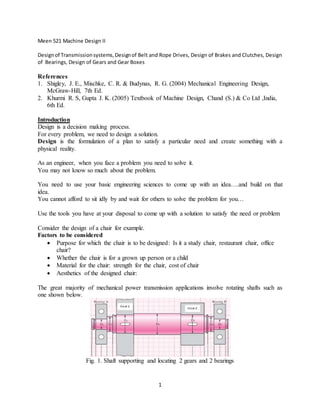
The great majority of mechanical power transmission applications involve rotating shafts such as
one shown below.
Fig. 1. Shaft supporting and locating 2 gears and 2 bearings
2
The shaft supports other machine elements such as gears, bearings, etc which aid in effective
transmission of power
Recall:
Design: Is an innovative and highly iterative process that aims to formulate a plan for the
satisfaction of a specified need to solve a problem.
When the plan results in creation of something with a physical reality, then the product must
possess the following;
 functional,
 safe,
 reliable,
 competitive,
 usable,
 manufacturable and
 marketable
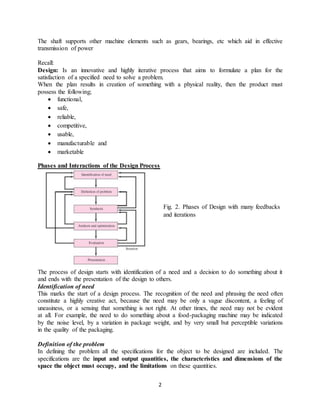
Phases and Interactions of the Design Process
The process of design starts with identification of a need and a decision to do something about it
and ends with the presentation of the design to others.
Identification of need
This marks the start of a design process. The recognition of the need and phrasing the need often
constitute a highly creative act, because the need may be only a vague discontent, a feeling of
uneasiness, or a sensing that something is not right. At other times, the need may not be evident
at all. For example, the need to do something about a food-packaging machine may be indicated
by the noise level, by a variation in package weight, and by very small but perceptible variations
in the quality of the packaging.
Definition of the problem
In defining the problem all the specifications for the object to be designed are included. The
specifications are the input and output quantities, the characteristics and dimensions of the
space the object must occupy, and the limitations on these quantities.
Fig. 2. Phases of Design with many feedbacks
and iterations
3
Specifications define the cost, the number to be manufactured, the expected life, the range, the
operating temperature, and the reliability.
Specified characteristics may include the speeds, feeds, temperature limitations, maximum range,
expected variations in the variables, dimensional and weight limitations, etc.
The manufacturing processes available, in addition to the facilities of a certain plant, constitute
restrictions on a designer’s freedom. This consists of implied specifications.
It may be that a small plant, for instance, does not own cold-working machinery.
Knowing this, the designer might select other metal-processing methods that can be performed in
the plant.
Labor skills available and the competitive situation also constitute implied constraints.
Note: Anything that limits the designer’s freedom of choice is a constraint.
Synthesis
During synthesis, various schemes must be proposed, investigated and quantified in terms of
established metrics.
Analysis and Optimization
In this stage analyses are performed to assess whether the system performance is satisfactory or
better, and, if satisfactory, just how well it will perform. System schemes that do not survive
analysis are revised, improved, or discarded. Those with potential are optimized to determine the
best performance of which the scheme is capable. Competing schemes are compared so that the
path leading to the most competitive product can be chosen.
Note: Synthesis and analysis and optimization are intimately and iteratively related.
Design being an iterative process we proceed through several steps, check the results, and then
return to an earlier phase of the procedure to see what effect this has on the remaining parts of
the system (see Fig. 2).
For example: Design of a system to transmit power requires attention to the design and selection
of individual components such as gears, bearings and shafts.
In order to design the shaft for stress and deflection, it is necessary to know the applied forces.
If the forces are transmitted through gears, it is necessary to know the gear specifications in order
to determine the forces that will be transmitted to the shaft.
Stock gears come with certain bore sizes, requiring knowledge of the necessary shaft diameter.
Therefore, in design, rough estimates will need to be made in order to proceed through the
process, refining and iterating until a final design is obtained that is satisfactory for each
individual component as well as for the overall design specifications.
Evaluation
4
This is significant phase of the total design process. It is the final proof of a successful design
and usually involves the testing of a prototype in the laboratory.
By evaluation, we wish to discover if the design really satisfies the needs, if it is reliable, if it
will compete successfully with similar products, if it is economical to manufacture and to use, if
profit can be made from its sale or use, if recalls will be needed to replace defective parts or
systems, etc
Presentation
Communicating the design to others is the final, vital step in the design process and is known as
presentation. The engineer, when presenting a new solution to administrative, management, or
supervisory persons, is attempting to sell or to prove to them that this solution is a better one.
Unless this can be done successfully, the time and effort spent on obtaining the solution have
been largely wasted.
Note: When designers sell a new idea, they also sell themselves. If they are repeatedly successful
in selling ideas, designs, and new solutions to management, they begin to receive salary
increases and promotions; in fact, this is how anyone succeeds in his or her profession.

Meen 521 machine design ii

  • 1.
    1 Meen 521 MachineDesign II Designof Transmissionsystems,Designof Belt and Rope Drives, Design of Brakes and Clutches, Design of Bearings, Design of Gears and Gear Boxes References 1. Shigley, J. E., Mischke, C. R. & Budynas, R. G. (2004) Mechanical Engineering Design, McGraw-Hill, 7th Ed. 2. Khurmi R. S, Gupta J. K. (2005) Textbook of Machine Design, Chand (S.) & Co Ltd ,India, 6th Ed. Introduction Design is a decision making process. For every problem, we need to design a solution. Design is the formulation of a plan to satisfy a particular need and create something with a physical reality. As an engineer, when you face a problem you need to solve it. You may not know so much about the problem. You need to use your basic engineering sciences to come up with an idea….and build on that idea. You cannot afford to sit idly by and wait for others to solve the problem for you… Use the tools you have at your disposal to come up with a solution to satisfy the need or problem Consider the design of a chair for example. Factors to be considered  Purpose for which the chair is to be designed: Is it a study chair, restaurant chair, office chair?  Whether the chair is for a grown up person or a child  Material for the chair: strength for the chair, cost of chair  Aesthetics of the designed chair: The great majority of mechanical power transmission applications involve rotating shafts such as one shown below. Fig. 1. Shaft supporting and locating 2 gears and 2 bearings
  • 2.
    2 The shaft supportsother machine elements such as gears, bearings, etc which aid in effective transmission of power Recall: Design: Is an innovative and highly iterative process that aims to formulate a plan for the satisfaction of a specified need to solve a problem. When the plan results in creation of something with a physical reality, then the product must possess the following;  functional,  safe,  reliable,  competitive,  usable,  manufacturable and  marketable Phases and Interactions of the Design Process The process of design starts with identification of a need and a decision to do something about it and ends with the presentation of the design to others. Identification of need This marks the start of a design process. The recognition of the need and phrasing the need often constitute a highly creative act, because the need may be only a vague discontent, a feeling of uneasiness, or a sensing that something is not right. At other times, the need may not be evident at all. For example, the need to do something about a food-packaging machine may be indicated by the noise level, by a variation in package weight, and by very small but perceptible variations in the quality of the packaging. Definition of the problem In defining the problem all the specifications for the object to be designed are included. The specifications are the input and output quantities, the characteristics and dimensions of the space the object must occupy, and the limitations on these quantities. Fig. 2. Phases of Design with many feedbacks and iterations
  • 3.
    3 Specifications define thecost, the number to be manufactured, the expected life, the range, the operating temperature, and the reliability. Specified characteristics may include the speeds, feeds, temperature limitations, maximum range, expected variations in the variables, dimensional and weight limitations, etc. The manufacturing processes available, in addition to the facilities of a certain plant, constitute restrictions on a designer’s freedom. This consists of implied specifications. It may be that a small plant, for instance, does not own cold-working machinery. Knowing this, the designer might select other metal-processing methods that can be performed in the plant. Labor skills available and the competitive situation also constitute implied constraints. Note: Anything that limits the designer’s freedom of choice is a constraint. Synthesis During synthesis, various schemes must be proposed, investigated and quantified in terms of established metrics. Analysis and Optimization In this stage analyses are performed to assess whether the system performance is satisfactory or better, and, if satisfactory, just how well it will perform. System schemes that do not survive analysis are revised, improved, or discarded. Those with potential are optimized to determine the best performance of which the scheme is capable. Competing schemes are compared so that the path leading to the most competitive product can be chosen. Note: Synthesis and analysis and optimization are intimately and iteratively related. Design being an iterative process we proceed through several steps, check the results, and then return to an earlier phase of the procedure to see what effect this has on the remaining parts of the system (see Fig. 2). For example: Design of a system to transmit power requires attention to the design and selection of individual components such as gears, bearings and shafts. In order to design the shaft for stress and deflection, it is necessary to know the applied forces. If the forces are transmitted through gears, it is necessary to know the gear specifications in order to determine the forces that will be transmitted to the shaft. Stock gears come with certain bore sizes, requiring knowledge of the necessary shaft diameter. Therefore, in design, rough estimates will need to be made in order to proceed through the process, refining and iterating until a final design is obtained that is satisfactory for each individual component as well as for the overall design specifications. Evaluation
  • 4.
    4 This is significantphase of the total design process. It is the final proof of a successful design and usually involves the testing of a prototype in the laboratory. By evaluation, we wish to discover if the design really satisfies the needs, if it is reliable, if it will compete successfully with similar products, if it is economical to manufacture and to use, if profit can be made from its sale or use, if recalls will be needed to replace defective parts or systems, etc Presentation Communicating the design to others is the final, vital step in the design process and is known as presentation. The engineer, when presenting a new solution to administrative, management, or supervisory persons, is attempting to sell or to prove to them that this solution is a better one. Unless this can be done successfully, the time and effort spent on obtaining the solution have been largely wasted. Note: When designers sell a new idea, they also sell themselves. If they are repeatedly successful in selling ideas, designs, and new solutions to management, they begin to receive salary increases and promotions; in fact, this is how anyone succeeds in his or her profession.