Basic Electrical Technology
[ELE 1051]
SINGLE PHASE AC CIRCUITS
L19 – Power in AC circuits
Monday, March 11, 2024 Dept. of Electrical & Electronics Engg., MIT - Manipal 1
Topics covered…
 Impedance, phasor & Power Diagram
 Concept of power factor and its significance
 Need for power factor improvement
Monday, March 11, 2024 Dept. of Electrical & Electronics Engg., MIT - Manipal 2
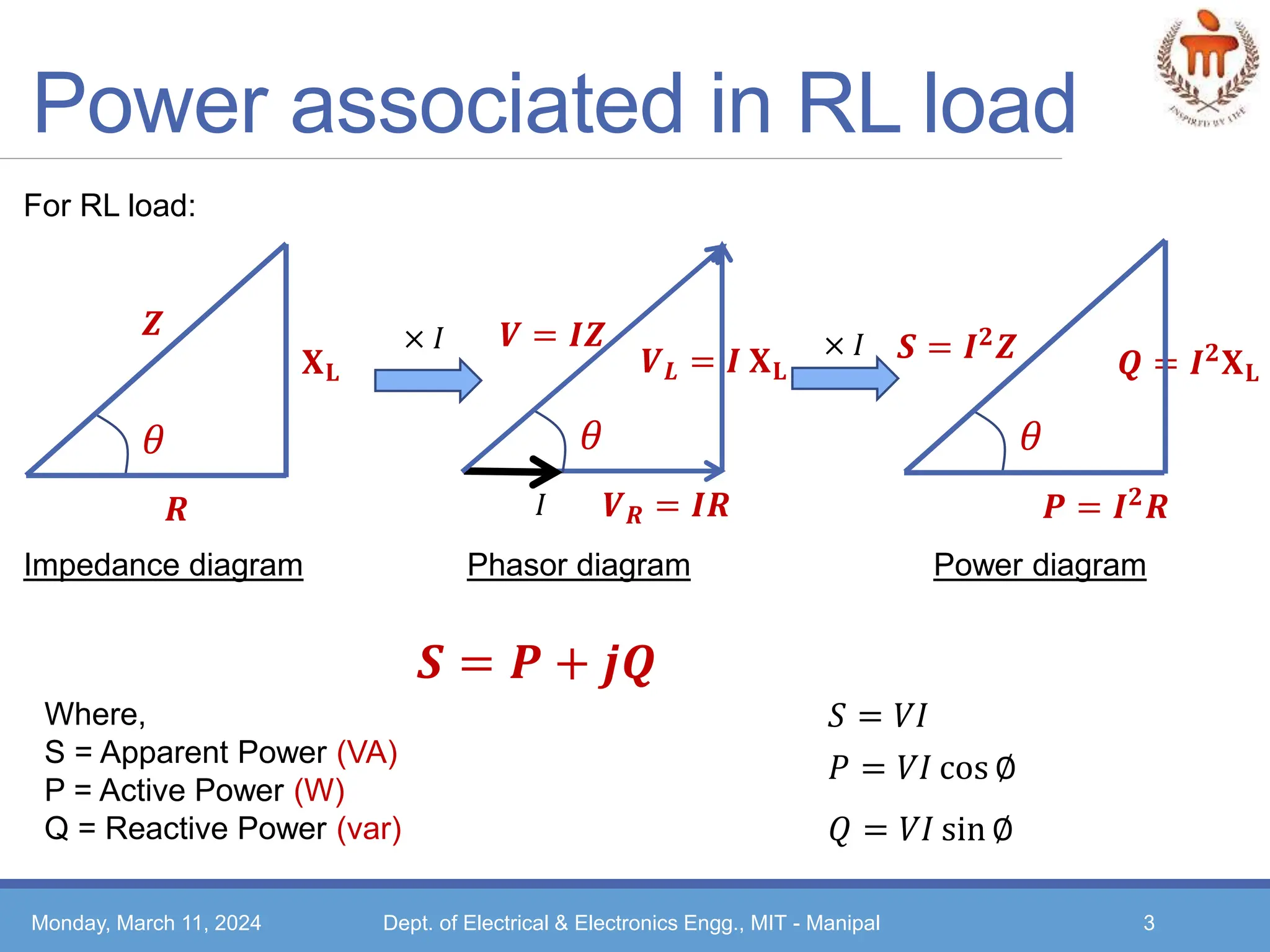
Power associated in RL load
Monday, March 11, 2024 Dept. of Electrical & Electronics Engg., MIT - Manipal 3
For RL load:
𝜃
𝑹
𝐗𝐋
𝒁
Impedance diagram
× 𝐼
𝜃
𝑷 = 𝑰𝟐𝑹
𝑸 = 𝑰𝟐𝐗𝐋
𝑺 = 𝑰𝟐𝒁
Power diagram
× 𝐼
𝜃
𝑽𝑹 = 𝑰𝑹
𝑽𝑳 = 𝑰 𝐗𝐋
𝑽 = 𝑰𝒁
𝐼
Phasor diagram
𝑺 = 𝑷 + 𝒋𝑸
𝑆 = 𝑉𝐼
𝑃 = 𝑉𝐼 cos ∅
𝑄 = 𝑉𝐼 sin ∅
Where,
S = Apparent Power (VA)
P = Active Power (W)
Q = Reactive Power (var)
Power associated in RL load
Monday, March 11, 2024 Dept. of Electrical & Electronics Engg., MIT - Manipal 4
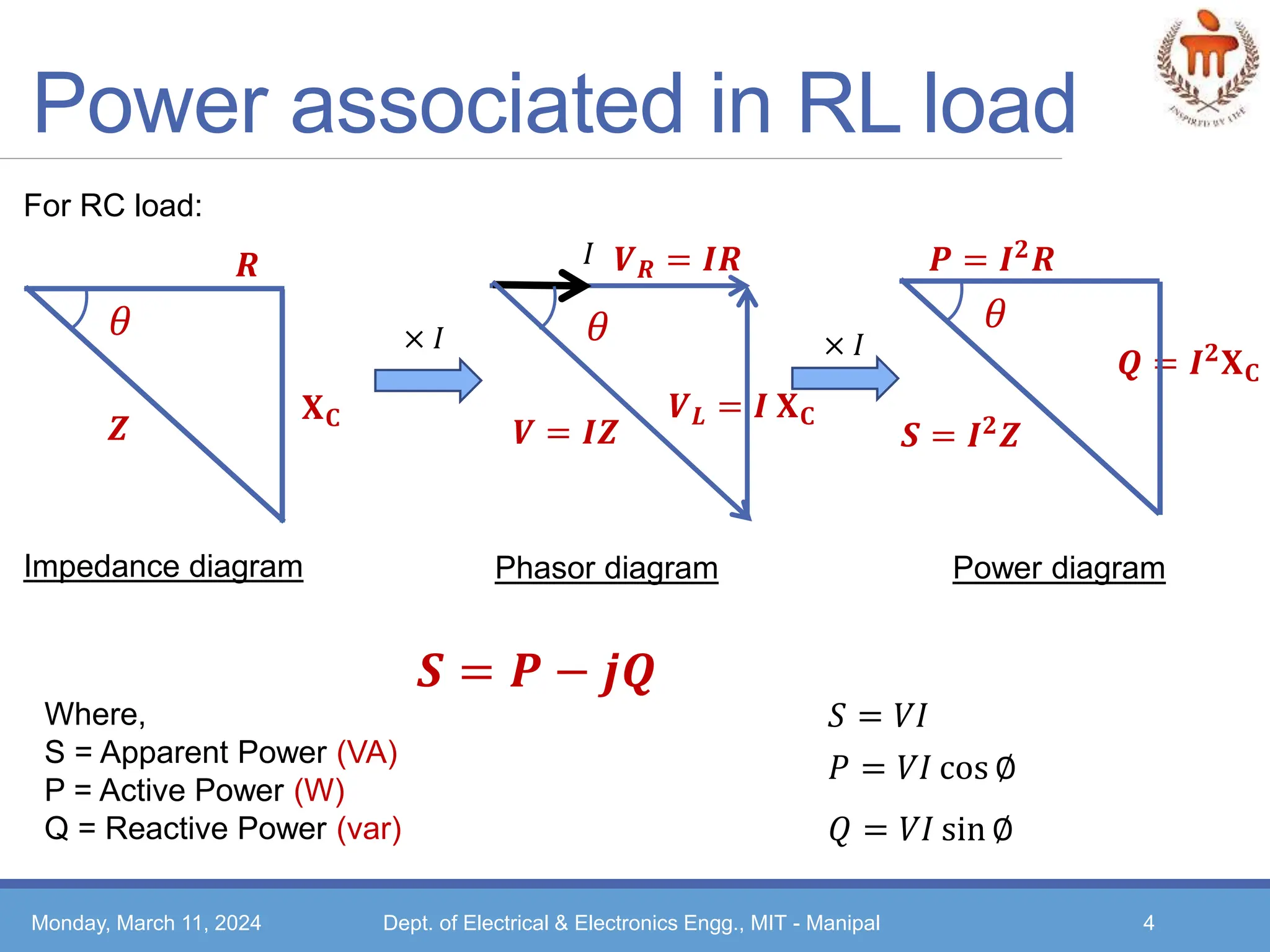
For RC load:
× 𝐼 × 𝐼
𝑺 = 𝑷 − 𝒋𝑸
Where,
S = Apparent Power (VA)
P = Active Power (W)
Q = Reactive Power (var)
𝜃
𝑹
𝐗𝐂
𝒁
Impedance diagram
𝜃
𝑽𝑹 = 𝑰𝑹
𝑽𝑳 = 𝑰 𝐗𝐂
𝑽 = 𝑰𝒁
𝐼
Phasor diagram
𝑷 = 𝑰𝟐
𝑹
𝑸 = 𝑰𝟐𝐗𝐂
𝑺 = 𝑰𝟐𝒁
Power diagram
𝜃
𝑆 = 𝑉𝐼
𝑃 = 𝑉𝐼 cos ∅
𝑄 = 𝑉𝐼 sin ∅
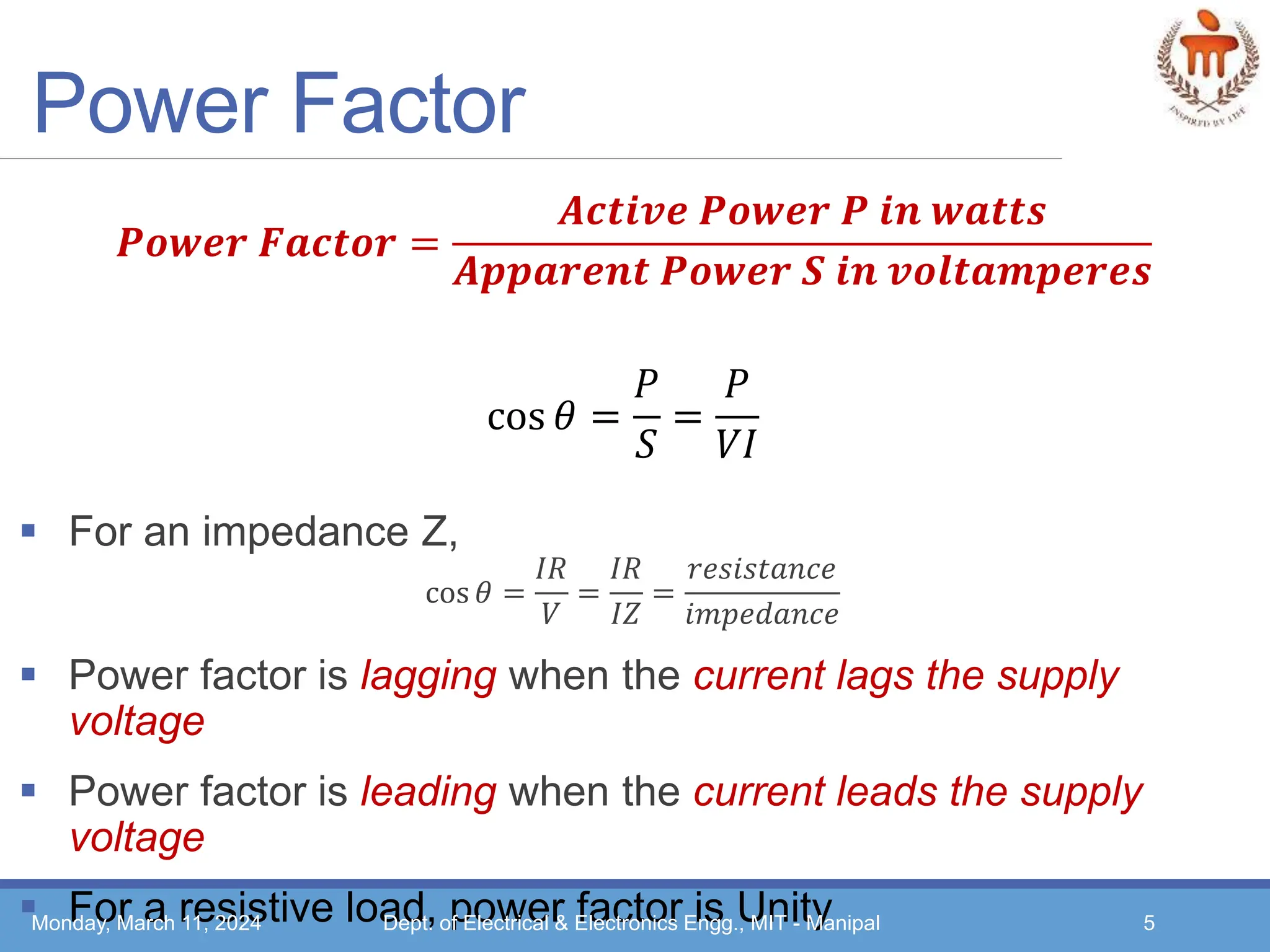
Power Factor
 For an impedance Z,
cos 𝜃 =
𝐼𝑅
𝑉
=
𝐼𝑅
𝐼𝑍
=
𝑟𝑒𝑠𝑖𝑠𝑡𝑎𝑛𝑐𝑒
𝑖𝑚𝑝𝑒𝑑𝑎𝑛𝑐𝑒
 Power factor is lagging when the current lags the supply
voltage
 Power factor is leading when the current leads the supply
voltage
 For a resistive load, power factor is Unity
Monday, March 11, 2024 Dept. of Electrical & Electronics Engg., MIT - Manipal 5
𝑷𝒐𝒘𝒆𝒓 𝑭𝒂𝒄𝒕𝒐𝒓 =
𝑨𝒄𝒕𝒊𝒗𝒆 𝑷𝒐𝒘𝒆𝒓 𝑷 𝒊𝒏 𝒘𝒂𝒕𝒕𝒔
𝑨𝒑𝒑𝒂𝒓𝒆𝒏𝒕 𝑷𝒐𝒘𝒆𝒓 𝑺 𝒊𝒏 𝒗𝒐𝒍𝒕𝒂𝒎𝒑𝒆𝒓𝒆𝒔
cos 𝜃 =
𝑃
𝑆
=
𝑃
𝑉𝐼
Disadvantages of Low Power Factor
 Under utilisation of power system network
 Increased transmission losses
 Hence bulk consumers are advised to maintain the power
factor close to unity by power utilities
Remedial Measures
o Most of the industrial loads are inductive in nature
o Reactive power demand of Inductive loads can be
compensated with capacitive loads
o Hence it is possible to localise reactive power requirement by
connecting parallel capacitors across the load
Monday, March 11, 2024 Dept. of Electrical & Electronics Engg., MIT - Manipal 6
Power Triangle
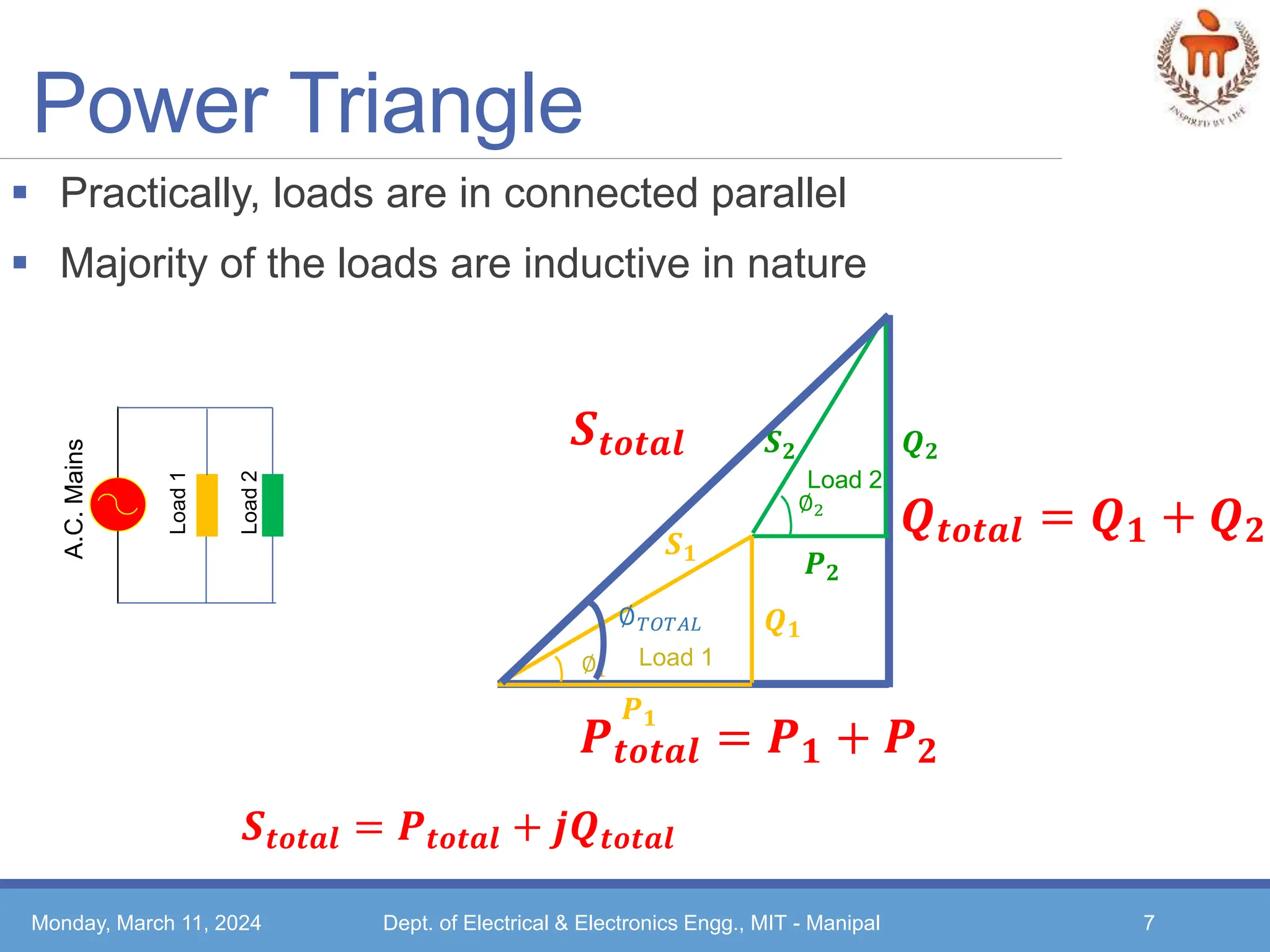
 Practically, loads are in connected parallel
 Majority of the loads are inductive in nature
Monday, March 11, 2024 Dept. of Electrical & Electronics Engg., MIT - Manipal 7
A.C.
Mains
Load
2
Load
1
𝑺𝒕𝒐𝒕𝒂𝒍
𝑷𝒕𝒐𝒕𝒂𝒍 = 𝑷𝟏 + 𝑷𝟐
𝑸𝒕𝒐𝒕𝒂𝒍 = 𝑸𝟏 + 𝑸𝟐
𝑺𝒕𝒐𝒕𝒂𝒍 = 𝑷𝒕𝒐𝒕𝒂𝒍 + 𝒋𝑸𝒕𝒐𝒕𝒂𝒍
Load 2
∅2
𝑺𝟐
𝑷𝟐
𝑸𝟐
Load 1
∅1
𝑷𝟏
𝑸𝟏
𝑺𝟏
∅𝑇𝑂𝑇𝐴𝐿
Power Factor Improvement
 Connect capacitor parallel to the load
 Energy stored by the capacitor provides the required reactive power
by the load
Monday, March 11, 2024 Dept. of Electrical & Electronics Engg., MIT - Manipal 8
𝑺𝒕
𝑷𝒕
𝑸𝒕
∅𝑇𝑂𝑇𝐴𝐿
Load
2
Load
1
A.C.
Mains
capacitor
𝑺𝒕
𝑷𝒕
𝑸𝒄
∅𝑇𝑂𝑇𝐴𝐿
∅𝑛𝑒𝑤
𝑸𝒏𝒆𝒘 = 𝑸𝒕 − 𝑸𝒄
𝑺𝒏𝒆𝒘
• Calculate 𝑄𝑐needed to improve power factor to 𝑐𝑜𝑠∅𝑛𝑒𝑤
• Calculate 𝑋𝑐 =
𝑉2
𝑄𝐶
& c =
𝑋𝑐
2𝜋𝑓
Calculation of capacitor value
Illustration 1
A single-phase motor takes 8.3 A at a power factor of 0.866
lagging when connected to a 230 V, 50 Hz supply. Capacitance
bank is now connected in parallel with the motor to raise the
power factor to unity. Determine the capacitance value
Monday, March 11, 2024 Dept. of Electrical & Electronics Engg., MIT - Manipal 9
Ans: 𝟓𝟕. 𝟒 𝝁𝑭
Illustration 2
A single-phase load of 5 kW operates at a power factor of 0.6
lagging. It is proposed to improve this power factor to 0.95
lagging by connecting a capacitor across the load. Calculate the
kvar rating of the capacitor
Monday, March 11, 2024 Dept. of Electrical & Electronics Engg., MIT - Manipal 10
Ans: 5.02 kvar
Summary
 Power in AC circuit is given by, 𝑺 = 𝑽𝑰
 For any load with impedance Z,
o Active Power (watt), 𝑷 = 𝑽𝑰 𝐜𝐨𝐬 𝜽 = 𝑰𝟐
𝒁 𝐜𝐨𝐬 𝜽 = 𝑰𝟐
𝑹
o Reactive Power (var), 𝑸 = 𝑽𝑰 𝐬𝐢𝐧 𝜽 = 𝑰𝟐
𝒁 𝐬𝒊𝒏 𝜽 = 𝑰𝟐
𝑿
o Apparent Power (VA), 𝑺 = 𝑽𝑰 = 𝑰𝟐
𝒁
 𝑷𝒐𝒘𝒆𝒓 𝑭𝒂𝒄𝒕𝒐𝒓 =
𝑨𝒄𝒕𝒊𝒗𝒆 𝑷𝒐𝒘𝒆𝒓
𝑨𝒑𝒑𝒂𝒓𝒆𝒏𝒕 𝑷𝒐𝒘𝒆𝒓
=
𝑃
𝑆
=
𝑅
𝑍
= cos 𝜃
Monday, March 11, 2024 Dept. of Electrical & Electronics Engg., MIT - Manipal 11
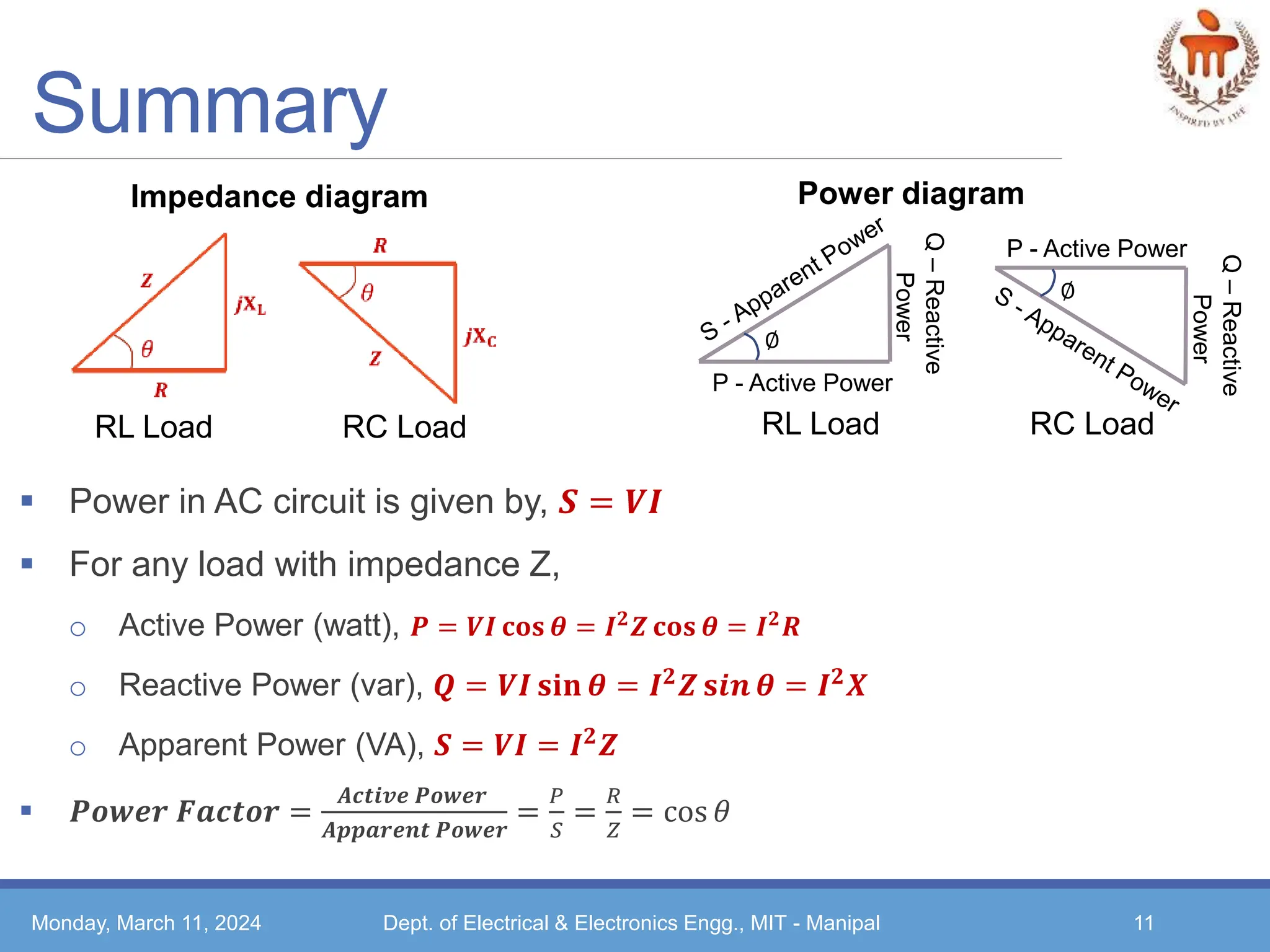
Impedance diagram
RL Load RC Load
Power diagram
RL Load RC Load
∅
P - Active Power
Q
–
Reactive
Power
∅
P - Active Power
Q
–
Reactive
Power
Summary
 Low power factor loads must be avoided
 Capacitor bank connected parallel to the load serves as the
source of reactive power for the load
o Improves load power factor
o Reduces transmission and distribution losses
Monday, March 11, 2024 Dept. of Electrical & Electronics Engg., MIT - Manipal 12

Basic electric theory - Power in AC circuits.pptx

  • 1.
    Basic Electrical Technology [ELE1051] SINGLE PHASE AC CIRCUITS L19 – Power in AC circuits Monday, March 11, 2024 Dept. of Electrical & Electronics Engg., MIT - Manipal 1
  • 2.
    Topics covered…  Impedance,phasor & Power Diagram  Concept of power factor and its significance  Need for power factor improvement Monday, March 11, 2024 Dept. of Electrical & Electronics Engg., MIT - Manipal 2
  • 3.
    Power associated inRL load Monday, March 11, 2024 Dept. of Electrical & Electronics Engg., MIT - Manipal 3 For RL load: 𝜃 𝑹 𝐗𝐋 𝒁 Impedance diagram × 𝐼 𝜃 𝑷 = 𝑰𝟐𝑹 𝑸 = 𝑰𝟐𝐗𝐋 𝑺 = 𝑰𝟐𝒁 Power diagram × 𝐼 𝜃 𝑽𝑹 = 𝑰𝑹 𝑽𝑳 = 𝑰 𝐗𝐋 𝑽 = 𝑰𝒁 𝐼 Phasor diagram 𝑺 = 𝑷 + 𝒋𝑸 𝑆 = 𝑉𝐼 𝑃 = 𝑉𝐼 cos ∅ 𝑄 = 𝑉𝐼 sin ∅ Where, S = Apparent Power (VA) P = Active Power (W) Q = Reactive Power (var)
  • 4.
    Power associated inRL load Monday, March 11, 2024 Dept. of Electrical & Electronics Engg., MIT - Manipal 4 For RC load: × 𝐼 × 𝐼 𝑺 = 𝑷 − 𝒋𝑸 Where, S = Apparent Power (VA) P = Active Power (W) Q = Reactive Power (var) 𝜃 𝑹 𝐗𝐂 𝒁 Impedance diagram 𝜃 𝑽𝑹 = 𝑰𝑹 𝑽𝑳 = 𝑰 𝐗𝐂 𝑽 = 𝑰𝒁 𝐼 Phasor diagram 𝑷 = 𝑰𝟐 𝑹 𝑸 = 𝑰𝟐𝐗𝐂 𝑺 = 𝑰𝟐𝒁 Power diagram 𝜃 𝑆 = 𝑉𝐼 𝑃 = 𝑉𝐼 cos ∅ 𝑄 = 𝑉𝐼 sin ∅
  • 5.
    Power Factor  Foran impedance Z, cos 𝜃 = 𝐼𝑅 𝑉 = 𝐼𝑅 𝐼𝑍 = 𝑟𝑒𝑠𝑖𝑠𝑡𝑎𝑛𝑐𝑒 𝑖𝑚𝑝𝑒𝑑𝑎𝑛𝑐𝑒  Power factor is lagging when the current lags the supply voltage  Power factor is leading when the current leads the supply voltage  For a resistive load, power factor is Unity Monday, March 11, 2024 Dept. of Electrical & Electronics Engg., MIT - Manipal 5 𝑷𝒐𝒘𝒆𝒓 𝑭𝒂𝒄𝒕𝒐𝒓 = 𝑨𝒄𝒕𝒊𝒗𝒆 𝑷𝒐𝒘𝒆𝒓 𝑷 𝒊𝒏 𝒘𝒂𝒕𝒕𝒔 𝑨𝒑𝒑𝒂𝒓𝒆𝒏𝒕 𝑷𝒐𝒘𝒆𝒓 𝑺 𝒊𝒏 𝒗𝒐𝒍𝒕𝒂𝒎𝒑𝒆𝒓𝒆𝒔 cos 𝜃 = 𝑃 𝑆 = 𝑃 𝑉𝐼
  • 6.
    Disadvantages of LowPower Factor  Under utilisation of power system network  Increased transmission losses  Hence bulk consumers are advised to maintain the power factor close to unity by power utilities Remedial Measures o Most of the industrial loads are inductive in nature o Reactive power demand of Inductive loads can be compensated with capacitive loads o Hence it is possible to localise reactive power requirement by connecting parallel capacitors across the load Monday, March 11, 2024 Dept. of Electrical & Electronics Engg., MIT - Manipal 6
  • 7.
    Power Triangle  Practically,loads are in connected parallel  Majority of the loads are inductive in nature Monday, March 11, 2024 Dept. of Electrical & Electronics Engg., MIT - Manipal 7 A.C. Mains Load 2 Load 1 𝑺𝒕𝒐𝒕𝒂𝒍 𝑷𝒕𝒐𝒕𝒂𝒍 = 𝑷𝟏 + 𝑷𝟐 𝑸𝒕𝒐𝒕𝒂𝒍 = 𝑸𝟏 + 𝑸𝟐 𝑺𝒕𝒐𝒕𝒂𝒍 = 𝑷𝒕𝒐𝒕𝒂𝒍 + 𝒋𝑸𝒕𝒐𝒕𝒂𝒍 Load 2 ∅2 𝑺𝟐 𝑷𝟐 𝑸𝟐 Load 1 ∅1 𝑷𝟏 𝑸𝟏 𝑺𝟏 ∅𝑇𝑂𝑇𝐴𝐿
  • 8.
    Power Factor Improvement Connect capacitor parallel to the load  Energy stored by the capacitor provides the required reactive power by the load Monday, March 11, 2024 Dept. of Electrical & Electronics Engg., MIT - Manipal 8 𝑺𝒕 𝑷𝒕 𝑸𝒕 ∅𝑇𝑂𝑇𝐴𝐿 Load 2 Load 1 A.C. Mains capacitor 𝑺𝒕 𝑷𝒕 𝑸𝒄 ∅𝑇𝑂𝑇𝐴𝐿 ∅𝑛𝑒𝑤 𝑸𝒏𝒆𝒘 = 𝑸𝒕 − 𝑸𝒄 𝑺𝒏𝒆𝒘 • Calculate 𝑄𝑐needed to improve power factor to 𝑐𝑜𝑠∅𝑛𝑒𝑤 • Calculate 𝑋𝑐 = 𝑉2 𝑄𝐶 & c = 𝑋𝑐 2𝜋𝑓 Calculation of capacitor value
  • 9.
    Illustration 1 A single-phasemotor takes 8.3 A at a power factor of 0.866 lagging when connected to a 230 V, 50 Hz supply. Capacitance bank is now connected in parallel with the motor to raise the power factor to unity. Determine the capacitance value Monday, March 11, 2024 Dept. of Electrical & Electronics Engg., MIT - Manipal 9 Ans: 𝟓𝟕. 𝟒 𝝁𝑭
  • 10.
    Illustration 2 A single-phaseload of 5 kW operates at a power factor of 0.6 lagging. It is proposed to improve this power factor to 0.95 lagging by connecting a capacitor across the load. Calculate the kvar rating of the capacitor Monday, March 11, 2024 Dept. of Electrical & Electronics Engg., MIT - Manipal 10 Ans: 5.02 kvar
  • 11.
    Summary  Power inAC circuit is given by, 𝑺 = 𝑽𝑰  For any load with impedance Z, o Active Power (watt), 𝑷 = 𝑽𝑰 𝐜𝐨𝐬 𝜽 = 𝑰𝟐 𝒁 𝐜𝐨𝐬 𝜽 = 𝑰𝟐 𝑹 o Reactive Power (var), 𝑸 = 𝑽𝑰 𝐬𝐢𝐧 𝜽 = 𝑰𝟐 𝒁 𝐬𝒊𝒏 𝜽 = 𝑰𝟐 𝑿 o Apparent Power (VA), 𝑺 = 𝑽𝑰 = 𝑰𝟐 𝒁  𝑷𝒐𝒘𝒆𝒓 𝑭𝒂𝒄𝒕𝒐𝒓 = 𝑨𝒄𝒕𝒊𝒗𝒆 𝑷𝒐𝒘𝒆𝒓 𝑨𝒑𝒑𝒂𝒓𝒆𝒏𝒕 𝑷𝒐𝒘𝒆𝒓 = 𝑃 𝑆 = 𝑅 𝑍 = cos 𝜃 Monday, March 11, 2024 Dept. of Electrical & Electronics Engg., MIT - Manipal 11 Impedance diagram RL Load RC Load Power diagram RL Load RC Load ∅ P - Active Power Q – Reactive Power ∅ P - Active Power Q – Reactive Power
  • 12.
    Summary  Low powerfactor loads must be avoided  Capacitor bank connected parallel to the load serves as the source of reactive power for the load o Improves load power factor o Reduces transmission and distribution losses Monday, March 11, 2024 Dept. of Electrical & Electronics Engg., MIT - Manipal 12

Editor's Notes

  • #10 ‘Huges Electrical & Electronic Technology’, 10th edition Page No. 272, Exercise problem 1
  • #11 ‘Huges Electrical & Electronic Technology’, 10th edition Page No. 272, Exercise problem 2a