Chapter 2 Lecture
Chemistry
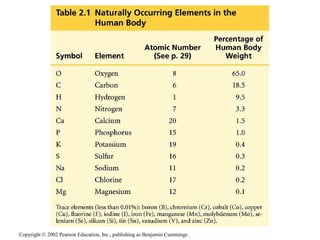
• About 25 of the 92 natural elements are
known to be essential for life.
– Four elements - carbon (C), oxygen (O),
hydrogen (H), and nitrogen (N) - make up
96% of living matter.
– Most of the remaining 4% of an organism’s
weight consists of phosphorus (P), sulfur (S),
calcium (Ca), and potassium (K).
2. Life requires about 25 chemical
elements
Copyright © 2002 Pearson Education, Inc., publishing as Benjamin Cummings
• Each element consists of unique atoms.
• An atom is the smallest unit of matter that
still retains the properties of an element.
– Atoms are composed of even smaller parts,
called subatomic particles.
– Two of these, neutrons and protons, are
packed together to form a dense core, the
atomic nucleus, at the center of an atom.
– Electrons form a cloud around the nucleus.
1. Atomic structure determines
the behavior of an element
Copyright © 2002 Pearson Education, Inc., publishing as Benjamin Cummings
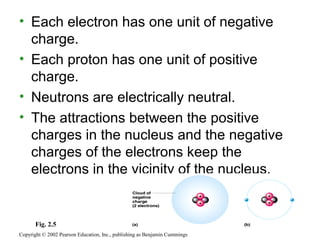
• Each electron has one unit of negative
charge.
• Each proton has one unit of positive
charge.
• Neutrons are electrically neutral.
• The attractions between the positive
charges in the nucleus and the negative
charges of the electrons keep the
electrons in the vicinity of the nucleus.
Copyright © 2002 Pearson Education, Inc., publishing as Benjamin Cummings
Fig. 2.5
• A neutron and a proton are almost
identical in mass, about 1.7 x 10⁻²⁴
gram
per particle.
• For convenience, an alternative unit of
measure, the dalton, is used to measure
the mass subatomic particles, atoms or
molecules.
– The mass of a neutron or a proton is close to
1 dalton.
• The mass of an electron is about 1/2000th
that of a neutron or proton.
– Therefore, we typically ignore the contribution
of electrons when determining the total mass
of an atom.
Copyright © 2002 Pearson Education, Inc., publishing as Benjamin Cummings
• All atoms of a particular element have the
same number of protons in their nuclei.
– Each element has a unique number of
protons, its unique atomic number.
– The atomic number is written as a subscript
before the symbol for the element (for
example, 2He).
• Unless otherwise indicated, atoms have
equal numbers of protons and electrons -
no net charge.
– Therefore, the atomic number tells us the
number of protons and the number of
electrons that are found in a neutral atom of a
specific element.
Copyright © 2002 Pearson Education, Inc., publishing as Benjamin Cummings
• The mass number is the sum of the number of
protons and neutrons in the nucleus of an atom.
– Therefore, we can determine the number of neutrons
in an atom by subtracting the number of protons (the
atomic number) from the mass number.
– The mass number is written as a superscript before
an element’s symbol (for example, 4
He).
• The atomic weight of an atom, a measure of its
mass, can be approximated by the mass
number.
– For example, 4
He has a mass number of 4 and an
estimated atomic weight of 4 daltons.
– More precisely, its atomic weight is 4.003 daltons.
Copyright © 2002 Pearson Education, Inc., publishing as Benjamin Cummings
• While all atoms of a given element have
the same number of protons, they may
differ in the number of neutrons.
• Two atoms of the same element that
differ in the number of neutrons are
called isotopes.
• In nature, an element occurs as a
mixture of isotopes.
– For example, 99% of carbon atoms have 6
neutrons (12
C).
– Most of the remaining 1% of carbon atoms
have 7 neutrons (13
C) while the rarest
isotope, with 8 neutrons is 14
C.
• Most isotopes are stable; they do not tend
to loose particles.
– Both 12
C and 13
C are stable isotopes.
• The nuclei of some isotopes are unstable
and decay spontaneously, emitting
particles and energy.
– 14
C is a one of these unstable or radioactive
isotopes.
– In its decay, an neutron is converted to a
proton and electron.
– This converts 14
C to 14
N, changing the identity of
that atom.
Copyright © 2002 Pearson Education, Inc., publishing as Benjamin Cummings
• To gain an accurate perspective of the
relative proportions of an atom, if the
nucleus was the size of a golf ball, the
electrons would be moving about 1
kilometer from the nucleus.
– Atoms are mostly empty space.
• When two elements interact during a
chemical reaction, it is actually their
electrons that are actually involved.
– The nuclei do not come close enough to
interact.
Copyright © 2002 Pearson Education, Inc., publishing as Benjamin Cummings
• The electrons of an atom may vary in the
amount of energy that they possess.
• Energy is the ability to do work.
• Potential energy is the energy that matter
stores because of its position or location.
– Water stored behind a dam has potential
energy that can be used to do work turning
electric generators.
– Because potential energy has been expended,
the water stores less energy at the bottom of
the dam than it did in the reservoir.
Copyright © 2002 Pearson Education, Inc., publishing as Benjamin Cummings
• Electrons have potential energy because of
their position relative to the nucleus.
– The negatively charged electrons are attracted
to the positively charged nucleus.
– The farther electrons are from the nucleus, the
more potential energy they have.
• However, electrons cannot occupy just any
location away from the nucleus.
• Changes in potential energy can only occur
in steps of a fixed amount, moving the
electron to a fixed location.
– An electron cannot exist between these fixed
locations.
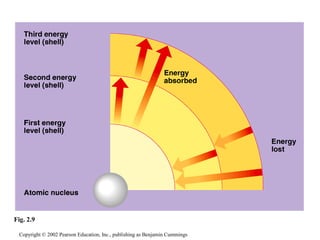
• The different states of potential energy that
the electrons of an atoms can have are
called energy levels or electron shells.
– The first shell, closest to the nucleus, has the
lowest potential energy.
– Electrons in outer shells have more potential
energy.
– Electrons can only change their position if they
absorb or release a quantity of energy that
matches the difference in potential energy
between the two levels.
Copyright © 2002 Pearson Education, Inc., publishing as Benjamin Cummings
Fig. 2.9
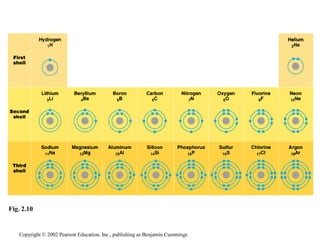
• The chemical behavior of an atom is
determined by its electron configuration -
the distribution of electrons in its electron
shells.
– The first 18 elements, including those most
important in biological processes, can be
arranged in 8 columns and 3 rows.
• Elements in the same row use the same shells.
• Moving from left to right, each element has a
sequential addition of electrons (and protons).
Copyright © 2002 Pearson Education, Inc., publishing as Benjamin Cummings
Fig. 2.10
• The first electron shell can hold only 2
electrons.
– The two electrons of Helium fill the first shell.
• Atoms with more than two electrons must
place the extra electrons in higher shells.
– For example, Lithium with three electrons has
two in the first shell and one in the second
shell.
• The second shell can hold up to 8
electrons.
– Neon, with 10 total electrons, has two in the
first shell and eight in the second, filling both
shells.
• The chemical behavior of an atom depends
mostly on the number of electrons in its
outermost shell, the valence shell.
– Electrons in the valence shell are known as
valence electrons.
• Atoms with the same number of valence
electrons have similar chemical behavior.
• An atom with a completed valence shell is
unreactive.
• All other atoms are chemically reactive
because they have incomplete valence
shells.
Copyright © 2002 Pearson Education, Inc., publishing as Benjamin Cummings
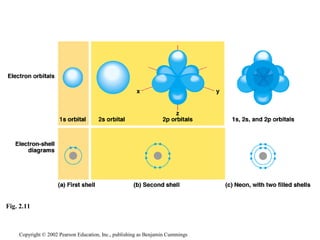
• While the paths of electrons are often
visualized as concentric paths, like planets
orbiting the sun.
• In reality, an electron occupies a more
complex three-dimensional space, an
orbital.
– The first shell has room for a single spherical
orbital for its pair of electrons.
– The second shell can pack pairs of electrons
into a spherical orbital and three p orbitals
(dumbbell-shaped).
Copyright © 2002 Pearson Education, Inc., publishing as Benjamin Cummings
Fig. 2.11
• The reactivity of atoms arises from the
presence of unpaired electrons in one or
more orbitals of their valence shells.
– Electrons preferentially occupy separate
orbitals within the valence shell until forced to
share orbitals.
• The four valence electrons of carbon each occupy
separate orbitals, but the five valence electrons of
nitrogen are distributed into three unshared orbitals
and one shared orbital.
– When atoms interact to complete their valence
shells, it is the unpaired electrons that are
involved.
Copyright © 2002 Pearson Education, Inc., publishing as Benjamin Cummings
• Atoms with incomplete valence shells
interact by either sharing or transferring
valence electrons.
• These interactions typically result in the
atoms remaining close together, held by
an attractions called chemical bonds.
– The strongest chemical bonds are covalent
bonds and ionic bonds.
2. Atoms combine by chemical
bonding to form molecules
Copyright © 2002 Pearson Education, Inc., publishing as Benjamin Cummings
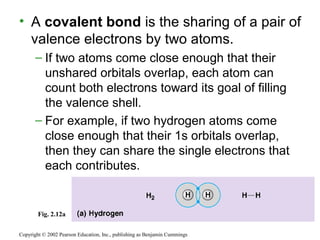
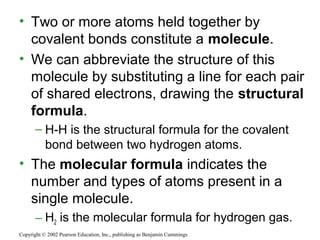
• A covalent bond is the sharing of a pair of
valence electrons by two atoms.
– If two atoms come close enough that their
unshared orbitals overlap, each atom can
count both electrons toward its goal of filling
the valence shell.
– For example, if two hydrogen atoms come
close enough that their 1s orbitals overlap,
then they can share the single electrons that
each contributes.
Copyright © 2002 Pearson Education, Inc., publishing as Benjamin Cummings
Fig. 2.12a
• Two or more atoms held together by
covalent bonds constitute a molecule.
• We can abbreviate the structure of this
molecule by substituting a line for each pair
of shared electrons, drawing the structural
formula.
– H-H is the structural formula for the covalent
bond between two hydrogen atoms.
• The molecular formula indicates the
number and types of atoms present in a
single molecule.
– H2 is the molecular formula for hydrogen gas.
Copyright © 2002 Pearson Education, Inc., publishing as Benjamin Cummings
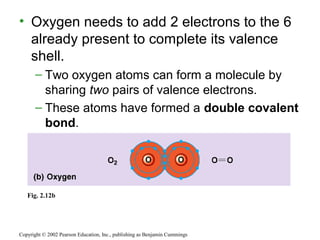
• Oxygen needs to add 2 electrons to the 6
already present to complete its valence
shell.
– Two oxygen atoms can form a molecule by
sharing two pairs of valence electrons.
– These atoms have formed a double covalent
bond.
Copyright © 2002 Pearson Education, Inc., publishing as Benjamin Cummings
Fig. 2.12b
• Every atom has a characteristic total
number of covalent bonds that it can form -
an atom’s valence.
– The valence of hydrogen is 1.
– Oxygen is 2.
– Nitrogen is 3.
– Carbon is 4.
– Phosphorus should have a valence of 3, based
on its three unpaired electrons, but in biological
molecules it generally has a valence of 5,
forming three single covalent bonds and one
double bond.
Copyright © 2002 Pearson Education, Inc., publishing as Benjamin Cummings
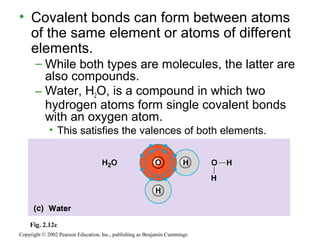
• Covalent bonds can form between atoms
of the same element or atoms of different
elements.
– While both types are molecules, the latter are
also compounds.
– Water, H2O, is a compound in which two
hydrogen atoms form single covalent bonds
with an oxygen atom.
• This satisfies the valences of both elements.
Copyright © 2002 Pearson Education, Inc., publishing as Benjamin Cummings
Fig. 2.12c
Copyright © 2002 Pearson Education, Inc., publishing as Benjamin Cummings
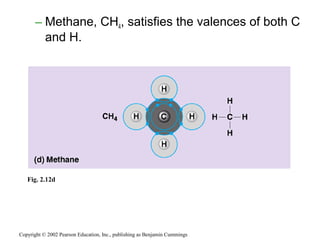
Fig. 2.12d
– Methane, CH4, satisfies the valences of both C
and H.
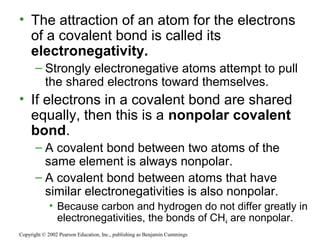
• The attraction of an atom for the electrons
of a covalent bond is called its
electronegativity.
– Strongly electronegative atoms attempt to pull
the shared electrons toward themselves.
• If electrons in a covalent bond are shared
equally, then this is a nonpolar covalent
bond.
– A covalent bond between two atoms of the
same element is always nonpolar.
– A covalent bond between atoms that have
similar electronegativities is also nonpolar.
• Because carbon and hydrogen do not differ greatly in
electronegativities, the bonds of CH4 are nonpolar.
Copyright © 2002 Pearson Education, Inc., publishing as Benjamin Cummings
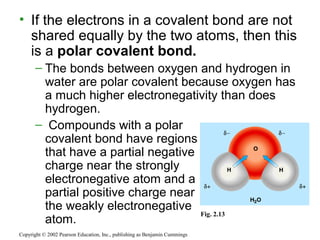
• If the electrons in a covalent bond are not
shared equally by the two atoms, then this
is a polar covalent bond.
– The bonds between oxygen and hydrogen in
water are polar covalent because oxygen has
a much higher electronegativity than does
hydrogen.
– Compounds with a polar
covalent bond have regions
that have a partial negative
charge near the strongly
electronegative atom and a
partial positive charge near
the weakly electronegative
atom.
Copyright © 2002 Pearson Education, Inc., publishing as Benjamin Cummings
Fig. 2.13
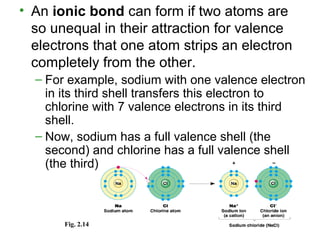
• An ionic bond can form if two atoms are
so unequal in their attraction for valence
electrons that one atom strips an electron
completely from the other.
– For example, sodium with one valence electron
in its third shell transfers this electron to
chlorine with 7 valence electrons in its third
shell.
– Now, sodium has a full valence shell (the
second) and chlorine has a full valence shell
(the third).
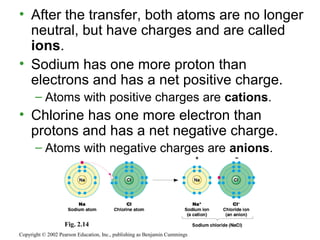
Fig. 2.14
• After the transfer, both atoms are no longer
neutral, but have charges and are called
ions.
• Sodium has one more proton than
electrons and has a net positive charge.
– Atoms with positive charges are cations.
• Chlorine has one more electron than
protons and has a net negative charge.
– Atoms with negative charges are anions.
Copyright © 2002 Pearson Education, Inc., publishing as Benjamin Cummings
Fig. 2.14
• Because of differences in charge, cations
and anions are attracted to each other to
form an ionic bond.
– Atoms in an ionic bonds need not have
acquired their charge by electrons transferred
with each other.
Copyright © 2002 Pearson Education, Inc., publishing as Benjamin Cummings
• Compounds formed by ionic bonds are
ionic compounds or salts, like NaCl or
table salt.
• The formula for an ionic compound
indicates the ratio of elements in a crystal
of that salt.
– Atoms in a crystal do not form molecules with a
definitive size and number of atoms as in
covalent bonds.
Copyright © 2002 Pearson Education, Inc., publishing as Benjamin Cummings
• Ionic compounds can have ratios of
elements different from 1:1.
– For example, the ionic compound magnesium
chloride (MgCl2) has 2 chloride atoms per
magnesium atom.
• Magnesium needs to loose 2 electrons to drop to a
full outer shell, each chlorine needs to gain 1.
• Entire molecules that have full electrical
charges are also called ions.
– In the salt ammonium chloride (NH4Cl), the
anion is Cl-
and the cation is NH4
+
.
• The strength of ionic bonds depends on
environmental conditions.Copyright © 2002 Pearson Education, Inc., publishing as Benjamin Cummings
• Within a cell, weak, brief bonds between
molecules are important to a variety of
processes.
– For example, signal molecules from one neuron
use weak bonds to bind briefly to receptor
molecules on the surface of a receiving neuron.
– This triggers a momentary response by the
recipient.
• Weak interactions include ionic bonds
(weak in water), hydrogen bonds, and van
der Waals interactions.
3. Weak chemical bonds play important roles in
the chemistry of life
Copyright © 2002 Pearson Education, Inc., publishing as Benjamin Cummings
• Hydrogen bonds form when a hydrogen
atom that is already covalently bonded to a
strongly electronegative atom is attracted to
another strongly electronegative atom.
– These strongly electronegative atoms are
typically nitrogen or oxygen.
– Typically, these bonds result because the polar
covalent bond with hydrogen leaves the
hydrogen atom with a partial positive charge
and the other atom with a partial negative
charge.
– The partially positive charged hydrogen atom is
attracted to negatively charged (partial or full)
molecules, atoms, or even regions of the same
large molecule.
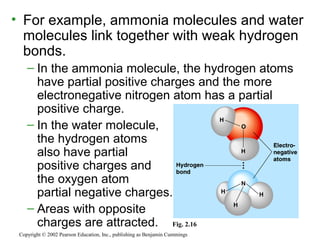
• For example, ammonia molecules and water
molecules link together with weak hydrogen
bonds.
– In the ammonia molecule, the hydrogen atoms
have partial positive charges and the more
electronegative nitrogen atom has a partial
positive charge.
– In the water molecule,
the hydrogen atoms
also have partial
positive charges and
the oxygen atom
partial negative charges.
– Areas with opposite
charges are attracted.
Copyright © 2002 Pearson Education, Inc., publishing as Benjamin Cummings
Fig. 2.16
• Even molecules with nonpolar covalent bonds
can have partially negative and positive regions.
– Because electrons are constantly in motion, there can
be periods when they accumulate by chance in one
area of a molecule.
– This created ever-changing regions of negative and
positive charge within a molecule.
• Molecules or atoms in close proximity can be
attracted by these fleeting charge differences,
creating van der Waals interactions.
• While individual bonds (ionic, hydrogen, van der
Waals) are weak, collectively they have strength.
Copyright © 2002 Pearson Education, Inc., publishing as Benjamin Cummings
• The three-dimensional shape of a molecule
is an important determinant of its function in
a cell.
• The shape of a molecule is determined by
the arrangement of electron orbitals that are
shared by the atoms involved in the bond.
– When covalent bonds form, the orbitals in the
valence shell rearrange.
– A molecule with two atoms is always linear.
– However, a molecule with more than two atoms
has a more complex shape.
4. A molecule’s biological
function is related to its shape
Copyright © 2002 Pearson Education, Inc., publishing as Benjamin Cummings
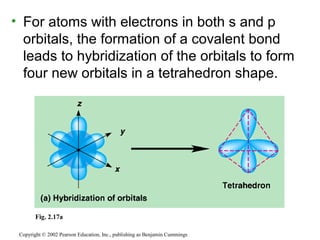
• For atoms with electrons in both s and p
orbitals, the formation of a covalent bond
leads to hybridization of the orbitals to form
four new orbitals in a tetrahedron shape.
Copyright © 2002 Pearson Education, Inc., publishing as Benjamin Cummings
Fig. 2.17a
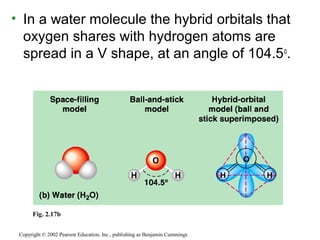
• In a water molecule the hybrid orbitals that
oxygen shares with hydrogen atoms are
spread in a V shape, at an angle of 104.5o
.
Copyright © 2002 Pearson Education, Inc., publishing as Benjamin Cummings
Fig. 2.17b
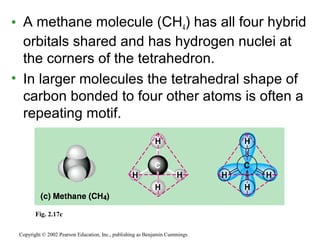
• A methane molecule (CH4) has all four hybrid
orbitals shared and has hydrogen nuclei at
the corners of the tetrahedron.
• In larger molecules the tetrahedral shape of
carbon bonded to four other atoms is often a
repeating motif.
Copyright © 2002 Pearson Education, Inc., publishing as Benjamin Cummings
Fig. 2.17c
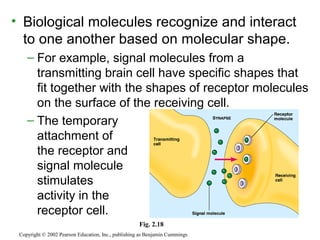
• Biological molecules recognize and interact
to one another based on molecular shape.
– For example, signal molecules from a
transmitting brain cell have specific shapes that
fit together with the shapes of receptor molecules
on the surface of the receiving cell.
– The temporary
attachment of
the receptor and
signal molecule
stimulates
activity in the
receptor cell.
Copyright © 2002 Pearson Education, Inc., publishing as Benjamin Cummings
Fig. 2.18
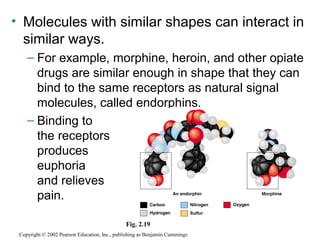
• Molecules with similar shapes can interact in
similar ways.
– For example, morphine, heroin, and other opiate
drugs are similar enough in shape that they can
bind to the same receptors as natural signal
molecules, called endorphins.
– Binding to
the receptors
produces
euphoria
and relieves
pain.
Copyright © 2002 Pearson Education, Inc., publishing as Benjamin Cummings
Fig. 2.19
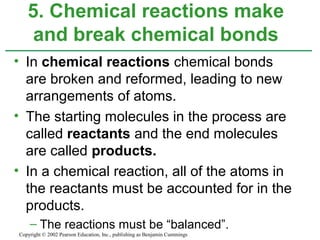
• In chemical reactions chemical bonds
are broken and reformed, leading to new
arrangements of atoms.
• The starting molecules in the process are
called reactants and the end molecules
are called products.
• In a chemical reaction, all of the atoms in
the reactants must be accounted for in the
products.
– The reactions must be “balanced”.
5. Chemical reactions make
and break chemical bonds
Copyright © 2002 Pearson Education, Inc., publishing as Benjamin Cummings
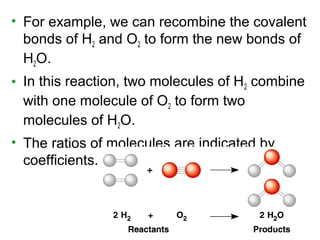
• For example, we can recombine the covalent
bonds of H2 and O2 to form the new bonds of
H2O.
• In this reaction, two molecules of H2 combine
with one molecule of O2 to form two
molecules of H2O.
• The ratios of molecules are indicated by
coefficients.
• Photosynthesis is an important chemical reaction.
• Green plants combine carbon dioxide (CO2) from
the air and water (H2O) from the soil to create sugar
molecules and molecular oxygen (O2), a byproduct.
• This chemical reaction is powered by sunlight.
• Humans and other animals depend on
photosynthesis for food and oxygen.
• The overall process of photosynthesis is
– 6CO2 + 6H2O -> C6H12O6 + 6H2O
• This process occurs in a sequence of individual
chemical reactions.
Copyright © 2002 Pearson Education, Inc., publishing as Benjamin Cummings
• Some chemical reactions go to completion; that is,
all the reactants are converted to products.
• Most chemical reactions are reversible, the
products in the forward reaction becoming the
reactants for the reverse reaction.
• For example in this reaction: 3H2 + N2 <=> 2NH3
hydrogen and nitrogen molecules combine to form
ammonia, but ammonia can decompose to
hydrogen and nitrogen molecules.
– Initially, when reactant concentrations are high, they
frequently collide to create products.
– As products accumulate, they collide to reform reactants.
Copyright © 2002 Pearson Education, Inc., publishing as Benjamin Cummings
• Eventually, the rate of formation of products
is the same as the rate of breakdown of
products (formation of reactants) and the
system is at chemical equilibrium.
– At equilibrium, products and reactants are
continually being formed, but there is no net
change in the concentrations of reactants and
products.
– At equilibrium, the concentrations of reactants
and products are typically not equal, but their
concentrations have stabilized.
Copyright © 2002 Pearson Education, Inc., publishing as Benjamin Cummings
•THE END
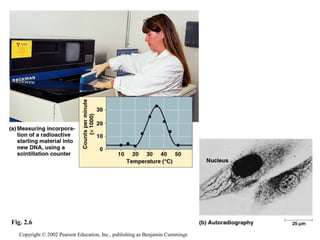
• Radioactive isotopes have many
applications in biological research.
– Radioactive decay rates can be used to date
fossils.
– Radioactive isotopes can be used to trace
atoms in metabolism.
Copyright © 2002 Pearson Education, Inc., publishing as Benjamin Cummings
Fig. 2.6
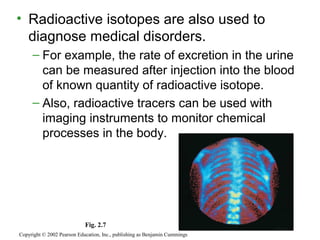
• Radioactive isotopes are also used to
diagnose medical disorders.
– For example, the rate of excretion in the urine
can be measured after injection into the blood
of known quantity of radioactive isotope.
– Also, radioactive tracers can be used with
imaging instruments to monitor chemical
processes in the body.
Copyright © 2002 Pearson Education, Inc., publishing as Benjamin Cummings
Fig. 2.7
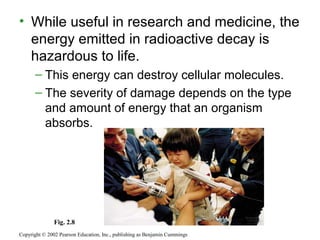
• While useful in research and medicine, the
energy emitted in radioactive decay is
hazardous to life.
– This energy can destroy cellular molecules.
– The severity of damage depends on the type
and amount of energy that an organism
absorbs.
Copyright © 2002 Pearson Education, Inc., publishing as Benjamin Cummings
Fig. 2.8

Chapter2 chemistry

  • 1.
  • 2.
    • About 25of the 92 natural elements are known to be essential for life. – Four elements - carbon (C), oxygen (O), hydrogen (H), and nitrogen (N) - make up 96% of living matter. – Most of the remaining 4% of an organism’s weight consists of phosphorus (P), sulfur (S), calcium (Ca), and potassium (K). 2. Life requires about 25 chemical elements Copyright © 2002 Pearson Education, Inc., publishing as Benjamin Cummings
  • 3.
    Copyright © 2002Pearson Education, Inc., publishing as Benjamin Cummings
  • 4.
    • Each elementconsists of unique atoms. • An atom is the smallest unit of matter that still retains the properties of an element. – Atoms are composed of even smaller parts, called subatomic particles. – Two of these, neutrons and protons, are packed together to form a dense core, the atomic nucleus, at the center of an atom. – Electrons form a cloud around the nucleus. 1. Atomic structure determines the behavior of an element Copyright © 2002 Pearson Education, Inc., publishing as Benjamin Cummings
  • 5.
    • Each electronhas one unit of negative charge. • Each proton has one unit of positive charge. • Neutrons are electrically neutral. • The attractions between the positive charges in the nucleus and the negative charges of the electrons keep the electrons in the vicinity of the nucleus. Copyright © 2002 Pearson Education, Inc., publishing as Benjamin Cummings Fig. 2.5
  • 6.
    • A neutronand a proton are almost identical in mass, about 1.7 x 10⁻²⁴ gram per particle. • For convenience, an alternative unit of measure, the dalton, is used to measure the mass subatomic particles, atoms or molecules. – The mass of a neutron or a proton is close to 1 dalton. • The mass of an electron is about 1/2000th that of a neutron or proton. – Therefore, we typically ignore the contribution of electrons when determining the total mass of an atom. Copyright © 2002 Pearson Education, Inc., publishing as Benjamin Cummings
  • 7.
    • All atomsof a particular element have the same number of protons in their nuclei. – Each element has a unique number of protons, its unique atomic number. – The atomic number is written as a subscript before the symbol for the element (for example, 2He). • Unless otherwise indicated, atoms have equal numbers of protons and electrons - no net charge. – Therefore, the atomic number tells us the number of protons and the number of electrons that are found in a neutral atom of a specific element. Copyright © 2002 Pearson Education, Inc., publishing as Benjamin Cummings
  • 8.
    • The massnumber is the sum of the number of protons and neutrons in the nucleus of an atom. – Therefore, we can determine the number of neutrons in an atom by subtracting the number of protons (the atomic number) from the mass number. – The mass number is written as a superscript before an element’s symbol (for example, 4 He). • The atomic weight of an atom, a measure of its mass, can be approximated by the mass number. – For example, 4 He has a mass number of 4 and an estimated atomic weight of 4 daltons. – More precisely, its atomic weight is 4.003 daltons. Copyright © 2002 Pearson Education, Inc., publishing as Benjamin Cummings
  • 9.
    • While allatoms of a given element have the same number of protons, they may differ in the number of neutrons. • Two atoms of the same element that differ in the number of neutrons are called isotopes. • In nature, an element occurs as a mixture of isotopes. – For example, 99% of carbon atoms have 6 neutrons (12 C). – Most of the remaining 1% of carbon atoms have 7 neutrons (13 C) while the rarest isotope, with 8 neutrons is 14 C.
  • 10.
    • Most isotopesare stable; they do not tend to loose particles. – Both 12 C and 13 C are stable isotopes. • The nuclei of some isotopes are unstable and decay spontaneously, emitting particles and energy. – 14 C is a one of these unstable or radioactive isotopes. – In its decay, an neutron is converted to a proton and electron. – This converts 14 C to 14 N, changing the identity of that atom. Copyright © 2002 Pearson Education, Inc., publishing as Benjamin Cummings
  • 11.
    • To gainan accurate perspective of the relative proportions of an atom, if the nucleus was the size of a golf ball, the electrons would be moving about 1 kilometer from the nucleus. – Atoms are mostly empty space. • When two elements interact during a chemical reaction, it is actually their electrons that are actually involved. – The nuclei do not come close enough to interact. Copyright © 2002 Pearson Education, Inc., publishing as Benjamin Cummings
  • 12.
    • The electronsof an atom may vary in the amount of energy that they possess. • Energy is the ability to do work. • Potential energy is the energy that matter stores because of its position or location. – Water stored behind a dam has potential energy that can be used to do work turning electric generators. – Because potential energy has been expended, the water stores less energy at the bottom of the dam than it did in the reservoir. Copyright © 2002 Pearson Education, Inc., publishing as Benjamin Cummings
  • 13.
    • Electrons havepotential energy because of their position relative to the nucleus. – The negatively charged electrons are attracted to the positively charged nucleus. – The farther electrons are from the nucleus, the more potential energy they have. • However, electrons cannot occupy just any location away from the nucleus. • Changes in potential energy can only occur in steps of a fixed amount, moving the electron to a fixed location. – An electron cannot exist between these fixed locations.
  • 14.
    • The differentstates of potential energy that the electrons of an atoms can have are called energy levels or electron shells. – The first shell, closest to the nucleus, has the lowest potential energy. – Electrons in outer shells have more potential energy. – Electrons can only change their position if they absorb or release a quantity of energy that matches the difference in potential energy between the two levels. Copyright © 2002 Pearson Education, Inc., publishing as Benjamin Cummings
  • 15.
    Copyright © 2002Pearson Education, Inc., publishing as Benjamin Cummings Fig. 2.9
  • 16.
    • The chemicalbehavior of an atom is determined by its electron configuration - the distribution of electrons in its electron shells. – The first 18 elements, including those most important in biological processes, can be arranged in 8 columns and 3 rows. • Elements in the same row use the same shells. • Moving from left to right, each element has a sequential addition of electrons (and protons). Copyright © 2002 Pearson Education, Inc., publishing as Benjamin Cummings
  • 17.
    Copyright © 2002Pearson Education, Inc., publishing as Benjamin Cummings Fig. 2.10
  • 18.
    • The firstelectron shell can hold only 2 electrons. – The two electrons of Helium fill the first shell. • Atoms with more than two electrons must place the extra electrons in higher shells. – For example, Lithium with three electrons has two in the first shell and one in the second shell. • The second shell can hold up to 8 electrons. – Neon, with 10 total electrons, has two in the first shell and eight in the second, filling both shells.
  • 19.
    • The chemicalbehavior of an atom depends mostly on the number of electrons in its outermost shell, the valence shell. – Electrons in the valence shell are known as valence electrons. • Atoms with the same number of valence electrons have similar chemical behavior. • An atom with a completed valence shell is unreactive. • All other atoms are chemically reactive because they have incomplete valence shells. Copyright © 2002 Pearson Education, Inc., publishing as Benjamin Cummings
  • 20.
    • While thepaths of electrons are often visualized as concentric paths, like planets orbiting the sun. • In reality, an electron occupies a more complex three-dimensional space, an orbital. – The first shell has room for a single spherical orbital for its pair of electrons. – The second shell can pack pairs of electrons into a spherical orbital and three p orbitals (dumbbell-shaped). Copyright © 2002 Pearson Education, Inc., publishing as Benjamin Cummings
  • 21.
    Copyright © 2002Pearson Education, Inc., publishing as Benjamin Cummings Fig. 2.11
  • 22.
    • The reactivityof atoms arises from the presence of unpaired electrons in one or more orbitals of their valence shells. – Electrons preferentially occupy separate orbitals within the valence shell until forced to share orbitals. • The four valence electrons of carbon each occupy separate orbitals, but the five valence electrons of nitrogen are distributed into three unshared orbitals and one shared orbital. – When atoms interact to complete their valence shells, it is the unpaired electrons that are involved. Copyright © 2002 Pearson Education, Inc., publishing as Benjamin Cummings
  • 23.
    • Atoms withincomplete valence shells interact by either sharing or transferring valence electrons. • These interactions typically result in the atoms remaining close together, held by an attractions called chemical bonds. – The strongest chemical bonds are covalent bonds and ionic bonds. 2. Atoms combine by chemical bonding to form molecules Copyright © 2002 Pearson Education, Inc., publishing as Benjamin Cummings
  • 24.
    • A covalentbond is the sharing of a pair of valence electrons by two atoms. – If two atoms come close enough that their unshared orbitals overlap, each atom can count both electrons toward its goal of filling the valence shell. – For example, if two hydrogen atoms come close enough that their 1s orbitals overlap, then they can share the single electrons that each contributes. Copyright © 2002 Pearson Education, Inc., publishing as Benjamin Cummings Fig. 2.12a
  • 25.
    • Two ormore atoms held together by covalent bonds constitute a molecule. • We can abbreviate the structure of this molecule by substituting a line for each pair of shared electrons, drawing the structural formula. – H-H is the structural formula for the covalent bond between two hydrogen atoms. • The molecular formula indicates the number and types of atoms present in a single molecule. – H2 is the molecular formula for hydrogen gas. Copyright © 2002 Pearson Education, Inc., publishing as Benjamin Cummings
  • 26.
    • Oxygen needsto add 2 electrons to the 6 already present to complete its valence shell. – Two oxygen atoms can form a molecule by sharing two pairs of valence electrons. – These atoms have formed a double covalent bond. Copyright © 2002 Pearson Education, Inc., publishing as Benjamin Cummings Fig. 2.12b
  • 27.
    • Every atomhas a characteristic total number of covalent bonds that it can form - an atom’s valence. – The valence of hydrogen is 1. – Oxygen is 2. – Nitrogen is 3. – Carbon is 4. – Phosphorus should have a valence of 3, based on its three unpaired electrons, but in biological molecules it generally has a valence of 5, forming three single covalent bonds and one double bond. Copyright © 2002 Pearson Education, Inc., publishing as Benjamin Cummings
  • 28.
    • Covalent bondscan form between atoms of the same element or atoms of different elements. – While both types are molecules, the latter are also compounds. – Water, H2O, is a compound in which two hydrogen atoms form single covalent bonds with an oxygen atom. • This satisfies the valences of both elements. Copyright © 2002 Pearson Education, Inc., publishing as Benjamin Cummings Fig. 2.12c
  • 29.
    Copyright © 2002Pearson Education, Inc., publishing as Benjamin Cummings Fig. 2.12d – Methane, CH4, satisfies the valences of both C and H.
  • 30.
    • The attractionof an atom for the electrons of a covalent bond is called its electronegativity. – Strongly electronegative atoms attempt to pull the shared electrons toward themselves. • If electrons in a covalent bond are shared equally, then this is a nonpolar covalent bond. – A covalent bond between two atoms of the same element is always nonpolar. – A covalent bond between atoms that have similar electronegativities is also nonpolar. • Because carbon and hydrogen do not differ greatly in electronegativities, the bonds of CH4 are nonpolar. Copyright © 2002 Pearson Education, Inc., publishing as Benjamin Cummings
  • 31.
    • If theelectrons in a covalent bond are not shared equally by the two atoms, then this is a polar covalent bond. – The bonds between oxygen and hydrogen in water are polar covalent because oxygen has a much higher electronegativity than does hydrogen. – Compounds with a polar covalent bond have regions that have a partial negative charge near the strongly electronegative atom and a partial positive charge near the weakly electronegative atom. Copyright © 2002 Pearson Education, Inc., publishing as Benjamin Cummings Fig. 2.13
  • 32.
    • An ionicbond can form if two atoms are so unequal in their attraction for valence electrons that one atom strips an electron completely from the other. – For example, sodium with one valence electron in its third shell transfers this electron to chlorine with 7 valence electrons in its third shell. – Now, sodium has a full valence shell (the second) and chlorine has a full valence shell (the third). Fig. 2.14
  • 33.
    • After thetransfer, both atoms are no longer neutral, but have charges and are called ions. • Sodium has one more proton than electrons and has a net positive charge. – Atoms with positive charges are cations. • Chlorine has one more electron than protons and has a net negative charge. – Atoms with negative charges are anions. Copyright © 2002 Pearson Education, Inc., publishing as Benjamin Cummings Fig. 2.14
  • 34.
    • Because ofdifferences in charge, cations and anions are attracted to each other to form an ionic bond. – Atoms in an ionic bonds need not have acquired their charge by electrons transferred with each other. Copyright © 2002 Pearson Education, Inc., publishing as Benjamin Cummings
  • 35.
    • Compounds formedby ionic bonds are ionic compounds or salts, like NaCl or table salt. • The formula for an ionic compound indicates the ratio of elements in a crystal of that salt. – Atoms in a crystal do not form molecules with a definitive size and number of atoms as in covalent bonds. Copyright © 2002 Pearson Education, Inc., publishing as Benjamin Cummings
  • 36.
    • Ionic compoundscan have ratios of elements different from 1:1. – For example, the ionic compound magnesium chloride (MgCl2) has 2 chloride atoms per magnesium atom. • Magnesium needs to loose 2 electrons to drop to a full outer shell, each chlorine needs to gain 1. • Entire molecules that have full electrical charges are also called ions. – In the salt ammonium chloride (NH4Cl), the anion is Cl- and the cation is NH4 + . • The strength of ionic bonds depends on environmental conditions.Copyright © 2002 Pearson Education, Inc., publishing as Benjamin Cummings
  • 37.
    • Within acell, weak, brief bonds between molecules are important to a variety of processes. – For example, signal molecules from one neuron use weak bonds to bind briefly to receptor molecules on the surface of a receiving neuron. – This triggers a momentary response by the recipient. • Weak interactions include ionic bonds (weak in water), hydrogen bonds, and van der Waals interactions. 3. Weak chemical bonds play important roles in the chemistry of life Copyright © 2002 Pearson Education, Inc., publishing as Benjamin Cummings
  • 38.
    • Hydrogen bondsform when a hydrogen atom that is already covalently bonded to a strongly electronegative atom is attracted to another strongly electronegative atom. – These strongly electronegative atoms are typically nitrogen or oxygen. – Typically, these bonds result because the polar covalent bond with hydrogen leaves the hydrogen atom with a partial positive charge and the other atom with a partial negative charge. – The partially positive charged hydrogen atom is attracted to negatively charged (partial or full) molecules, atoms, or even regions of the same large molecule.
  • 39.
    • For example,ammonia molecules and water molecules link together with weak hydrogen bonds. – In the ammonia molecule, the hydrogen atoms have partial positive charges and the more electronegative nitrogen atom has a partial positive charge. – In the water molecule, the hydrogen atoms also have partial positive charges and the oxygen atom partial negative charges. – Areas with opposite charges are attracted. Copyright © 2002 Pearson Education, Inc., publishing as Benjamin Cummings Fig. 2.16
  • 40.
    • Even moleculeswith nonpolar covalent bonds can have partially negative and positive regions. – Because electrons are constantly in motion, there can be periods when they accumulate by chance in one area of a molecule. – This created ever-changing regions of negative and positive charge within a molecule. • Molecules or atoms in close proximity can be attracted by these fleeting charge differences, creating van der Waals interactions. • While individual bonds (ionic, hydrogen, van der Waals) are weak, collectively they have strength. Copyright © 2002 Pearson Education, Inc., publishing as Benjamin Cummings
  • 41.
    • The three-dimensionalshape of a molecule is an important determinant of its function in a cell. • The shape of a molecule is determined by the arrangement of electron orbitals that are shared by the atoms involved in the bond. – When covalent bonds form, the orbitals in the valence shell rearrange. – A molecule with two atoms is always linear. – However, a molecule with more than two atoms has a more complex shape. 4. A molecule’s biological function is related to its shape Copyright © 2002 Pearson Education, Inc., publishing as Benjamin Cummings
  • 42.
    • For atomswith electrons in both s and p orbitals, the formation of a covalent bond leads to hybridization of the orbitals to form four new orbitals in a tetrahedron shape. Copyright © 2002 Pearson Education, Inc., publishing as Benjamin Cummings Fig. 2.17a
  • 43.
    • In awater molecule the hybrid orbitals that oxygen shares with hydrogen atoms are spread in a V shape, at an angle of 104.5o . Copyright © 2002 Pearson Education, Inc., publishing as Benjamin Cummings Fig. 2.17b
  • 44.
    • A methanemolecule (CH4) has all four hybrid orbitals shared and has hydrogen nuclei at the corners of the tetrahedron. • In larger molecules the tetrahedral shape of carbon bonded to four other atoms is often a repeating motif. Copyright © 2002 Pearson Education, Inc., publishing as Benjamin Cummings Fig. 2.17c
  • 45.
    • Biological moleculesrecognize and interact to one another based on molecular shape. – For example, signal molecules from a transmitting brain cell have specific shapes that fit together with the shapes of receptor molecules on the surface of the receiving cell. – The temporary attachment of the receptor and signal molecule stimulates activity in the receptor cell. Copyright © 2002 Pearson Education, Inc., publishing as Benjamin Cummings Fig. 2.18
  • 46.
    • Molecules withsimilar shapes can interact in similar ways. – For example, morphine, heroin, and other opiate drugs are similar enough in shape that they can bind to the same receptors as natural signal molecules, called endorphins. – Binding to the receptors produces euphoria and relieves pain. Copyright © 2002 Pearson Education, Inc., publishing as Benjamin Cummings Fig. 2.19
  • 47.
    • In chemicalreactions chemical bonds are broken and reformed, leading to new arrangements of atoms. • The starting molecules in the process are called reactants and the end molecules are called products. • In a chemical reaction, all of the atoms in the reactants must be accounted for in the products. – The reactions must be “balanced”. 5. Chemical reactions make and break chemical bonds Copyright © 2002 Pearson Education, Inc., publishing as Benjamin Cummings
  • 48.
    • For example,we can recombine the covalent bonds of H2 and O2 to form the new bonds of H2O. • In this reaction, two molecules of H2 combine with one molecule of O2 to form two molecules of H2O. • The ratios of molecules are indicated by coefficients.
  • 49.
    • Photosynthesis isan important chemical reaction. • Green plants combine carbon dioxide (CO2) from the air and water (H2O) from the soil to create sugar molecules and molecular oxygen (O2), a byproduct. • This chemical reaction is powered by sunlight. • Humans and other animals depend on photosynthesis for food and oxygen. • The overall process of photosynthesis is – 6CO2 + 6H2O -> C6H12O6 + 6H2O • This process occurs in a sequence of individual chemical reactions. Copyright © 2002 Pearson Education, Inc., publishing as Benjamin Cummings
  • 50.
    • Some chemicalreactions go to completion; that is, all the reactants are converted to products. • Most chemical reactions are reversible, the products in the forward reaction becoming the reactants for the reverse reaction. • For example in this reaction: 3H2 + N2 <=> 2NH3 hydrogen and nitrogen molecules combine to form ammonia, but ammonia can decompose to hydrogen and nitrogen molecules. – Initially, when reactant concentrations are high, they frequently collide to create products. – As products accumulate, they collide to reform reactants. Copyright © 2002 Pearson Education, Inc., publishing as Benjamin Cummings
  • 51.
    • Eventually, therate of formation of products is the same as the rate of breakdown of products (formation of reactants) and the system is at chemical equilibrium. – At equilibrium, products and reactants are continually being formed, but there is no net change in the concentrations of reactants and products. – At equilibrium, the concentrations of reactants and products are typically not equal, but their concentrations have stabilized. Copyright © 2002 Pearson Education, Inc., publishing as Benjamin Cummings
  • 52.
  • 53.
    • Radioactive isotopeshave many applications in biological research. – Radioactive decay rates can be used to date fossils. – Radioactive isotopes can be used to trace atoms in metabolism. Copyright © 2002 Pearson Education, Inc., publishing as Benjamin Cummings
  • 54.
    Copyright © 2002Pearson Education, Inc., publishing as Benjamin Cummings Fig. 2.6
  • 55.
    • Radioactive isotopesare also used to diagnose medical disorders. – For example, the rate of excretion in the urine can be measured after injection into the blood of known quantity of radioactive isotope. – Also, radioactive tracers can be used with imaging instruments to monitor chemical processes in the body. Copyright © 2002 Pearson Education, Inc., publishing as Benjamin Cummings Fig. 2.7
  • 56.
    • While usefulin research and medicine, the energy emitted in radioactive decay is hazardous to life. – This energy can destroy cellular molecules. – The severity of damage depends on the type and amount of energy that an organism absorbs. Copyright © 2002 Pearson Education, Inc., publishing as Benjamin Cummings Fig. 2.8