PART II         CONCEPTS AND PROBLEMS
                  IN MACROECONOMICS


                                           Introduction to
                                         Macroeconomics
                                                                                                            5


© 2009 Pearson Education, Inc. Publishing as Prentice Hall   Principles of Macroeconomics 9e by Case, Fair and Oster
PART II    CONCEPTS AND PROBLEMS
                                 IN MACROECONOMICS


                                              Introduction to
                                            Macroeconomics
                                                                                                            5
                                                                                      CHAPTER OUTLINE
                                                                                      Macroeconomic Concerns
                                                                                      Output Growth
                                                                                      Unemployment
                                                                                      Inflation and Deflation

                                                                                      The Components of the Macroeconomy
                                                                                      The Circular Flow Diagram
                                                                                      The Three Market Arenas
                                                                                      The Role of the Government in the
                                                                                       Macroeconomy

                                                                                      A Brief History of Macroeconomics

                                                                                      The U.S. Economy Since 1970
cA HCt not c udo t n
 a Mo i         r I


© 2009 Pearson Education, Inc. Publishing as Prentice Hall   Principles of Macroeconomics 9e by Case, Fair and Oster   2 of 24
Introduction to Macroeconomics


                                    microeconomics Examines the functioning of
                                    individual industries and the behavior of individual
                                    decision-making units—firms and households.

                                    macroeconomics Deals with the economy as a
                                    whole. Macroeconomics focuses on the
                                    determinants of total national income, deals with
                                    aggregates such as aggregate consumption and
                                    investment, and looks at the overall level of prices
                                    instead of individual prices.

                                    aggregate behavior The behavior of all
                                    households and firms together.

                                    sticky prices Prices that do not always adjust
cA HCt not c udo t n
                r I


                                    rapidly to maintain equality between quantity
                                    supplied and quantity demanded.
 a Mo i


© 2009 Pearson Education, Inc. Publishing as Prentice Hall   Principles of Macroeconomics 9e by Case, Fair and Oster   3 of 24
Macroeconomic Concerns


                                  Three of the major concerns of macroeconomics
                                  are

                                        Output growth

                                        Unemployment

                                        Inflation and deflation
cA HCt not c udo t n
 a Mo i         r I


© 2009 Pearson Education, Inc. Publishing as Prentice Hall   Principles of Macroeconomics 9e by Case, Fair and Oster   4 of 24
Macroeconomic Concerns
                           Output Growth


                                   business cycle The cycle of short-term ups and
                                   downs in the economy.
                                   aggregate output The total quantity of goods and
                                   services produced in an economy in a given
                                   period.
                                   recession A period during which aggregate
                                   output declines. Conventionally, a period in which
                                   aggregate output declines for two consecutive
                                   quarters.

                                   depression A prolonged and deep recession.
cA HCt not c udo t n
 a Mo i         r I


© 2009 Pearson Education, Inc. Publishing as Prentice Hall   Principles of Macroeconomics 9e by Case, Fair and Oster   5 of 24
Macroeconomic Concerns
                           Output Growth


                                   expansion or boom The period in the business
                                   cycle from a trough up to a peak during which
                                   output and employment grow.

                                   contraction, recession, or slump The period in
                                   the business cycle from a peak down to a trough
                                   during which output and employment fall.
cA HCt not c udo t n
 a Mo i         r I


© 2009 Pearson Education, Inc. Publishing as Prentice Hall   Principles of Macroeconomics 9e by Case, Fair and Oster   6 of 24
Macroeconomic Concerns
                           Output Growth


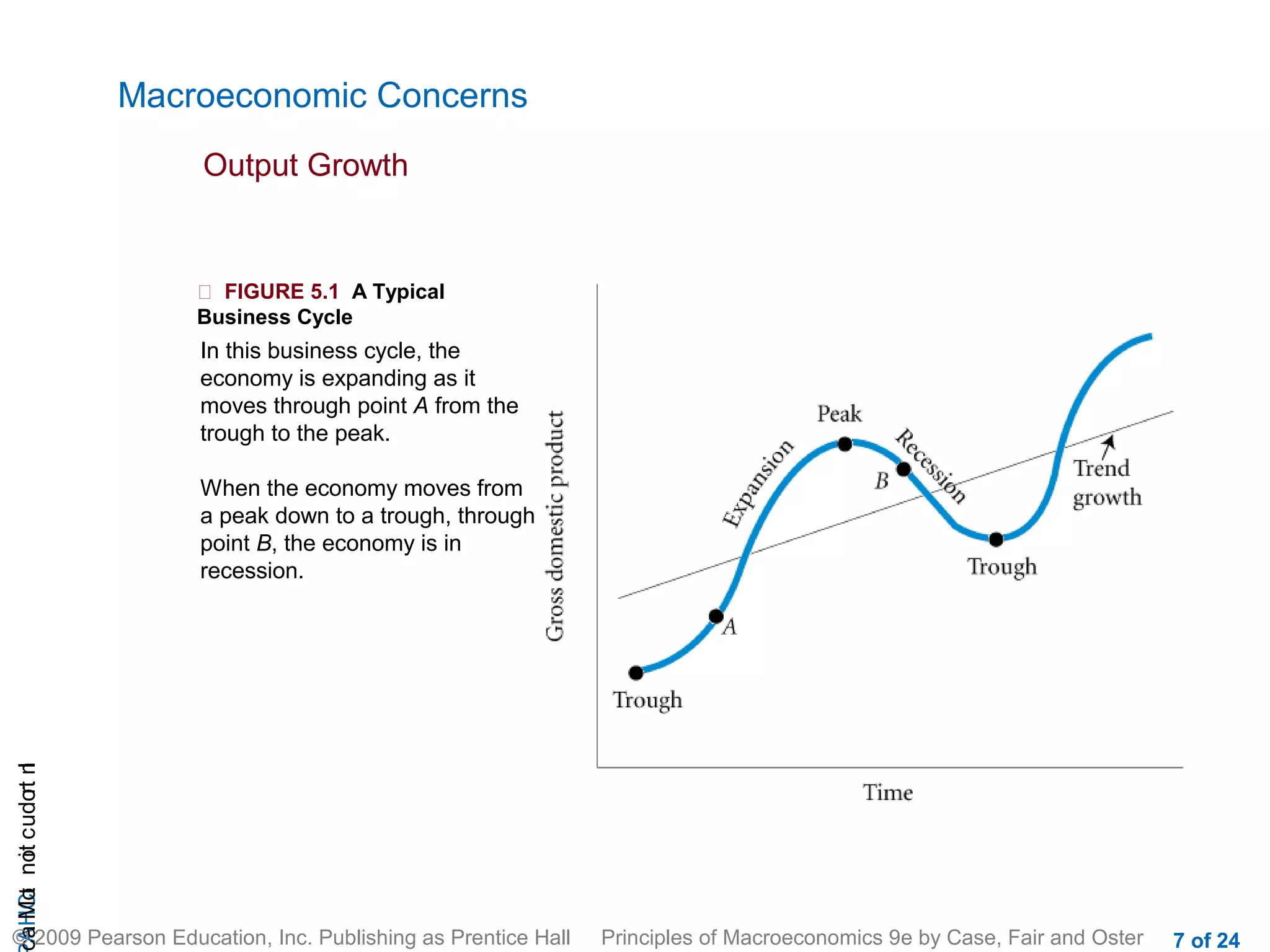
                            FIGURE 5.1 A Typical
                           Business Cycle
                           In this business cycle, the
                           economy is expanding as it
                           moves through point A from the
                           trough to the peak.

                           When the economy moves from
                           a peak down to a trough, through
                           point B, the economy is in
                           recession.
cA HCt not c udo t n
 a Mo i         r I


© 2009 Pearson Education, Inc. Publishing as Prentice Hall    Principles of Macroeconomics 9e by Case, Fair and Oster   7 of 24
Macroeconomic Concerns
                           Output Growth
cA HCt not c udo t n
                r I


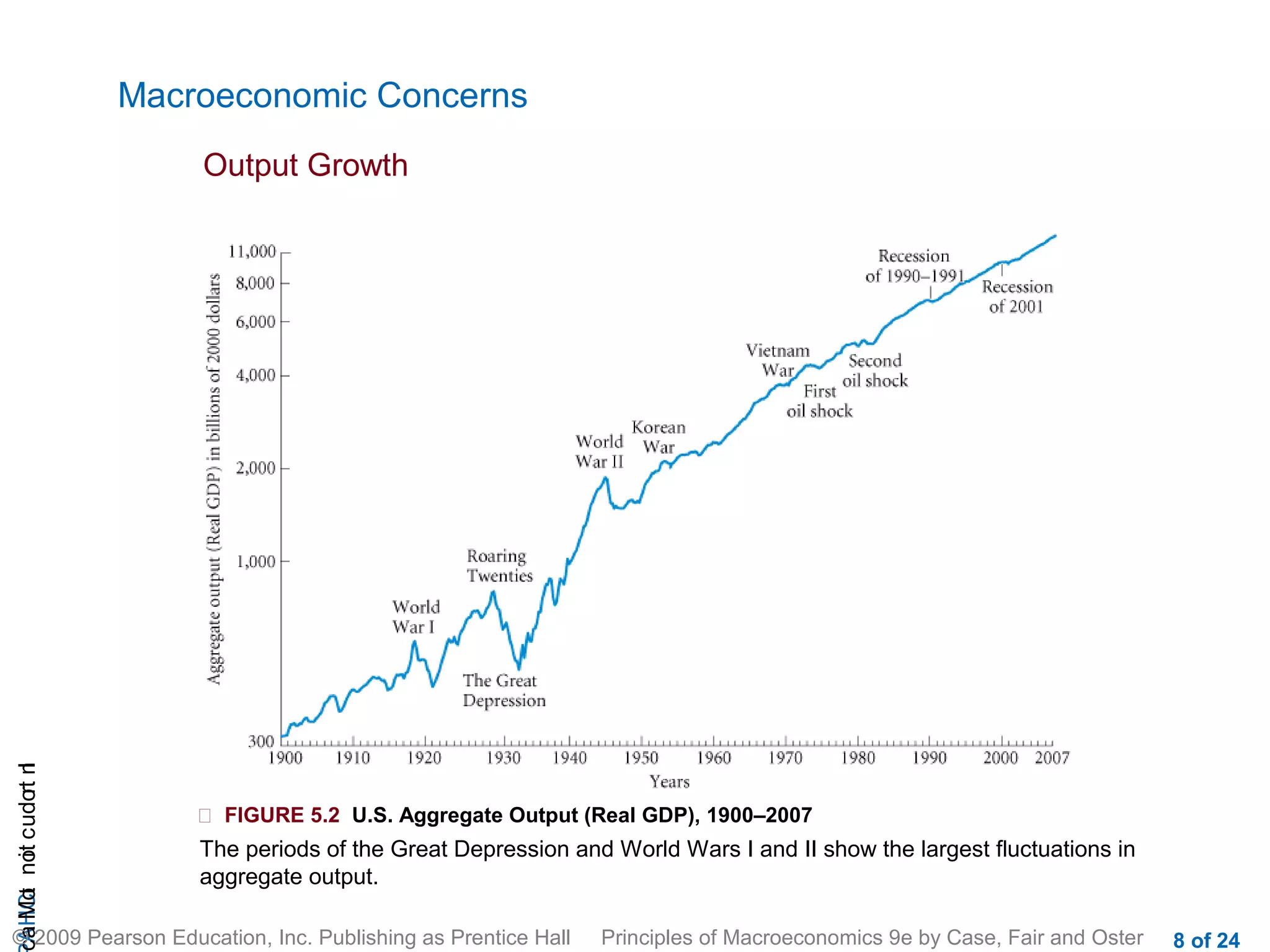
                            FIGURE 5.2 U.S. Aggregate Output (Real GDP), 1900–2007
                           The periods of the Great Depression and World Wars I and II show the largest fluctuations in
 a Mo i


                           aggregate output.

© 2009 Pearson Education, Inc. Publishing as Prentice Hall        Principles of Macroeconomics 9e by Case, Fair and Oster   8 of 24
Macroeconomic Concerns
                           Unemployment


                                     unemployment rate The percentage of the labor
                                     force that is unemployed.


                           Inflation and Deflation


                                     inflation An increase in the overall price level.

                                     hyperinflation A period of very rapid increases in
                                     the overall price level.

                                     deflation A decrease in the overall price level.
cA HCt not c udo t n
 a Mo i         r I


© 2009 Pearson Education, Inc. Publishing as Prentice Hall   Principles of Macroeconomics 9e by Case, Fair and Oster   9 of 24
The Components of the Macroeconomy


                                   Macroeconomics focuses on four groups. To see
                                   the big picture, it is helpful to divide the
                                   participants in the economy into four broad groups:

                                   (1) households,

                                   (2) firms,

                                   (3) the government, and

                                   (4) the rest of the world.
cA HCt not c udo t n
 a Mo i         r I


© 2009 Pearson Education, Inc. Publishing as Prentice Hall   Principles of Macroeconomics 9e by Case, Fair and Oster   10 of 24
The Components of the Macroeconomy
                           The Circular Flow Diagram


                                    circular flow A diagram showing the income
                                    received and payments made by each sector of
                                    the economy.

                                    transfer payments Cash payments made by the
                                    government to people who do not supply goods,
                                    services, or labor in exchange for these payments.
                                    They include Social Security benefits, veterans’
                                    benefits, and welfare payments.
cA HCt not c udo t n
 a Mo i         r I


© 2009 Pearson Education, Inc. Publishing as Prentice Hall   Principles of Macroeconomics 9e by Case, Fair and Oster   11 of 24
The Components of the Macroeconomy
                           The Circular Flow Diagram

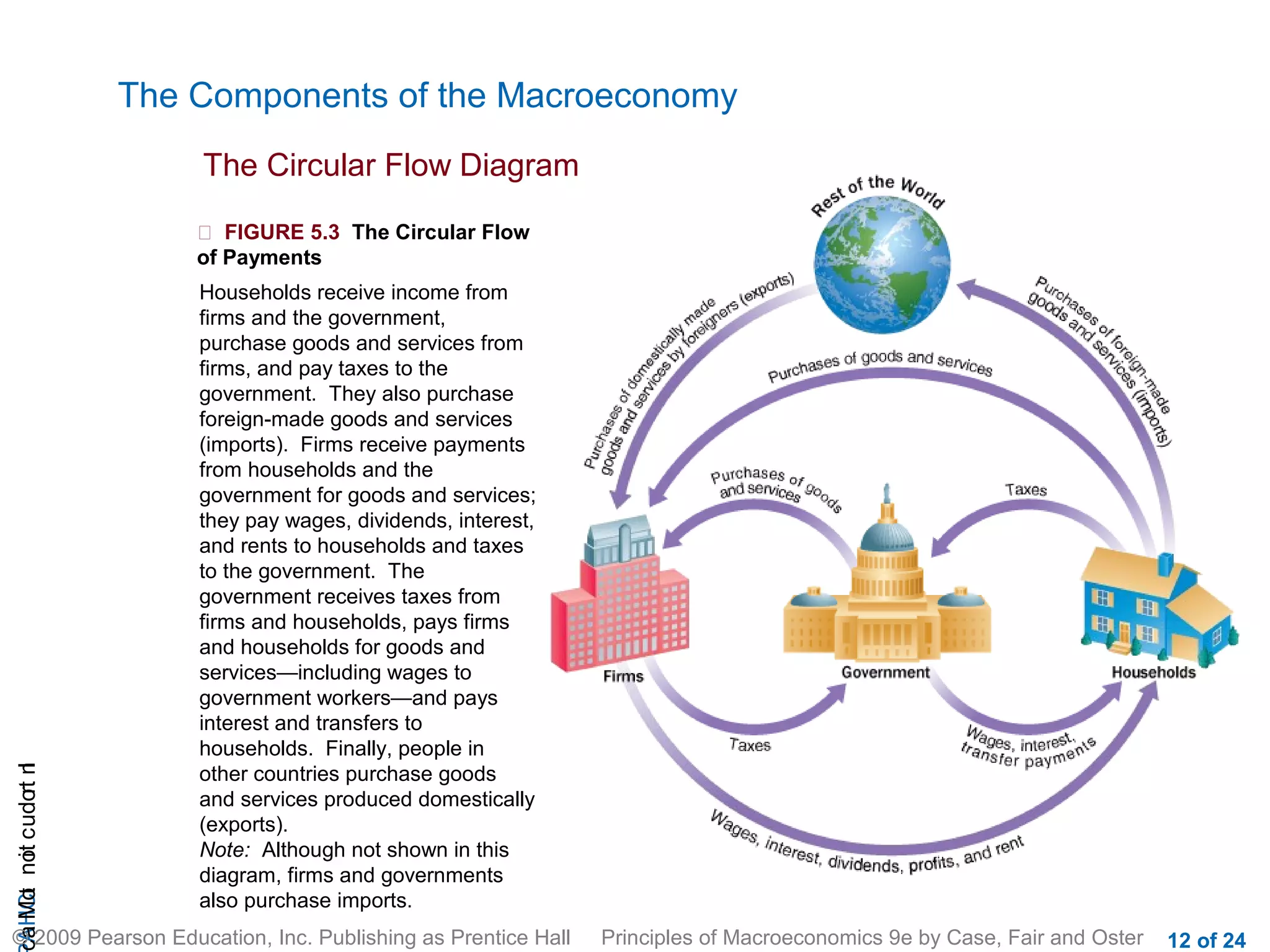
                            FIGURE 5.3 The Circular Flow
                           of Payments
                           Households receive income from
                           firms and the government,
                           purchase goods and services from
                           firms, and pay taxes to the
                           government. They also purchase
                           foreign-made goods and services
                           (imports). Firms receive payments
                           from households and the
                           government for goods and services;
                           they pay wages, dividends, interest,
                           and rents to households and taxes
                           to the government. The
                           government receives taxes from
                           firms and households, pays firms
                           and households for goods and
                           services—including wages to
                           government workers—and pays
                           interest and transfers to
                           households. Finally, people in
                           other countries purchase goods
cA HCt not c udo t n
                r I


                           and services produced domestically
                           (exports).
                           Note: Although not shown in this
 a Mo i


                           diagram, firms and governments
                           also purchase imports.
© 2009 Pearson Education, Inc. Publishing as Prentice Hall        Principles of Macroeconomics 9e by Case, Fair and Oster   12 of 24
The Components of the Macroeconomy
                           The Three Market Arenas


                                   Another way of looking at the ways households,
                                   firms, the government, and the rest of the world
                                   relate to each other is to consider the markets in
                                   which they interact.

                                   We divide the markets into three broad arenas:

                                   (1) the goods-and-services market,

                                   (2) the labor market, and

                                   (3) the money (financial) market.
cA HCt not c udo t n
 a Mo i         r I


© 2009 Pearson Education, Inc. Publishing as Prentice Hall   Principles of Macroeconomics 9e by Case, Fair and Oster   13 of 24
The Components of the Macroeconomy
                           The Three Market Arenas

                           Goods-and-Services Market

                                   Firms supply to the goods-and-services market.
                                   Households, the government, and firms demand
                                   from this market.


                           Labor Market

                                   In this market, households supply labor and firms
                                   and the government demand labor.
cA HCt not c udo t n
 a Mo i         r I


© 2009 Pearson Education, Inc. Publishing as Prentice Hall   Principles of Macroeconomics 9e by Case, Fair and Oster   14 of 24
The Components of the Macroeconomy
                           The Three Market Arenas

                           Money Market

                                   Households supply funds to this market in the
                                   expectation of earning income in the form of
                                   dividends on stocks and interest on bonds.

                                   Firms, the government, and the rest of the world
                                   also engage in borrowing and lending which is
                                   coordinated by financial institutions.
cA HCt not c udo t n
 a Mo i         r I


© 2009 Pearson Education, Inc. Publishing as Prentice Hall   Principles of Macroeconomics 9e by Case, Fair and Oster   15 of 24
The Components of the Macroeconomy
                           The Three Market Arenas

                           Money Market

                                   Treasury bonds, notes, and bills Promissory
                                   notes issued by the federal government when it
                                   borrows money.

                                   corporate bonds Promissory notes issued by
                                   firms when they borrow money.

                                   shares of stock Financial instruments that give to
                                   the holder a share in the firm’s ownership and
                                   therefore the right to share in the firm’s profits.

                                   dividends The portion of a firm’s profits that the
                                   firm pays out each period to its shareholders.
cA HCt not c udo t n
 a Mo i         r I


© 2009 Pearson Education, Inc. Publishing as Prentice Hall   Principles of Macroeconomics 9e by Case, Fair and Oster   16 of 24
The Components of the Macroeconomy
                           The Role of the Government in the Macroeconomy


                                   fiscal policy Government policies concerning
                                   taxes and spending.

                                   monetary policy The tools used by the Federal
                                   Reserve to control the quantity of money, which in
                                   turn affects interest rates.
cA HCt not c udo t n
 a Mo i         r I


© 2009 Pearson Education, Inc. Publishing as Prentice Hall   Principles of Macroeconomics 9e by Case, Fair and Oster   17 of 24
A Brief History of Macroeconomics


                                    Great Depression The period of severe
                                    economic contraction and high unemployment that
                                    began in 1929 and continued throughout the
                                    1930s.

                                    fine-tuning The phrase used by Walter Heller to
                                    refer to the government’s role in regulating inflation
                                    and unemployment.

                                    stagflation A situation of both high inflation and
                                    high unemployment.
cA HCt not c udo t n
 a Mo i         r I


© 2009 Pearson Education, Inc. Publishing as Prentice Hall   Principles of Macroeconomics 9e by Case, Fair and Oster   18 of 24
A Brief History of Macroeconomics


                            Macroeconomics in
                            Literature
                            The underlying phenomena that
                            economists study are the stuff of
                            novels as well as graphs and
                            equations.
                                             The Great Gatsby
cA HCt not c udo t n
                r I


                                         The Grapes of Wrath
 a Mo i


© 2009 Pearson Education, Inc. Publishing as Prentice Hall   Principles of Macroeconomics 9e by Case, Fair and Oster   19 of 24
The U.S Economy Since 1970


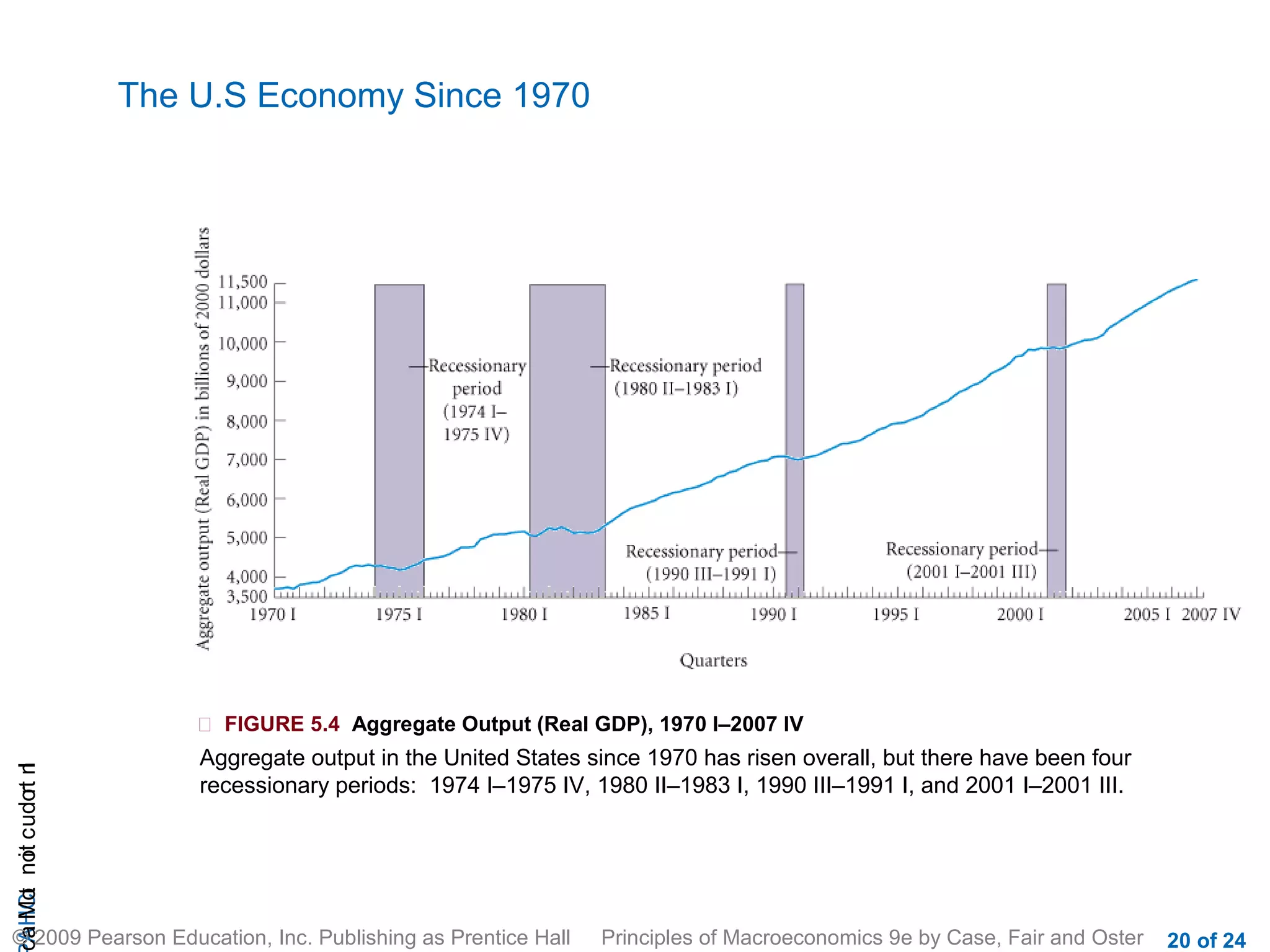
                            FIGURE 5.4 Aggregate Output (Real GDP), 1970 I–2007 IV
                           Aggregate output in the United States since 1970 has risen overall, but there have been four
cA HCt not c udo t n
                r I


                           recessionary periods: 1974 I–1975 IV, 1980 II–1983 I, 1990 III–1991 I, and 2001 I–2001 III.
 a Mo i


© 2009 Pearson Education, Inc. Publishing as Prentice Hall        Principles of Macroeconomics 9e by Case, Fair and Oster   20 of 24
The U.S Economy Since 1970


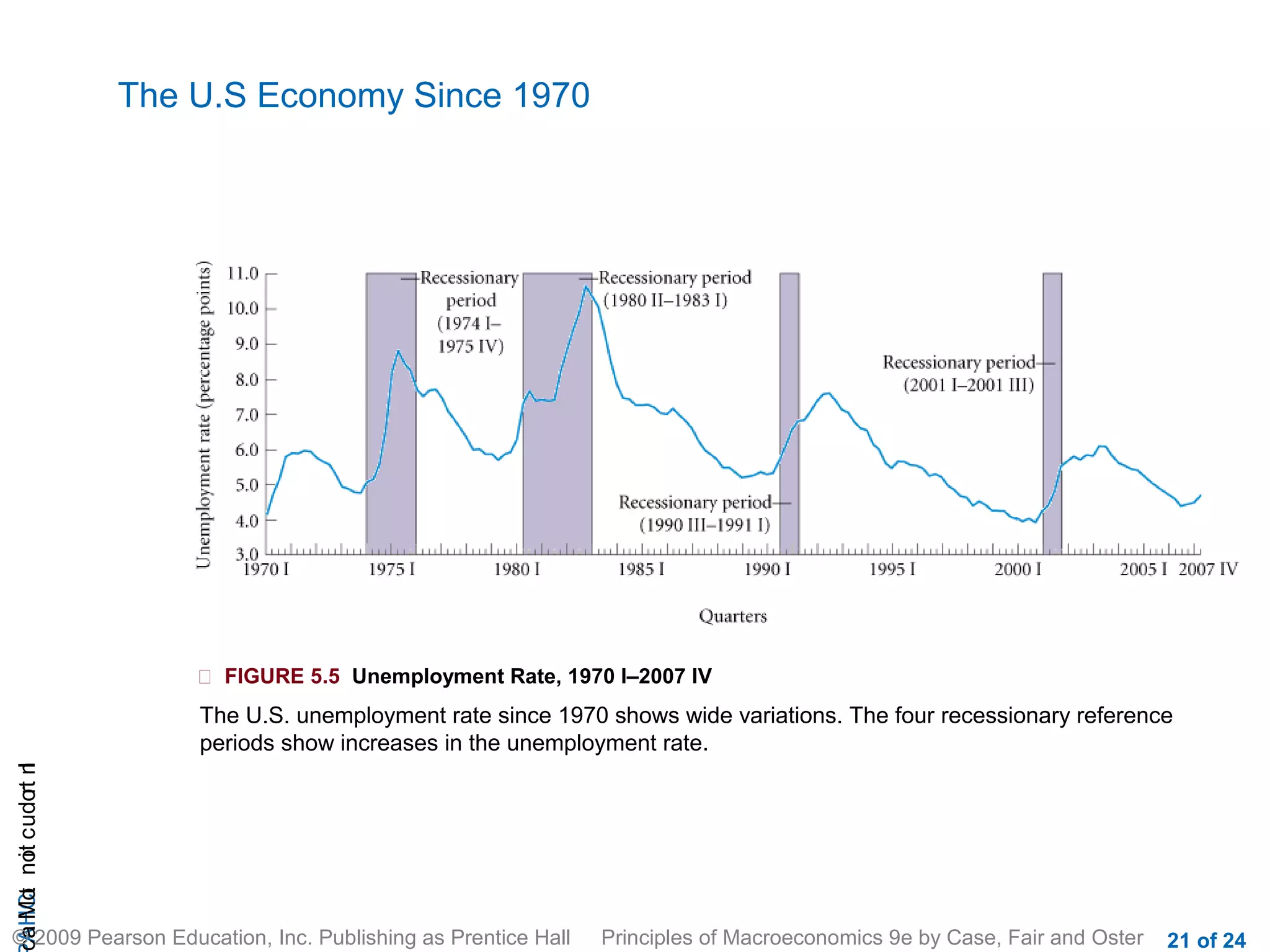
                            FIGURE 5.5 Unemployment Rate, 1970 I–2007 IV
                           The U.S. unemployment rate since 1970 shows wide variations. The four recessionary reference
                           periods show increases in the unemployment rate.
cA HCt not c udo t n
 a Mo i         r I


© 2009 Pearson Education, Inc. Publishing as Prentice Hall      Principles of Macroeconomics 9e by Case, Fair and Oster   21 of 24
The U.S Economy Since 1970


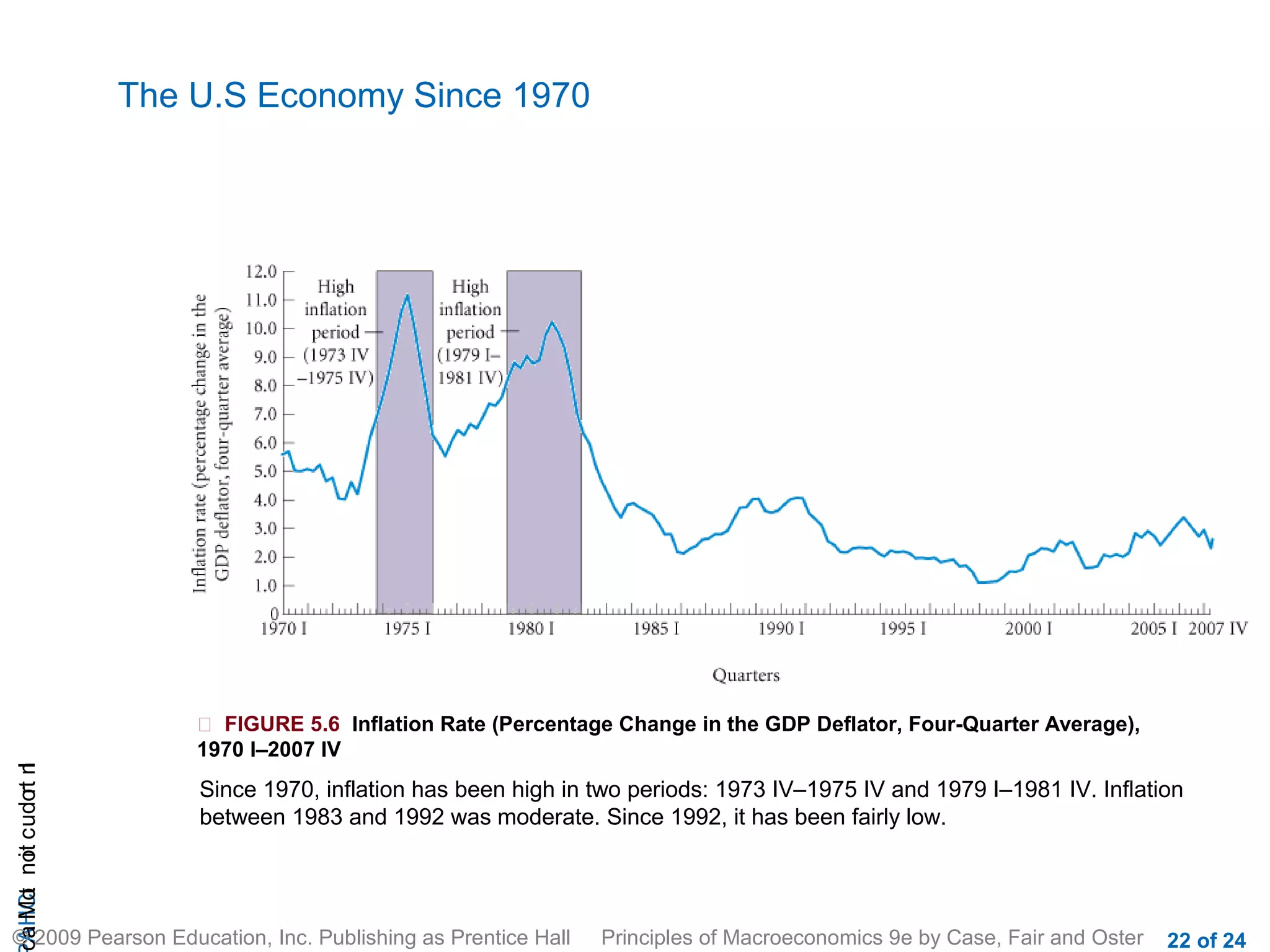
                            FIGURE 5.6 Inflation Rate (Percentage Change in the GDP Deflator, Four-Quarter Average),
                           1970 I–2007 IV
cA HCt not c udo t n
                r I


                           Since 1970, inflation has been high in two periods: 1973 IV–1975 IV and 1979 I–1981 IV. Inflation
                           between 1983 and 1992 was moderate. Since 1992, it has been fairly low.
 a Mo i


© 2009 Pearson Education, Inc. Publishing as Prentice Hall        Principles of Macroeconomics 9e by Case, Fair and Oster   22 of 24
The U.S Economy Since 1970


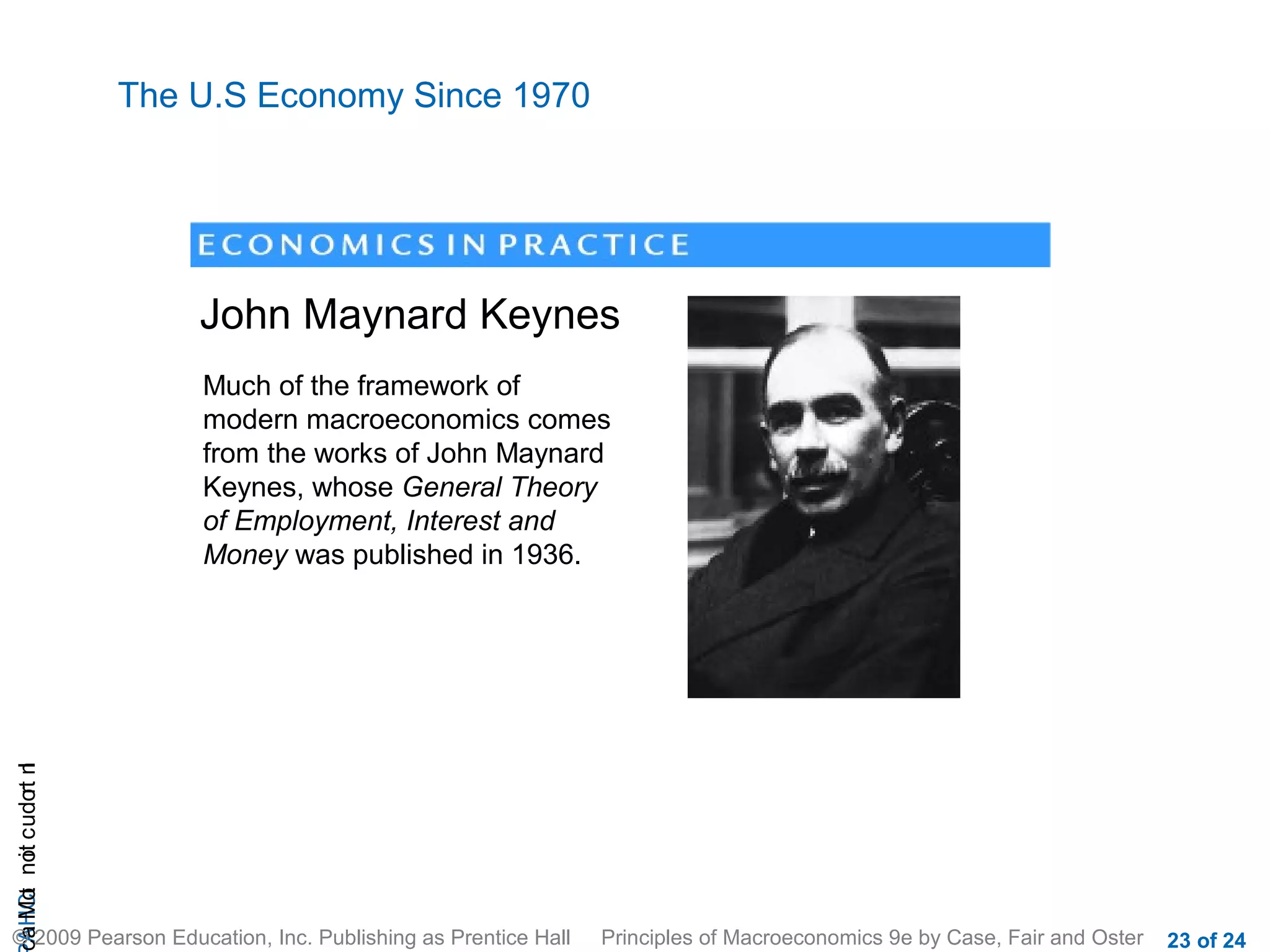
                           John Maynard Keynes
                           Much of the framework of
                           modern macroeconomics comes
                           from the works of John Maynard
                           Keynes, whose General Theory
                           of Employment, Interest and
                           Money was published in 1936.
cA HCt not c udo t n
 a Mo i         r I


© 2009 Pearson Education, Inc. Publishing as Prentice Hall   Principles of Macroeconomics 9e by Case, Fair and Oster   23 of 24
REVIEW TERMS AND CONCEPTS


                       aggregate behavior                                  hyperinflation
                       aggregate output                                    inflation
                       business cycle                                      macroeconomics
                       circular flow                                       microeconomics
                       contraction, recession, or slump                    monetary policy
                       corporate bonds                                     recession
                       deflation                                           shares of stock
                       depression                                          stagflation
                       dividends                                           sticky prices
                       expansion or boom                                   transfer payments
                       fine-tuning                                         Treasury bonds, notes, and
cA HCt not c udo t n
                r I


                                                                             bills
                       fiscal policy
                                                                           unemployment rate
 a Mo i


                       Great Depression
© 2009 Pearson Education, Inc. Publishing as Prentice Hall   Principles of Macroeconomics 9e by Case, Fair and Oster   24 of 24

Topic 1 introduction to macroeconomics

  • 1.
    PART II CONCEPTS AND PROBLEMS IN MACROECONOMICS Introduction to Macroeconomics 5 © 2009 Pearson Education, Inc. Publishing as Prentice Hall Principles of Macroeconomics 9e by Case, Fair and Oster
  • 2.
    PART II CONCEPTS AND PROBLEMS IN MACROECONOMICS Introduction to Macroeconomics 5 CHAPTER OUTLINE Macroeconomic Concerns Output Growth Unemployment Inflation and Deflation The Components of the Macroeconomy The Circular Flow Diagram The Three Market Arenas The Role of the Government in the Macroeconomy A Brief History of Macroeconomics The U.S. Economy Since 1970 cA HCt not c udo t n a Mo i r I © 2009 Pearson Education, Inc. Publishing as Prentice Hall Principles of Macroeconomics 9e by Case, Fair and Oster 2 of 24
  • 3.
    Introduction to Macroeconomics microeconomics Examines the functioning of individual industries and the behavior of individual decision-making units—firms and households. macroeconomics Deals with the economy as a whole. Macroeconomics focuses on the determinants of total national income, deals with aggregates such as aggregate consumption and investment, and looks at the overall level of prices instead of individual prices. aggregate behavior The behavior of all households and firms together. sticky prices Prices that do not always adjust cA HCt not c udo t n r I rapidly to maintain equality between quantity supplied and quantity demanded. a Mo i © 2009 Pearson Education, Inc. Publishing as Prentice Hall Principles of Macroeconomics 9e by Case, Fair and Oster 3 of 24
  • 4.
    Macroeconomic Concerns Three of the major concerns of macroeconomics are Output growth Unemployment Inflation and deflation cA HCt not c udo t n a Mo i r I © 2009 Pearson Education, Inc. Publishing as Prentice Hall Principles of Macroeconomics 9e by Case, Fair and Oster 4 of 24
  • 5.
    Macroeconomic Concerns Output Growth business cycle The cycle of short-term ups and downs in the economy. aggregate output The total quantity of goods and services produced in an economy in a given period. recession A period during which aggregate output declines. Conventionally, a period in which aggregate output declines for two consecutive quarters. depression A prolonged and deep recession. cA HCt not c udo t n a Mo i r I © 2009 Pearson Education, Inc. Publishing as Prentice Hall Principles of Macroeconomics 9e by Case, Fair and Oster 5 of 24
  • 6.
    Macroeconomic Concerns Output Growth expansion or boom The period in the business cycle from a trough up to a peak during which output and employment grow. contraction, recession, or slump The period in the business cycle from a peak down to a trough during which output and employment fall. cA HCt not c udo t n a Mo i r I © 2009 Pearson Education, Inc. Publishing as Prentice Hall Principles of Macroeconomics 9e by Case, Fair and Oster 6 of 24
  • 7.
    Macroeconomic Concerns Output Growth  FIGURE 5.1 A Typical Business Cycle In this business cycle, the economy is expanding as it moves through point A from the trough to the peak. When the economy moves from a peak down to a trough, through point B, the economy is in recession. cA HCt not c udo t n a Mo i r I © 2009 Pearson Education, Inc. Publishing as Prentice Hall Principles of Macroeconomics 9e by Case, Fair and Oster 7 of 24
  • 8.
    Macroeconomic Concerns Output Growth cA HCt not c udo t n r I  FIGURE 5.2 U.S. Aggregate Output (Real GDP), 1900–2007 The periods of the Great Depression and World Wars I and II show the largest fluctuations in a Mo i aggregate output. © 2009 Pearson Education, Inc. Publishing as Prentice Hall Principles of Macroeconomics 9e by Case, Fair and Oster 8 of 24
  • 9.
    Macroeconomic Concerns Unemployment unemployment rate The percentage of the labor force that is unemployed. Inflation and Deflation inflation An increase in the overall price level. hyperinflation A period of very rapid increases in the overall price level. deflation A decrease in the overall price level. cA HCt not c udo t n a Mo i r I © 2009 Pearson Education, Inc. Publishing as Prentice Hall Principles of Macroeconomics 9e by Case, Fair and Oster 9 of 24
  • 10.
    The Components ofthe Macroeconomy Macroeconomics focuses on four groups. To see the big picture, it is helpful to divide the participants in the economy into four broad groups: (1) households, (2) firms, (3) the government, and (4) the rest of the world. cA HCt not c udo t n a Mo i r I © 2009 Pearson Education, Inc. Publishing as Prentice Hall Principles of Macroeconomics 9e by Case, Fair and Oster 10 of 24
  • 11.
    The Components ofthe Macroeconomy The Circular Flow Diagram circular flow A diagram showing the income received and payments made by each sector of the economy. transfer payments Cash payments made by the government to people who do not supply goods, services, or labor in exchange for these payments. They include Social Security benefits, veterans’ benefits, and welfare payments. cA HCt not c udo t n a Mo i r I © 2009 Pearson Education, Inc. Publishing as Prentice Hall Principles of Macroeconomics 9e by Case, Fair and Oster 11 of 24
  • 12.
    The Components ofthe Macroeconomy The Circular Flow Diagram  FIGURE 5.3 The Circular Flow of Payments Households receive income from firms and the government, purchase goods and services from firms, and pay taxes to the government. They also purchase foreign-made goods and services (imports). Firms receive payments from households and the government for goods and services; they pay wages, dividends, interest, and rents to households and taxes to the government. The government receives taxes from firms and households, pays firms and households for goods and services—including wages to government workers—and pays interest and transfers to households. Finally, people in other countries purchase goods cA HCt not c udo t n r I and services produced domestically (exports). Note: Although not shown in this a Mo i diagram, firms and governments also purchase imports. © 2009 Pearson Education, Inc. Publishing as Prentice Hall Principles of Macroeconomics 9e by Case, Fair and Oster 12 of 24
  • 13.
    The Components ofthe Macroeconomy The Three Market Arenas Another way of looking at the ways households, firms, the government, and the rest of the world relate to each other is to consider the markets in which they interact. We divide the markets into three broad arenas: (1) the goods-and-services market, (2) the labor market, and (3) the money (financial) market. cA HCt not c udo t n a Mo i r I © 2009 Pearson Education, Inc. Publishing as Prentice Hall Principles of Macroeconomics 9e by Case, Fair and Oster 13 of 24
  • 14.
    The Components ofthe Macroeconomy The Three Market Arenas Goods-and-Services Market Firms supply to the goods-and-services market. Households, the government, and firms demand from this market. Labor Market In this market, households supply labor and firms and the government demand labor. cA HCt not c udo t n a Mo i r I © 2009 Pearson Education, Inc. Publishing as Prentice Hall Principles of Macroeconomics 9e by Case, Fair and Oster 14 of 24
  • 15.
    The Components ofthe Macroeconomy The Three Market Arenas Money Market Households supply funds to this market in the expectation of earning income in the form of dividends on stocks and interest on bonds. Firms, the government, and the rest of the world also engage in borrowing and lending which is coordinated by financial institutions. cA HCt not c udo t n a Mo i r I © 2009 Pearson Education, Inc. Publishing as Prentice Hall Principles of Macroeconomics 9e by Case, Fair and Oster 15 of 24
  • 16.
    The Components ofthe Macroeconomy The Three Market Arenas Money Market Treasury bonds, notes, and bills Promissory notes issued by the federal government when it borrows money. corporate bonds Promissory notes issued by firms when they borrow money. shares of stock Financial instruments that give to the holder a share in the firm’s ownership and therefore the right to share in the firm’s profits. dividends The portion of a firm’s profits that the firm pays out each period to its shareholders. cA HCt not c udo t n a Mo i r I © 2009 Pearson Education, Inc. Publishing as Prentice Hall Principles of Macroeconomics 9e by Case, Fair and Oster 16 of 24
  • 17.
    The Components ofthe Macroeconomy The Role of the Government in the Macroeconomy fiscal policy Government policies concerning taxes and spending. monetary policy The tools used by the Federal Reserve to control the quantity of money, which in turn affects interest rates. cA HCt not c udo t n a Mo i r I © 2009 Pearson Education, Inc. Publishing as Prentice Hall Principles of Macroeconomics 9e by Case, Fair and Oster 17 of 24
  • 18.
    A Brief Historyof Macroeconomics Great Depression The period of severe economic contraction and high unemployment that began in 1929 and continued throughout the 1930s. fine-tuning The phrase used by Walter Heller to refer to the government’s role in regulating inflation and unemployment. stagflation A situation of both high inflation and high unemployment. cA HCt not c udo t n a Mo i r I © 2009 Pearson Education, Inc. Publishing as Prentice Hall Principles of Macroeconomics 9e by Case, Fair and Oster 18 of 24
  • 19.
    A Brief Historyof Macroeconomics Macroeconomics in Literature The underlying phenomena that economists study are the stuff of novels as well as graphs and equations. The Great Gatsby cA HCt not c udo t n r I The Grapes of Wrath a Mo i © 2009 Pearson Education, Inc. Publishing as Prentice Hall Principles of Macroeconomics 9e by Case, Fair and Oster 19 of 24
  • 20.
    The U.S EconomySince 1970  FIGURE 5.4 Aggregate Output (Real GDP), 1970 I–2007 IV Aggregate output in the United States since 1970 has risen overall, but there have been four cA HCt not c udo t n r I recessionary periods: 1974 I–1975 IV, 1980 II–1983 I, 1990 III–1991 I, and 2001 I–2001 III. a Mo i © 2009 Pearson Education, Inc. Publishing as Prentice Hall Principles of Macroeconomics 9e by Case, Fair and Oster 20 of 24
  • 21.
    The U.S EconomySince 1970  FIGURE 5.5 Unemployment Rate, 1970 I–2007 IV The U.S. unemployment rate since 1970 shows wide variations. The four recessionary reference periods show increases in the unemployment rate. cA HCt not c udo t n a Mo i r I © 2009 Pearson Education, Inc. Publishing as Prentice Hall Principles of Macroeconomics 9e by Case, Fair and Oster 21 of 24
  • 22.
    The U.S EconomySince 1970  FIGURE 5.6 Inflation Rate (Percentage Change in the GDP Deflator, Four-Quarter Average), 1970 I–2007 IV cA HCt not c udo t n r I Since 1970, inflation has been high in two periods: 1973 IV–1975 IV and 1979 I–1981 IV. Inflation between 1983 and 1992 was moderate. Since 1992, it has been fairly low. a Mo i © 2009 Pearson Education, Inc. Publishing as Prentice Hall Principles of Macroeconomics 9e by Case, Fair and Oster 22 of 24
  • 23.
    The U.S EconomySince 1970 John Maynard Keynes Much of the framework of modern macroeconomics comes from the works of John Maynard Keynes, whose General Theory of Employment, Interest and Money was published in 1936. cA HCt not c udo t n a Mo i r I © 2009 Pearson Education, Inc. Publishing as Prentice Hall Principles of Macroeconomics 9e by Case, Fair and Oster 23 of 24
  • 24.
    REVIEW TERMS ANDCONCEPTS aggregate behavior hyperinflation aggregate output inflation business cycle macroeconomics circular flow microeconomics contraction, recession, or slump monetary policy corporate bonds recession deflation shares of stock depression stagflation dividends sticky prices expansion or boom transfer payments fine-tuning Treasury bonds, notes, and cA HCt not c udo t n r I bills fiscal policy unemployment rate a Mo i Great Depression © 2009 Pearson Education, Inc. Publishing as Prentice Hall Principles of Macroeconomics 9e by Case, Fair and Oster 24 of 24