NATURAL HAZARDS
Natural Hazard
Natural hazards are potenti
ally damaging natural phenom
ena that may occur within spe
cific period of time in a given
area that may cause danger to
people, structures or economi
c assets and which may lead t
o a disaster.
KINDS OF NATURAL HAZAR
DS
1. Hydro Meteorogical Hazards
2. Geological Hazards
3. Astronomical Hazards
GEOLOGICAL HAZARDS
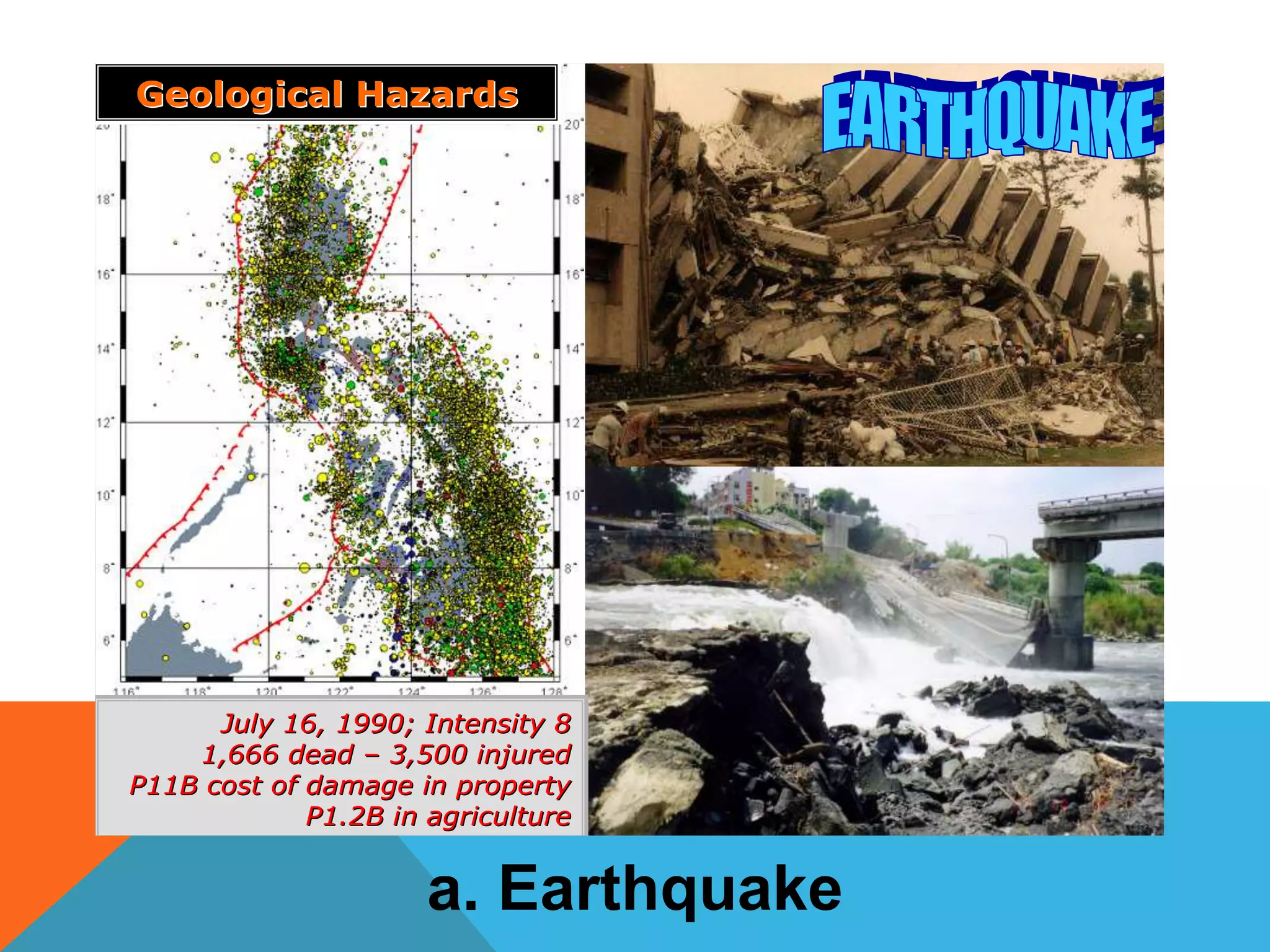
July 16, 1990; Intensity 8July 16, 1990; Intensity 8
1,666 dead1,666 dead –– 3,500 injured3,500 injured
P11B cost of damage in propertyP11B cost of damage in property
P1.2B in agricultureP1.2B in agriculture
Geological HazardsGeological Hazards
a. Earthquake
a. Earthquake
- An earthquake is a shaking
of the ground caused by
sudden slippage of rock masses bel
ow or at the surface
of the earth.
- It is a wave-like movement o
f the earth’s surface.
Preparedness and Mitigation (What t
o do before):
•Evaluate the structural soundness of school bui
ldings and important infrastructures and recom
mend for strengthening or retrofitting if found ne
cessary.
• Determine whether the school site is alo
ng the active fault and/or liquefaction or la
ndslide prone areas which may cause scho
ol building to fall;
• Make sure that proper structural design and
engineering practice is followed when constru
cting a school building;
• Make sure that all classrooms shall have a
n entry and exit doors to include an entry and
exit gates, both doors at swing-out mode.
• Familiarize students as well as school pers
onnel with the easiest exit or route to take
• Teach the school children on how to use fir
e extinguishers, first aid kits, alarms and emer
gency exits.
• Do not use the elevator during and after the ea
rthquake. Structural and power failure may lea
d you to get stranded in the elevator.
• Identify strong parts of the building like door ja
mbs, near elevator shafts, sturdy tables where
the pupils/students can take refuge during an e
arthquake.
• Prepare and maintain an earthquake survival k
it consisting of a battery-powered radio, flashlig
ht, first aid kit, potable water, candies, ready to
eat food, whistle and dust mask.
• Develop a School Earthquake Evacuation Plan.
• Conduct Orientation and Earthquake Drill.
•Acquire the most recent school grounds layou
t or planning to identify open spaces and deter
mine the total area of available space that can
be utilized as “area of temporary refuge” that w
ill be designated for the occupants of each sch
ool building.
• Obtain a building lay out/floor plan for each b
uilding that shows the rooms, corridors, stairca
ses and exit points.
•Conduct building watching exercise and identi
fy safe and unsafe spots inside the school gro
unds.
Response (What to do during):
•Stay inside a structurally sound building.
•Advise students to protect their body from fall
ing debris by bracing themselves in a doorwa
y or by getting under a sturdy desk or table.
•Pull to the side of the road and stop, when in
side a vehicle,. Do not attempt to cross bridg
es or overpasses which may have been dama
ged.
• Direct students to move to an open area
when they are in the outside.
• Stay away from buildings with large glass
panes.
• Move away from steep escarpments whic
h may be affected by landslides particular
ly if they are on a mountain or near a ste
ep hill slopes.
• Stay away from power lines, posts, walls,
and other structures that may fall or colla
pse
Rehabilitation (What to do after):
•Advise students to take the fastest and saf
est way out if caught in an old and weak cl
assroom. They should be advised to :
•Get out calmly and in an orderly manner.
Not to rush or push one another.
•Do not use elevators instead use the stair
s;
•Check themselves for cuts and for injuries
and approach the nearest teacher for assi
stance.
• Check the surroundings of the schools
• Call the authority to clean up chemical spills, to
xic and flammable materials since this is hazardou
s to untrained people.
• Check for fire and if any, have it controlled.
• Check the water and electrical lines for defects.
If any damage is suspected, turn the system off in
the main valve or switch.
• Help reduce the number of casualties from the e
arthquake:
• Do not enter partially damaged school buildings,
as strong aftershocks may cause these to collap
se.
• Gather information and disaster preventio
n instructions from battery-operated radio
s.
• Obey public safety precautions.
• Do not use your telephone to call relatives
and friends. Disaster prevention authoritie
s may need the lines for emergency calls
and communications.
• Do not use your car and drive around area
s of damage. Rescue and relief operation
s need the roads for mobility.
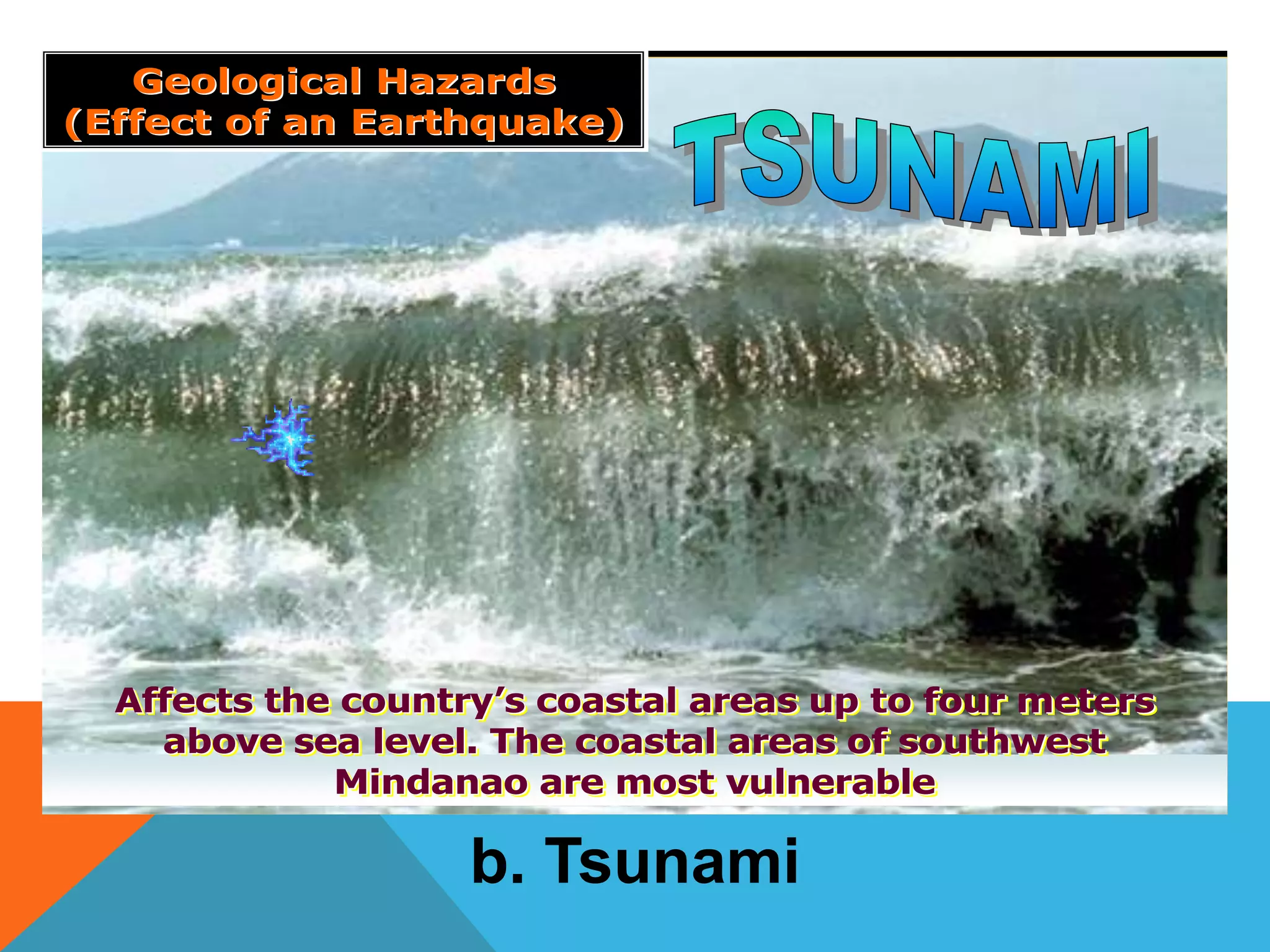
Affects the country’s coastal areas up to four meters
above sea level. The coastal areas of southwest
Mindanao are most vulnerable
Affects the countryAffects the country’’s coastal areas up to four meterss coastal areas up to four meters
above sea level. The coastal areas of southwestabove sea level. The coastal areas of southwest
Mindanao are most vulnerableMindanao are most vulnerable
Geological HazardsGeological Hazards
(Effect of an Earthquake)(Effect of an Earthquake)
b. Tsunami
TSUNAMI
- Tsunamis are giant sea w
aves generated by under-the s
ea earthquakes and volcanic er
uptions.
Not all submarine earthquakes
, however, can cause the occurrenc
e of tsunamis.
Preparedness and Mitigation (What t
o do before):
•Conduct school advocacy on tsunami awar
eness, preparedness and mitigation. Regula
r tsunami drills should be conducted.
•Turn on your radio to learn if there is a tsun
ami warning if an earthquake occurs and yo
u are in a coastal area.
•Assign a focal person to monitor and obser
ve the water recession after an earthquake.
Response (What to do during):
•CAUTION: Move away immediately, if
there is noticeable recession in water a
way from the shoreline.
•Move inland to predetermined higher g
round immediately and stay there.
•Stay away from the beach. Never go d
own to the beach to watch a tsunami co
me in. If you can see the wave you are
too close to escape it.
Rehabilitation (What to do after):
•Stay away from flooded and damage
d areas until officials say it is safe to r
eturn.
•Stay away from debris in the water; i
t may pose a safety hazard to boats a
nd people.
•Save yourself – not your possession
s.
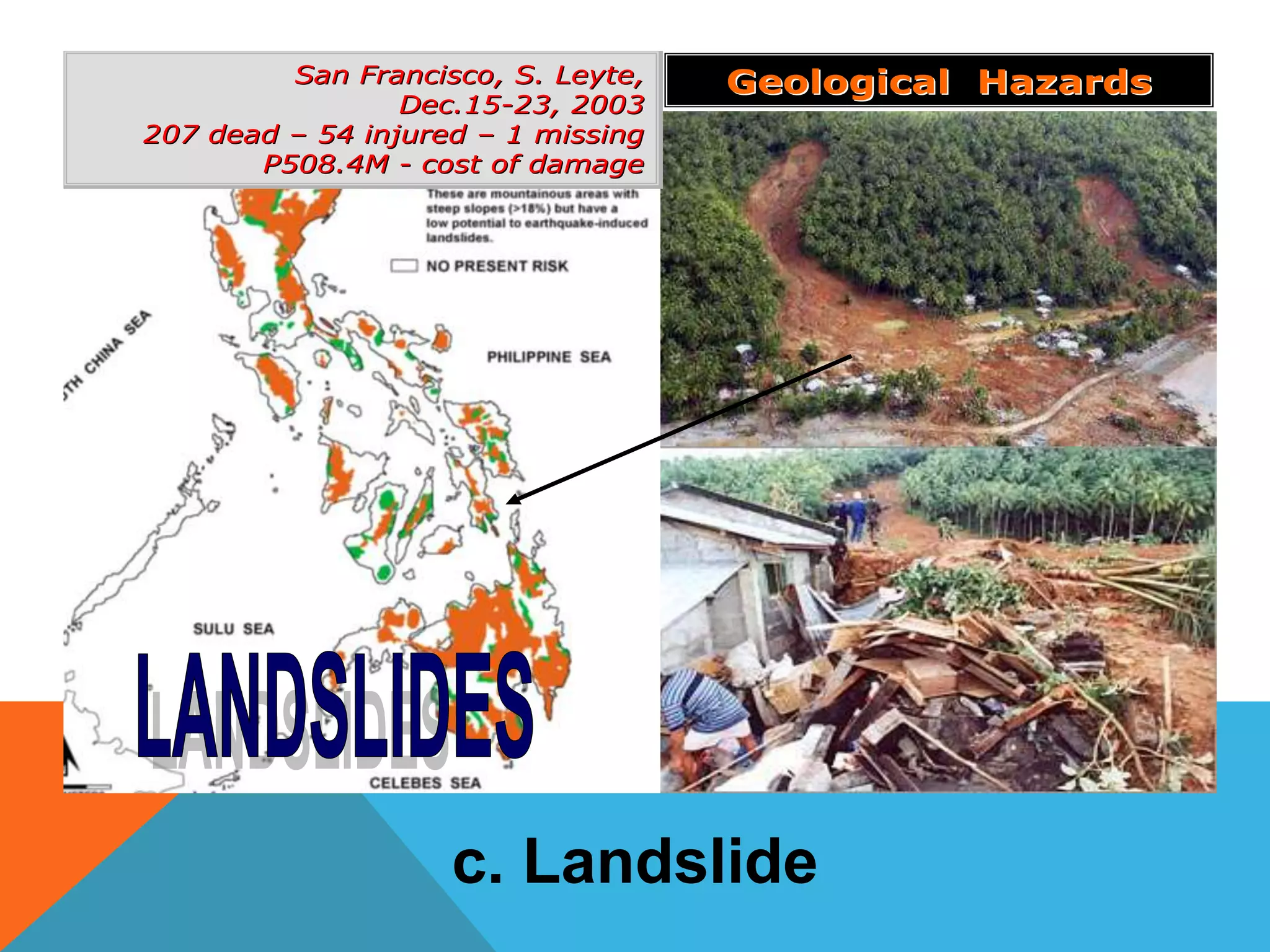
Geological HazardsGeological HazardsSan Francisco, S.San Francisco, S. LeyteLeyte,,
Dec.15Dec.15--23, 200323, 2003
207 dead207 dead –– 54 injured54 injured –– 1 missing1 missing
P508.4MP508.4M -- cost of damagecost of damage
c. Landslide
Geological HazardsGeological Hazards
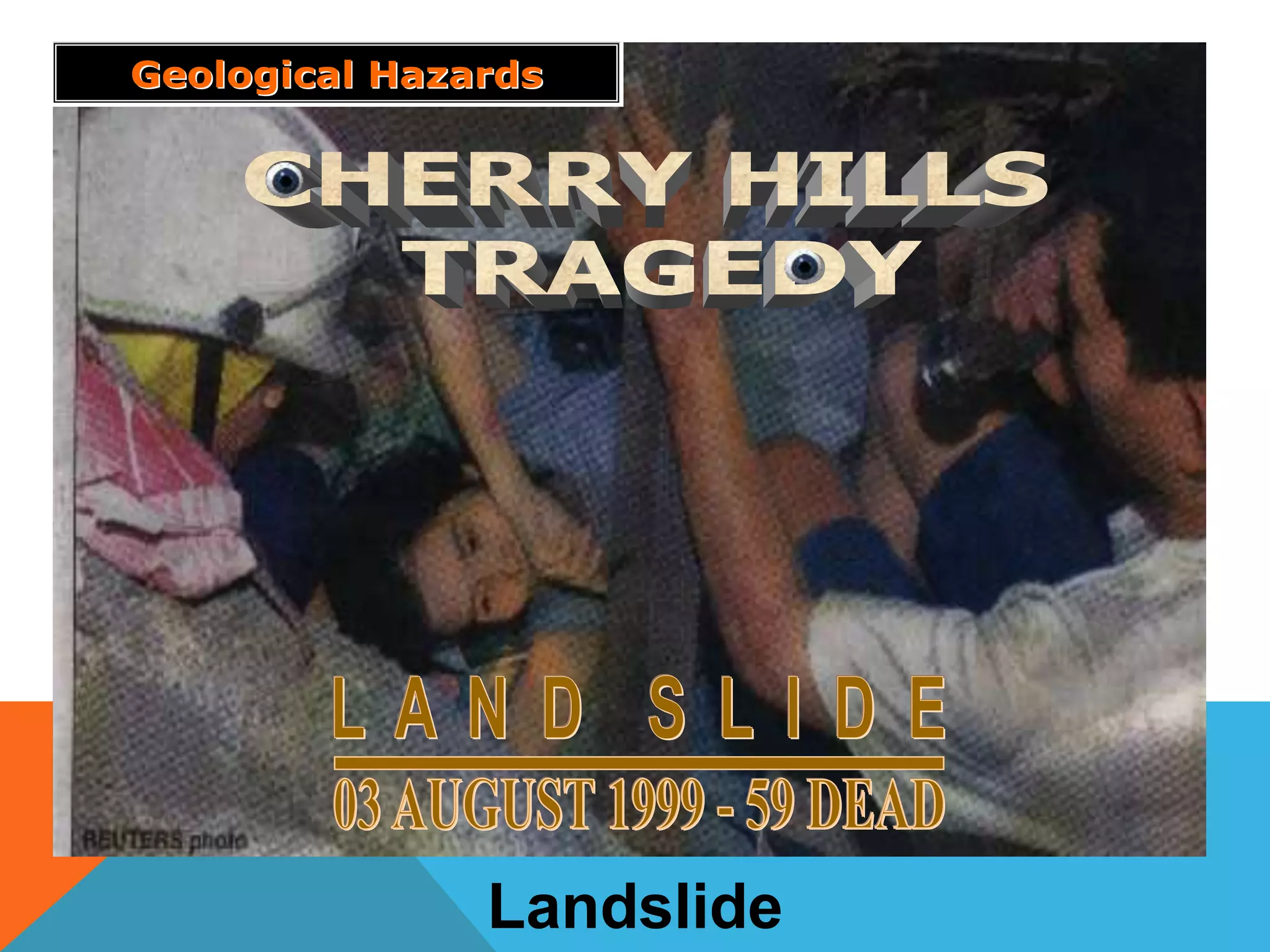
Landslide
c. Landslide
Geological HazardsGeological HazardsSan Francisco, S.San Francisco, S. LeyteLeyte,,
Dec.15Dec.15--23, 200323, 2003
207 dead207 dead –– 54 injured54 injured –– 1 missing1 missing
P508.4MP508.4M -- cost of damagecost of damage
•A landslide is a massive outwa
rd and downward movement of
slope-forming materials.
•The term landslide is restricted
to movements of rocks and soil
masses. These masses may ra
nge in sized from card to entire
mountainsides.
•Their movements may vary in v
elocities
•Landslide as a geological haza
rd is caused by earthquake or v
olcanic eruption.
•This initiated when a section of
a hill slope or sloping section of
a sea bed is rendered weak to s
upport its own weight
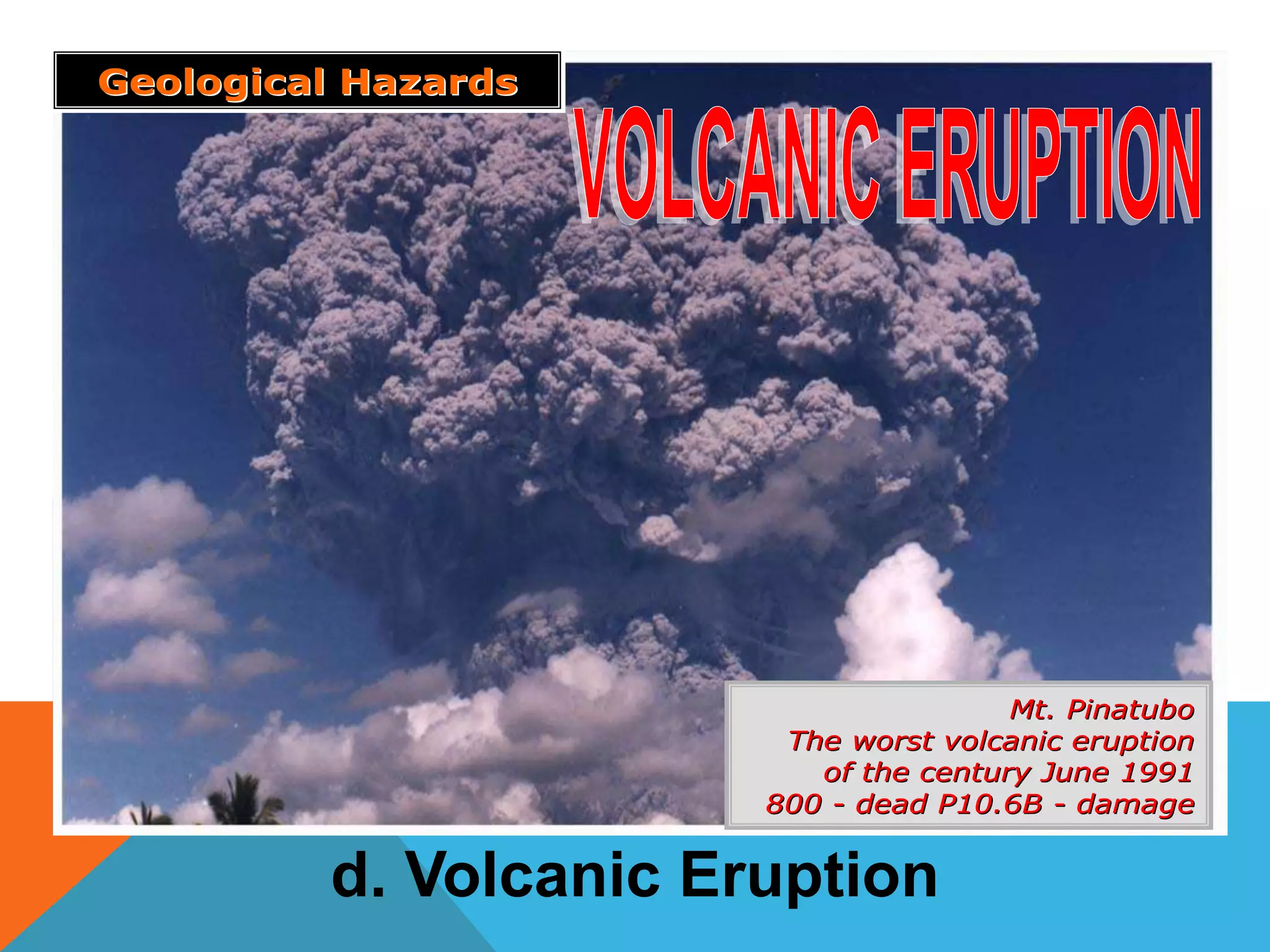
Mt. PinatuboMt. Pinatubo
The worst volcanic eruptionThe worst volcanic eruption
of the century June 1991of the century June 1991
800800 -- dead P10.6Bdead P10.6B -- damagedamage
Geological HazardsGeological Hazards
d. Volcanic Eruption
Volcanic Eruption is a process wher
ein volcanic materials such as molten o
r hot fragmented rocks or gaseous mat
erials are ejected from a volcano. Haza
rds from volcanoes may be of different
nature. These hazards include flowing
of fast-moving molten rocks and other e
jected.
Three Phases of Strategy
1. Preparedness and Mitigation (
what to do before)
2. Response (what to do during)
3. Rehabilitation (what to do afte
r)
Prepared By:
Cirilyn Grace A
baya
Thank You

natural and geological hazards

  • 1.
  • 2.
    Natural Hazard Natural hazardsare potenti ally damaging natural phenom ena that may occur within spe cific period of time in a given area that may cause danger to people, structures or economi c assets and which may lead t o a disaster.
  • 3.
    KINDS OF NATURALHAZAR DS 1. Hydro Meteorogical Hazards 2. Geological Hazards 3. Astronomical Hazards
  • 4.
  • 5.
    July 16, 1990;Intensity 8July 16, 1990; Intensity 8 1,666 dead1,666 dead –– 3,500 injured3,500 injured P11B cost of damage in propertyP11B cost of damage in property P1.2B in agricultureP1.2B in agriculture Geological HazardsGeological Hazards a. Earthquake
  • 6.
    a. Earthquake - Anearthquake is a shaking of the ground caused by sudden slippage of rock masses bel ow or at the surface of the earth. - It is a wave-like movement o f the earth’s surface.
  • 7.
    Preparedness and Mitigation(What t o do before): •Evaluate the structural soundness of school bui ldings and important infrastructures and recom mend for strengthening or retrofitting if found ne cessary. • Determine whether the school site is alo ng the active fault and/or liquefaction or la ndslide prone areas which may cause scho ol building to fall;
  • 8.
    • Make surethat proper structural design and engineering practice is followed when constru cting a school building; • Make sure that all classrooms shall have a n entry and exit doors to include an entry and exit gates, both doors at swing-out mode. • Familiarize students as well as school pers onnel with the easiest exit or route to take • Teach the school children on how to use fir e extinguishers, first aid kits, alarms and emer gency exits.
  • 9.
    • Do notuse the elevator during and after the ea rthquake. Structural and power failure may lea d you to get stranded in the elevator. • Identify strong parts of the building like door ja mbs, near elevator shafts, sturdy tables where the pupils/students can take refuge during an e arthquake. • Prepare and maintain an earthquake survival k it consisting of a battery-powered radio, flashlig ht, first aid kit, potable water, candies, ready to eat food, whistle and dust mask. • Develop a School Earthquake Evacuation Plan. • Conduct Orientation and Earthquake Drill.
  • 10.
    •Acquire the mostrecent school grounds layou t or planning to identify open spaces and deter mine the total area of available space that can be utilized as “area of temporary refuge” that w ill be designated for the occupants of each sch ool building. • Obtain a building lay out/floor plan for each b uilding that shows the rooms, corridors, stairca ses and exit points. •Conduct building watching exercise and identi fy safe and unsafe spots inside the school gro unds.
  • 11.
    Response (What todo during): •Stay inside a structurally sound building. •Advise students to protect their body from fall ing debris by bracing themselves in a doorwa y or by getting under a sturdy desk or table. •Pull to the side of the road and stop, when in side a vehicle,. Do not attempt to cross bridg es or overpasses which may have been dama ged.
  • 12.
    • Direct studentsto move to an open area when they are in the outside. • Stay away from buildings with large glass panes. • Move away from steep escarpments whic h may be affected by landslides particular ly if they are on a mountain or near a ste ep hill slopes. • Stay away from power lines, posts, walls, and other structures that may fall or colla pse
  • 13.
    Rehabilitation (What todo after): •Advise students to take the fastest and saf est way out if caught in an old and weak cl assroom. They should be advised to : •Get out calmly and in an orderly manner. Not to rush or push one another. •Do not use elevators instead use the stair s; •Check themselves for cuts and for injuries and approach the nearest teacher for assi stance.
  • 14.
    • Check thesurroundings of the schools • Call the authority to clean up chemical spills, to xic and flammable materials since this is hazardou s to untrained people. • Check for fire and if any, have it controlled. • Check the water and electrical lines for defects. If any damage is suspected, turn the system off in the main valve or switch. • Help reduce the number of casualties from the e arthquake: • Do not enter partially damaged school buildings, as strong aftershocks may cause these to collap se.
  • 15.
    • Gather informationand disaster preventio n instructions from battery-operated radio s. • Obey public safety precautions. • Do not use your telephone to call relatives and friends. Disaster prevention authoritie s may need the lines for emergency calls and communications. • Do not use your car and drive around area s of damage. Rescue and relief operation s need the roads for mobility.
  • 16.
    Affects the country’scoastal areas up to four meters above sea level. The coastal areas of southwest Mindanao are most vulnerable Affects the countryAffects the country’’s coastal areas up to four meterss coastal areas up to four meters above sea level. The coastal areas of southwestabove sea level. The coastal areas of southwest Mindanao are most vulnerableMindanao are most vulnerable Geological HazardsGeological Hazards (Effect of an Earthquake)(Effect of an Earthquake) b. Tsunami
  • 17.
    TSUNAMI - Tsunamis aregiant sea w aves generated by under-the s ea earthquakes and volcanic er uptions. Not all submarine earthquakes , however, can cause the occurrenc e of tsunamis.
  • 18.
    Preparedness and Mitigation(What t o do before): •Conduct school advocacy on tsunami awar eness, preparedness and mitigation. Regula r tsunami drills should be conducted. •Turn on your radio to learn if there is a tsun ami warning if an earthquake occurs and yo u are in a coastal area. •Assign a focal person to monitor and obser ve the water recession after an earthquake.
  • 19.
    Response (What todo during): •CAUTION: Move away immediately, if there is noticeable recession in water a way from the shoreline. •Move inland to predetermined higher g round immediately and stay there. •Stay away from the beach. Never go d own to the beach to watch a tsunami co me in. If you can see the wave you are too close to escape it.
  • 20.
    Rehabilitation (What todo after): •Stay away from flooded and damage d areas until officials say it is safe to r eturn. •Stay away from debris in the water; i t may pose a safety hazard to boats a nd people. •Save yourself – not your possession s.
  • 21.
    Geological HazardsGeological HazardsSanFrancisco, S.San Francisco, S. LeyteLeyte,, Dec.15Dec.15--23, 200323, 2003 207 dead207 dead –– 54 injured54 injured –– 1 missing1 missing P508.4MP508.4M -- cost of damagecost of damage c. Landslide
  • 22.
  • 23.
    c. Landslide Geological HazardsGeologicalHazardsSan Francisco, S.San Francisco, S. LeyteLeyte,, Dec.15Dec.15--23, 200323, 2003 207 dead207 dead –– 54 injured54 injured –– 1 missing1 missing P508.4MP508.4M -- cost of damagecost of damage •A landslide is a massive outwa rd and downward movement of slope-forming materials. •The term landslide is restricted to movements of rocks and soil masses. These masses may ra nge in sized from card to entire mountainsides. •Their movements may vary in v elocities •Landslide as a geological haza rd is caused by earthquake or v olcanic eruption. •This initiated when a section of a hill slope or sloping section of a sea bed is rendered weak to s upport its own weight
  • 24.
    Mt. PinatuboMt. Pinatubo Theworst volcanic eruptionThe worst volcanic eruption of the century June 1991of the century June 1991 800800 -- dead P10.6Bdead P10.6B -- damagedamage Geological HazardsGeological Hazards d. Volcanic Eruption
  • 25.
    d. Volcanic Eruption VolcanicEruption is a process wher ein volcanic materials such as molten o r hot fragmented rocks or gaseous mat erials are ejected from a volcano. Haza rds from volcanoes may be of different nature. These hazards include flowing of fast-moving molten rocks and other e jected.
  • 26.
    Three Phases ofStrategy 1. Preparedness and Mitigation ( what to do before) 2. Response (what to do during) 3. Rehabilitation (what to do afte r)
  • 27.
  • 28.