Disaster
Readiness and
Risk Reduction
04 • 13 • 2023
ACTIVITY 1
Recall Me!
Direction:
Select the letter of the correct answer.
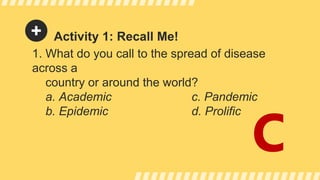
Activity 1: Recall Me!
1. What do you call to the spread of disease
across a
country or around the world?
a. Academic c. Pandemic
b. Epidemic d. Prolific
C
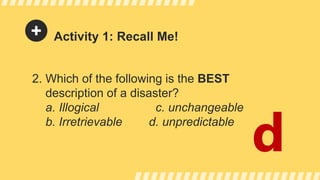
Activity 1: Recall Me!
2. Which of the following is the BEST
description of a disaster?
a. Illogical c. unchangeable
b. Irretrievable d. unpredictable
d
Activity 1: Recall Me!
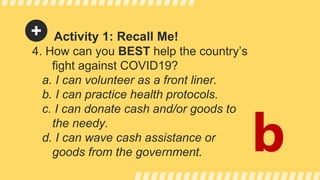
4. How can you BEST help the country’s
fight against COVID19?
a. I can volunteer as a front liner.
b. I can practice health protocols.
c. I can donate cash and/or goods to
the needy.
d. I can wave cash assistance or
goods from the government. b
Activity 1: Recall Me!
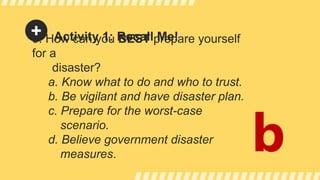
5. How can you BEST prepare yourself
for a
disaster?
a. Know what to do and who to trust.
b. Be vigilant and have disaster plan.
c. Prepare for the worst-case
scenario.
d. Believe government disaster
measures.
b
Activity 1: Recall Me!
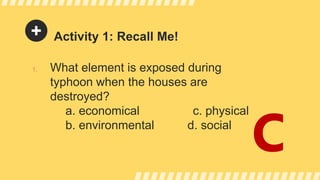
1. What element is exposed during
typhoon when the houses are
destroyed?
a. economical c. physical
b. environmental d. social
C
NICE!
ACTIVITY 2
Share it!
Share it!
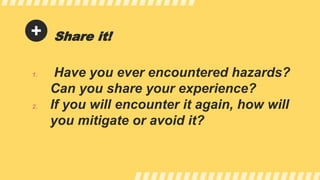
1. Have you ever encountered hazards?
Can you share your experience?
2. If you will encounter it again, how will
you mitigate or avoid it?
ACTIVITY 3
Picture Analysis!
Direction:
analyze the pictures and answer the given questions.
Picture Analysis!
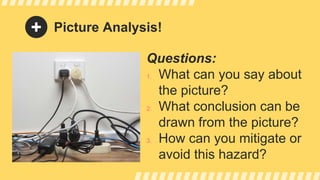
Questions:
1. What can you say about
the picture?
2. What conclusion can be
drawn from the picture?
3. How can you mitigate or
avoid this hazard?
Picture Analysis!
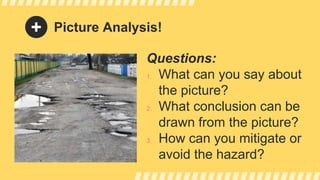
Questions:
1. What can you say about
the picture?
2. What conclusion can be
drawn from the picture?
3. How can you mitigate or
avoid the hazard?
HAZARD and
Its Types
?
What is
HAZARD?
?
These are the some definitions of Hazards
from different sources:
• A danger or risk. Oxford Dictionary
• It is defined as a source of potential harm or a
situation with a potential to cause loss (Standards
Australia 2000).
These are the some definitions of Hazards
from different sources:
• A hazard is any object, situation, or behavior that has
the potential to cause injury, ill health, or damage to
property or the environment.
• As stated in Philippine DRRR law 2010, Hazard is a
dangerous phenomenon, substance, human activity
or condition that may cause loss of life, injury or other
health impacts, property damage, loss of livelihoods
and services, social and economic disruption, or
environmental damage.
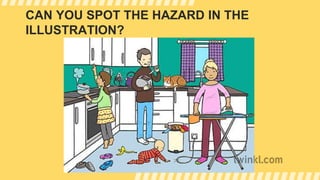
CAN YOU SPOT THE HAZARD IN THE
ILLUSTRATION?
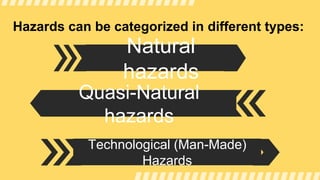
Natural
hazards
Quasi-Natural
hazards
Hazards can be categorized in different types:
Technological (Man-Made)
Hazards
NATURAL HAZARDS
Defined as environmental phenomena
that have the potential to impact societies
and the human environment.
QUASI-NATURAL HAZARDS
refers to those hazards caused due to
the interaction between human activity and
natural earth processes.
TECHNOLOGICAL (OR MAN-MADE)
HAZARDS
These arise directly as a result of
human activities.
EXAMPLES OF
NATURAL HAZARDS
?
NATURAL HAZARDS
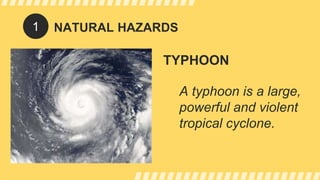
TYPHOON
A typhoon is a large,
powerful and violent
tropical cyclone.
1
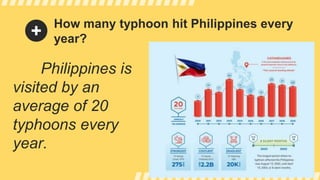
How many typhoon hit Philippines every
year?
Philippines is
visited by an
average of 20
typhoons every
year.
NATURAL HAZARDS
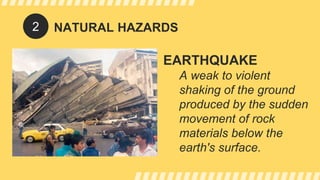
EARTHQUAKE
A weak to violent
shaking of the ground
produced by the sudden
movement of rock
materials below the
earth's surface.
2
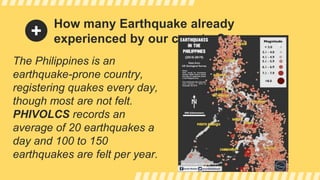
How many Earthquake already
experienced by our country?
The Philippines is an
earthquake-prone country,
registering quakes every day,
though most are not felt.
PHIVOLCS records an
average of 20 earthquakes a
day and 100 to 150
earthquakes are felt per year.
NATURAL HAZARDS
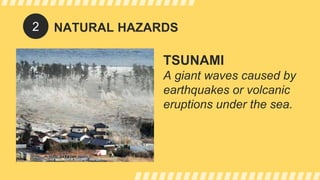
TSUNAMI
A giant waves caused by
earthquakes or volcanic
eruptions under the sea.
2
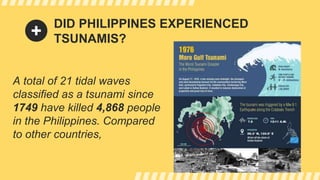
DID PHILIPPINES EXPERIENCED
TSUNAMIS?
A total of 21 tidal waves
classified as a tsunami since
1749 have killed 4,868 people
in the Philippines. Compared
to other countries,
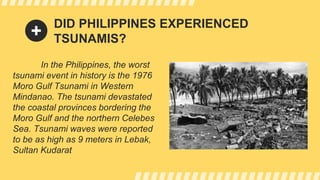
DID PHILIPPINES EXPERIENCED
TSUNAMIS?
In the Philippines, the worst
tsunami event in history is the 1976
Moro Gulf Tsunami in Western
Mindanao. The tsunami devastated
the coastal provinces bordering the
Moro Gulf and the northern Celebes
Sea. Tsunami waves were reported
to be as high as 9 meters in Lebak,
Sultan Kudarat
EXAMPLES OF
QUASI-NATURAL
HAZARDS
?
QUASI-NATURAL HAZARDS
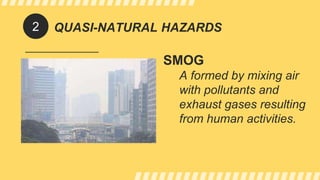
SMOG
A formed by mixing air
with pollutants and
exhaust gases resulting
from human activities.
2
QUASI-NATURAL HAZARDS
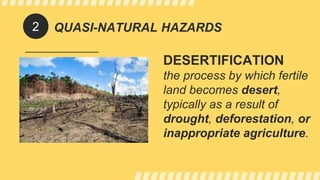
DESERTIFICATION
the process by which fertile
land becomes desert,
typically as a result of
drought, deforestation, or
inappropriate agriculture.
2
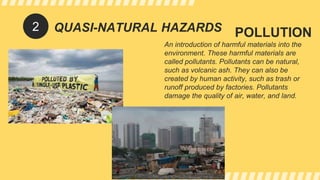
QUASI-NATURAL HAZARDS POLLUTION
An introduction of harmful materials into the
environment. These harmful materials are
called pollutants. Pollutants can be natural,
such as volcanic ash. They can also be
created by human activity, such as trash or
runoff produced by factories. Pollutants
damage the quality of air, water, and land.
2
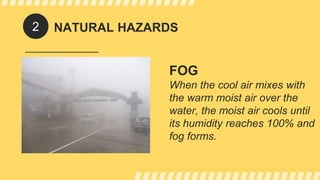
NATURAL HAZARDS
FOG
When the cool air mixes with
the warm moist air over the
water, the moist air cools until
its humidity reaches 100% and
fog forms.
2
EXAMPLES OF
TECHNOLOGICAL OR
MAN-MADE HAZARDS
?
TECHNOLOGICAL OR MAN-MADE
HAZARDS
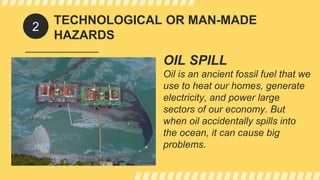
OIL SPILL
Oil is an ancient fossil fuel that we
use to heat our homes, generate
electricity, and power large
sectors of our economy. But
when oil accidentally spills into
the ocean, it can cause big
problems.
2
TECHNOLOGICAL OR MAN-MADE
HAZARDS
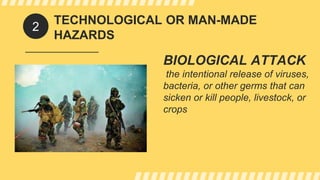
BIOLOGICAL ATTACK
the intentional release of viruses,
bacteria, or other germs that can
sicken or kill people, livestock, or
crops
2
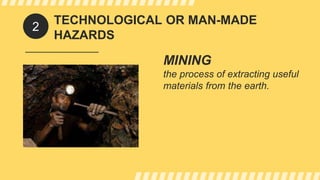
TECHNOLOGICAL OR MAN-MADE
HAZARDS
MINING
the process of extracting useful
materials from the earth.
2
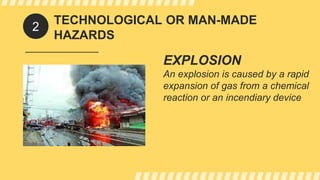
TECHNOLOGICAL OR MAN-MADE
HAZARDS
EXPLOSION
An explosion is caused by a rapid
expansion of gas from a chemical
reaction or an incendiary device
2
ACTIVITY 5
Arrange and Show Me!
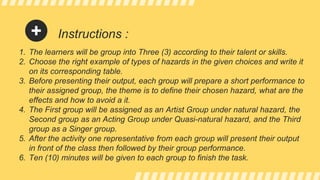
Instructions :
1. The learners will be group into Three (3) according to their talent or skills.
2. Choose the right example of types of hazards in the given choices and write it
on its corresponding table.
3. Before presenting their output, each group will prepare a short performance to
their assigned group, the theme is to define their chosen hazard, what are the
effects and how to avoid a it.
4. The First group will be assigned as an Artist Group under natural hazard, the
Second group as an Acting Group under Quasi-natural hazard, and the Third
group as a Singer group.
5. After the activity one representative from each group will present their output
in front of the class then followed by their group performance.
6. Ten (10) minutes will be given to each group to finish the task.
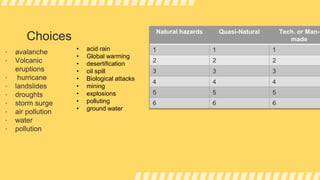
Choices
• avalanche
• Volcanic
eruptions
• hurricane
• landslides
• droughts
• storm surge
• air pollution
• water
• pollution
Natural hazards Quasi-Natural Tech. or Man-
made
1 1 1
2 2 2
3 3 3
4 4 4
5 5 5
6 6 6
• acid rain
• Global warming
• desertification
• oil spill
• Biological attacks
• mining
• explosions
• polluting
• ground water
PRESENTATION
!
Point out some hazards seen in your house or
school and how you will mitigate or avoid it.
Activity 6
FILL ME!
Direction:
Choose the right example of types of hazards below
and write it on the corresponding table.
SHORT QUIZ!
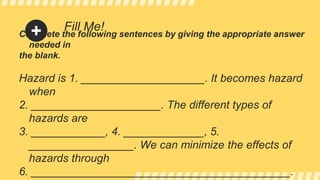
Fill Me!
Complete the following sentences by giving the appropriate answer
needed in
the blank.
Hazard is 1. ____________________. It becomes hazard
when
2. _____________________. The different types of
hazards are
3. ____________, 4. _____________, 5.
_________________. We can minimize the effects of
hazards through
6. __________________________________________.
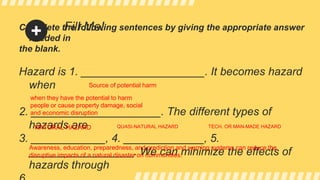
Fill Me!
Complete the following sentences by giving the appropriate answer
needed in
the blank.
Hazard is 1. ____________________. It becomes hazard
when
2. _____________________. The different types of
hazards are
3. ____________, 4. _____________, 5.
_________________. We can minimize the effects of
hazards through
when they have the potential to harm
people or cause property damage, social
and economic disruption
NATURAL HAZARD QUASI-NATURAL HAZARD TECH. OR MAN-MADE HAZARD
Awareness, education, preparedness, and prediction and warning systems can reduce the
disruptive impacts of a natural disaster on communities.
Source of potential harm
Assignment!
Let’s Pretend!
ESSAY (50-100 Words)
The Philippines is considered as the third most prone to hazard
country in the world, having more than 20 tropical cyclones in a year,
earthquakes, and more than 20 active volcanoes found all over the
country. As a disaster advocate, what are the things that you can
contribute to possibly minimize the risks of disaster in your home and
school?
2
THANK YOU!
-----END------

my plan

  • 1.
  • 2.
    ACTIVITY 1 Recall Me! Direction: Selectthe letter of the correct answer.
  • 3.
    Activity 1: RecallMe! 1. What do you call to the spread of disease across a country or around the world? a. Academic c. Pandemic b. Epidemic d. Prolific C
  • 4.
    Activity 1: RecallMe! 2. Which of the following is the BEST description of a disaster? a. Illogical c. unchangeable b. Irretrievable d. unpredictable d
  • 5.
    Activity 1: RecallMe! 4. How can you BEST help the country’s fight against COVID19? a. I can volunteer as a front liner. b. I can practice health protocols. c. I can donate cash and/or goods to the needy. d. I can wave cash assistance or goods from the government. b
  • 6.
    Activity 1: RecallMe! 5. How can you BEST prepare yourself for a disaster? a. Know what to do and who to trust. b. Be vigilant and have disaster plan. c. Prepare for the worst-case scenario. d. Believe government disaster measures. b
  • 7.
    Activity 1: RecallMe! 1. What element is exposed during typhoon when the houses are destroyed? a. economical c. physical b. environmental d. social C
  • 8.
  • 9.
  • 10.
    Share it! 1. Haveyou ever encountered hazards? Can you share your experience? 2. If you will encounter it again, how will you mitigate or avoid it?
  • 11.
    ACTIVITY 3 Picture Analysis! Direction: analyzethe pictures and answer the given questions.
  • 12.
    Picture Analysis! Questions: 1. Whatcan you say about the picture? 2. What conclusion can be drawn from the picture? 3. How can you mitigate or avoid this hazard?
  • 13.
    Picture Analysis! Questions: 1. Whatcan you say about the picture? 2. What conclusion can be drawn from the picture? 3. How can you mitigate or avoid the hazard?
  • 14.
  • 15.
  • 16.
    These are thesome definitions of Hazards from different sources: • A danger or risk. Oxford Dictionary • It is defined as a source of potential harm or a situation with a potential to cause loss (Standards Australia 2000).
  • 17.
    These are thesome definitions of Hazards from different sources: • A hazard is any object, situation, or behavior that has the potential to cause injury, ill health, or damage to property or the environment. • As stated in Philippine DRRR law 2010, Hazard is a dangerous phenomenon, substance, human activity or condition that may cause loss of life, injury or other health impacts, property damage, loss of livelihoods and services, social and economic disruption, or environmental damage.
  • 18.
    CAN YOU SPOTTHE HAZARD IN THE ILLUSTRATION?
  • 19.
    Natural hazards Quasi-Natural hazards Hazards can becategorized in different types: Technological (Man-Made) Hazards
  • 20.
    NATURAL HAZARDS Defined asenvironmental phenomena that have the potential to impact societies and the human environment.
  • 21.
    QUASI-NATURAL HAZARDS refers tothose hazards caused due to the interaction between human activity and natural earth processes.
  • 22.
    TECHNOLOGICAL (OR MAN-MADE) HAZARDS Thesearise directly as a result of human activities.
  • 23.
  • 24.
    NATURAL HAZARDS TYPHOON A typhoonis a large, powerful and violent tropical cyclone. 1
  • 25.
    How many typhoonhit Philippines every year? Philippines is visited by an average of 20 typhoons every year.
  • 26.
    NATURAL HAZARDS EARTHQUAKE A weakto violent shaking of the ground produced by the sudden movement of rock materials below the earth's surface. 2
  • 27.
    How many Earthquakealready experienced by our country? The Philippines is an earthquake-prone country, registering quakes every day, though most are not felt. PHIVOLCS records an average of 20 earthquakes a day and 100 to 150 earthquakes are felt per year.
  • 28.
    NATURAL HAZARDS TSUNAMI A giantwaves caused by earthquakes or volcanic eruptions under the sea. 2
  • 29.
    DID PHILIPPINES EXPERIENCED TSUNAMIS? Atotal of 21 tidal waves classified as a tsunami since 1749 have killed 4,868 people in the Philippines. Compared to other countries,
  • 30.
    DID PHILIPPINES EXPERIENCED TSUNAMIS? Inthe Philippines, the worst tsunami event in history is the 1976 Moro Gulf Tsunami in Western Mindanao. The tsunami devastated the coastal provinces bordering the Moro Gulf and the northern Celebes Sea. Tsunami waves were reported to be as high as 9 meters in Lebak, Sultan Kudarat
  • 31.
  • 32.
    QUASI-NATURAL HAZARDS SMOG A formedby mixing air with pollutants and exhaust gases resulting from human activities. 2
  • 33.
    QUASI-NATURAL HAZARDS DESERTIFICATION the processby which fertile land becomes desert, typically as a result of drought, deforestation, or inappropriate agriculture. 2
  • 34.
    QUASI-NATURAL HAZARDS POLLUTION Anintroduction of harmful materials into the environment. These harmful materials are called pollutants. Pollutants can be natural, such as volcanic ash. They can also be created by human activity, such as trash or runoff produced by factories. Pollutants damage the quality of air, water, and land. 2
  • 35.
    NATURAL HAZARDS FOG When thecool air mixes with the warm moist air over the water, the moist air cools until its humidity reaches 100% and fog forms. 2
  • 36.
  • 37.
    TECHNOLOGICAL OR MAN-MADE HAZARDS OILSPILL Oil is an ancient fossil fuel that we use to heat our homes, generate electricity, and power large sectors of our economy. But when oil accidentally spills into the ocean, it can cause big problems. 2
  • 38.
    TECHNOLOGICAL OR MAN-MADE HAZARDS BIOLOGICALATTACK the intentional release of viruses, bacteria, or other germs that can sicken or kill people, livestock, or crops 2
  • 39.
    TECHNOLOGICAL OR MAN-MADE HAZARDS MINING theprocess of extracting useful materials from the earth. 2
  • 40.
    TECHNOLOGICAL OR MAN-MADE HAZARDS EXPLOSION Anexplosion is caused by a rapid expansion of gas from a chemical reaction or an incendiary device 2
  • 41.
  • 42.
    Instructions : 1. Thelearners will be group into Three (3) according to their talent or skills. 2. Choose the right example of types of hazards in the given choices and write it on its corresponding table. 3. Before presenting their output, each group will prepare a short performance to their assigned group, the theme is to define their chosen hazard, what are the effects and how to avoid a it. 4. The First group will be assigned as an Artist Group under natural hazard, the Second group as an Acting Group under Quasi-natural hazard, and the Third group as a Singer group. 5. After the activity one representative from each group will present their output in front of the class then followed by their group performance. 6. Ten (10) minutes will be given to each group to finish the task.
  • 43.
    Choices • avalanche • Volcanic eruptions •hurricane • landslides • droughts • storm surge • air pollution • water • pollution Natural hazards Quasi-Natural Tech. or Man- made 1 1 1 2 2 2 3 3 3 4 4 4 5 5 5 6 6 6 • acid rain • Global warming • desertification • oil spill • Biological attacks • mining • explosions • polluting • ground water
  • 44.
  • 45.
    Point out somehazards seen in your house or school and how you will mitigate or avoid it.
  • 46.
    Activity 6 FILL ME! Direction: Choosethe right example of types of hazards below and write it on the corresponding table.
  • 47.
  • 48.
    Fill Me! Complete thefollowing sentences by giving the appropriate answer needed in the blank. Hazard is 1. ____________________. It becomes hazard when 2. _____________________. The different types of hazards are 3. ____________, 4. _____________, 5. _________________. We can minimize the effects of hazards through 6. __________________________________________.
  • 49.
    Fill Me! Complete thefollowing sentences by giving the appropriate answer needed in the blank. Hazard is 1. ____________________. It becomes hazard when 2. _____________________. The different types of hazards are 3. ____________, 4. _____________, 5. _________________. We can minimize the effects of hazards through when they have the potential to harm people or cause property damage, social and economic disruption NATURAL HAZARD QUASI-NATURAL HAZARD TECH. OR MAN-MADE HAZARD Awareness, education, preparedness, and prediction and warning systems can reduce the disruptive impacts of a natural disaster on communities. Source of potential harm
  • 50.
  • 51.
    ESSAY (50-100 Words) ThePhilippines is considered as the third most prone to hazard country in the world, having more than 20 tropical cyclones in a year, earthquakes, and more than 20 active volcanoes found all over the country. As a disaster advocate, what are the things that you can contribute to possibly minimize the risks of disaster in your home and school? 2
  • 52.