BLOCK DIAGRAM OF A
COMPUTER
INPUT UNIT
Computer receives data and
instructions through the
Input Unit.
The input unit consists of one
or more input devices.
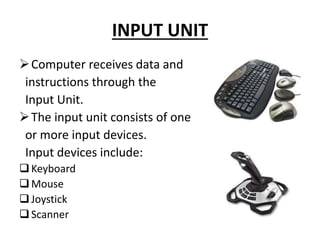
Input devices include:
Keyboard
Mouse
Joystick
Scanner
FUNCTIONS OF INPUT UNIT
Accept the data and instructions from the
outside world.
Convert it to a form that the computer can
understand.
Supply the converted data to the computer
system for further processing.
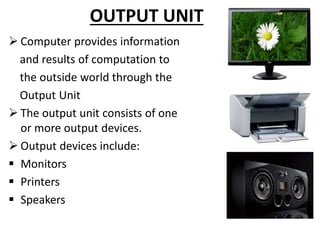
OUTPUT UNIT
 Computer provides information
and results of computation to
the outside world through the
Output Unit
 The output unit consists of one
or more output devices.
 Output devices include:
 Monitors
 Printers
 Speakers
FUNCTIONS OF OUTPUT UNIT
Accept the results produced by the computer.
(These are in a coded form.)
Convert it to a form that the outside world can
understand. (OR, Converts it into human
readable form.)
Supply the converted results to the outside
world.
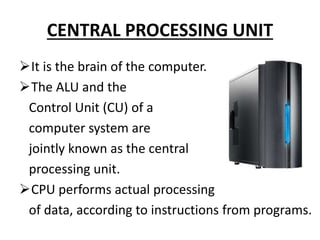
CENTRAL PROCESSING UNIT
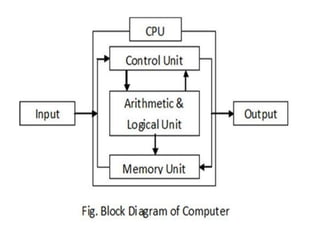
It is the brain of the computer.
The ALU and the
Control Unit (CU) of a
computer system are
jointly known as the central
processing unit.
CPU performs actual processing
of data, according to instructions from programs.
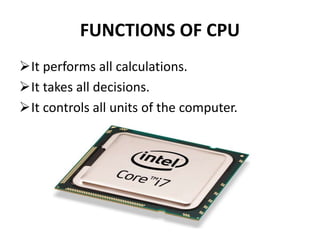
FUNCTIONS OF CPU
It performs all calculations.
It takes all decisions.
It controls all units of the computer.
CONTROL UNIT
It controls all other units in the computer.
It is the central nervous system of the
computer that controls and synchronizes
its working.
FUNCTIONS OF CONTROL UNIT
It instructs the input unit, where to store
the data after receiving it from the user.
It controls the flow of data and
instructions from the storage unit to ALU.
ARITHMETIC LOGIC UNIT
All calculations are performed in the
Arithmetic Logic Unit (ALU) of the computer.
FUNCTIONS OF ALU
It performs all arithmetic operations
(addition, subtraction, multiplication, and
division).
It performs all logic operations.
It does comparison and takes decision.
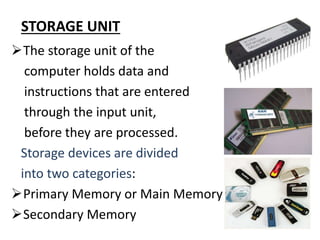
STORAGE UNIT
The storage unit of the
computer holds data and
instructions that are entered
through the input unit,
before they are processed.
Storage devices are divided
into two categories:
Primary Memory or Main Memory
Secondary Memory
FUNCTIONS OF STORAGE UNIT
It received the data and instructions
required for processing from the input
unit.
It stores the intermediate results.
It stores the final results before these
results are released to the output unit.
It saves data for later use.
block_diagram_of_computer.pptx

block_diagram_of_computer.pptx

  • 1.
    BLOCK DIAGRAM OFA COMPUTER
  • 3.
    INPUT UNIT Computer receivesdata and instructions through the Input Unit. The input unit consists of one or more input devices. Input devices include: Keyboard Mouse Joystick Scanner
  • 4.
    FUNCTIONS OF INPUTUNIT Accept the data and instructions from the outside world. Convert it to a form that the computer can understand. Supply the converted data to the computer system for further processing.
  • 5.
    OUTPUT UNIT  Computerprovides information and results of computation to the outside world through the Output Unit  The output unit consists of one or more output devices.  Output devices include:  Monitors  Printers  Speakers
  • 6.
    FUNCTIONS OF OUTPUTUNIT Accept the results produced by the computer. (These are in a coded form.) Convert it to a form that the outside world can understand. (OR, Converts it into human readable form.) Supply the converted results to the outside world.
  • 7.
    CENTRAL PROCESSING UNIT Itis the brain of the computer. The ALU and the Control Unit (CU) of a computer system are jointly known as the central processing unit. CPU performs actual processing of data, according to instructions from programs.
  • 8.
    FUNCTIONS OF CPU Itperforms all calculations. It takes all decisions. It controls all units of the computer.
  • 9.
    CONTROL UNIT It controlsall other units in the computer. It is the central nervous system of the computer that controls and synchronizes its working. FUNCTIONS OF CONTROL UNIT It instructs the input unit, where to store the data after receiving it from the user. It controls the flow of data and instructions from the storage unit to ALU.
  • 10.
    ARITHMETIC LOGIC UNIT Allcalculations are performed in the Arithmetic Logic Unit (ALU) of the computer. FUNCTIONS OF ALU It performs all arithmetic operations (addition, subtraction, multiplication, and division). It performs all logic operations. It does comparison and takes decision.
  • 11.
    STORAGE UNIT The storageunit of the computer holds data and instructions that are entered through the input unit, before they are processed. Storage devices are divided into two categories: Primary Memory or Main Memory Secondary Memory
  • 12.
    FUNCTIONS OF STORAGEUNIT It received the data and instructions required for processing from the input unit. It stores the intermediate results. It stores the final results before these results are released to the output unit. It saves data for later use.