Baseline Wandering
Digital Transmission: NRZ
CMS-A-CC-4-8
Lockdown Talk Series: DCNIT-LDTalks-4
Arunabha Saha
Department of Computer Science, Vidyasagar College
University of Calcutta
May 2020
Outline
Preliminaries : Bit Rate vs Signal Rate
Preliminaries: SNR vs E/BNR
Baseline Wandering Problem
Mathematical Explanation
Observations & Effects of Baseline Wander
Conclusions
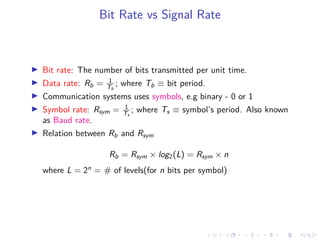
Bit Rate vs Signal Rate
Bit rate: The number of bits transmitted per unit time.
Data rate: Rb = 1
Tb
; where Tb ≡ bit period.
Communication systems uses symbols, e.g binary - 0 or 1
Symbol rate: Rsym = 1
Ts
; where Ts ≡ symbol’s period. Also known
as Baud rate.
Relation between Rb and Rsym
Rb = Rsym × log2(L) = Rsym × n
where L = 2n
= # of levels(for n bits per symbol)
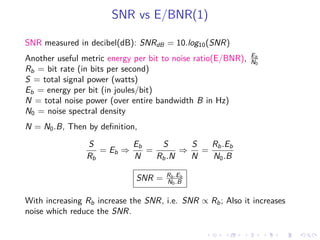
SNR vs E/BNR(1)
SNR measured in decibel(dB): SNRdB = 10.log10(SNR)
Another useful metric energy per bit to noise ratio(E/BNR), Eb
N0
Rb = bit rate (in bits per second)
S = total signal power (watts)
Eb = energy per bit (in joules/bit)
N = total noise power (over entire bandwidth B in Hz)
N0 = noise spectral density
N = N0.B, Then by definition,
S
Rb
= Eb ⇒
Eb
N
=
S
Rb.N
⇒
S
N
=
Rb.Eb
N0.B
SNR = Rb.Eb
N0.B
With increasing Rb increase the SNR, i.e. SNR ∝ Rb; Also it increases
noise which reduce the SNR.
SNR vs E/BNR(2)
In digital communications systems, the Eb/N0 ratio can be thought of as
a normalized signal-to-noise ratio.
We can roughly equate signal power to energy per bit by
Eb = Psignal .Ts
Eb
N0
generally used to establish the bit error rate(BER) for modulation
techniques.
NRZ Recap(1)
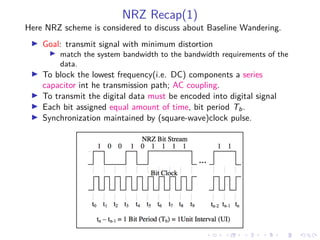
Here NRZ scheme is considered to discuss about Baseline Wandering.
Goal: transmit signal with minimum distortion
match the system bandwidth to the bandwidth requirements of the
data.
To block the lowest frequency(i.e. DC) components a series
capacitor int he transmission path; AC coupling.
To transmit the digital data must be encoded into digital signal
Each bit assigned equal amount of time, bit period Tb.
Synchronization maintained by (square-wave)clock pulse.
NRZ: PSD(2)
The power spectral density(PSD) of NRZ scheme mathematically given
by
Su(f ) = αTbSinc2
(Tbf ) (1)
where Sinc(x) = Sin(πx)
πx , α is proportionality constant and f is frequency
in Hz.
power spectrum of random NRZ data
NRZ: Low-Frequency(LF) Cutoff(3)
The NRZ power spectrum got modified on attenuating the LF
components. The normalized frequency, Tbfc represents the half-power
(3 dB) frequency termed as LF cutoff.
Loss of the low-frequency
portion of the signal power
will reduce the SNR and
thus degrade the BER.
By removing the LF
components the BER will
be reduced, known as
baseline wandering.
Baseline Wander(1)
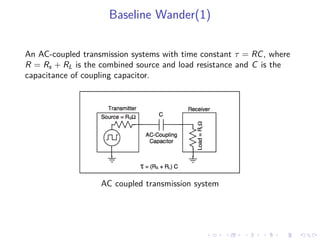
An AC-coupled transmission systems with time constant τ = RC, where
R = Rs + RL is the combined source and load resistance and C is the
capacitance of coupling capacitor.
AC coupled transmission system
Baseline Wander(2)
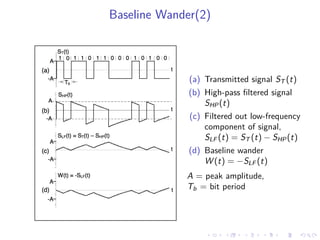
(a) Transmitted signal ST (t)
(b) High-pass filtered signal
SHP(t)
(c) Filtered out low-frequency
component of signal,
SLF (t) = ST (t) − SHP(t)
(d) Baseline wander
W (t) = −SLF (t)
A = peak amplitude,
Tb = bit period
Baseline Wander: Mathematical explanation(3)
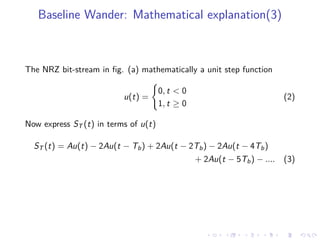
The NRZ bit-stream in fig. (a) mathematically a unit step function
u(t) =
0, t < 0
1, t ≥ 0
(2)
Now express ST (t) in terms of u(t)
ST (t) = Au(t) − 2Au(t − Tb) + 2Au(t − 2Tb) − 2Au(t − 4Tb)
+ 2Au(t − 5Tb) − .... (3)
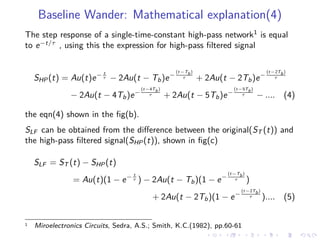
Baseline Wander: Mathematical explanation(4)
The step response of a single-time-constant high-pass network1
is equal
to e−t/τ
, using this the expression for high-pass filtered signal
SHP(t) = Au(t)e− t
τ − 2Au(t − Tb)e−
(t−Tb)
τ + 2Au(t − 2Tb)e−
(t−2Tb)
τ
− 2Au(t − 4Tb)e−
(t−4Tb)
τ + 2Au(t − 5Tb)e−
(t−5Tb)
τ − .... (4)
the eqn(4) shown in the fig(b).
SLF can be obtained from the difference between the original(ST (t)) and
the high-pass filtered signal(SHP(t)), shown in fig(c)
SLF = ST (t) − SHP(t)
= Au(t)(1 − e− t
τ ) − 2Au(t − Tb)(1 − e−
(t−Tb)
τ )
+ 2Au(t − 2Tb)(1 − e−
(t−2Tb)
τ ).... (5)
1 Miroelectronics Circuits, Sedra, A.S.; Smith, K.C.(1982), pp.60-61
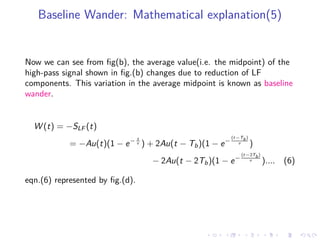
Baseline Wander: Mathematical explanation(5)
Now we can see from fig(b), the average value(i.e. the midpoint) of the
high-pass signal shown in fig.(b) changes due to reduction of LF
components. This variation in the average midpoint is known as baseline
wander.
W (t) = −SLF (t)
= −Au(t)(1 − e− t
τ ) + 2Au(t − Tb)(1 − e−
(t−Tb)
τ )
− 2Au(t − 2Tb)(1 − e−
(t−2Tb)
τ ).... (6)
eqn.(6) represented by fig.(d).
Observations: CBD definition(1)
Define Cumulative bit difference(CBD), difference between the number of
transmitted zeros and the number of transmitted ones2
,
CBD[n] = N0[n] − N1[n] (7)
where CBD[n] = cumulative bit difference at the n-th bit of the pattern
N0 = cumulative number of 0s in the pattern up to the n-th bit
N1 = cumulative number of 1s in the pattern up to the n-th bit
2 NRZ Bandwidth – LF Cutoff and Baseline Wander, Maxim Integerted
Observations
Magnitude of baseline wander in NRZ determined by CBD[n] and LF
cutoff.
Baseline wander changes fastest when there are consecutive identical
digits(CID), and this also changes the CBD too.
Apart from CIDs, and imbalance in number of 0s and 1s create
wandering.
The baseline wander depend on the CBD only when the CBD is
computed over a number of bit periods that constitute a small
fraction of one time constant.
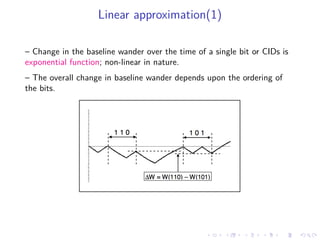
Linear approximation(1)
– Change in the baseline wander over the time of a single bit or CIDs is
exponential function; non-linear in nature.
– The overall change in baseline wander depends upon the ordering of
the bits.
Linear approximation(2)
– Assumption: rate of change of baseline wander is constant(i.e. linear).
– For linear baseline wander, the offset will adds up linearly irrespective of
the bit pattern.
– Then approximate baseline wander can be a function of local CBD.
using the linear approximation, eqn.(6) reduced to,
W (t) = −Au(t) 1 −
t
Tb
+ 2Au(t − Tb) 1 −
t − Tb
τ
(8)
– Taking summation over entire bit sequence in eqn.(8)
W (t) = CBD[n] ×
Tb
τ
(9)
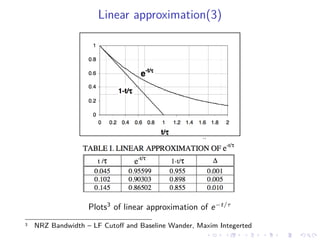
Linear approximation(3)
Plots3
of linear approximation of e−t/τ
3 NRZ Bandwidth – LF Cutoff and Baseline Wander, Maxim Integerted
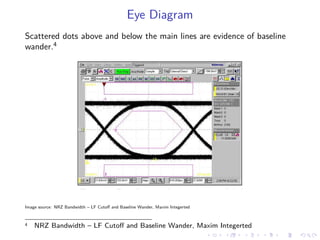
Eye Diagram
Scattered dots above and below the main lines are evidence of baseline
wander.4
Image source: NRZ Bandwidth – LF Cutoff and Baseline Wander, Maxim Integerted
4 NRZ Bandwidth – LF Cutoff and Baseline Wander, Maxim Integerted
Wrap-up with Conclusions
Q. What is Baseline wander? reason? result?
– It is a slow variation the the average of the signal waveform.
Caused by attenuation and LF components of the signal.
Increase jitter and reduce BER.
Q. How can be controlled?
– Ensuring nearly equal number of 0s and 1s will manage to keep small
LF cutoff.
Using some smart coding techniques, e.g. data scrambling and 8b/10b
encoding to control CBD and limit LF contents.
Thank You
Image source: Google Images
all materials and codes are copyright protected under GNU GPL and Creative Commons(cc) license. Anyone can share or redistribute for
non-commercial purpose only. Usage of any lecture materials or(and) codes by any individual or institution for commercial benefits or
advancement without permission is strictly prohibited.

Baseline Wandering

  • 1.
    Baseline Wandering Digital Transmission:NRZ CMS-A-CC-4-8 Lockdown Talk Series: DCNIT-LDTalks-4 Arunabha Saha Department of Computer Science, Vidyasagar College University of Calcutta May 2020
  • 2.
    Outline Preliminaries : BitRate vs Signal Rate Preliminaries: SNR vs E/BNR Baseline Wandering Problem Mathematical Explanation Observations & Effects of Baseline Wander Conclusions
  • 3.
    Bit Rate vsSignal Rate Bit rate: The number of bits transmitted per unit time. Data rate: Rb = 1 Tb ; where Tb ≡ bit period. Communication systems uses symbols, e.g binary - 0 or 1 Symbol rate: Rsym = 1 Ts ; where Ts ≡ symbol’s period. Also known as Baud rate. Relation between Rb and Rsym Rb = Rsym × log2(L) = Rsym × n where L = 2n = # of levels(for n bits per symbol)
  • 4.
    SNR vs E/BNR(1) SNRmeasured in decibel(dB): SNRdB = 10.log10(SNR) Another useful metric energy per bit to noise ratio(E/BNR), Eb N0 Rb = bit rate (in bits per second) S = total signal power (watts) Eb = energy per bit (in joules/bit) N = total noise power (over entire bandwidth B in Hz) N0 = noise spectral density N = N0.B, Then by definition, S Rb = Eb ⇒ Eb N = S Rb.N ⇒ S N = Rb.Eb N0.B SNR = Rb.Eb N0.B With increasing Rb increase the SNR, i.e. SNR ∝ Rb; Also it increases noise which reduce the SNR.
  • 5.
    SNR vs E/BNR(2) Indigital communications systems, the Eb/N0 ratio can be thought of as a normalized signal-to-noise ratio. We can roughly equate signal power to energy per bit by Eb = Psignal .Ts Eb N0 generally used to establish the bit error rate(BER) for modulation techniques.
  • 6.
    NRZ Recap(1) Here NRZscheme is considered to discuss about Baseline Wandering. Goal: transmit signal with minimum distortion match the system bandwidth to the bandwidth requirements of the data. To block the lowest frequency(i.e. DC) components a series capacitor int he transmission path; AC coupling. To transmit the digital data must be encoded into digital signal Each bit assigned equal amount of time, bit period Tb. Synchronization maintained by (square-wave)clock pulse.
  • 7.
    NRZ: PSD(2) The powerspectral density(PSD) of NRZ scheme mathematically given by Su(f ) = αTbSinc2 (Tbf ) (1) where Sinc(x) = Sin(πx) πx , α is proportionality constant and f is frequency in Hz. power spectrum of random NRZ data
  • 8.
    NRZ: Low-Frequency(LF) Cutoff(3) TheNRZ power spectrum got modified on attenuating the LF components. The normalized frequency, Tbfc represents the half-power (3 dB) frequency termed as LF cutoff. Loss of the low-frequency portion of the signal power will reduce the SNR and thus degrade the BER. By removing the LF components the BER will be reduced, known as baseline wandering.
  • 9.
    Baseline Wander(1) An AC-coupledtransmission systems with time constant τ = RC, where R = Rs + RL is the combined source and load resistance and C is the capacitance of coupling capacitor. AC coupled transmission system
  • 10.
    Baseline Wander(2) (a) Transmittedsignal ST (t) (b) High-pass filtered signal SHP(t) (c) Filtered out low-frequency component of signal, SLF (t) = ST (t) − SHP(t) (d) Baseline wander W (t) = −SLF (t) A = peak amplitude, Tb = bit period
  • 11.
    Baseline Wander: Mathematicalexplanation(3) The NRZ bit-stream in fig. (a) mathematically a unit step function u(t) = 0, t < 0 1, t ≥ 0 (2) Now express ST (t) in terms of u(t) ST (t) = Au(t) − 2Au(t − Tb) + 2Au(t − 2Tb) − 2Au(t − 4Tb) + 2Au(t − 5Tb) − .... (3)
  • 12.
    Baseline Wander: Mathematicalexplanation(4) The step response of a single-time-constant high-pass network1 is equal to e−t/τ , using this the expression for high-pass filtered signal SHP(t) = Au(t)e− t τ − 2Au(t − Tb)e− (t−Tb) τ + 2Au(t − 2Tb)e− (t−2Tb) τ − 2Au(t − 4Tb)e− (t−4Tb) τ + 2Au(t − 5Tb)e− (t−5Tb) τ − .... (4) the eqn(4) shown in the fig(b). SLF can be obtained from the difference between the original(ST (t)) and the high-pass filtered signal(SHP(t)), shown in fig(c) SLF = ST (t) − SHP(t) = Au(t)(1 − e− t τ ) − 2Au(t − Tb)(1 − e− (t−Tb) τ ) + 2Au(t − 2Tb)(1 − e− (t−2Tb) τ ).... (5) 1 Miroelectronics Circuits, Sedra, A.S.; Smith, K.C.(1982), pp.60-61
  • 13.
    Baseline Wander: Mathematicalexplanation(5) Now we can see from fig(b), the average value(i.e. the midpoint) of the high-pass signal shown in fig.(b) changes due to reduction of LF components. This variation in the average midpoint is known as baseline wander. W (t) = −SLF (t) = −Au(t)(1 − e− t τ ) + 2Au(t − Tb)(1 − e− (t−Tb) τ ) − 2Au(t − 2Tb)(1 − e− (t−2Tb) τ ).... (6) eqn.(6) represented by fig.(d).
  • 14.
    Observations: CBD definition(1) DefineCumulative bit difference(CBD), difference between the number of transmitted zeros and the number of transmitted ones2 , CBD[n] = N0[n] − N1[n] (7) where CBD[n] = cumulative bit difference at the n-th bit of the pattern N0 = cumulative number of 0s in the pattern up to the n-th bit N1 = cumulative number of 1s in the pattern up to the n-th bit 2 NRZ Bandwidth – LF Cutoff and Baseline Wander, Maxim Integerted
  • 15.
    Observations Magnitude of baselinewander in NRZ determined by CBD[n] and LF cutoff. Baseline wander changes fastest when there are consecutive identical digits(CID), and this also changes the CBD too. Apart from CIDs, and imbalance in number of 0s and 1s create wandering. The baseline wander depend on the CBD only when the CBD is computed over a number of bit periods that constitute a small fraction of one time constant.
  • 16.
    Linear approximation(1) – Changein the baseline wander over the time of a single bit or CIDs is exponential function; non-linear in nature. – The overall change in baseline wander depends upon the ordering of the bits.
  • 17.
    Linear approximation(2) – Assumption:rate of change of baseline wander is constant(i.e. linear). – For linear baseline wander, the offset will adds up linearly irrespective of the bit pattern. – Then approximate baseline wander can be a function of local CBD. using the linear approximation, eqn.(6) reduced to, W (t) = −Au(t) 1 − t Tb + 2Au(t − Tb) 1 − t − Tb τ (8) – Taking summation over entire bit sequence in eqn.(8) W (t) = CBD[n] × Tb τ (9)
  • 18.
    Linear approximation(3) Plots3 of linearapproximation of e−t/τ 3 NRZ Bandwidth – LF Cutoff and Baseline Wander, Maxim Integerted
  • 19.
    Eye Diagram Scattered dotsabove and below the main lines are evidence of baseline wander.4 Image source: NRZ Bandwidth – LF Cutoff and Baseline Wander, Maxim Integerted 4 NRZ Bandwidth – LF Cutoff and Baseline Wander, Maxim Integerted
  • 20.
    Wrap-up with Conclusions Q.What is Baseline wander? reason? result? – It is a slow variation the the average of the signal waveform. Caused by attenuation and LF components of the signal. Increase jitter and reduce BER. Q. How can be controlled? – Ensuring nearly equal number of 0s and 1s will manage to keep small LF cutoff. Using some smart coding techniques, e.g. data scrambling and 8b/10b encoding to control CBD and limit LF contents.
  • 21.
    Thank You Image source:Google Images all materials and codes are copyright protected under GNU GPL and Creative Commons(cc) license. Anyone can share or redistribute for non-commercial purpose only. Usage of any lecture materials or(and) codes by any individual or institution for commercial benefits or advancement without permission is strictly prohibited.