Polar-NRZ & Polar-RZ
Line Coding: Polar encoding Techniques
CMS-A-CC-4-8
Lockdown Talk Series: DCNIT-LDTalks-5
Arunabha Saha
Department of Computer Science, Vidyasagar College
University of Calcutta
May 2020
Outline
Overview of polar encoding
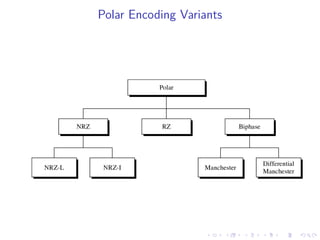
Variants of polar encoding schemes
NRZ-L and NRZ-I scheme
Polar-RZ scheme
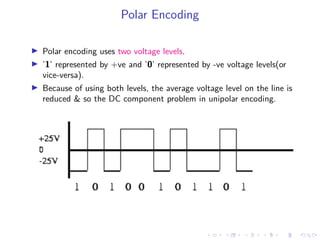
Polar Encoding
Polar encoding uses two voltage levels.
’1’ represented by +ve and ’0’ represented by -ve voltage levels(or
vice-versa).
Because of using both levels, the average voltage level on the line is
reduced & so the DC component problem in unipolar encoding.
Polar Encoding Variants
Polar-NRZ(1)
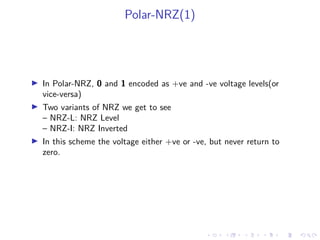
In Polar-NRZ, 0 and 1 encoded as +ve and -ve voltage levels(or
vice-versa)
Two variants of NRZ we get to see
– NRZ-L: NRZ Level
– NRZ-I: NRZ Inverted
In this scheme the voltage either +ve or -ve, but never return to
zero.
Polar-NRZ(2)
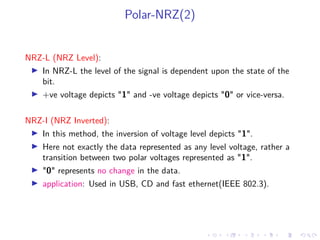
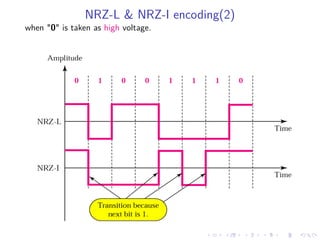
NRZ-L (NRZ Level):
In NRZ-L the level of the signal is dependent upon the state of the
bit.
+ve voltage depicts "1" and -ve voltage depicts "0" or vice-versa.
NRZ-I (NRZ Inverted):
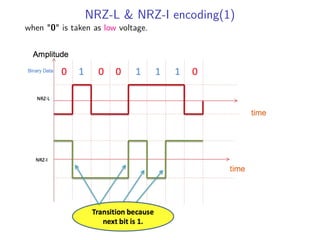
In this method, the inversion of voltage level depicts "1".
Here not exactly the data represented as any level voltage, rather a
transition between two polar voltages represented as "1".
"0" represents no change in the data.
application: Used in USB, CD and fast ethernet(IEEE 802.3).
NRZ-L & NRZ-I encoding(1)
when "0" is taken as low voltage.
NRZ-L & NRZ-I encoding(2)
when "0" is taken as high voltage.
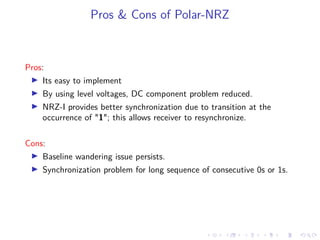
Pros & Cons of Polar-NRZ
Pros:
Its easy to implement
By using level voltages, DC component problem reduced.
NRZ-I provides better synchronization due to transition at the
occurrence of "1"; this allows receiver to resynchronize.
Cons:
Baseline wandering issue persists.
Synchronization problem for long sequence of consecutive 0s or 1s.
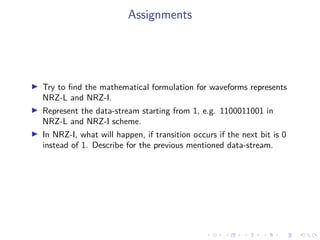
Assignments
Try to find the mathematical formulation for waveforms represents
NRZ-L and NRZ-I.
Represent the data-stream starting from 1, e.g. 1100011001 in
NRZ-L and NRZ-I scheme.
In NRZ-I, what will happen, if transition occurs if the next bit is 0
instead of 1. Describe for the previous mentioned data-stream.
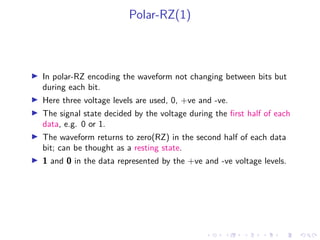
Polar-RZ(1)
In polar-RZ encoding the waveform not changing between bits but
during each bit.
Here three voltage levels are used, 0, +ve and -ve.
The signal state decided by the voltage during the first half of each
data, e.g. 0 or 1.
The waveform returns to zero(RZ) in the second half of each data
bit; can be thought as a resting state.
1 and 0 in the data represented by the +ve and -ve voltage levels.
Polar-RZ(2)
[assignment: find the mathematical expression for the waveform]
Pros & Cons of Polar-RZ
Pros:
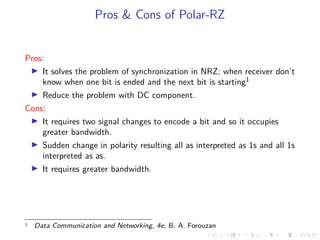
It solves the problem of synchronization in NRZ; when receiver don’t
know when one bit is ended and the next bit is starting1
Reduce the problem with DC component.
Cons:
It requires two signal changes to encode a bit and so it occupies
greater bandwidth.
Sudden change in polarity resulting all as interpreted as 1s and all 1s
interpreted as as.
It requires greater bandwidth.
1 Data Communication and Networking, 4e, B. A. Forouzan
Thank You
Image source: Google Images
all materials and codes are copyright protected under GNU GPL and Creative Commons(cc) license. Anyone can share or redistribute for
non-commercial purpose only. Usage of any lecture materials or(and) codes by any individual or institution for commercial benefits or
advancement without permission is strictly prohibited.

Polar-NRZ & Polar-RZ encoding schemes

  • 1.
    Polar-NRZ & Polar-RZ LineCoding: Polar encoding Techniques CMS-A-CC-4-8 Lockdown Talk Series: DCNIT-LDTalks-5 Arunabha Saha Department of Computer Science, Vidyasagar College University of Calcutta May 2020
  • 2.
    Outline Overview of polarencoding Variants of polar encoding schemes NRZ-L and NRZ-I scheme Polar-RZ scheme
  • 3.
    Polar Encoding Polar encodinguses two voltage levels. ’1’ represented by +ve and ’0’ represented by -ve voltage levels(or vice-versa). Because of using both levels, the average voltage level on the line is reduced & so the DC component problem in unipolar encoding.
  • 4.
  • 5.
    Polar-NRZ(1) In Polar-NRZ, 0and 1 encoded as +ve and -ve voltage levels(or vice-versa) Two variants of NRZ we get to see – NRZ-L: NRZ Level – NRZ-I: NRZ Inverted In this scheme the voltage either +ve or -ve, but never return to zero.
  • 6.
    Polar-NRZ(2) NRZ-L (NRZ Level): InNRZ-L the level of the signal is dependent upon the state of the bit. +ve voltage depicts "1" and -ve voltage depicts "0" or vice-versa. NRZ-I (NRZ Inverted): In this method, the inversion of voltage level depicts "1". Here not exactly the data represented as any level voltage, rather a transition between two polar voltages represented as "1". "0" represents no change in the data. application: Used in USB, CD and fast ethernet(IEEE 802.3).
  • 7.
    NRZ-L & NRZ-Iencoding(1) when "0" is taken as low voltage.
  • 8.
    NRZ-L & NRZ-Iencoding(2) when "0" is taken as high voltage.
  • 9.
    Pros & Consof Polar-NRZ Pros: Its easy to implement By using level voltages, DC component problem reduced. NRZ-I provides better synchronization due to transition at the occurrence of "1"; this allows receiver to resynchronize. Cons: Baseline wandering issue persists. Synchronization problem for long sequence of consecutive 0s or 1s.
  • 10.
    Assignments Try to findthe mathematical formulation for waveforms represents NRZ-L and NRZ-I. Represent the data-stream starting from 1, e.g. 1100011001 in NRZ-L and NRZ-I scheme. In NRZ-I, what will happen, if transition occurs if the next bit is 0 instead of 1. Describe for the previous mentioned data-stream.
  • 11.
    Polar-RZ(1) In polar-RZ encodingthe waveform not changing between bits but during each bit. Here three voltage levels are used, 0, +ve and -ve. The signal state decided by the voltage during the first half of each data, e.g. 0 or 1. The waveform returns to zero(RZ) in the second half of each data bit; can be thought as a resting state. 1 and 0 in the data represented by the +ve and -ve voltage levels.
  • 12.
    Polar-RZ(2) [assignment: find themathematical expression for the waveform]
  • 13.
    Pros & Consof Polar-RZ Pros: It solves the problem of synchronization in NRZ; when receiver don’t know when one bit is ended and the next bit is starting1 Reduce the problem with DC component. Cons: It requires two signal changes to encode a bit and so it occupies greater bandwidth. Sudden change in polarity resulting all as interpreted as 1s and all 1s interpreted as as. It requires greater bandwidth. 1 Data Communication and Networking, 4e, B. A. Forouzan
  • 14.
    Thank You Image source:Google Images all materials and codes are copyright protected under GNU GPL and Creative Commons(cc) license. Anyone can share or redistribute for non-commercial purpose only. Usage of any lecture materials or(and) codes by any individual or institution for commercial benefits or advancement without permission is strictly prohibited.