Line Coding Schemes
Digital Transmission: D/D Conversion
CMS-A-CC-4-8
Lockdown Talk Series: DCNIT-LDTalks-2
Arunabha Saha
Department of Computer Science, Vidyasagar College
University of Calcutta
April 2020
Outline
Introduction to Line Coding
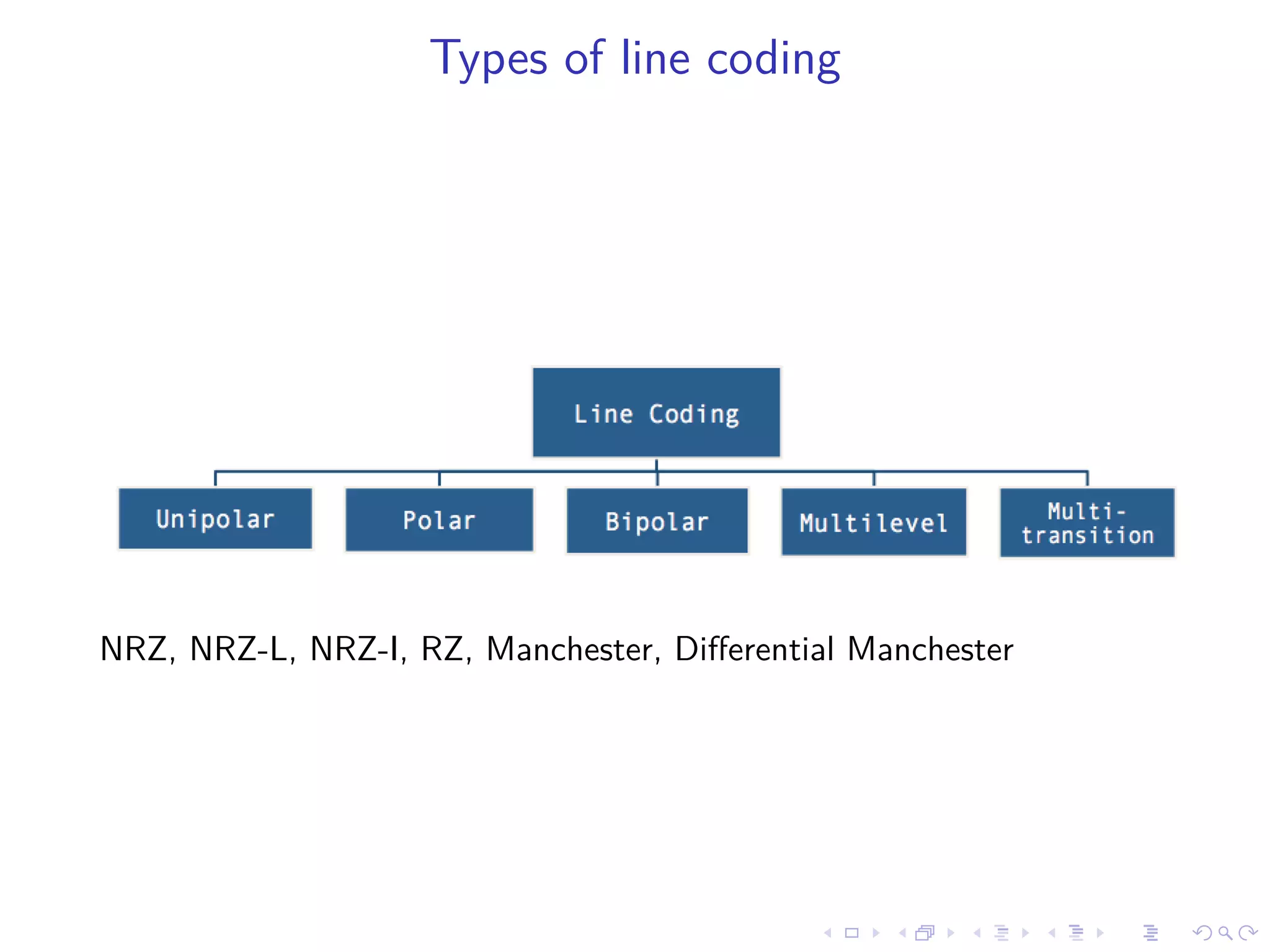
Classification of line coding schemes
Properties of line coding
Applications
Line coding(1)
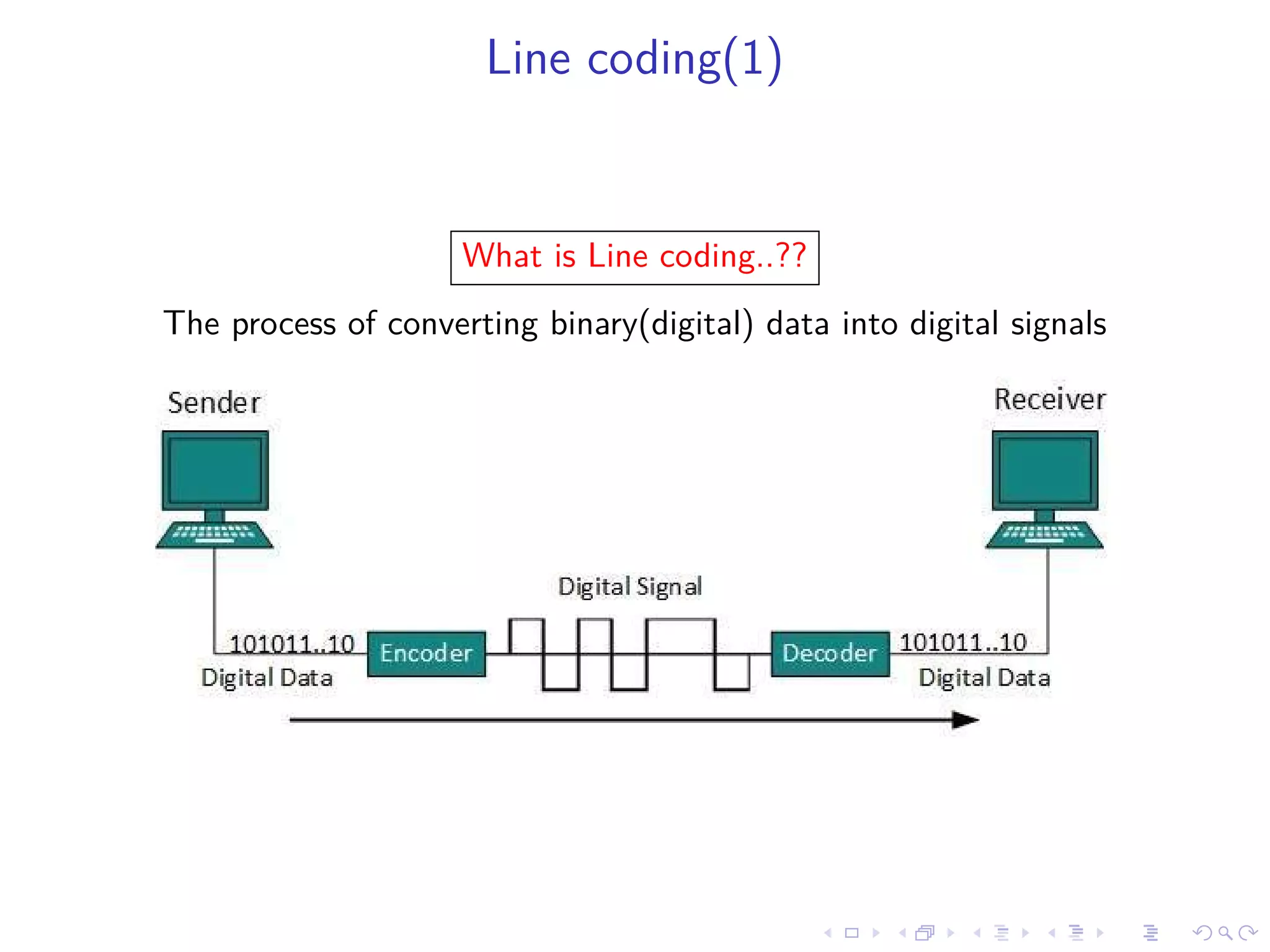
What is Line coding..??
The process of converting binary(digital) data into digital signals
Line coding(2)
Also known as Baseband transmission
Baseband signals(or lowpass) , which includes the frequencies close
to 0 in comparison with the highest frequency
It uses baseband channel(or lowpass) to transfer the low frequencies;
e.g. serial cable, LAN.
The output of a multiplexer is coded into electrical pulses or waveforms
for the purpose of transmission ovr the channel. This process is called line
coding1
.
1 Modern Digital and Analog Communication Systems, 3e, B.P. Lathi, OUP, 1998
Types of line coding
NRZ, NRZ-L, NRZ-I, RZ, Manchester, Differential Manchester
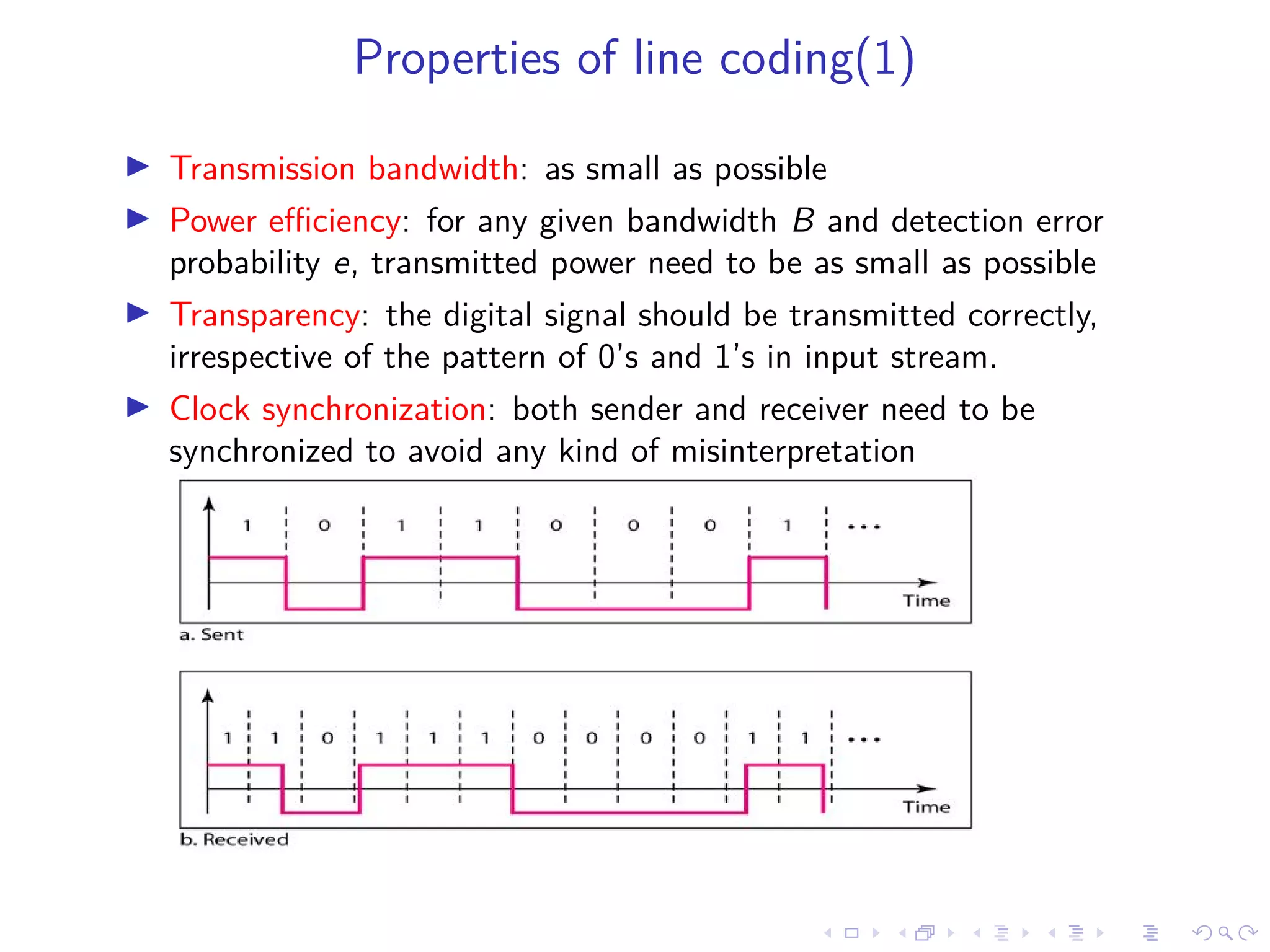
Properties of line coding(1)
Transmission bandwidth: as small as possible
Power efficiency: for any given bandwidth B and detection error
probability e, transmitted power need to be as small as possible
Transparency: the digital signal should be transmitted correctly,
irrespective of the pattern of 0’s and 1’s in input stream.
Clock synchronization: both sender and receiver need to be
synchronized to avoid any kind of misinterpretation
Properties....(2)
Error handling: error should be detected and corrected properly
Baseline wandering: In decoding a digital signal, the receiver
calculates a running average of the received signal power. This
average is called the baseline. The incoming signal power is
evaluated against this baseline to determine the value of the data
element. A long string of 0s or 1s can result a drift in the baseline
(baseline wandering) and introduce errors in decoded output. A
good line coding scheme needs to prevent baseline wandering.
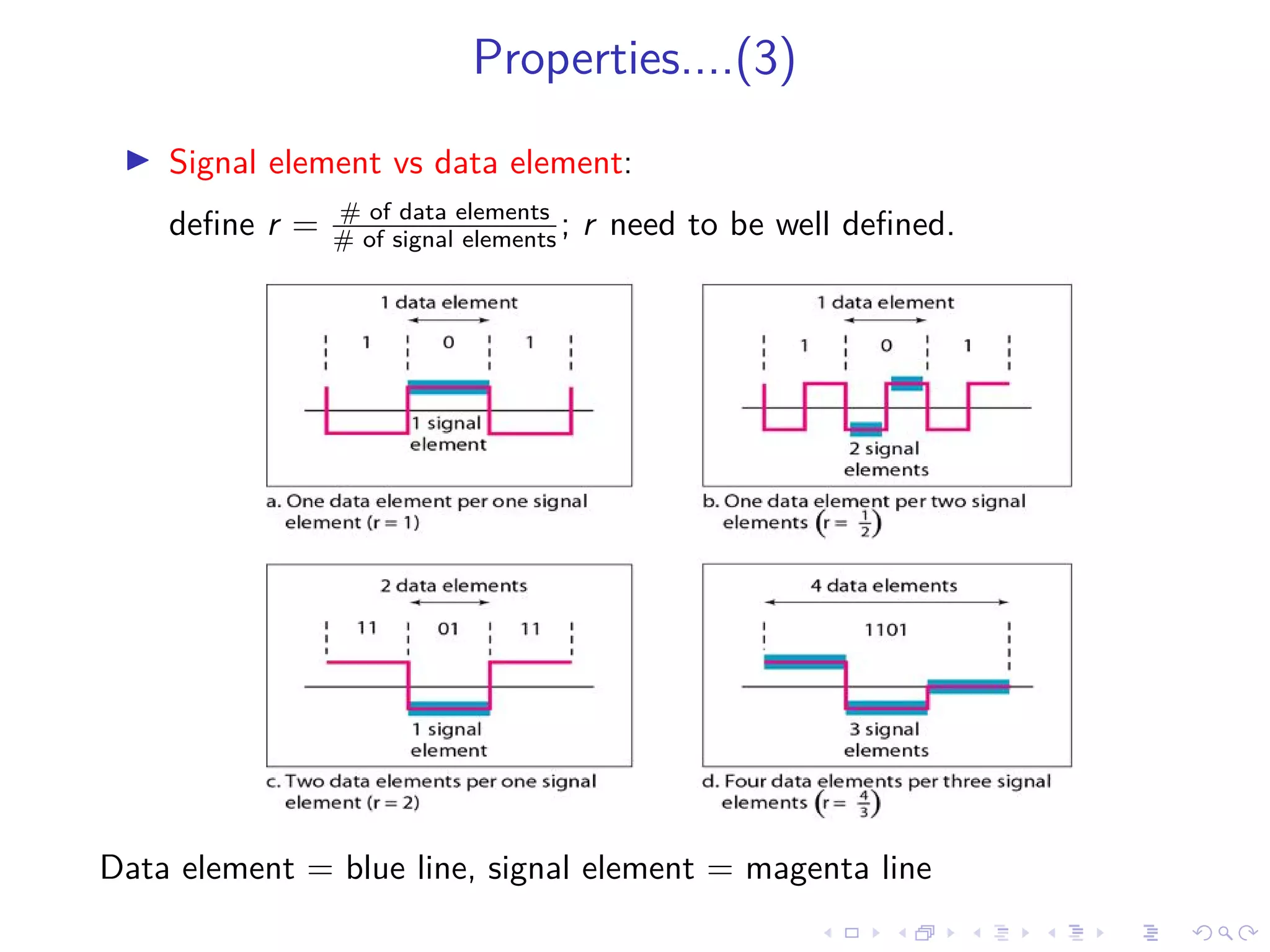
Properties....(3)
Signal element vs data element:
define r = # of data elements
# of signal elements ; r need to be well defined.
Data element = blue line, signal element = magenta line
Applications
Data transmission over LAN and WAN.
Pulse shaping and relocation without modulation or filtering.
e.g. in telephonic transmission, the transfer characteristics highly
attenuated bellow 300 Hz.
References
Modern Digital and Analog Communication Systems, 3e, Lathi,B.P.
(1998), OUP.
Computer Networks, 5e, Tanenbaum, A. S.; Wetherall, D.J. (2011),
Prentice Hall.
Thank You
Image source: Google Images
all materials and codes are copyright protected under GNU GPL and Creative Commons(cc) license. Anyone can share or redistribute for
non-commercial purpose only. Usage of any lecture materials or(and) codes by any individual or institution for commercial benefits or
advancement without permission is strictly prohibited.

Introduction to Line Coding Schemes

  • 1.
    Line Coding Schemes DigitalTransmission: D/D Conversion CMS-A-CC-4-8 Lockdown Talk Series: DCNIT-LDTalks-2 Arunabha Saha Department of Computer Science, Vidyasagar College University of Calcutta April 2020
  • 2.
    Outline Introduction to LineCoding Classification of line coding schemes Properties of line coding Applications
  • 3.
    Line coding(1) What isLine coding..?? The process of converting binary(digital) data into digital signals
  • 4.
    Line coding(2) Also knownas Baseband transmission Baseband signals(or lowpass) , which includes the frequencies close to 0 in comparison with the highest frequency It uses baseband channel(or lowpass) to transfer the low frequencies; e.g. serial cable, LAN. The output of a multiplexer is coded into electrical pulses or waveforms for the purpose of transmission ovr the channel. This process is called line coding1 . 1 Modern Digital and Analog Communication Systems, 3e, B.P. Lathi, OUP, 1998
  • 5.
    Types of linecoding NRZ, NRZ-L, NRZ-I, RZ, Manchester, Differential Manchester
  • 6.
    Properties of linecoding(1) Transmission bandwidth: as small as possible Power efficiency: for any given bandwidth B and detection error probability e, transmitted power need to be as small as possible Transparency: the digital signal should be transmitted correctly, irrespective of the pattern of 0’s and 1’s in input stream. Clock synchronization: both sender and receiver need to be synchronized to avoid any kind of misinterpretation
  • 7.
    Properties....(2) Error handling: errorshould be detected and corrected properly Baseline wandering: In decoding a digital signal, the receiver calculates a running average of the received signal power. This average is called the baseline. The incoming signal power is evaluated against this baseline to determine the value of the data element. A long string of 0s or 1s can result a drift in the baseline (baseline wandering) and introduce errors in decoded output. A good line coding scheme needs to prevent baseline wandering.
  • 8.
    Properties....(3) Signal element vsdata element: define r = # of data elements # of signal elements ; r need to be well defined. Data element = blue line, signal element = magenta line
  • 9.
    Applications Data transmission overLAN and WAN. Pulse shaping and relocation without modulation or filtering. e.g. in telephonic transmission, the transfer characteristics highly attenuated bellow 300 Hz. References Modern Digital and Analog Communication Systems, 3e, Lathi,B.P. (1998), OUP. Computer Networks, 5e, Tanenbaum, A. S.; Wetherall, D.J. (2011), Prentice Hall.
  • 10.
    Thank You Image source:Google Images all materials and codes are copyright protected under GNU GPL and Creative Commons(cc) license. Anyone can share or redistribute for non-commercial purpose only. Usage of any lecture materials or(and) codes by any individual or institution for commercial benefits or advancement without permission is strictly prohibited.