Types Of Risks and Its Management
In Banking & Rural Finance
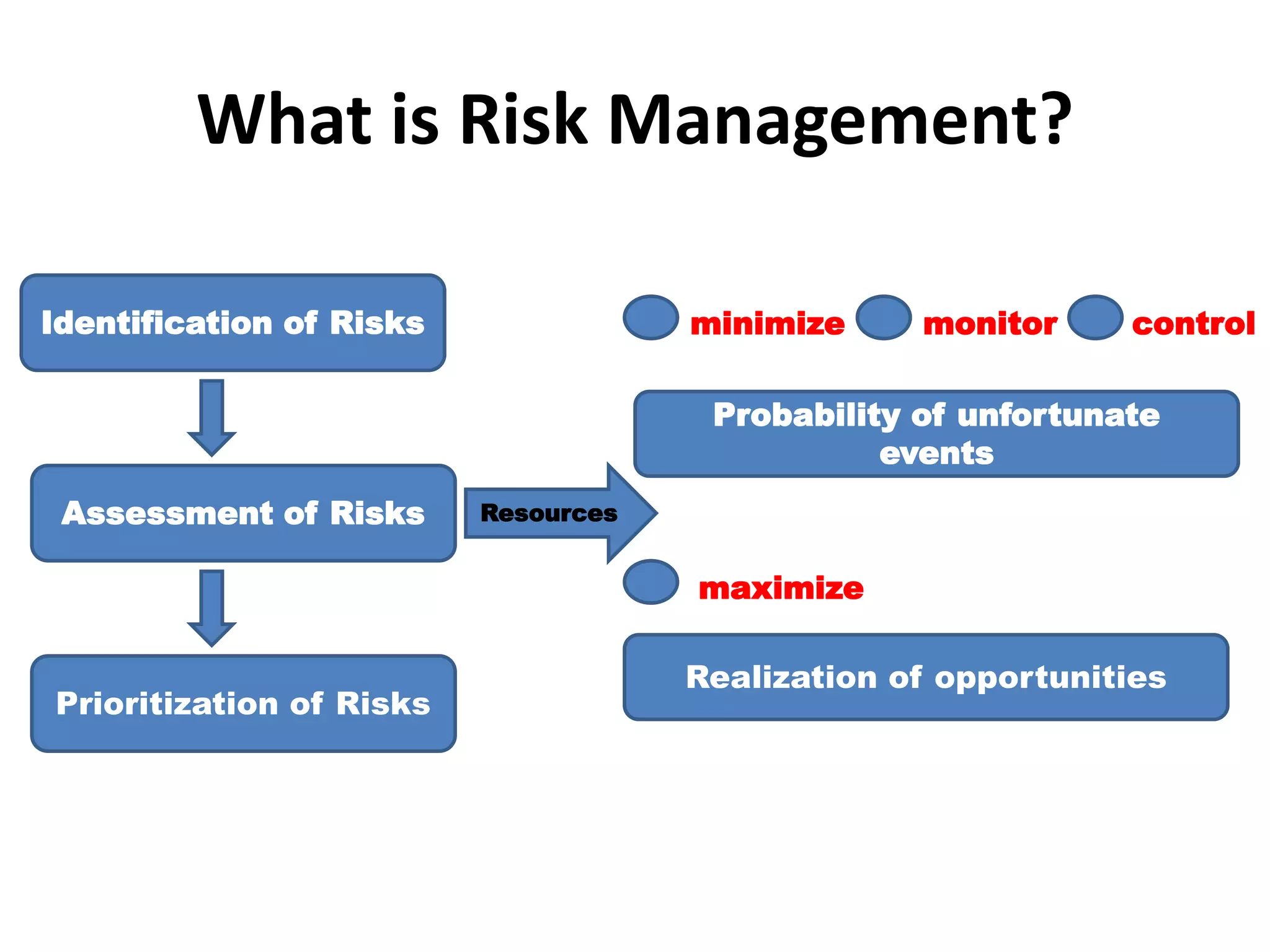
What is Risk Management?
Identification of Risks
Assessment of Risks
Prioritization of Risks
minimize monitor control
Probability of unfortunate
events
maximize
Realization of opportunities
Resources
Types of Risk in Banking &
Rural Finance
Credit or Default Risk
Liquidity Risk
Interest Rate Risk
Market Risk
Credit Risk
 Credit risk is the risk of
default on a debt that
may arise from a
borrower failing to make
required payments
Methods to measure
Expected Loss Method
Altman Z score
Credit Risk -Expected Loss
Method
Probability of Default
(PD)
is the likelihood that a loan
will not be repaid and will
fall into default.
The credit history of the
borrower and the nature of
the investment must be
taken into consideration
when calculating PD
Loss Given Default
(LGD)
the credit loss incurred if
an obligor of the bank
defaults.
LGD = 1- RR
Exposure at Default
(EAD)
is equal to outstanding loan
amount (OS) plus the
percentage of unused loan
commitment (COM) drawn-
down by the borrower
EAD = OS + (COM – OS) *
(UGD)
Altman Z score
= 1.2*X1 + 1.4*X2 + 3.3*X3 + 0.6*X4 + 0.99*X5
Where :
X1 is Working capital / Total Assets
X2 is Retained Earning / Total Assets
X3 is EBITDA/ Total Assets
X4 is market Value of Equity / Total Liabilities
X5 is Net Sales / Total Assets
Liquidity Risk
 Liquidity risk occurs when
an individual investor,
business or financial
institution cannot meet
short-term debt obligations
 Method to measure :-
Liquidity Coverage Ratio
Net Stable Funding Ratio
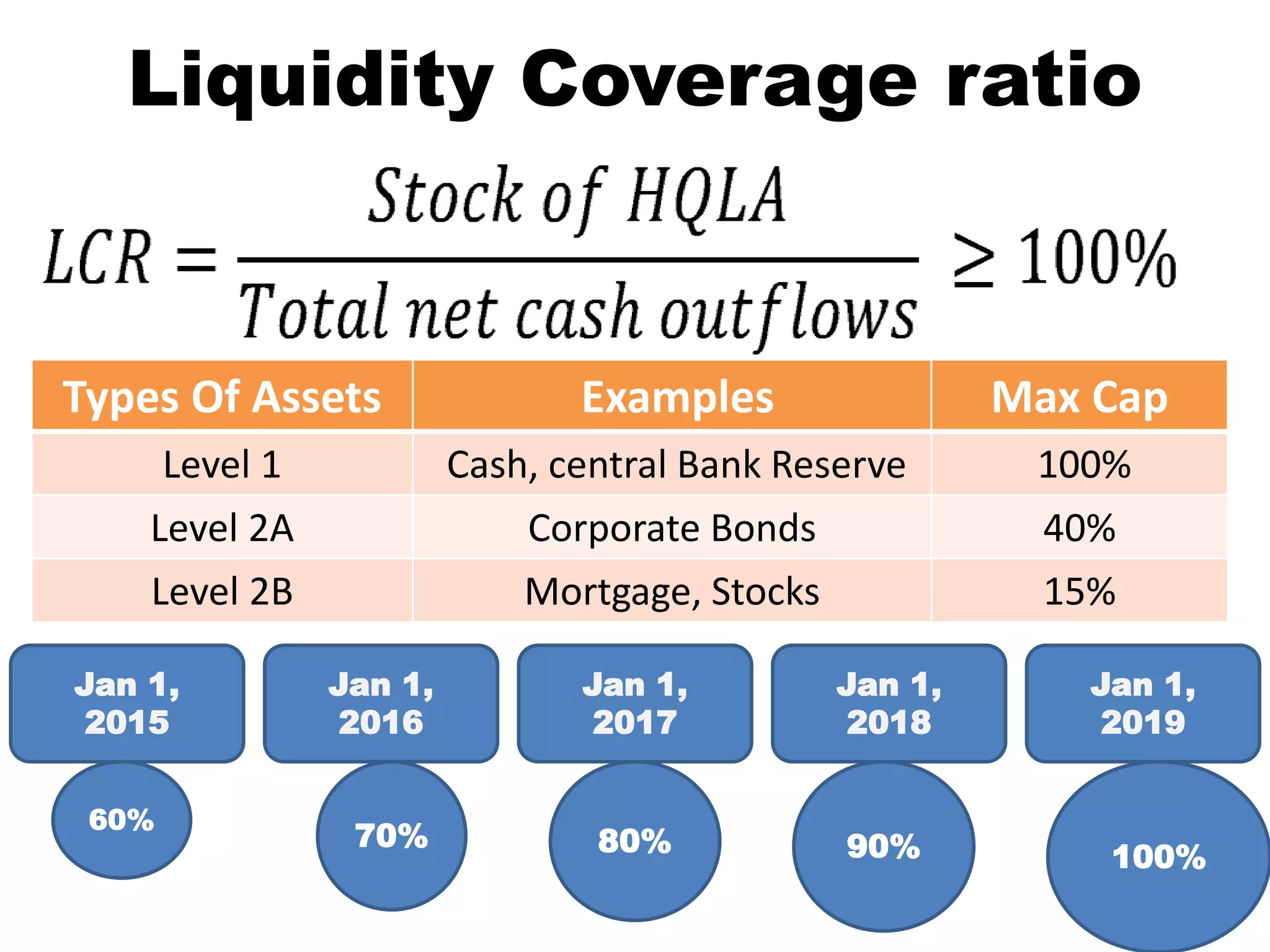
Liquidity Coverage ratio
Types Of Assets Examples Max Cap
Level 1 Cash, central Bank Reserve 100%
Level 2A Corporate Bonds 40%
Level 2B Mortgage, Stocks 15%
Jan 1,
2015
Jan 1,
2016
Jan 1,
2017
Jan 1,
2018
Jan 1,
2019
60%
70% 80%
100%90%
Interest Rate Risk
The Potential loss from
unexpected changes in
Interest rate which can
significantly alter the
bank profitability and
market value of equity
Interest Rate Risk
Management
Repricing
Risk
Yield Curve
Risk
Basic Risk
Embedded
Option Risk
Market Risk
Market risk is the
possibility for an investor
to experience losses due
to factors that affect the
overall performance of
the financial markets in
which he is involved
Method to measure ; -
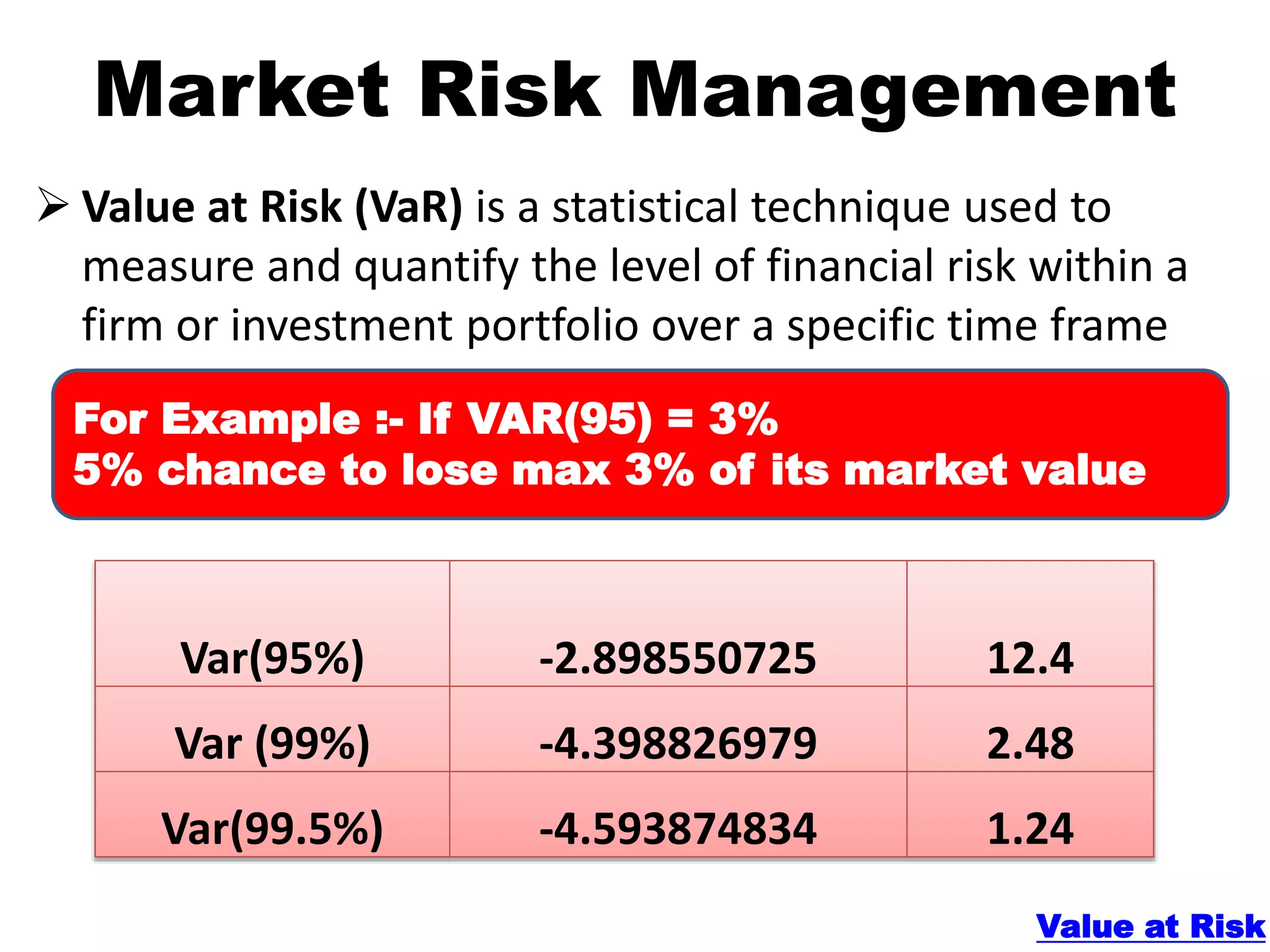
Value at Risk
For Example :- If VAR(95) = 3%
5% chance to lose max 3% of its market value
Market Risk Management
 Value at Risk (VaR) is a statistical technique used to
measure and quantify the level of financial risk within a
firm or investment portfolio over a specific time frame
Var(95%) -2.898550725 12.4
Var (99%) -4.398826979 2.48
Var(99.5%) -4.593874834 1.24
Value at Risk
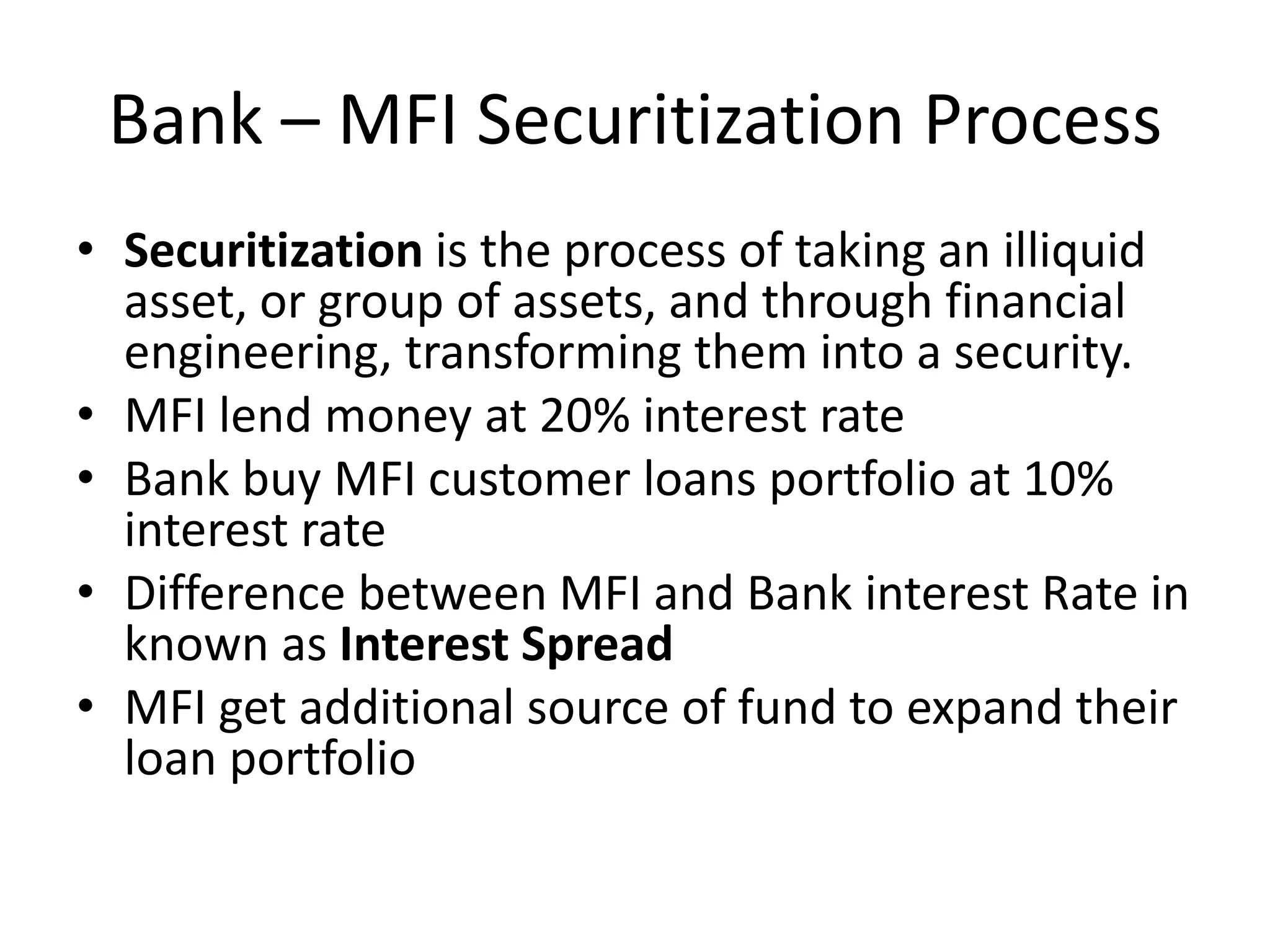
Bank – MFI Securitization Process
• Securitization is the process of taking an illiquid
asset, or group of assets, and through financial
engineering, transforming them into a security.
• MFI lend money at 20% interest rate
• Bank buy MFI customer loans portfolio at 10%
interest rate
• Difference between MFI and Bank interest Rate in
known as Interest Spread
• MFI get additional source of fund to expand their
loan portfolio
Securitization Process
Subscription
Monthly
Payout
Collection
SPV
Obligors
(MF Loans)
Service / Collection
agent (MFs/NBFCS)
Originators
(MFS/NBFCs)
Investor in
PTC
Credit Enhancement Provider
(MFs/NBFCs)
Subordinated Principal /
Over Collateral
Techniques to Mitigate Risk in
Securitization
• Waterfall Mechanism:
• Excess Interest Spread
• Credit Enhancement
• Over Collateralization:
Thanks

Types of Risks and its Management in Banking

  • 1.
    Types Of Risksand Its Management In Banking & Rural Finance
  • 2.
    What is RiskManagement? Identification of Risks Assessment of Risks Prioritization of Risks minimize monitor control Probability of unfortunate events maximize Realization of opportunities Resources
  • 3.
    Types of Riskin Banking & Rural Finance Credit or Default Risk Liquidity Risk Interest Rate Risk Market Risk
  • 4.
    Credit Risk  Creditrisk is the risk of default on a debt that may arise from a borrower failing to make required payments Methods to measure Expected Loss Method Altman Z score
  • 5.
    Credit Risk -ExpectedLoss Method Probability of Default (PD) is the likelihood that a loan will not be repaid and will fall into default. The credit history of the borrower and the nature of the investment must be taken into consideration when calculating PD Loss Given Default (LGD) the credit loss incurred if an obligor of the bank defaults. LGD = 1- RR Exposure at Default (EAD) is equal to outstanding loan amount (OS) plus the percentage of unused loan commitment (COM) drawn- down by the borrower EAD = OS + (COM – OS) * (UGD)
  • 6.
    Altman Z score =1.2*X1 + 1.4*X2 + 3.3*X3 + 0.6*X4 + 0.99*X5 Where : X1 is Working capital / Total Assets X2 is Retained Earning / Total Assets X3 is EBITDA/ Total Assets X4 is market Value of Equity / Total Liabilities X5 is Net Sales / Total Assets
  • 7.
    Liquidity Risk  Liquidityrisk occurs when an individual investor, business or financial institution cannot meet short-term debt obligations  Method to measure :- Liquidity Coverage Ratio Net Stable Funding Ratio
  • 8.
    Liquidity Coverage ratio TypesOf Assets Examples Max Cap Level 1 Cash, central Bank Reserve 100% Level 2A Corporate Bonds 40% Level 2B Mortgage, Stocks 15% Jan 1, 2015 Jan 1, 2016 Jan 1, 2017 Jan 1, 2018 Jan 1, 2019 60% 70% 80% 100%90%
  • 9.
    Interest Rate Risk ThePotential loss from unexpected changes in Interest rate which can significantly alter the bank profitability and market value of equity Interest Rate Risk Management Repricing Risk Yield Curve Risk Basic Risk Embedded Option Risk
  • 10.
    Market Risk Market riskis the possibility for an investor to experience losses due to factors that affect the overall performance of the financial markets in which he is involved Method to measure ; - Value at Risk
  • 11.
    For Example :-If VAR(95) = 3% 5% chance to lose max 3% of its market value Market Risk Management  Value at Risk (VaR) is a statistical technique used to measure and quantify the level of financial risk within a firm or investment portfolio over a specific time frame Var(95%) -2.898550725 12.4 Var (99%) -4.398826979 2.48 Var(99.5%) -4.593874834 1.24 Value at Risk
  • 12.
    Bank – MFISecuritization Process • Securitization is the process of taking an illiquid asset, or group of assets, and through financial engineering, transforming them into a security. • MFI lend money at 20% interest rate • Bank buy MFI customer loans portfolio at 10% interest rate • Difference between MFI and Bank interest Rate in known as Interest Spread • MFI get additional source of fund to expand their loan portfolio
  • 13.
    Securitization Process Subscription Monthly Payout Collection SPV Obligors (MF Loans) Service/ Collection agent (MFs/NBFCS) Originators (MFS/NBFCs) Investor in PTC Credit Enhancement Provider (MFs/NBFCs) Subordinated Principal / Over Collateral
  • 14.
    Techniques to MitigateRisk in Securitization • Waterfall Mechanism: • Excess Interest Spread • Credit Enhancement • Over Collateralization:
  • 15.