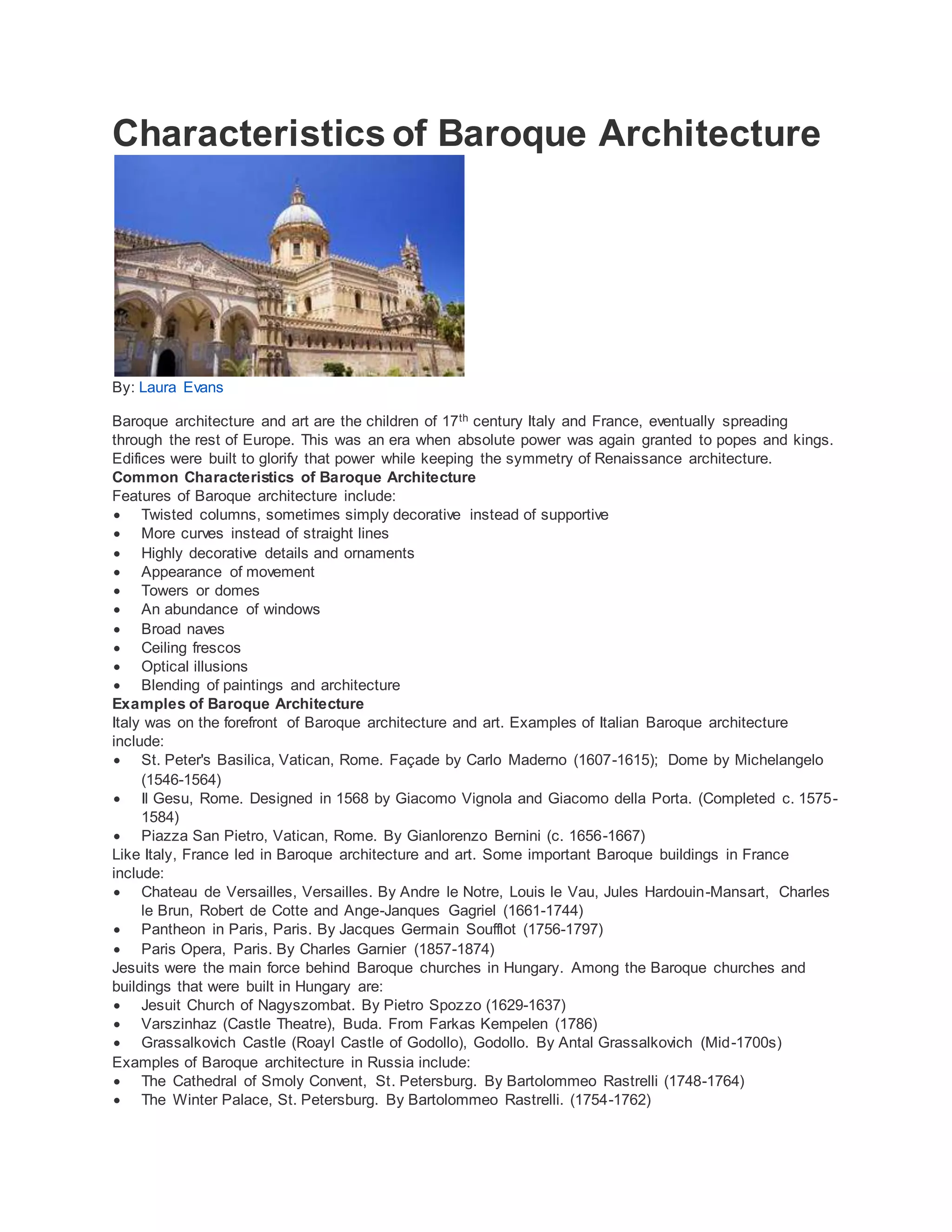

Characteristics of Baroque Architecture
By: Laura Evans
Baroque architecture and art are the children of 17th century Italy and France, eventually spreading
through the rest of Europe. This was an era when absolute power was again granted to popes and kings.
Edifices were built to glorify that power while keeping the symmetry of Renaissance architecture.
Common Characteristics of Baroque Architecture
Features of Baroque architecture include:
 Twisted columns, sometimes simply decorative instead of supportive
 More curves instead of straight lines
 Highly decorative details and ornaments
 Appearance of movement
 Towers or domes
 An abundance of windows
 Broad naves
 Ceiling frescos
 Optical illusions
 Blending of paintings and architecture
Examples of Baroque Architecture
Italy was on the forefront of Baroque architecture and art. Examples of Italian Baroque architecture
include:
 St. Peter's Basilica, Vatican, Rome. Façade by Carlo Maderno (1607-1615); Dome by Michelangelo
(1546-1564)
 Il Gesu, Rome. Designed in 1568 by Giacomo Vignola and Giacomo della Porta. (Completed c. 1575-
1584)
 Piazza San Pietro, Vatican, Rome. By Gianlorenzo Bernini (c. 1656-1667)
Like Italy, France led in Baroque architecture and art. Some important Baroque buildings in France
include:
 Chateau de Versailles, Versailles. By Andre le Notre, Louis le Vau, Jules Hardouin-Mansart, Charles
le Brun, Robert de Cotte and Ange-Janques Gagriel (1661-1744)
 Pantheon in Paris, Paris. By Jacques Germain Soufflot (1756-1797)
 Paris Opera, Paris. By Charles Garnier (1857-1874)
Jesuits were the main force behind Baroque churches in Hungary. Among the Baroque churches and
buildings that were built in Hungary are:
 Jesuit Church of Nagyszombat. By Pietro Spozzo (1629-1637)
 Varszinhaz (Castle Theatre), Buda. From Farkas Kempelen (1786)
 Grassalkovich Castle (Roayl Castle of Godollo), Godollo. By Antal Grassalkovich (Mid-1700s)
Examples of Baroque architecture in Russia include:
 The Cathedral of Smoly Convent, St. Petersburg. By Bartolommeo Rastrelli (1748-1764)
 The Winter Palace, St. Petersburg. By Bartolommeo Rastrelli. (1754-1762)
 The Kunstkammer, St. Petersburg. By Mikhail Zemstov, Gaetano Chiaveria, Georg Johann
Mattarnovi and Nicolaus Herbel (1718-1734).
Baroque architecture wasn't limited to Europe. The Spanish brought Baroque styles to the New World, as
can be evidenced by the Chapel of Pocito in Guadalupe, Mexico. The Chapel was designed by Franciso
Guerrero y Torres and built in the late 1700s.

Characteristics of baroque architecture

  • 1.
    Characteristics of BaroqueArchitecture By: Laura Evans Baroque architecture and art are the children of 17th century Italy and France, eventually spreading through the rest of Europe. This was an era when absolute power was again granted to popes and kings. Edifices were built to glorify that power while keeping the symmetry of Renaissance architecture. Common Characteristics of Baroque Architecture Features of Baroque architecture include:  Twisted columns, sometimes simply decorative instead of supportive  More curves instead of straight lines  Highly decorative details and ornaments  Appearance of movement  Towers or domes  An abundance of windows  Broad naves  Ceiling frescos  Optical illusions  Blending of paintings and architecture Examples of Baroque Architecture Italy was on the forefront of Baroque architecture and art. Examples of Italian Baroque architecture include:  St. Peter's Basilica, Vatican, Rome. Façade by Carlo Maderno (1607-1615); Dome by Michelangelo (1546-1564)  Il Gesu, Rome. Designed in 1568 by Giacomo Vignola and Giacomo della Porta. (Completed c. 1575- 1584)  Piazza San Pietro, Vatican, Rome. By Gianlorenzo Bernini (c. 1656-1667) Like Italy, France led in Baroque architecture and art. Some important Baroque buildings in France include:  Chateau de Versailles, Versailles. By Andre le Notre, Louis le Vau, Jules Hardouin-Mansart, Charles le Brun, Robert de Cotte and Ange-Janques Gagriel (1661-1744)  Pantheon in Paris, Paris. By Jacques Germain Soufflot (1756-1797)  Paris Opera, Paris. By Charles Garnier (1857-1874) Jesuits were the main force behind Baroque churches in Hungary. Among the Baroque churches and buildings that were built in Hungary are:  Jesuit Church of Nagyszombat. By Pietro Spozzo (1629-1637)  Varszinhaz (Castle Theatre), Buda. From Farkas Kempelen (1786)  Grassalkovich Castle (Roayl Castle of Godollo), Godollo. By Antal Grassalkovich (Mid-1700s) Examples of Baroque architecture in Russia include:  The Cathedral of Smoly Convent, St. Petersburg. By Bartolommeo Rastrelli (1748-1764)  The Winter Palace, St. Petersburg. By Bartolommeo Rastrelli. (1754-1762)
  • 2.
     The Kunstkammer,St. Petersburg. By Mikhail Zemstov, Gaetano Chiaveria, Georg Johann Mattarnovi and Nicolaus Herbel (1718-1734). Baroque architecture wasn't limited to Europe. The Spanish brought Baroque styles to the New World, as can be evidenced by the Chapel of Pocito in Guadalupe, Mexico. The Chapel was designed by Franciso Guerrero y Torres and built in the late 1700s.