Accounts
Categories Types
Features





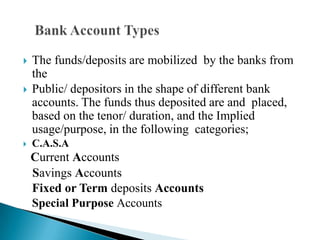
The funds/deposits are mobilized by the banks from
the
Public/ depositors in the shape of different bank
accounts. The funds thus deposited are and placed,
based on the tenor/ duration, and the Implied
usage/purpose, in the following categories;
C.A.S.A

Current Accounts
Savings Accounts
Fixed or Term deposits Accounts
Special Purpose Accounts


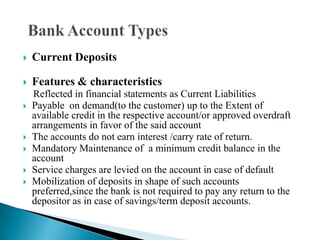
Current Deposits



Features & characteristics








Reflected in financial statements as Current Liabilities
Payable on demand(to the customer) up to the Extent of
available credit in the respective account/or approved overdraft
arrangements in favor of the said account
The accounts do not earn interest /carry rate of return.
Mandatory Maintenance of a minimum credit balance in the
account
Service charges are levied on the account in case of default
Mobilization of deposits in shape of such accounts
preferred,since the bank is not required to pay any return to the
depositor as in case of savings/term deposit accounts.










Savings Deposits.
History:
Instituted under the under the Trustees Savings Bank
Act 1863
Objectives:
To mobilize & encourage savings among people of
small means, household women, children etc
Initiated in undivided India under Post Office savings
Bank in 1882


Features:



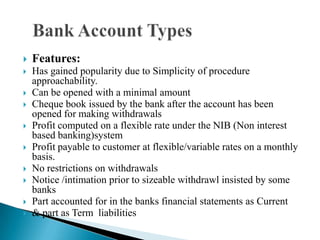
Has gained popularity due to Simplicity of procedure
approachability.
Can be opened with a minimal amount
Cheque book issued by the bank after the account has been
opened for making withdrawals
Profit computed on a flexible rate under the NIB (Non interest
based banking)system
Profit payable to customer at flexible/variable rates on a monthly
basis.
No restrictions on withdrawals
Notice /intimation prior to sizeable withdrawl insisted by some
banks
Part accounted for in the banks financial statements as Current
& part as Term liabilities



















Fixed Deposits/Term Deposits
Features;
Accounted for as Time liabilities
Placed for a mutually agreed specified
duration/period of time, varying from;
Three months to five years.
Withdraw able upon maturity
Profit rate is variable & linked with the duration.
A receipt is issued to the depositor













Fixed/Term deposits
Premature Withdrawal/Payment
A certain amount is deducted from the profit,
As service charge.
Profit Rate calculated on the lower side
Limitation;
Profit on the Fixed deposit ceases on maturity
Unless renewed
Deposits can be made in individual & joint names
Terms of payment in accordance with the respective
account rules.











Non Resident Accounts
Description & nomenclature
Non Resident Accounts (N.R.A)
Maintained in Pak Rupees in the names of
Pakistani ,& Foreign
Individuals
Firms, companies ,
Residing or operating outside Pakistan













Non Resident Accounts; Pak Rupee
Accounts of the following are treated as N.R. Account & do
not require prior permission from the State Bank but need to
be maintained separate from other accounts.
Eligible's
Pakistani Nationals permanently resident or domiciled abroad
Pakistanis engaged in frequent trips overseas in connection
with,
Education
Business
Tourism
Resident foreign nationals occasionally visiting overseas
Foreign nationals residing abroad
Treated as resident on permanent return/arrival in Pakistan.


Accounts of Foreign nationals Resident in Pakistan
under A.22
Accounts of Foreign nationals/companies,(other than Banks)
residing,/operating in Pakistan are also treated as
Non Resident accounts
Undertaking to be given by the Account holder/s
They will not provide any foreign exchange outside
Pakistan against pak rupee relating to business
transactions in Pakistan












Debits Authorized from such accounts
Payment of Insurance dues/utilities/Taxes
Memberships fee. Duly supported by Documents of
receipts,
Disbursements against remittances received
Investments in shares, Prize Bonds
Payments to dependants for sustenance
Debt servicing, loan repayments
Approved remittances


Feedings/Credits to such accounts



Receipts on account of salaries, bonuses
Interests, Dividends
Rental Income
Foreign remittances through bank channels
Maturity proceeds,
Paid up value of insurance policies








Foreign currency accounts



Features;
Accounts in all major foreign currencies can be
opened in authorized /designated branches of
Pakistani & foreign commercial banks.
All account opening procedures as applicable in
other accounts are
Mandatory.







Rupee convertibility facility
Disclosure of Sources of funds under KYC is mandatory














Rupee convertibility facility
The Foreign currency balance in such account is convertible in
equivalent Pak rupees on the exchange parity notified /as per
value date
Disclosure of Sources of funds under KYC is mandatory
Eligible entities;
All Individual
Resident/Non Resident, Pakistani/foreign individuals
Companies/firms.
Account Nature
The accounts can be opened as
Current account
Savings Accounts
Fixed/Term deposits












Foreign currency Accounts
Additional features
Rupee Loan facility
Loans in Pak rupee is available against banks lien on the credit
balance in the account
Profit Liable for levy of 10% withholding tax
Exempt from Zakat available as per rules
Funds Can be utilized for sponsoring parents /spouse ,by overseas
Pakistanis
Funds utilized by holding banks for :
Financing Documentary credit. Imports
Purchase/discounting of foreign bills


Special Purpose Accounts
Description
Special purpose accounts are established in Pakistan banks
for the
purpose of pooling funds receivable/received for specific
uses,
routed through;
Collections
Donations
Utilized for facilitating/funding mass /public welfare
projects chartered by the government or charity oriented
Trust or other organizations
Exempt from Govt Taxes, Zakat & similar levies



.









Global interpretation of SPA



A Special Purpose Entity /Account , is a:



Legal entity, usually a limited of some type created to
fulfill specific or temporary objectives.
Typically used by companies to isolate the firm from
financial risk.








Hide debt (inflating profits),
Hide ownership, and
Obscure relationships between different entities
which are in fact related to each other







Company transfers assets to the SPE for management
or to finance a large project thereby achieving a
narrow set of goals without exposing the entire firm
to risk.
Owned by one or more other entities
Used in complex financings to separate different
layers of equity infusion. Commonly created and
registered in tax havens
set up as 'orphan' companies with their shares settled
on charitable trust and with
professional directors provided by an administration
company to avoid linkage connection with the
sponsor.





Securitization:
Example, a bank may wish to issue a mortgagebacked security whose payments come from a pool of
loans.
To ensure that the holders of the mortgage-back
securities have the first priority right to receive
payments on the loans, these loans are legally
separated from the other obligations of the bank, by
creating an SPE, and then transferring the loans from
the bank to the SPE.







Risk sharing:
Corporations may use SPEs to legally isolate a high
risk project/asset from the parent company and to
allow other investors to take a share of the risk.
Asset transfer: Many permits required to operate
certain assets (such as power plants) are either nontransferable or difficult to transfer.
The SPE owns the asset and all the permits, which
can be sold as a self-contained package, rather than
assign numerous permits.








Financial engineering:
used in financial engineering schemes to avoid tax or
manipulation of financial statements.
Enron case is the most famous example of a company
using SPEs to achieve the said goal.
Regulatory reasons:
Account can sometimes be set up within an orphan
structure to avoid regulatory restrictions, such as
nationality f ownership of specific assets
Bank Account Types
Bank Account Types

Bank Account Types

  • 1.
  • 2.
       The funds/deposits aremobilized by the banks from the Public/ depositors in the shape of different bank accounts. The funds thus deposited are and placed, based on the tenor/ duration, and the Implied usage/purpose, in the following categories; C.A.S.A Current Accounts Savings Accounts Fixed or Term deposits Accounts Special Purpose Accounts
  • 3.
     Current Deposits  Features &characteristics      Reflected in financial statements as Current Liabilities Payable on demand(to the customer) up to the Extent of available credit in the respective account/or approved overdraft arrangements in favor of the said account The accounts do not earn interest /carry rate of return. Mandatory Maintenance of a minimum credit balance in the account Service charges are levied on the account in case of default Mobilization of deposits in shape of such accounts preferred,since the bank is not required to pay any return to the depositor as in case of savings/term deposit accounts.
  • 4.
          Savings Deposits. History: Instituted underthe under the Trustees Savings Bank Act 1863 Objectives: To mobilize & encourage savings among people of small means, household women, children etc Initiated in undivided India under Post Office savings Bank in 1882
  • 5.
     Features:  Has gained popularitydue to Simplicity of procedure approachability. Can be opened with a minimal amount Cheque book issued by the bank after the account has been opened for making withdrawals Profit computed on a flexible rate under the NIB (Non interest based banking)system Profit payable to customer at flexible/variable rates on a monthly basis. No restrictions on withdrawals Notice /intimation prior to sizeable withdrawl insisted by some banks Part accounted for in the banks financial statements as Current & part as Term liabilities        
  • 6.
           Fixed Deposits/Term Deposits Features; Accountedfor as Time liabilities Placed for a mutually agreed specified duration/period of time, varying from; Three months to five years. Withdraw able upon maturity Profit rate is variable & linked with the duration. A receipt is issued to the depositor
  • 7.
              Fixed/Term deposits Premature Withdrawal/Payment Acertain amount is deducted from the profit, As service charge. Profit Rate calculated on the lower side Limitation; Profit on the Fixed deposit ceases on maturity Unless renewed Deposits can be made in individual & joint names Terms of payment in accordance with the respective account rules.
  • 8.
            Non Resident Accounts Description& nomenclature Non Resident Accounts (N.R.A) Maintained in Pak Rupees in the names of Pakistani ,& Foreign Individuals Firms, companies , Residing or operating outside Pakistan
  • 9.
               Non Resident Accounts;Pak Rupee Accounts of the following are treated as N.R. Account & do not require prior permission from the State Bank but need to be maintained separate from other accounts. Eligible's Pakistani Nationals permanently resident or domiciled abroad Pakistanis engaged in frequent trips overseas in connection with, Education Business Tourism Resident foreign nationals occasionally visiting overseas Foreign nationals residing abroad Treated as resident on permanent return/arrival in Pakistan.
  • 10.
     Accounts of Foreignnationals Resident in Pakistan under A.22 Accounts of Foreign nationals/companies,(other than Banks) residing,/operating in Pakistan are also treated as Non Resident accounts Undertaking to be given by the Account holder/s They will not provide any foreign exchange outside Pakistan against pak rupee relating to business transactions in Pakistan
  • 11.
            Debits Authorized fromsuch accounts Payment of Insurance dues/utilities/Taxes Memberships fee. Duly supported by Documents of receipts, Disbursements against remittances received Investments in shares, Prize Bonds Payments to dependants for sustenance Debt servicing, loan repayments Approved remittances
  • 12.
     Feedings/Credits to suchaccounts  Receipts on account of salaries, bonuses Interests, Dividends Rental Income Foreign remittances through bank channels Maturity proceeds, Paid up value of insurance policies     
  • 13.
     Foreign currency accounts  Features; Accountsin all major foreign currencies can be opened in authorized /designated branches of Pakistani & foreign commercial banks. All account opening procedures as applicable in other accounts are Mandatory.     Rupee convertibility facility Disclosure of Sources of funds under KYC is mandatory
  • 14.
               Rupee convertibility facility TheForeign currency balance in such account is convertible in equivalent Pak rupees on the exchange parity notified /as per value date Disclosure of Sources of funds under KYC is mandatory Eligible entities; All Individual Resident/Non Resident, Pakistani/foreign individuals Companies/firms. Account Nature The accounts can be opened as Current account Savings Accounts Fixed/Term deposits
  • 15.
             Foreign currency Accounts Additionalfeatures Rupee Loan facility Loans in Pak rupee is available against banks lien on the credit balance in the account Profit Liable for levy of 10% withholding tax Exempt from Zakat available as per rules Funds Can be utilized for sponsoring parents /spouse ,by overseas Pakistanis Funds utilized by holding banks for : Financing Documentary credit. Imports Purchase/discounting of foreign bills
  • 17.
     Special Purpose Accounts Description Specialpurpose accounts are established in Pakistan banks for the purpose of pooling funds receivable/received for specific uses, routed through; Collections Donations Utilized for facilitating/funding mass /public welfare projects chartered by the government or charity oriented Trust or other organizations Exempt from Govt Taxes, Zakat & similar levies  .    
  • 18.
     Global interpretation ofSPA  A Special Purpose Entity /Account , is a:  Legal entity, usually a limited of some type created to fulfill specific or temporary objectives. Typically used by companies to isolate the firm from financial risk.      Hide debt (inflating profits), Hide ownership, and Obscure relationships between different entities which are in fact related to each other
  • 19.
        Company transfers assetsto the SPE for management or to finance a large project thereby achieving a narrow set of goals without exposing the entire firm to risk. Owned by one or more other entities Used in complex financings to separate different layers of equity infusion. Commonly created and registered in tax havens set up as 'orphan' companies with their shares settled on charitable trust and with professional directors provided by an administration company to avoid linkage connection with the sponsor.
  • 20.
       Securitization: Example, a bankmay wish to issue a mortgagebacked security whose payments come from a pool of loans. To ensure that the holders of the mortgage-back securities have the first priority right to receive payments on the loans, these loans are legally separated from the other obligations of the bank, by creating an SPE, and then transferring the loans from the bank to the SPE.
  • 21.
        Risk sharing: Corporations mayuse SPEs to legally isolate a high risk project/asset from the parent company and to allow other investors to take a share of the risk. Asset transfer: Many permits required to operate certain assets (such as power plants) are either nontransferable or difficult to transfer. The SPE owns the asset and all the permits, which can be sold as a self-contained package, rather than assign numerous permits.
  • 22.
         Financial engineering: used infinancial engineering schemes to avoid tax or manipulation of financial statements. Enron case is the most famous example of a company using SPEs to achieve the said goal. Regulatory reasons: Account can sometimes be set up within an orphan structure to avoid regulatory restrictions, such as nationality f ownership of specific assets