
Banking and Financial
Institutions
By: Abbas vattoli
Asst: Professor
Dept of Commerce
Amal College Nilambur
Syllabus
Origin of the term Bank
• Italian word – ‘banco’
• Latin word – ‘bancus’
• Greek word – ‘banque’
• French word – ‘banque’
            Which mean bench
• German word – ‘banc’ or ‘banck’ which means a
  joint stock fund.
Definition
• Sec 5(1)(c ) of indian Banking regulation Act
  1949 defines
• The term banking company as any company
  which transacts the business of banking in india.
• Sec 5(1) (b) defines the term banking as
  accepting, for the purpose of lending or
  investment, of deposits of money from the
  public, repayable on demand or otherwise and
  withdrawable by cheques, draft, order or
  otherwise.
• In sec 6 various activities included in banking
  are listed such as lending, borrowing, accepting
  and discounting of bills, dealing in foreign
  currency, deposit lockers, trasfer of money,etc
• Sec 8 prohibits a bank from buying and selling
  goods
• Sec 9 prohibits from holding immovable
  property
Evolution of banking
• Banking existed in babylonia as early as in 2000
  BC
• Temples were used a place for money lending
• Banking confined money lending
• Bank of england established in 1694
• In india banking was in existance during vedic
  period
• Modern banks emerged only during industrial
  revolution(1750 to 1850 )
Ancestors of modern banks
• Merchant banks- traders become financiaers
• Money lenders- only lends money
• Goldsmiths- for safe keeping of valuables and
  money
Role and Importance of Banks
•   Deposit mobilization
•   Granting of credit
•   Creation of credit
•   Channalize funds into productive investments
•   Provision of finance to the government
•   Protecting the funds of depositors
•   Provision of remittance facilities
•   Provision of medium of exchange
•   Discharge of social responsibility
•   Innovative services
Acts relating to banks


• Banking [Regulation] Act, 1949
• Deposit Insurance Corporation Act, 1961
• Industrial Development Bank of India Act, 19
• Export-Import Bank of India Act, 1981
• Industrial Reconstruction Bank of India Act, 1984
• National Housing Bank Act, 1987
• Regional Rural Banks Act, 1976
• Reserve Bank of India Act, 1934
• Small Industries Development Bank of India Act,
  1989
• State Bank of India Act, 1955
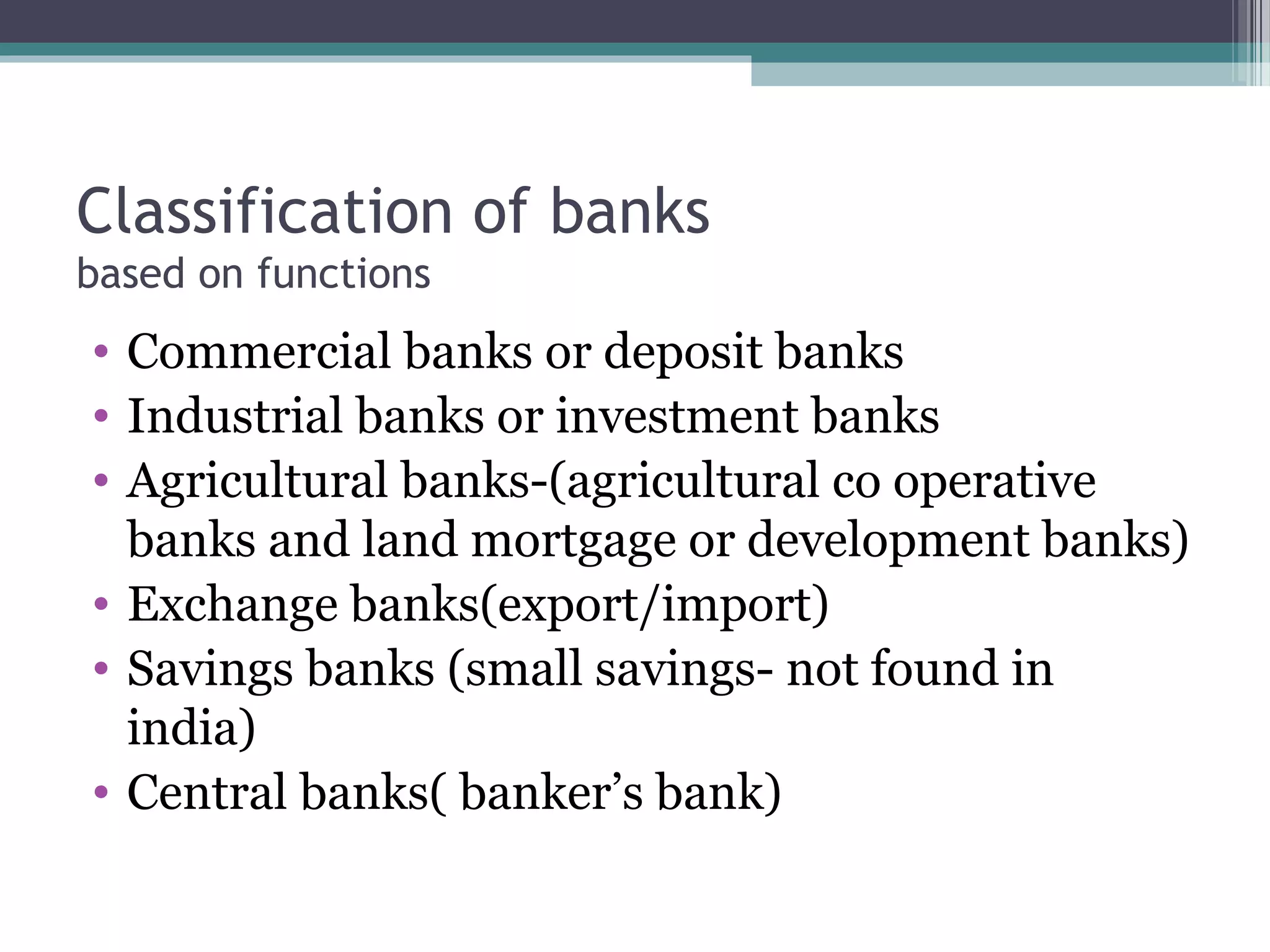
Classification of banks
based on functions
• Commercial banks or deposit banks
• Industrial banks or investment banks
• Agricultural banks-(agricultural co operative
  banks and land mortgage or development banks)
• Exchange banks(export/import)
• Savings banks (small savings- not found in
  india)
• Central banks( banker’s bank)
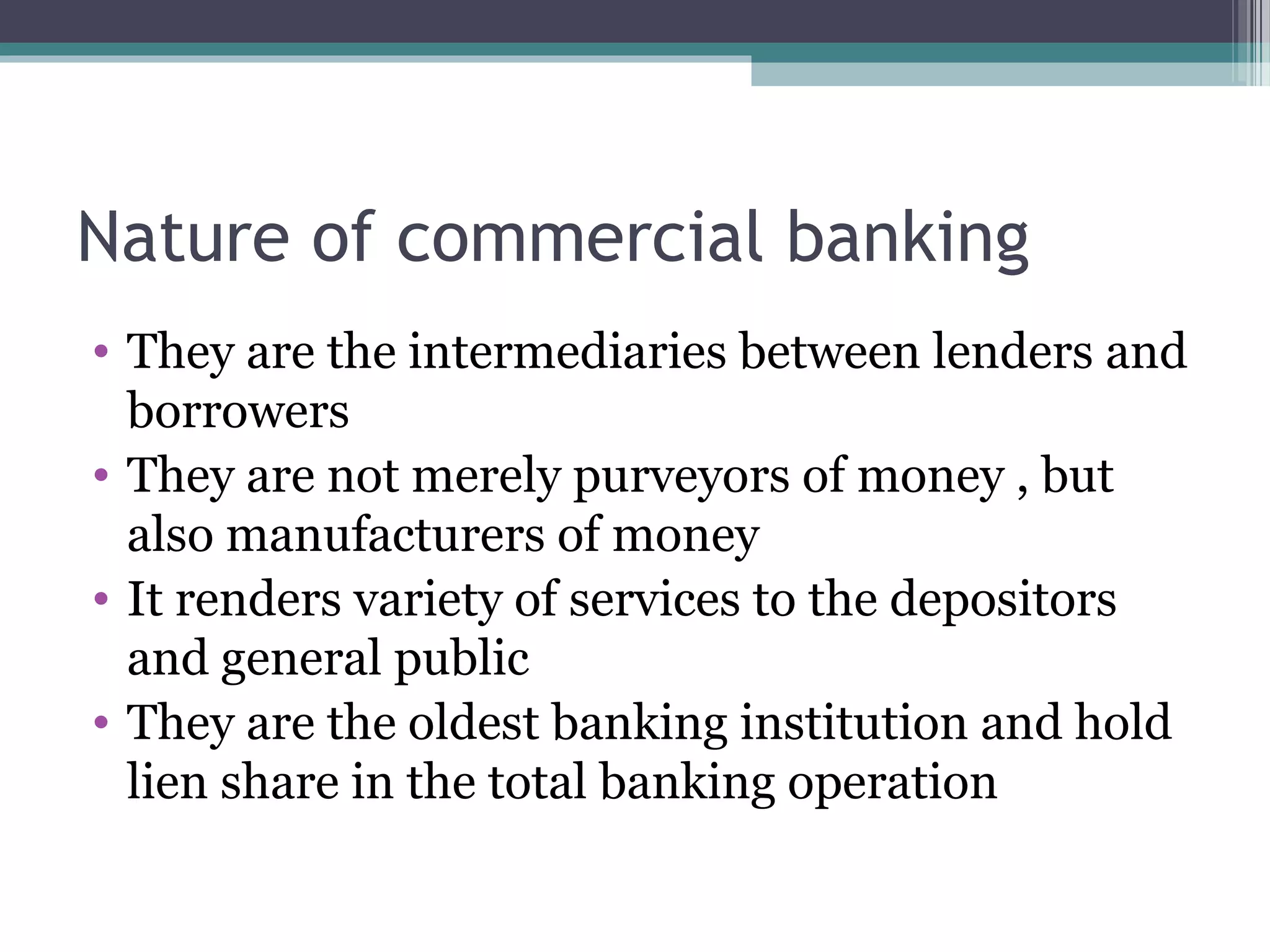
Nature of commercial banking
• They are the intermediaries between lenders and
  borrowers
• They are not merely purveyors of money , but
  also manufacturers of money
• It renders variety of services to the depositors
  and general public
• They are the oldest banking institution and hold
  lien share in the total banking operation
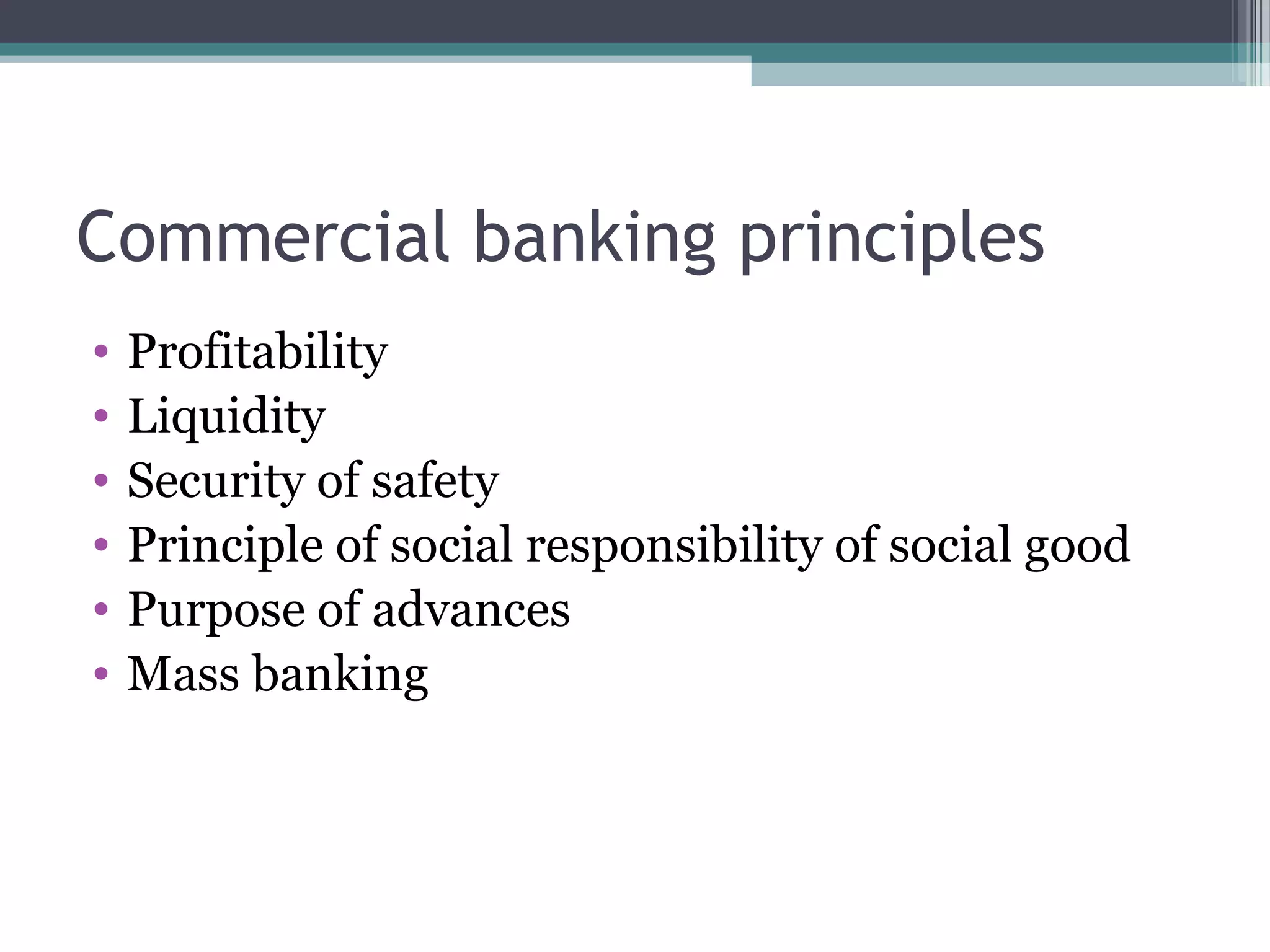
Commercial banking principles
•   Profitability
•   Liquidity
•   Security of safety
•   Principle of social responsibility of social good
•   Purpose of advances
•   Mass banking
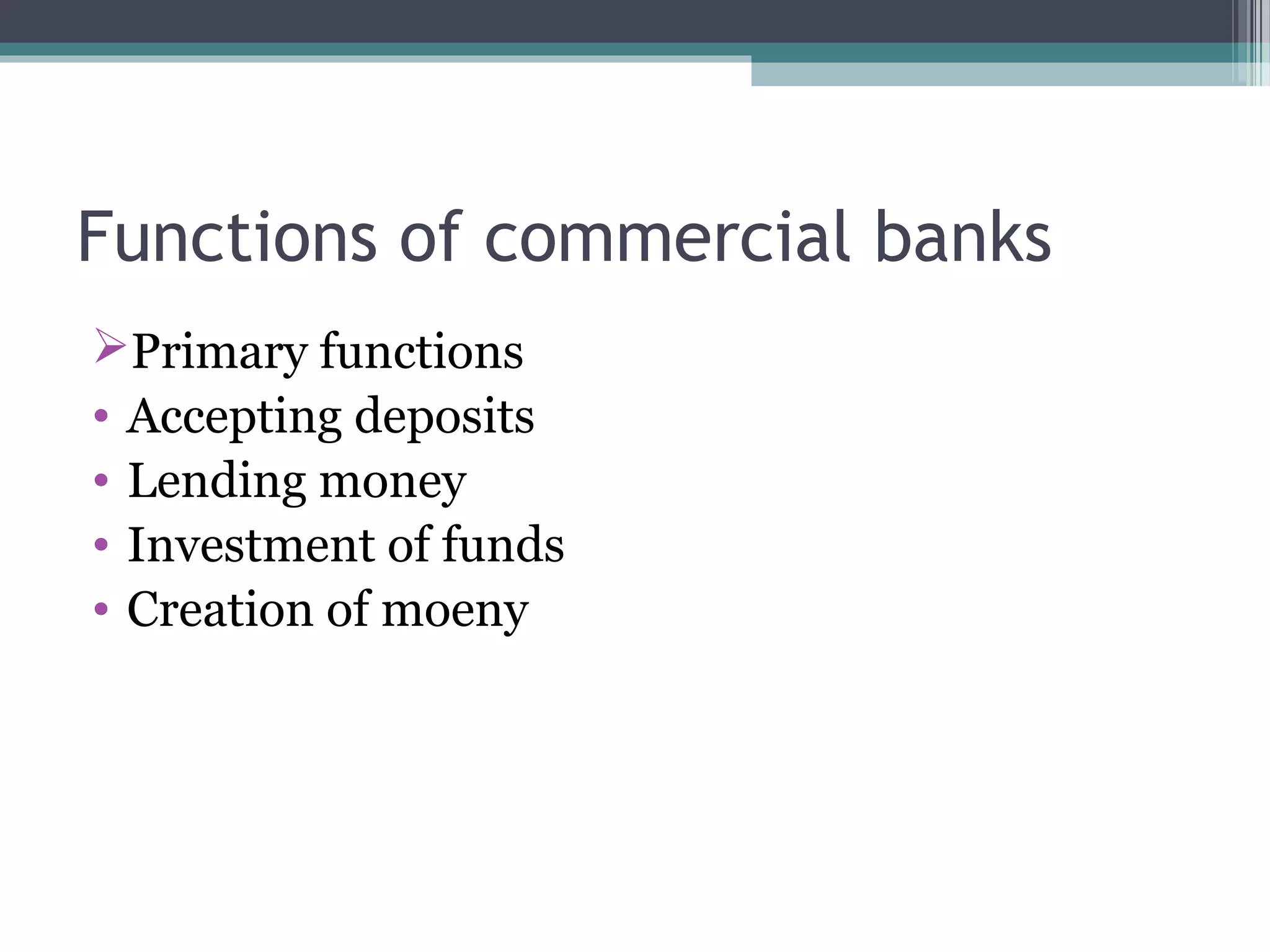
Functions of commercial banks
Primary functions
• Accepting deposits
• Lending money
• Investment of funds
• Creation of moeny
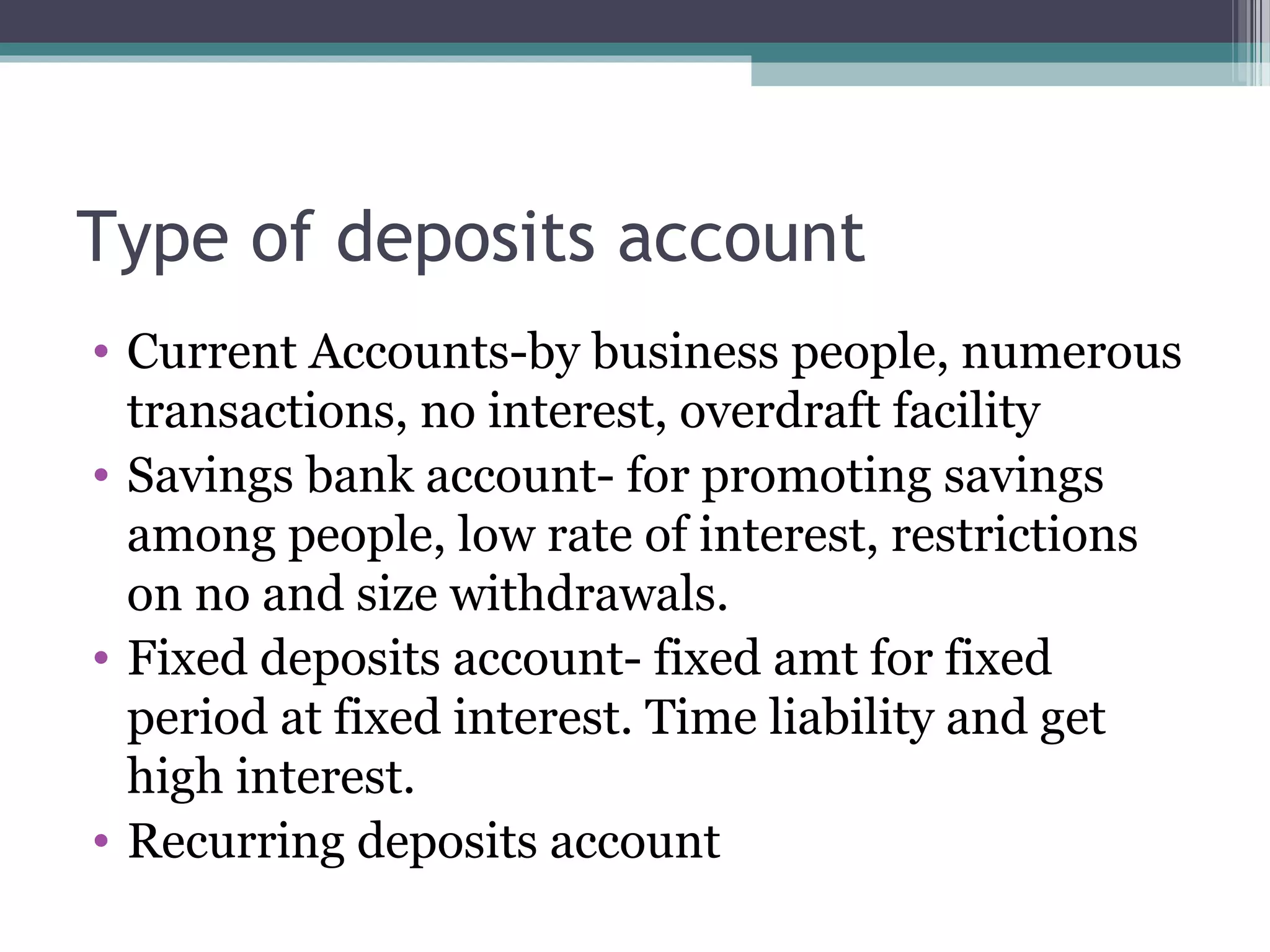
Type of deposits account
• Current Accounts-by business people, numerous
  transactions, no interest, overdraft facility
• Savings bank account- for promoting savings
  among people, low rate of interest, restrictions
  on no and size withdrawals.
• Fixed deposits account- fixed amt for fixed
  period at fixed interest. Time liability and get
  high interest.
• Recurring deposits account
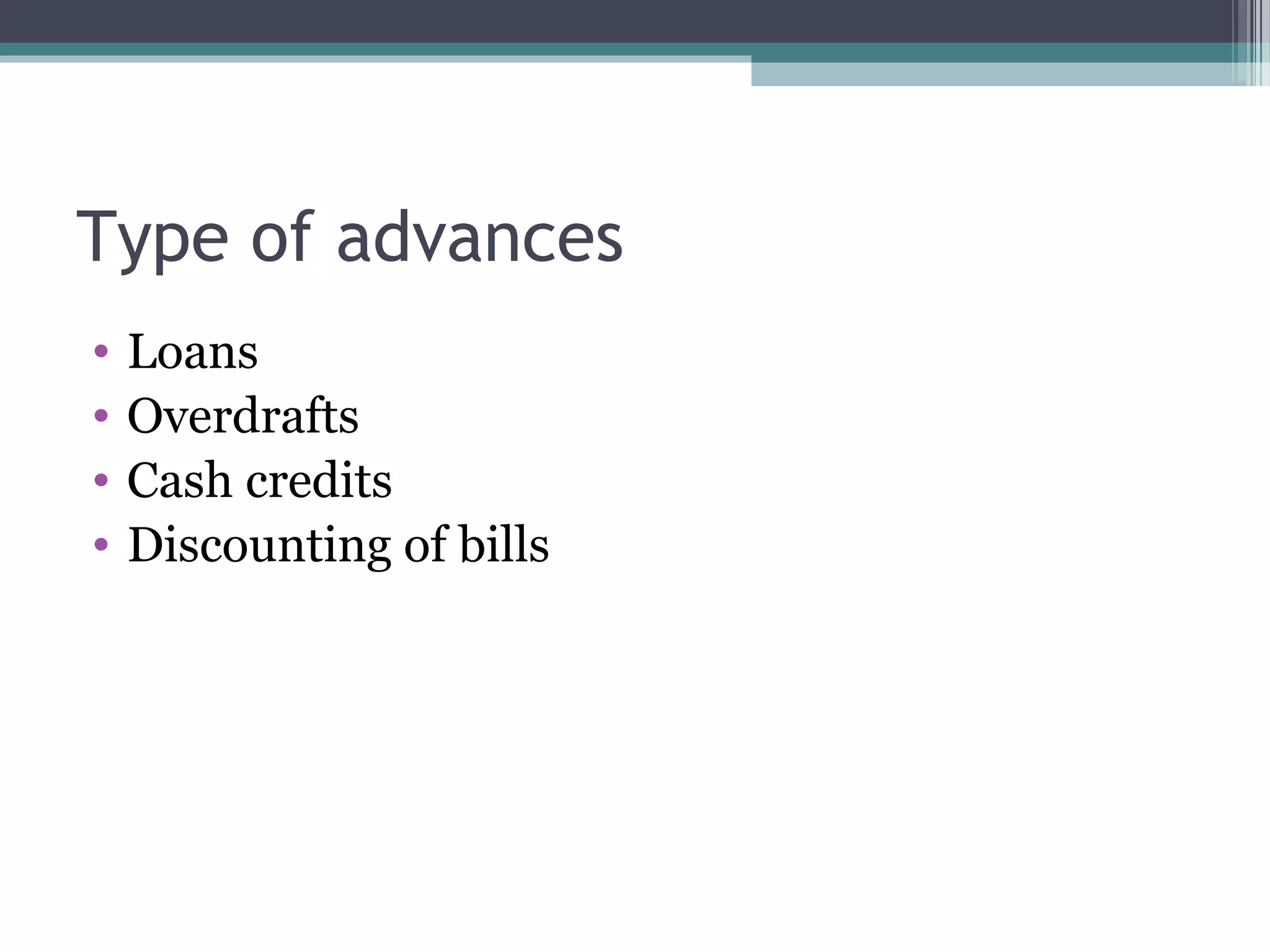
Type of advances
•   Loans
•   Overdrafts
•   Cash credits
•   Discounting of bills
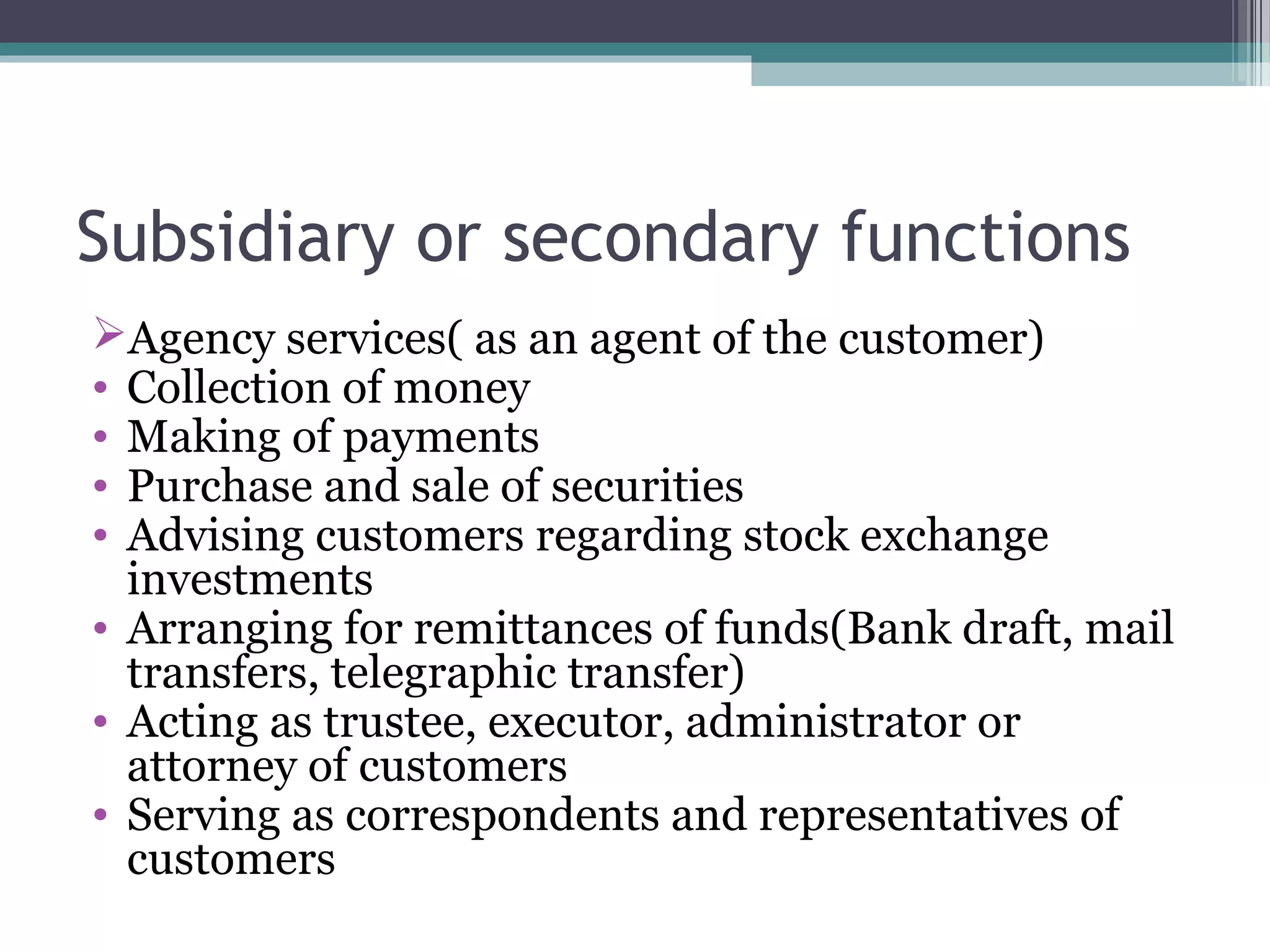
Subsidiary or secondary functions
Agency services( as an agent of the customer)
• Collection of money
• Making of payments
• Purchase and sale of securities
• Advising customers regarding stock exchange
  investments
• Arranging for remittances of funds(Bank draft, mail
  transfers, telegraphic transfer)
• Acting as trustee, executor, administrator or
  attorney of customers
• Serving as correspondents and representatives of
  customers
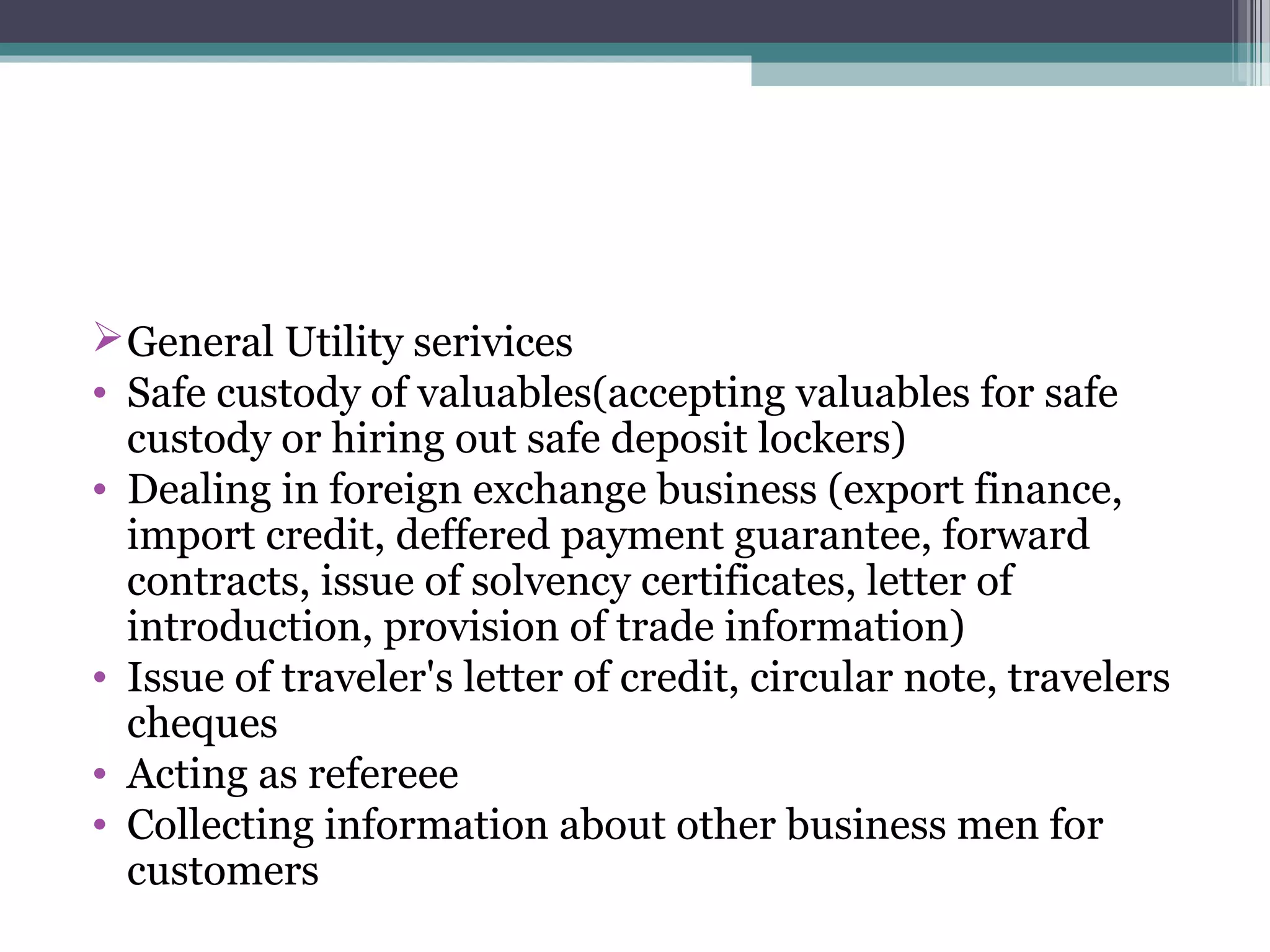
 General Utility serivices
• Safe custody of valuables(accepting valuables for safe
  custody or hiring out safe deposit lockers)
• Dealing in foreign exchange business (export finance,
  import credit, deffered payment guarantee, forward
  contracts, issue of solvency certificates, letter of
  introduction, provision of trade information)
• Issue of traveler's letter of credit, circular note, travelers
  cheques
• Acting as refereee
• Collecting information about other business men for
  customers
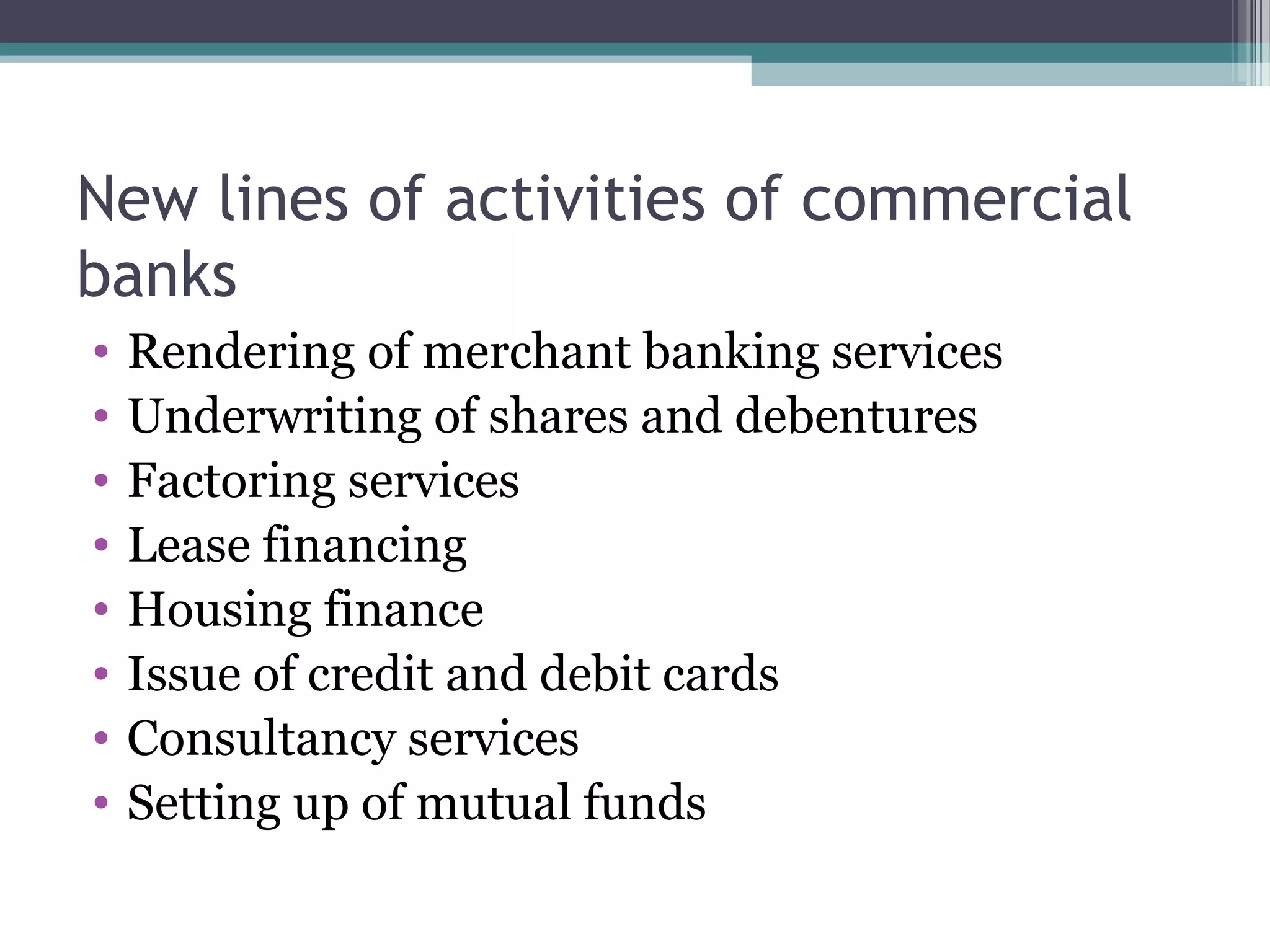
New lines of activities of commercial
banks
•   Rendering of merchant banking services
•   Underwriting of shares and debentures
•   Factoring services
•   Lease financing
•   Housing finance
•   Issue of credit and debit cards
•   Consultancy services
•   Setting up of mutual funds
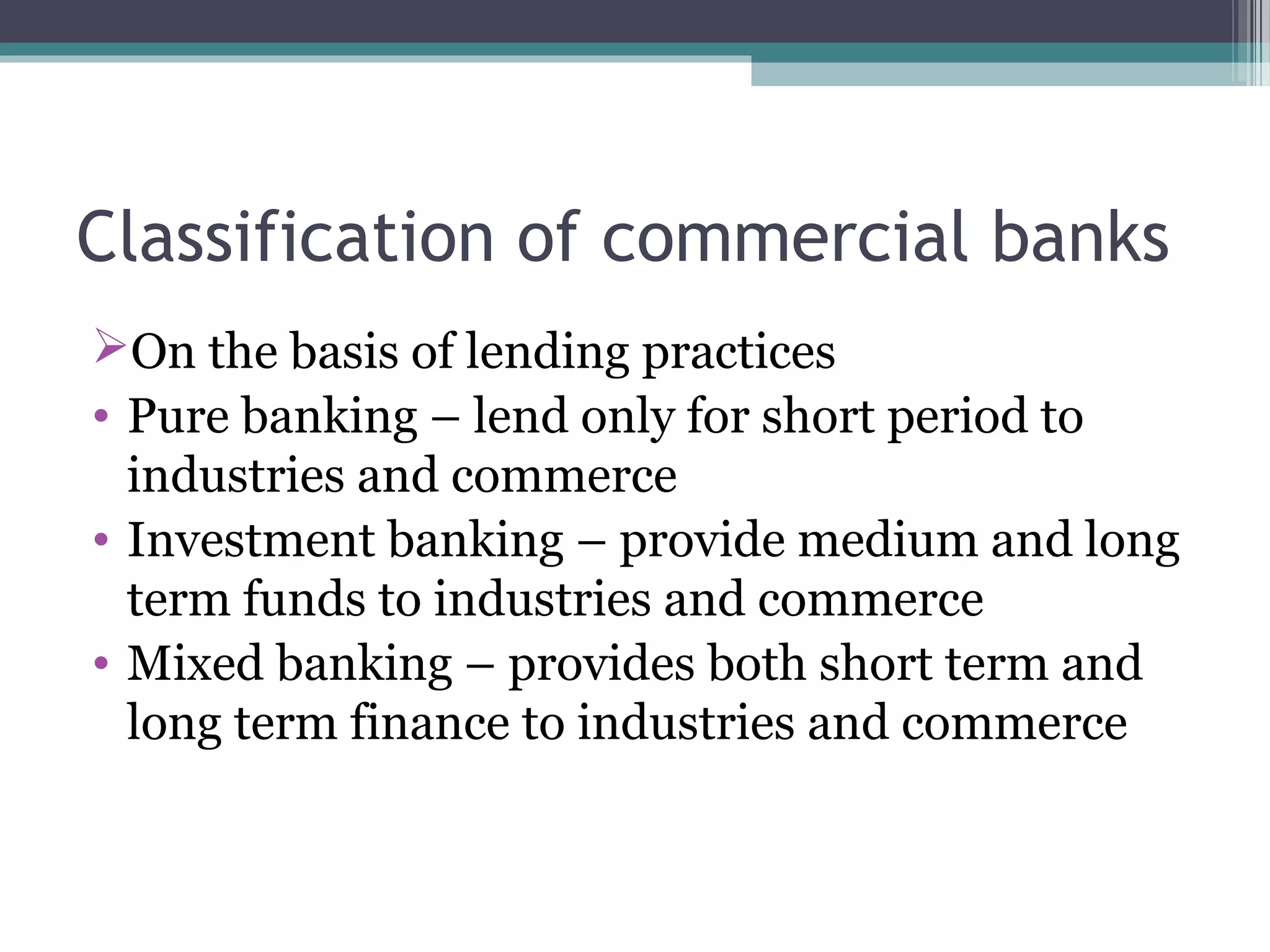
Classification of commercial banks
On the basis of lending practices
• Pure banking – lend only for short period to
  industries and commerce
• Investment banking – provide medium and long
  term funds to industries and commerce
• Mixed banking – provides both short term and
  long term finance to industries and commerce
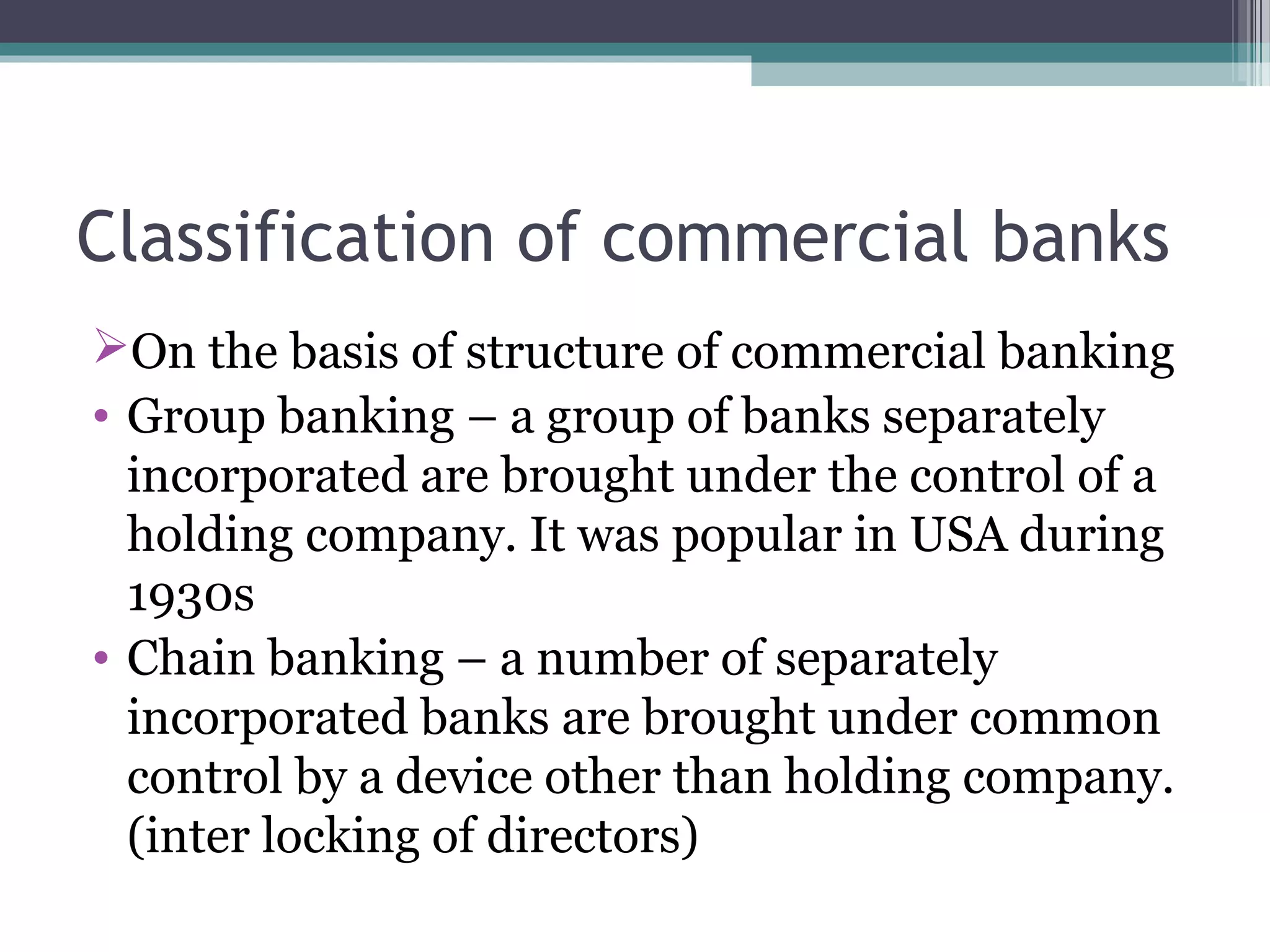
Classification of commercial banks
On the basis of structure of commercial banking
• Group banking – a group of banks separately
  incorporated are brought under the control of a
  holding company. It was popular in USA during
  1930s
• Chain banking – a number of separately
  incorporated banks are brought under common
  control by a device other than holding company.
  (inter locking of directors)
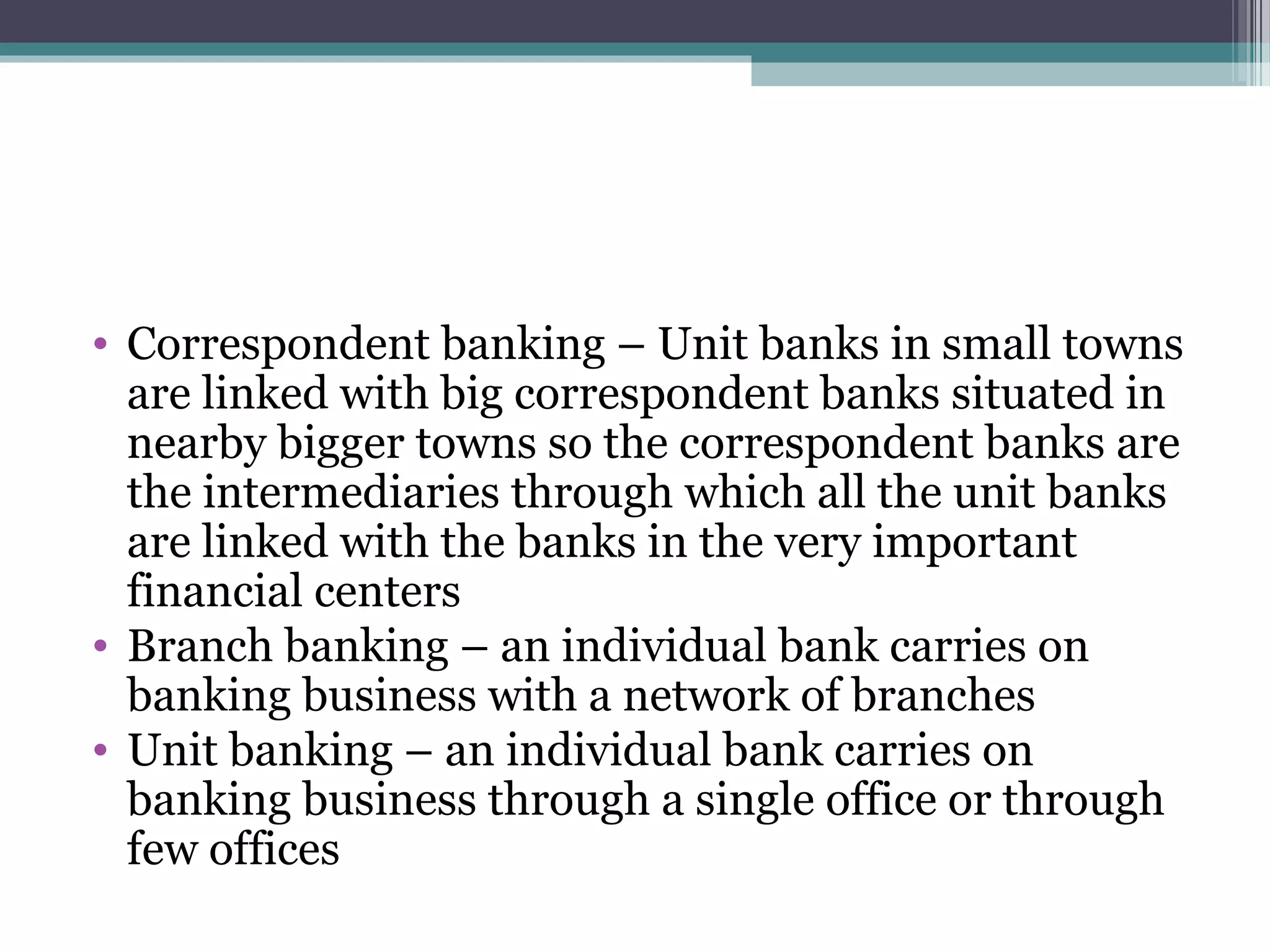
• Correspondent banking – Unit banks in small towns
  are linked with big correspondent banks situated in
  nearby bigger towns so the correspondent banks are
  the intermediaries through which all the unit banks
  are linked with the banks in the very important
  financial centers
• Branch banking – an individual bank carries on
  banking business with a network of branches
• Unit banking – an individual bank carries on
  banking business through a single office or through
  few offices
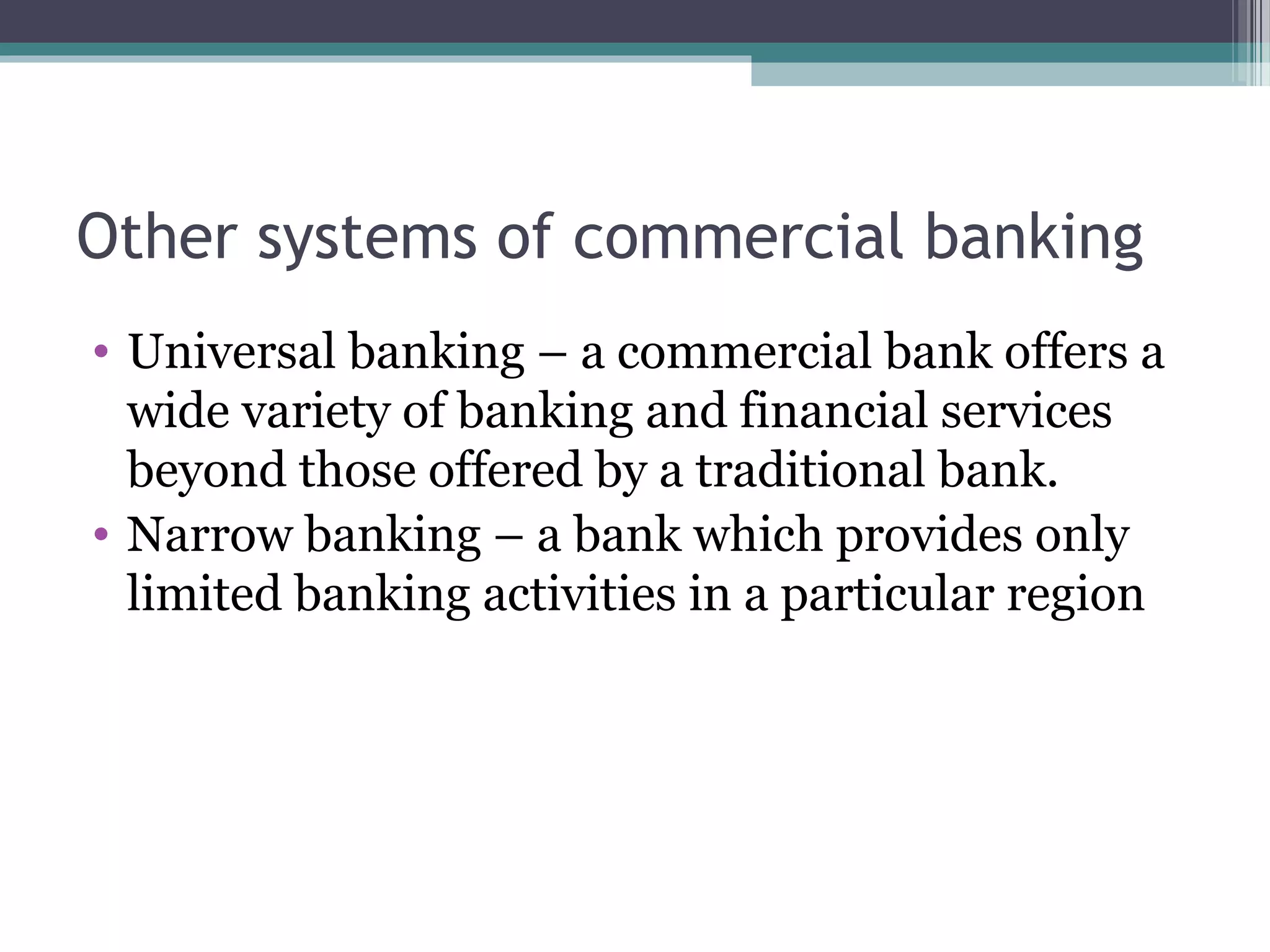
Other systems of commercial banking
• Universal banking – a commercial bank offers a
  wide variety of banking and financial services
  beyond those offered by a traditional bank.
• Narrow banking – a bank which provides only
  limited banking activities in a particular region
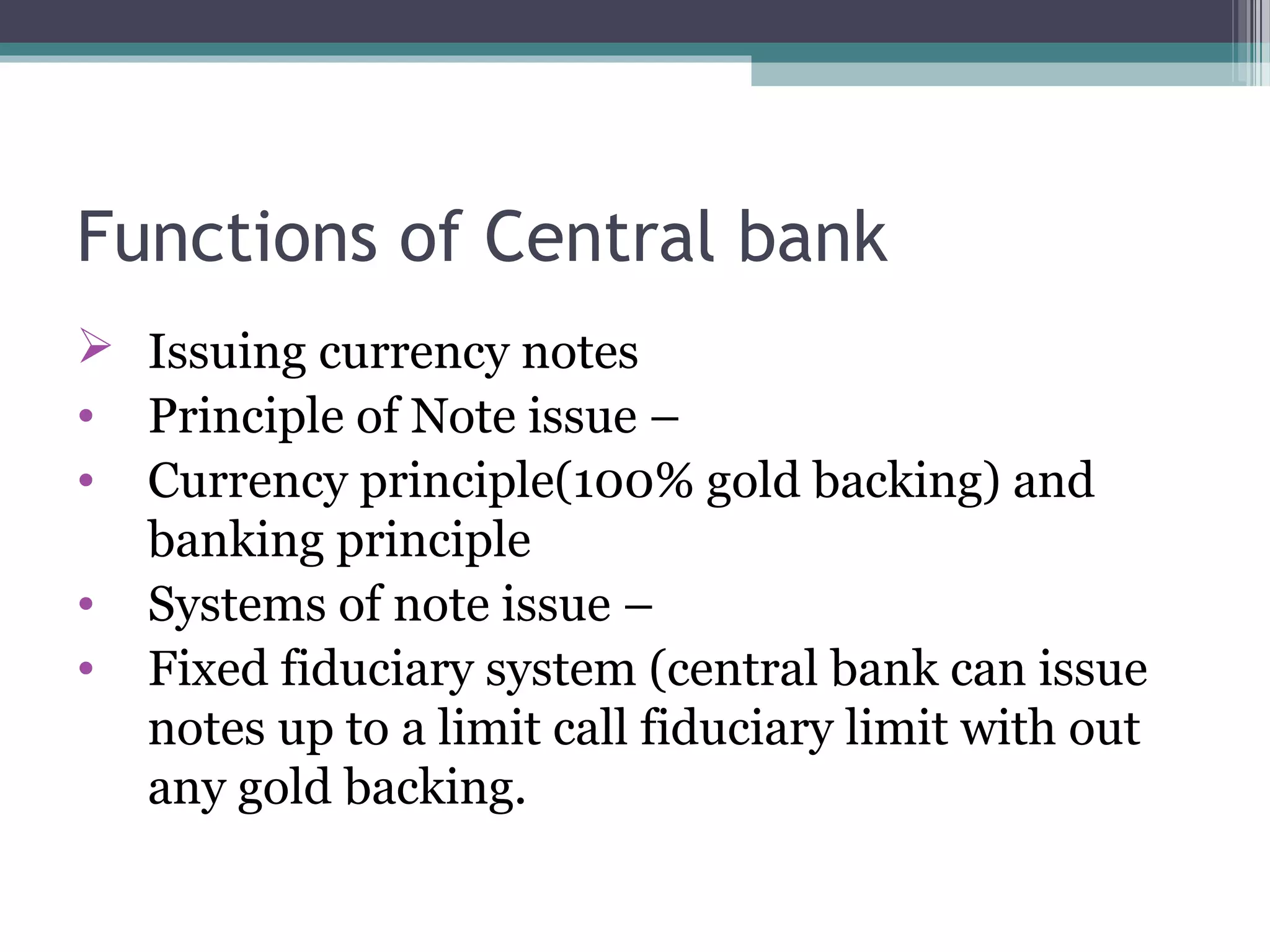
Functions of Central bank
 Issuing currency notes
• Principle of Note issue –
• Currency principle(100% gold backing) and
  banking principle
• Systems of note issue –
• Fixed fiduciary system (central bank can issue
  notes up to a limit call fiduciary limit with out
  any gold backing.
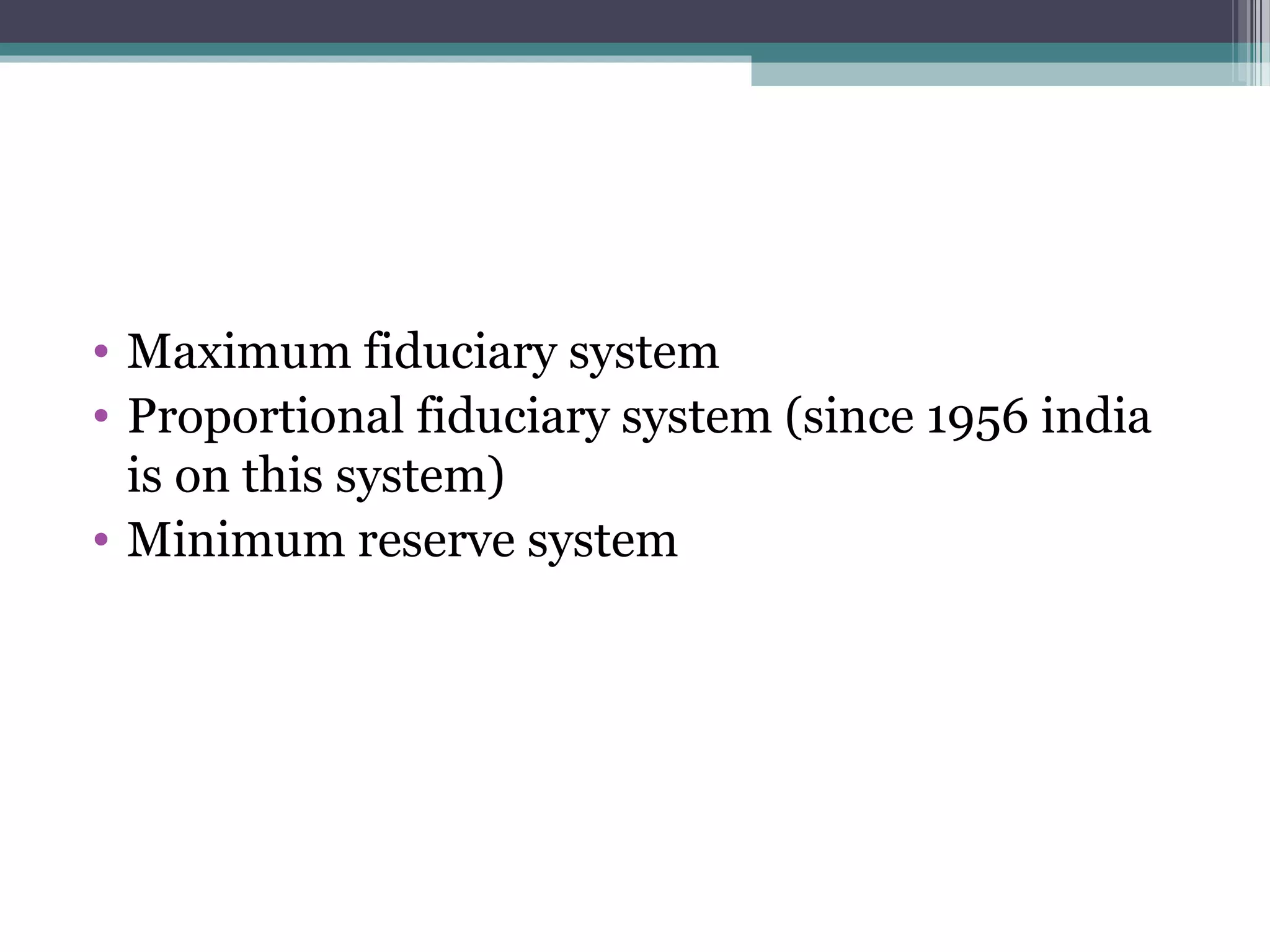
• Maximum fiduciary system
• Proportional fiduciary system (since 1956 india
  is on this system)
• Minimum reserve system
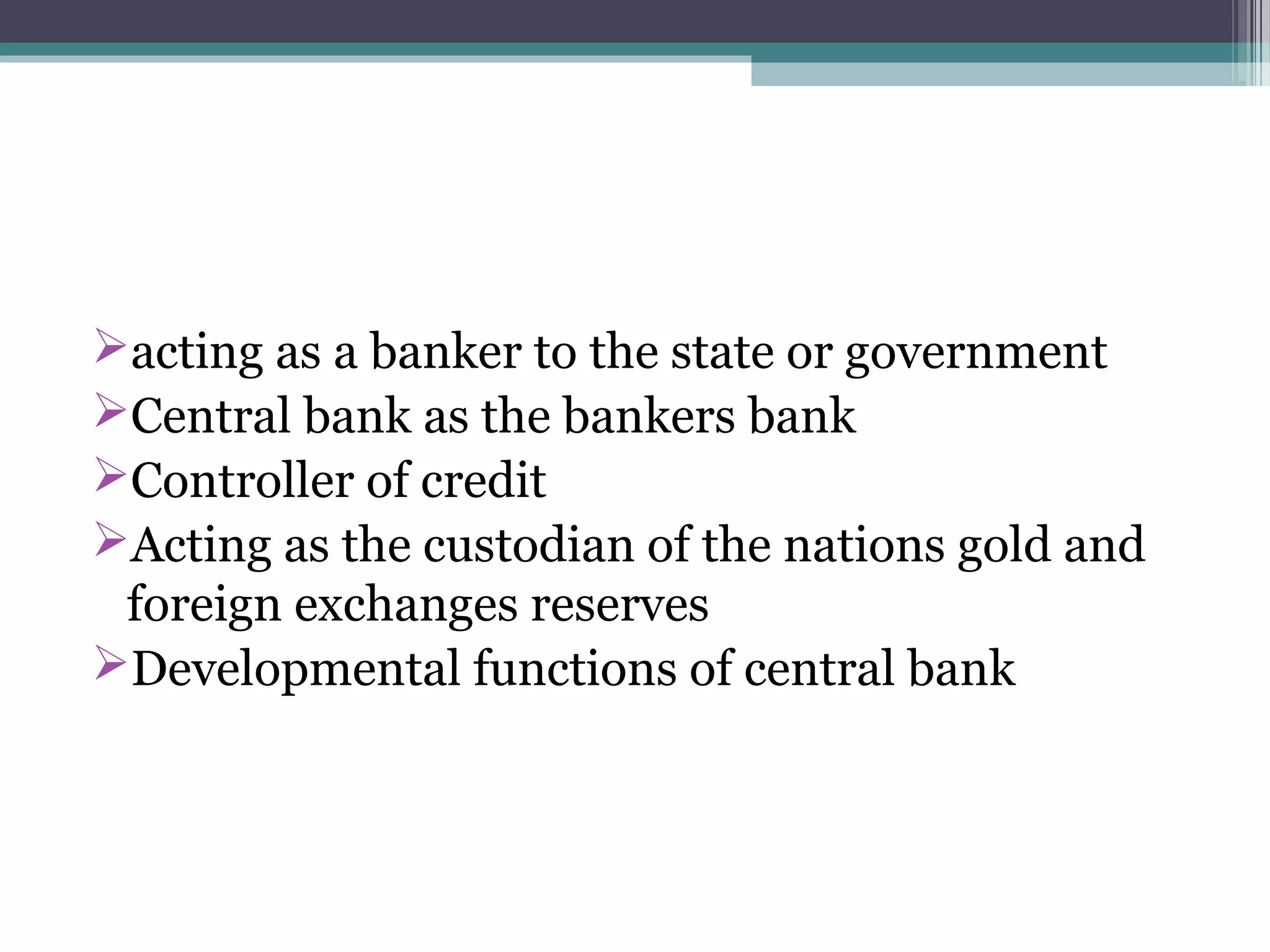
acting as a banker to the state or government
Central bank as the bankers bank
Controller of credit
Acting as the custodian of the nations gold and
 foreign exchanges reserves
Developmental functions of central bank
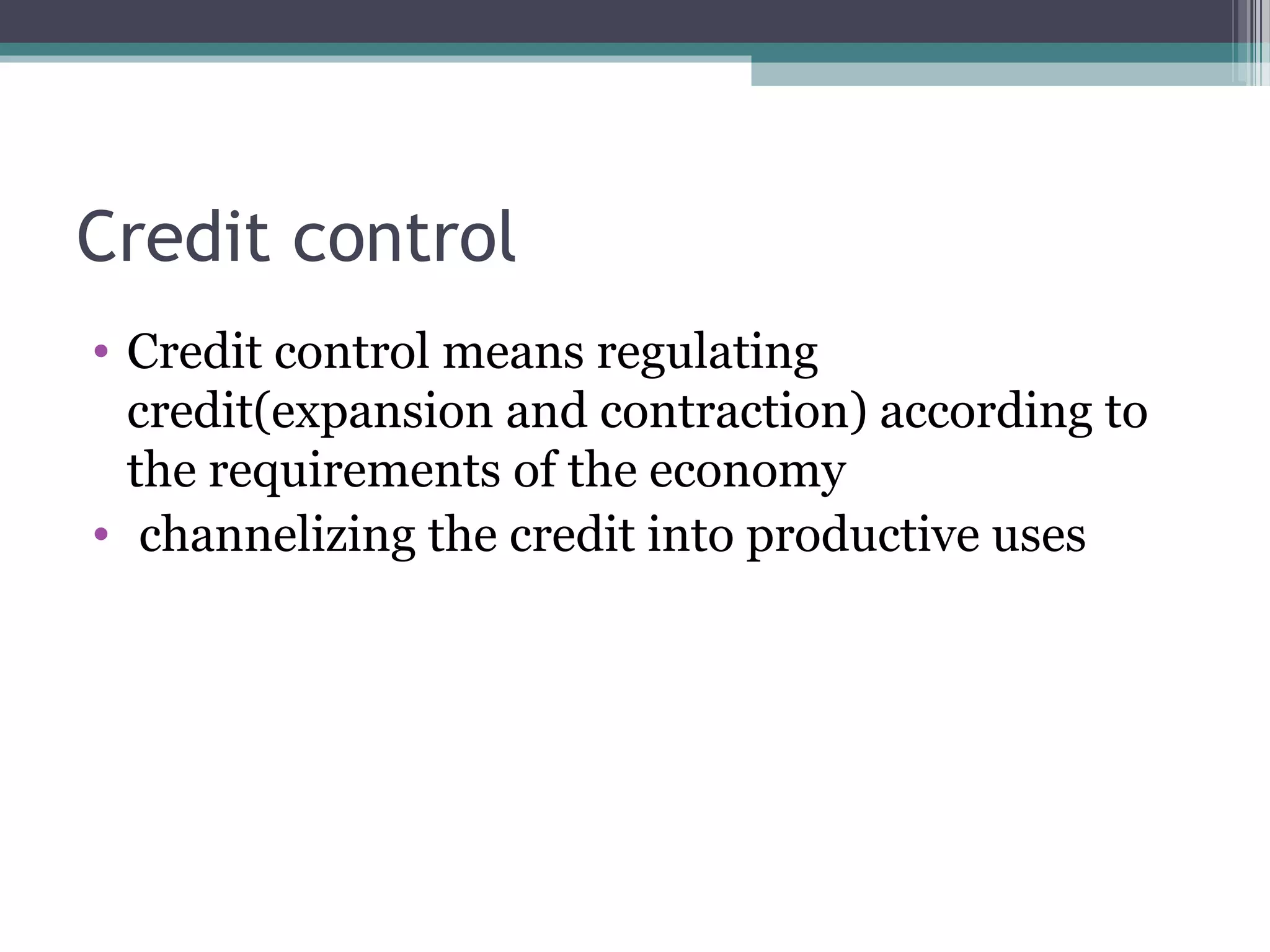
Credit control
• Credit control means regulating
  credit(expansion and contraction) according to
  the requirements of the economy
• channelizing the credit into productive uses
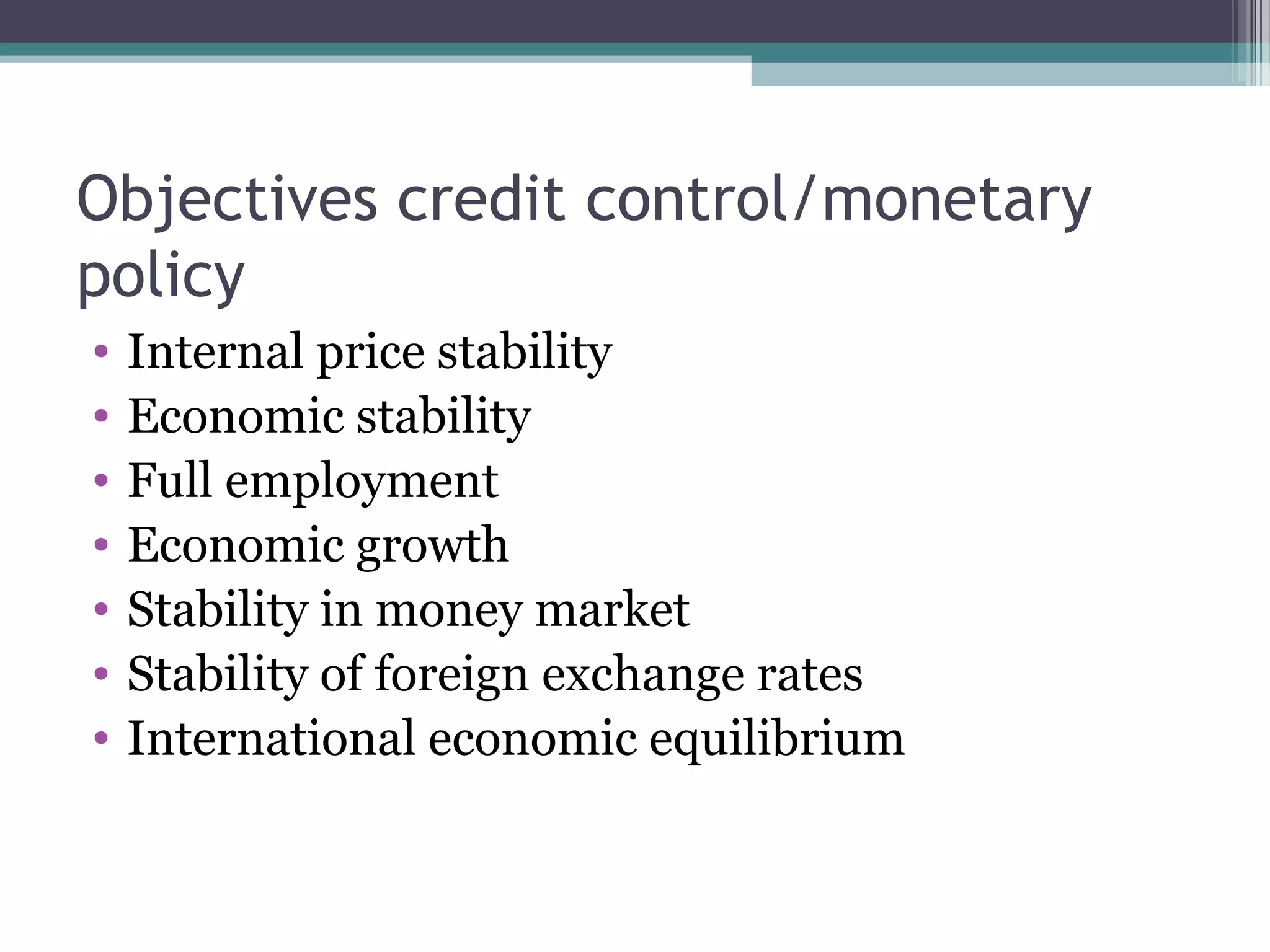
Objectives credit control/monetary
policy
•   Internal price stability
•   Economic stability
•   Full employment
•   Economic growth
•   Stability in money market
•   Stability of foreign exchange rates
•   International economic equilibrium
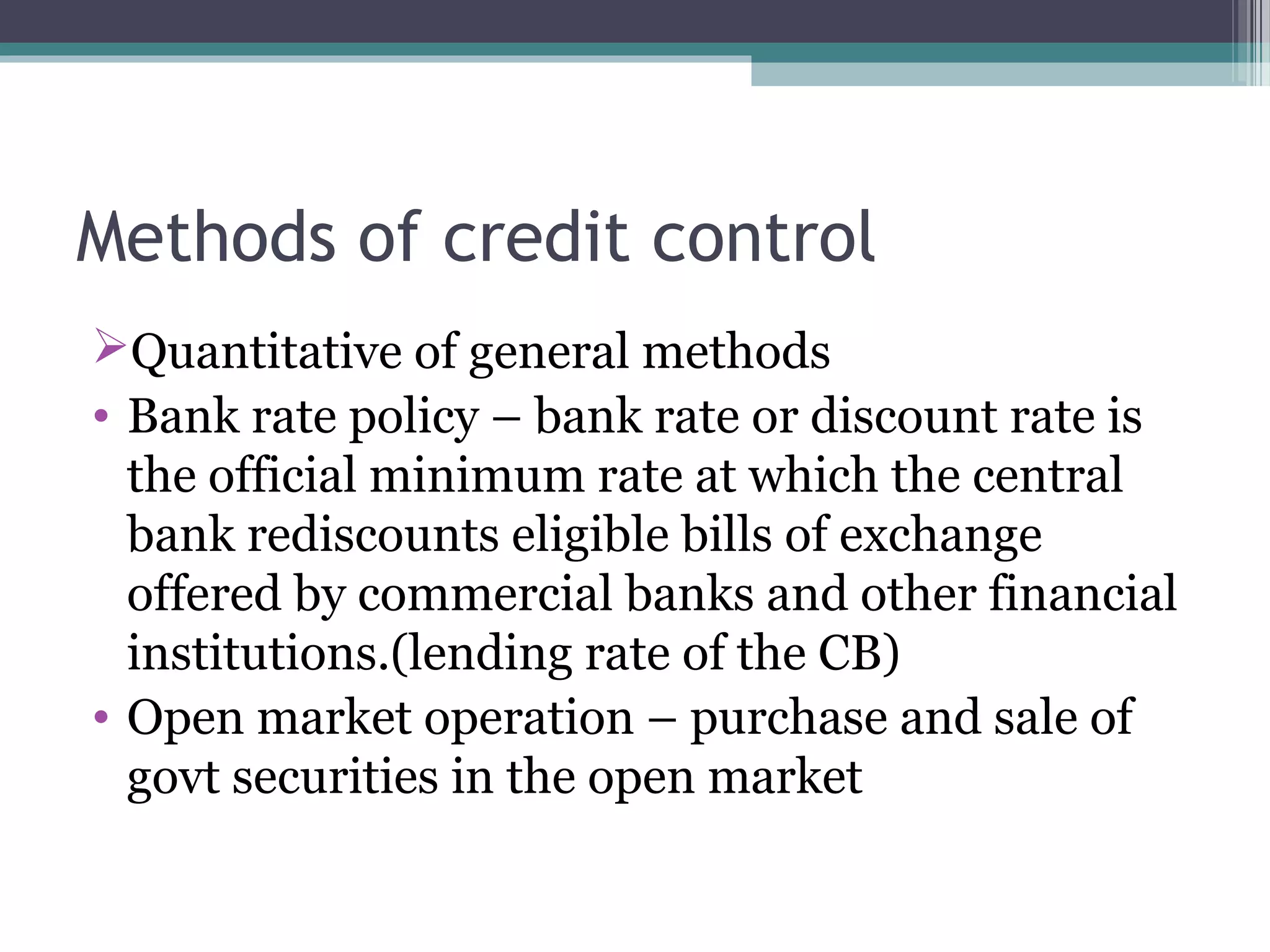
Methods of credit control
Quantitative of general methods
• Bank rate policy – bank rate or discount rate is
  the official minimum rate at which the central
  bank rediscounts eligible bills of exchange
  offered by commercial banks and other financial
  institutions.(lending rate of the CB)
• Open market operation – purchase and sale of
  govt securities in the open market
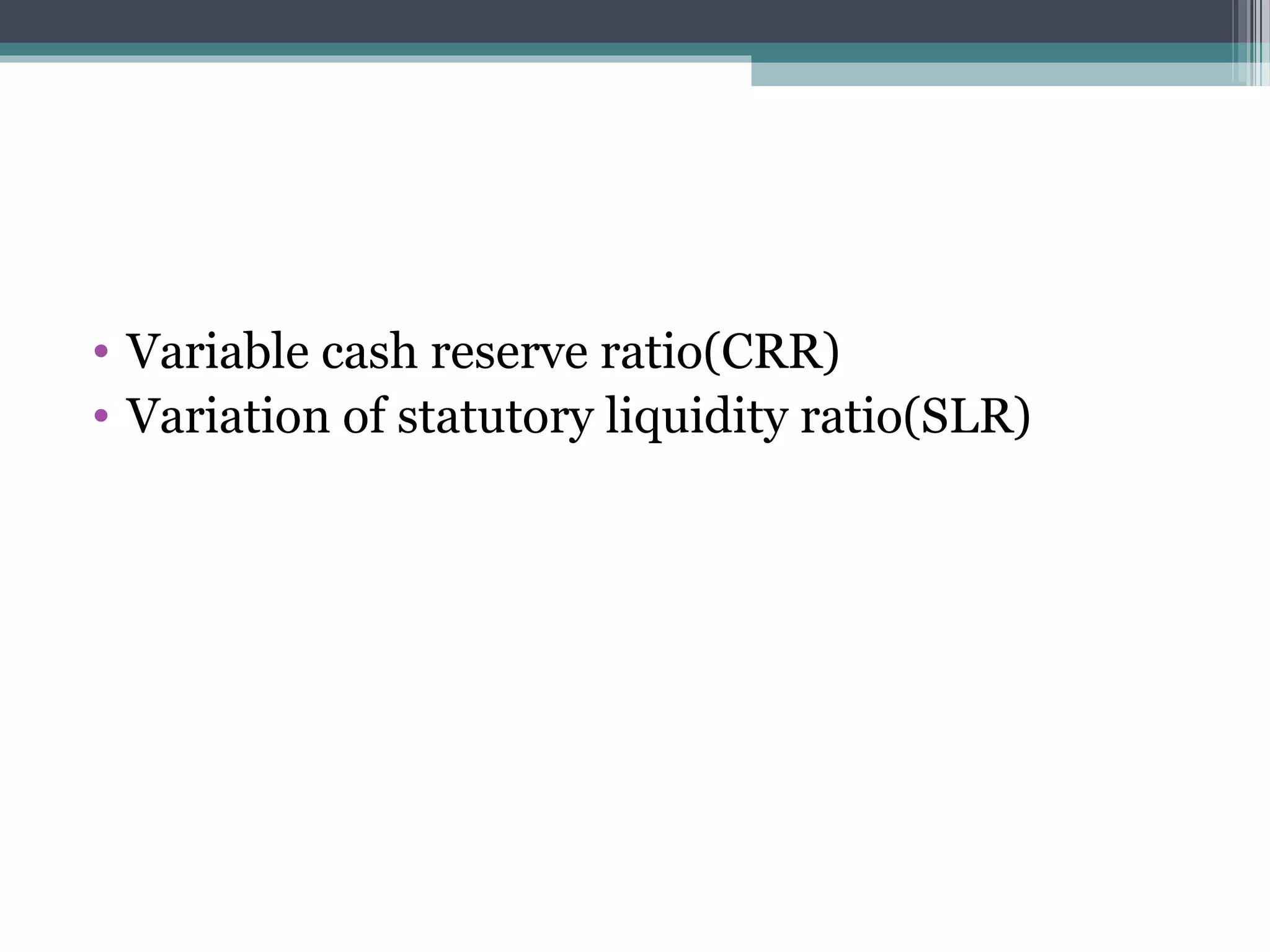
• Variable cash reserve ratio(CRR)
• Variation of statutory liquidity ratio(SLR)
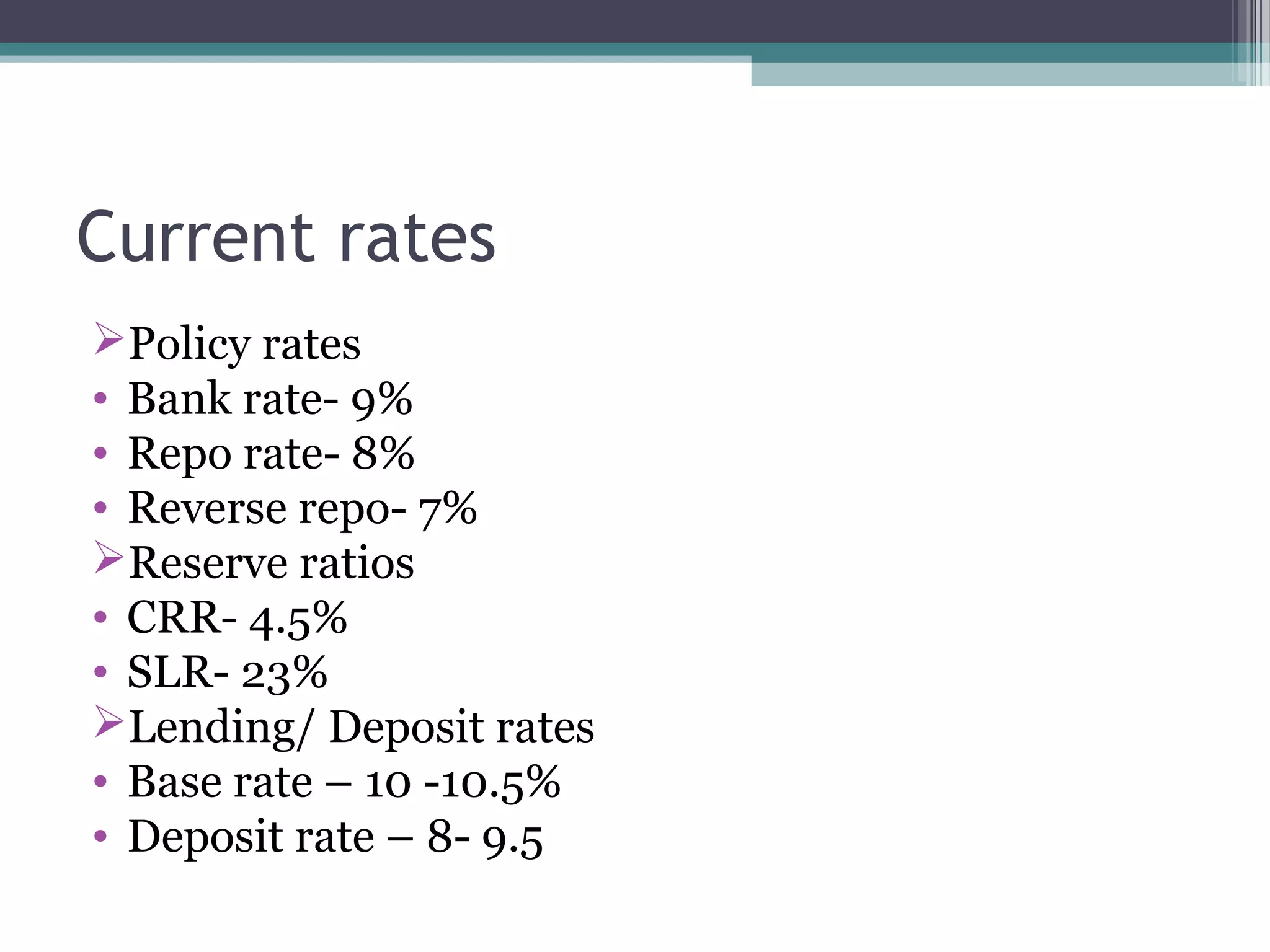
Current rates
Policy rates
• Bank rate- 9%
• Repo rate- 8%
• Reverse repo- 7%
Reserve ratios
• CRR- 4.5%
• SLR- 23%
Lending/ Deposit rates
• Base rate – 10 -10.5%
• Deposit rate – 8- 9.5
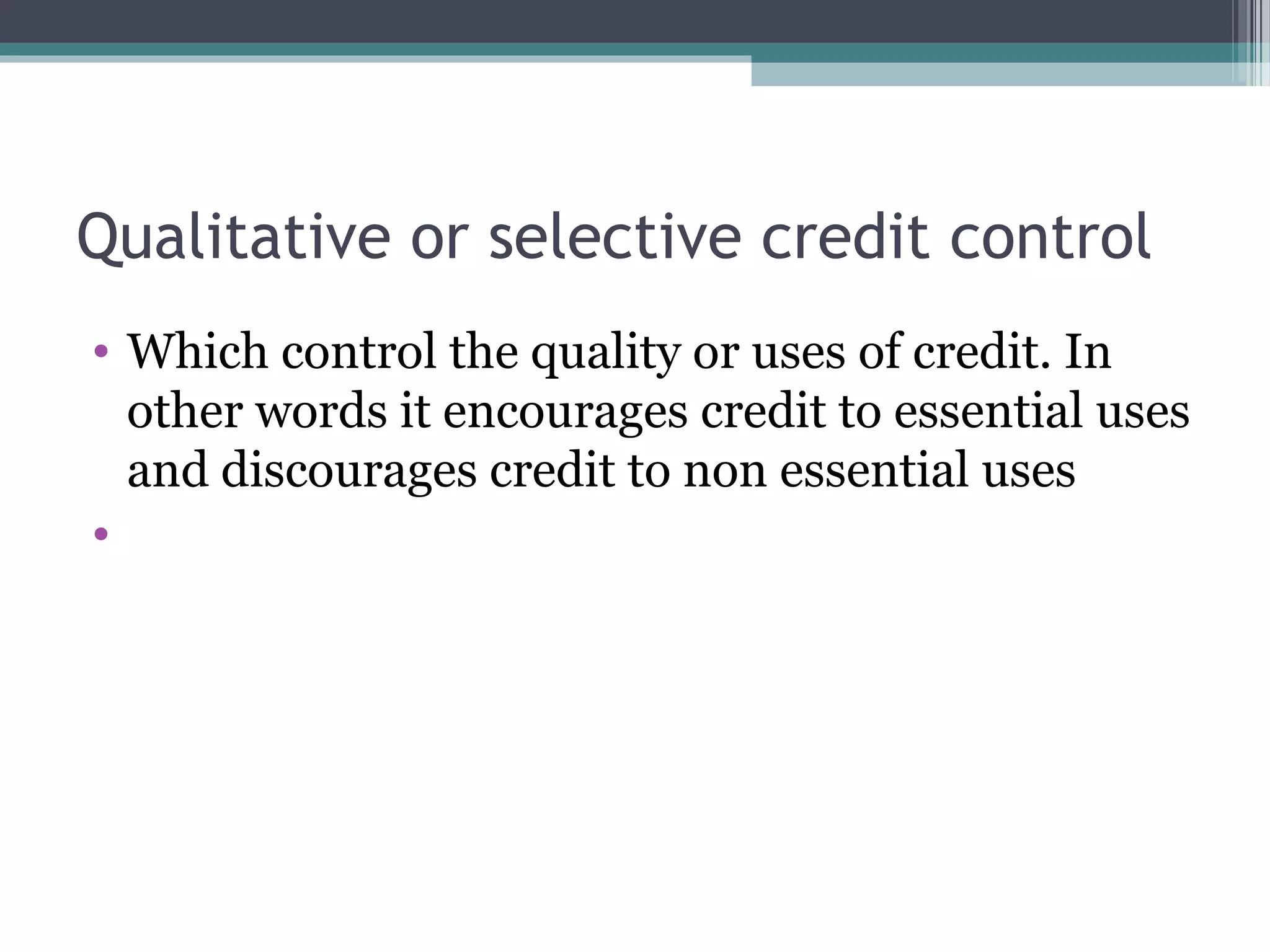
Qualitative or selective credit control
• Which control the quality or uses of credit. In
  other words it encourages credit to essential uses
  and discourages credit to non essential uses
•
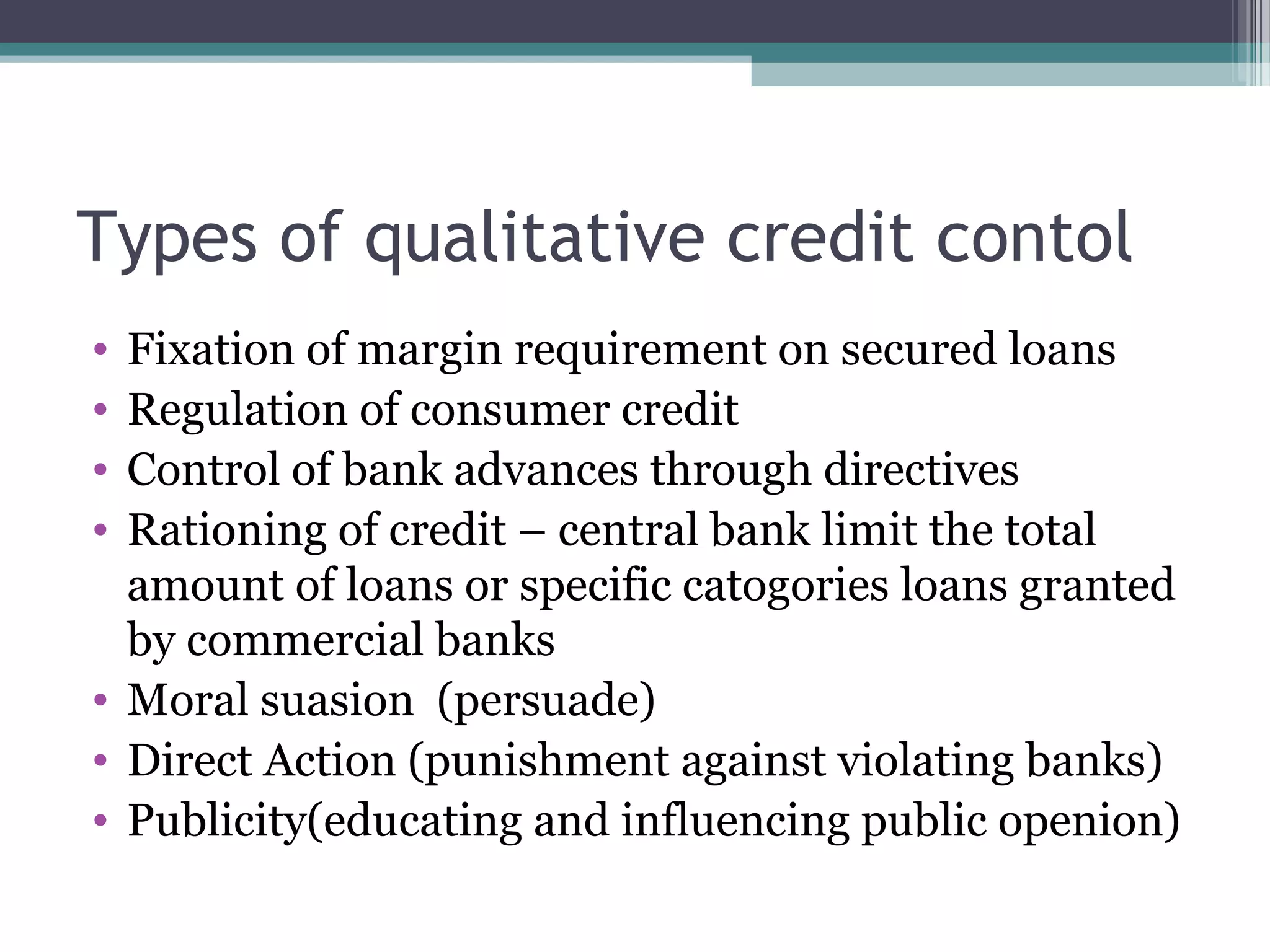
Types of qualitative credit contol
• Fixation of margin requirement on secured loans
• Regulation of consumer credit
• Control of bank advances through directives
• Rationing of credit – central bank limit the total
  amount of loans or specific catogories loans granted
  by commercial banks
• Moral suasion (persuade)
• Direct Action (punishment against violating banks)
• Publicity(educating and influencing public openion)
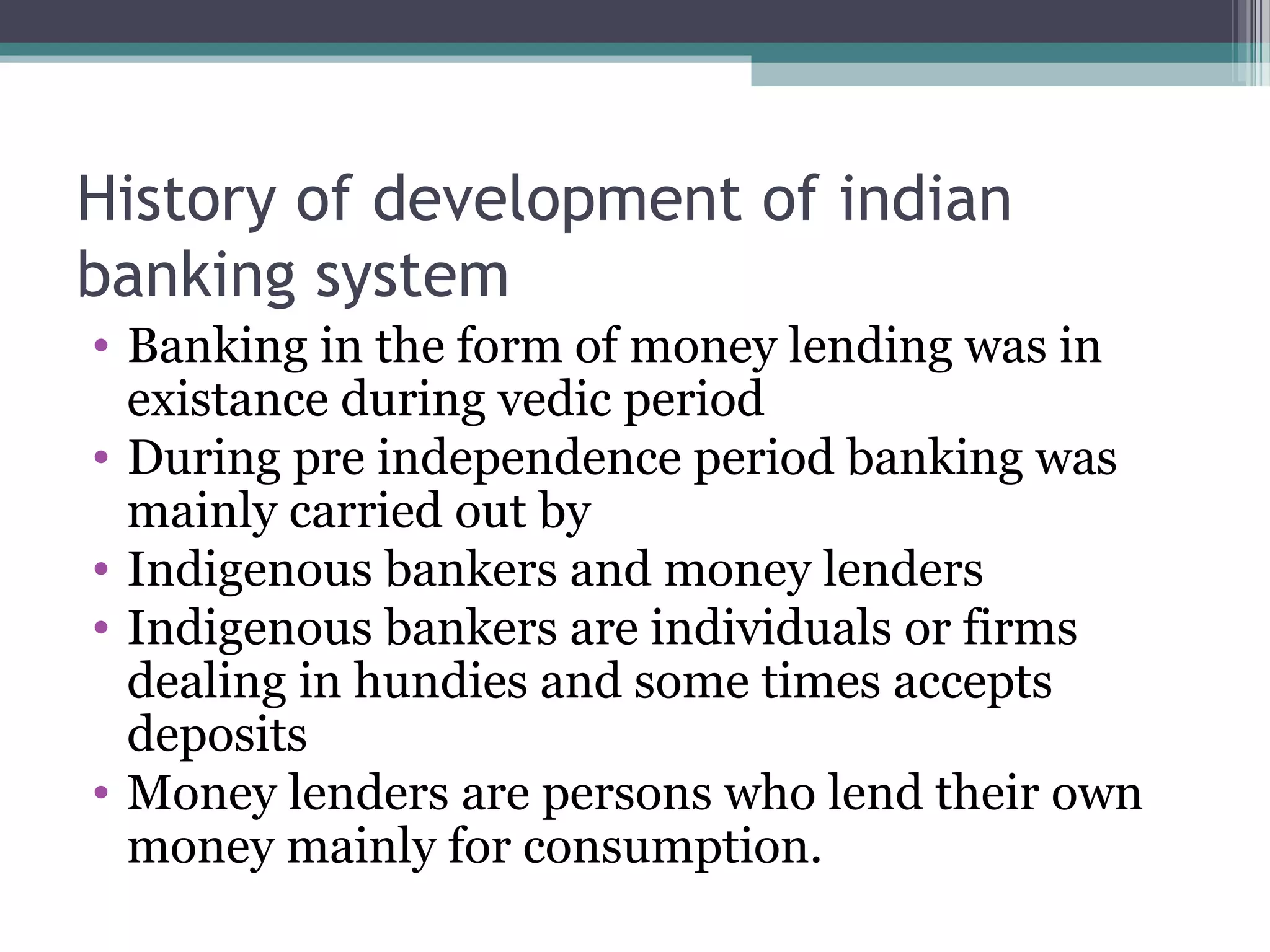
History of development of indian
banking system
• Banking in the form of money lending was in
  existance during vedic period
• During pre independence period banking was
  mainly carried out by
• Indigenous bankers and money lenders
• Indigenous bankers are individuals or firms
  dealing in hundies and some times accepts
  deposits
• Money lenders are persons who lend their own
  money mainly for consumption.
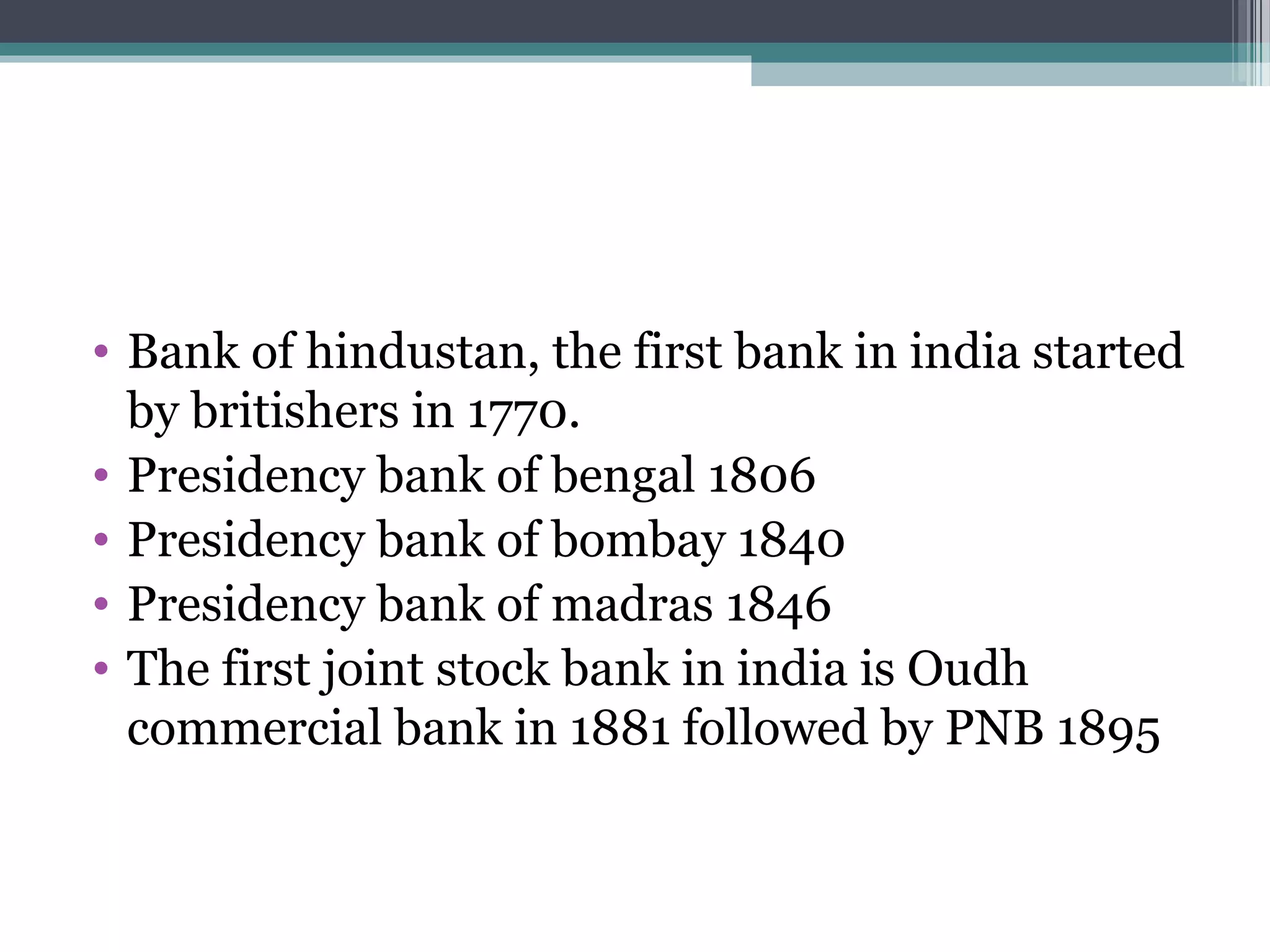
• Bank of hindustan, the first bank in india started
  by britishers in 1770.
• Presidency bank of bengal 1806
• Presidency bank of bombay 1840
• Presidency bank of madras 1846
• The first joint stock bank in india is Oudh
  commercial bank in 1881 followed by PNB 1895
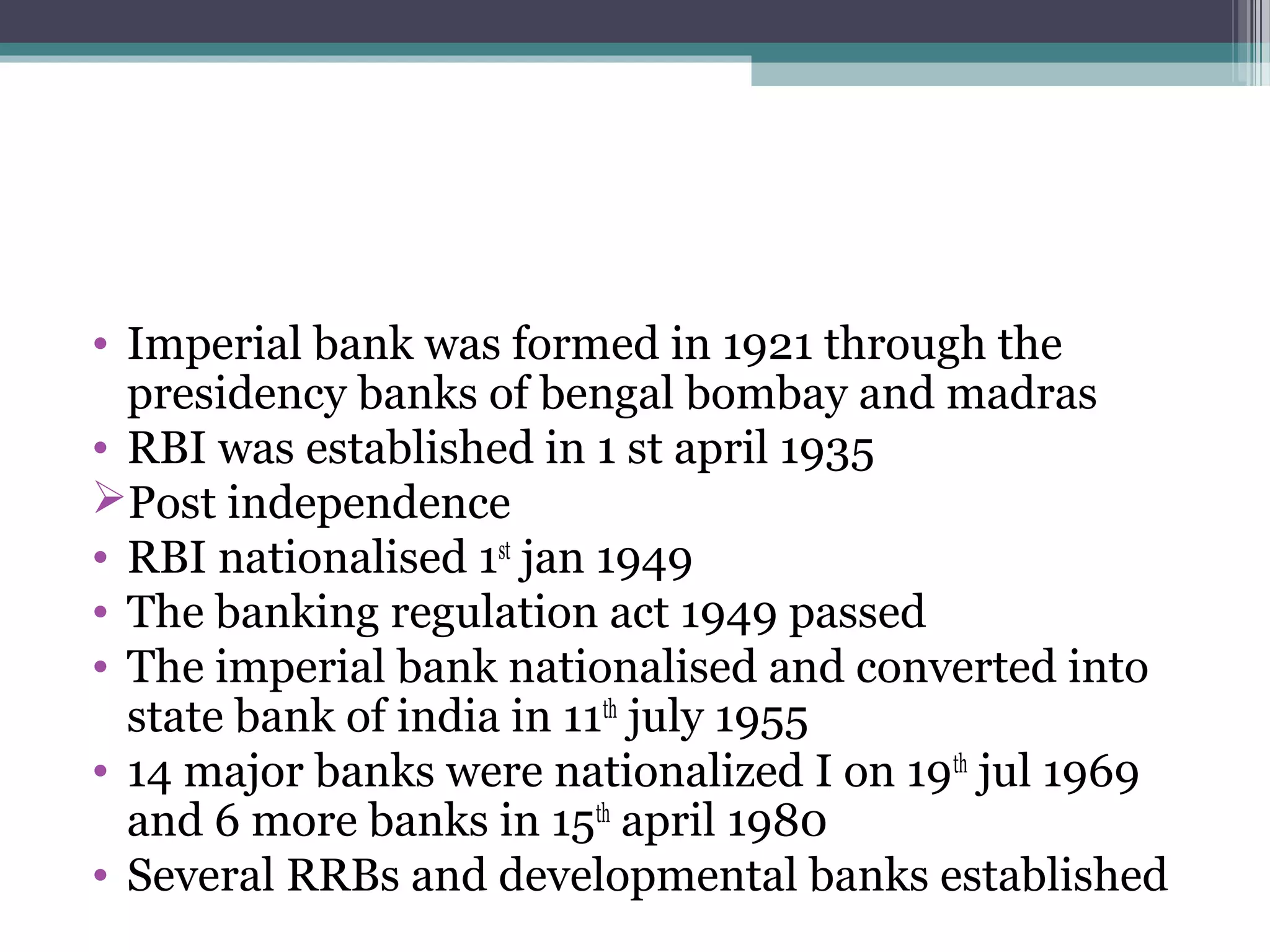
• Imperial bank was formed in 1921 through the
  presidency banks of bengal bombay and madras
• RBI was established in 1 st april 1935
Post independence
• RBI nationalised 1st jan 1949
• The banking regulation act 1949 passed
• The imperial bank nationalised and converted into
  state bank of india in 11th july 1955
• 14 major banks were nationalized I on 19th jul 1969
  and 6 more banks in 15th april 1980
• Several RRBs and developmental banks established
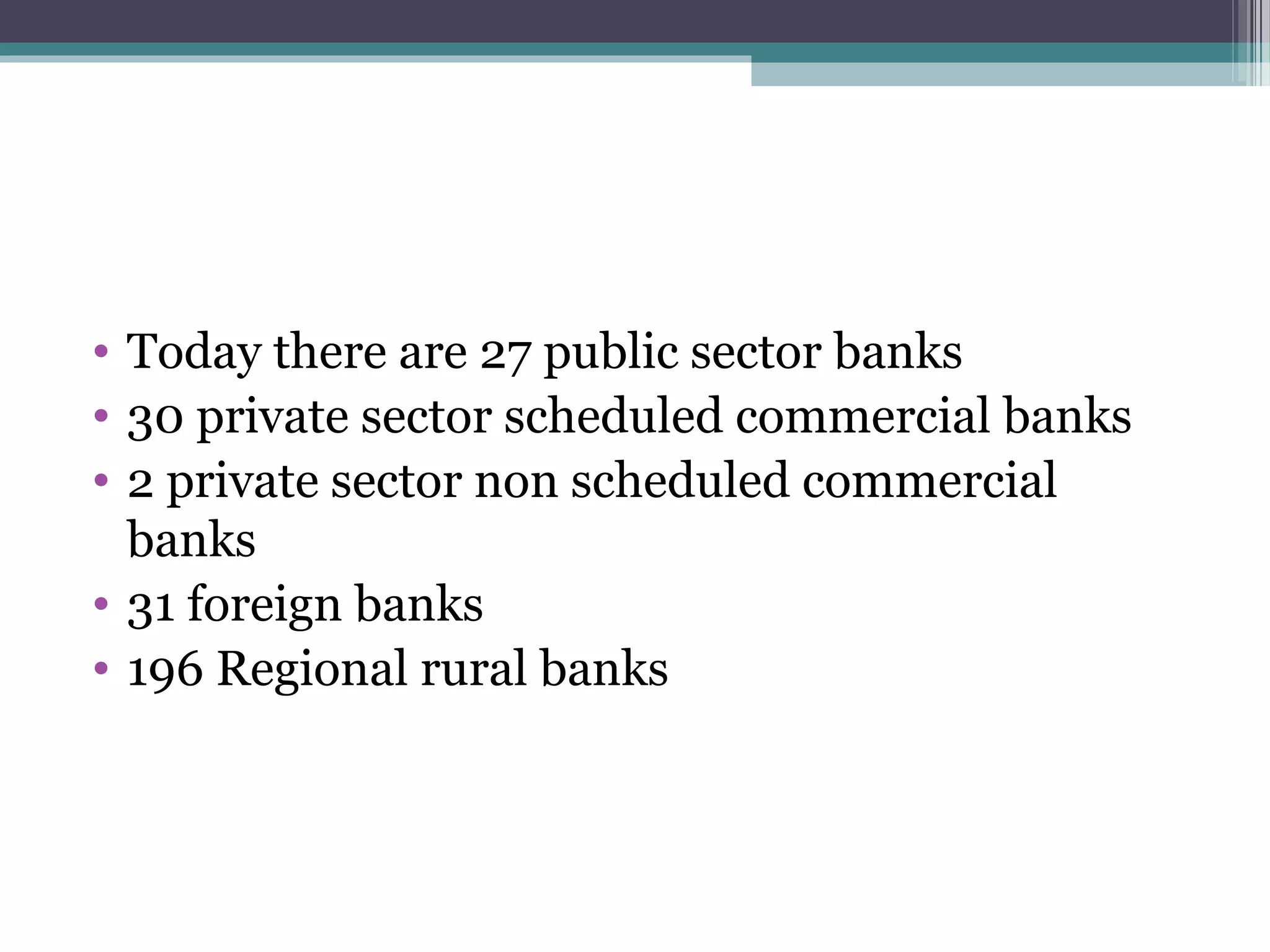
• Today there are 27 public sector banks
• 30 private sector scheduled commercial banks
• 2 private sector non scheduled commercial
  banks
• 31 foreign banks
• 196 Regional rural banks
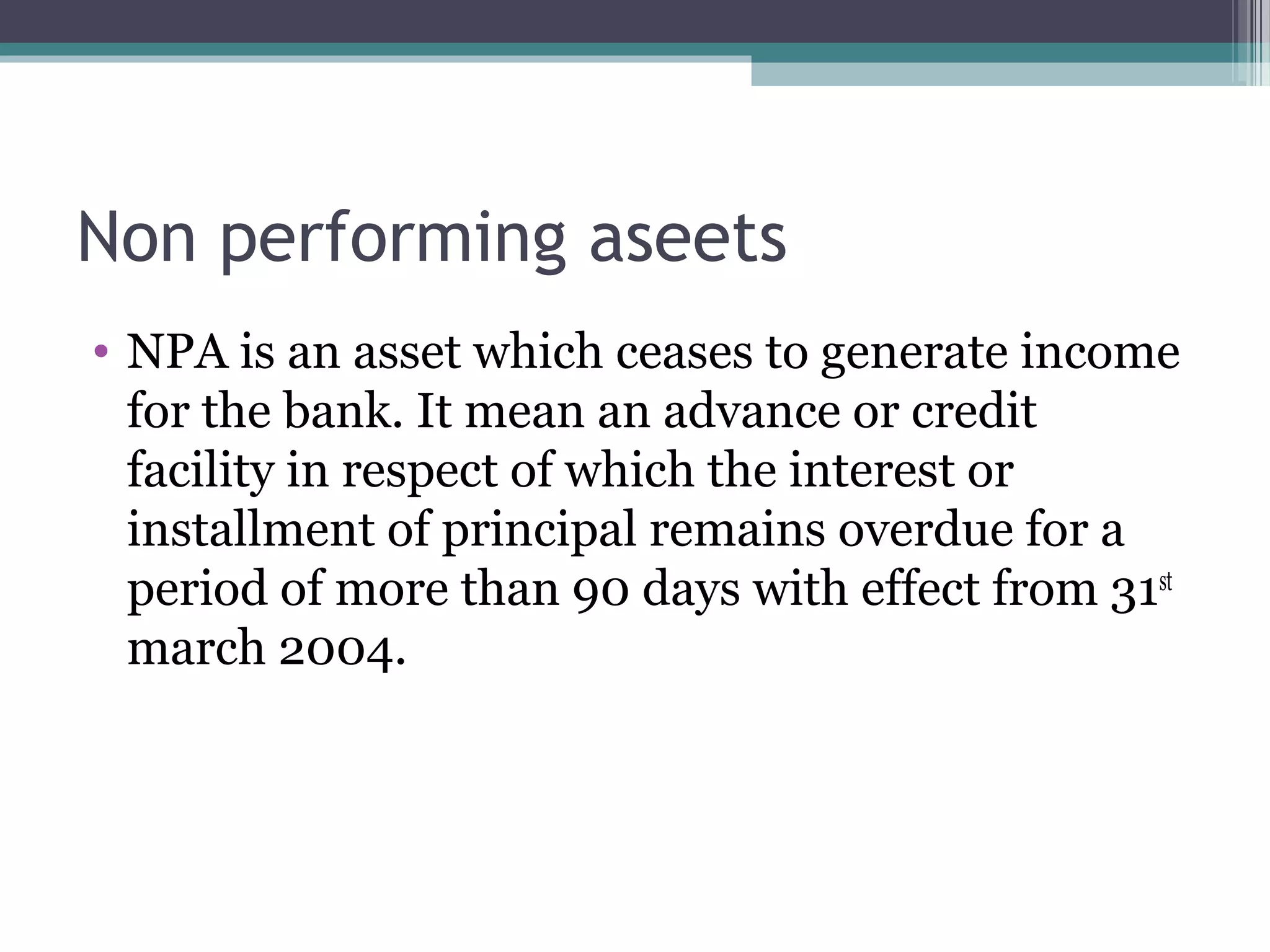
Non performing aseets
• NPA is an asset which ceases to generate income
  for the bank. It mean an advance or credit
  facility in respect of which the interest or
  installment of principal remains overdue for a
  period of more than 90 days with effect from 31st
  march 2004.
Impact of NPA
• They do not generate income
• They enhance the administrative, legal and
  recovery costs of loans
• They reduce profitability of the lending bank
• They affect banks credibility and image
• They adversely affect decision making for fresh
  loans
Early indicators of NPA
• Financial warning signal – default in repayment,
  falling profits, rising level of bad debts, decliainign
  sales
• Operational warning signal- under utilisation of
  capacity, frequent labour problems, over stocking
• Banking warning signals- frequent requests for
  further loans, delay in payment of interest or install
  ment due, reduction in transactions, dishonour of
  cheques, opeing account with other banks, etc
• Managerial warning signal- poor financial
  control, frequent change in ownership,
  undertaking of undu risks, window dressing
• External warning signal – economic recession,
  change in govt policies, new competition
Factors responsible for NPA
Internal factors
• Diversion of funds by the borrowers
• Delay and consequent increase in cost of the
  project
• Business failure
External factors
• Recession
• Shortage of input/power
• Rise in prices of inputs
Techniques for managing NPA
•   Ensure that loans are diversified across sectors
•   Loans are granted to credit worthy borrowers
•   Improving its monitoring system
•   React to early warning signals
•   Knowing clients profile thoroughly
•   Adapting credit rating system

•
Banking legislations in india
• The Negotiable instruments Act 1881
• The banking regulation act 1949
• The reserve bank of india act 1934
Banking ombudsman scheme
• A banking ombudsman is a person appointed by
  the reserve bank of india to redress customer
  complaints against certain deficiencies in
  banking services
• It is to resolve and settle complaints relating to
  the provisions of banking services
E Banking
• E banking means conduct of banking operations
  through electronic means of devices, such as
  computers, telephones, mobile phones, ATMs,
  etc
Forms of e banking
• Internet banking
• Mobile banking
• Telephone banking
• Home banking
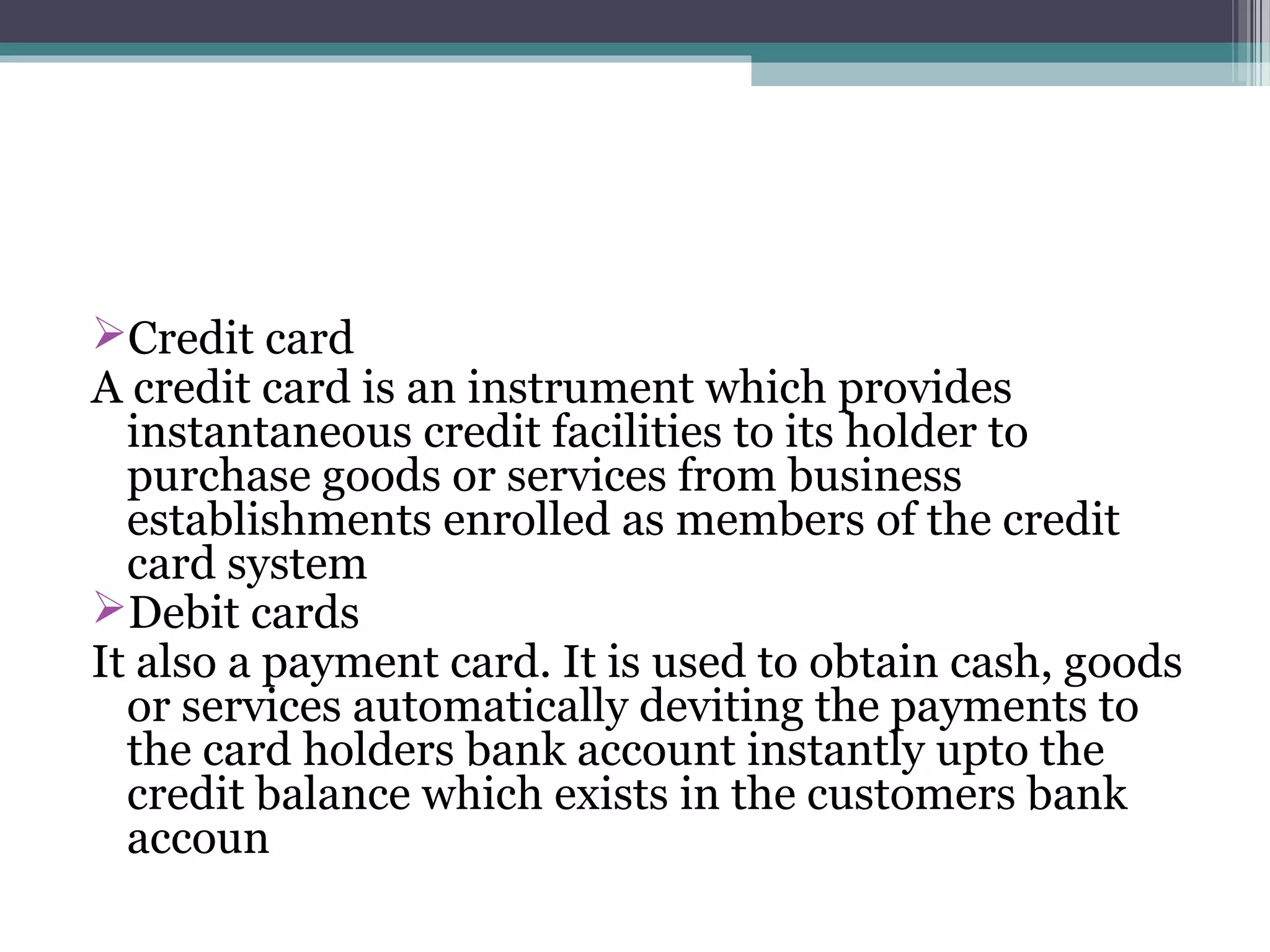
Credit card
A credit card is an instrument which provides
  instantaneous credit facilities to its holder to
  purchase goods or services from business
  establishments enrolled as members of the credit
  card system
Debit cards
It also a payment card. It is used to obtain cash, goods
  or services automatically deviting the payments to
  the card holders bank account instantly upto the
  credit balance which exists in the customers bank
  accoun
Electronic Fund Transfer
• It is a scheme of RBI introuduced in 1996.
• It helps banks to offer their customers money
  transfer service from one account to another
  account of a bank branch both intercity and intra
  city and also from one account of one bank to
  another account of another bank in the same city
  or different cities
NABARD
• National Bank for Agriculture and Rural
  Development
• an apex Development Bank for promotion and
  development of agriculture, small-scale
  industries, cottage and village industries,
  handicrafts and other rural crafts
• Established in 12 july, 1982, by an Act of
  Parliament
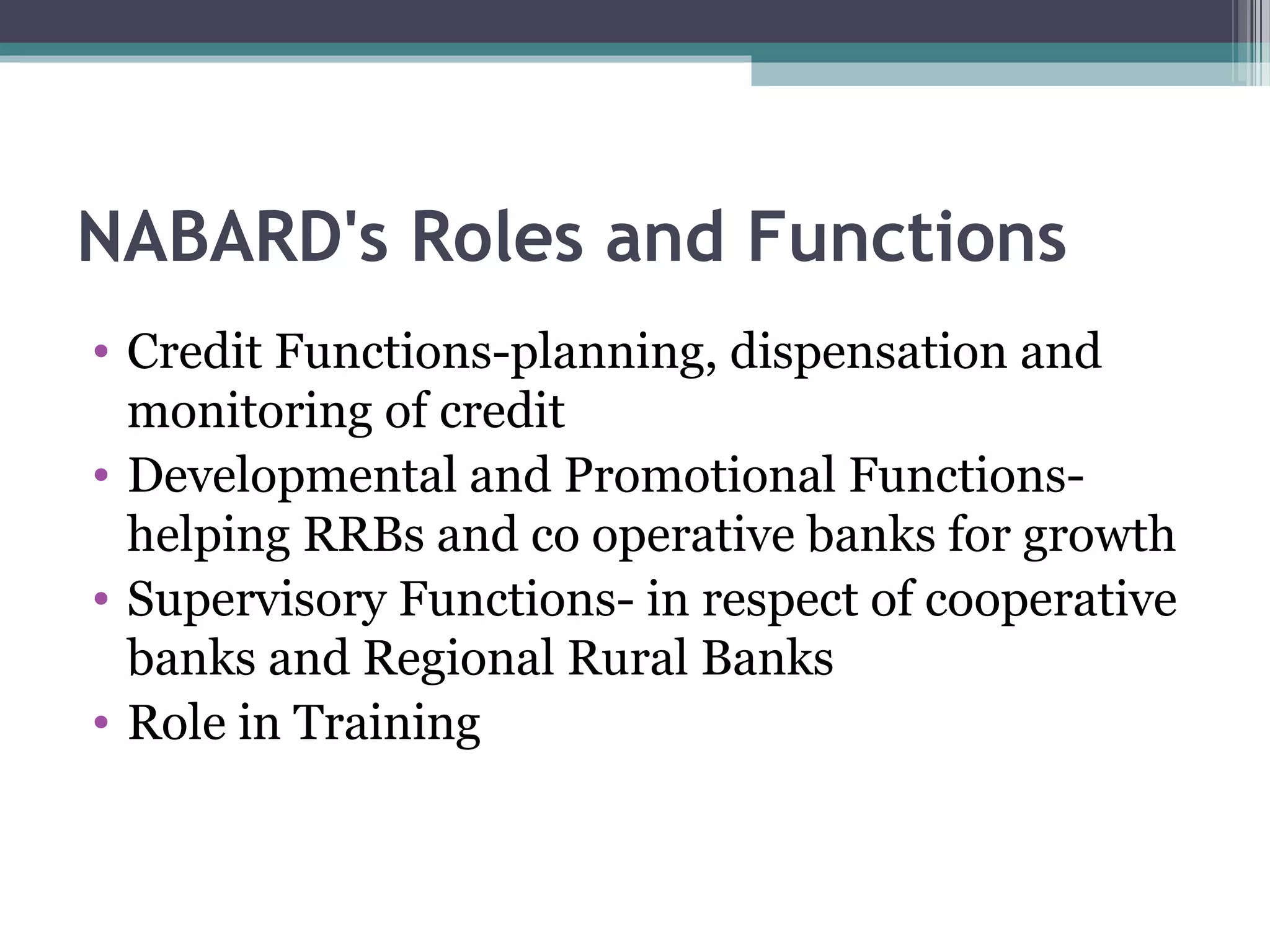
NABARD's Roles and Functions
• Credit Functions-planning, dispensation and
  monitoring of credit
• Developmental and Promotional Functions-
  helping RRBs and co operative banks for growth
• Supervisory Functions- in respect of cooperative
  banks and Regional Rural Banks
• Role in Training
NABARD’s Initiatives
• SHG Bank linkage programme started as a pilot project
  in 1992 with 500 SHGs
• Farmers Clubs
• Rural Infrastructure Development Fund (RIDF)
• Watershed Development 1999-2000
• Rural Innovation Fund in association with Swiss Agency
  for Development and Cooperation (SDC)
• agreements for co-financing with 14 commercial banks
  2006-07
• Kisan Credit Card
• NABARD Consultancy Services (Nabcons)
• NABARD Financial Services Limited, [NABFINS]
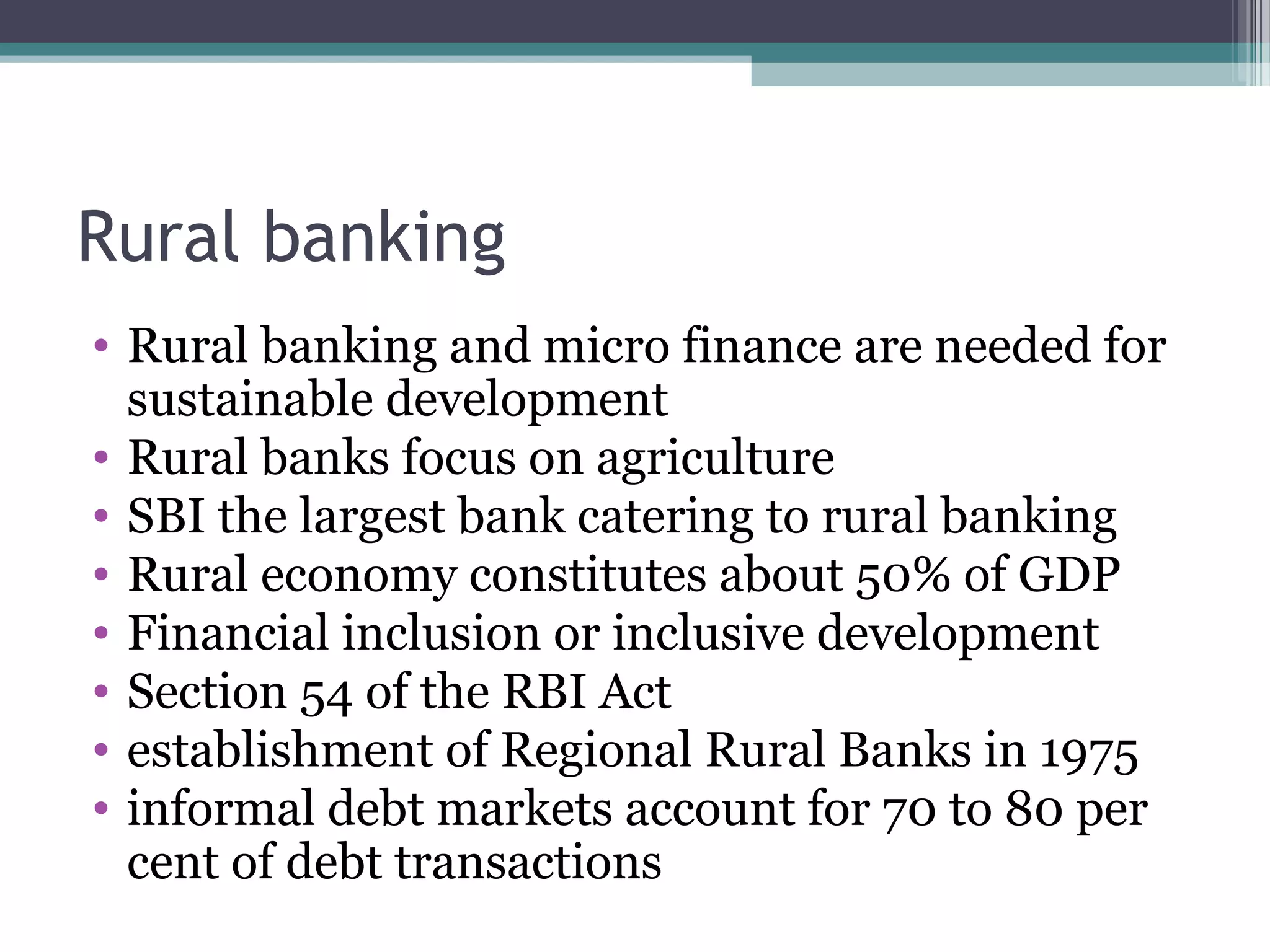
Rural banking
• Rural banking and micro finance are needed for
  sustainable development
• Rural banks focus on agriculture
• SBI the largest bank catering to rural banking
• Rural economy constitutes about 50% of GDP
• Financial inclusion or inclusive development
• Section 54 of the RBI Act
• establishment of Regional Rural Banks in 1975
• informal debt markets account for 70 to 80 per
  cent of debt transactions
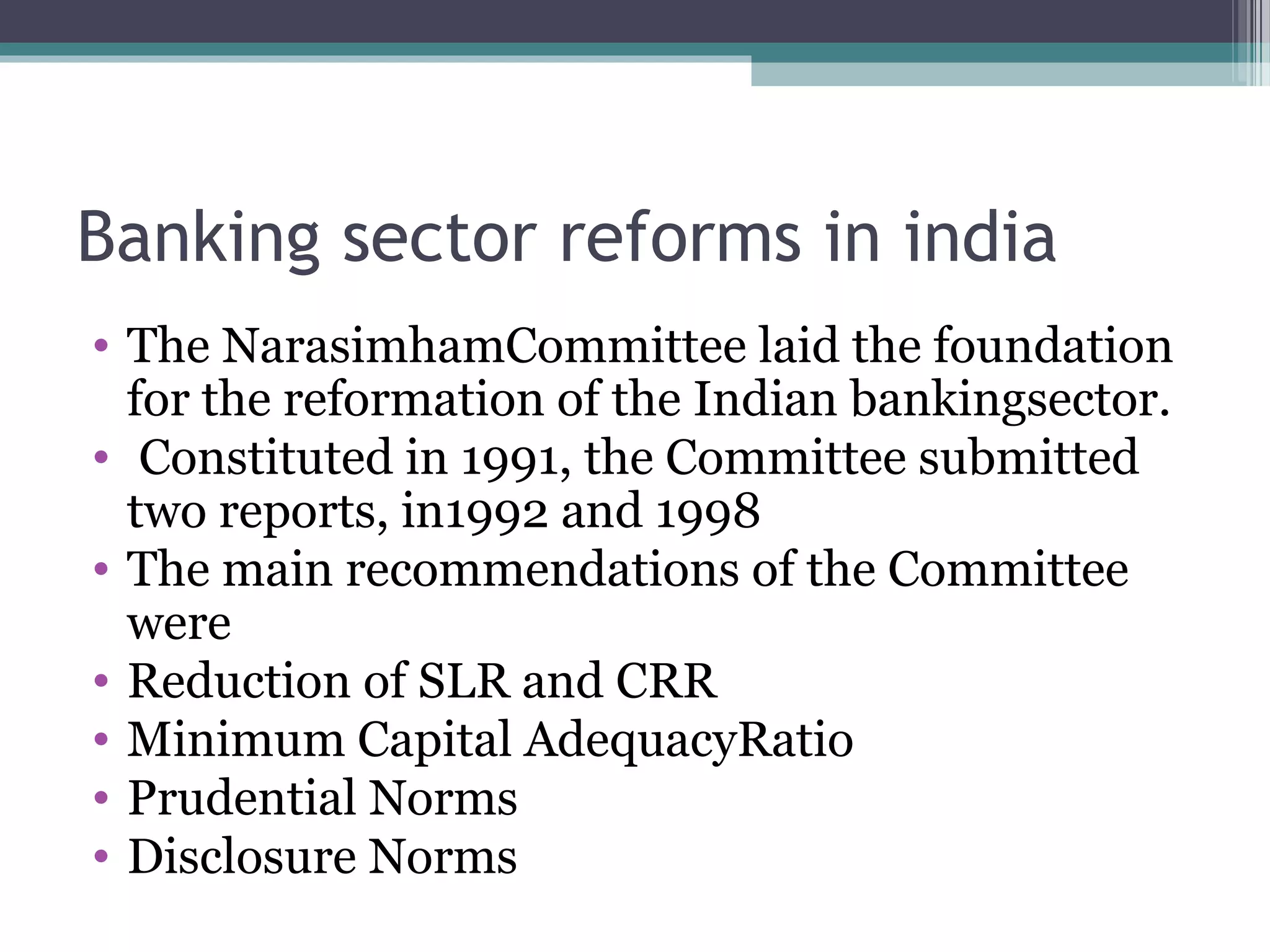
Banking sector reforms in india
• The NarasimhamCommittee laid the foundation
  for the reformation of the Indian bankingsector.
• Constituted in 1991, the Committee submitted
  two reports, in1992 and 1998
• The main recommendations of the Committee
  were
• Reduction of SLR and CRR
• Minimum Capital AdequacyRatio
• Prudential Norms
• Disclosure Norms
• Rationalisation of Foreign Operations in india
• Special Tribunals and Asset Reconstruction
  Fund
• Restructuring of Weak Banks
• Reduction of Government Stake in PSBs
• Deregulation on Interest Rates
Capital Adequacy Ratio
• The Committee on Banking Regulations and Supervisory
  Practices (Basel Committee) had released the guidelines
  on capital measures and capital standards in July 1988
• In India it has been implement-ed by RBI w.e.f. 1.4.92
• Minimum requirements of capital fund in India:
  * Existing Banks 09 %
  * New Private Sector Banks 10 %
  * Banks undertaking Insurance business 10 %
  * Local Area Banks 15%
• Capital Fund has two tiers - Tier I capital and Tier II
Basel Norms
• Basel is a city in Switzerland. It is the headquarters
  of Bureau of International Settlement (BIS)
• Currently there are 27 member nations in the
  committee.
• Basel guidelines refer to broad supervisory
  standards formulated by this group of central banks
• India adopted Basel 1 guidelines in 1999.
• In June ’04, Basel II guidelines were published by
  BCBS
• In 2010, Basel III guidelines were released
Industrial Development Bank of
India (IDBI)
• established in July 01, 1964 a subsidiary of RBI
• the apex institute to finance the industries and it
  also coordinates with the other banks for
  financing
• In 1976 it was converted as the autonomous
  body
• It become IDBI ltd October 01, 2004
• The merger with idbi bank ltd became effective
  from April 02, 2005
• the new name idbi bank ltd became effective
• Direct assistance is provided by way of project
  loans, underwriting of and direct subscription to
  industrial securities, soft loans, technical refund
  loans, etc
• indirect assistance is in the form of refinance
  facilities to industrial concerns
Industrial Finance Corporation of
India (IFCI)
• established in 1948 under an Act of Parliament
• the first Development Financial Institution in
  the country to cater to the long-term finance
  needs of the industrial sector
• Converted to Joint-Stock Company 1993
• Products and services include
• Financial Products
• Project Development
• Corporate Advisory services
• Nodal Agency for Sugar Development Fund
State Financial Corporations
• A Central Industrial Finance corporation was set
  up under the industrial Financecorporations Act,
  1948 in order to provide medium and long term
  credit to industrialundertakings which fall
  outside normal activities of commercial banks
• State financial Corporations Act 1951 was passed
  in the parliament
• There are 18 SFCs in india
• Kerala Financial Corporation (KFC)
Unit Trust of India
• created by the UTI Act 1963
• For more than two decades it remained the sole
  vehicle for investment in the capital market by
  the Indian citizens
• In mid- 1980s public sector banks were allowed
  to open mutual funds
• its flagship and largest scheme was US 64
Small Industries Development Bank
of India (SIDBI)
• set up on April 2, 1990 under an Act of Indian
  Parliament
• Principal Financial Institution for the
  Promotion, Financing and Development of the
  Micro, Small and Medium Enterprise (MSME)
  sector
• Wholly owned subsidary of idbi
• an e-platform ‘NTREES Promoted by SIDBI &
  NSE,
• NTREES will facilitate discounting of MSME
Thank you


        • abbasvattoli@yahoo.com
      • www.dcamal.wordpress.com

Banking and Financial Institutions (as per UGC NET syllabus)

  • 1.
    Banking and Financial Institutions By:Abbas vattoli Asst: Professor Dept of Commerce Amal College Nilambur
  • 2.
  • 3.
    Origin of theterm Bank • Italian word – ‘banco’ • Latin word – ‘bancus’ • Greek word – ‘banque’ • French word – ‘banque’ Which mean bench • German word – ‘banc’ or ‘banck’ which means a joint stock fund.
  • 4.
    Definition • Sec 5(1)(c) of indian Banking regulation Act 1949 defines • The term banking company as any company which transacts the business of banking in india. • Sec 5(1) (b) defines the term banking as accepting, for the purpose of lending or investment, of deposits of money from the public, repayable on demand or otherwise and withdrawable by cheques, draft, order or otherwise.
  • 5.
    • In sec6 various activities included in banking are listed such as lending, borrowing, accepting and discounting of bills, dealing in foreign currency, deposit lockers, trasfer of money,etc • Sec 8 prohibits a bank from buying and selling goods • Sec 9 prohibits from holding immovable property
  • 6.
    Evolution of banking •Banking existed in babylonia as early as in 2000 BC • Temples were used a place for money lending • Banking confined money lending • Bank of england established in 1694 • In india banking was in existance during vedic period • Modern banks emerged only during industrial revolution(1750 to 1850 )
  • 7.
    Ancestors of modernbanks • Merchant banks- traders become financiaers • Money lenders- only lends money • Goldsmiths- for safe keeping of valuables and money
  • 8.
    Role and Importanceof Banks • Deposit mobilization • Granting of credit • Creation of credit • Channalize funds into productive investments • Provision of finance to the government • Protecting the funds of depositors • Provision of remittance facilities • Provision of medium of exchange • Discharge of social responsibility • Innovative services
  • 10.
    Acts relating tobanks • Banking [Regulation] Act, 1949 • Deposit Insurance Corporation Act, 1961 • Industrial Development Bank of India Act, 19 • Export-Import Bank of India Act, 1981 • Industrial Reconstruction Bank of India Act, 1984 • National Housing Bank Act, 1987 • Regional Rural Banks Act, 1976 • Reserve Bank of India Act, 1934 • Small Industries Development Bank of India Act, 1989 • State Bank of India Act, 1955
  • 11.
    Classification of banks basedon functions • Commercial banks or deposit banks • Industrial banks or investment banks • Agricultural banks-(agricultural co operative banks and land mortgage or development banks) • Exchange banks(export/import) • Savings banks (small savings- not found in india) • Central banks( banker’s bank)
  • 12.
    Nature of commercialbanking • They are the intermediaries between lenders and borrowers • They are not merely purveyors of money , but also manufacturers of money • It renders variety of services to the depositors and general public • They are the oldest banking institution and hold lien share in the total banking operation
  • 13.
    Commercial banking principles • Profitability • Liquidity • Security of safety • Principle of social responsibility of social good • Purpose of advances • Mass banking
  • 14.
    Functions of commercialbanks Primary functions • Accepting deposits • Lending money • Investment of funds • Creation of moeny
  • 15.
    Type of depositsaccount • Current Accounts-by business people, numerous transactions, no interest, overdraft facility • Savings bank account- for promoting savings among people, low rate of interest, restrictions on no and size withdrawals. • Fixed deposits account- fixed amt for fixed period at fixed interest. Time liability and get high interest. • Recurring deposits account
  • 16.
    Type of advances • Loans • Overdrafts • Cash credits • Discounting of bills
  • 17.
    Subsidiary or secondaryfunctions Agency services( as an agent of the customer) • Collection of money • Making of payments • Purchase and sale of securities • Advising customers regarding stock exchange investments • Arranging for remittances of funds(Bank draft, mail transfers, telegraphic transfer) • Acting as trustee, executor, administrator or attorney of customers • Serving as correspondents and representatives of customers
  • 18.
     General Utilityserivices • Safe custody of valuables(accepting valuables for safe custody or hiring out safe deposit lockers) • Dealing in foreign exchange business (export finance, import credit, deffered payment guarantee, forward contracts, issue of solvency certificates, letter of introduction, provision of trade information) • Issue of traveler's letter of credit, circular note, travelers cheques • Acting as refereee • Collecting information about other business men for customers
  • 19.
    New lines ofactivities of commercial banks • Rendering of merchant banking services • Underwriting of shares and debentures • Factoring services • Lease financing • Housing finance • Issue of credit and debit cards • Consultancy services • Setting up of mutual funds
  • 20.
    Classification of commercialbanks On the basis of lending practices • Pure banking – lend only for short period to industries and commerce • Investment banking – provide medium and long term funds to industries and commerce • Mixed banking – provides both short term and long term finance to industries and commerce
  • 21.
    Classification of commercialbanks On the basis of structure of commercial banking • Group banking – a group of banks separately incorporated are brought under the control of a holding company. It was popular in USA during 1930s • Chain banking – a number of separately incorporated banks are brought under common control by a device other than holding company. (inter locking of directors)
  • 22.
    • Correspondent banking– Unit banks in small towns are linked with big correspondent banks situated in nearby bigger towns so the correspondent banks are the intermediaries through which all the unit banks are linked with the banks in the very important financial centers • Branch banking – an individual bank carries on banking business with a network of branches • Unit banking – an individual bank carries on banking business through a single office or through few offices
  • 23.
    Other systems ofcommercial banking • Universal banking – a commercial bank offers a wide variety of banking and financial services beyond those offered by a traditional bank. • Narrow banking – a bank which provides only limited banking activities in a particular region
  • 24.
    Functions of Centralbank  Issuing currency notes • Principle of Note issue – • Currency principle(100% gold backing) and banking principle • Systems of note issue – • Fixed fiduciary system (central bank can issue notes up to a limit call fiduciary limit with out any gold backing.
  • 25.
    • Maximum fiduciarysystem • Proportional fiduciary system (since 1956 india is on this system) • Minimum reserve system
  • 26.
    acting as abanker to the state or government Central bank as the bankers bank Controller of credit Acting as the custodian of the nations gold and foreign exchanges reserves Developmental functions of central bank
  • 27.
    Credit control • Creditcontrol means regulating credit(expansion and contraction) according to the requirements of the economy • channelizing the credit into productive uses
  • 28.
    Objectives credit control/monetary policy • Internal price stability • Economic stability • Full employment • Economic growth • Stability in money market • Stability of foreign exchange rates • International economic equilibrium
  • 29.
    Methods of creditcontrol Quantitative of general methods • Bank rate policy – bank rate or discount rate is the official minimum rate at which the central bank rediscounts eligible bills of exchange offered by commercial banks and other financial institutions.(lending rate of the CB) • Open market operation – purchase and sale of govt securities in the open market
  • 30.
    • Variable cashreserve ratio(CRR) • Variation of statutory liquidity ratio(SLR)
  • 31.
    Current rates Policy rates •Bank rate- 9% • Repo rate- 8% • Reverse repo- 7% Reserve ratios • CRR- 4.5% • SLR- 23% Lending/ Deposit rates • Base rate – 10 -10.5% • Deposit rate – 8- 9.5
  • 32.
    Qualitative or selectivecredit control • Which control the quality or uses of credit. In other words it encourages credit to essential uses and discourages credit to non essential uses •
  • 33.
    Types of qualitativecredit contol • Fixation of margin requirement on secured loans • Regulation of consumer credit • Control of bank advances through directives • Rationing of credit – central bank limit the total amount of loans or specific catogories loans granted by commercial banks • Moral suasion (persuade) • Direct Action (punishment against violating banks) • Publicity(educating and influencing public openion)
  • 34.
    History of developmentof indian banking system • Banking in the form of money lending was in existance during vedic period • During pre independence period banking was mainly carried out by • Indigenous bankers and money lenders • Indigenous bankers are individuals or firms dealing in hundies and some times accepts deposits • Money lenders are persons who lend their own money mainly for consumption.
  • 35.
    • Bank ofhindustan, the first bank in india started by britishers in 1770. • Presidency bank of bengal 1806 • Presidency bank of bombay 1840 • Presidency bank of madras 1846 • The first joint stock bank in india is Oudh commercial bank in 1881 followed by PNB 1895
  • 36.
    • Imperial bankwas formed in 1921 through the presidency banks of bengal bombay and madras • RBI was established in 1 st april 1935 Post independence • RBI nationalised 1st jan 1949 • The banking regulation act 1949 passed • The imperial bank nationalised and converted into state bank of india in 11th july 1955 • 14 major banks were nationalized I on 19th jul 1969 and 6 more banks in 15th april 1980 • Several RRBs and developmental banks established
  • 37.
    • Today thereare 27 public sector banks • 30 private sector scheduled commercial banks • 2 private sector non scheduled commercial banks • 31 foreign banks • 196 Regional rural banks
  • 38.
    Non performing aseets •NPA is an asset which ceases to generate income for the bank. It mean an advance or credit facility in respect of which the interest or installment of principal remains overdue for a period of more than 90 days with effect from 31st march 2004.
  • 39.
    Impact of NPA •They do not generate income • They enhance the administrative, legal and recovery costs of loans • They reduce profitability of the lending bank • They affect banks credibility and image • They adversely affect decision making for fresh loans
  • 40.
    Early indicators ofNPA • Financial warning signal – default in repayment, falling profits, rising level of bad debts, decliainign sales • Operational warning signal- under utilisation of capacity, frequent labour problems, over stocking • Banking warning signals- frequent requests for further loans, delay in payment of interest or install ment due, reduction in transactions, dishonour of cheques, opeing account with other banks, etc
  • 41.
    • Managerial warningsignal- poor financial control, frequent change in ownership, undertaking of undu risks, window dressing • External warning signal – economic recession, change in govt policies, new competition
  • 42.
    Factors responsible forNPA Internal factors • Diversion of funds by the borrowers • Delay and consequent increase in cost of the project • Business failure External factors • Recession • Shortage of input/power • Rise in prices of inputs
  • 43.
    Techniques for managingNPA • Ensure that loans are diversified across sectors • Loans are granted to credit worthy borrowers • Improving its monitoring system • React to early warning signals • Knowing clients profile thoroughly • Adapting credit rating system •
  • 44.
    Banking legislations inindia • The Negotiable instruments Act 1881 • The banking regulation act 1949 • The reserve bank of india act 1934
  • 45.
    Banking ombudsman scheme •A banking ombudsman is a person appointed by the reserve bank of india to redress customer complaints against certain deficiencies in banking services • It is to resolve and settle complaints relating to the provisions of banking services
  • 46.
    E Banking • Ebanking means conduct of banking operations through electronic means of devices, such as computers, telephones, mobile phones, ATMs, etc Forms of e banking • Internet banking • Mobile banking • Telephone banking • Home banking
  • 47.
    Credit card A creditcard is an instrument which provides instantaneous credit facilities to its holder to purchase goods or services from business establishments enrolled as members of the credit card system Debit cards It also a payment card. It is used to obtain cash, goods or services automatically deviting the payments to the card holders bank account instantly upto the credit balance which exists in the customers bank accoun
  • 48.
    Electronic Fund Transfer •It is a scheme of RBI introuduced in 1996. • It helps banks to offer their customers money transfer service from one account to another account of a bank branch both intercity and intra city and also from one account of one bank to another account of another bank in the same city or different cities
  • 49.
    NABARD • National Bankfor Agriculture and Rural Development • an apex Development Bank for promotion and development of agriculture, small-scale industries, cottage and village industries, handicrafts and other rural crafts • Established in 12 july, 1982, by an Act of Parliament
  • 50.
    NABARD's Roles andFunctions • Credit Functions-planning, dispensation and monitoring of credit • Developmental and Promotional Functions- helping RRBs and co operative banks for growth • Supervisory Functions- in respect of cooperative banks and Regional Rural Banks • Role in Training
  • 51.
    NABARD’s Initiatives • SHGBank linkage programme started as a pilot project in 1992 with 500 SHGs • Farmers Clubs • Rural Infrastructure Development Fund (RIDF) • Watershed Development 1999-2000 • Rural Innovation Fund in association with Swiss Agency for Development and Cooperation (SDC) • agreements for co-financing with 14 commercial banks 2006-07 • Kisan Credit Card • NABARD Consultancy Services (Nabcons) • NABARD Financial Services Limited, [NABFINS]
  • 52.
    Rural banking • Ruralbanking and micro finance are needed for sustainable development • Rural banks focus on agriculture • SBI the largest bank catering to rural banking • Rural economy constitutes about 50% of GDP • Financial inclusion or inclusive development • Section 54 of the RBI Act • establishment of Regional Rural Banks in 1975 • informal debt markets account for 70 to 80 per cent of debt transactions
  • 53.
    Banking sector reformsin india • The NarasimhamCommittee laid the foundation for the reformation of the Indian bankingsector. • Constituted in 1991, the Committee submitted two reports, in1992 and 1998 • The main recommendations of the Committee were • Reduction of SLR and CRR • Minimum Capital AdequacyRatio • Prudential Norms • Disclosure Norms
  • 54.
    • Rationalisation ofForeign Operations in india • Special Tribunals and Asset Reconstruction Fund • Restructuring of Weak Banks • Reduction of Government Stake in PSBs • Deregulation on Interest Rates
  • 55.
    Capital Adequacy Ratio •The Committee on Banking Regulations and Supervisory Practices (Basel Committee) had released the guidelines on capital measures and capital standards in July 1988 • In India it has been implement-ed by RBI w.e.f. 1.4.92 • Minimum requirements of capital fund in India: * Existing Banks 09 % * New Private Sector Banks 10 % * Banks undertaking Insurance business 10 % * Local Area Banks 15% • Capital Fund has two tiers - Tier I capital and Tier II
  • 56.
    Basel Norms • Baselis a city in Switzerland. It is the headquarters of Bureau of International Settlement (BIS) • Currently there are 27 member nations in the committee. • Basel guidelines refer to broad supervisory standards formulated by this group of central banks • India adopted Basel 1 guidelines in 1999. • In June ’04, Basel II guidelines were published by BCBS • In 2010, Basel III guidelines were released
  • 57.
    Industrial Development Bankof India (IDBI) • established in July 01, 1964 a subsidiary of RBI • the apex institute to finance the industries and it also coordinates with the other banks for financing • In 1976 it was converted as the autonomous body • It become IDBI ltd October 01, 2004 • The merger with idbi bank ltd became effective from April 02, 2005 • the new name idbi bank ltd became effective
  • 58.
    • Direct assistanceis provided by way of project loans, underwriting of and direct subscription to industrial securities, soft loans, technical refund loans, etc • indirect assistance is in the form of refinance facilities to industrial concerns
  • 59.
    Industrial Finance Corporationof India (IFCI) • established in 1948 under an Act of Parliament • the first Development Financial Institution in the country to cater to the long-term finance needs of the industrial sector • Converted to Joint-Stock Company 1993 • Products and services include • Financial Products • Project Development • Corporate Advisory services • Nodal Agency for Sugar Development Fund
  • 60.
    State Financial Corporations •A Central Industrial Finance corporation was set up under the industrial Financecorporations Act, 1948 in order to provide medium and long term credit to industrialundertakings which fall outside normal activities of commercial banks • State financial Corporations Act 1951 was passed in the parliament • There are 18 SFCs in india • Kerala Financial Corporation (KFC)
  • 61.
    Unit Trust ofIndia • created by the UTI Act 1963 • For more than two decades it remained the sole vehicle for investment in the capital market by the Indian citizens • In mid- 1980s public sector banks were allowed to open mutual funds • its flagship and largest scheme was US 64
  • 62.
    Small Industries DevelopmentBank of India (SIDBI) • set up on April 2, 1990 under an Act of Indian Parliament • Principal Financial Institution for the Promotion, Financing and Development of the Micro, Small and Medium Enterprise (MSME) sector • Wholly owned subsidary of idbi • an e-platform ‘NTREES Promoted by SIDBI & NSE, • NTREES will facilitate discounting of MSME
  • 63.
    Thank you • abbasvattoli@yahoo.com • www.dcamal.wordpress.com