1 | P a g e
CHAPTER 1 -INTRODUCTON
Bamboo is often described as very durable; however, this is primarily in reference to the
sustainable growth of the bamboo plant, and not so much about the durability of the bamboo
stems. Proper use, treatment, maintenance and care can ensure excellent durability because
there exist bamboo structures of more than 200 years old.
Bamboo belongs to the family of grasses and doesn't have the same properties as regular
wood.
A bamboo plant has a stem, branches and leaves but that's where the comparison with trees
end. Bamboo is hollow, has no bark or year rings, and doesn't increase in diameter as the
plant gets older.
Bamboo stems grow on average 25 cm per day, and reach their maximum height in just 6-7
months (some tropical bamboo species grow up to 30-40 m). Bamboo stems are mature and
ready for harvest in 3-6 years, after which new bamboo shoots will develop naturally.
Because of its amazing growth rate, it has many different uses, and the fact that bamboo
plants keep emerging without re-planting, it is considered a very sustainable resource.
1.1 Bamboo goes through various checks such as:
1) Compression test
2) Three-point bending test
3) Effects of Oils-Treatments on the Bamboo Appearance and Weight
4) Humidity Test
5) Water Immersion Test
6) Aging Test
7) Tensile Test [This test is mostly avoided in case of bamboos because it is difficult to
hold bamboo while stress is applied].
1.2 Advantages OF Bamboo:
The various advantages of bamboo are mentioned below.
1) Light, strong and versatile.
2) Light, strong, versatile.
3) Environment friendly.
4) Accessible to the poor.
5) Self-renewing resource
6) Fast growing.
7) Highly productive.
1.3 Disadvantages of Bamboo:
1) The major disadvantages of bamboo are as follows:
2) Requires preservation
3) Shaped by nature
4) Durability- bamboo is subjected to attack by fungi, insects; for this reason, untreated
bamboo structures are viewed as temporary with an expected life of not more than 5
years.
5) Jointing- although many jointing techniques exist, their structural efficiency is low.
6) Lack of design guidance and codes.
7) Prone to catch fire very fast by the friction among the culms during wind, and is seen
to cause forest fires.
Civil Prototyping MIT Academy of Engineering
2 | P a g e
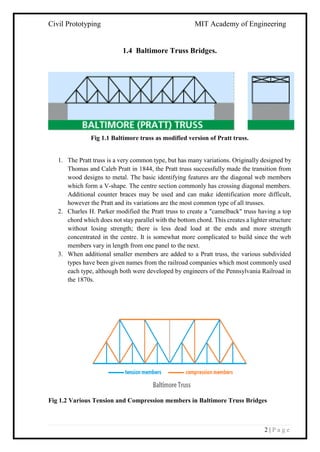
1.4 Baltimore Truss Bridges.
Fig 1.1 Baltimore truss as modified version of Pratt truss.
1. The Pratt truss is a very common type, but has many variations. Originally designed by
Thomas and Caleb Pratt in 1844, the Pratt truss successfully made the transition from
wood designs to metal. The basic identifying features are the diagonal web members
which form a V-shape. The centre section commonly has crossing diagonal members.
Additional counter braces may be used and can make identification more difficult,
however the Pratt and its variations are the most common type of all trusses.
2. Charles H. Parker modified the Pratt truss to create a "camelback" truss having a top
chord which does not stay parallel with the bottom chord. This creates a lighter structure
without losing strength; there is less dead load at the ends and more strength
concentrated in the centre. It is somewhat more complicated to build since the web
members vary in length from one panel to the next.
3. When additional smaller members are added to a Pratt truss, the various subdivided
types have been given names from the railroad companies which most commonly used
each type, although both were developed by engineers of the Pennsylvania Railroad in
the 1870s.
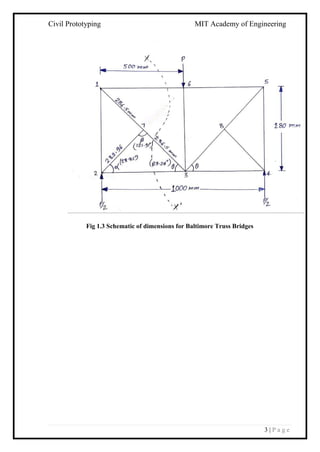
Fig 1.2 Various Tension and Compression members in Baltimore Truss Bridges
Civil Prototyping MIT Academy of Engineering
3 | P a g e
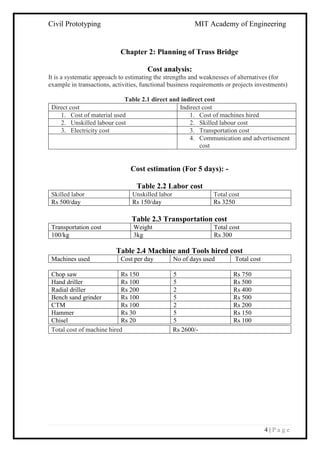
Fig 1.3 Schematic of dimensions for Baltimore Truss Bridges
Civil Prototyping MIT Academy of Engineering
4 | P a g e
Chapter 2: Planning of Truss Bridge
Cost analysis:
It is a systematic approach to estimating the strengths and weaknesses of alternatives (for
example in transactions, activities, functional business requirements or projects investments)
Table 2.1 direct and indirect cost
Cost estimation (For 5 days): -
Table 2.2 Labor cost
Skilled labor Unskilled labor Total cost
Rs 500/day Rs 150/day Rs 3250
Table 2.3 Transportation cost
Transportation cost Weight Total cost
100/kg 3kg Rs 300
Table 2.4 Machine and Tools hired cost
Machines used Cost per day No of days used Total cost
Chop saw Rs 150 5 Rs 750
Hand driller Rs 100 5 Rs 500
Radial driller Rs 200 2 Rs 400
Bench sand grinder Rs 100 5 Rs 500
CTM Rs 100 2 Rs 200
Hammer Rs 30 5 Rs 150
Chisel Rs 20 5 Rs 100
Direct cost Indirect cost
1. Cost of material used 1. Cost of machines hired
2. Unskilled labour cost 2. Skilled labour cost
3. Electricity cost 3. Transportation cost
4. Communication and advertisement
cost
Total cost of machine hired Rs 2600/-
Civil Prototyping MIT Academy of Engineering
5 | P a g e
Table 2.5 Electricity cost
Machine Used Electricity Used Cost/Kwh Total cost
Chop Saw 55Kwh(25min) Rs 5 Rs 275
Bench sand Grinder 11.25Kwh(30min) Rs 5 Rs 57
Drill Machine 40.5Kwh(90min) Rs 5 Rs 203
Total Cost- Rs 535
Table 2.6 Material Cost
Material used Quantity Cost Total cost
Bamboo 21.04ft Rs 130/18ft Rs 169
Binding wire 0.5 m Rs 20/m Rs 10
Total cost- Rs 179
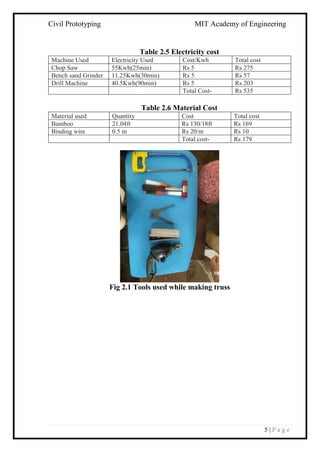
Fig 2.1 Tools used while making truss
Civil Prototyping MIT Academy of Engineering
6 | P a g e
CHAPTER 3 – PRE-TEST ANALYSIS
In this chapter we have performed pre-test analysis over a truss. During the process we mostly
focused on the factor which are going to be used during the performance while doing test.
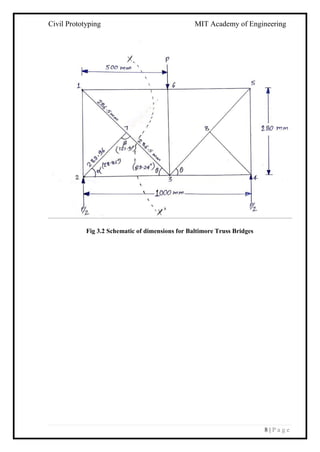
End to end dimension measurement:
As we want whole dimension of assembly vertically as 280mm we calculate it by
considering the diameter of two supporting bamboo and also by considering the fish mouth cut.
The slant truss we cut by using hypotenuse rule and other parts by using geometrical concepts.
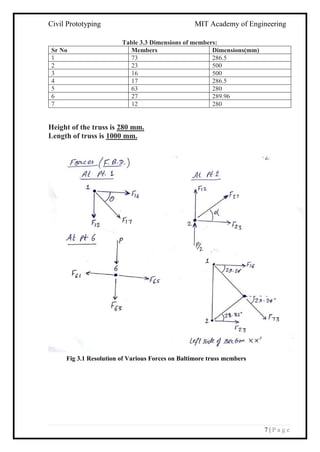
Force in individual members:
Firstly, we divided the figure of truss into equal portion section and then we have calculated
the force in individual member by using method of joint and method of separation. We
calculated the forces in each member in terms of p.
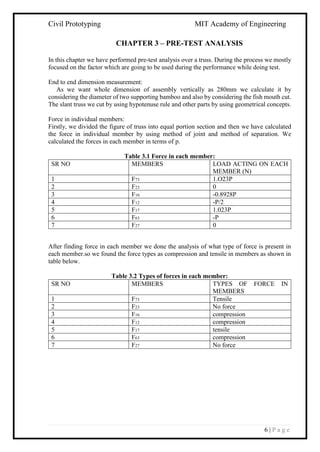
Table 3.1 Force in each member:
SR NO MEMBERS LOAD ACTING ON EACH
MEMBER (N)
1 F73 1.O23P
2 F23 0
3 F16 -0.8928P
4 F12 -P/2
5 F17 1.023P
6 F63 -P
7 F27 0
After finding force in each member we done the analysis of what type of force is present in
each member.so we found the force types as compression and tensile in members as shown in
table below.
Table 3.2 Types of forces in each member:
SR NO MEMBERS TYPES OF FORCE IN
MEMBERS
1 F73 Tensile
2 F23 No force
3 F16 compression
4 F12 compression
5 F17 tensile
6 F63 compression
7 F27 No force
Civil Prototyping MIT Academy of Engineering
7 | P a g e
Table 3.3 Dimensions of members:
Sr No Members Dimensions(mm)
1 73 286.5
2 23 500
3 16 500
4 17 286.5
5 63 280
6 27 289.96
7 12 280
Height of the truss is 280 mm.
Length of truss is 1000 mm.
Fig 3.1 Resolution of Various Forces on Baltimore truss members
Civil Prototyping MIT Academy of Engineering
8 | P a g e
Fig 3.2 Schematic of dimensions for Baltimore Truss Bridges
Civil Prototyping MIT Academy of Engineering
9 | P a g e
Chapter 4 – Compression, Tension and Joint test
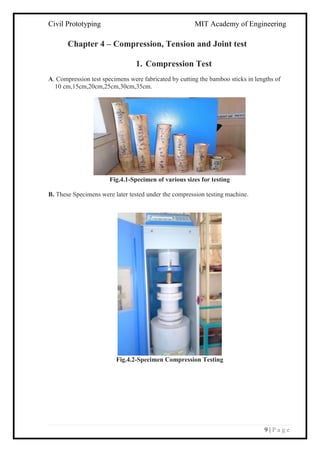
1. Compression Test
A. Compression test specimens were fabricated by cutting the bamboo sticks in lengths of
10 cm,15cm,20cm,25cm,30cm,35cm.
Fig.4.1-Specimen of various sizes for testing
B. These Specimens were later tested under the compression testing machine.
Fig.4.2-Specimen Compression Testing
Civil Prototyping MIT Academy of Engineering
10 | P a g e
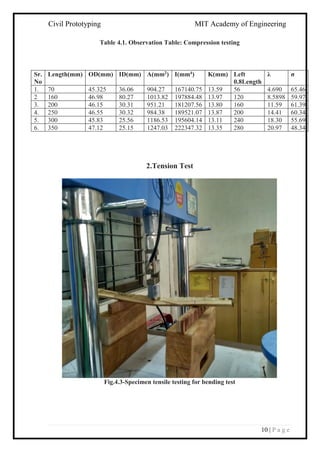
Table 4.1. Observation Table: Compression testing
2.Tension Test
Fig.4.3-Specimen tensile testing for bending test
Sr.
No
Length(mm) OD(mm) ID(mm) A(mm2) I(mm4) K(mm) Left
0.8Length
λ σ
1. 70 45.325 36.06 904.27 167140.75 13.59 56 4.690 65.46
2 160 46.98 80.27 1013.82 197884.48 13.97 120 8.5898 59.97
3. 200 46.15 30.31 951.21 181207.56 13.80 160 11.59 61.39
4. 250 46.55 30.32 984.38 189521.07 13.87 200 14.41 60.34
5. 300 45.83 25.56 1186.53 195604.14 13.11 240 18.30 55.69
6. 350 47.12 25.15 1247.03 222347.32 13.35 280 20.97 48.34
Civil Prototyping MIT Academy of Engineering
11 | P a g e
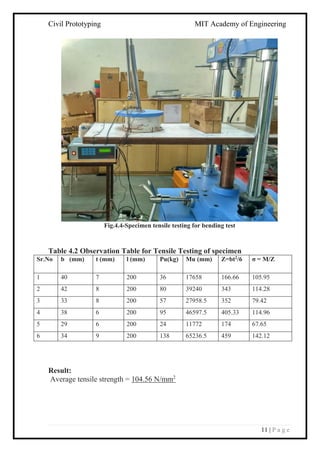
Fig.4.4-Specimen tensile testing for bending test
Table 4.2 Observation Table for Tensile Testing of specimen
Sr.No b (mm) t (mm) l (mm) Pu(kg) Mu (mm) Z=bt2/6 σ = M/Z
1 40 7 200 36 17658 166.66 105.95
2 42 8 200 80 39240 343 114.28
3 33 8 200 57 27958.5 352 79.42
4 38 6 200 95 46597.5 405.33 114.96
5 29 6 200 24 11772 174 67.65
6 34 9 200 138 65236.5 459 142.12
Result:
Average tensile strength = 104.56 N/mm2
Civil Prototyping MIT Academy of Engineering
12 | P a g e
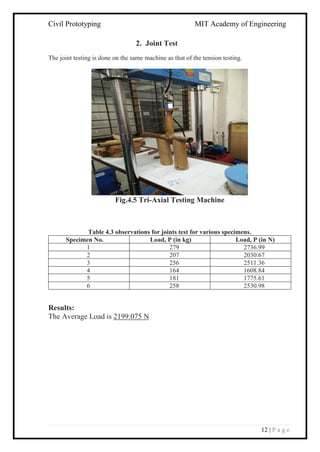
2. Joint Test
The joint testing is done on the same machine as that of the tension testing.
Fig.4.5 Tri-Axial Testing Machine
Table 4.3 observations for joints test for various specimens.
Specimen No. Load, P (in kg) Load, P (in N)
1 279 2736.99
2 207 2030.67
3 256 2511.36
4 164 1608.84
5 181 1775.61
6 258 2530.98
Results:
The Average Load is 2199.075 N
Civil Prototyping MIT Academy of Engineering
13 | P a g e
Chapter 5: Fabrication of Baltimore Truss
Various types of joints were used in making truss we studied them with details and tried
to make it from previous made examples. types of general joints are Bevel Cut Bolted
joints, fish Mouth Bolted Joints, Bevel Cut Bolted joints.
Fig-5.1 Fish Mouth Bolted Joints
These joints are made from cutting bamboo into radial drill machine. Its locked with
keys and bolts. Bolts and keys are made from bamboo.
Fig-5.2 Bevel Cut Bolted Joints
Bevel Cut bolted joints are made at 45o
Angle base joints and further this joint is more
responsible for failure or fractures as per predictions.
Civil Prototyping MIT Academy of Engineering
14 | P a g e
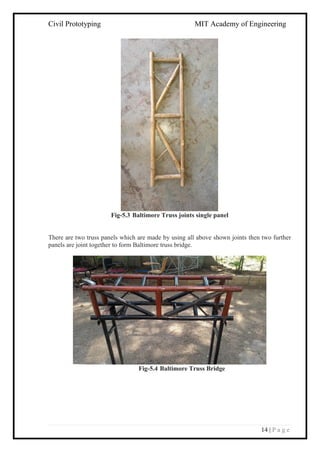
Fig-5.3 Baltimore Truss joints single panel
There are two truss panels which are made by using all above shown joints then two further
panels are joint together to form Baltimore truss bridge.
Fig-5.4 Baltimore Truss Bridge
Civil Prototyping MIT Academy of Engineering
15 | P a g e
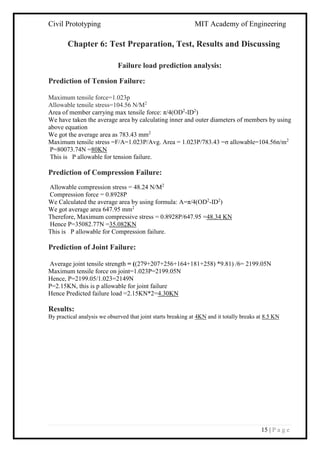
Chapter 6: Test Preparation, Test, Results and Discussing
Failure load prediction analysis:
Prediction of Tension Failure:
Maximum tensile force=1.023p
Allowable tensile stress=104.56 N/M2
Area of member carrying max tensile force: π/4(OD2
-ID2
)
We have taken the average area by calculating inner and outer diameters of members by using
above equation
We got the average area as 783.43 mm2
Maximum tensile stress =F/A=1.023P/Avg. Area = 1.023P/783.43 =σ allowable=104.56n/m2
P=80073.74N =80KN
This is P allowable for tension failure.
Prediction of Compression Failure:
Allowable compression stress = 48.24 N/M2
Compression force = 0.8928P
We Calculated the average area by using formula: A=π/4(OD2
-ID2
)
We got average area 647.95 mm2
Therefore, Maximum compressive stress = 0.8928P/647.95 =48.34 KN
Hence P=35082.77N =35.082KN
This is P allowable for Compression failure.
Prediction of Joint Failure:
Average joint tensile strength = ((279+207+256+164+181+258) *9.81) /6= 2199.05N
Maximum tensile force on joint=1.023P=2199.05N
Hence, P=2199.05/1.023=2149N
P=2.15KN, this is p allowable for joint failure
Hence Predicted failure load =2.15KN*2=4.30KN
Results:
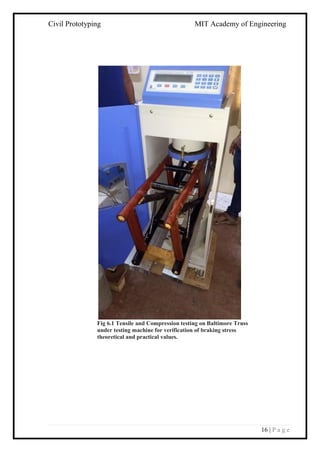
By practical analysis we observed that joint starts breaking at 4KN and it totally breaks at 8.5 KN
Civil Prototyping MIT Academy of Engineering
16 | P a g e
Fig 6.1 Tensile and Compression testing on Baltimore Truss
under testing machine for verification of braking stress
theoretical and practical values.
Civil Prototyping MIT Academy of Engineering
17 | P a g e
Chapter 7: Conclusion
1) By performing this civil prototyping course, we got acquainted with various
interesting facts about bamboo and its uses in various structures. Also, we came to
know that role of importance of accuracy in building structures.
2) Proper planning is required right from the sketch till the difficulties we are going to
face problem during actual constructions.
3) At the initial stages of Struss making, reverse engineering needs to be done so that
we can analyses that are already made.
4) There is slight difference between the cost analysis done by us and actual cost.
5) Pretest analysis also needs to be done for verification.
6) Before performing the actual test, there is need to find out different types of failure
of individual members.
7) Test like compression, flexure and joint test we performed on specimen samples of
joints and members respectively. The strength of failure members should be taken
into consideration while designing the truss.
8) The predicted analysis was seen that major failure was seen in joints. There was
discrepancy in theoretical and actual value of failure. In Our case value of failure
exceeded predicted value.
Civil Prototyping MIT Academy of Engineering
18 | P a g e
Reference
Website References
Books Reference
[1] Environmental Engineering B.C. Punamia(Part I & II), S.K. Garg (Part-I &
II), Peavy, Metcalf & Eddy
[2] Building Materials Rangwala, M.L. Gambhir
[3] Strength of Materials /Mechanics of Structure Gare & Timoshenko,
E.Popove, L. Singer, B.C. Punamia
[4] The Book of Bamboo - by David Farrelly
[1] https://en.wikipedia.org/wiki/Truss_bridge
[2] https://prezi.com/h-kihghauqfu/baltimore-truss-bridge/
[3] https://bridgehunter.com/category/tag/baltimore-truss/
[4] http://www.historyofbridges.com/facts-about-bridges/truss-bridge/
[5] https://www.garrettsbridges.com/design/baltimore-truss/
Civil Prototyping MIT Academy of Engineering
19 | P a g e
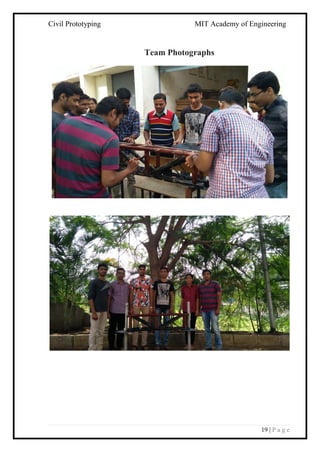
Team Photographs
Civil Prototyping MIT Academy of Engineering
20 | P a g e
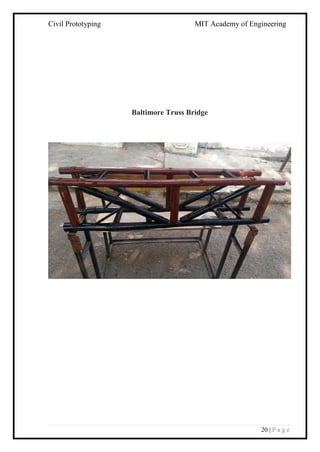
Baltimore Truss Bridge

Baltimore Truss Design Based on bamboo

  • 1.
    1 | Pa g e CHAPTER 1 -INTRODUCTON Bamboo is often described as very durable; however, this is primarily in reference to the sustainable growth of the bamboo plant, and not so much about the durability of the bamboo stems. Proper use, treatment, maintenance and care can ensure excellent durability because there exist bamboo structures of more than 200 years old. Bamboo belongs to the family of grasses and doesn't have the same properties as regular wood. A bamboo plant has a stem, branches and leaves but that's where the comparison with trees end. Bamboo is hollow, has no bark or year rings, and doesn't increase in diameter as the plant gets older. Bamboo stems grow on average 25 cm per day, and reach their maximum height in just 6-7 months (some tropical bamboo species grow up to 30-40 m). Bamboo stems are mature and ready for harvest in 3-6 years, after which new bamboo shoots will develop naturally. Because of its amazing growth rate, it has many different uses, and the fact that bamboo plants keep emerging without re-planting, it is considered a very sustainable resource. 1.1 Bamboo goes through various checks such as: 1) Compression test 2) Three-point bending test 3) Effects of Oils-Treatments on the Bamboo Appearance and Weight 4) Humidity Test 5) Water Immersion Test 6) Aging Test 7) Tensile Test [This test is mostly avoided in case of bamboos because it is difficult to hold bamboo while stress is applied]. 1.2 Advantages OF Bamboo: The various advantages of bamboo are mentioned below. 1) Light, strong and versatile. 2) Light, strong, versatile. 3) Environment friendly. 4) Accessible to the poor. 5) Self-renewing resource 6) Fast growing. 7) Highly productive. 1.3 Disadvantages of Bamboo: 1) The major disadvantages of bamboo are as follows: 2) Requires preservation 3) Shaped by nature 4) Durability- bamboo is subjected to attack by fungi, insects; for this reason, untreated bamboo structures are viewed as temporary with an expected life of not more than 5 years. 5) Jointing- although many jointing techniques exist, their structural efficiency is low. 6) Lack of design guidance and codes. 7) Prone to catch fire very fast by the friction among the culms during wind, and is seen to cause forest fires.
  • 2.
    Civil Prototyping MITAcademy of Engineering 2 | P a g e 1.4 Baltimore Truss Bridges. Fig 1.1 Baltimore truss as modified version of Pratt truss. 1. The Pratt truss is a very common type, but has many variations. Originally designed by Thomas and Caleb Pratt in 1844, the Pratt truss successfully made the transition from wood designs to metal. The basic identifying features are the diagonal web members which form a V-shape. The centre section commonly has crossing diagonal members. Additional counter braces may be used and can make identification more difficult, however the Pratt and its variations are the most common type of all trusses. 2. Charles H. Parker modified the Pratt truss to create a "camelback" truss having a top chord which does not stay parallel with the bottom chord. This creates a lighter structure without losing strength; there is less dead load at the ends and more strength concentrated in the centre. It is somewhat more complicated to build since the web members vary in length from one panel to the next. 3. When additional smaller members are added to a Pratt truss, the various subdivided types have been given names from the railroad companies which most commonly used each type, although both were developed by engineers of the Pennsylvania Railroad in the 1870s. Fig 1.2 Various Tension and Compression members in Baltimore Truss Bridges
  • 3.
    Civil Prototyping MITAcademy of Engineering 3 | P a g e Fig 1.3 Schematic of dimensions for Baltimore Truss Bridges
  • 4.
    Civil Prototyping MITAcademy of Engineering 4 | P a g e Chapter 2: Planning of Truss Bridge Cost analysis: It is a systematic approach to estimating the strengths and weaknesses of alternatives (for example in transactions, activities, functional business requirements or projects investments) Table 2.1 direct and indirect cost Cost estimation (For 5 days): - Table 2.2 Labor cost Skilled labor Unskilled labor Total cost Rs 500/day Rs 150/day Rs 3250 Table 2.3 Transportation cost Transportation cost Weight Total cost 100/kg 3kg Rs 300 Table 2.4 Machine and Tools hired cost Machines used Cost per day No of days used Total cost Chop saw Rs 150 5 Rs 750 Hand driller Rs 100 5 Rs 500 Radial driller Rs 200 2 Rs 400 Bench sand grinder Rs 100 5 Rs 500 CTM Rs 100 2 Rs 200 Hammer Rs 30 5 Rs 150 Chisel Rs 20 5 Rs 100 Direct cost Indirect cost 1. Cost of material used 1. Cost of machines hired 2. Unskilled labour cost 2. Skilled labour cost 3. Electricity cost 3. Transportation cost 4. Communication and advertisement cost Total cost of machine hired Rs 2600/-
  • 5.
    Civil Prototyping MITAcademy of Engineering 5 | P a g e Table 2.5 Electricity cost Machine Used Electricity Used Cost/Kwh Total cost Chop Saw 55Kwh(25min) Rs 5 Rs 275 Bench sand Grinder 11.25Kwh(30min) Rs 5 Rs 57 Drill Machine 40.5Kwh(90min) Rs 5 Rs 203 Total Cost- Rs 535 Table 2.6 Material Cost Material used Quantity Cost Total cost Bamboo 21.04ft Rs 130/18ft Rs 169 Binding wire 0.5 m Rs 20/m Rs 10 Total cost- Rs 179 Fig 2.1 Tools used while making truss
  • 6.
    Civil Prototyping MITAcademy of Engineering 6 | P a g e CHAPTER 3 – PRE-TEST ANALYSIS In this chapter we have performed pre-test analysis over a truss. During the process we mostly focused on the factor which are going to be used during the performance while doing test. End to end dimension measurement: As we want whole dimension of assembly vertically as 280mm we calculate it by considering the diameter of two supporting bamboo and also by considering the fish mouth cut. The slant truss we cut by using hypotenuse rule and other parts by using geometrical concepts. Force in individual members: Firstly, we divided the figure of truss into equal portion section and then we have calculated the force in individual member by using method of joint and method of separation. We calculated the forces in each member in terms of p. Table 3.1 Force in each member: SR NO MEMBERS LOAD ACTING ON EACH MEMBER (N) 1 F73 1.O23P 2 F23 0 3 F16 -0.8928P 4 F12 -P/2 5 F17 1.023P 6 F63 -P 7 F27 0 After finding force in each member we done the analysis of what type of force is present in each member.so we found the force types as compression and tensile in members as shown in table below. Table 3.2 Types of forces in each member: SR NO MEMBERS TYPES OF FORCE IN MEMBERS 1 F73 Tensile 2 F23 No force 3 F16 compression 4 F12 compression 5 F17 tensile 6 F63 compression 7 F27 No force
  • 7.
    Civil Prototyping MITAcademy of Engineering 7 | P a g e Table 3.3 Dimensions of members: Sr No Members Dimensions(mm) 1 73 286.5 2 23 500 3 16 500 4 17 286.5 5 63 280 6 27 289.96 7 12 280 Height of the truss is 280 mm. Length of truss is 1000 mm. Fig 3.1 Resolution of Various Forces on Baltimore truss members
  • 8.
    Civil Prototyping MITAcademy of Engineering 8 | P a g e Fig 3.2 Schematic of dimensions for Baltimore Truss Bridges
  • 9.
    Civil Prototyping MITAcademy of Engineering 9 | P a g e Chapter 4 – Compression, Tension and Joint test 1. Compression Test A. Compression test specimens were fabricated by cutting the bamboo sticks in lengths of 10 cm,15cm,20cm,25cm,30cm,35cm. Fig.4.1-Specimen of various sizes for testing B. These Specimens were later tested under the compression testing machine. Fig.4.2-Specimen Compression Testing
  • 10.
    Civil Prototyping MITAcademy of Engineering 10 | P a g e Table 4.1. Observation Table: Compression testing 2.Tension Test Fig.4.3-Specimen tensile testing for bending test Sr. No Length(mm) OD(mm) ID(mm) A(mm2) I(mm4) K(mm) Left 0.8Length λ σ 1. 70 45.325 36.06 904.27 167140.75 13.59 56 4.690 65.46 2 160 46.98 80.27 1013.82 197884.48 13.97 120 8.5898 59.97 3. 200 46.15 30.31 951.21 181207.56 13.80 160 11.59 61.39 4. 250 46.55 30.32 984.38 189521.07 13.87 200 14.41 60.34 5. 300 45.83 25.56 1186.53 195604.14 13.11 240 18.30 55.69 6. 350 47.12 25.15 1247.03 222347.32 13.35 280 20.97 48.34
  • 11.
    Civil Prototyping MITAcademy of Engineering 11 | P a g e Fig.4.4-Specimen tensile testing for bending test Table 4.2 Observation Table for Tensile Testing of specimen Sr.No b (mm) t (mm) l (mm) Pu(kg) Mu (mm) Z=bt2/6 σ = M/Z 1 40 7 200 36 17658 166.66 105.95 2 42 8 200 80 39240 343 114.28 3 33 8 200 57 27958.5 352 79.42 4 38 6 200 95 46597.5 405.33 114.96 5 29 6 200 24 11772 174 67.65 6 34 9 200 138 65236.5 459 142.12 Result: Average tensile strength = 104.56 N/mm2
  • 12.
    Civil Prototyping MITAcademy of Engineering 12 | P a g e 2. Joint Test The joint testing is done on the same machine as that of the tension testing. Fig.4.5 Tri-Axial Testing Machine Table 4.3 observations for joints test for various specimens. Specimen No. Load, P (in kg) Load, P (in N) 1 279 2736.99 2 207 2030.67 3 256 2511.36 4 164 1608.84 5 181 1775.61 6 258 2530.98 Results: The Average Load is 2199.075 N
  • 13.
    Civil Prototyping MITAcademy of Engineering 13 | P a g e Chapter 5: Fabrication of Baltimore Truss Various types of joints were used in making truss we studied them with details and tried to make it from previous made examples. types of general joints are Bevel Cut Bolted joints, fish Mouth Bolted Joints, Bevel Cut Bolted joints. Fig-5.1 Fish Mouth Bolted Joints These joints are made from cutting bamboo into radial drill machine. Its locked with keys and bolts. Bolts and keys are made from bamboo. Fig-5.2 Bevel Cut Bolted Joints Bevel Cut bolted joints are made at 45o Angle base joints and further this joint is more responsible for failure or fractures as per predictions.
  • 14.
    Civil Prototyping MITAcademy of Engineering 14 | P a g e Fig-5.3 Baltimore Truss joints single panel There are two truss panels which are made by using all above shown joints then two further panels are joint together to form Baltimore truss bridge. Fig-5.4 Baltimore Truss Bridge
  • 15.
    Civil Prototyping MITAcademy of Engineering 15 | P a g e Chapter 6: Test Preparation, Test, Results and Discussing Failure load prediction analysis: Prediction of Tension Failure: Maximum tensile force=1.023p Allowable tensile stress=104.56 N/M2 Area of member carrying max tensile force: π/4(OD2 -ID2 ) We have taken the average area by calculating inner and outer diameters of members by using above equation We got the average area as 783.43 mm2 Maximum tensile stress =F/A=1.023P/Avg. Area = 1.023P/783.43 =σ allowable=104.56n/m2 P=80073.74N =80KN This is P allowable for tension failure. Prediction of Compression Failure: Allowable compression stress = 48.24 N/M2 Compression force = 0.8928P We Calculated the average area by using formula: A=π/4(OD2 -ID2 ) We got average area 647.95 mm2 Therefore, Maximum compressive stress = 0.8928P/647.95 =48.34 KN Hence P=35082.77N =35.082KN This is P allowable for Compression failure. Prediction of Joint Failure: Average joint tensile strength = ((279+207+256+164+181+258) *9.81) /6= 2199.05N Maximum tensile force on joint=1.023P=2199.05N Hence, P=2199.05/1.023=2149N P=2.15KN, this is p allowable for joint failure Hence Predicted failure load =2.15KN*2=4.30KN Results: By practical analysis we observed that joint starts breaking at 4KN and it totally breaks at 8.5 KN
  • 16.
    Civil Prototyping MITAcademy of Engineering 16 | P a g e Fig 6.1 Tensile and Compression testing on Baltimore Truss under testing machine for verification of braking stress theoretical and practical values.
  • 17.
    Civil Prototyping MITAcademy of Engineering 17 | P a g e Chapter 7: Conclusion 1) By performing this civil prototyping course, we got acquainted with various interesting facts about bamboo and its uses in various structures. Also, we came to know that role of importance of accuracy in building structures. 2) Proper planning is required right from the sketch till the difficulties we are going to face problem during actual constructions. 3) At the initial stages of Struss making, reverse engineering needs to be done so that we can analyses that are already made. 4) There is slight difference between the cost analysis done by us and actual cost. 5) Pretest analysis also needs to be done for verification. 6) Before performing the actual test, there is need to find out different types of failure of individual members. 7) Test like compression, flexure and joint test we performed on specimen samples of joints and members respectively. The strength of failure members should be taken into consideration while designing the truss. 8) The predicted analysis was seen that major failure was seen in joints. There was discrepancy in theoretical and actual value of failure. In Our case value of failure exceeded predicted value.
  • 18.
    Civil Prototyping MITAcademy of Engineering 18 | P a g e Reference Website References Books Reference [1] Environmental Engineering B.C. Punamia(Part I & II), S.K. Garg (Part-I & II), Peavy, Metcalf & Eddy [2] Building Materials Rangwala, M.L. Gambhir [3] Strength of Materials /Mechanics of Structure Gare & Timoshenko, E.Popove, L. Singer, B.C. Punamia [4] The Book of Bamboo - by David Farrelly [1] https://en.wikipedia.org/wiki/Truss_bridge [2] https://prezi.com/h-kihghauqfu/baltimore-truss-bridge/ [3] https://bridgehunter.com/category/tag/baltimore-truss/ [4] http://www.historyofbridges.com/facts-about-bridges/truss-bridge/ [5] https://www.garrettsbridges.com/design/baltimore-truss/
  • 19.
    Civil Prototyping MITAcademy of Engineering 19 | P a g e Team Photographs
  • 20.
    Civil Prototyping MITAcademy of Engineering 20 | P a g e Baltimore Truss Bridge