CONTENTS
 INTRODUCTION
 PROPERTIES OF BAMBOO
 USE OF BAMBOO IN CONSTRUCTION
 CONSTRUCTION DETAILS IN BAMBOO
 ADVANTAGES OF BAMBOO
 DISADVANTAGES OF BAMBOO
 CONCLUSION
 REFERENCES
INTRODUCTION
INTRODUCTION TO BAMBOO
 Bamboo is a woody grass. It is the fastest-growing woody
plant in the world. Some species of bamboo grow so fast
you can almost see them grow.
 Bamboos are some of the fastest growing plants in the
world. They are capable of growing 60 cm or more per day.
However, the growth rate is dependent on local soil and
climatic conditions.
 Bamboo are found in diverse climates, from cold
mountains to hot tropical regions. They occur across East
Asia, through to Northern Australia, and west to India and
the Himalayas.
 In bamboo, the inter nodal regions of the stem are hollow
and the vascular bundles in the cross section are scattered
throughout the stem instead of in a cylindrical
arrangement.
BASIC PROPERTIES OF BAMBOO
TENSIL STRESS AND UNIT WEIGHT
 The common tensile stress in steel reinforcement is
160 N/mm2 and in bamboo 370 N/mm2.
 The mass per volume of steel is 7850 kg/m3 and of
bamboo is about 500-600 kg/m3.
 Evidently bamboo will be cheaper because the price of
bamboo per weight will be less than half that of steel.
MODULUS OF ELASTICITY
 The cellulose fibers in bamboo act as reinforcement
similar to reinforcing steel bars in concrete. The
distribution of these fibers increases from the inside to
the outside.
 The E-modulus for cellulose is 70 000 N/mm2 and
about 50% of the cross-section of the fiber is cellulose;
the E of the fiber is 35 000 N/mm2.
 In most bamboos, fibers constitute about 60% on the
outside and 10% on the inside.
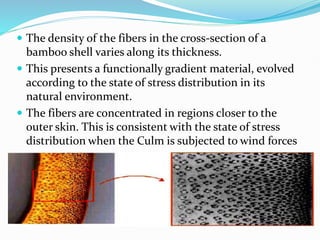
 The density of the fibers in the cross-section of a
bamboo shell varies along its thickness.
 This presents a functionally gradient material, evolved
according to the state of stress distribution in its
natural environment.
 The fibers are concentrated in regions closer to the
outer skin. This is consistent with the state of stress
distribution when the Culm is subjected to wind forces
DURABILTY
 Bamboo with low humidity is less prone to mould
attacks especially when humidity content is less than
15%.
 Physical and mechanical properties of bamboo
increase with a decrease in its humidity content.
 Bamboo to be treated with a preservative needs to be
dry to facilitate penetration. Bamboo can be dried in
air, green house, and oven or by fire.
 The durability of bamboo depends strongly on the
preservative treatment methods in accordance with basic
requirements, its chemical composition should not have
any effect on the bamboo fiber and once injected it must
not be washed out by rain or humidity.
 Many steel and concrete structures built in the past 30years
reveal serious deterioration caused mainly by the corrosion
of the steel reinforcement.
USE OF BAMBOO IN CONSTRUCTION
• Scaffolding
• Roofing
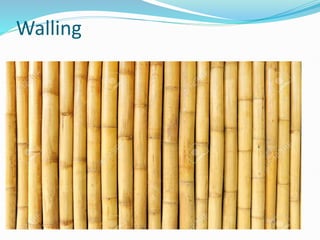
• Walling
• Doors & Windows
Scaffolding
R00FING
Walling
DOOR AND WINDOWS
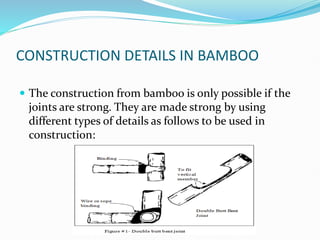
CONSTRUCTION DETAILS IN BAMBOO
 The construction from bamboo is only possible if the
joints are strong. They are made strong by using
different types of details as follows to be used in
construction:
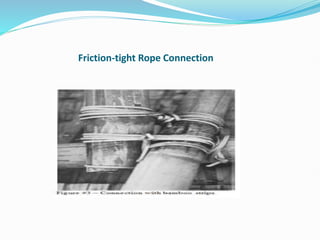
Friction-tight Rope Connection
ADVANTAGES OF USING BAMBOO
ADVANTAGES
 It is Light, strong and versatile.
 It is Environment friendly.
 Easily Accessible to the poor.
 Self renewing resource of nature.
 Speedily growing
 Highly productive.
 Low Cost Material
DISADVANTAGES
 It requires preservation.
 Shaped by nature
 Durability- bamboo is subjected to attack by fungi, insects;
for this reason, untreated bamboo structures are viewed as
temporary with an expected life of not more than 5 years.
 Jointing- although many jointing techniques exist, their
structural efficiency is low.
 Lack of design guidance and codes.
 Prone to catch fire very fast by the friction among the
culms during wind, and is seen to cause forest fires.
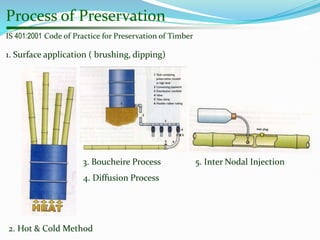
Process of Preservation
IS 401:2001 Code of Practice for Preservation of Timber
1. Surface application ( brushing, dipping)
2. Hot & Cold Method
3. Boucheire Process 5. Inter Nodal Injection
4. Diffusion Process
APPLICATION OF BAMBOO IN VARIOUS
PROJECTS
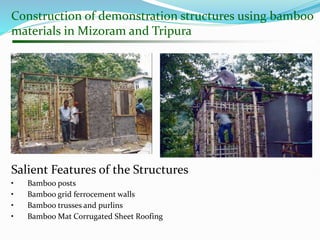
Construction of demonstration structures using bamboo
materials in Mizoram and Tripura
Salient Features of the Structures
• Bamboo posts
• Bamboo grid ferrocement walls
• Bamboo trusses and purlins
• Bamboo Mat Corrugated Sheet Roofing
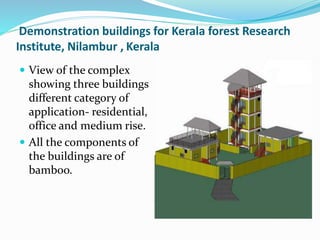
 View of the complex
showing three buildings
different category of
application- residential,
office and medium rise.
 All the components of
the buildings are of
bamboo.
Demonstration buildings for Kerala forest Research
Institute, Nilambur , Kerala
‘Whispering Palms’ Holiday resort for Abad
group of Hotels at Kumarakom.
CONCLUSION
 Since bamboo is an environment friendly material it should
give more importance.
 Bamboo is very light in weight with compare to steel so
dead load of the member can be decreased with use of it.
 Bamboo is easily avail material so it is economic material
and by using it we can reduced the cost of construction.
 Since bamboo is very effective in seismic resistance, use of
it should be safe.
Bamboo As construction Materials .. replace steels

Bamboo As construction Materials .. replace steels

  • 2.
    CONTENTS  INTRODUCTION  PROPERTIESOF BAMBOO  USE OF BAMBOO IN CONSTRUCTION  CONSTRUCTION DETAILS IN BAMBOO  ADVANTAGES OF BAMBOO  DISADVANTAGES OF BAMBOO  CONCLUSION  REFERENCES
  • 3.
  • 4.
    INTRODUCTION TO BAMBOO Bamboo is a woody grass. It is the fastest-growing woody plant in the world. Some species of bamboo grow so fast you can almost see them grow.  Bamboos are some of the fastest growing plants in the world. They are capable of growing 60 cm or more per day. However, the growth rate is dependent on local soil and climatic conditions.  Bamboo are found in diverse climates, from cold mountains to hot tropical regions. They occur across East Asia, through to Northern Australia, and west to India and the Himalayas.
  • 5.
     In bamboo,the inter nodal regions of the stem are hollow and the vascular bundles in the cross section are scattered throughout the stem instead of in a cylindrical arrangement.
  • 6.
  • 7.
    TENSIL STRESS ANDUNIT WEIGHT  The common tensile stress in steel reinforcement is 160 N/mm2 and in bamboo 370 N/mm2.  The mass per volume of steel is 7850 kg/m3 and of bamboo is about 500-600 kg/m3.  Evidently bamboo will be cheaper because the price of bamboo per weight will be less than half that of steel.
  • 8.
    MODULUS OF ELASTICITY The cellulose fibers in bamboo act as reinforcement similar to reinforcing steel bars in concrete. The distribution of these fibers increases from the inside to the outside.  The E-modulus for cellulose is 70 000 N/mm2 and about 50% of the cross-section of the fiber is cellulose; the E of the fiber is 35 000 N/mm2.  In most bamboos, fibers constitute about 60% on the outside and 10% on the inside.
  • 9.
     The densityof the fibers in the cross-section of a bamboo shell varies along its thickness.  This presents a functionally gradient material, evolved according to the state of stress distribution in its natural environment.  The fibers are concentrated in regions closer to the outer skin. This is consistent with the state of stress distribution when the Culm is subjected to wind forces
  • 10.
    DURABILTY  Bamboo withlow humidity is less prone to mould attacks especially when humidity content is less than 15%.  Physical and mechanical properties of bamboo increase with a decrease in its humidity content.  Bamboo to be treated with a preservative needs to be dry to facilitate penetration. Bamboo can be dried in air, green house, and oven or by fire.
  • 11.
     The durabilityof bamboo depends strongly on the preservative treatment methods in accordance with basic requirements, its chemical composition should not have any effect on the bamboo fiber and once injected it must not be washed out by rain or humidity.  Many steel and concrete structures built in the past 30years reveal serious deterioration caused mainly by the corrosion of the steel reinforcement.
  • 12.
    USE OF BAMBOOIN CONSTRUCTION
  • 13.
    USE OF BAMBOOIN CONSTRUCTION • Scaffolding • Roofing • Walling • Doors & Windows
  • 14.
  • 15.
  • 16.
  • 17.
  • 18.
    CONSTRUCTION DETAILS INBAMBOO  The construction from bamboo is only possible if the joints are strong. They are made strong by using different types of details as follows to be used in construction:
  • 19.
  • 21.
  • 22.
    ADVANTAGES  It isLight, strong and versatile.  It is Environment friendly.  Easily Accessible to the poor.  Self renewing resource of nature.  Speedily growing  Highly productive.  Low Cost Material
  • 23.
    DISADVANTAGES  It requirespreservation.  Shaped by nature  Durability- bamboo is subjected to attack by fungi, insects; for this reason, untreated bamboo structures are viewed as temporary with an expected life of not more than 5 years.  Jointing- although many jointing techniques exist, their structural efficiency is low.  Lack of design guidance and codes.  Prone to catch fire very fast by the friction among the culms during wind, and is seen to cause forest fires.
  • 24.
    Process of Preservation IS401:2001 Code of Practice for Preservation of Timber 1. Surface application ( brushing, dipping) 2. Hot & Cold Method 3. Boucheire Process 5. Inter Nodal Injection 4. Diffusion Process
  • 25.
    APPLICATION OF BAMBOOIN VARIOUS PROJECTS
  • 26.
    Construction of demonstrationstructures using bamboo materials in Mizoram and Tripura Salient Features of the Structures • Bamboo posts • Bamboo grid ferrocement walls • Bamboo trusses and purlins • Bamboo Mat Corrugated Sheet Roofing
  • 27.
     View ofthe complex showing three buildings different category of application- residential, office and medium rise.  All the components of the buildings are of bamboo. Demonstration buildings for Kerala forest Research Institute, Nilambur , Kerala
  • 28.
    ‘Whispering Palms’ Holidayresort for Abad group of Hotels at Kumarakom.
  • 29.
    CONCLUSION  Since bamboois an environment friendly material it should give more importance.  Bamboo is very light in weight with compare to steel so dead load of the member can be decreased with use of it.  Bamboo is easily avail material so it is economic material and by using it we can reduced the cost of construction.  Since bamboo is very effective in seismic resistance, use of it should be safe.