DESIGN PROJECT
DESIGN OF RESIDENTIAL
BUILDING
by
Kabilan.M (111711103027), Maadaswamy.U (111711103037),
Aravind.S (111711103005), Elango.S (111711103016)
GUIDE: Dr. BINU SUKUMAR, M.Tech.,Ph.D.
PROFESSOR & HEAD OF THE DEPARTMENT
R.M.K ENGINEERING COLLEGE, TIRUVALLUR.
OBJECTIVE
 To learn about the design of residential building.
 To have an exposure to design procedures.
 To use this as a platform for learning the manual method
of calculation used in computations, analysis and design.
INTRODUCTION
 The building is located in Sirumalai , Dindigul
district.
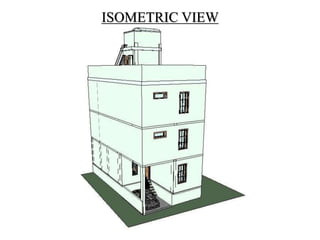
 The building is G+2 storied.
 The building is located in congested area without any
setbacks.
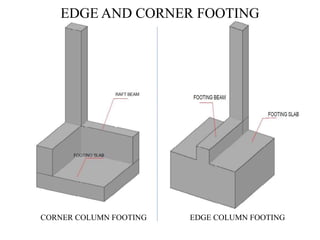
 The property line and the edge of wall coincides, so
edge footings are designed as fully eccentric footing.
 At a depth of 1.5 to 2m disintegrated rocks were
found.
 The SBC of the soil was found to be 240kN/m2 .
METHODOLOGY
 Drawing plan & elevation of the building.
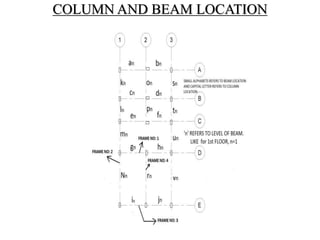
 Locating columns and beams.
 Applying dimensions to the beams and columns.
 Load calculation.
 Analysis to determine the shear force and bending
moment.
 Identifying the critical beam and column.
 Determination of type of footing and size of footing.
 Identifying the type of column.
METHODOLOGY(CONTD)
 Design of slab, beam, column and footing.
 Performing respective checks for the corresponding
design.
 Detailing of beam, column, beam column junctions and
footing.
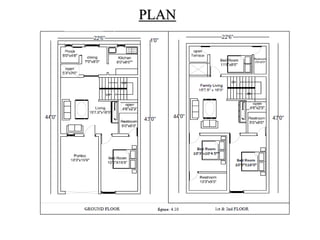
PLAN
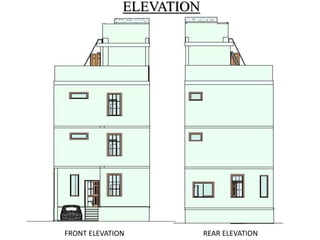
ELEVATION
FRONT ELEVATION REAR ELEVATION
ISOMETRIC VIEW
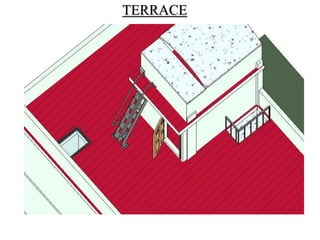
TERRACE
COLUMN AND BEAM LOCATION
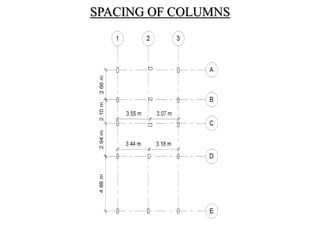
SPACING OF COLUMNS
LOADS
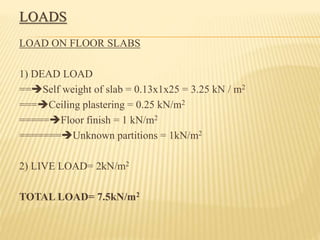
LOAD ON FLOOR SLABS
1) DEAD LOAD
==Self weight of slab = 0.13x1x25 = 3.25 kN / m2
===Ceiling plastering = 0.25 kN/m2
=====Floor finish = 1 kN/m2
=======Unknown partitions = 1kN/m2
2) LIVE LOAD= 2kN/m2
TOTAL LOAD= 7.5kN/m2
LOADS
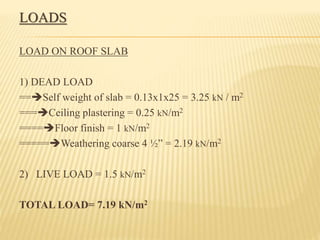
LOAD ON ROOF SLAB
1) DEAD LOAD
==Self weight of slab = 0.13x1x25 = 3.25 kN / m2
===Ceiling plastering = 0.25 kN/m2
====Floor finish = 1 kN/m2
=====Weathering coarse 4 ½” = 2.19 kN/m2
2) LIVE LOAD = 1.5 kN/m2
TOTAL LOAD= 7.19 kN/m2
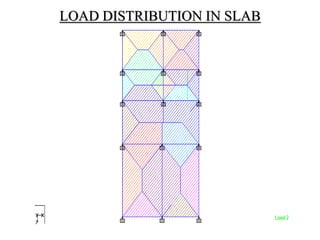
LOAD TRANSFERRED TO BEAM FROM SLAB
 The load transferred to beam from slab is determined
by using triangular, trapezoidal & rectangular
formula.
 Trapezoidal formula =W * Lx / 6 [ 3-( Lx/ Ly )2 ]
 Triangular formula = W * Lx / 3
 Rectangular formula = W * Lx / 2
LOAD DISTRIBUTION IN SLAB
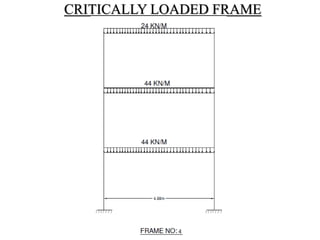
CRITICALLY LOADED FRAME
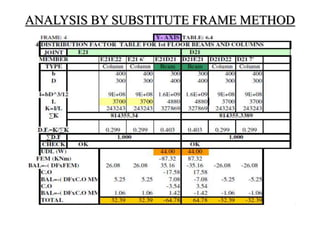
ANALYSIS BY SUBSTITUTE FRAME METHOD
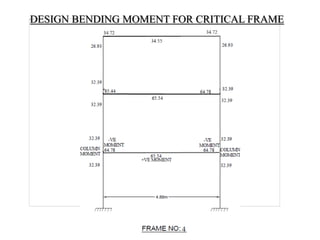
DESIGN BENDING MOMENT FOR CRITICAL FRAME
SLAB DESIGN
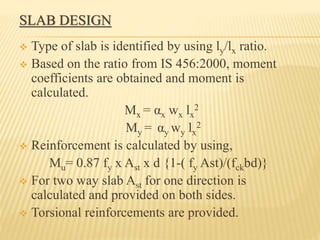
 Type of slab is identified by using ly/lx ratio.
 Based on the ratio from IS 456:2000, moment
coefficients are obtained and moment is
calculated.
Mx = αx wx lx
2
My = αy wy lx
2
 Reinforcement is calculated by using,
Mu= 0.87 fy x Ast x d {1-( fy Ast)/(fckbd)}
 For two way slab Ast for one direction is
calculated and provided on both sides.
 Torsional reinforcements are provided.
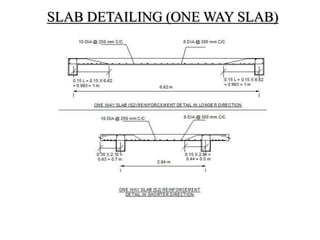
SLAB DETAILING
SLAB DETAILING (ONE WAY SLAB)
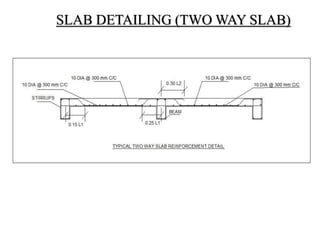
SLAB DETAILING (TWO WAY SLAB)
BEAM DESIGN
 Moment at support is calculated using substitute
frame method.
 Depth check is done.
 Based on Mu/bd2 & fy value, % of steel is calculated
from SP:16-1987.
 Shear check is done based on IS:456-2000,
accordingly shear reinforcement has been given.
 Deflection check is done.
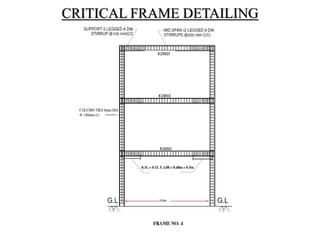
CRITICAL FRAME DETAILING
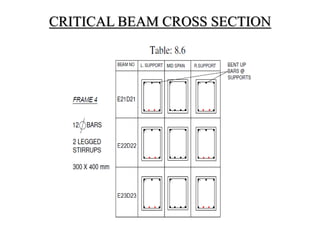
CRITICAL BEAM CROSS SECTION
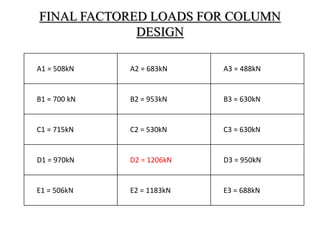
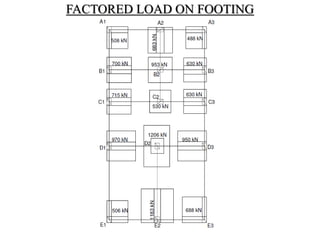
FINAL FACTORED LOADS FOR COLUMN
DESIGN
A1 = 508kN A2 = 683kN A3 = 488kN
B1 = 700 kN B2 = 953kN B3 = 630kN
C1 = 715kN C2 = 530kN C3 = 630kN
D1 = 970kN D2 = 1206kN D3 = 950kN
E1 = 506kN E2 = 1183kN E3 = 688kN
COLUMNS DESIGN
 For axial columns Ast is calculated by using,
Pu = 0.4fckAc+ 0.67fyAsc
 For uniaxial column the Ast is calculated using SP-16
1987 charts, based on the values of d’/D, Pu/fckbD &
Mu/fckbD2, the value of p/fck is determined, from
which % of steel can be calculated.
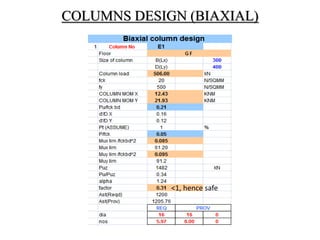
COLUMNS DESIGN (BIAXIAL)
<1, hence safe
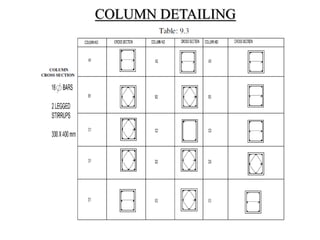
COLUMN DETAILING
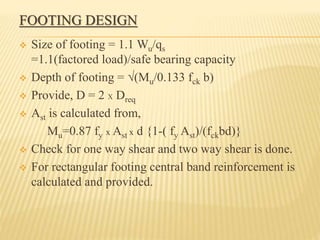
FOOTING DESIGN
 Size of footing = 1.1 Wu/qs
=1.1(factored load)/safe bearing capacity
 Depth of footing = √(Mu/0.133 fck b)
 Provide, D = 2 X Dreq
 Ast is calculated from,
Mu=0.87 fy x Ast x d {1-( fy Ast)/(fckbd)}
 Check for one way shear and two way shear is done.
 For rectangular footing central band reinforcement is
calculated and provided.
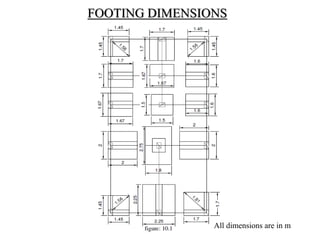
FACTORED LOAD ON FOOTING
FOOTING DIMENSIONS
All dimensions are in m
EDGE AND CORNER FOOTING
CORNER COLUMN FOOTING EDGE COLUMN FOOTING
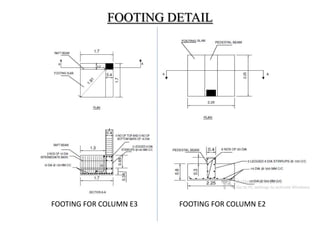
FOOTING DETAIL
FOOTING FOR COLUMN E3 FOOTING FOR COLUMN E2
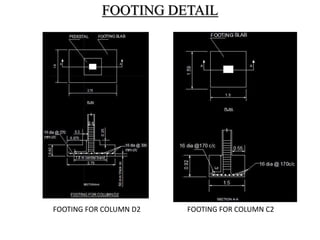
FOOTING DETAIL
FOOTING FOR COLUMN D2 FOOTING FOR COLUMN C2
CONCLUSION
 Learnt
1) design of complete structure.
2) substitute frame method.
3) practical difficulties faced in field.
 Was useful and will be helpful in our carrier.
 Special mentions.
REFERENCE
 Design of reinforced concrete structures -Ramamruthum.
 Reinforced concrete design - Devdas Menon.
 Theory of structures - B.C.Punmia.
 Advanced design of reinforced concrete - Krishna Raju.
 Design of G+3 building - Karve & Shah.
 IS 456:2000.
 SP:16 1987.
 SP:34 1987.
Design project

Design project

  • 1.
    DESIGN PROJECT DESIGN OFRESIDENTIAL BUILDING by Kabilan.M (111711103027), Maadaswamy.U (111711103037), Aravind.S (111711103005), Elango.S (111711103016) GUIDE: Dr. BINU SUKUMAR, M.Tech.,Ph.D. PROFESSOR & HEAD OF THE DEPARTMENT R.M.K ENGINEERING COLLEGE, TIRUVALLUR.
  • 2.
    OBJECTIVE  To learnabout the design of residential building.  To have an exposure to design procedures.  To use this as a platform for learning the manual method of calculation used in computations, analysis and design.
  • 3.
    INTRODUCTION  The buildingis located in Sirumalai , Dindigul district.  The building is G+2 storied.  The building is located in congested area without any setbacks.  The property line and the edge of wall coincides, so edge footings are designed as fully eccentric footing.  At a depth of 1.5 to 2m disintegrated rocks were found.  The SBC of the soil was found to be 240kN/m2 .
  • 4.
    METHODOLOGY  Drawing plan& elevation of the building.  Locating columns and beams.  Applying dimensions to the beams and columns.  Load calculation.  Analysis to determine the shear force and bending moment.  Identifying the critical beam and column.  Determination of type of footing and size of footing.  Identifying the type of column.
  • 5.
    METHODOLOGY(CONTD)  Design ofslab, beam, column and footing.  Performing respective checks for the corresponding design.  Detailing of beam, column, beam column junctions and footing.
  • 6.
  • 7.
  • 8.
  • 9.
  • 10.
  • 11.
  • 12.
    LOADS LOAD ON FLOORSLABS 1) DEAD LOAD ==Self weight of slab = 0.13x1x25 = 3.25 kN / m2 ===Ceiling plastering = 0.25 kN/m2 =====Floor finish = 1 kN/m2 =======Unknown partitions = 1kN/m2 2) LIVE LOAD= 2kN/m2 TOTAL LOAD= 7.5kN/m2
  • 13.
    LOADS LOAD ON ROOFSLAB 1) DEAD LOAD ==Self weight of slab = 0.13x1x25 = 3.25 kN / m2 ===Ceiling plastering = 0.25 kN/m2 ====Floor finish = 1 kN/m2 =====Weathering coarse 4 ½” = 2.19 kN/m2 2) LIVE LOAD = 1.5 kN/m2 TOTAL LOAD= 7.19 kN/m2
  • 14.
    LOAD TRANSFERRED TOBEAM FROM SLAB  The load transferred to beam from slab is determined by using triangular, trapezoidal & rectangular formula.  Trapezoidal formula =W * Lx / 6 [ 3-( Lx/ Ly )2 ]  Triangular formula = W * Lx / 3  Rectangular formula = W * Lx / 2
  • 15.
  • 16.
  • 17.
  • 18.
    DESIGN BENDING MOMENTFOR CRITICAL FRAME
  • 19.
    SLAB DESIGN  Typeof slab is identified by using ly/lx ratio.  Based on the ratio from IS 456:2000, moment coefficients are obtained and moment is calculated. Mx = αx wx lx 2 My = αy wy lx 2  Reinforcement is calculated by using, Mu= 0.87 fy x Ast x d {1-( fy Ast)/(fckbd)}  For two way slab Ast for one direction is calculated and provided on both sides.  Torsional reinforcements are provided.
  • 20.
  • 21.
  • 22.
  • 23.
    BEAM DESIGN  Momentat support is calculated using substitute frame method.  Depth check is done.  Based on Mu/bd2 & fy value, % of steel is calculated from SP:16-1987.  Shear check is done based on IS:456-2000, accordingly shear reinforcement has been given.  Deflection check is done.
  • 24.
  • 25.
  • 26.
    FINAL FACTORED LOADSFOR COLUMN DESIGN A1 = 508kN A2 = 683kN A3 = 488kN B1 = 700 kN B2 = 953kN B3 = 630kN C1 = 715kN C2 = 530kN C3 = 630kN D1 = 970kN D2 = 1206kN D3 = 950kN E1 = 506kN E2 = 1183kN E3 = 688kN
  • 27.
    COLUMNS DESIGN  Foraxial columns Ast is calculated by using, Pu = 0.4fckAc+ 0.67fyAsc  For uniaxial column the Ast is calculated using SP-16 1987 charts, based on the values of d’/D, Pu/fckbD & Mu/fckbD2, the value of p/fck is determined, from which % of steel can be calculated.
  • 28.
  • 29.
  • 30.
    FOOTING DESIGN  Sizeof footing = 1.1 Wu/qs =1.1(factored load)/safe bearing capacity  Depth of footing = √(Mu/0.133 fck b)  Provide, D = 2 X Dreq  Ast is calculated from, Mu=0.87 fy x Ast x d {1-( fy Ast)/(fckbd)}  Check for one way shear and two way shear is done.  For rectangular footing central band reinforcement is calculated and provided.
  • 31.
  • 32.
  • 33.
    EDGE AND CORNERFOOTING CORNER COLUMN FOOTING EDGE COLUMN FOOTING
  • 34.
    FOOTING DETAIL FOOTING FORCOLUMN E3 FOOTING FOR COLUMN E2
  • 35.
    FOOTING DETAIL FOOTING FORCOLUMN D2 FOOTING FOR COLUMN C2
  • 36.
    CONCLUSION  Learnt 1) designof complete structure. 2) substitute frame method. 3) practical difficulties faced in field.  Was useful and will be helpful in our carrier.  Special mentions.
  • 37.
    REFERENCE  Design ofreinforced concrete structures -Ramamruthum.  Reinforced concrete design - Devdas Menon.  Theory of structures - B.C.Punmia.  Advanced design of reinforced concrete - Krishna Raju.  Design of G+3 building - Karve & Shah.  IS 456:2000.  SP:16 1987.  SP:34 1987.