Paper Number 2
FINAL DESIGN REPORT
TEAM STRATOS, BIT
Team #8, Car #8
Copyright © 2009 SAE International
ABSTRACT
The aim of this report is to highlight the final design of
Team Stratos’ mini-Baja vehicle which will compete in
Baja SAEASIA 2010.
The team’s primary objective was to design a safe and
functional vehicle based on a rigid and torsion-free roll
cage and chassis, well mounted powertrain, and
dynamically tested steering and suspension systems.
The secondary objective was to enhance performance
and maneuverability of the vehicle.
The team was divided into core groups responsible for
the design and optimization of major sub-systems
which were later integrated into the final blueprint.
Current CAD modeling and FEA approaches were
used.
INTRODUCTION
We approached our design by considering all possible
alternatives for a system & modeling them in CAD
software like CATIA, AutoCAD etc. to obtain a model
with maximum geometric details.
The models were then subjected to analysis using
ANSYS FEA software. Based on analysis results, the
model was modified and retested and a final design
was frozen.
Dynamics analysis was done in Lotus suspension
analysis software and MSC ADAMS. The aim was to
optimize suspension variables to improve
maneuverability. Theoretical calculations of
performance characteristics were also done.
Extensive weight reduction techniques were followed
at every stage of the design to improve performance
without sacrificing structural integrity.
DESIGN OF MAJOR SYSTEMS
FRAME DESIGN
Material chosen for the frame is ASTM A106 schedule
40 steel with a radius of 1” and a wall thickness of
3mm. Some bracing members have 2mm wall
thickness. In accordance with section 31.5 sub-section
A of the rule book, the material chosen has a carbon
content of 0.265% which is >0.18%.
Joining method used will be Flux Metal Arc Welding.
This method was compared with Metal Inert Gas
Welding and found to be giving welds of equal
strength. FMAW was chosen since it is more
economical.
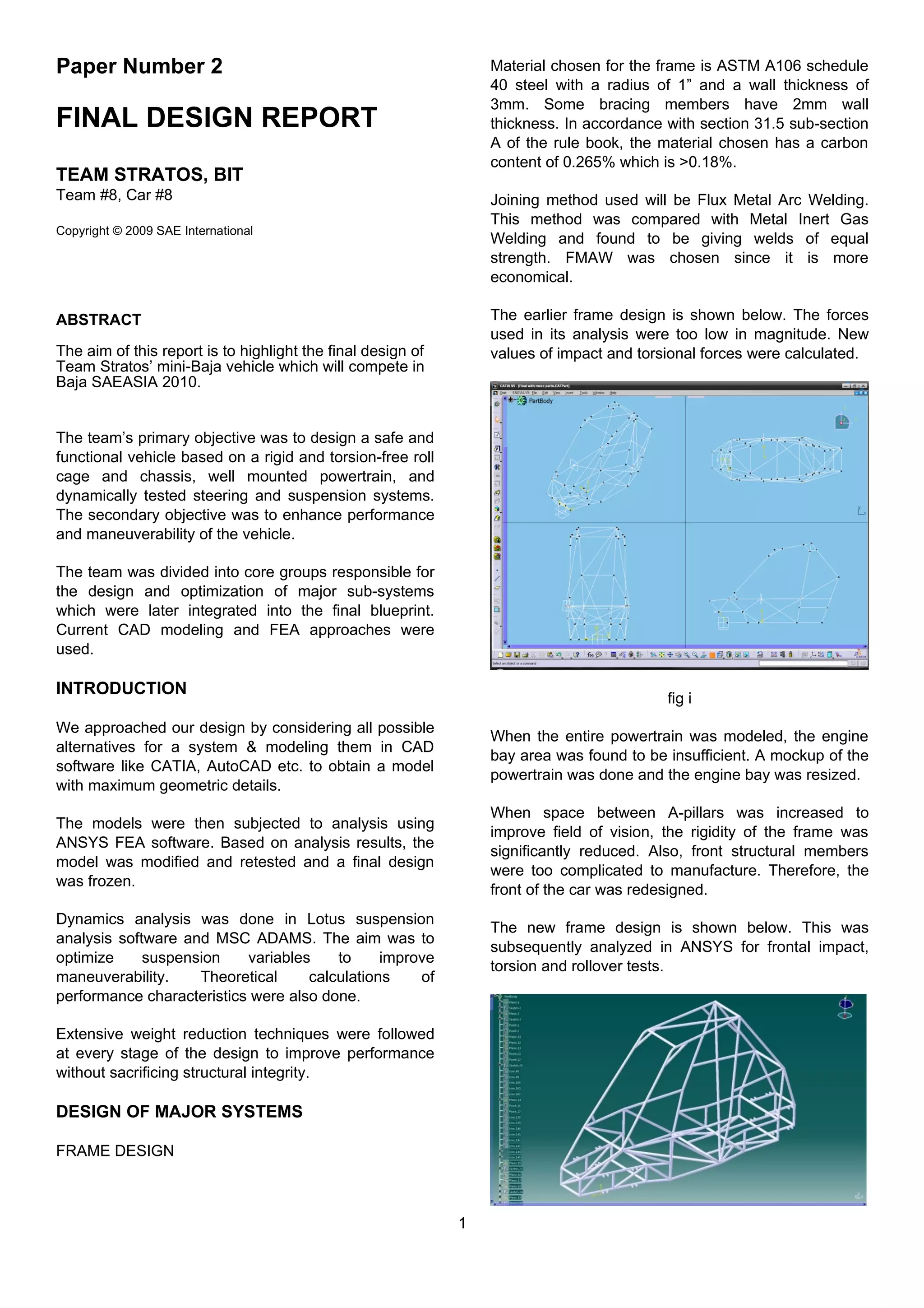
The earlier frame design is shown below. The forces
used in its analysis were too low in magnitude. New
values of impact and torsional forces were calculated.
fig i
When the entire powertrain was modeled, the engine
bay area was found to be insufficient. A mockup of the
powertrain was done and the engine bay was resized.
When space between A-pillars was increased to
improve field of vision, the rigidity of the frame was
significantly reduced. Also, front structural members
were too complicated to manufacture. Therefore, the
front of the car was redesigned.
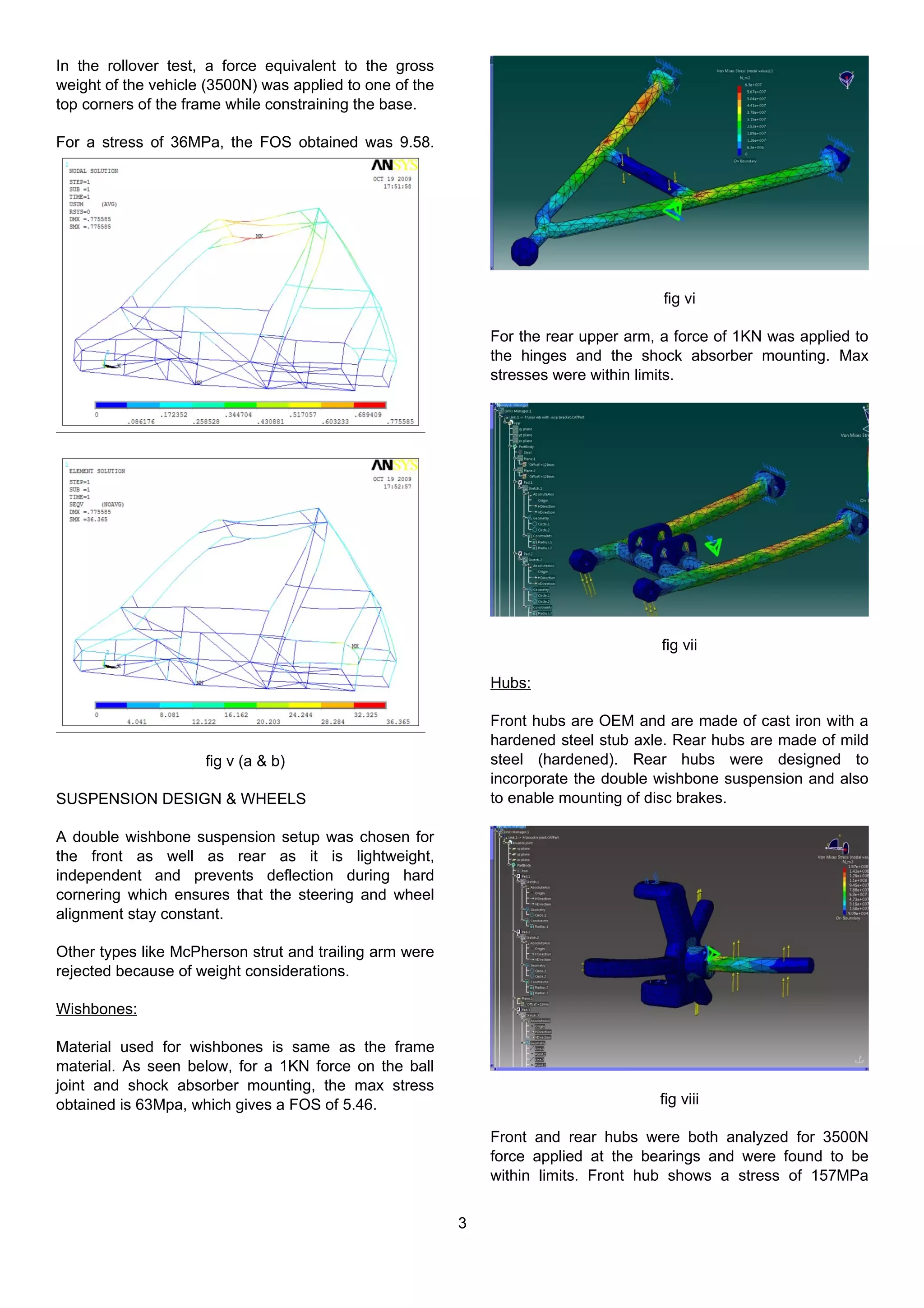
The new frame design is shown below. This was
subsequently analyzed in ANSYS for frontal impact,
torsion and rollover tests.
1
fig ii (a & b)
Frontal Impact Test:
For a perfectly inelastic collision, energy transferred is
DE = ½ (m1m2/m1+m2)(u2-u1)2
where m1 and m2 are
masses of two vehicles and u1 and u2 are
corresponding velocities. Assuming m1=m2=350kg
and u2=0 (vehicle at rest),
DE = 1/4 m1u1
2
& F=DE/t where t=100ms
Then, F= [.25 x 350 x (16.67)^2] / [10x.1] = 24315N
Hence, a frontal impact force of 6000N was applied at
4 points on the frame. The back of the frame was
completely constrained.
The deformation and stresses are shown below. For a
stress of 67MPa, the FOS obtained was 5.15.
fig iii (a & b)
Torsion Test:
For torsion test, a force equivalent to the gross weight
of the vehicle (3500N) was applied at one of the 4
corners of the frame while constraining the other 3.
Deformation and stresses were as follows. For a stress
of 163MPa, the FOS obtained was 2.12.
fig iv (a & b)
Rollover Test:
2
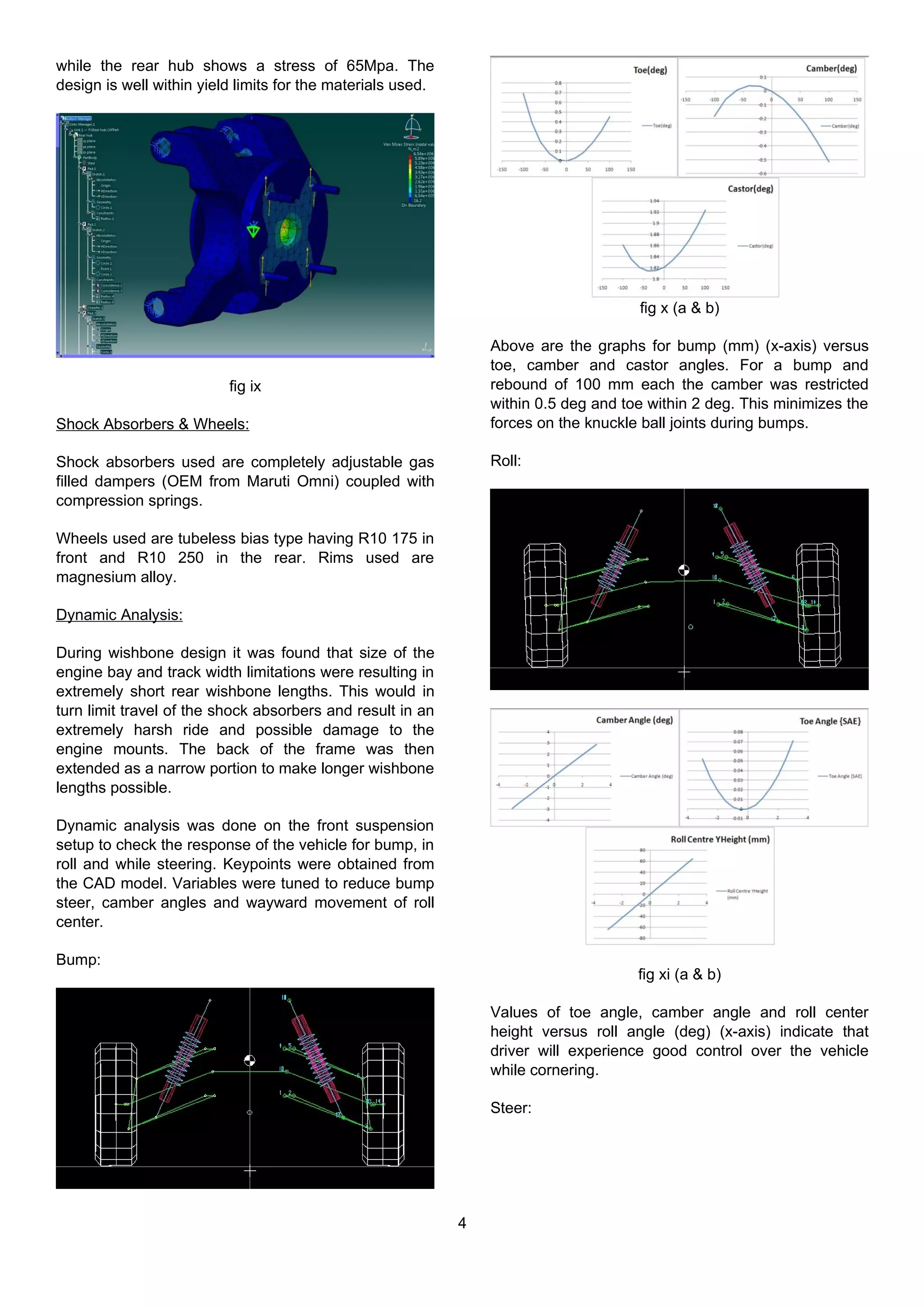
In the rollover test, a force equivalent to the gross
weight of the vehicle (3500N) was applied to one of the
top corners of the frame while constraining the base.
For a stress of 36MPa, the FOS obtained was 9.58.
fig v (a & b)
SUSPENSION DESIGN & WHEELS
A double wishbone suspension setup was chosen for
the front as well as rear as it is lightweight,
independent and prevents deflection during hard
cornering which ensures that the steering and wheel
alignment stay constant.
Other types like McPherson strut and trailing arm were
rejected because of weight considerations.
Wishbones:
Material used for wishbones is same as the frame
material. As seen below, for a 1KN force on the ball
joint and shock absorber mounting, the max stress
obtained is 63Mpa, which gives a FOS of 5.46.
fig vi
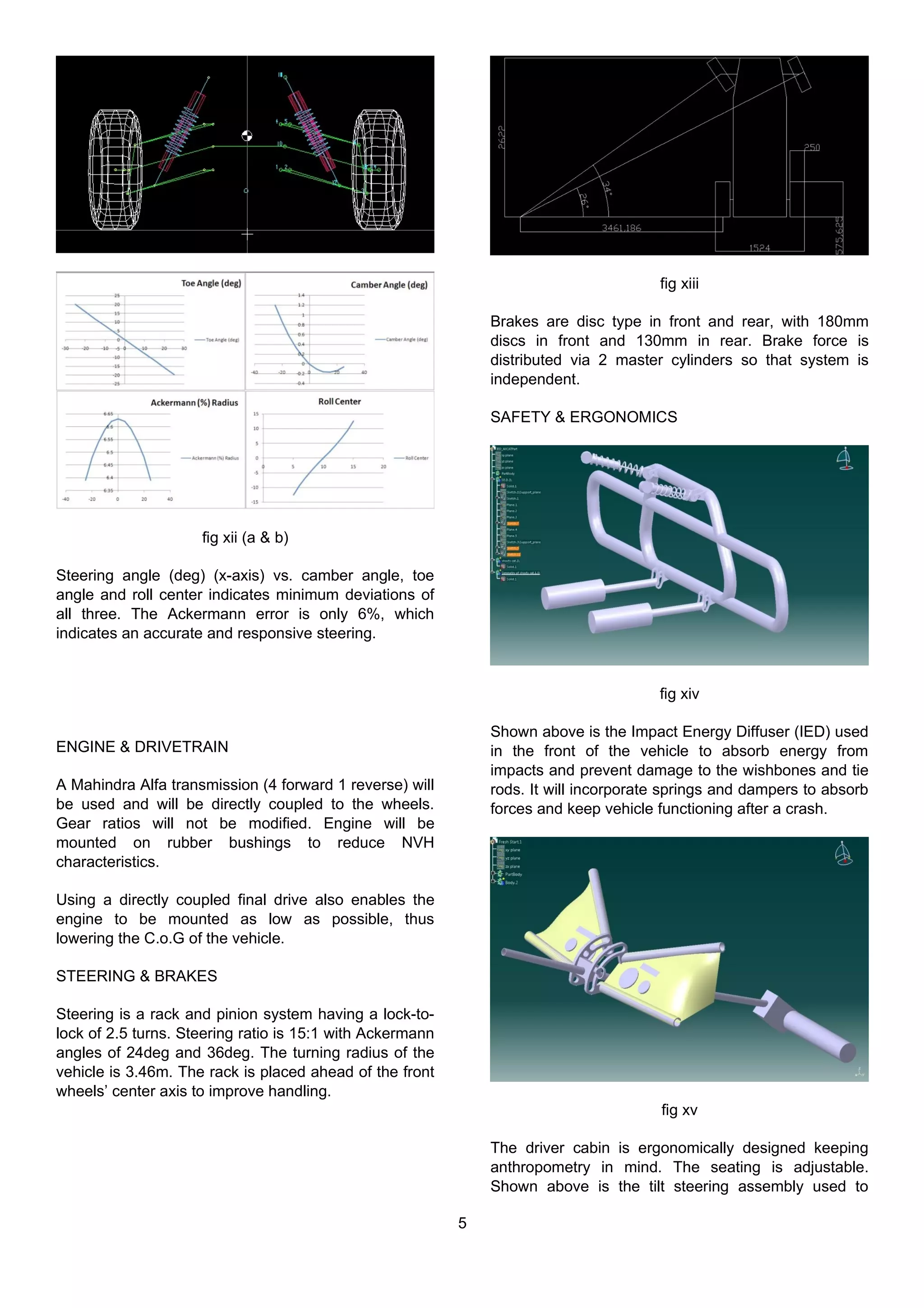
For the rear upper arm, a force of 1KN was applied to
the hinges and the shock absorber mounting. Max
stresses were within limits.
fig vii
Hubs:
Front hubs are OEM and are made of cast iron with a
hardened steel stub axle. Rear hubs are made of mild
steel (hardened). Rear hubs were designed to
incorporate the double wishbone suspension and also
to enable mounting of disc brakes.
fig viii
Front and rear hubs were both analyzed for 3500N
force applied at the bearings and were found to be
within limits. Front hub shows a stress of 157MPa
3
while the rear hub shows a stress of 65Mpa. The
design is well within yield limits for the materials used.
fig ix
Shock Absorbers & Wheels:
Shock absorbers used are completely adjustable gas
filled dampers (OEM from Maruti Omni) coupled with
compression springs.
Wheels used are tubeless bias type having R10 175 in
front and R10 250 in the rear. Rims used are
magnesium alloy.
Dynamic Analysis:
During wishbone design it was found that size of the
engine bay and track width limitations were resulting in
extremely short rear wishbone lengths. This would in
turn limit travel of the shock absorbers and result in an
extremely harsh ride and possible damage to the
engine mounts. The back of the frame was then
extended as a narrow portion to make longer wishbone
lengths possible.
Dynamic analysis was done on the front suspension
setup to check the response of the vehicle for bump, in
roll and while steering. Keypoints were obtained from
the CAD model. Variables were tuned to reduce bump
steer, camber angles and wayward movement of roll
center.
Bump:
fig x (a & b)
Above are the graphs for bump (mm) (x-axis) versus
toe, camber and castor angles. For a bump and
rebound of 100 mm each the camber was restricted
within 0.5 deg and toe within 2 deg. This minimizes the
forces on the knuckle ball joints during bumps.
Roll:
fig xi (a & b)
Values of toe angle, camber angle and roll center
height versus roll angle (deg) (x-axis) indicate that
driver will experience good control over the vehicle
while cornering.
Steer:
4
fig xii (a & b)
Steering angle (deg) (x-axis) vs. camber angle, toe
angle and roll center indicates minimum deviations of
all three. The Ackermann error is only 6%, which
indicates an accurate and responsive steering.
ENGINE & DRIVETRAIN
A Mahindra Alfa transmission (4 forward 1 reverse) will
be used and will be directly coupled to the wheels.
Gear ratios will not be modified. Engine will be
mounted on rubber bushings to reduce NVH
characteristics.
Using a directly coupled final drive also enables the
engine to be mounted as low as possible, thus
lowering the C.o.G of the vehicle.
STEERING & BRAKES
Steering is a rack and pinion system having a lock-to-
lock of 2.5 turns. Steering ratio is 15:1 with Ackermann
angles of 24deg and 36deg. The turning radius of the
vehicle is 3.46m. The rack is placed ahead of the front
wheels’ center axis to improve handling.
fig xiii
Brakes are disc type in front and rear, with 180mm
discs in front and 130mm in rear. Brake force is
distributed via 2 master cylinders so that system is
independent.
SAFETY & ERGONOMICS
fig xiv
Shown above is the Impact Energy Diffuser (IED) used
in the front of the vehicle to absorb energy from
impacts and prevent damage to the wishbones and tie
rods. It will incorporate springs and dampers to absorb
forces and keep vehicle functioning after a crash.
fig xv
The driver cabin is ergonomically designed keeping
anthropometry in mind. The seating is adjustable.
Shown above is the tilt steering assembly used to
5
provide different steering settings depending on the
user’s preferences. It utilizes a spring loaded locking
mechanism to hold the steering column in preset
positions. It can also be moved completely out of the
way to enhance ease of ingress/egress.
EXPECTED PERFORMANCE
CHARACTERISTICS
POWER & TORQUE:
Power to Weight ratio is (10.72/275)*1000 = 39
bhp/ton. Torque is calculated as follows.
BRAKING DISTANCE:
Using OEM master cylinders & assuming force applied
by driver on pedal to be 85lbs = 386N, force on master
cylinder = 386 x 0.26 (dist in m from pedal to cylinder)
= 100.36N
Now, this is equal to F x ram length, i.e. 100.36=Fx.08
so F=1254.5N
Then, pressure delivered by the cylinder P=F/A =
1254.5/314.15e-4 = 39,933N/m^2
Assuming front:rear brake bias as 68:32 gives
P(f)=27154.4N and P(r)=12788.6N.
Hence, force applied by the rear cylinder F(r) = P(r)*A
= 490.9e-4*12788.6 = 627.70N and similarly, F(f) =
1333.1N.
Also Force applied on the discs by the cylinder F(R) =
2*F(r)*µ = 2*627.70*0.3 = 376.62N and F(F)=798.7N.
Which implies torque on each disc in the rear= T(R)=
F(R)*Radius = 376.62*0.06 = 22.6N and that on the
front (with radius of the disc=0.08 m) T(F)=63.9N
Finally force per wheel in the rear becomes F(Rw) =
T(R)/Radius of the wheel (R(w)) = 22.6/0.292 = 77.36N
and also F(Rr) = 218.72N.
Thus, net deceleration Acc=[2*F(Rw)+2*F(Rr)]/Weight
of the vehicle(W) = 2(77.36+218.72)/3500 =
16.9m/s^2.
And, Stopping distance D(s) = V^2/2*a =
(14*14)/2*16.9 = 2.89m.
C.o.G & WEIGHT DISTRIBUTION:
C.o.G calculations were done by considering the
origin at the front end for X, at the chassis for Z and at
the wheels for Y. The final value for Z was arrived at
after adding the ground clearance.
6
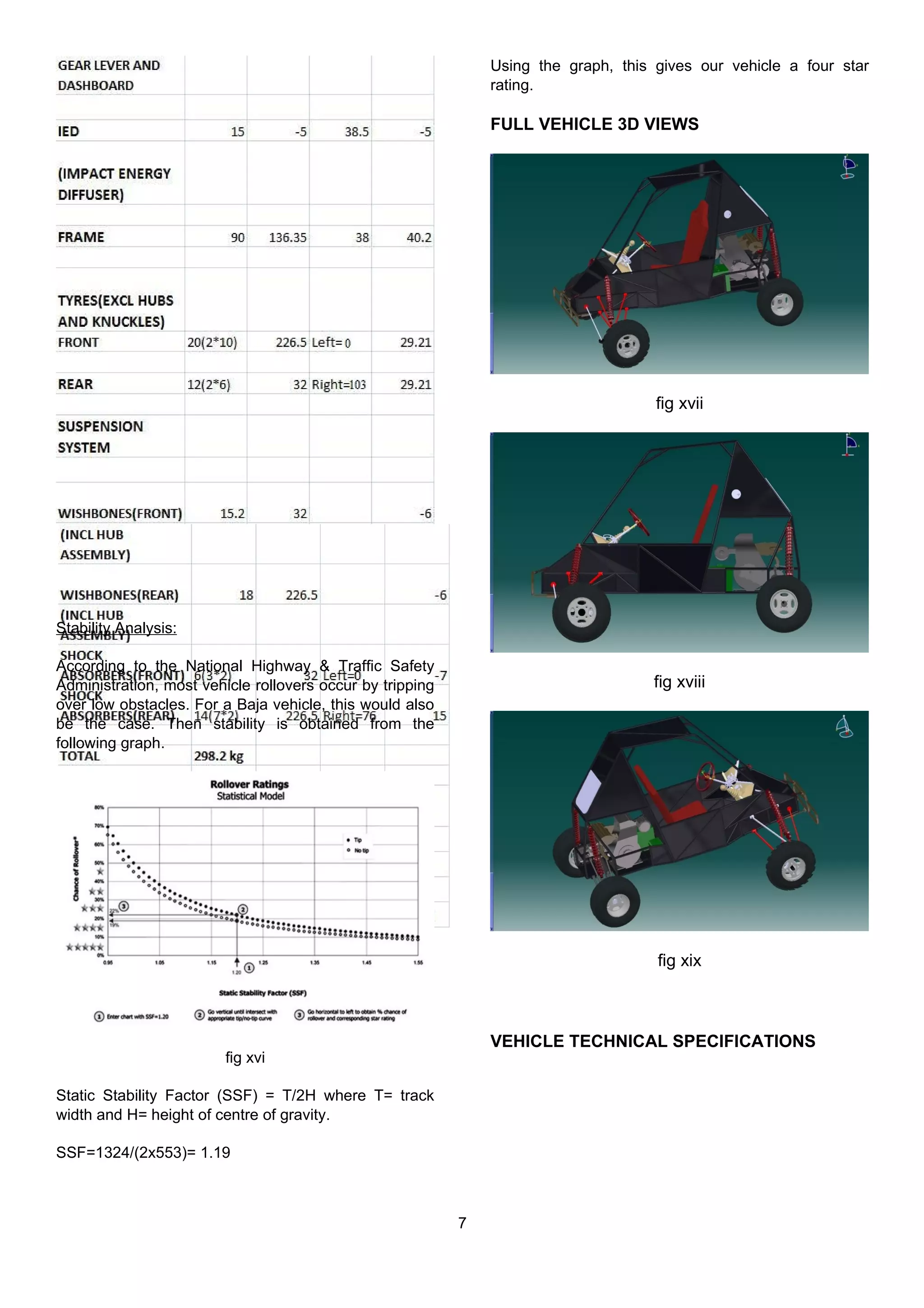
Stability Analysis:
According to the National Highway & Traffic Safety
Administration, most vehicle rollovers occur by tripping
over low obstacles. For a Baja vehicle, this would also
be the case. Then stability is obtained from the
following graph.
fig xvi
Static Stability Factor (SSF) = T/2H where T= track
width and H= height of centre of gravity.
SSF=1324/(2x553)= 1.19
Using the graph, this gives our vehicle a four star
rating.
FULL VEHICLE 3D VIEWS
fig xvii
fig xviii
fig xix
VEHICLE TECHNICAL SPECIFICATIONS
7
CONCLUSION
This being Team Stratos’ first attempt at Baja SAE ,
our team’s objective was to design and build a vehicle
that can complete all competition events without
failure. All designs and calculations were done to
realize this aim.
Reliability and safety were considered paramount,
keeping the nature of the end-user in mind. Finally, a
high level of manufacturability was incorporated to
ensure feasibility for mass-production.
REFERENCES
1. Chassis Engineering by Herb Adams
2. Automotive Mechanics by Crouse Anglin
3. Race Car Vehicle Dynamics by Millikens &
Millikens
CONTACT
Manish O. – Team Captain – 91-9844421914
Mokshith S.N – Design Head – 91-9611666646
Karthik N – Marketing Head – 91-9036227798
8

Baja project 2010 report by bangalore institue of tech

  • 1.
    Paper Number 2 FINALDESIGN REPORT TEAM STRATOS, BIT Team #8, Car #8 Copyright © 2009 SAE International ABSTRACT The aim of this report is to highlight the final design of Team Stratos’ mini-Baja vehicle which will compete in Baja SAEASIA 2010. The team’s primary objective was to design a safe and functional vehicle based on a rigid and torsion-free roll cage and chassis, well mounted powertrain, and dynamically tested steering and suspension systems. The secondary objective was to enhance performance and maneuverability of the vehicle. The team was divided into core groups responsible for the design and optimization of major sub-systems which were later integrated into the final blueprint. Current CAD modeling and FEA approaches were used. INTRODUCTION We approached our design by considering all possible alternatives for a system & modeling them in CAD software like CATIA, AutoCAD etc. to obtain a model with maximum geometric details. The models were then subjected to analysis using ANSYS FEA software. Based on analysis results, the model was modified and retested and a final design was frozen. Dynamics analysis was done in Lotus suspension analysis software and MSC ADAMS. The aim was to optimize suspension variables to improve maneuverability. Theoretical calculations of performance characteristics were also done. Extensive weight reduction techniques were followed at every stage of the design to improve performance without sacrificing structural integrity. DESIGN OF MAJOR SYSTEMS FRAME DESIGN Material chosen for the frame is ASTM A106 schedule 40 steel with a radius of 1” and a wall thickness of 3mm. Some bracing members have 2mm wall thickness. In accordance with section 31.5 sub-section A of the rule book, the material chosen has a carbon content of 0.265% which is >0.18%. Joining method used will be Flux Metal Arc Welding. This method was compared with Metal Inert Gas Welding and found to be giving welds of equal strength. FMAW was chosen since it is more economical. The earlier frame design is shown below. The forces used in its analysis were too low in magnitude. New values of impact and torsional forces were calculated. fig i When the entire powertrain was modeled, the engine bay area was found to be insufficient. A mockup of the powertrain was done and the engine bay was resized. When space between A-pillars was increased to improve field of vision, the rigidity of the frame was significantly reduced. Also, front structural members were too complicated to manufacture. Therefore, the front of the car was redesigned. The new frame design is shown below. This was subsequently analyzed in ANSYS for frontal impact, torsion and rollover tests. 1
  • 2.
    fig ii (a& b) Frontal Impact Test: For a perfectly inelastic collision, energy transferred is DE = ½ (m1m2/m1+m2)(u2-u1)2 where m1 and m2 are masses of two vehicles and u1 and u2 are corresponding velocities. Assuming m1=m2=350kg and u2=0 (vehicle at rest), DE = 1/4 m1u1 2 & F=DE/t where t=100ms Then, F= [.25 x 350 x (16.67)^2] / [10x.1] = 24315N Hence, a frontal impact force of 6000N was applied at 4 points on the frame. The back of the frame was completely constrained. The deformation and stresses are shown below. For a stress of 67MPa, the FOS obtained was 5.15. fig iii (a & b) Torsion Test: For torsion test, a force equivalent to the gross weight of the vehicle (3500N) was applied at one of the 4 corners of the frame while constraining the other 3. Deformation and stresses were as follows. For a stress of 163MPa, the FOS obtained was 2.12. fig iv (a & b) Rollover Test: 2
  • 3.
    In the rollovertest, a force equivalent to the gross weight of the vehicle (3500N) was applied to one of the top corners of the frame while constraining the base. For a stress of 36MPa, the FOS obtained was 9.58. fig v (a & b) SUSPENSION DESIGN & WHEELS A double wishbone suspension setup was chosen for the front as well as rear as it is lightweight, independent and prevents deflection during hard cornering which ensures that the steering and wheel alignment stay constant. Other types like McPherson strut and trailing arm were rejected because of weight considerations. Wishbones: Material used for wishbones is same as the frame material. As seen below, for a 1KN force on the ball joint and shock absorber mounting, the max stress obtained is 63Mpa, which gives a FOS of 5.46. fig vi For the rear upper arm, a force of 1KN was applied to the hinges and the shock absorber mounting. Max stresses were within limits. fig vii Hubs: Front hubs are OEM and are made of cast iron with a hardened steel stub axle. Rear hubs are made of mild steel (hardened). Rear hubs were designed to incorporate the double wishbone suspension and also to enable mounting of disc brakes. fig viii Front and rear hubs were both analyzed for 3500N force applied at the bearings and were found to be within limits. Front hub shows a stress of 157MPa 3
  • 4.
    while the rearhub shows a stress of 65Mpa. The design is well within yield limits for the materials used. fig ix Shock Absorbers & Wheels: Shock absorbers used are completely adjustable gas filled dampers (OEM from Maruti Omni) coupled with compression springs. Wheels used are tubeless bias type having R10 175 in front and R10 250 in the rear. Rims used are magnesium alloy. Dynamic Analysis: During wishbone design it was found that size of the engine bay and track width limitations were resulting in extremely short rear wishbone lengths. This would in turn limit travel of the shock absorbers and result in an extremely harsh ride and possible damage to the engine mounts. The back of the frame was then extended as a narrow portion to make longer wishbone lengths possible. Dynamic analysis was done on the front suspension setup to check the response of the vehicle for bump, in roll and while steering. Keypoints were obtained from the CAD model. Variables were tuned to reduce bump steer, camber angles and wayward movement of roll center. Bump: fig x (a & b) Above are the graphs for bump (mm) (x-axis) versus toe, camber and castor angles. For a bump and rebound of 100 mm each the camber was restricted within 0.5 deg and toe within 2 deg. This minimizes the forces on the knuckle ball joints during bumps. Roll: fig xi (a & b) Values of toe angle, camber angle and roll center height versus roll angle (deg) (x-axis) indicate that driver will experience good control over the vehicle while cornering. Steer: 4
  • 5.
    fig xii (a& b) Steering angle (deg) (x-axis) vs. camber angle, toe angle and roll center indicates minimum deviations of all three. The Ackermann error is only 6%, which indicates an accurate and responsive steering. ENGINE & DRIVETRAIN A Mahindra Alfa transmission (4 forward 1 reverse) will be used and will be directly coupled to the wheels. Gear ratios will not be modified. Engine will be mounted on rubber bushings to reduce NVH characteristics. Using a directly coupled final drive also enables the engine to be mounted as low as possible, thus lowering the C.o.G of the vehicle. STEERING & BRAKES Steering is a rack and pinion system having a lock-to- lock of 2.5 turns. Steering ratio is 15:1 with Ackermann angles of 24deg and 36deg. The turning radius of the vehicle is 3.46m. The rack is placed ahead of the front wheels’ center axis to improve handling. fig xiii Brakes are disc type in front and rear, with 180mm discs in front and 130mm in rear. Brake force is distributed via 2 master cylinders so that system is independent. SAFETY & ERGONOMICS fig xiv Shown above is the Impact Energy Diffuser (IED) used in the front of the vehicle to absorb energy from impacts and prevent damage to the wishbones and tie rods. It will incorporate springs and dampers to absorb forces and keep vehicle functioning after a crash. fig xv The driver cabin is ergonomically designed keeping anthropometry in mind. The seating is adjustable. Shown above is the tilt steering assembly used to 5
  • 6.
    provide different steeringsettings depending on the user’s preferences. It utilizes a spring loaded locking mechanism to hold the steering column in preset positions. It can also be moved completely out of the way to enhance ease of ingress/egress. EXPECTED PERFORMANCE CHARACTERISTICS POWER & TORQUE: Power to Weight ratio is (10.72/275)*1000 = 39 bhp/ton. Torque is calculated as follows. BRAKING DISTANCE: Using OEM master cylinders & assuming force applied by driver on pedal to be 85lbs = 386N, force on master cylinder = 386 x 0.26 (dist in m from pedal to cylinder) = 100.36N Now, this is equal to F x ram length, i.e. 100.36=Fx.08 so F=1254.5N Then, pressure delivered by the cylinder P=F/A = 1254.5/314.15e-4 = 39,933N/m^2 Assuming front:rear brake bias as 68:32 gives P(f)=27154.4N and P(r)=12788.6N. Hence, force applied by the rear cylinder F(r) = P(r)*A = 490.9e-4*12788.6 = 627.70N and similarly, F(f) = 1333.1N. Also Force applied on the discs by the cylinder F(R) = 2*F(r)*µ = 2*627.70*0.3 = 376.62N and F(F)=798.7N. Which implies torque on each disc in the rear= T(R)= F(R)*Radius = 376.62*0.06 = 22.6N and that on the front (with radius of the disc=0.08 m) T(F)=63.9N Finally force per wheel in the rear becomes F(Rw) = T(R)/Radius of the wheel (R(w)) = 22.6/0.292 = 77.36N and also F(Rr) = 218.72N. Thus, net deceleration Acc=[2*F(Rw)+2*F(Rr)]/Weight of the vehicle(W) = 2(77.36+218.72)/3500 = 16.9m/s^2. And, Stopping distance D(s) = V^2/2*a = (14*14)/2*16.9 = 2.89m. C.o.G & WEIGHT DISTRIBUTION: C.o.G calculations were done by considering the origin at the front end for X, at the chassis for Z and at the wheels for Y. The final value for Z was arrived at after adding the ground clearance. 6
  • 7.
    Stability Analysis: According tothe National Highway & Traffic Safety Administration, most vehicle rollovers occur by tripping over low obstacles. For a Baja vehicle, this would also be the case. Then stability is obtained from the following graph. fig xvi Static Stability Factor (SSF) = T/2H where T= track width and H= height of centre of gravity. SSF=1324/(2x553)= 1.19 Using the graph, this gives our vehicle a four star rating. FULL VEHICLE 3D VIEWS fig xvii fig xviii fig xix VEHICLE TECHNICAL SPECIFICATIONS 7
  • 8.
    CONCLUSION This being TeamStratos’ first attempt at Baja SAE , our team’s objective was to design and build a vehicle that can complete all competition events without failure. All designs and calculations were done to realize this aim. Reliability and safety were considered paramount, keeping the nature of the end-user in mind. Finally, a high level of manufacturability was incorporated to ensure feasibility for mass-production. REFERENCES 1. Chassis Engineering by Herb Adams 2. Automotive Mechanics by Crouse Anglin 3. Race Car Vehicle Dynamics by Millikens & Millikens CONTACT Manish O. – Team Captain – 91-9844421914 Mokshith S.N – Design Head – 91-9611666646 Karthik N – Marketing Head – 91-9036227798 8