NEW TEAM ID : 15094
OLD TEAM ID : 14182
CAR NO : 79
TOTAL SCORE : 583
1SRI VENKATESWARA COLLEGE OF ENGINEERING
CHENNAI-602117
2
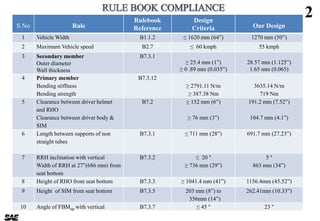
S.No Rule
Rulebook
Reference
Design
Criteria Our Design
1 Vehicle Width B1.1.2 ≤ 1620 mm (64”) 1270 mm (50”)
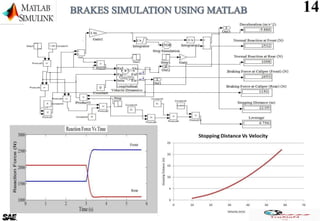
2 Maximum Vehicle speed B2.7 ≤ 60 kmph 55 kmph
3 Secondary member
Outer diameter
Wall thickness
B7.3.1
≥ 25.4 mm (1”)
≥ 0 .89 mm (0.035”)
28.57 mm (1.125”)
1.65 mm (0.065)
4 Primary member
Bending stiffness
Bending strength
B7.3.12
≥ 2791.11 N/m
≥ 387.38 Nm
3635.14 N/m
719 Nm
5 Clearance between driver helmet
and RHO
Clearance between driver body &
SIM
B7.2 ≥ 152 mm (6”)
≥ 76 mm (3”)
191.2 mm (7.52”)
104.7 mm (4.1”)
6 Length between supports of non
straight tubes
B7.3.1 ≤ 711 mm (28”) 691.7 mm (27.23”)
7 RRH inclination with vertical
Width of RRH at 27”(686 mm) from
seat bottom
B7.3.2 ≤ 20 °
≥ 736 mm (29”)
5 °
863 mm (34”)
8 Height of RHO from seat bottom B7.3.3 ≥ 1041.4 mm (41”) 1156.4mm (45.52”)
9 Height of SIM from seat bottom B7.3.5 203 mm (8”) to
356mm (14”)
262.41mm (10.33”)
10 Angle of FBMup with vertical B7.3.7 ≤ 45 ° 23 °
3
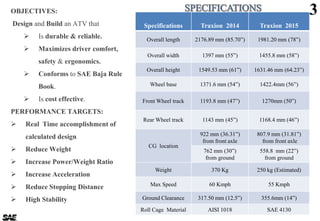
Specifications Traxion 2014 Traxion 2015
Overall length 2176.89 mm (85.70”) 1981.20 mm (78”)
Overall width 1397 mm (55”) 1455.8 mm (58”)
Overall height 1549.53 mm (61”) 1631.46 mm (64.23”)
Wheel base 1371.6 mm (54”) 1422.4mm (56”)
Front Wheel track 1193.8 mm (47”) 1270mm (50”)
Rear Wheel track 1143 mm (45”) 1168.4 mm (46”)
CG location
922 mm (36.31”)
from front axle
807.9 mm (31.81”)
from front axle
762 mm (30”)
from ground
558.8 mm (22”)
from ground
Weight 370 Kg 250 kg (Estimated)
Max Speed 60 Kmph 55 Kmph
Ground Clearance 317.50 mm (12.5”) 355.6mm (14”)
Roll Cage Material AISI 1018 SAE 4130
OBJECTIVES:
Design and Build an ATV that
 Is durable & reliable.
 Maximizes driver comfort,
safety & ergonomics.
 Conforms to SAE Baja Rule
Book.
 Is cost effective.
PERFORMANCE TARGETS:
 Real Time accomplishment of
calculated design
 Reduce Weight
 Increase Power/Weight Ratio
 Increase Acceleration
 Reduce Stopping Distance
 High Stability
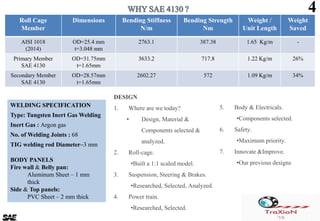
Roll Cage
Member
Dimensions Bending Stiffness
N/m
Bending Strength
Nm
Weight /
Unit Length
Weight
Saved
AISI 1018
(2014)
OD=25.4 mm
t=3.048 mm
2763.1 387.38 1.65 Kg/m -
Primary Member
SAE 4130
OD=31.75mm
t=1.65mm
3633.2 717.8 1.22 Kg/m 26%
Secondary Member
SAE 4130
OD=28.57mm
t=1.65mm
2602.27 572 1.09 Kg/m 34%
4
DESIGN
1. Where are we today?
• Design, Material &
Components selected &
analyzed.
2. Roll-cage.
•Built a 1:1 scaled model.
3. Suspension, Steering & Brakes.
•Researched, Selected, Analyzed.
4. Power train.
•Researched, Selected.
5. Body & Electricals.
•Components selected.
6. Safety.
•Maximum priority.
7. Innovate &Improve.
•Our previous designs
WELDING SPECIFICATION
Type: Tungsten Inert Gas Welding
Inert Gas : Argon gas
No. of Welding Joints : 68
TIG welding rod Diameter–3 mm
BODY PANELS
Fire wall & Belly pan:
Aluminum Sheet – 1 mm
thick
Side & Top panels:
PVC Sheet – 2 mm thick
5
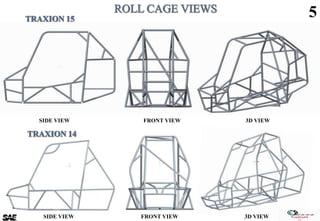
SIDE VIEW
3D VIEW
FRONT VIEW
SIDE VIEW FRONT VIEW
3D VIEW
3D VIEW
EARLIER DESIGN
ANALYSIS AND
LESSONS LEARNT
Uniform cross sections were used
which resulted in increased weight.
Complicated design resulted in
tedious Sheet metal work.
IMPROVEMENTS PLANNED
Use separate cross sections for
Primary and Secondary member
which will reduce the weight.
Avoid Unnecessary Bends which
will make the Sheet Metal work
easy.
Reduce the number of weld joints
Restrict the maximum number of
tube intersections at one node.
S.No Type Force
(N)
Displacement
(mm)
Von Misses Stress
(MPa)
F.O.S
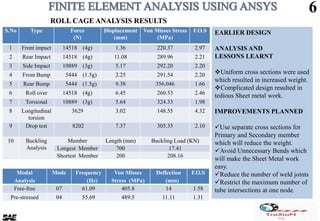
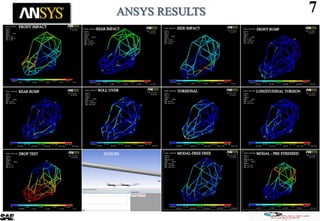
1 Front impact 14518 (4g) 1.36 220.37 2.97
2 Rear Impact 14518 (4g) 11.08 289.96 2.21
3 Side Impact 10889 (3g) 5.17 292.20 2.20
4 Front Bump 5444 (1.5g) 2.25 291.54 2.20
5 Rear Bump 5444 (1.5g) 9.38 356.046 1.66
6 Roll over 14518 (4g) 6.45 260.53 2.46
7 Torsional 10889 (3g) 5.64 324.33 1.98
8 Longitudinal
torsion
3629 3.02 148.55 4.32
9 Drop test 8202 7.37 305.35 2.10
10 Buckling
Analysis
Member Length (mm) Buckling Load (KN)
Longest Member 700 17.41
Shortest Member 200 208.16
ROLL CAGE ANALYSIS RESULTS
6
Modal
Analysis
Mode Frequency
(Hz)
Von Misses
Stress (MPa)
Deflection
(mm)
F.O.S
Free-free 07 61.09 405.8 14 1.58
Pre-stressed 04 55.69 489.5 11.11 1.31
7
8
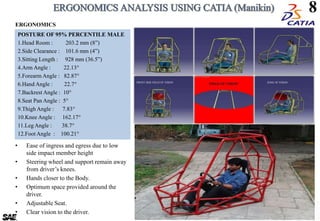
ERGONOMICS
POSTURE OF 95% PERCENTILE MALE
1.Head Room : 203.2 mm (8”)
2.Side Clearance : 101.6 mm (4”)
3.Sitting Length : 928 mm (36.5”)
4.Arm Angle : 22.13°
5.Forearm Angle : 82.87°
6.Hand Angle : 22.7°
7.Backrest Angle : 10°
8.Seat Pan Angle : 5°
9.Thigh Angle : 7.83°
10.Knee Angle : 162.17°
11.Leg Angle : 38.7°
12.Foot Angle : 100.21°
• Ease of ingress and egress due to low
side impact member height
• Steering wheel and support remain away
from driver’s knees.
• Hands closer to the Body.
• Optimum space provided around the
driver.
• Adjustable Seat.
• Clear vision to the driver.
KINEMATICS
Motion Ratio 0.85 0.85
Wheel Static Deflection 76.2 mm (3”) 63.5 mm (2.5”)
Spring Static Deflection 64.77 mm (2.55”) 53.9 mm (2.12”)
Wheel Travel 254 mm (10”) 254 mm (10”)
Roll Centre Height 457.2 mm (18” ) 584.2 mm (23”)
Roll Stiffness 102.48 Nm/deg 150 Nm/deg
Pitch Centre Height 228.6 mm (9”) -
Anti Dive 40% 0
Maximum Track
Change
50.8 mm (2”) 0
Maximum Base
Change
0 16 mm (0.62”)
9
Parameter
Front
Suspension
Rear
Suspension
Dimensions
DOUBLE
WISHBONE
TRAILING
ARM
Lower Arm Length 330.2 mm (13”)
530mm (20.86”)
Upper Arm Length 279.4 mm (11”)
Spring Angle 70o 80o
KINETICS
Spring Rate
13.90 N/mm
(80 lb/inch)
20.33 N/mm
(117 lb/inch)
Wheel Rate
10.04 N/mm
(57.8 lb/inch)
14.69 N/mm
(84.53 lb/inch)
Ride Natural
Frequency
1.8 Hz 1.98 Hz
Wheel Natural
Frequency
6.21 Hz 7.91 Hz
Combined Rate
6.60 N/mm
(33.56 lb/inch)
6.60 N/mm
(49.07 lb/inch)
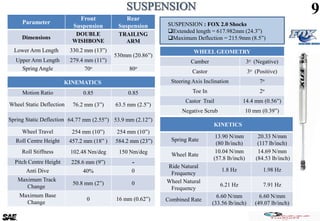
SUSPENSION : FOX 2.0 Shocks
Extended length = 617.982mm (24.3”)
Maximum Deflection = 215.9mm (8.5”)
WHEEL GEOMETRY
Camber 3o (Negative)
Castor 3o (Positive)
Steering Axis Inclination 7o
Toe In 2o
Castor Trail 14.4 mm (0.56”)
Negative Scrub 10 mm (0.39”)
TraXion 15
10
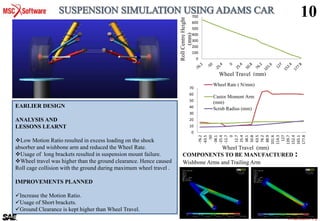
COMPONENTS TO BE MANUFACTURED :
Wishbone Arms and Trailing Arm
0
10
20
30
40
50
60
70
-76.2
-63.5
-50
-38.1
-25.4
-12.7
0
12.7
25.4
38.1
50.8
63.5
76.2
88.9
101.6
114.3
127
139.7
152.4
165.1
177.8
Wheel Rate ( N/mm)
Castor Moment Arm
(mm)
Scrub Radius (mm)
Wheel Travel (mm)
0
100
200
300
400
500
600
700
RollCentreHeight
(mm)
Wheel Travel (mm)
EARLIER DESIGN
ANALYSIS AND
LESSONS LEARNT
Low Motion Ratio resulted in excess loading on the shock
absorber and wishbone arm and reduced the Wheel Rate.
Usage of long brackets resulted in suspension mount failure.
Wheel travel was higher than the ground clearance. Hence caused
Roll cage collision with the ground during maximum wheel travel .
IMPROVEMENTS PLANNED
Increase the Motion Ratio.
Usage of Short brackets.
Ground Clearance is kept higher than Wheel Travel.
11
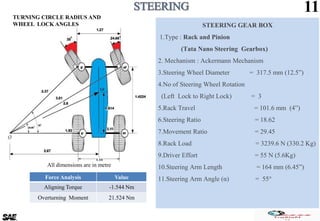
Force Analysis Value
Aligning Torque -1.544 Nm
Overturning Moment 21.524 Nm
All dimensions are in metre
TURNING CIRCLE RADIUS AND
WHEEL LOCK ANGLES STEERING GEAR BOX
1.Type : Rack and Pinion
(Tata Nano Steering Gearbox)
2. Mechanism : Ackermann Mechanism
3.Steering Wheel Diameter = 317.5 mm (12.5”)
4.No of Steering Wheel Rotation
(Left Lock to Right Lock) = 3
5.Rack Travel = 101.6 mm (4”)
6.Steering Ratio = 18.62
7.Movement Ratio = 29.45
8.Rack Load = 3239.6 N (330.2 Kg)
9.Driver Effort = 55 N (5.6Kg)
10.Steering Arm Length = 164 mm (6.45”)
11.Steering Arm Angle (α) = 55°
EARLIER DESIGN
ANALYSIS AND
LESSONS LEARNT
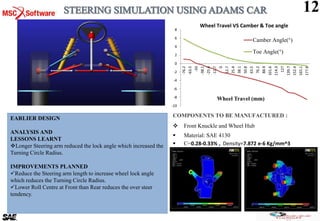
Longer Steering arm reduced the lock angle which increased the
Turning Circle Radius.
IMPROVEMENTS PLANNED
Reduce the Steering arm length to increase wheel lock angle
which reduces the Turning Circle Radius.
Lower Roll Centre at Front than Rear reduces the over steer
tendency.
12
COMPONENTS TO BE MANUFACTURED :
 Front Knuckle and Wheel Hub
 Material: SAE 4130
 C=0.28-0.33% , Density=7.872 e-6 Kg/mm^3
-10
-8
-6
-4
-2
0
2
4
6
8
-76.2
-63.5
-50
-38.1
-25.4
-12.7
0
12.7
25.4
38.1
50.8
63.5
76.2
88.9
101.6
114.3
127
139.7
152.4
165.1
177.8
Wheel Travel (mm)
Camber Angle(°)
Toe Angle(°)
Wheel Travel VS Camber & Toe angle
EARLIER DESIGN
ANALYSIS AND LESSONS LEARNT
 Slipping of Brakes at Front due to inadequate applied
Braking Force.
IMPROVEMENTS PLANNED
 Lower the C.G height. Reduces the Braking Force
required at Front.
 Increase the Leverage at Pedal lever to increase
applied Braking Force.
13
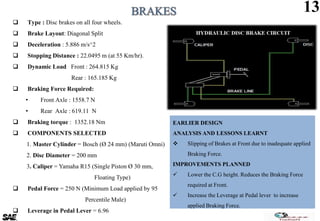
 Type : Disc brakes on all four wheels.
 Brake Layout: Diagonal Split
 Deceleration : 5.886 m/s^2
 Stopping Distance : 22.0495 m (at 55 Km/hr).
 Dynamic Load Front : 264.815 Kg
Rear : 165.185 Kg
 Braking Force Required:
• Front Axle : 1558.7 N
• Rear Axle : 619.11 N
 Braking torque : 1352.18 Nm
 COMPONENTS SELECTED
1. Master Cylinder = Bosch (Ø 24 mm) (Maruti Omni)
2. Disc Diameter = 200 mm
3. Caliper = Yamaha R15 (Single Piston Ø 30 mm,
Floating Type)
 Pedal Force = 250 N (Minimum Load applied by 95
Percentile Male)
 Leverage in Pedal Lever = 6.96
14
15
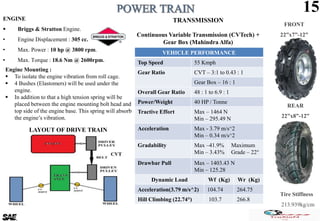
ENGINE
 Briggs & Stratton Engine.
• Engine Displacement : 305 cc.
• Max. Power : 10 hp @ 3800 rpm.
• Max. Torque : 18.6 Nm @ 2600rpm.
VEHICLE PERFORMANCE
Top Speed 55 Kmph
Gear Ratio CVT – 3:1 to 0.43 : 1
Gear Box – 16 : 1
Overall Gear Ratio 48 : 1 to 6.9 : 1
Power/Weight 40 HP / Tonne
Tractive Effort Max – 1464 N
Min – 295.49 N
Acceleration Max - 3.79 m/s^2
Min – 0.34 m/s^2
Gradability Max –41.9%
Min – 3.43%
Maximum
Grade – 22°
Drawbar Pull Max – 1403.43 N
Min – 125.28
Dynamic Load Wf (Kg) Wr (Kg)
Acceleration(3.79 m/s^2) 104.74 264.75
Hill Climbing (22.74°) 103.7 266.8
TRANSMISSION
Continuous Variable Transmission (CVTech) +
Gear Box (Mahindra Alfa)
REAR
22”x8”-12”
FRONT
22”x7”-12”
Tire Stiffness
213.939kg/cm
Engine Mounting :
 To isolate the engine vibration from roll cage.
 4 Bushes (Elastomers) will be used under the
engine.
 In addition to that a high tension spring will be
placed between the engine mounting bolt head and
top side of the engine base. This spring will absorb
the engine’s vibration.
LAYOUT OF DRIVE TRAIN
16
EARLIER DESIGN
ANALYSIS AND LESSONS LEARNT
 Gear box was used without clutch which
made the Gear Shifting tedious.
 Tire Diameter was larger which reduced
the Tractive effort and Acceleration
IMPROVEMENTS PLANNED
 Use Gear box with Clutch.
 Increase CVT driver pulley fly weight
mass to 270 g and use spring with low
stiffness to increase the Pick-UP.
 Customize the Gear Box to limit the Top
speed.
 Reduce Tire Diameter which increases
Tractive effort and Acceleration.
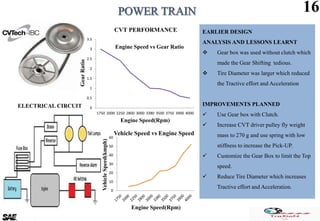
ELECTRICAL CIRCUIT 0
0.5
1
1.5
2
2.5
3
3.5
1750 2000 2250 2800 3000 3380 3500 3750 3900 4000
GearRatio
Engine Speed(Rpm)
0
10
20
30
40
50
60
VehicleSpeed(kmph)
Engine Speed(Rpm)
CVT PERFORMANCE
Vehicle Speed vs Engine Speed
Engine Speed vs Gear Ratio
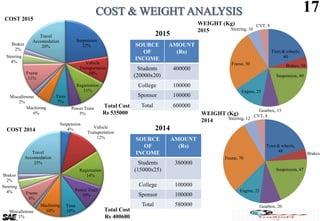
SOURCE
OF
INCOME
AMOUNT
(Rs)
Students
(15000x25)
380000
College 100000
Sponsor 100000
Total 580000
17
SOURCE
OF
INCOME
AMOUNT
(Rs)
Students
(20000x20)
400000
College 100000
Sponsor 100000
Total 600000
WEIGHT (Kg)
2014
WEIGHT (Kg)
2015
2015
2014
Suspension
4% Vehicle
Transportation
12%
Registration
14%
Power Train
10%
Tires
10%
Machining
10%Miscallenous
1%
Frame
8%
Steering
4%
Brakes
2%
Travel
Accomodation
25%
COST 2014
Total Cost
Rs 400680
Suspension
22%
Vehicle
Transportation
10%
Registration
11%
Power Train
5%
Tires
7%
Machining
6%
Miscallenous
2%
Frame
11%
Steering
4%
Brakes
2%
Travel
Accomodation
20%
COST 2015
Total Cost
Rs 535000
Tires & wheels,
48
Brakes,
Suspension, 47
Gearbox, 20
Engine, 25
Frame, 70
Steering, 12
CVT, 8
Tires & wheels,
40
Brakes, 10
Suspension, 40
Gearbox, 15
Engine, 25
Frame, 50
Steering, 10
CVT, 8
18
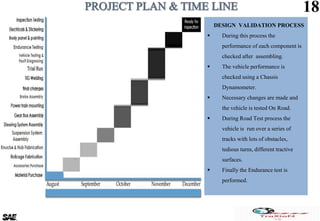
DESIGN VALIDATION PROCESS
 During this process the
performance of each component is
checked after assembling.
 The vehicle performance is
checked using a Chassis
Dynamometer.
 Necessary changes are made and
the vehicle is tested On Road.
 During Road Test process the
vehicle is run over a series of
tracks with lots of obstacles,
tedious turns, different tractive
surfaces.
 Finally the Endurance test is
performed.
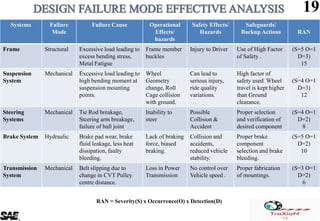
Systems Failure
Mode
Failure Cause Operational
Effects/
hazards
Safety Effects/
Hazards
Safeguards/
Backup Actions RAN
Frame Structural Excessive load leading to
excess bending stress,
Metal Fatigue
Frame member
buckles
Injury to Driver Use of High Factor
of Safety .
(S=5 O=1
D=3)
15
Suspension
System
Mechanical Excessive load leading to
high bending moment at
suspension mounting
points.
Wheel
Geometry
change, Roll
Cage collision
with ground.
Can lead to
serious injury,
ride quality
variations.
High factor of
safety used. Wheel
travel is kept higher
than Ground
clearance.
(S=4 O=1
D=3)
12
Steering
Systems
Mechanical Tie Rod breakage,
Steering arm breakage,
failure of ball joint
Inability to
steer
Possible
Collision &
Accident
Proper selection
and verification of
desired component
(S=4 O=1
D=2)
8
Brake System Hydraulic Brake pad wear, brake
fluid leakage, less heat
dissipation, faulty
bleeding.
Lack of braking
force, biased
braking.
Collision and
accidents,
reduced vehicle
stability.
Proper brake
component
selection and brake
bleeding.
(S=5 O=1
D=2)
10
Transmission
System
Mechanical Belt slipping due to
change in CVT Pulley
centre distance.
Loss in Power
Transmission
No control over
Vehicle speed .
Proper fabrication
of mountings.
(S=3 O=1
D=2)
6
19
RAN = Severity(S) x Occurrence(O) x Detection(D)
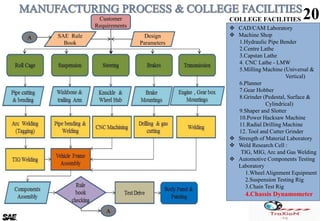
20COLLEGE FACILITIES
 CAD/CAM Laboratory
 Machine Shop
1.Hydraulic Pipe Bender
2.Centre Lathe
3.Capstan Lathe
4. CNC Lathe - LMW
5.Milling Machine (Universal &
Vertical)
6.Planner
7.Gear Hobber
8.Grinder (Pedestal, Surface &
Cylindrical)
9.Shaper and Slotter
10.Power Hacksaw Machine
11.Radial Drilling Machine
12. Tool and Cutter Grinder
 Strength of Material Laboratory
 Weld Research Cell :
TIG, MIG, Arc and Gas Welding
 Automotive Components Testing
Laboratory
1.Wheel Alignment Equipment
2.Suspension Testing Rig
3.Chain Test Rig
4.Chassis Dynamometer
Customer
Requirements
SAE Rule
Book
Design
Parameters
A
A
21Faculty Advisor
Mr. K. Paul Durai
DESIGN
Krishna Kumar
Shanmuga
Sundaram
Sathish Kumar
(Driver)
Bala Sundar
SUSPENSION
Karthikeyan
Saran
Asif
STEERING
Maniraj
Mohit R
Thakur
Piyush
Chopra
Arunachalam
BRAKES
Vishaal
Krishna
Akilan
Ram Kumar
Bala chandar
TRANSMISSION
Chandrasekar
Geethan Ramu
Raj Kumar
Captain
Dhamodharan
Vice-Captain
Ashwath
Fabrication Procurement Presentation Driver Treasurer
Old
member
THANK YOU

Team Traxion'15 - Virtual Baja 2015 Presentation

  • 1.
    NEW TEAM ID: 15094 OLD TEAM ID : 14182 CAR NO : 79 TOTAL SCORE : 583 1SRI VENKATESWARA COLLEGE OF ENGINEERING CHENNAI-602117
  • 2.
    2 S.No Rule Rulebook Reference Design Criteria OurDesign 1 Vehicle Width B1.1.2 ≤ 1620 mm (64”) 1270 mm (50”) 2 Maximum Vehicle speed B2.7 ≤ 60 kmph 55 kmph 3 Secondary member Outer diameter Wall thickness B7.3.1 ≥ 25.4 mm (1”) ≥ 0 .89 mm (0.035”) 28.57 mm (1.125”) 1.65 mm (0.065) 4 Primary member Bending stiffness Bending strength B7.3.12 ≥ 2791.11 N/m ≥ 387.38 Nm 3635.14 N/m 719 Nm 5 Clearance between driver helmet and RHO Clearance between driver body & SIM B7.2 ≥ 152 mm (6”) ≥ 76 mm (3”) 191.2 mm (7.52”) 104.7 mm (4.1”) 6 Length between supports of non straight tubes B7.3.1 ≤ 711 mm (28”) 691.7 mm (27.23”) 7 RRH inclination with vertical Width of RRH at 27”(686 mm) from seat bottom B7.3.2 ≤ 20 ° ≥ 736 mm (29”) 5 ° 863 mm (34”) 8 Height of RHO from seat bottom B7.3.3 ≥ 1041.4 mm (41”) 1156.4mm (45.52”) 9 Height of SIM from seat bottom B7.3.5 203 mm (8”) to 356mm (14”) 262.41mm (10.33”) 10 Angle of FBMup with vertical B7.3.7 ≤ 45 ° 23 °
  • 3.
    3 Specifications Traxion 2014Traxion 2015 Overall length 2176.89 mm (85.70”) 1981.20 mm (78”) Overall width 1397 mm (55”) 1455.8 mm (58”) Overall height 1549.53 mm (61”) 1631.46 mm (64.23”) Wheel base 1371.6 mm (54”) 1422.4mm (56”) Front Wheel track 1193.8 mm (47”) 1270mm (50”) Rear Wheel track 1143 mm (45”) 1168.4 mm (46”) CG location 922 mm (36.31”) from front axle 807.9 mm (31.81”) from front axle 762 mm (30”) from ground 558.8 mm (22”) from ground Weight 370 Kg 250 kg (Estimated) Max Speed 60 Kmph 55 Kmph Ground Clearance 317.50 mm (12.5”) 355.6mm (14”) Roll Cage Material AISI 1018 SAE 4130 OBJECTIVES: Design and Build an ATV that  Is durable & reliable.  Maximizes driver comfort, safety & ergonomics.  Conforms to SAE Baja Rule Book.  Is cost effective. PERFORMANCE TARGETS:  Real Time accomplishment of calculated design  Reduce Weight  Increase Power/Weight Ratio  Increase Acceleration  Reduce Stopping Distance  High Stability
  • 4.
    Roll Cage Member Dimensions BendingStiffness N/m Bending Strength Nm Weight / Unit Length Weight Saved AISI 1018 (2014) OD=25.4 mm t=3.048 mm 2763.1 387.38 1.65 Kg/m - Primary Member SAE 4130 OD=31.75mm t=1.65mm 3633.2 717.8 1.22 Kg/m 26% Secondary Member SAE 4130 OD=28.57mm t=1.65mm 2602.27 572 1.09 Kg/m 34% 4 DESIGN 1. Where are we today? • Design, Material & Components selected & analyzed. 2. Roll-cage. •Built a 1:1 scaled model. 3. Suspension, Steering & Brakes. •Researched, Selected, Analyzed. 4. Power train. •Researched, Selected. 5. Body & Electricals. •Components selected. 6. Safety. •Maximum priority. 7. Innovate &Improve. •Our previous designs WELDING SPECIFICATION Type: Tungsten Inert Gas Welding Inert Gas : Argon gas No. of Welding Joints : 68 TIG welding rod Diameter–3 mm BODY PANELS Fire wall & Belly pan: Aluminum Sheet – 1 mm thick Side & Top panels: PVC Sheet – 2 mm thick
  • 5.
    5 SIDE VIEW 3D VIEW FRONTVIEW SIDE VIEW FRONT VIEW 3D VIEW 3D VIEW
  • 6.
    EARLIER DESIGN ANALYSIS AND LESSONSLEARNT Uniform cross sections were used which resulted in increased weight. Complicated design resulted in tedious Sheet metal work. IMPROVEMENTS PLANNED Use separate cross sections for Primary and Secondary member which will reduce the weight. Avoid Unnecessary Bends which will make the Sheet Metal work easy. Reduce the number of weld joints Restrict the maximum number of tube intersections at one node. S.No Type Force (N) Displacement (mm) Von Misses Stress (MPa) F.O.S 1 Front impact 14518 (4g) 1.36 220.37 2.97 2 Rear Impact 14518 (4g) 11.08 289.96 2.21 3 Side Impact 10889 (3g) 5.17 292.20 2.20 4 Front Bump 5444 (1.5g) 2.25 291.54 2.20 5 Rear Bump 5444 (1.5g) 9.38 356.046 1.66 6 Roll over 14518 (4g) 6.45 260.53 2.46 7 Torsional 10889 (3g) 5.64 324.33 1.98 8 Longitudinal torsion 3629 3.02 148.55 4.32 9 Drop test 8202 7.37 305.35 2.10 10 Buckling Analysis Member Length (mm) Buckling Load (KN) Longest Member 700 17.41 Shortest Member 200 208.16 ROLL CAGE ANALYSIS RESULTS 6 Modal Analysis Mode Frequency (Hz) Von Misses Stress (MPa) Deflection (mm) F.O.S Free-free 07 61.09 405.8 14 1.58 Pre-stressed 04 55.69 489.5 11.11 1.31
  • 7.
  • 8.
    8 ERGONOMICS POSTURE OF 95%PERCENTILE MALE 1.Head Room : 203.2 mm (8”) 2.Side Clearance : 101.6 mm (4”) 3.Sitting Length : 928 mm (36.5”) 4.Arm Angle : 22.13° 5.Forearm Angle : 82.87° 6.Hand Angle : 22.7° 7.Backrest Angle : 10° 8.Seat Pan Angle : 5° 9.Thigh Angle : 7.83° 10.Knee Angle : 162.17° 11.Leg Angle : 38.7° 12.Foot Angle : 100.21° • Ease of ingress and egress due to low side impact member height • Steering wheel and support remain away from driver’s knees. • Hands closer to the Body. • Optimum space provided around the driver. • Adjustable Seat. • Clear vision to the driver.
  • 9.
    KINEMATICS Motion Ratio 0.850.85 Wheel Static Deflection 76.2 mm (3”) 63.5 mm (2.5”) Spring Static Deflection 64.77 mm (2.55”) 53.9 mm (2.12”) Wheel Travel 254 mm (10”) 254 mm (10”) Roll Centre Height 457.2 mm (18” ) 584.2 mm (23”) Roll Stiffness 102.48 Nm/deg 150 Nm/deg Pitch Centre Height 228.6 mm (9”) - Anti Dive 40% 0 Maximum Track Change 50.8 mm (2”) 0 Maximum Base Change 0 16 mm (0.62”) 9 Parameter Front Suspension Rear Suspension Dimensions DOUBLE WISHBONE TRAILING ARM Lower Arm Length 330.2 mm (13”) 530mm (20.86”) Upper Arm Length 279.4 mm (11”) Spring Angle 70o 80o KINETICS Spring Rate 13.90 N/mm (80 lb/inch) 20.33 N/mm (117 lb/inch) Wheel Rate 10.04 N/mm (57.8 lb/inch) 14.69 N/mm (84.53 lb/inch) Ride Natural Frequency 1.8 Hz 1.98 Hz Wheel Natural Frequency 6.21 Hz 7.91 Hz Combined Rate 6.60 N/mm (33.56 lb/inch) 6.60 N/mm (49.07 lb/inch) SUSPENSION : FOX 2.0 Shocks Extended length = 617.982mm (24.3”) Maximum Deflection = 215.9mm (8.5”) WHEEL GEOMETRY Camber 3o (Negative) Castor 3o (Positive) Steering Axis Inclination 7o Toe In 2o Castor Trail 14.4 mm (0.56”) Negative Scrub 10 mm (0.39”)
  • 10.
    TraXion 15 10 COMPONENTS TOBE MANUFACTURED : Wishbone Arms and Trailing Arm 0 10 20 30 40 50 60 70 -76.2 -63.5 -50 -38.1 -25.4 -12.7 0 12.7 25.4 38.1 50.8 63.5 76.2 88.9 101.6 114.3 127 139.7 152.4 165.1 177.8 Wheel Rate ( N/mm) Castor Moment Arm (mm) Scrub Radius (mm) Wheel Travel (mm) 0 100 200 300 400 500 600 700 RollCentreHeight (mm) Wheel Travel (mm) EARLIER DESIGN ANALYSIS AND LESSONS LEARNT Low Motion Ratio resulted in excess loading on the shock absorber and wishbone arm and reduced the Wheel Rate. Usage of long brackets resulted in suspension mount failure. Wheel travel was higher than the ground clearance. Hence caused Roll cage collision with the ground during maximum wheel travel . IMPROVEMENTS PLANNED Increase the Motion Ratio. Usage of Short brackets. Ground Clearance is kept higher than Wheel Travel.
  • 11.
    11 Force Analysis Value AligningTorque -1.544 Nm Overturning Moment 21.524 Nm All dimensions are in metre TURNING CIRCLE RADIUS AND WHEEL LOCK ANGLES STEERING GEAR BOX 1.Type : Rack and Pinion (Tata Nano Steering Gearbox) 2. Mechanism : Ackermann Mechanism 3.Steering Wheel Diameter = 317.5 mm (12.5”) 4.No of Steering Wheel Rotation (Left Lock to Right Lock) = 3 5.Rack Travel = 101.6 mm (4”) 6.Steering Ratio = 18.62 7.Movement Ratio = 29.45 8.Rack Load = 3239.6 N (330.2 Kg) 9.Driver Effort = 55 N (5.6Kg) 10.Steering Arm Length = 164 mm (6.45”) 11.Steering Arm Angle (α) = 55°
  • 12.
    EARLIER DESIGN ANALYSIS AND LESSONSLEARNT Longer Steering arm reduced the lock angle which increased the Turning Circle Radius. IMPROVEMENTS PLANNED Reduce the Steering arm length to increase wheel lock angle which reduces the Turning Circle Radius. Lower Roll Centre at Front than Rear reduces the over steer tendency. 12 COMPONENTS TO BE MANUFACTURED :  Front Knuckle and Wheel Hub  Material: SAE 4130  C=0.28-0.33% , Density=7.872 e-6 Kg/mm^3 -10 -8 -6 -4 -2 0 2 4 6 8 -76.2 -63.5 -50 -38.1 -25.4 -12.7 0 12.7 25.4 38.1 50.8 63.5 76.2 88.9 101.6 114.3 127 139.7 152.4 165.1 177.8 Wheel Travel (mm) Camber Angle(°) Toe Angle(°) Wheel Travel VS Camber & Toe angle
  • 13.
    EARLIER DESIGN ANALYSIS ANDLESSONS LEARNT  Slipping of Brakes at Front due to inadequate applied Braking Force. IMPROVEMENTS PLANNED  Lower the C.G height. Reduces the Braking Force required at Front.  Increase the Leverage at Pedal lever to increase applied Braking Force. 13  Type : Disc brakes on all four wheels.  Brake Layout: Diagonal Split  Deceleration : 5.886 m/s^2  Stopping Distance : 22.0495 m (at 55 Km/hr).  Dynamic Load Front : 264.815 Kg Rear : 165.185 Kg  Braking Force Required: • Front Axle : 1558.7 N • Rear Axle : 619.11 N  Braking torque : 1352.18 Nm  COMPONENTS SELECTED 1. Master Cylinder = Bosch (Ø 24 mm) (Maruti Omni) 2. Disc Diameter = 200 mm 3. Caliper = Yamaha R15 (Single Piston Ø 30 mm, Floating Type)  Pedal Force = 250 N (Minimum Load applied by 95 Percentile Male)  Leverage in Pedal Lever = 6.96
  • 14.
  • 15.
    15 ENGINE  Briggs &Stratton Engine. • Engine Displacement : 305 cc. • Max. Power : 10 hp @ 3800 rpm. • Max. Torque : 18.6 Nm @ 2600rpm. VEHICLE PERFORMANCE Top Speed 55 Kmph Gear Ratio CVT – 3:1 to 0.43 : 1 Gear Box – 16 : 1 Overall Gear Ratio 48 : 1 to 6.9 : 1 Power/Weight 40 HP / Tonne Tractive Effort Max – 1464 N Min – 295.49 N Acceleration Max - 3.79 m/s^2 Min – 0.34 m/s^2 Gradability Max –41.9% Min – 3.43% Maximum Grade – 22° Drawbar Pull Max – 1403.43 N Min – 125.28 Dynamic Load Wf (Kg) Wr (Kg) Acceleration(3.79 m/s^2) 104.74 264.75 Hill Climbing (22.74°) 103.7 266.8 TRANSMISSION Continuous Variable Transmission (CVTech) + Gear Box (Mahindra Alfa) REAR 22”x8”-12” FRONT 22”x7”-12” Tire Stiffness 213.939kg/cm Engine Mounting :  To isolate the engine vibration from roll cage.  4 Bushes (Elastomers) will be used under the engine.  In addition to that a high tension spring will be placed between the engine mounting bolt head and top side of the engine base. This spring will absorb the engine’s vibration. LAYOUT OF DRIVE TRAIN
  • 16.
    16 EARLIER DESIGN ANALYSIS ANDLESSONS LEARNT  Gear box was used without clutch which made the Gear Shifting tedious.  Tire Diameter was larger which reduced the Tractive effort and Acceleration IMPROVEMENTS PLANNED  Use Gear box with Clutch.  Increase CVT driver pulley fly weight mass to 270 g and use spring with low stiffness to increase the Pick-UP.  Customize the Gear Box to limit the Top speed.  Reduce Tire Diameter which increases Tractive effort and Acceleration. ELECTRICAL CIRCUIT 0 0.5 1 1.5 2 2.5 3 3.5 1750 2000 2250 2800 3000 3380 3500 3750 3900 4000 GearRatio Engine Speed(Rpm) 0 10 20 30 40 50 60 VehicleSpeed(kmph) Engine Speed(Rpm) CVT PERFORMANCE Vehicle Speed vs Engine Speed Engine Speed vs Gear Ratio
  • 17.
    SOURCE OF INCOME AMOUNT (Rs) Students (15000x25) 380000 College 100000 Sponsor 100000 Total580000 17 SOURCE OF INCOME AMOUNT (Rs) Students (20000x20) 400000 College 100000 Sponsor 100000 Total 600000 WEIGHT (Kg) 2014 WEIGHT (Kg) 2015 2015 2014 Suspension 4% Vehicle Transportation 12% Registration 14% Power Train 10% Tires 10% Machining 10%Miscallenous 1% Frame 8% Steering 4% Brakes 2% Travel Accomodation 25% COST 2014 Total Cost Rs 400680 Suspension 22% Vehicle Transportation 10% Registration 11% Power Train 5% Tires 7% Machining 6% Miscallenous 2% Frame 11% Steering 4% Brakes 2% Travel Accomodation 20% COST 2015 Total Cost Rs 535000 Tires & wheels, 48 Brakes, Suspension, 47 Gearbox, 20 Engine, 25 Frame, 70 Steering, 12 CVT, 8 Tires & wheels, 40 Brakes, 10 Suspension, 40 Gearbox, 15 Engine, 25 Frame, 50 Steering, 10 CVT, 8
  • 18.
    18 DESIGN VALIDATION PROCESS During this process the performance of each component is checked after assembling.  The vehicle performance is checked using a Chassis Dynamometer.  Necessary changes are made and the vehicle is tested On Road.  During Road Test process the vehicle is run over a series of tracks with lots of obstacles, tedious turns, different tractive surfaces.  Finally the Endurance test is performed.
  • 19.
    Systems Failure Mode Failure CauseOperational Effects/ hazards Safety Effects/ Hazards Safeguards/ Backup Actions RAN Frame Structural Excessive load leading to excess bending stress, Metal Fatigue Frame member buckles Injury to Driver Use of High Factor of Safety . (S=5 O=1 D=3) 15 Suspension System Mechanical Excessive load leading to high bending moment at suspension mounting points. Wheel Geometry change, Roll Cage collision with ground. Can lead to serious injury, ride quality variations. High factor of safety used. Wheel travel is kept higher than Ground clearance. (S=4 O=1 D=3) 12 Steering Systems Mechanical Tie Rod breakage, Steering arm breakage, failure of ball joint Inability to steer Possible Collision & Accident Proper selection and verification of desired component (S=4 O=1 D=2) 8 Brake System Hydraulic Brake pad wear, brake fluid leakage, less heat dissipation, faulty bleeding. Lack of braking force, biased braking. Collision and accidents, reduced vehicle stability. Proper brake component selection and brake bleeding. (S=5 O=1 D=2) 10 Transmission System Mechanical Belt slipping due to change in CVT Pulley centre distance. Loss in Power Transmission No control over Vehicle speed . Proper fabrication of mountings. (S=3 O=1 D=2) 6 19 RAN = Severity(S) x Occurrence(O) x Detection(D)
  • 20.
    20COLLEGE FACILITIES  CAD/CAMLaboratory  Machine Shop 1.Hydraulic Pipe Bender 2.Centre Lathe 3.Capstan Lathe 4. CNC Lathe - LMW 5.Milling Machine (Universal & Vertical) 6.Planner 7.Gear Hobber 8.Grinder (Pedestal, Surface & Cylindrical) 9.Shaper and Slotter 10.Power Hacksaw Machine 11.Radial Drilling Machine 12. Tool and Cutter Grinder  Strength of Material Laboratory  Weld Research Cell : TIG, MIG, Arc and Gas Welding  Automotive Components Testing Laboratory 1.Wheel Alignment Equipment 2.Suspension Testing Rig 3.Chain Test Rig 4.Chassis Dynamometer Customer Requirements SAE Rule Book Design Parameters A A
  • 21.
    21Faculty Advisor Mr. K.Paul Durai DESIGN Krishna Kumar Shanmuga Sundaram Sathish Kumar (Driver) Bala Sundar SUSPENSION Karthikeyan Saran Asif STEERING Maniraj Mohit R Thakur Piyush Chopra Arunachalam BRAKES Vishaal Krishna Akilan Ram Kumar Bala chandar TRANSMISSION Chandrasekar Geethan Ramu Raj Kumar Captain Dhamodharan Vice-Captain Ashwath Fabrication Procurement Presentation Driver Treasurer Old member THANK YOU

Editor's Notes