UNIT I
Trends in Retailing
TYPES OF RETAILERS
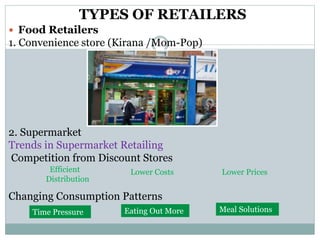
 Food Retailers
1. Convenience store (Kirana /Mom-Pop)
2. Supermarket
Trends in Supermarket Retailing
Competition from Discount Stores
Changing Consumption Patterns
Efficient
Distribution
Lower Costs Lower Prices
Time Pressure Eating Out More Meal Solutions
TYPES OF RETAILERS
 General Merchandise Retailers
1. Departmental stores
2. Discount stores
3. Speciality stores
4. Category killers or specialists
5. Hypermarket or Super centers
6. Drug stores
7. Factory Outlet or Off-price stores
8. Family shops
9. Wholesale clubs
10. Shopping malls
11. One dollar store
12. Parasite stores
13. Hobby stores
14. Airport retailing
15. Shop-in-Shops
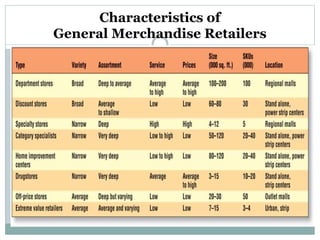
Characteristics of
General Merchandise Retailers
TYPES OF RETAILERS
 Non-Store Retailers
1. e-tailing
2. Television Shopping
3. Tele-Marketing
4. Kiosks – Audio and video
5. Vending machines
 Service Retailers
1. Personal services – dry cleaning, health care, studio,
parlours, movie theatres, multiplexes, clubs,
amusement park, game arcades, etc.
2. Repair Services – Automobile, electrical gadgets,
electronic gadgets, watch repair centers, Mobile
service centers, etc.
3. Hotel services – Hotels, restaurants, fast-foods,
Resort etc.
4.Professional Services – Lawyers, Doctors, Chartered
Accountants, stock brokers, real estate agents etc.
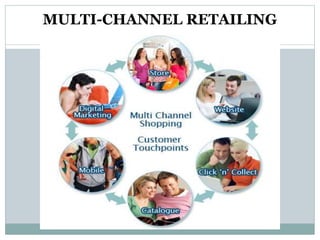
MULTI-CHANNEL RETAILING
 Multi-channel retailing is a marketing strategy that offers
your customers a choice of ways to buy products.
 A true multi-channel strategy covers purchases from a
store, purchases from a website, telephone ordering, mail
orders, interactive television, catalog ordering and
comparison shopping sites.
 The aim of a multi-channel retailing strategy is to
maximize revenue and loyalty by offering your customers
choice and convenience.
 Pioneers of multichannel retailing include Macy's, Next
PLC, John Lewis and Neiman Marcus, though specialist
businesses such as Channel Grabber have made the
concept the success that it is in modern e-commerce.
MULTI-CHANNEL RETAILING
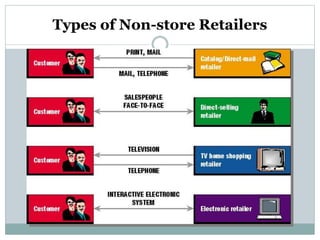
Issues in Catalogue Retailing
 Low Start Up Cost
 Evolution of Multi-Channel Offering
 Hard to compete with large well established firms
 Increasing Mail Costs
 Clutter from other Catalogs
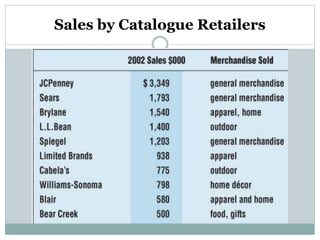
 General merchandise catalogs like JC Penney
 Specialty Catalogs like JC Whitney, Victoria Secret
Sales by Catalogue Retailers
Issues in Direct Selling
 Providing information and demonstrations is costly
 Party plan system: merchandise is demonstrated in a
party atmosphere
 Multi-level network: Master distributors sell to
distributors who sell merchandise
 Pyramid schemes: Firm sells to other distributors
and little if any merchandise goes to end users
Issues in Television Home Shopping
 Consumers watch cable stations, infomercials or direct
response ads
 Few consumers watch regularly
 Most purchases made by small proportion of viewers
 Customers can’t examine merchandise
 Customers must wait for merchandise to come on
 Sells mostly jewellery, apparel, cosmetics, kitchenware,
exercise equipment
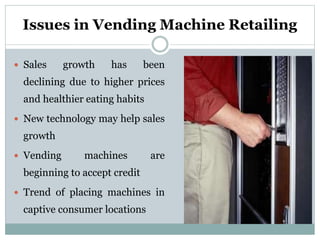
Issues in Vending Machine Retailing
 Sales growth has been
declining due to higher prices
and healthier eating habits
 New technology may help sales
growth
 Vending machines are
beginning to accept credit
 Trend of placing machines in
captive consumer locations
Types of Non-store Retailers
CUSTOMER BUYING BEHAVIOR
 How do customers decide which retailer to go to and
what merchandise to buy?
 What social and personal factors affect customer
purchase decisions?
 How can retailers get customers to visit their stores
more frequently, and buy more merchandise during
each visit?
 Why and how do retailers group customers into
market segments?
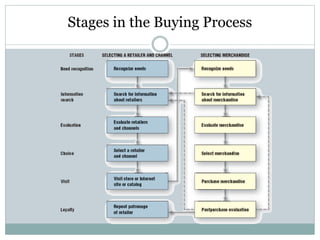
Stages in the Buying Process
Customer Buying Behavior Patterns
1. Place of Purchase
2. Items Purchased
3. Time and Frequency of Purchase
4. Method of Purchase
5. Response to Sales Promotion devices through
a. Displays – window, models, racks, posters, sign board
b. Pricing – deal, offers, prices, discounts, coupon
c. Demonstration - samples
d. Sales talks - explanation
Overview of Retail Technology
 Multimedia Kiosks – Promotional touch screen booth
 Web Based Commerce – e-commerce
 EP0S – Electronic Point of Sale – (Loyalty card databases holds customer
demographic information and addresses. Specific offers to specific customers)
Ex: Used by Wal-Mart sales of beer and nappies were linked that joint sales
were highest on Friday evening.
USES
1. Scanning System To Charge Accurate Prices
2. Monitor staff to increase their producticity
3. In food industry – eliminates price for individual items
All the above points help to cut down the labour costs and accurate
shopping basket data can be collected & stored for analysis.
 EDI – Electronic Data Interchange (Time between sending an order and
receiving the merchandise has been slashed at TESCO)
 GSI – Geographic Information Systems (socio-demographic data by postal
code along with company transaction to forecast the likely turnover of stores
in different locations.
RT Ex: Safeways, UK applies this system where it provides a small hand
scanner to customers to watch the prices before they are placed in the
shopping basket.
Role of Emerging IT in Retailing –
I. Management Information Systems (MIS)
Converting Data to information
1. Customers who buy toothpaste tend to also buy
toothbrush
2. Talcum powder does not sell well
3. Almost everyone wants to sell bread
Functions of MIS
 Capture of Data
 Storage of Data: hard disks, optical devices, CDs and
magnetic tapes
 Processing of Data: data mining
 Distribution of Data and Information
 Presentation of Information
Old MIS
 Restricted to creating data for account auditing
 Tracking of records
 Stocks, money, bank accounts and balances, records
of wages and attendance, tax paid and payable etc..
New MIS systems
 It evolved into areas that were earlier unthinkable
 Assists managers in making decisions in all areas of
business
 Marketing, Personnel, Cash Management,
Investment, Production, Operations, Logistics etc..
Characteristics of Good MIS
 Information should be available when it is needed
 Accuracy of information should not be compromised
 Information should be complete
 Information must be relevant to its users
Why does an Organization need MIS
 Developing and enhancing core competences
 Enhancing supply chain management
 Facilitating quicker decision making
 Improving the effectiveness and efficiency of retail
managers
 Facilitating CRM
 Improving Organizational control
 Developing competitive advantage
II. Marketing Support Systems (MSS)
 Differentiating One’s offering
 Establishing credibility
 Developing distribution channels
 Creating and maintaining relationships with
customers
 Reducing the time-to-market
Retail Information Systems
1. E-Point of Sale (PoS)
2. Sourcing
3. Inventory Management (Stock)
4. Networking and Communication (Channels)
5. Customer Relationship Management (CRM)
6. Loyalty Management (Brand Loyal & Store Loyal)
7. Payroll Administration
8. E-commerce
9. Accounting
Point of Sale
 Identify products using barcodes, RFID
 Record customer purchases
 Record refunds
 Print bills
 Record payment amounts and payment mode
 Handle discounts
Sourcing
 Purchasing the right products from the right vendors
at the right time
 Tracking
 Managing
 Maintain sourcing data
 Relationships
 Payments
 Transactions
Inventory Management
 Inventory occupies space and costs money
 Minimizing inventory is a objective
 Low inventory leads to the risk of stock outs
 Stock outs lead to customer dissatisfaction
 Stock outs could lead a customer to change their
choice of retailer
 Reordering as different frequencies
Networking and communication
 Ability to interact with other computer systems is
important
 Automated and instantaneous re-ordering of
products has revolutionized inventory management
 Triggering emails, SMSs for special events
 Ability to network using the internet or LAN is a
most powerful feature
Networking and communication
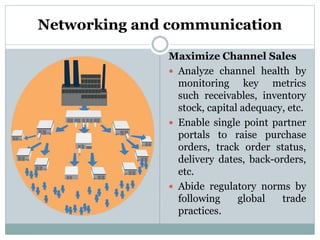
Maximize Channel Sales
 Analyze channel health by
monitoring key metrics
such receivables, inventory
stock, capital adequacy, etc.
 Enable single point partner
portals to raise purchase
orders, track order status,
delivery dates, back-orders,
etc.
 Abide regulatory norms by
following global trade
practices.
CRM
 Capturing, storing, mining and using customer data is one of the
important functions of an RIS
Implications of CRM in Retailing
 Data Capture
Give your customers incentives to provide their contact information, and
you'll be able to target them after the sale with your retail marketing.
This information also can be used in CRM software, to segment your
customer base by demographic indicators and sales histories.
Improve Sales
• Try new strategies for increasing your sales, or focusing your
customers on the items with the highest profit margins, determine
methods of isolating these strategies in your sales data.
Ex. Sales thro. display is high or ad is high - staffs find out thro.
observation and feed it in PoS
 Data mining
After capturing your new retail sales data, begin mining this information
in your CRM software to correlate which sales initiatives are relating to the
most profitable techniques.
Ex. a store selling cold drinks may offer one-day discounts if the manager
believes that high temperatures correlate to higher sales.
Loyalty Management
 Formulate up sell strategies by mining existing
customer data.
 Run loyalty programs to retain and reward repeat
customers.
 Customers are loyal for two,
1. Brand loyal
2. Store Loyal
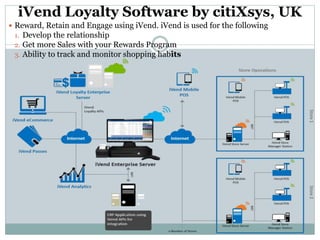
iVend Loyalty Software by citiXsys, UK
 Reward, Retain and Engage using iVend. iVend is used for the following
1. Develop the relationship
2. Get more Sales with your Rewards Program
3. Ability to track and monitor shopping habits
Loyalty Square Software
Loyalty Square helps fuel your business growth and profitability through
our marketing analytics such as response models, cross sell analytics, retention
strategies, market basket analysis, sales force effectiveness and market mix
models.
 Customer Buying Behavior:
1.Month beginning shopping vs. month-end shopping
2.Weekday purchase vs. weekend purchase
3.Intraday purchase
4.Shopping basket, etc. Loyalty Square helps in deep dive analysis of
categories, identify monthly shoppers, etc.
 Response Models: Through predictive analytics, we aid you in your market
decisioning process,
1. To determine purchase and loyalty propensities
2. To set prices
3. Forecast sales or test the effectiveness of alternate marketing plans.
 Cross-sell Analytics:
1. To increase value of your customer relationships
2. Drive product penetration
3. Increase the revenue per customer and thereby profitability, Loyalty
Square's solutions will provide more actionable marketing decisions,
allowing you to execute cross sell and up sell programs.
Loyalty Square Software..
 Retention Strategies:
1. In an era of customer choice, brand disloyalty and low switching costs retaining good
customers is no easy task.
2. Our marketing analytics combined with market consulting and database services aid
companies identify valuable customers and design the right strategies and allocate the right
resources to retain them.
 Market Basket Analysis:
1. Understanding the purchase pattern of customers is highly beneficial in driving up sales.
2. Loyalty Square’s analytic solutions will help you to identify affinity between various products.
3. This information will help you to design combo offers, optimal store layouts, inventory
management, etc.
 Sales Force Effectiveness:
1. Monitoring sales force performance and adjusting to shifts in market share positions are
imperative to optimizing market strategies.
2. Loyalty Square helps you shift through prospects and customers to select the best targets and
build an effective strategic plan to meet your revenue and profitability targets.
 Market Mix Models:
Helps in designing successful marketing strategies like,
1. Assessing sales performance of your company with respect to competition
2. Your marketing activities
3. Pricing
4. Response by store group/cluster or consumer segment
Payroll Administration
 Managing large number of employees is easy with
‘best of breed’ software for payroll management
 Salary, perks, incentives, commission, allowances etc
E-Commerce
 High price of real estate to the retailer
 Inconvenience of physical shopping to the consumer
 Increased penetration of internet connectivity
 Evolution of secure payment options online
 Availability of reliable logistics providers
 e-tailing, electronic fund transfer, online trading etc
Accounting
 Accounting is the most important system of internal
control for a retail organisation
 RIS packages tend to include accounting modules
 Most retailers prefer to use specialized accounting
software such as Tally instead of relying on the
accounting module of their RIS
 Cost Accounting (Price fixation for merchandise)

BAITC Retail_DoMS NIT Unit 1

  • 1.
  • 2.
    TYPES OF RETAILERS Food Retailers 1. Convenience store (Kirana /Mom-Pop) 2. Supermarket Trends in Supermarket Retailing Competition from Discount Stores Changing Consumption Patterns Efficient Distribution Lower Costs Lower Prices Time Pressure Eating Out More Meal Solutions
  • 3.
    TYPES OF RETAILERS General Merchandise Retailers 1. Departmental stores 2. Discount stores 3. Speciality stores 4. Category killers or specialists 5. Hypermarket or Super centers 6. Drug stores 7. Factory Outlet or Off-price stores 8. Family shops 9. Wholesale clubs 10. Shopping malls 11. One dollar store 12. Parasite stores 13. Hobby stores 14. Airport retailing 15. Shop-in-Shops
  • 4.
  • 5.
    TYPES OF RETAILERS Non-Store Retailers 1. e-tailing 2. Television Shopping 3. Tele-Marketing 4. Kiosks – Audio and video 5. Vending machines  Service Retailers 1. Personal services – dry cleaning, health care, studio, parlours, movie theatres, multiplexes, clubs, amusement park, game arcades, etc. 2. Repair Services – Automobile, electrical gadgets, electronic gadgets, watch repair centers, Mobile service centers, etc. 3. Hotel services – Hotels, restaurants, fast-foods, Resort etc. 4.Professional Services – Lawyers, Doctors, Chartered Accountants, stock brokers, real estate agents etc.
  • 6.
    MULTI-CHANNEL RETAILING  Multi-channelretailing is a marketing strategy that offers your customers a choice of ways to buy products.  A true multi-channel strategy covers purchases from a store, purchases from a website, telephone ordering, mail orders, interactive television, catalog ordering and comparison shopping sites.  The aim of a multi-channel retailing strategy is to maximize revenue and loyalty by offering your customers choice and convenience.  Pioneers of multichannel retailing include Macy's, Next PLC, John Lewis and Neiman Marcus, though specialist businesses such as Channel Grabber have made the concept the success that it is in modern e-commerce.
  • 7.
  • 8.
    Issues in CatalogueRetailing  Low Start Up Cost  Evolution of Multi-Channel Offering  Hard to compete with large well established firms  Increasing Mail Costs  Clutter from other Catalogs  General merchandise catalogs like JC Penney  Specialty Catalogs like JC Whitney, Victoria Secret
  • 9.
  • 10.
    Issues in DirectSelling  Providing information and demonstrations is costly  Party plan system: merchandise is demonstrated in a party atmosphere  Multi-level network: Master distributors sell to distributors who sell merchandise  Pyramid schemes: Firm sells to other distributors and little if any merchandise goes to end users
  • 11.
    Issues in TelevisionHome Shopping  Consumers watch cable stations, infomercials or direct response ads  Few consumers watch regularly  Most purchases made by small proportion of viewers  Customers can’t examine merchandise  Customers must wait for merchandise to come on  Sells mostly jewellery, apparel, cosmetics, kitchenware, exercise equipment
  • 12.
    Issues in VendingMachine Retailing  Sales growth has been declining due to higher prices and healthier eating habits  New technology may help sales growth  Vending machines are beginning to accept credit  Trend of placing machines in captive consumer locations
  • 13.
  • 14.
    CUSTOMER BUYING BEHAVIOR How do customers decide which retailer to go to and what merchandise to buy?  What social and personal factors affect customer purchase decisions?  How can retailers get customers to visit their stores more frequently, and buy more merchandise during each visit?  Why and how do retailers group customers into market segments?
  • 15.
    Stages in theBuying Process
  • 16.
    Customer Buying BehaviorPatterns 1. Place of Purchase 2. Items Purchased 3. Time and Frequency of Purchase 4. Method of Purchase 5. Response to Sales Promotion devices through a. Displays – window, models, racks, posters, sign board b. Pricing – deal, offers, prices, discounts, coupon c. Demonstration - samples d. Sales talks - explanation
  • 17.
    Overview of RetailTechnology  Multimedia Kiosks – Promotional touch screen booth  Web Based Commerce – e-commerce  EP0S – Electronic Point of Sale – (Loyalty card databases holds customer demographic information and addresses. Specific offers to specific customers) Ex: Used by Wal-Mart sales of beer and nappies were linked that joint sales were highest on Friday evening. USES 1. Scanning System To Charge Accurate Prices 2. Monitor staff to increase their producticity 3. In food industry – eliminates price for individual items All the above points help to cut down the labour costs and accurate shopping basket data can be collected & stored for analysis.  EDI – Electronic Data Interchange (Time between sending an order and receiving the merchandise has been slashed at TESCO)  GSI – Geographic Information Systems (socio-demographic data by postal code along with company transaction to forecast the likely turnover of stores in different locations. RT Ex: Safeways, UK applies this system where it provides a small hand scanner to customers to watch the prices before they are placed in the shopping basket.
  • 18.
    Role of EmergingIT in Retailing – I. Management Information Systems (MIS) Converting Data to information 1. Customers who buy toothpaste tend to also buy toothbrush 2. Talcum powder does not sell well 3. Almost everyone wants to sell bread
  • 19.
    Functions of MIS Capture of Data  Storage of Data: hard disks, optical devices, CDs and magnetic tapes  Processing of Data: data mining  Distribution of Data and Information  Presentation of Information
  • 20.
    Old MIS  Restrictedto creating data for account auditing  Tracking of records  Stocks, money, bank accounts and balances, records of wages and attendance, tax paid and payable etc..
  • 21.
    New MIS systems It evolved into areas that were earlier unthinkable  Assists managers in making decisions in all areas of business  Marketing, Personnel, Cash Management, Investment, Production, Operations, Logistics etc..
  • 22.
    Characteristics of GoodMIS  Information should be available when it is needed  Accuracy of information should not be compromised  Information should be complete  Information must be relevant to its users
  • 23.
    Why does anOrganization need MIS  Developing and enhancing core competences  Enhancing supply chain management  Facilitating quicker decision making  Improving the effectiveness and efficiency of retail managers  Facilitating CRM  Improving Organizational control  Developing competitive advantage
  • 24.
    II. Marketing SupportSystems (MSS)  Differentiating One’s offering  Establishing credibility  Developing distribution channels  Creating and maintaining relationships with customers  Reducing the time-to-market
  • 25.
    Retail Information Systems 1.E-Point of Sale (PoS) 2. Sourcing 3. Inventory Management (Stock) 4. Networking and Communication (Channels) 5. Customer Relationship Management (CRM) 6. Loyalty Management (Brand Loyal & Store Loyal) 7. Payroll Administration 8. E-commerce 9. Accounting
  • 26.
    Point of Sale Identify products using barcodes, RFID  Record customer purchases  Record refunds  Print bills  Record payment amounts and payment mode  Handle discounts
  • 27.
    Sourcing  Purchasing theright products from the right vendors at the right time  Tracking  Managing  Maintain sourcing data  Relationships  Payments  Transactions
  • 28.
    Inventory Management  Inventoryoccupies space and costs money  Minimizing inventory is a objective  Low inventory leads to the risk of stock outs  Stock outs lead to customer dissatisfaction  Stock outs could lead a customer to change their choice of retailer  Reordering as different frequencies
  • 29.
    Networking and communication Ability to interact with other computer systems is important  Automated and instantaneous re-ordering of products has revolutionized inventory management  Triggering emails, SMSs for special events  Ability to network using the internet or LAN is a most powerful feature
  • 30.
    Networking and communication MaximizeChannel Sales  Analyze channel health by monitoring key metrics such receivables, inventory stock, capital adequacy, etc.  Enable single point partner portals to raise purchase orders, track order status, delivery dates, back-orders, etc.  Abide regulatory norms by following global trade practices.
  • 31.
    CRM  Capturing, storing,mining and using customer data is one of the important functions of an RIS Implications of CRM in Retailing  Data Capture Give your customers incentives to provide their contact information, and you'll be able to target them after the sale with your retail marketing. This information also can be used in CRM software, to segment your customer base by demographic indicators and sales histories. Improve Sales • Try new strategies for increasing your sales, or focusing your customers on the items with the highest profit margins, determine methods of isolating these strategies in your sales data. Ex. Sales thro. display is high or ad is high - staffs find out thro. observation and feed it in PoS  Data mining After capturing your new retail sales data, begin mining this information in your CRM software to correlate which sales initiatives are relating to the most profitable techniques. Ex. a store selling cold drinks may offer one-day discounts if the manager believes that high temperatures correlate to higher sales.
  • 32.
    Loyalty Management  Formulateup sell strategies by mining existing customer data.  Run loyalty programs to retain and reward repeat customers.  Customers are loyal for two, 1. Brand loyal 2. Store Loyal
  • 33.
    iVend Loyalty Softwareby citiXsys, UK  Reward, Retain and Engage using iVend. iVend is used for the following 1. Develop the relationship 2. Get more Sales with your Rewards Program 3. Ability to track and monitor shopping habits
  • 34.
    Loyalty Square Software LoyaltySquare helps fuel your business growth and profitability through our marketing analytics such as response models, cross sell analytics, retention strategies, market basket analysis, sales force effectiveness and market mix models.  Customer Buying Behavior: 1.Month beginning shopping vs. month-end shopping 2.Weekday purchase vs. weekend purchase 3.Intraday purchase 4.Shopping basket, etc. Loyalty Square helps in deep dive analysis of categories, identify monthly shoppers, etc.  Response Models: Through predictive analytics, we aid you in your market decisioning process, 1. To determine purchase and loyalty propensities 2. To set prices 3. Forecast sales or test the effectiveness of alternate marketing plans.  Cross-sell Analytics: 1. To increase value of your customer relationships 2. Drive product penetration 3. Increase the revenue per customer and thereby profitability, Loyalty Square's solutions will provide more actionable marketing decisions, allowing you to execute cross sell and up sell programs.
  • 35.
    Loyalty Square Software.. Retention Strategies: 1. In an era of customer choice, brand disloyalty and low switching costs retaining good customers is no easy task. 2. Our marketing analytics combined with market consulting and database services aid companies identify valuable customers and design the right strategies and allocate the right resources to retain them.  Market Basket Analysis: 1. Understanding the purchase pattern of customers is highly beneficial in driving up sales. 2. Loyalty Square’s analytic solutions will help you to identify affinity between various products. 3. This information will help you to design combo offers, optimal store layouts, inventory management, etc.  Sales Force Effectiveness: 1. Monitoring sales force performance and adjusting to shifts in market share positions are imperative to optimizing market strategies. 2. Loyalty Square helps you shift through prospects and customers to select the best targets and build an effective strategic plan to meet your revenue and profitability targets.  Market Mix Models: Helps in designing successful marketing strategies like, 1. Assessing sales performance of your company with respect to competition 2. Your marketing activities 3. Pricing 4. Response by store group/cluster or consumer segment
  • 36.
    Payroll Administration  Managinglarge number of employees is easy with ‘best of breed’ software for payroll management  Salary, perks, incentives, commission, allowances etc
  • 37.
    E-Commerce  High priceof real estate to the retailer  Inconvenience of physical shopping to the consumer  Increased penetration of internet connectivity  Evolution of secure payment options online  Availability of reliable logistics providers  e-tailing, electronic fund transfer, online trading etc
  • 38.
    Accounting  Accounting isthe most important system of internal control for a retail organisation  RIS packages tend to include accounting modules  Most retailers prefer to use specialized accounting software such as Tally instead of relying on the accounting module of their RIS  Cost Accounting (Price fixation for merchandise)