EDGE OF PAGE
MARGIN
CROPMARKS
MARGIN
EDGE OF PAGE
CROPMARKS
MARGINMARGIN
EDGE OF PAGE
MARGIN
CROPMARKS
MARGIN
EDGE OF PAGE
CROPMARKS
MARGIN
MARGIN
Globalretail

trends2018

Global Consumer & Retail
March 2018
Introduction
Over the last few years, we’ve heard about
the disruption that is coming. In reality, we
are already disrupted. The new retail world
that we have been promised is here.
The tools, strategies and technologies
required to be successful in this new world
are available.The toolbox for success is
here, and it’s up to retailers to choose the
right tools from the toolbox in order to grow
their business.
In this document, we discuss some of the
biggest retail trends impacting our industry
and highlight how some companies are
responding.
If you would like more information regarding
this document please contact
Dev Devani or Dan Coonan from the Global
Consumer & Retail team at KPMG.
2 | Retail Trends 2018
3 | Retail Trends 2018
Contents
Overview of 2018 retail trends 4
Trend 1 – The customer experience is 6
more important than ever
Trend 2 – Artificial intelligence will 10
gain more clout
Trend 3 – The rise of the conscious 14
customer will continue
Trend 4 – The retail world we were 18
promised is now here
Trend 5 – A tale of two hemispheres 22
is playing out
Top 10 lessons for retailers 28
Contacts 32
Further publications 33
© 2018 KPMG International Cooperative (“KPMG International”), a Swiss entity. Member
firms of the KPMG network of independent firms are affiliated with KPMG International.
-
1
The customer experience is
more important than ever
The customer experience is more important than ever as
retailers are striving to differentiate themselves in a
challenging and crowded market. Consequently,
experience per square foot will be the new retail metric
to measure success.
2
Artificial intelligence will gain more clout
Artificial Intelligence will gain more clout with some
executives predicting that 85 percent of all transactions will
be AI based by 2020. 2018 will be the year we see AI being
deployed at scale.
3
The rise of the conscious customer
will continue
The rise of the conscious customer will continue as
consumers base their buying decisions on many factors
beyond price. These new consumers, led and influenced by
millennials, are exerting influence on retailers and forcing
them to take action.
4 | Retail Trends 20184 | Retail Trends 2018
5 | Retail Trends 2018
--
-
The retail world we were promised is
now here
The retail world we were promised is now here it has
changed and will continue to impact the path to purchase.
We’ve arrived at the intersection of elevated consumer
expectations and technical possibility.
4
A tale of two hemispheres is playing out
A tale of two hemispheres is playing out as platform
players and non traditional retailers expand their reach and
offerings. The juxtaposition between what is happening in
the West and the East will dominate the retail landscape
with the latter in many cases moving faster than the
former.
5
Retail Trends 2018 | 5
Trend 1:

Thecustomer
experienceis
moreimportant
thanever
6 | Retail Trends 20186 | Retail Trends 2018
Welcome to the
experience economy
where we have a new
metric for a new era.
Experience per square foot will
become an important metric for
retailers.
Traditionally, the primary measure of retail
performance has been sales per square foot.
However, as stores become experience
hubs as well as points of sale, retailers are
thinking differently about the metrics they
use to measure performance.
According to the ‘Customers 2020
study by Walker, a customer
intelligence consulting firm:
Customer
experience will
overtake price and
product as the key
brand differentiator
by the year 2020.
Retail Trends 2018 | 7Retail Trends 2018 | 7
Trend 1:
Thecustomer
experienceismore
importantthanever
Successful retailing in 2018 comes down to obsessing about customer
experience. Essential to achieving this is digital and physical touchpoints
working together seamlessly.
Despite the notion of the demise of brick-and-mortar stores, physical retail isn't actually dead,
but boring retail is. Store closures in certain countries hit all-time highs in 2017. The list of
longstanding retail brands that shut their door is too long to list. Often overlooked is the fact
that many stores opened as well. We will see a similar pattern in 2018. By January 2019, 90
percent of all retail will still be done in physical stores. Iconic retail brands like Apple, Sephora
and Costco continue to succeed, despite relying mainly on brick-and-mortar stores.
As a consequence, new classes of retailers are emerging. There are retailers who started
online and are moving to physical brick-and-mortar and others are merging “bricks and clicks.”
Retailers are seeking to understand their share of consumer spending, and how their
consumers search, shop and buy in order to devise new retail models. Whether that means,
having a show room or only having a strong presence in e-commerce, retailers are reinventing
how they do business.
So, why aren’t physical stores dead? Put simply, stores that are doing well offer a customer
experience that meets or exceeds customer expectations. Joe Mach, the President of North
America at Verifone predicts consumers will visit physical stores as long as there are new and
interesting reasons to go. Leading retailers take advantage of their physical spaces to
maximize experience per square foot and the real-life interactions customers have there. In
summary, customers will shop where they enjoy their experience, this could be on a single
channel or a combination of channels.
8 | Retail Trends 2018
As retailers enter 2018, they are already seeing that if customers are going
to visit a store, it needs to be about more than just the transaction.
Retailers need to offer something you can’t get online.They need to offer
an experience.
Casestudies

Nike
“Nike’s latest store in New York is like LEGOLAND for people who love sports.”
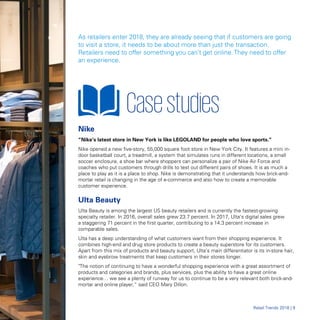
Nike opened a new five-story, 55,000 square foot store in New York City. It features a mini in-
door basketball court, a treadmill, a system that simulates runs in different locations, a small
soccer enclosure, a shoe bar where shoppers can personalize a pair of Nike Air Force and
coaches who put customers through drills to test out different pairs of shoes. It is as much a
place to play as it is a place to shop. Nike is demonstrating that it understands how brick-and-
mortar retail is changing in the age of e-commerce and also how to create a memorable
customer experience.
Ulta Beauty
Ulta Beauty is among the largest US beauty retailers and is currently the fastest-growing
specialty retailer. In 2016, overall sales grew 23.7 percent. In 2017, Ulta’s digital sales grew
a staggering 71 percent in the first quarter, contributing to a 14.3 percent increase in
comparable sales.
Ulta has a deep understanding of what customers want from their shopping experience. It
combines high-end and drug store products to create a beauty superstore for its customers.
Apart from this mix of products and beauty support, Ulta’s main differentiator is its in-store hair,
skin and eyebrow treatments that keep customers in their stores longer.
"The notion of continuing to have a wonderful shopping experience with a great assortment of
products and categories and brands, plus services, plus the ability to have a great online
experience… we see a plenty of runway for us to continue to be a very relevant both brick-and-
mortar and online player,“ said CEO Mary Dillon.
RRetetaaiill TrTrendsends 20182018 || 99
Trend 2

Artificial
intelligence
willgain
moreclout
10 | Retail Trends 201810 | Retail Trends 2018
Retail experts at the National Retail Federation’s 2018 Big Show said
that retailers should be using artificial intelligence to solve specific
problems, not just deploy it for its own sake. In 2018, retailers will
start to discover the value that AI can bring to their business.
Definition of AI:
An area of computer
science that deals
with giving machines the ability
to seem like they have human
intelligence. In short, it is the
power of a machine to copy
intelligent human behavior.
Example: Robotic process automation (RPA) is
being applied to highly repetitive tasks normally
performed by humans.
Business examples:
—	 Machine learning algorithms are being
integrated into analytics and Customer
Relationship Management (CRM) platforms
to uncover information on how to better
serve customers.
—	 Chatbots have been incorporated into
websites to provide immediate service to
customers.
Charlie Cole, global Chief E-
commerce Officer at Samsonite
tells Forbes that 2018 is the
year that:
Artificial intelligence
will have its
breakthrough
moment. More and
more retailers will
start using it to
power various parts
of the retail and
e-commerce
experience.
Retail Trends 2018 | 11Retail Trends 2018 | 11
Trend 2:
Artificialintelligence

willgainmoreclout

Katrina Gosek, Director of commerce product strategy at
Oracle, says that AI will “finally (be) something that helps
retailers reach that holy grail" of personalization.
Back in 2016, Gartner predicted that by 2020, 85 percent of customer
interactions would be managed without human involvement. In 2018 we will see
AI adoption continue to rise with chatbots taking the lead. Due to increasing
ease of deployment, instant availability and improved quality, chatbots will
become more and more common to manage customer service queries and to
make intelligent purchase recommendations. We will also see the rise of AI-
powered conversational interfaces and voice assistants. Retailers can engage
this kind of technology to answer routine questions and supplement human
customer support with chat-based shopping or voice commerce.
Alongside having the technology available, retailers now also have a significant
amount of data to power AI and deliver personalized, customized and localized
experiences to customers. AI will be applied across the entire retail product and
service cycle, from manufacturing to post-sale customer service interactions.
Retailers using AI to its fullest potential will be able to influence purchases in the
moment and anticipate future purchases, guiding shoppers towards the right
products in a regular and highly personalized manner.
In order to maximize the impact of AI, in 2018 we will see new partnerships and
collaborations between retailers and technology companies emerge. Retailers
recognize that building or buying the technology they need isn’t the best use of
their resources. Instead, we will see a rise retailers partnering with niche
technology players – collaboration will be the key to success.
12 | Retail Trends 2018
Artificial Intelligence isn’t just for the movies anymore.
Customers are now demanding better, faster and personalized
experiences. Retailers need to meet this demand and AI
technology can help.
Casestudies

Taco Bell
Meet Tacobot. Taco Bell’s chatbot that will never let you go hungry. Tacobot is
currently in private beta mode and requires a quick install. However as soon as it
is installed, you can start chatting and ask it questions about the menu,
recommendations, special offers and dietary requirements and even ask how
Tacobot is feeling.
Tacobot is connected to your ta.co account, so that all your favorites, including
locations, are stored and transferred over. You can place your order for pickup
or through their partnership with DoorDash, and have it delivered straight to
your door.
Amazon
Not only is Amazon using AI, they are also selling it. They are penetrating the
mass market with their Echo and Alexa devices, and nearly overnight it has
become the norm to speak to a small device in your home, and to many it almost
feels like part of the family.
The Amazon bot personality Alexa uses chatbot technology and voice recognition
simultaneously. The goal of Echo is to create a seamless user experience
anywhere in the user’s home. By speaking directly to Alexa, you can place food
orders, play music, plan events, check your calendar, make phone calls and so
on. The list is endless and all you need to do is talk to her.
Voicebot estimates that total shipments of Amazon Echo devices were 20.54
million through Q3 of 2017. In Q4 of 2017, it is said Amazon sold “tens of
millions” of Echo hardware devices. Echo Dot was the top-selling product on
Amazon across all categories.
RRetetaaiill TrTrendsends 20182018 || 1313
Trend 3

Theriseofthe
conscious
customer
willcontinue
14 | Retail Trends 201814 | Retail Trends 2018
Authenticity is on the tip of the tongue of every marketer today. The
question is, why has it suddenly become a major factor in the
customer decision-making process? 

In an age of
authenticity where
consumer trust has
plummeted,
customers are now demanding
transparency. Honesty and
authenticity have emerged as the
attributes that matter most to
customers. Consumers, more
than ever before, are holding
brands to a higher standard.
An international survey by Cohn &
Wolfe found that 87 percent of
global consumers felt that it was
important for brands to:
Act with integrity at
all times, ranking
authenticity above
innovation (72
percent) and
product uniqueness
(71 percent) when
asked what they
valued most in a
brand.
Retail Trends 2018 | 15Retail Trends 2018 | 15
Trend 3:
Theriseoftheconscious

customerwillcontinue

Customers are demanding transparency as they take an increased interest in
the ethical practices of the brands they buy from. Furthermore, customers
today who are more tech savvy, have a much keener eye for authenticity versus
marketing speak.
Today’s customers have a well-developed sense of what is authentic and what is solely intended to
drive sales. This has led to a rise in consumers who make values based judgements about what to
buy and where to shop. These consumers believe their purchase habits have an impact on the world.
To win customers today, businesses need to stand for something and reflect that message
consistently throughout the entire business from senior leadership through to front
line staff.
The conscious consumer movement is growing. One third of UK consumers, for example, claim to
be very concerned about issues regarding the origin of products. In another example, a study from
YouGov and the Global Poverty Project revealed that 74 percent of those surveyed would pay a
higher cost for their clothes if there was a guarantee that workers were being paid fairly and working
in safe conditions.
Authenticity is especially key unlocking the wallets of customers of all ages. Millennials are having a
deep impact on the generations that came before them (Boomers, Gen X etc.) as well as the one
that comes next: commonly referred to as Gen Z.
A Global Corporate Sustainability Report published by Nielsen indicates that, globally, 66 percent of
consumers are willing to spend more on a product if it comes from a sustainable brand. Millennials
gave an even more impressive showing, with 73 percent indicating a similar preference. Simply put,
customers want the companies they buy from to practice sustainability, strong ethical behavior and
transparency. Customers want to buy an honest brand.
Retailers have to be authentic and transparent, but they also need to communicate this in a
sophisticated and trustworthy way, or consumers may turn to another brand.
16 | Retail Trends 2018
In this business environment, brands and retailers are
required to focus more on corporate social responsibility.
As Sir Martin Sorrell, head of the world’s largest
advertising group WPP, said “doing good is
good business.”
Casestudies

Brandless
Brandless is an American company that openly states, “our mission is
deeply rooted in quality, transparency, and community-driven values.
Better stuff, fewer dollars. It's that simple.”
It sells a wide variety of products for a universal flat fee of US$3. On its
website, it says that BrandTax™ is the hidden costs you pay for a
national brand. This is how they have managed to keep costs so low.
Brandless focuses on what matters to their customers. They offer
organic, non- toxic, hypoallergenic products that haven’t been tested on
animals. They believe in helping the consumer and the world at the same
time.
Gucci
Italian fashion designer, Gucci has banned the use of fur. The ban will
take effect with its spring/summer 2018 collections. The company has
now signed up for the Fur Free Alliance, an organization that promises to
end the exploitation and killing of animals for fur, as part of a wider
sustainability plan. Part of this alliance are competitors, Calvin Klein,
Ralph Lauren, Armani and Tommy Hilfiger.
Not only does this decision adapt to changing consumer tastes, but
Marco Bizzarri the CEO of Gucci also says, “I need to do it because
(otherwise) the best talent will not come to work for Gucci.”
Bizzarri went on to say, "Being socially responsible is one of Gucci's core
values, and we will continue to strive to do better for the environment
and animals.”
RRetetaaiill TrTrendsends 20182018 || 1717
Trend 4

Theretailworld
wewere
promisedis
nowhere
18 | Retail Trends 201818 | Retail Trends 2018
When retailers analyze shopper behavior, it is remarkably clear
that consumers have changed dramatically. Retailers need
to understand and react to these changes.
Technology has made it
easier than ever for
shoppers to consume
information, find
products or services and easily
share their experiences. This has
resulted in new customer
expectations that have created a
new retail world.
Paul Wissmann Sector Leader for
Media & Telecommunications at
KPMG in the US says,
“Technology has become so
embedded in our daily lives that
consumers now view instant
access as the norm.”
Over the last ten years,
technology has opened
the floodgates to a wave
of unregulated new
entrants that have both
changed the way in
which we manage the
flows in and out of our
wallet, while also
dramatically raising
our expectations.
Me, my life, my wallet –
KPMG Customer Insights
Program
Retail Trends 2018 | 19Retail Trends 2018 | 19
Trend 4:
Theretailworldwewere
promisedisnowhere
As more retailers adapt to the changing
expectations of customers, we are finally
seeing the new retail world evolve.This is
the consequence of significant behavioral
shifts over the last few years.
Many retailers who haven’t met customers demands
are simply no longer in the game. Forrester anticipates
this challenging new environment will “place harsh and
unfamiliar demands on companies, requiring changes in
how they develop, market, sell and deliver products and
services.”
The predictions and attributes that people have been
talking about for years have now become customer
expectations and have drastically changed the path to
purchase. According to Forrester, we’re five years into
the Age of the Customer, in which newly empowered
customers place elevated expectations on every
interaction they have with brands.
New technologies have put customers in the
driver’s seat — they have the power. Apps like
Snapchat, WeChat and WhatsApp show we are quickly
moving toward a reality in which everything happens in
real time. The natural outcome is that people want that
instant gratification. This has had a deep impact on
customer expectation.
This just in time gratification puts a huge strain on
retailers. In a Salesforce.com report, 64 percent of
consumers said they expect companies to respond to
and interact with them in real time. The need for speed
will only increase as technology enables and advances.
The point of engagement and the point of transaction
are converging, meaning brands that can offer
immediacy, instant gratification, personalization,
authenticity and accessibility will win.
20 | Retail Trends 2018
Well-performing retailers are changing their businesses to adapt to
consumer demands.This is setting a new standard for the industry.
Amazon 

Prime

USA
$12.99per month. OR


$99.00annual subscription.


UK
£79.00annual subscription.


Casestudies

Amazon
Nearly half of US households are now Amazon Prime subscribers.
Data from Kantar estimates that 45 percent of households in the US are willing to pay
Amazon prime membership fees in exchange for the promise of free two-day shipping
on eligible items, despite the yearly fee of $99.
Not so long ago, it was acceptable to wait at least a week for delivery. This is no
longer the case. Amazon has adapted to this expectation and Prime membership has
boomed because of it. In the UK, Prime members can even receive same day delivery
on selected items. Options like this, make consumers switch to brands who offer this
just in time fulfillment.
Target
Target has announced that beginning in February with a roll out across the
country throughout the year, the retailer will offer same day delivery as the
retail wars heat up in the US.
The offering is a new way for Target to compete with other online shopping sites like
Amazon, which dominates with 38 percent of all online shopping, and whose
customers are now demanding faster speed, greater convenience and lower price. As
Darren Seifer, a food and beverage industry analyst for NPD says “Target clearly sees
the writing on the wall. If they're going to stay competitive, they need to up their
convenience game to remain competitive with the likes of Wal-Mart, Jet, and
Amazon.”
RRetetaaiill TrTrendsends 20182018 || 2121
Trend 5

Ataleoftwo
hemispheresis
playingout E
22 | Retail Trends 201822 | Retail Trends 2018
An ongoing competition between the hemispheres has been a
topic of interest within the retail world. Who is actually leading?
Who is growing quicker, and most importantly, who is going
to win?
China takes another
step towards a
service economy.
China’s economy
continues its historic shift to
becoming more consumption
and service-driven that could
help sustain the country’s growth
over the next decade and
beyond.”
It doesn't matter if I
failed. At least I
passed the concept
on to others. Even if
I don't succeed,
someone will
succeed.
Jack Ma –
Executive chairman
of Alibaba Group
Retail Trends 2018 | 23Retail Trends 2018 | 23
Trend 5:
Ataleoftwo
hemispheresis
playingout
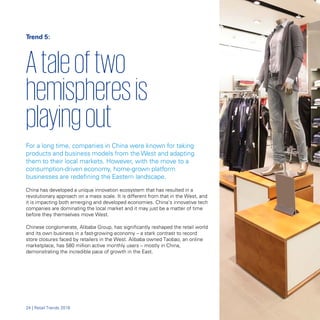
For a long time, companies in China were known for taking
products and business models from the West and adapting
them to their local markets. However, with the move to a
consumption-driven economy, home-grown platform
businesses are redefining the Eastern landscape.
China has developed a unique innovation ecosystem that has resulted in a
revolutionary approach on a mass scale. It is different from that in the West, and
it is impacting both emerging and developed economies. China’s innovative tech
companies are dominating the local market and it may just be a matter of time
before they themselves move West.
Chinese conglomerate, Alibaba Group, has significantly reshaped the retail world
and its own business in a fast-growing economy – a stark contrast to record
store closures faced by retailers in the West. Alibaba owned Taobao, an online
marketplace, has 580 million active monthly users – mostly in China,
demonstrating the incredible pace of growth in the East.
24 | Retail Trends 2018
In 2017, we witnessed Alibaba's Singles' Day (11/11) achieving
record revenue of over $25 billion.Single’s day was much
bigger than Black Friday and Cyber Monday combined.
In 2017, Singles’ Day’s record-breaking sales represented 39 percent YoY
growth. Alibaba processed 812 million orders within 24 hours and its payment
service, Alipay, handled 1.5 billion transactions, peaking at an incredible
256,000 transactions per second. Meanwhile, Cyber Monday became the
largest online shopping day in US history with a record $6.59 billion online
transactions.
Cyber Monday Black Friday Singles’ Day
2017 2017 2017

$6.6bn $7.9bn
17% 18% 39%increase from 2016 increase from 2016 increase from 2016
Biggest shopping day in Biggest one-day shopping
history of US e-commerce event worldwide
$25.3bn
It is projected that by 2030, the Chinese middle class will add 800 million to
one billion new consumers and over 200 cities will have populations over
1 million. To put this into context, the OECD has projected that Europe would
add 16 million consumers by 2030 and has only 35 cities with populations
over a million today.
With the middle class moving from a projected 12 percent to 73 percent of
the Chinese population from 2009 to 2030, consumption in China is projected
to be 2.5 times that of the US.
Already today, more Chinese consumers use mobile phones to access the
internet than those in America, Brazil and Indonesia combined. About half of
China’s online sales take place via mobile, compared to barely a third in
the US.
RRetetaaiill TrTrendsends 20182018 || 2525
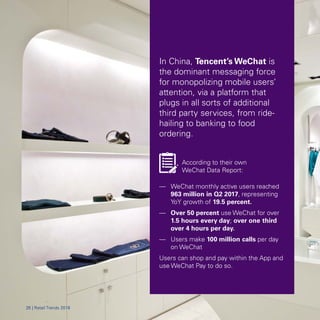
In China, Tencent’s WeChat is
the dominant messaging force
for monopolizing mobile users’
attention, via a platform that
plugs in all sorts of additional
third party services, from ride-
hailing to banking to food
ordering.
According to their own
WeChat Data Report:
—	 WeChat monthly active users reached
963 million in Q2 2017, representing
YoY growth of 19.5 percent.
—	 Over 50 percent use WeChat for over
1.5 hours every day; over one-third
over 4 hours per day.
—	 Users make 100 million calls per day
on WeChat
Users can shop and pay within the App and
use WeChat Pay to do so.
2626 || RRetetaaiill TrTrendsends 20182018
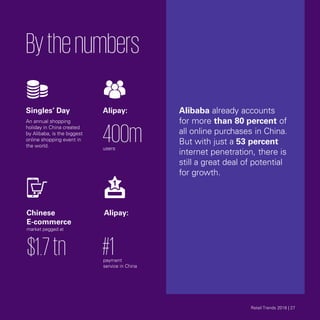
Bythenumbers

Singles’ Day
An annual shopping
holiday in China created
by Alibaba, is the biggest
online shopping event in
the world.
Chinese
E-commerce
market pegged at
$1.7tn
Alipay:
400musers


Alipay:
#1payment
service in China
Alibaba already accounts
for more than 80 percent of
all online purchases in China.
But with just a 53 percent
internet penetration, there is
still a great deal of potential
for growth.
Retail Trends 2018 | 27
Top10

lessonsfor

retailers
 10.00
28 | Retail Trends 201828 | Retail Trends 2018
- -
-
one six
Customer experience is the key to success. The
commercial battleground is no longer just price, product
or efficient supply chain. It is now customer experience.
two
New metrics for success are taking over. Experience
per square foot will become an important metric.
three
Don’t give up on brick and mortar. Understand the
balance of digital and e commerce required in order to
reach your customer.
four
Understand how AI can help your business. In 2018
we will see more AI adoption. Retailers need to
understand where AI fits within their organization.
five
Look externally to help build your technology.
The best way for many companies, to achieve
successful implementation of technologies is to look
outside their own four walls.
Stay true to the core of your brand. Customers
want authenticity and transparency. They want to
know exactly who they are buying from.
seven
Understand that the customer has changed. It is
important to understand that the old ways of doing
customer segmentation aren’t sufficient. You need a
multidimensional view of your customer.
eight
Recognize that customer expectations have
changed and retailers who don’t meet expectations
are no longer contenders.
nine
Be knowledgeable about what Eastern retailers
are doing. Advances in the East could be an indication
of how retail will change in the West.
ten
Embrace the new retail world – it is here.
The tools and technologies to transform retail have
arrived.
Retail trends 2018 | 29
When you’re trying
to make an important
decision, and you’re
sort of divided on the
issue, ask yourself: If
the customer were
here, what would
she (or he) say.
Dharmesh Shah
CTO of Hubspot
30 | Retail Trends 201830 | Retail Trends 201730 | Retail Trends 2017
31 | Retail Trends 2018 Retail trends 2018 | 31
Contacts

Willy Kruh
Global Chair,
Consumer & Retail
Toronto
Dan Coonan
Director,
Consumer & Retail
New York
Devika Devani
Assistant Manager,
Consumer & Retail
London
3232 || RRetetaaiill TrTrendsends 20182018
33 | Retail Trends 2018
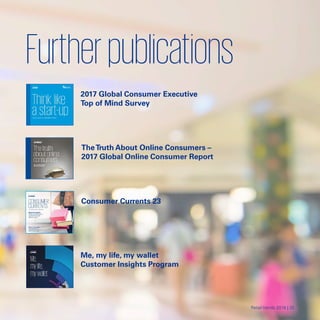
Furtherpublications

2017 Global Consumer Executive
Top of Mind Survey
TheTruth About Online Consumers –

2017 Global Online Consumer Report

Consumer Currents 23

Me, my life, my wallet
Customer Insights Program
Retail trends 2018 | 33
kpmg.com
© 2018 KPMG International Cooperative (“KPMG International”), a Swiss entity. Member firms of the KPMG

network of independent firms are affiliated with KPMG International. KPMG International provides no client services.

No member firm has any authority to obligate or bind KPMG International or any other member firm vis-à-vis third 

parties, nor does KPMG International have any such authority to obligate or bind any member firm.

All rights reserved.

The KPMG name and logo are registered trademarks or trademarks of KPMG International.

Designed by CREATE | CRT92741 | March 2018

Global retail-trends-2018

  • 1.
    EDGE OF PAGE MARGIN CROPMARKS MARGIN EDGEOF PAGE CROPMARKS MARGINMARGIN EDGE OF PAGE MARGIN CROPMARKS MARGIN EDGE OF PAGE CROPMARKS MARGIN MARGIN Globalretail trends2018 Global Consumer & Retail March 2018
  • 2.
    Introduction Over the lastfew years, we’ve heard about the disruption that is coming. In reality, we are already disrupted. The new retail world that we have been promised is here. The tools, strategies and technologies required to be successful in this new world are available.The toolbox for success is here, and it’s up to retailers to choose the right tools from the toolbox in order to grow their business. In this document, we discuss some of the biggest retail trends impacting our industry and highlight how some companies are responding. If you would like more information regarding this document please contact Dev Devani or Dan Coonan from the Global Consumer & Retail team at KPMG. 2 | Retail Trends 2018
  • 3.
    3 | RetailTrends 2018 Contents Overview of 2018 retail trends 4 Trend 1 – The customer experience is 6 more important than ever Trend 2 – Artificial intelligence will 10 gain more clout Trend 3 – The rise of the conscious 14 customer will continue Trend 4 – The retail world we were 18 promised is now here Trend 5 – A tale of two hemispheres 22 is playing out Top 10 lessons for retailers 28 Contacts 32 Further publications 33 © 2018 KPMG International Cooperative (“KPMG International”), a Swiss entity. Member firms of the KPMG network of independent firms are affiliated with KPMG International.
  • 4.
    - 1 The customer experienceis more important than ever The customer experience is more important than ever as retailers are striving to differentiate themselves in a challenging and crowded market. Consequently, experience per square foot will be the new retail metric to measure success. 2 Artificial intelligence will gain more clout Artificial Intelligence will gain more clout with some executives predicting that 85 percent of all transactions will be AI based by 2020. 2018 will be the year we see AI being deployed at scale. 3 The rise of the conscious customer will continue The rise of the conscious customer will continue as consumers base their buying decisions on many factors beyond price. These new consumers, led and influenced by millennials, are exerting influence on retailers and forcing them to take action. 4 | Retail Trends 20184 | Retail Trends 2018
  • 5.
    5 | RetailTrends 2018 -- - The retail world we were promised is now here The retail world we were promised is now here it has changed and will continue to impact the path to purchase. We’ve arrived at the intersection of elevated consumer expectations and technical possibility. 4 A tale of two hemispheres is playing out A tale of two hemispheres is playing out as platform players and non traditional retailers expand their reach and offerings. The juxtaposition between what is happening in the West and the East will dominate the retail landscape with the latter in many cases moving faster than the former. 5 Retail Trends 2018 | 5
  • 6.
    Trend 1: Thecustomer experienceis moreimportant thanever 6 |Retail Trends 20186 | Retail Trends 2018
  • 7.
    Welcome to the experienceeconomy where we have a new metric for a new era. Experience per square foot will become an important metric for retailers. Traditionally, the primary measure of retail performance has been sales per square foot. However, as stores become experience hubs as well as points of sale, retailers are thinking differently about the metrics they use to measure performance. According to the ‘Customers 2020 study by Walker, a customer intelligence consulting firm: Customer experience will overtake price and product as the key brand differentiator by the year 2020. Retail Trends 2018 | 7Retail Trends 2018 | 7
  • 8.
    Trend 1: Thecustomer experienceismore importantthanever Successful retailingin 2018 comes down to obsessing about customer experience. Essential to achieving this is digital and physical touchpoints working together seamlessly. Despite the notion of the demise of brick-and-mortar stores, physical retail isn't actually dead, but boring retail is. Store closures in certain countries hit all-time highs in 2017. The list of longstanding retail brands that shut their door is too long to list. Often overlooked is the fact that many stores opened as well. We will see a similar pattern in 2018. By January 2019, 90 percent of all retail will still be done in physical stores. Iconic retail brands like Apple, Sephora and Costco continue to succeed, despite relying mainly on brick-and-mortar stores. As a consequence, new classes of retailers are emerging. There are retailers who started online and are moving to physical brick-and-mortar and others are merging “bricks and clicks.” Retailers are seeking to understand their share of consumer spending, and how their consumers search, shop and buy in order to devise new retail models. Whether that means, having a show room or only having a strong presence in e-commerce, retailers are reinventing how they do business. So, why aren’t physical stores dead? Put simply, stores that are doing well offer a customer experience that meets or exceeds customer expectations. Joe Mach, the President of North America at Verifone predicts consumers will visit physical stores as long as there are new and interesting reasons to go. Leading retailers take advantage of their physical spaces to maximize experience per square foot and the real-life interactions customers have there. In summary, customers will shop where they enjoy their experience, this could be on a single channel or a combination of channels. 8 | Retail Trends 2018
  • 9.
    As retailers enter2018, they are already seeing that if customers are going to visit a store, it needs to be about more than just the transaction. Retailers need to offer something you can’t get online.They need to offer an experience. Casestudies Nike “Nike’s latest store in New York is like LEGOLAND for people who love sports.” Nike opened a new five-story, 55,000 square foot store in New York City. It features a mini in- door basketball court, a treadmill, a system that simulates runs in different locations, a small soccer enclosure, a shoe bar where shoppers can personalize a pair of Nike Air Force and coaches who put customers through drills to test out different pairs of shoes. It is as much a place to play as it is a place to shop. Nike is demonstrating that it understands how brick-and- mortar retail is changing in the age of e-commerce and also how to create a memorable customer experience. Ulta Beauty Ulta Beauty is among the largest US beauty retailers and is currently the fastest-growing specialty retailer. In 2016, overall sales grew 23.7 percent. In 2017, Ulta’s digital sales grew a staggering 71 percent in the first quarter, contributing to a 14.3 percent increase in comparable sales. Ulta has a deep understanding of what customers want from their shopping experience. It combines high-end and drug store products to create a beauty superstore for its customers. Apart from this mix of products and beauty support, Ulta’s main differentiator is its in-store hair, skin and eyebrow treatments that keep customers in their stores longer. "The notion of continuing to have a wonderful shopping experience with a great assortment of products and categories and brands, plus services, plus the ability to have a great online experience… we see a plenty of runway for us to continue to be a very relevant both brick-and- mortar and online player,“ said CEO Mary Dillon. RRetetaaiill TrTrendsends 20182018 || 99
  • 10.
    Trend 2 Artificial intelligence willgain moreclout 10 |Retail Trends 201810 | Retail Trends 2018
  • 11.
    Retail experts atthe National Retail Federation’s 2018 Big Show said that retailers should be using artificial intelligence to solve specific problems, not just deploy it for its own sake. In 2018, retailers will start to discover the value that AI can bring to their business. Definition of AI: An area of computer science that deals with giving machines the ability to seem like they have human intelligence. In short, it is the power of a machine to copy intelligent human behavior. Example: Robotic process automation (RPA) is being applied to highly repetitive tasks normally performed by humans. Business examples: — Machine learning algorithms are being integrated into analytics and Customer Relationship Management (CRM) platforms to uncover information on how to better serve customers. — Chatbots have been incorporated into websites to provide immediate service to customers. Charlie Cole, global Chief E- commerce Officer at Samsonite tells Forbes that 2018 is the year that: Artificial intelligence will have its breakthrough moment. More and more retailers will start using it to power various parts of the retail and e-commerce experience. Retail Trends 2018 | 11Retail Trends 2018 | 11
  • 12.
    Trend 2: Artificialintelligence willgainmoreclout Katrina Gosek,Director of commerce product strategy at Oracle, says that AI will “finally (be) something that helps retailers reach that holy grail" of personalization. Back in 2016, Gartner predicted that by 2020, 85 percent of customer interactions would be managed without human involvement. In 2018 we will see AI adoption continue to rise with chatbots taking the lead. Due to increasing ease of deployment, instant availability and improved quality, chatbots will become more and more common to manage customer service queries and to make intelligent purchase recommendations. We will also see the rise of AI- powered conversational interfaces and voice assistants. Retailers can engage this kind of technology to answer routine questions and supplement human customer support with chat-based shopping or voice commerce. Alongside having the technology available, retailers now also have a significant amount of data to power AI and deliver personalized, customized and localized experiences to customers. AI will be applied across the entire retail product and service cycle, from manufacturing to post-sale customer service interactions. Retailers using AI to its fullest potential will be able to influence purchases in the moment and anticipate future purchases, guiding shoppers towards the right products in a regular and highly personalized manner. In order to maximize the impact of AI, in 2018 we will see new partnerships and collaborations between retailers and technology companies emerge. Retailers recognize that building or buying the technology they need isn’t the best use of their resources. Instead, we will see a rise retailers partnering with niche technology players – collaboration will be the key to success. 12 | Retail Trends 2018
  • 13.
    Artificial Intelligence isn’tjust for the movies anymore. Customers are now demanding better, faster and personalized experiences. Retailers need to meet this demand and AI technology can help. Casestudies Taco Bell Meet Tacobot. Taco Bell’s chatbot that will never let you go hungry. Tacobot is currently in private beta mode and requires a quick install. However as soon as it is installed, you can start chatting and ask it questions about the menu, recommendations, special offers and dietary requirements and even ask how Tacobot is feeling. Tacobot is connected to your ta.co account, so that all your favorites, including locations, are stored and transferred over. You can place your order for pickup or through their partnership with DoorDash, and have it delivered straight to your door. Amazon Not only is Amazon using AI, they are also selling it. They are penetrating the mass market with their Echo and Alexa devices, and nearly overnight it has become the norm to speak to a small device in your home, and to many it almost feels like part of the family. The Amazon bot personality Alexa uses chatbot technology and voice recognition simultaneously. The goal of Echo is to create a seamless user experience anywhere in the user’s home. By speaking directly to Alexa, you can place food orders, play music, plan events, check your calendar, make phone calls and so on. The list is endless and all you need to do is talk to her. Voicebot estimates that total shipments of Amazon Echo devices were 20.54 million through Q3 of 2017. In Q4 of 2017, it is said Amazon sold “tens of millions” of Echo hardware devices. Echo Dot was the top-selling product on Amazon across all categories. RRetetaaiill TrTrendsends 20182018 || 1313
  • 14.
    Trend 3 Theriseofthe conscious customer willcontinue 14 |Retail Trends 201814 | Retail Trends 2018
  • 15.
    Authenticity is onthe tip of the tongue of every marketer today. The question is, why has it suddenly become a major factor in the customer decision-making process? In an age of authenticity where consumer trust has plummeted, customers are now demanding transparency. Honesty and authenticity have emerged as the attributes that matter most to customers. Consumers, more than ever before, are holding brands to a higher standard. An international survey by Cohn & Wolfe found that 87 percent of global consumers felt that it was important for brands to: Act with integrity at all times, ranking authenticity above innovation (72 percent) and product uniqueness (71 percent) when asked what they valued most in a brand. Retail Trends 2018 | 15Retail Trends 2018 | 15
  • 16.
    Trend 3: Theriseoftheconscious customerwillcontinue Customers aredemanding transparency as they take an increased interest in the ethical practices of the brands they buy from. Furthermore, customers today who are more tech savvy, have a much keener eye for authenticity versus marketing speak. Today’s customers have a well-developed sense of what is authentic and what is solely intended to drive sales. This has led to a rise in consumers who make values based judgements about what to buy and where to shop. These consumers believe their purchase habits have an impact on the world. To win customers today, businesses need to stand for something and reflect that message consistently throughout the entire business from senior leadership through to front line staff. The conscious consumer movement is growing. One third of UK consumers, for example, claim to be very concerned about issues regarding the origin of products. In another example, a study from YouGov and the Global Poverty Project revealed that 74 percent of those surveyed would pay a higher cost for their clothes if there was a guarantee that workers were being paid fairly and working in safe conditions. Authenticity is especially key unlocking the wallets of customers of all ages. Millennials are having a deep impact on the generations that came before them (Boomers, Gen X etc.) as well as the one that comes next: commonly referred to as Gen Z. A Global Corporate Sustainability Report published by Nielsen indicates that, globally, 66 percent of consumers are willing to spend more on a product if it comes from a sustainable brand. Millennials gave an even more impressive showing, with 73 percent indicating a similar preference. Simply put, customers want the companies they buy from to practice sustainability, strong ethical behavior and transparency. Customers want to buy an honest brand. Retailers have to be authentic and transparent, but they also need to communicate this in a sophisticated and trustworthy way, or consumers may turn to another brand. 16 | Retail Trends 2018
  • 17.
    In this businessenvironment, brands and retailers are required to focus more on corporate social responsibility. As Sir Martin Sorrell, head of the world’s largest advertising group WPP, said “doing good is good business.” Casestudies Brandless Brandless is an American company that openly states, “our mission is deeply rooted in quality, transparency, and community-driven values. Better stuff, fewer dollars. It's that simple.” It sells a wide variety of products for a universal flat fee of US$3. On its website, it says that BrandTax™ is the hidden costs you pay for a national brand. This is how they have managed to keep costs so low. Brandless focuses on what matters to their customers. They offer organic, non- toxic, hypoallergenic products that haven’t been tested on animals. They believe in helping the consumer and the world at the same time. Gucci Italian fashion designer, Gucci has banned the use of fur. The ban will take effect with its spring/summer 2018 collections. The company has now signed up for the Fur Free Alliance, an organization that promises to end the exploitation and killing of animals for fur, as part of a wider sustainability plan. Part of this alliance are competitors, Calvin Klein, Ralph Lauren, Armani and Tommy Hilfiger. Not only does this decision adapt to changing consumer tastes, but Marco Bizzarri the CEO of Gucci also says, “I need to do it because (otherwise) the best talent will not come to work for Gucci.” Bizzarri went on to say, "Being socially responsible is one of Gucci's core values, and we will continue to strive to do better for the environment and animals.” RRetetaaiill TrTrendsends 20182018 || 1717
  • 18.
    Trend 4 Theretailworld wewere promisedis nowhere 18 |Retail Trends 201818 | Retail Trends 2018
  • 19.
    When retailers analyzeshopper behavior, it is remarkably clear that consumers have changed dramatically. Retailers need to understand and react to these changes. Technology has made it easier than ever for shoppers to consume information, find products or services and easily share their experiences. This has resulted in new customer expectations that have created a new retail world. Paul Wissmann Sector Leader for Media & Telecommunications at KPMG in the US says, “Technology has become so embedded in our daily lives that consumers now view instant access as the norm.” Over the last ten years, technology has opened the floodgates to a wave of unregulated new entrants that have both changed the way in which we manage the flows in and out of our wallet, while also dramatically raising our expectations. Me, my life, my wallet – KPMG Customer Insights Program Retail Trends 2018 | 19Retail Trends 2018 | 19
  • 20.
    Trend 4: Theretailworldwewere promisedisnowhere As moreretailers adapt to the changing expectations of customers, we are finally seeing the new retail world evolve.This is the consequence of significant behavioral shifts over the last few years. Many retailers who haven’t met customers demands are simply no longer in the game. Forrester anticipates this challenging new environment will “place harsh and unfamiliar demands on companies, requiring changes in how they develop, market, sell and deliver products and services.” The predictions and attributes that people have been talking about for years have now become customer expectations and have drastically changed the path to purchase. According to Forrester, we’re five years into the Age of the Customer, in which newly empowered customers place elevated expectations on every interaction they have with brands. New technologies have put customers in the driver’s seat — they have the power. Apps like Snapchat, WeChat and WhatsApp show we are quickly moving toward a reality in which everything happens in real time. The natural outcome is that people want that instant gratification. This has had a deep impact on customer expectation. This just in time gratification puts a huge strain on retailers. In a Salesforce.com report, 64 percent of consumers said they expect companies to respond to and interact with them in real time. The need for speed will only increase as technology enables and advances. The point of engagement and the point of transaction are converging, meaning brands that can offer immediacy, instant gratification, personalization, authenticity and accessibility will win. 20 | Retail Trends 2018
  • 21.
    Well-performing retailers arechanging their businesses to adapt to consumer demands.This is setting a new standard for the industry. Amazon Prime USA $12.99per month. OR $99.00annual subscription. UK £79.00annual subscription. Casestudies Amazon Nearly half of US households are now Amazon Prime subscribers. Data from Kantar estimates that 45 percent of households in the US are willing to pay Amazon prime membership fees in exchange for the promise of free two-day shipping on eligible items, despite the yearly fee of $99. Not so long ago, it was acceptable to wait at least a week for delivery. This is no longer the case. Amazon has adapted to this expectation and Prime membership has boomed because of it. In the UK, Prime members can even receive same day delivery on selected items. Options like this, make consumers switch to brands who offer this just in time fulfillment. Target Target has announced that beginning in February with a roll out across the country throughout the year, the retailer will offer same day delivery as the retail wars heat up in the US. The offering is a new way for Target to compete with other online shopping sites like Amazon, which dominates with 38 percent of all online shopping, and whose customers are now demanding faster speed, greater convenience and lower price. As Darren Seifer, a food and beverage industry analyst for NPD says “Target clearly sees the writing on the wall. If they're going to stay competitive, they need to up their convenience game to remain competitive with the likes of Wal-Mart, Jet, and Amazon.” RRetetaaiill TrTrendsends 20182018 || 2121
  • 22.
    Trend 5 Ataleoftwo hemispheresis playingout E 22| Retail Trends 201822 | Retail Trends 2018
  • 23.
    An ongoing competitionbetween the hemispheres has been a topic of interest within the retail world. Who is actually leading? Who is growing quicker, and most importantly, who is going to win? China takes another step towards a service economy. China’s economy continues its historic shift to becoming more consumption and service-driven that could help sustain the country’s growth over the next decade and beyond.” It doesn't matter if I failed. At least I passed the concept on to others. Even if I don't succeed, someone will succeed. Jack Ma – Executive chairman of Alibaba Group Retail Trends 2018 | 23Retail Trends 2018 | 23
  • 24.
    Trend 5: Ataleoftwo hemispheresis playingout For along time, companies in China were known for taking products and business models from the West and adapting them to their local markets. However, with the move to a consumption-driven economy, home-grown platform businesses are redefining the Eastern landscape. China has developed a unique innovation ecosystem that has resulted in a revolutionary approach on a mass scale. It is different from that in the West, and it is impacting both emerging and developed economies. China’s innovative tech companies are dominating the local market and it may just be a matter of time before they themselves move West. Chinese conglomerate, Alibaba Group, has significantly reshaped the retail world and its own business in a fast-growing economy – a stark contrast to record store closures faced by retailers in the West. Alibaba owned Taobao, an online marketplace, has 580 million active monthly users – mostly in China, demonstrating the incredible pace of growth in the East. 24 | Retail Trends 2018
  • 25.
    In 2017, wewitnessed Alibaba's Singles' Day (11/11) achieving record revenue of over $25 billion.Single’s day was much bigger than Black Friday and Cyber Monday combined. In 2017, Singles’ Day’s record-breaking sales represented 39 percent YoY growth. Alibaba processed 812 million orders within 24 hours and its payment service, Alipay, handled 1.5 billion transactions, peaking at an incredible 256,000 transactions per second. Meanwhile, Cyber Monday became the largest online shopping day in US history with a record $6.59 billion online transactions. Cyber Monday Black Friday Singles’ Day 2017 2017 2017 $6.6bn $7.9bn 17% 18% 39%increase from 2016 increase from 2016 increase from 2016 Biggest shopping day in Biggest one-day shopping history of US e-commerce event worldwide $25.3bn It is projected that by 2030, the Chinese middle class will add 800 million to one billion new consumers and over 200 cities will have populations over 1 million. To put this into context, the OECD has projected that Europe would add 16 million consumers by 2030 and has only 35 cities with populations over a million today. With the middle class moving from a projected 12 percent to 73 percent of the Chinese population from 2009 to 2030, consumption in China is projected to be 2.5 times that of the US. Already today, more Chinese consumers use mobile phones to access the internet than those in America, Brazil and Indonesia combined. About half of China’s online sales take place via mobile, compared to barely a third in the US. RRetetaaiill TrTrendsends 20182018 || 2525
  • 26.
    In China, Tencent’sWeChat is the dominant messaging force for monopolizing mobile users’ attention, via a platform that plugs in all sorts of additional third party services, from ride- hailing to banking to food ordering. According to their own WeChat Data Report: — WeChat monthly active users reached 963 million in Q2 2017, representing YoY growth of 19.5 percent. — Over 50 percent use WeChat for over 1.5 hours every day; over one-third over 4 hours per day. — Users make 100 million calls per day on WeChat Users can shop and pay within the App and use WeChat Pay to do so. 2626 || RRetetaaiill TrTrendsends 20182018
  • 27.
    Bythenumbers Singles’ Day An annualshopping holiday in China created by Alibaba, is the biggest online shopping event in the world. Chinese E-commerce market pegged at $1.7tn Alipay: 400musers Alipay: #1payment service in China Alibaba already accounts for more than 80 percent of all online purchases in China. But with just a 53 percent internet penetration, there is still a great deal of potential for growth. Retail Trends 2018 | 27
  • 28.
    Top10 lessonsfor retailers 10.00 28 |Retail Trends 201828 | Retail Trends 2018
  • 29.
    - - - one six Customerexperience is the key to success. The commercial battleground is no longer just price, product or efficient supply chain. It is now customer experience. two New metrics for success are taking over. Experience per square foot will become an important metric. three Don’t give up on brick and mortar. Understand the balance of digital and e commerce required in order to reach your customer. four Understand how AI can help your business. In 2018 we will see more AI adoption. Retailers need to understand where AI fits within their organization. five Look externally to help build your technology. The best way for many companies, to achieve successful implementation of technologies is to look outside their own four walls. Stay true to the core of your brand. Customers want authenticity and transparency. They want to know exactly who they are buying from. seven Understand that the customer has changed. It is important to understand that the old ways of doing customer segmentation aren’t sufficient. You need a multidimensional view of your customer. eight Recognize that customer expectations have changed and retailers who don’t meet expectations are no longer contenders. nine Be knowledgeable about what Eastern retailers are doing. Advances in the East could be an indication of how retail will change in the West. ten Embrace the new retail world – it is here. The tools and technologies to transform retail have arrived. Retail trends 2018 | 29
  • 30.
    When you’re trying tomake an important decision, and you’re sort of divided on the issue, ask yourself: If the customer were here, what would she (or he) say. Dharmesh Shah CTO of Hubspot 30 | Retail Trends 201830 | Retail Trends 201730 | Retail Trends 2017
  • 31.
    31 | RetailTrends 2018 Retail trends 2018 | 31
  • 32.
    Contacts Willy Kruh Global Chair, Consumer& Retail Toronto Dan Coonan Director, Consumer & Retail New York Devika Devani Assistant Manager, Consumer & Retail London 3232 || RRetetaaiill TrTrendsends 20182018
  • 33.
    33 | RetailTrends 2018 Furtherpublications 2017 Global Consumer Executive Top of Mind Survey TheTruth About Online Consumers – 2017 Global Online Consumer Report Consumer Currents 23 Me, my life, my wallet Customer Insights Program Retail trends 2018 | 33
  • 34.
    kpmg.com © 2018 KPMGInternational Cooperative (“KPMG International”), a Swiss entity. Member firms of the KPMG network of independent firms are affiliated with KPMG International. KPMG International provides no client services. No member firm has any authority to obligate or bind KPMG International or any other member firm vis-à-vis third parties, nor does KPMG International have any such authority to obligate or bind any member firm. All rights reserved. The KPMG name and logo are registered trademarks or trademarks of KPMG International. Designed by CREATE | CRT92741 | March 2018