SALES AND RETAIL MANAGEMENT
        10MBAMM312


           PART B
     Retail Management
Module - 8
VTU Syllabus

Relationship Marketing in Retailing

 Management of Relationship
 Evaluation of Relationship Marketing
 Relationship Marketing Strategies
 Retail Research
 Retail Audits
Building and Sustaining Relationships
             in Retailing
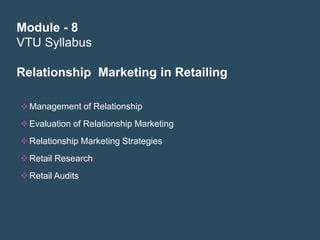
In recent years Relationship Marketing (RM) has been widely promoted as
a means of retaining customers.
Relationship Marketing refers to a long-term arrangement where
both the buyer and seller have an interest in providing a more
satisfying exchange!


Relationship marketing is not about having a "buddy-buddy"
relationship with your customers! & the customer don’t want
that. Relationship Marketing uses the event-driven tactics of
customer retention marketing, but treats marketing as a process
over time rather than single unconnected events.


Relationship Marketing approach achieves very high customer
satisfaction and is highly profitable
What is Value?
The bottom line:
 Consumers will demand more for
  less from the shopping experience
 They will spend less time
  shopping
 They will split the commodity-
  shopping trip from the value-added
  shopping trip
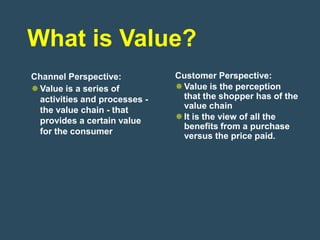
What is Value?
Channel Perspective:           Customer Perspective:
 Value is a series of          Value is the perception
  activities and processes -     that the shopper has of the
  the value chain - that         value chain
  provides a certain value      It is the view of all the
                                 benefits from a purchase
  for the consumer
                                 versus the price paid.
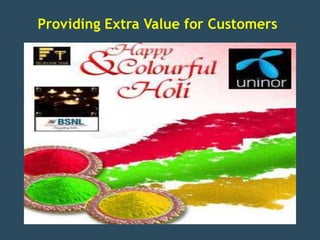
Providing Extra Value for Customers
Retail Value Chain
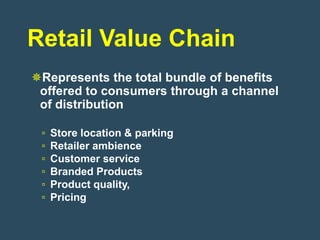
Represents the total bundle of benefits
 offered to consumers through a channel
 of distribution

 ▫   Store location & parking
 ▫   Retailer ambience
 ▫   Customer service
 ▫   Branded Products
 ▫   Product quality,
 ▫   Pricing
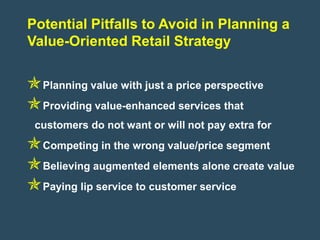
Potential Pitfalls to Avoid in Planning a
Value-Oriented Retail Strategy


Planning value with just a price perspective
Providing value-enhanced services that
 customers do not want or will not pay extra for
Competing in the wrong value/price segment
Believing augmented elements alone create value
Paying lip service to customer service
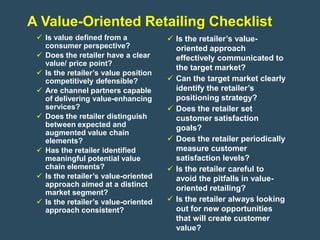
A Value-Oriented Retailing Checklist
  Is value defined from a             Is the retailer’s value-
   consumer perspective?                oriented approach
  Does the retailer have a clear       effectively communicated to
   value/ price point?
                                        the target market?
  Is the retailer’s value position
   competitively defensible?           Can the target market clearly
  Are channel partners capable         identify the retailer’s
   of delivering value-enhancing        positioning strategy?
   services?                           Does the retailer set
  Does the retailer distinguish        customer satisfaction
   between expected and                 goals?
   augmented value chain
   elements?                           Does the retailer periodically
  Has the retailer identified          measure customer
   meaningful potential value           satisfaction levels?
   chain elements?                     Is the retailer careful to
  Is the retailer’s value-oriented     avoid the pitfalls in value-
   approach aimed at a distinct
                                        oriented retailing?
   market segment?
  Is the retailer’s value-oriented    Is the retailer always looking
   approach consistent?                 out for new opportunities
                                        that will create customer
                                        value?
Bring the Care Back to Health
Care
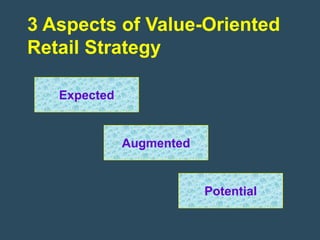
3 Aspects of Value-Oriented
Retail Strategy

   Expected


              Augmented


                          Potential
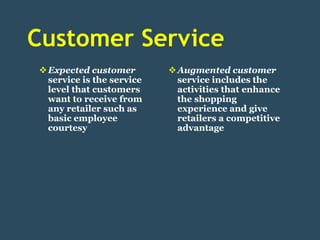
Customer Service
 Expected customer         Augmented customer
  service is the service     service includes the
  level that customers       activities that enhance
  want to receive from       the shopping
  any retailer such as       experience and give
  basic employee             retailers a competitive
  courtesy                   advantage
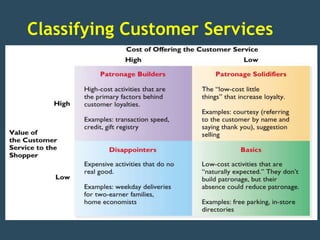
Classifying Customer Services
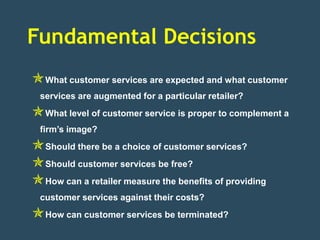
Fundamental Decisions
What customer services are expected and what customer
  services are augmented for a particular retailer?
What level of customer service is proper to complement a
  firm’s image?
Should there be a choice of customer services?
Should customer services be free?
How can a retailer measure the benefits of providing
  customer services against their costs?
How can customer services be terminated?
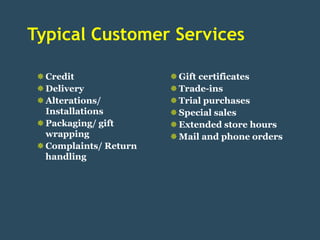
Typical Customer Services

  Credit                Gift certificates
  Delivery              Trade-ins
  Alterations/          Trial purchases
   Installations         Special sales
  Packaging/ gift       Extended store hours
   wrapping              Mail and phone orders
  Complaints/ Return
   handling
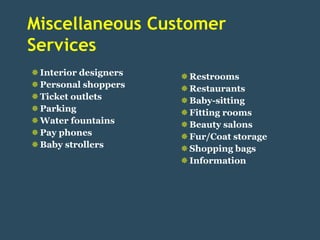
Miscellaneous Customer
Services
 Interior designers    Restrooms
 Personal shoppers     Restaurants
 Ticket outlets        Baby-sitting
 Parking               Fitting rooms
 Water fountains       Beauty salons
 Pay phones            Fur/Coat storage
 Baby strollers        Shopping bags
                        Information
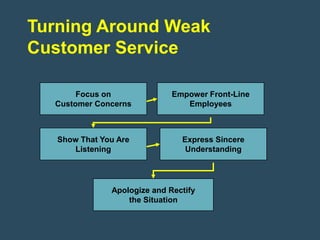
Turning Around Weak
Customer Service

       Focus on               Empower Front-Line
  Customer Concerns              Employees


   Show That You Are            Express Sincere
      Listening                  Understanding


               Apologize and Rectify
                   the Situation
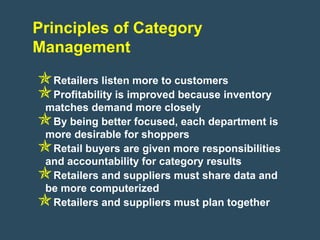
Principles of Category
Management
Retailers listen more to customers
Profitability is improved because inventory
 matches demand more closely
By being better focused, each department is
 more desirable for shoppers
Retail buyers are given more responsibilities
 and accountability for category results
Retailers and suppliers must share data and
 be more computerized
Retailers and suppliers must plan together
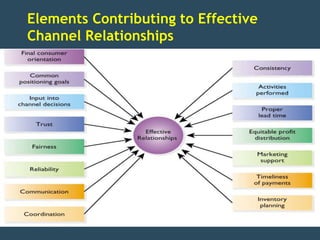
Elements Contributing to Effective
Channel Relationships
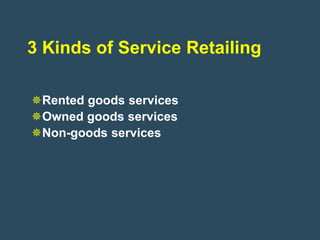
3 Kinds of Service Retailing

Rented goods services
Owned goods services
Non-goods services
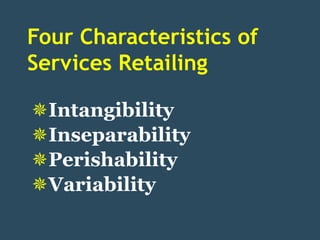
Four Characteristics of
Services Retailing

Intangibility
Inseparability
Perishability
Variability
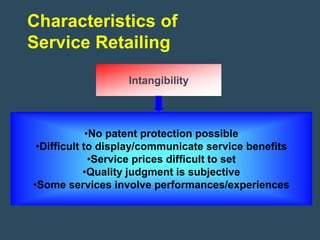
Characteristics of
Service Retailing

                   Intangibility


             •No patent protection possible
 •Difficult to display/communicate service benefits
              •Service prices difficult to set
            •Quality judgment is subjective
•Some services involve performances/experiences
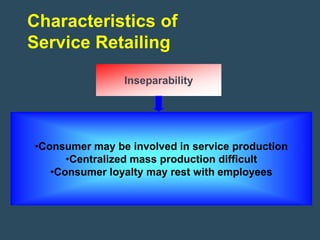
Characteristics of
Service Retailing

                Inseparability


•Consumer may be involved in service production
      •Centralized mass production difficult
   •Consumer loyalty may rest with employees
Characteristics of
Service Retailing

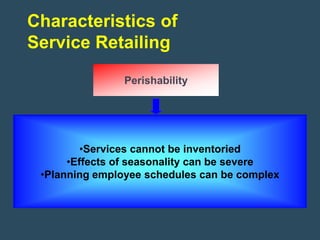
                Perishability


         •Services cannot be inventoried
      •Effects of seasonality can be severe
 •Planning employee schedules can be complex
Characteristics of
Service Retailing

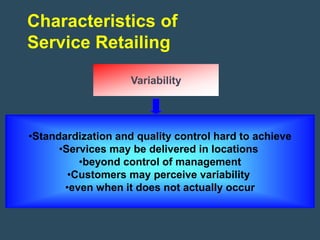
                    Variability


•Standardization and quality control hard to achieve
      •Services may be delivered in locations
          •beyond control of management
        •Customers may perceive variability
       •even when it does not actually occur
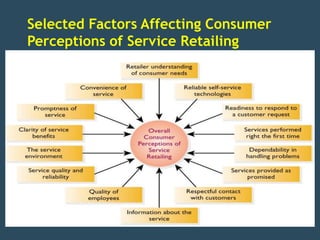
Selected Factors Affecting Consumer
Perceptions of Service Retailing
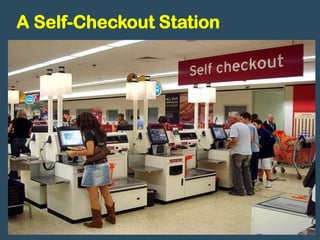
A Self-Checkout Station
Consumer Advantages to
Self-Checkout

Shorter lines
Increased speed
Privacy
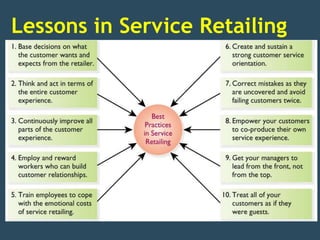
Lessons in Service Retailing
RETAIL
              RESEARCH


Information Gathering and
Processing in Retailing
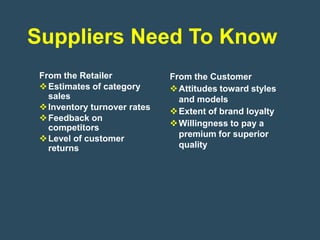
Suppliers Need To Know
 From the Retailer            From the Customer
  Estimates of category       Attitudes toward styles
   sales                        and models
  Inventory turnover rates    Extent of brand loyalty
  Feedback on
   competitors                 Willingness to pay a
                                premium for superior
  Level of customer
   returns                      quality
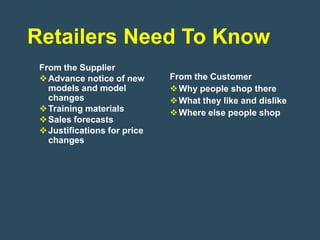
Retailers Need To Know
 From the Supplier
  Advance notice of new      From the Customer
   models and model            Why people shop there
   changes                     What they like and dislike
  Training materials          Where else people shop
  Sales forecasts
  Justifications for price
   changes
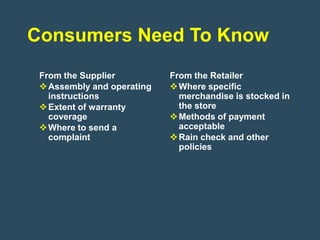
Consumers Need To Know
 From the Supplier          From the Retailer
  Assembly and operating    Where specific
   instructions               merchandise is stocked in
  Extent of warranty         the store
   coverage                  Methods of payment
  Where to send a            acceptable
   complaint                 Rain check and other
                              policies
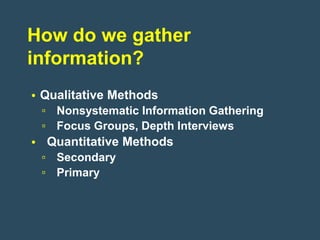
How do we gather
information?
• Qualitative Methods
 ▫ Nonsystematic Information Gathering
 ▫ Focus Groups, Depth Interviews
• Quantitative Methods
 ▫ Secondary
 ▫ Primary
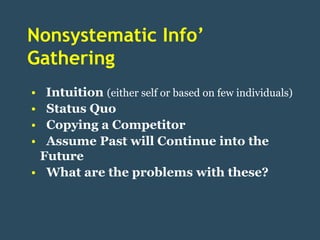
Nonsystematic Info’
Gathering
• Intuition (either self or based on few individuals)
• Status Quo
• Copying a Competitor
• Assume Past will Continue into the
 Future
• What are the problems with these?
Retail Information System
(RIS)
 Anticipates the information needs of
  the organization
 Collects, organizes, and stores
  relevant data on a continuous basis
 Directs the flow of information to the
  proper decision makers
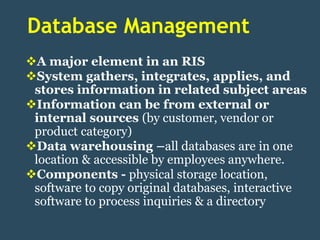
Database Management
A major element in an RIS
System gathers, integrates, applies, and
 stores information in related subject areas
Information can be from external or
 internal sources (by customer, vendor or
 product category)
Data warehousing –all databases are in one
 location & accessible by employees anywhere.
Components - physical storage location,
 software to copy original databases, interactive
 software to process inquiries & a directory
Data Mining and
Micromarketing
Data mining is the in-depth analysis of
 information to gain specific insights about
 customers, product categories, vendors, and
 so forth
Micromarketing is an application of data
 mining, whereby retailers use differentiated
 marketing and develop focused retail
 strategy mixes for specific customer
 segments
Marketing Research in Retailing

• The collection and analysis of
    information relating to specific issues
    or problems facing a retailer
•   Examples: How can we improve sales in this
    store? How effective was our last promotion
    campaign?
•   Secondary data –existing data:
    internal/external
•   Primary data – collected specifically for
    issue under consideration – usually collected
    when secondary data is inadequate
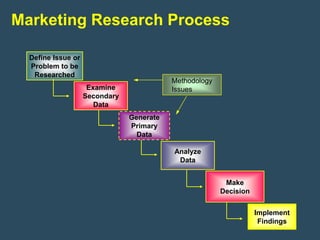
Marketing Research Process

  Define Issue or
  Problem to be
   Researched
                                           Methodology
                     Examine               Issues
                    Secondary
                       Data
                                Generate
                                Primary
                                  Data

                                           Analyze
                                            Data


                                                          Make
                                                         Decision


                                                                    Implement
                                                                     Findings
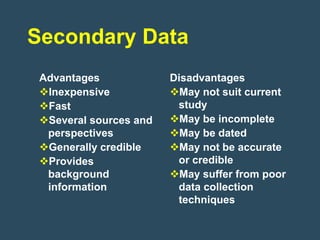
Secondary Data
 Advantages             Disadvantages
 Inexpensive           May not suit current
 Fast                   study
 Several sources and   May be incomplete
  perspectives          May be dated
 Generally credible    May not be accurate
 Provides               or credible
  background            May suffer from poor
  information            data collection
                         techniques
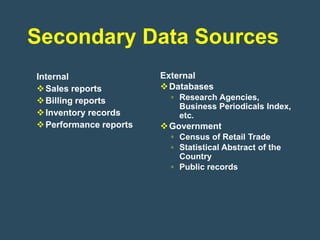
Secondary Data Sources
Internal                External
 Sales reports          Databases
 Billing reports         ▫ Research Agencies,
                            Business Periodicals Index,
 Inventory records         etc.
 Performance reports    Government
                          ▫ Census of Retail Trade
                          ▫ Statistical Abstract of the
                            Country
                          ▫ Public records
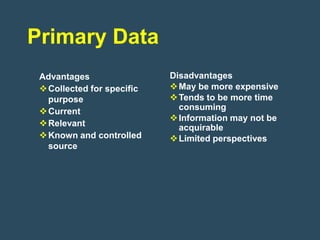
Primary Data
 Advantages                 Disadvantages
  Collected for specific    May be more expensive
   purpose                   Tends to be more time
  Current                    consuming
                             Information may not be
  Relevant                   acquirable
  Known and controlled      Limited perspectives
   source
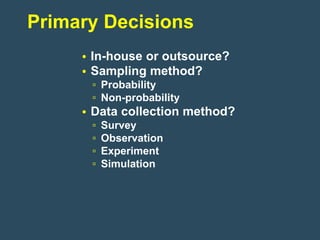
Primary Decisions
     • In-house or outsource?
     • Sampling method?
      ▫ Probability
      ▫ Non-probability
     • Data collection method?
      ▫   Survey
      ▫   Observation
      ▫   Experiment
      ▫   Simulation
Survey Methods
  In-person             Disguised
  Over the telephone    Non-disguised
  By mail
  Online
Mystery Shoppers


Retailers hire people to pose as
 customers and observe operations from
 sales presentations to how well displays
 are maintained to service calls
UPC & EDI
Universal Product Code read by scanners
 contains model number, size, color, etc
UPC-A labeling format – numbers & lines
Advantages: speed transaction, reduce
 errors, rich data, inventory management
Electronic data interchange – data
 transfer using networks (computer systems
 linked together)
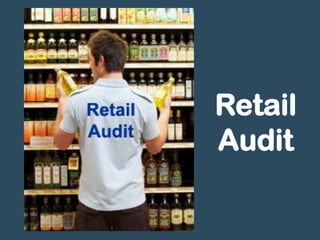
Retail
Audit
RETAIL AUDIT

Retail-audit service providers gather
information on a brand’s sales volume,
sales trends, stock levels, effectiveness
of in-store display and promotion efforts,
and other associated aspects.
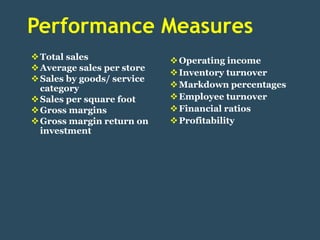
Performance Measures
 Total sales                Operating income
 Average sales per store
                             Inventory turnover
 Sales by goods/ service
  category                   Markdown percentages
 Sales per square foot      Employee turnover
 Gross margins              Financial ratios
 Gross margin return on     Profitability
  investment
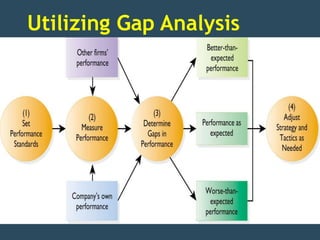
Utilizing Gap Analysis
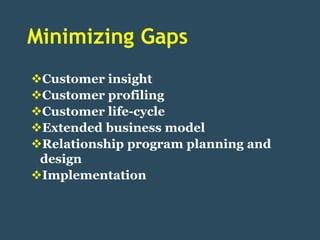
Minimizing Gaps
Customer insight
Customer profiling
Customer life-cycle
Extended business model
Relationship program planning and
 design
Implementation
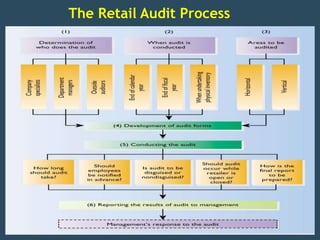
The Retail Audit Process
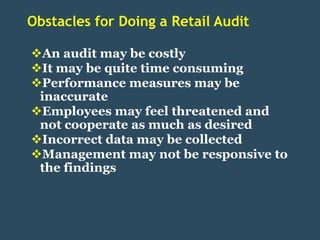
Obstacles for Doing a Retail Audit

An audit may be costly
It may be quite time consuming
Performance measures may be
 inaccurate
Employees may feel threatened and
 not cooperate as much as desired
Incorrect data may be collected
Management may not be responsive to
 the findings
Thank You

Retail management

  • 1.
    SALES AND RETAILMANAGEMENT 10MBAMM312 PART B Retail Management
  • 2.
    Module - 8 VTUSyllabus Relationship Marketing in Retailing  Management of Relationship  Evaluation of Relationship Marketing  Relationship Marketing Strategies  Retail Research  Retail Audits
  • 3.
    Building and SustainingRelationships in Retailing In recent years Relationship Marketing (RM) has been widely promoted as a means of retaining customers.
  • 4.
    Relationship Marketing refersto a long-term arrangement where both the buyer and seller have an interest in providing a more satisfying exchange! Relationship marketing is not about having a "buddy-buddy" relationship with your customers! & the customer don’t want that. Relationship Marketing uses the event-driven tactics of customer retention marketing, but treats marketing as a process over time rather than single unconnected events. Relationship Marketing approach achieves very high customer satisfaction and is highly profitable
  • 5.
    What is Value? Thebottom line: Consumers will demand more for less from the shopping experience They will spend less time shopping They will split the commodity- shopping trip from the value-added shopping trip
  • 6.
    What is Value? ChannelPerspective: Customer Perspective:  Value is a series of  Value is the perception activities and processes - that the shopper has of the the value chain - that value chain provides a certain value  It is the view of all the benefits from a purchase for the consumer versus the price paid.
  • 7.
    Providing Extra Valuefor Customers
  • 8.
    Retail Value Chain Representsthe total bundle of benefits offered to consumers through a channel of distribution ▫ Store location & parking ▫ Retailer ambience ▫ Customer service ▫ Branded Products ▫ Product quality, ▫ Pricing
  • 9.
    Potential Pitfalls toAvoid in Planning a Value-Oriented Retail Strategy Planning value with just a price perspective Providing value-enhanced services that customers do not want or will not pay extra for Competing in the wrong value/price segment Believing augmented elements alone create value Paying lip service to customer service
  • 10.
    A Value-Oriented RetailingChecklist  Is value defined from a  Is the retailer’s value- consumer perspective? oriented approach  Does the retailer have a clear effectively communicated to value/ price point? the target market?  Is the retailer’s value position competitively defensible?  Can the target market clearly  Are channel partners capable identify the retailer’s of delivering value-enhancing positioning strategy? services?  Does the retailer set  Does the retailer distinguish customer satisfaction between expected and goals? augmented value chain elements?  Does the retailer periodically  Has the retailer identified measure customer meaningful potential value satisfaction levels? chain elements?  Is the retailer careful to  Is the retailer’s value-oriented avoid the pitfalls in value- approach aimed at a distinct oriented retailing? market segment?  Is the retailer’s value-oriented  Is the retailer always looking approach consistent? out for new opportunities that will create customer value?
  • 11.
    Bring the CareBack to Health Care
  • 12.
    3 Aspects ofValue-Oriented Retail Strategy Expected Augmented Potential
  • 13.
    Customer Service  Expectedcustomer  Augmented customer service is the service service includes the level that customers activities that enhance want to receive from the shopping any retailer such as experience and give basic employee retailers a competitive courtesy advantage
  • 14.
  • 15.
    Fundamental Decisions What customerservices are expected and what customer services are augmented for a particular retailer? What level of customer service is proper to complement a firm’s image? Should there be a choice of customer services? Should customer services be free? How can a retailer measure the benefits of providing customer services against their costs? How can customer services be terminated?
  • 16.
    Typical Customer Services  Credit  Gift certificates  Delivery  Trade-ins  Alterations/  Trial purchases Installations  Special sales  Packaging/ gift  Extended store hours wrapping  Mail and phone orders  Complaints/ Return handling
  • 17.
    Miscellaneous Customer Services  Interiordesigners  Restrooms  Personal shoppers  Restaurants  Ticket outlets  Baby-sitting  Parking  Fitting rooms  Water fountains  Beauty salons  Pay phones  Fur/Coat storage  Baby strollers  Shopping bags  Information
  • 18.
    Turning Around Weak CustomerService Focus on Empower Front-Line Customer Concerns Employees Show That You Are Express Sincere Listening Understanding Apologize and Rectify the Situation
  • 19.
    Principles of Category Management Retailerslisten more to customers Profitability is improved because inventory matches demand more closely By being better focused, each department is more desirable for shoppers Retail buyers are given more responsibilities and accountability for category results Retailers and suppliers must share data and be more computerized Retailers and suppliers must plan together
  • 20.
    Elements Contributing toEffective Channel Relationships
  • 21.
    3 Kinds ofService Retailing Rented goods services Owned goods services Non-goods services
  • 22.
    Four Characteristics of ServicesRetailing Intangibility Inseparability Perishability Variability
  • 23.
    Characteristics of Service Retailing Intangibility •No patent protection possible •Difficult to display/communicate service benefits •Service prices difficult to set •Quality judgment is subjective •Some services involve performances/experiences
  • 24.
    Characteristics of Service Retailing Inseparability •Consumer may be involved in service production •Centralized mass production difficult •Consumer loyalty may rest with employees
  • 25.
    Characteristics of Service Retailing Perishability •Services cannot be inventoried •Effects of seasonality can be severe •Planning employee schedules can be complex
  • 26.
    Characteristics of Service Retailing Variability •Standardization and quality control hard to achieve •Services may be delivered in locations •beyond control of management •Customers may perceive variability •even when it does not actually occur
  • 27.
    Selected Factors AffectingConsumer Perceptions of Service Retailing
  • 28.
  • 29.
    Consumer Advantages to Self-Checkout Shorterlines Increased speed Privacy
  • 30.
  • 31.
    RETAIL RESEARCH Information Gathering and Processing in Retailing
  • 32.
    Suppliers Need ToKnow From the Retailer From the Customer  Estimates of category  Attitudes toward styles sales and models  Inventory turnover rates  Extent of brand loyalty  Feedback on competitors  Willingness to pay a premium for superior  Level of customer returns quality
  • 33.
    Retailers Need ToKnow From the Supplier  Advance notice of new From the Customer models and model  Why people shop there changes  What they like and dislike  Training materials  Where else people shop  Sales forecasts  Justifications for price changes
  • 34.
    Consumers Need ToKnow From the Supplier From the Retailer  Assembly and operating  Where specific instructions merchandise is stocked in  Extent of warranty the store coverage  Methods of payment  Where to send a acceptable complaint  Rain check and other policies
  • 35.
    How do wegather information? • Qualitative Methods ▫ Nonsystematic Information Gathering ▫ Focus Groups, Depth Interviews • Quantitative Methods ▫ Secondary ▫ Primary
  • 36.
    Nonsystematic Info’ Gathering • Intuition(either self or based on few individuals) • Status Quo • Copying a Competitor • Assume Past will Continue into the Future • What are the problems with these?
  • 37.
    Retail Information System (RIS) Anticipates the information needs of the organization Collects, organizes, and stores relevant data on a continuous basis Directs the flow of information to the proper decision makers
  • 38.
    Database Management A majorelement in an RIS System gathers, integrates, applies, and stores information in related subject areas Information can be from external or internal sources (by customer, vendor or product category) Data warehousing –all databases are in one location & accessible by employees anywhere. Components - physical storage location, software to copy original databases, interactive software to process inquiries & a directory
  • 39.
    Data Mining and Micromarketing Datamining is the in-depth analysis of information to gain specific insights about customers, product categories, vendors, and so forth Micromarketing is an application of data mining, whereby retailers use differentiated marketing and develop focused retail strategy mixes for specific customer segments
  • 40.
    Marketing Research inRetailing • The collection and analysis of information relating to specific issues or problems facing a retailer • Examples: How can we improve sales in this store? How effective was our last promotion campaign? • Secondary data –existing data: internal/external • Primary data – collected specifically for issue under consideration – usually collected when secondary data is inadequate
  • 41.
    Marketing Research Process Define Issue or Problem to be Researched Methodology Examine Issues Secondary Data Generate Primary Data Analyze Data Make Decision Implement Findings
  • 42.
    Secondary Data Advantages Disadvantages Inexpensive May not suit current Fast study Several sources and May be incomplete perspectives May be dated Generally credible May not be accurate Provides or credible background May suffer from poor information data collection techniques
  • 43.
    Secondary Data Sources Internal External  Sales reports  Databases  Billing reports ▫ Research Agencies, Business Periodicals Index,  Inventory records etc.  Performance reports  Government ▫ Census of Retail Trade ▫ Statistical Abstract of the Country ▫ Public records
  • 44.
    Primary Data Advantages Disadvantages  Collected for specific  May be more expensive purpose  Tends to be more time  Current consuming  Information may not be  Relevant acquirable  Known and controlled  Limited perspectives source
  • 45.
    Primary Decisions • In-house or outsource? • Sampling method? ▫ Probability ▫ Non-probability • Data collection method? ▫ Survey ▫ Observation ▫ Experiment ▫ Simulation
  • 46.
    Survey Methods In-person  Disguised  Over the telephone  Non-disguised  By mail  Online
  • 47.
    Mystery Shoppers Retailers hirepeople to pose as customers and observe operations from sales presentations to how well displays are maintained to service calls
  • 48.
    UPC & EDI UniversalProduct Code read by scanners contains model number, size, color, etc UPC-A labeling format – numbers & lines Advantages: speed transaction, reduce errors, rich data, inventory management Electronic data interchange – data transfer using networks (computer systems linked together)
  • 49.
  • 50.
    RETAIL AUDIT Retail-audit serviceproviders gather information on a brand’s sales volume, sales trends, stock levels, effectiveness of in-store display and promotion efforts, and other associated aspects.
  • 51.
    Performance Measures  Totalsales  Operating income  Average sales per store  Inventory turnover  Sales by goods/ service category  Markdown percentages  Sales per square foot  Employee turnover  Gross margins  Financial ratios  Gross margin return on  Profitability investment
  • 52.
  • 53.
    Minimizing Gaps Customer insight Customerprofiling Customer life-cycle Extended business model Relationship program planning and design Implementation
  • 54.
  • 55.
    Obstacles for Doinga Retail Audit An audit may be costly It may be quite time consuming Performance measures may be inaccurate Employees may feel threatened and not cooperate as much as desired Incorrect data may be collected Management may not be responsive to the findings
  • 56.