

Scope of IT in Retail Business
System of Trading
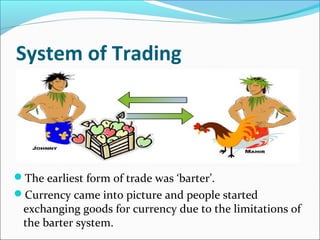
The earliest form of trade was ‘barter’.
Currency came into picture and people started
exchanging goods for currency due to the limitations of
the barter system.
Grocery System
Over time street hawkers and grocery (kirana) stores
evolved.
The kirana stores operate in a traditional manner.
Customers would just ask for a product such as bread
and the shopkeeper used to hand over the bread and
receive the money.
Kirana shop keepers are popular for extending credits
to their customers.
Kirana Store is called unorganized retail and it
contributes 96% of retail business in India.
Evolution of Supermarket
As times passage supermarkets and new format
business of came into being and started replacing
kirana stores.
These formats included
Departmental stores.
Low priced stores
Hypermarkets and malls.
Organized Retail
In organized retail, professional and trained staff with
a different outlook towards customer service are
deployed.
It concentrate more on customer’s comfort and
convenience and are termed as organized retail.
Organized retail contributes remaining 4% of the
Indian retail industry.
Manual work is reduced to a minimum with the
boom in the field of information technology (IT).
Retail Management
Today just selling a quality product is not enough to
run a profitable business.
To survive in the throat-cut scenario, retailers have to
think everyday what they can offer over and above
competitors.
Due to growing competition, retailers struggle to
create loyal customers.
Proper management of inventory in store enhances
effectiveness and efficiency which in turn create a
healthy customer base.
Role of IT in Retail
Modern equipments and applications i.e. software
provide a great help in deciding the right inventory.
IT is used in store operations and retail
management activities.
IT is used in planning the business, implementing
the plan, running the business and maintaining the
business.
IT in Retail
Information technology (IT) in retail deliver revolutionary new processes
effectively.
Redefine the industry or to change the approach towards business.
Retailer uses IT in the form of:
Software
Hardware
Wire line and Wireless communication
Most IT users use software to manage the inventory and to complete financial
transactions in the organisation including additional standard applications.
Solution Concepts
The application of technology depends on the way the
business is performed
Various solutions and applications for efficient retailing
include:
Electronic Data Interchange (EDI)
Database Management, Data Warehousing and Data Mining
Radio Frequency Identification (RFID)
Product Identification
A retailer must understand the characteristics of the product
which is in demand to be able to re-order products.
It is necessary to note down the variations in the characteristics
of the products over a period of time.
The Universal Product Code (UPC) is a product identifier that
helps to identify the product across various retail locations and
provide information about the product to be associated with it
quickly.
It is one of the IT tools used for automatic data capture with
100% accuracy.
Role of IT in Electronic Retailing
Electronic retailing is done through the internet
Electronic retailing is necessary due to:
 The consumer time poverty.
 The consumer need of controlling over time and place of transaction.
 The technology convergence.
 The growing experience of the benefits of the medium.
It fastens the communication within the organisation.
Role of IT in Electronic Retailing
Electronic retailing can be categorised into two types:
• Passive Systems: In this system, a retailer decides the content and timing of
messages and includes all forms of one way communication media such as
shopping pages, or one way cables.
• Interactive systems: In this system, retailer can have two way interaction and
include the Internet or promotional touch screen booths.
Classification of retailers who have adopted electronic commerce:
• Virtual retailers: These retailers will not have any shops or stores or physical
presence in the high street, malls or out-of-town locations instead they trade
exclusively on the Internet or on television.
• Two-channel retailers: These retailers establish stores having developed an
electronic retailing capability as a major or minor aspect of the business.
• Multi channel retailers: These retailers establish stores that meet customer
needs in a number of ways, including shops, telephone ordering, the Internet,
catalogues and TV.
Factors to be Considered in e-
Retailing
Various factors need to be measured to monitor in the progress of e-retailing includes:
 Number and types of visits to the site.
 Length of time on the site
 Number of orders placed
 Average basket or transaction value for each order.
 Number and profile of different customers
 Value of transaction by individual customer
 Average time and clicks prior to making an online order
 Delivery accuracy and timing
 Customer satisfaction levels.
Modern Retail & IT
Modern retail has got organized framework
To locate the store
To identify and to target the right customers
To decide from where to buy inventory and how much
inventory to buy and when to reorder
Increasing the footfalls and the customer base, gaining
customer loyalty, customer and employee safety,
billing, customer service, and staffing and scheduling
are all planned well in advance.
 All these activities are today strongly influenced by IT.
IT in Retail Business Operations
IT is immeasurably used in following operations:
Supply chain management
Assortment planning
Inventory management
Marketing and advertising
Customer relationship management (CRM)
Customer loyalty
Point of sale
Running promotions
Financial planning
Staffing and scheduling
Loss prevention
Business intelligence
Customer service
Supply Chain Management
It involves the movement of goods right from where they
are manufactured till they reach the hands of a customer.
Various supply chain applications available in the market
enable retail companies to efficiently respond to the
increasing demands and changing needs of customers.
The supply chain management application helps in
efficient planning, timely executing and controlling all the
supply chain activities.
The supply chain management applications such as
Consona, Epicor, IQMS, Netsuite, JDA, Sage, Microsoft
Dynamics, Oracle, SAP, IBM, and Manhattan Associates
are being used by some major market players.
Assortment Planning
The assortment planning system uses data,
algorithms and statistics to find current buying
trends, and helps retailers to stock the right range of
assortments (merchandise) in the store at the right
time.
The assortment planning software ensures the
merchandise is not over or under stocked.
Overstocking leads to blocked inventory costs, risk of
change of season, fashion and under-stocking leads to
loss of sales.
Companies which develop assortment planning
software are SAP, ADT, and JDA.
Inventory Management
Inventory is any merchandise available for sale in the
store.Out-of-stock situation arises if the inventory is not
well ordered.
To manage the vast inventory, retailers invest in software
called as inventory management system.
This system automatically tracks the sales and once the
inventory reaches a level called as reorder level it
automatically triggers the release of an order to the vendor.
If there is a sudden increase in the demand of a particular
product the system is also capable of handling such
exceptions.
Along with the inventory management system, retailers
also invest in the latest technology i.e. the Radio
Frequency Identification (RFID).
Radio Frequency Identification
RFID uses a reader and a tag attached to each item.
Whenever an item is sold, RFID tag is scanned at the cash
counter.
The scanner scans the information and transfers it to the
inventory management system.
Every item sold is automatically deducted from the total
available inventory.
Similarly any inventory received in the store is also added
to the inventory. RFID provides real time information and
avoids out-of-stock situations.
Some developers of the inventory management systems
are Sage, Tompkins Associates, and Netsuite.
Marketing and Advertising
With the advent of internet and advanced technology,
marketing and advertising of products has taken a different
dimension altogether.
Marketing application software systems keeps a track of
customers’ shopping patterns and identifies the most profitable
customer segment.
Once the advertising or marketing campaigns are launched, the
marketing systems enable measuring performance and calculate
the return on investments.
Marketing and advertising systems increase effectiveness of
campaigns. Effective campaigns attract more customers and
provide more sales, resulting in increased profit margins.
Some companies developing the marketing systems are Sage,
Oracle, and Techserious.
Customer Relationship
Management
Customers want the best quality products at the lowest
price and need prompt service, convenience, comfort,
access to products at their convenience (in terms of time
and space) and a wide variety of products to choose from.
In order to satisfy the customer, retailers need to fulfill the
above customer demands.
Customers have got a lots of options and it is easy for
them to switch retail stores.
To avoid this loss, retailers are striving to build
relationships with their customers. Strong relationships
can be built only if retailers know their customers well and
have necessary information about customers.
Customer Relationship
Management
IT helps in analyzing required information to fulfill
customer requirements.
Customer data is stored and analyzed by CRM (customer
relationship management) applications.
CRM helps retailers in managing long term relationships
with current customers and attract new customers.
CRM system stores customer data as a record or database
in the computer. This data includes customer’s name,
phone number, best time to call, address, previous
purchases made etc.
CRM system analyzes the buying pattern of customers and
facilitates retailers to find out the probability of future
sale.
Customer Relationship
Management
CRM assists retailers to provide excellent customer
service and better quality products.
CRM also helps in controlling inventory and
managing costs.
CRM is a real time tool that enables retailers to
increase customer loyalty and boost repeat traffic.
Some companies developing CRM software for retail
industry are SAP, Oracle, Microsoft, IBM, and Epicor
Solutions.
Customer Loyalty
Retailers invest a huge portion of their capital in collecting
customer data, analyzing it and use the analyzed
information to take necessary action.
Here, necessary action relates to increasing customer
loyalty and increasing sales. Customer data is collected
using loyalty or membership programs.
Have you ever come across a situation when the cashier
asked
 You for loyalty card while billing?
 If you are a member of the store?
Why do retailers give great importance to these loyalty
programs? Customers get points or credits, but what does
the retailer earn from this?
Customer Loyalty
There is only one reason behind above questions is, loyalty
cards enable retailers
To create loyal customers,
To boost repeated sales which in turn increase profit margins.
Retailers provide customers with a loyalty or membership card
which holds customer information like name, phone number,
and address.
While billing the merchandise, the cashier swipes the loyalty
card. Customer information available on card with current
purchases is tracked in a central database.
CRM analyzes a buying pattern from these purchases and also
indicates probability of customer’s future purchases.
Retailers also make sure the inventory that customers are likely
to purchase is in stock.
Point of Sale
Traditional method of billing
was not very reliable as it was
prone to errors and was time
consuming.
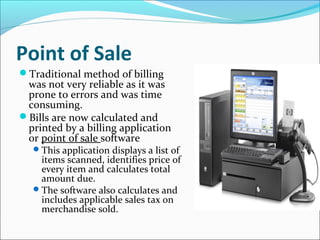
Bills are now calculated and
printed by a billing application
or point of sale software
This application displays a list of
items scanned, identifies price of
every item and calculates total
amount due.
The software also calculates and
includes applicable sales tax on
merchandise sold.
Point of Sale (POS)
Customers can pay the bill by debit card, credit card,
cash, and gift card or store credit.
Acceptable method of payment is decided when the store
operations policies are set.
Once customer pays for merchandise, cash drawer
automatically opens and the POS application indicates
how much change you should return to customer.
The POS application can also generate various reports
such as cashier wise end of day report, total sales report
(for a day/week/month/six-months/year), and cash flow
report. POS application makes the billing process efficient
and accurate.
Running Promotions
A well planned promotional campaign is used to maximize
profits. To do so retailers use promotions software.
It analyzes customer information (buying patterns) and
plans the promotion (in terms of price, time and strategy).
The application also indicates target customers, strategy
to maximize utilization of allocated resources and
minimize costs involved.
By automating these activities retailers save a lot of time,
money and resources and utilize these resources for other
important aspects of business.
The promotions application helps in increasing sales by
building more effective promotions.
Running Promotions
Marketing wing of retailers uses promotions applications
to plan the right offers at the right time, for the right
group of customers.
Along with planning and execution of promotions this
application also evaluates performance of a promotion.
Performance is evaluated in terms of effectiveness and
availability of right products, service and most importantly
sales.
Sales numbers indicate customer’s response to a
promotion.
Companies developing retails promotions software are:
SAP and Universal Ad.
Financial Planning
To make a retail business profitable, financial aspects
are need to be managed properly.
To manage financial aspects, retailers invest in
financial planning and accounting applications.
This application streamlines financial processes and
keeps a track of cash flow (incoming and outgoing
cash).
It generates financial reports, analyzes these reports
and suggests corrective actions if required.
Financial Planning System
Other features of a financial planning system are
It keeps a track of payments due and payments to be
received.
It manages payroll, cash, and tax.
It enables bank reconciliation, forecasting, planning
and budgeting.
It improves financial transparency and accountability.
SAP, Oracle, IBM and Epicor are some of the major
developers of financial planning and accounting
software’s.
Staffing and Scheduling
People are the most important resource in a retail
business.
To maximize productivity, retailers need to be able
to track if employees are working efficiently .
Staffing and scheduling system or Labor
Management System (LMS) helps retailers to staff
and schedule people with desired skill set for a
specific job.
LMS
LMS measures the performance of employees against set
standards and helps in appraising the employees.
LMS helps in planning and execution of entire staffing and
scheduling process.
The tracked activities also show if an employee is eligible
for any incentives, thus contributing to employee
motivation.
Depending on employee performance it also identifies
training needs.
Some top developers of Labor Management Systems
software are Tompkins Associates, ADP and Argent Global
Services (VantageRPM).
Loss Prevention
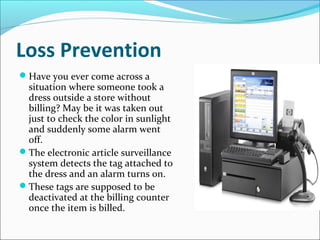
Have you ever come across a
situation where someone took a
dress outside a store without
billing? May be it was taken out
just to check the color in sunlight
and suddenly some alarm went
off.
The electronic article surveillance
system detects the tag attached to
the dress and an alarm turns on.
These tags are supposed to be
deactivated at the billing counter
once the item is billed.
Loss Prevention
Losses in retail sector can be in the form of:
Theft (by customers or employees),
Fraud,
Wastage or dump.
Big and small scale retailers are investing in various security
systems to save their hard earned money from being stolen.
 Security systems include:
Closed circuit television to monitor important areas of store.
Security tags
Electronic surveillance systems.
Access control using swipe cards to backroom doors and any
other limited access areas is also a type of security system.
Loss Prevention
RFID electronic tags and alarm systems (fire alarms and
burglar alarms) also help to reduce loss.
Video surveillance or closed circuit televisions (CCTVs)
are popular security equipments among retailers.
It indicates any suspicious activity or tracks what happened
before or after a store theft incident.
Some major companies developing loss prevention
applications are ADT, Shopguard, and Zicom Electronic
Systems Ltd.
Along with these systems store staff is also trained to
locate any suspicious behavior in store and take necessary
action.
Business Intelligence
In earlier days, there were no defined strategy or
guideline to add more customers to business, retailers
used to do business based on what customer asks for.
In modern retail industry there is lot of competition
and customers are also very demanding. So, if
customers do not find a product in one store, they will
find it elsewhere.
Therefore, retailers today use business intelligence (BI)
systems to ensure customers find all that they need in
their store,
BI System
The BI application collects customer data, analyzes it
and generates various reports enabling retailers to
make fast and accurate business decisions in defining
and creating business development strategies.
Retailers decide future purchases of merchandise,
different categories, and stock keeping units as per
reports generated by the BI system.
BI systems also analyze customer buying patterns;
suggest pricing strategy; evaluate performance of a
promotion and strategize launch of new products.
Companies developing BI systems are Epicor and
IBM.
Customer Service
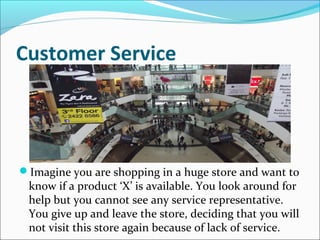
Imagine you are shopping in a huge store and want to
know if a product ‘X’ is available. You look around for
help but you cannot see any service representative.
You give up and leave the store, deciding that you will
not visit this store again because of lack of service.
Customer Service
Besides CRM and customer loyalty applications,
there are some other IT resources retailers use to
provide comfort and convenience to customers.
These IT resources are interactive devices like:
Kiosks
Self scanners
Digital displays or signage
Kiosks
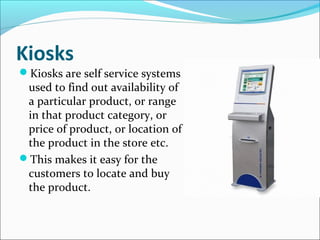
Kiosks are self service systems
used to find out availability of
a particular product, or range
in that product category, or
price of product, or location of
the product in the store etc.
This makes it easy for the
customers to locate and buy
the product.
Digital Signage
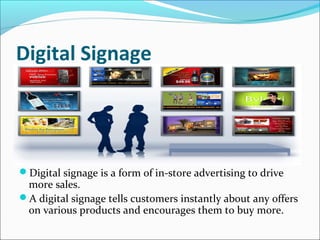
Digital signage is a form of in-store advertising to drive
more sales.
A digital signage tells customers instantly about any offers
on various products and encourages them to buy more.
IT: Game Changer in Retail Sector
IT helps in maximizing profits by proper assortment
planning, inventory management, customer relationship
management, financial planning, point of sale, and
running right promotions.
IT also minimizes losses to the retail business, by using
various systems like fire alarm, burglar alarm, closed
circuit television, electronic article surveillance, security
tags etc.
 IT helps in increasing customer base by achieving greater
customer satisfaction levels. In the next sub section let us
list the benefits of IT in modern retail industry.
IT Application in Retail
IT systems are needed to fulfill the following
requirements:
Understanding customers by studying and analyzing
customer data (feedback/past and current purchases)
Build long term relationship with end users, vendors
and suppliers
Increasing store operations efficiency
To have right product, at right time, in right place, and
in the required quantity
Reduce costs, maximize profits and minimize losses
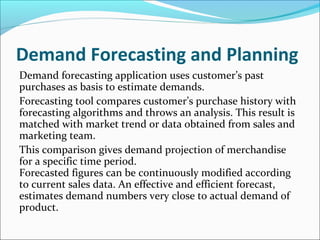
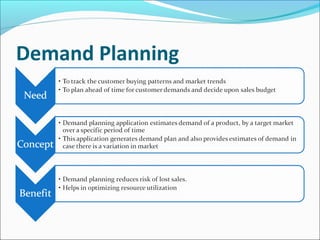
Demand Forecasting and Planning
Demand forecasting application uses customer’s past
purchases as basis to estimate demands.
Forecasting tool compares customer’s purchase history with
forecasting algorithms and throws an analysis. This result is
matched with market trend or data obtained from sales and
marketing team.
This comparison gives demand projection of merchandise
for a specific time period.
Forecasted figures can be continuously modified according
to current sales data. An effective and efficient forecast,
estimates demand numbers very close to actual demand of
product.
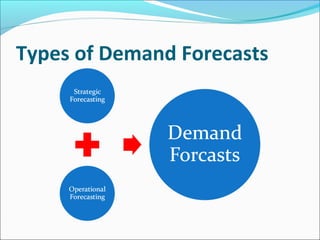
Types of Demand Forecasts
Strategic Forecasting
Strategic Forecasting deals with planning for store operations
requirements in long run and it begins with studying
customers.
Customers are divided into segments based upon parameters
such as:
Buying patterns
Community attitudes
Demography
Adding any new product to current inventory list also depends
on evaluation against these parameters.
For example: Assume a grocery store is in a community with
majority of vegetarian families. Strategic forecasting helps retailers
to decide upon product range to be carried. The product range
should be appealing to the vegetarian families.
Operational Forecasting
Deals with demand
planning for day to day
store operations
Helping retailers plan
resources for short term.
Involves forecasting for
products in the store
depending upon regular
buying patterns of
customers
Parameters of Forecasting
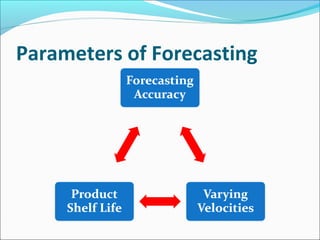
Forecasting Accuracy: Demand forecasting application should
compare actual sales data with projected figures to evaluate
forecasting performance or accuracy. Because of varying demand
forecast for some products is inaccurate. Demand variation could be
because of many reasons such as recession or bad weather conditions.
Varying Velocities: Different products have different speed at which
they are sold. Some products move fast and some are slow moving
items. If inventory level for all products in the store is same, then fast
moving items will be out of stock and slow moving items will not be
sold. Thus, varying velocities of products should be taken into
account.
Product Shelf Life: Along with forecasting accuracy and varying
velocities demand planning system should also include the parameter
of shelf life of products. Every product has a specific shelf life after
which it cannot be sold. A good forecasting application forecasts the
demand according to the shelf life of the product, thus minimizing
wastage.
Demand Planning
Factors affecting IT in retail
The list of factors that affect the business decision of
adopting IT are:
Ignorance
Mindset of retailers
Cost of buying, implementing, and maintaining IT
Return on investment of the IT solutions
Scale of operations of a business
Skilled IT manager
Value for money
Perception and understanding
Retailing through Internet
Retailing started with barter system. It grew into
street hawkers, kirana stores, and to supermarkets. In
last few decades retail business developed in the‟
form department stores, hypermarkets, and huge
malls.
All these retail formats compete with each other to
make a special place in the market and do more
business.
However, in this electronic world the competition is
not only between these brick and mortar shops, but it
is with the internet business.
Retailing through Internet
A lot of time is consumed while buying from a
traditional shop.
The e-commerce overcomes these limitations.
In today’s internet world more and more business is
done online.
The commerce that is conducted via the internet is
called as e-commerce.
Customers can visit online stores even at 1.00 am and
they can also find answers to most of their questions.
• In current scenario, IT has revolutionized the retail sector
providing barrier and boundary less shopping
• The phenomenal spread of mobile telephony and the advent of
3G in the country facilitates the buyers from small towns and
cities to purchase the products in large numbers.
• In fact, internet has dissolved the discriminating factor
between the small and the big cities enabling buyers from
small towns to have access to the same branded and quality
goods, which were earlier a privilege of large city buyers only.
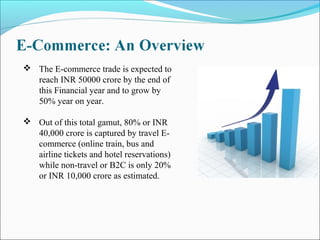
 The E-commerce trade is expected to
reach INR 50000 crore by the end of
this Financial year and to grow by
50% year on year.
 Out of this total gamut, 80% or INR
40,000 crore is captured by travel E-
commerce (online train, bus and
airline tickets and hotel reservations)
while non-travel or B2C is only 20%
or INR 10,000 crore as estimated.
Types of e-Commerce
Types of e-Commerce
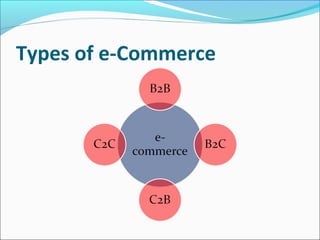
Business to Business (B2B):In business-to-business
type of e-commerce a business sells its products
and/or services to another business.
Example: A B2B site is Riktam Technologies
This is a type of e-commerce companies sell its
products and/or service to end-users. Products are
shipped to the address provided by consumer while
placing an order.
Examples of business to consumer sites are Amazon;
make my trip, deals to buy etc.
Types of e-Commerce
Consumer to Business (C2B): This is the latest business
model in which consumers are allowed to sell products to
businesses.
Consumers can sell text ads, advertising banners or any
promotional items on sites like Google adsense, Commission
junction.
Businesses also buy consumer opinions on several survey
sites like Mypoints, Surveyscout, and Survey Monkey.
Consumer to consumer (C2C): If a consumer wishes to sell
a used television, they can put it up for sale on any of
these sites.
Sites like e-bay, Amazon, Sulekha, and Craig list allow
consumers to sell and buy products or services.
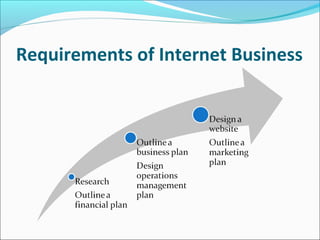
Requirements of Internet Business
Research
Before starting an online store, e-retailer should browse all possible
websites. Especially they should browse business sites which are
similar to their business i.e. competitor’s websites.
The research would narrow down if there were no competitors for
your type of business. However if there is competition, entrepreneur’s
should make of a note of all positive and negative features of
competitor’s website.
 e-Retailer should not forget to note even the smallest feature that
created a positive impression and also things they would never
appreciate on their own website.
Understanding strengths and weaknesses of competition is very
important.
Research should be done for what are the resources required to start
an online business.
Requirements of Internet Business
Outline a Business Plan
Creating a business plan is a very important step
towards launching a business and for its success.
 A business plan helps in deciding upon the aims and
objectives of a business.
A business plan for an e-business includes plans to
design a web site, marketing and advertising, business
management, policies and procedures, financial plan,
and business development.
Requirements of Internet Business
Design a Website
Web site for an online business is like a virtual store. A
primary requirement for a business site is it should be
accessible anytime the customer wants. The site should
also provide customers with some basic information such
as:
Company name
Contact information
Target customer base
Name of manufacturers or brands whose products you carry
Information about other services provided such as free
shipping on orders over Rs. 1000.
Shipping methods and payment methods
Advantage of E-Commerce
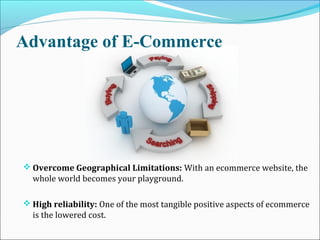
 Overcome Geographical Limitations: With an ecommerce website, the
whole world becomes your playground.
 High reliability: One of the most tangible positive aspects of ecommerce
is the lowered cost.
Advantage of E-Commerce
 Locate the Product Quicker: It is no longer pushing a shopping cart
to the correct aisle, or scouting for the desired product. On an
E-commerce website, customers can click through intuitive navigation
or use a search box to immediately narrow down their product search.
Some websites remember customer preferences and shopping lists to
facilitate repeat purchase.
Advantage of E-Commerce
 Eliminate Travel Time and Cost: It is not feasible for customers to
travel long distances to reach their preferred physical store.
E-commerce allows them to visit the same store virtually, with a few
mouse clicks.
Advantage of E-Commerce
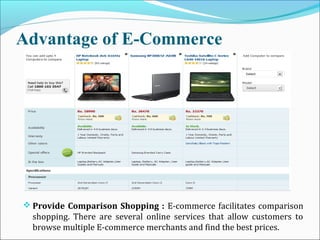
 Provide Comparison Shopping : E-commerce facilitates comparison
shopping. There are several online services that allow customers to
browse multiple E-commerce merchants and find the best prices.
Advantage of E-Commerce
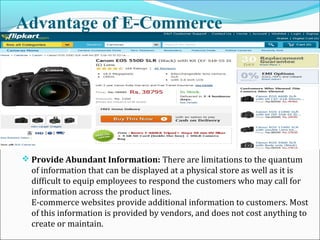
 Provide Abundant Information: There are limitations to the quantum
of information that can be displayed at a physical store as well as it is
difficult to equip employees to respond the customers who may call for
information across the product lines.
E-commerce websites provide additional information to customers. Most
of this information is provided by vendors, and does not cost anything to
create or maintain.
Advantage of E-Commerce
 Create Targeted Communication: Using the information that a
customer provides in the registration form, and by placing cookies on the
customer's computer, an E-commerce merchant can access a lot of
information about its customers. This, in turn, can be used to
communicate relevant messages.
Example: If you are searching for a certain product on Amazon.com, you
will automatically be shown listings of other similar products. In addition,
Amazon.com may also e-mail you about the related products.
Advantage of E-Commerce
 Remain Opened All the Time : E-commerce websites can run all the time.
From the merchant's point of view, such facilities make a significant
increment in the number of orders what they receive earlier. From the
customer's point of view, an "always open" store is more convenient.
Logistics Challenges in E-Commerce
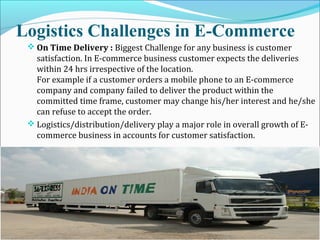
 On Time Delivery : Biggest Challenge for any business is customer
satisfaction. In E-commerce business customer expects the deliveries
within 24 hrs irrespective of the location.
For example if a customer orders a mobile phone to an E-commerce
company and company failed to deliver the product within the
committed time frame, customer may change his/her interest and he/she
can refuse to accept the order.
 Logistics/distribution/delivery play a major role in overall growth of E-
commerce business in accounts for customer satisfaction.
Logistics Challenges of E-Commerce
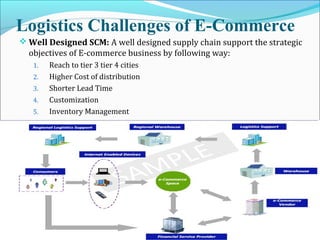
 Well Designed SCM: A well designed supply chain support the strategic
objectives of E-commerce business by following way:
1. Reach to tier 3 tier 4 cities
2. Higher Cost of distribution
3. Shorter Lead Time
4. Customization
5. Inventory Management
Logistics Challenges of E-Commerce
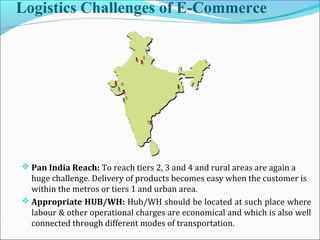
 Pan India Reach: To reach tiers 2, 3 and 4 and rural areas are again a
huge challenge. Delivery of products becomes easy when the customer is
within the metros or tiers 1 and urban area.
 Appropriate HUB/WH: Hub/WH should be located at such place where
labour & other operational charges are economical and which is also well
connected through different modes of transportation.
Logistics Challenges of E-Commerce
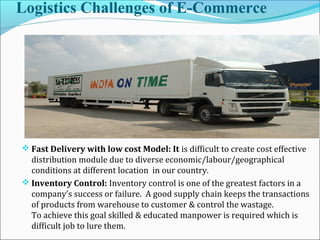
 Fast Delivery with low cost Model: It is difficult to create cost effective
distribution module due to diverse economic/labour/geographical
conditions at different location in our country.
 Inventory Control: Inventory control is one of the greatest factors in a
company’s success or failure. A good supply chain keeps the transactions
of products from warehouse to customer & control the wastage.
To achieve this goal skilled & educated manpower is required which is
difficult job to lure them.
Logistics Challenges of E-Commerce
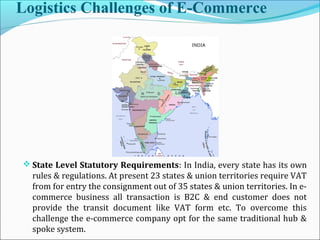
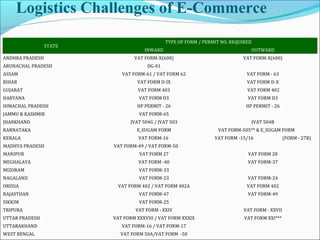
 State Level Statutory Requirements: In India, every state has its own
rules & regulations. At present 23 states & union territories require VAT
from for entry the consignment out of 35 states & union territories. In e-
commerce business all transaction is B2C & end customer does not
provide the transit document like VAT form etc. To overcome this
challenge the e-commerce company opt for the same traditional hub &
spoke system.
Logistics Challenges of E-Commerce
STATE
TYPE OF FORM / PERMIT NO. REQUIRED
INWARD OUTWARD
ANDHRA PRADESH VAT FORM-X(600) VAT FORM-X(600)
ARUNACHAL PRADESH DG-01
ASSAM VAT FORM-61 / VAT FORM 62 VAT FORM - 63
BIHAR VAT FORM D-IX VAT FORM D-X
GUJARAT VAT FORM 403 VAT FORM 402
HARYANA VAT FORM D3 VAT FORM D3
HIMACHAL PRADESH HP PERMIT - 26 HP PERMIT - 26
JAMMU & KASHMIR VAT FORM-65
JHARKHAND JVAT 504G / JVAT 503 JVAT 504B
KARNATAKA E_SUGAM FORM VAT FORM-505** & E_SUGAM FORM
KERALA VAT FORM-16 VAT FORM -15/16 (FORM - 27B)
MADHYA PRADESH VAT FORM-49 / VAT FORM-50
MANIPUR VAT FORM 27 VAT FORM 28
MEGHALAYA VAT FORM -40 VAT FORM-37
MIZORAM VAT FORM-33
NAGALAND VAT FORM-23 VAT FORM-24
ORISSA VAT FORM 402 / VAT FORM 402A VAT FORM 402
RAJASTHAN VAT FORM-47 VAT FORM-49
SIKKIM VAT FORM-25
TRIPURA VAT FORM - XXIV VAT FORM - XXVII
UTTAR PRADESH VAT FORM XXXVIII / VAT FORM XXXIX VAT FORM XXI***
UTTARAKHAND VAT FORM-16 / VAT FORM-17
WEST BENGAL VAT FORM 50A/VAT FORM -50
Logistics Challenges of E-Commerce
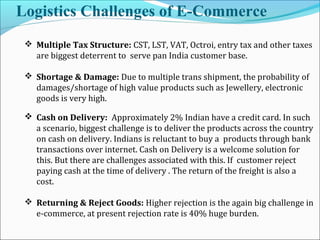
 Multiple Tax Structure: CST, LST, VAT, Octroi, entry tax and other taxes
are biggest deterrent to serve pan India customer base.
 Shortage & Damage: Due to multiple trans shipment, the probability of
damages/shortage of high value products such as Jewellery, electronic
goods is very high.
 Cash on Delivery: Approximately 2% Indian have a credit card. In such
a scenario, biggest challenge is to deliver the products across the country
on cash on delivery. Indians is reluctant to buy a products through bank
transactions over internet. Cash on Delivery is a welcome solution for
this. But there are challenges associated with this. If customer reject
paying cash at the time of delivery . The return of the freight is also a
cost.
 Returning & Reject Goods: Higher rejection is the again big challenge in
e-commerce, at present rejection rate is 40% huge burden.
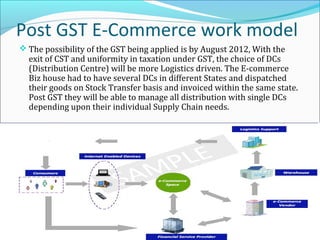
Post GST E-Commerce work model
 The possibility of the GST being applied is by August 2012, With the
exit of CST and uniformity in taxation under GST, the choice of DCs
(Distribution Centre) will be more Logistics driven. The E-commerce
Biz house had to have several DCs in different States and dispatched
their goods on Stock Transfer basis and invoiced within the same state.
Post GST they will be able to manage all distribution with single DCs
depending upon their individual Supply Chain needs.
Summary
Though much is yet to be achieved, remember E-
tailing is a new industry in India. With broadband
internet access still accessible to entire population,
this industry may see an explosive growth. Most
growth drivers are in India’s favor – demographics,
economy, changing lifestyle, exposure to new ideas. It
is just a question of creating a sustainable eco system
for E-tailing, which is at an inflection point. Time to
fasten the seat belts
Satish Aryan
581111776
Thanks...

E retail

  • 1.
    Scope of ITin Retail Business
  • 3.
    System of Trading Theearliest form of trade was ‘barter’. Currency came into picture and people started exchanging goods for currency due to the limitations of the barter system.
  • 4.
    Grocery System Over timestreet hawkers and grocery (kirana) stores evolved. The kirana stores operate in a traditional manner. Customers would just ask for a product such as bread and the shopkeeper used to hand over the bread and receive the money. Kirana shop keepers are popular for extending credits to their customers. Kirana Store is called unorganized retail and it contributes 96% of retail business in India.
  • 5.
    Evolution of Supermarket Astimes passage supermarkets and new format business of came into being and started replacing kirana stores. These formats included Departmental stores. Low priced stores Hypermarkets and malls.
  • 6.
    Organized Retail In organizedretail, professional and trained staff with a different outlook towards customer service are deployed. It concentrate more on customer’s comfort and convenience and are termed as organized retail. Organized retail contributes remaining 4% of the Indian retail industry. Manual work is reduced to a minimum with the boom in the field of information technology (IT).
  • 7.
    Retail Management Today justselling a quality product is not enough to run a profitable business. To survive in the throat-cut scenario, retailers have to think everyday what they can offer over and above competitors. Due to growing competition, retailers struggle to create loyal customers. Proper management of inventory in store enhances effectiveness and efficiency which in turn create a healthy customer base.
  • 8.
    Role of ITin Retail Modern equipments and applications i.e. software provide a great help in deciding the right inventory. IT is used in store operations and retail management activities. IT is used in planning the business, implementing the plan, running the business and maintaining the business.
  • 9.
    IT in Retail Informationtechnology (IT) in retail deliver revolutionary new processes effectively. Redefine the industry or to change the approach towards business. Retailer uses IT in the form of: Software Hardware Wire line and Wireless communication Most IT users use software to manage the inventory and to complete financial transactions in the organisation including additional standard applications.
  • 10.
    Solution Concepts The applicationof technology depends on the way the business is performed Various solutions and applications for efficient retailing include: Electronic Data Interchange (EDI) Database Management, Data Warehousing and Data Mining Radio Frequency Identification (RFID)
  • 11.
    Product Identification A retailermust understand the characteristics of the product which is in demand to be able to re-order products. It is necessary to note down the variations in the characteristics of the products over a period of time. The Universal Product Code (UPC) is a product identifier that helps to identify the product across various retail locations and provide information about the product to be associated with it quickly. It is one of the IT tools used for automatic data capture with 100% accuracy.
  • 12.
    Role of ITin Electronic Retailing Electronic retailing is done through the internet Electronic retailing is necessary due to:  The consumer time poverty.  The consumer need of controlling over time and place of transaction.  The technology convergence.  The growing experience of the benefits of the medium. It fastens the communication within the organisation.
  • 13.
    Role of ITin Electronic Retailing Electronic retailing can be categorised into two types: • Passive Systems: In this system, a retailer decides the content and timing of messages and includes all forms of one way communication media such as shopping pages, or one way cables. • Interactive systems: In this system, retailer can have two way interaction and include the Internet or promotional touch screen booths. Classification of retailers who have adopted electronic commerce: • Virtual retailers: These retailers will not have any shops or stores or physical presence in the high street, malls or out-of-town locations instead they trade exclusively on the Internet or on television. • Two-channel retailers: These retailers establish stores having developed an electronic retailing capability as a major or minor aspect of the business. • Multi channel retailers: These retailers establish stores that meet customer needs in a number of ways, including shops, telephone ordering, the Internet, catalogues and TV.
  • 14.
    Factors to beConsidered in e- Retailing Various factors need to be measured to monitor in the progress of e-retailing includes:  Number and types of visits to the site.  Length of time on the site  Number of orders placed  Average basket or transaction value for each order.  Number and profile of different customers  Value of transaction by individual customer  Average time and clicks prior to making an online order  Delivery accuracy and timing  Customer satisfaction levels.
  • 15.
    Modern Retail &IT Modern retail has got organized framework To locate the store To identify and to target the right customers To decide from where to buy inventory and how much inventory to buy and when to reorder Increasing the footfalls and the customer base, gaining customer loyalty, customer and employee safety, billing, customer service, and staffing and scheduling are all planned well in advance.  All these activities are today strongly influenced by IT.
  • 16.
    IT in RetailBusiness Operations IT is immeasurably used in following operations: Supply chain management Assortment planning Inventory management Marketing and advertising Customer relationship management (CRM) Customer loyalty Point of sale Running promotions Financial planning Staffing and scheduling Loss prevention Business intelligence Customer service
  • 17.
    Supply Chain Management Itinvolves the movement of goods right from where they are manufactured till they reach the hands of a customer. Various supply chain applications available in the market enable retail companies to efficiently respond to the increasing demands and changing needs of customers. The supply chain management application helps in efficient planning, timely executing and controlling all the supply chain activities. The supply chain management applications such as Consona, Epicor, IQMS, Netsuite, JDA, Sage, Microsoft Dynamics, Oracle, SAP, IBM, and Manhattan Associates are being used by some major market players.
  • 18.
    Assortment Planning The assortmentplanning system uses data, algorithms and statistics to find current buying trends, and helps retailers to stock the right range of assortments (merchandise) in the store at the right time. The assortment planning software ensures the merchandise is not over or under stocked. Overstocking leads to blocked inventory costs, risk of change of season, fashion and under-stocking leads to loss of sales. Companies which develop assortment planning software are SAP, ADT, and JDA.
  • 19.
    Inventory Management Inventory isany merchandise available for sale in the store.Out-of-stock situation arises if the inventory is not well ordered. To manage the vast inventory, retailers invest in software called as inventory management system. This system automatically tracks the sales and once the inventory reaches a level called as reorder level it automatically triggers the release of an order to the vendor. If there is a sudden increase in the demand of a particular product the system is also capable of handling such exceptions. Along with the inventory management system, retailers also invest in the latest technology i.e. the Radio Frequency Identification (RFID).
  • 20.
    Radio Frequency Identification RFIDuses a reader and a tag attached to each item. Whenever an item is sold, RFID tag is scanned at the cash counter. The scanner scans the information and transfers it to the inventory management system. Every item sold is automatically deducted from the total available inventory. Similarly any inventory received in the store is also added to the inventory. RFID provides real time information and avoids out-of-stock situations. Some developers of the inventory management systems are Sage, Tompkins Associates, and Netsuite.
  • 21.
    Marketing and Advertising Withthe advent of internet and advanced technology, marketing and advertising of products has taken a different dimension altogether. Marketing application software systems keeps a track of customers’ shopping patterns and identifies the most profitable customer segment. Once the advertising or marketing campaigns are launched, the marketing systems enable measuring performance and calculate the return on investments. Marketing and advertising systems increase effectiveness of campaigns. Effective campaigns attract more customers and provide more sales, resulting in increased profit margins. Some companies developing the marketing systems are Sage, Oracle, and Techserious.
  • 22.
    Customer Relationship Management Customers wantthe best quality products at the lowest price and need prompt service, convenience, comfort, access to products at their convenience (in terms of time and space) and a wide variety of products to choose from. In order to satisfy the customer, retailers need to fulfill the above customer demands. Customers have got a lots of options and it is easy for them to switch retail stores. To avoid this loss, retailers are striving to build relationships with their customers. Strong relationships can be built only if retailers know their customers well and have necessary information about customers.
  • 23.
    Customer Relationship Management IT helpsin analyzing required information to fulfill customer requirements. Customer data is stored and analyzed by CRM (customer relationship management) applications. CRM helps retailers in managing long term relationships with current customers and attract new customers. CRM system stores customer data as a record or database in the computer. This data includes customer’s name, phone number, best time to call, address, previous purchases made etc. CRM system analyzes the buying pattern of customers and facilitates retailers to find out the probability of future sale.
  • 24.
    Customer Relationship Management CRM assistsretailers to provide excellent customer service and better quality products. CRM also helps in controlling inventory and managing costs. CRM is a real time tool that enables retailers to increase customer loyalty and boost repeat traffic. Some companies developing CRM software for retail industry are SAP, Oracle, Microsoft, IBM, and Epicor Solutions.
  • 25.
    Customer Loyalty Retailers investa huge portion of their capital in collecting customer data, analyzing it and use the analyzed information to take necessary action. Here, necessary action relates to increasing customer loyalty and increasing sales. Customer data is collected using loyalty or membership programs. Have you ever come across a situation when the cashier asked  You for loyalty card while billing?  If you are a member of the store? Why do retailers give great importance to these loyalty programs? Customers get points or credits, but what does the retailer earn from this?
  • 26.
    Customer Loyalty There isonly one reason behind above questions is, loyalty cards enable retailers To create loyal customers, To boost repeated sales which in turn increase profit margins. Retailers provide customers with a loyalty or membership card which holds customer information like name, phone number, and address. While billing the merchandise, the cashier swipes the loyalty card. Customer information available on card with current purchases is tracked in a central database. CRM analyzes a buying pattern from these purchases and also indicates probability of customer’s future purchases. Retailers also make sure the inventory that customers are likely to purchase is in stock.
  • 27.
    Point of Sale Traditionalmethod of billing was not very reliable as it was prone to errors and was time consuming. Bills are now calculated and printed by a billing application or point of sale software This application displays a list of items scanned, identifies price of every item and calculates total amount due. The software also calculates and includes applicable sales tax on merchandise sold.
  • 28.
    Point of Sale(POS) Customers can pay the bill by debit card, credit card, cash, and gift card or store credit. Acceptable method of payment is decided when the store operations policies are set. Once customer pays for merchandise, cash drawer automatically opens and the POS application indicates how much change you should return to customer. The POS application can also generate various reports such as cashier wise end of day report, total sales report (for a day/week/month/six-months/year), and cash flow report. POS application makes the billing process efficient and accurate.
  • 29.
    Running Promotions A wellplanned promotional campaign is used to maximize profits. To do so retailers use promotions software. It analyzes customer information (buying patterns) and plans the promotion (in terms of price, time and strategy). The application also indicates target customers, strategy to maximize utilization of allocated resources and minimize costs involved. By automating these activities retailers save a lot of time, money and resources and utilize these resources for other important aspects of business. The promotions application helps in increasing sales by building more effective promotions.
  • 30.
    Running Promotions Marketing wingof retailers uses promotions applications to plan the right offers at the right time, for the right group of customers. Along with planning and execution of promotions this application also evaluates performance of a promotion. Performance is evaluated in terms of effectiveness and availability of right products, service and most importantly sales. Sales numbers indicate customer’s response to a promotion. Companies developing retails promotions software are: SAP and Universal Ad.
  • 31.
    Financial Planning To makea retail business profitable, financial aspects are need to be managed properly. To manage financial aspects, retailers invest in financial planning and accounting applications. This application streamlines financial processes and keeps a track of cash flow (incoming and outgoing cash). It generates financial reports, analyzes these reports and suggests corrective actions if required.
  • 32.
    Financial Planning System Otherfeatures of a financial planning system are It keeps a track of payments due and payments to be received. It manages payroll, cash, and tax. It enables bank reconciliation, forecasting, planning and budgeting. It improves financial transparency and accountability. SAP, Oracle, IBM and Epicor are some of the major developers of financial planning and accounting software’s.
  • 33.
    Staffing and Scheduling Peopleare the most important resource in a retail business. To maximize productivity, retailers need to be able to track if employees are working efficiently . Staffing and scheduling system or Labor Management System (LMS) helps retailers to staff and schedule people with desired skill set for a specific job.
  • 34.
    LMS LMS measures theperformance of employees against set standards and helps in appraising the employees. LMS helps in planning and execution of entire staffing and scheduling process. The tracked activities also show if an employee is eligible for any incentives, thus contributing to employee motivation. Depending on employee performance it also identifies training needs. Some top developers of Labor Management Systems software are Tompkins Associates, ADP and Argent Global Services (VantageRPM).
  • 35.
    Loss Prevention Have youever come across a situation where someone took a dress outside a store without billing? May be it was taken out just to check the color in sunlight and suddenly some alarm went off. The electronic article surveillance system detects the tag attached to the dress and an alarm turns on. These tags are supposed to be deactivated at the billing counter once the item is billed.
  • 36.
    Loss Prevention Losses inretail sector can be in the form of: Theft (by customers or employees), Fraud, Wastage or dump. Big and small scale retailers are investing in various security systems to save their hard earned money from being stolen.  Security systems include: Closed circuit television to monitor important areas of store. Security tags Electronic surveillance systems. Access control using swipe cards to backroom doors and any other limited access areas is also a type of security system.
  • 37.
    Loss Prevention RFID electronictags and alarm systems (fire alarms and burglar alarms) also help to reduce loss. Video surveillance or closed circuit televisions (CCTVs) are popular security equipments among retailers. It indicates any suspicious activity or tracks what happened before or after a store theft incident. Some major companies developing loss prevention applications are ADT, Shopguard, and Zicom Electronic Systems Ltd. Along with these systems store staff is also trained to locate any suspicious behavior in store and take necessary action.
  • 38.
    Business Intelligence In earlierdays, there were no defined strategy or guideline to add more customers to business, retailers used to do business based on what customer asks for. In modern retail industry there is lot of competition and customers are also very demanding. So, if customers do not find a product in one store, they will find it elsewhere. Therefore, retailers today use business intelligence (BI) systems to ensure customers find all that they need in their store,
  • 39.
    BI System The BIapplication collects customer data, analyzes it and generates various reports enabling retailers to make fast and accurate business decisions in defining and creating business development strategies. Retailers decide future purchases of merchandise, different categories, and stock keeping units as per reports generated by the BI system. BI systems also analyze customer buying patterns; suggest pricing strategy; evaluate performance of a promotion and strategize launch of new products. Companies developing BI systems are Epicor and IBM.
  • 40.
    Customer Service Imagine youare shopping in a huge store and want to know if a product ‘X’ is available. You look around for help but you cannot see any service representative. You give up and leave the store, deciding that you will not visit this store again because of lack of service.
  • 41.
    Customer Service Besides CRMand customer loyalty applications, there are some other IT resources retailers use to provide comfort and convenience to customers. These IT resources are interactive devices like: Kiosks Self scanners Digital displays or signage
  • 42.
    Kiosks Kiosks are selfservice systems used to find out availability of a particular product, or range in that product category, or price of product, or location of the product in the store etc. This makes it easy for the customers to locate and buy the product.
  • 43.
    Digital Signage Digital signageis a form of in-store advertising to drive more sales. A digital signage tells customers instantly about any offers on various products and encourages them to buy more.
  • 44.
    IT: Game Changerin Retail Sector IT helps in maximizing profits by proper assortment planning, inventory management, customer relationship management, financial planning, point of sale, and running right promotions. IT also minimizes losses to the retail business, by using various systems like fire alarm, burglar alarm, closed circuit television, electronic article surveillance, security tags etc.  IT helps in increasing customer base by achieving greater customer satisfaction levels. In the next sub section let us list the benefits of IT in modern retail industry.
  • 45.
    IT Application inRetail IT systems are needed to fulfill the following requirements: Understanding customers by studying and analyzing customer data (feedback/past and current purchases) Build long term relationship with end users, vendors and suppliers Increasing store operations efficiency To have right product, at right time, in right place, and in the required quantity Reduce costs, maximize profits and minimize losses
  • 46.
    Demand Forecasting andPlanning Demand forecasting application uses customer’s past purchases as basis to estimate demands. Forecasting tool compares customer’s purchase history with forecasting algorithms and throws an analysis. This result is matched with market trend or data obtained from sales and marketing team. This comparison gives demand projection of merchandise for a specific time period. Forecasted figures can be continuously modified according to current sales data. An effective and efficient forecast, estimates demand numbers very close to actual demand of product.
  • 47.
    Types of DemandForecasts
  • 48.
    Strategic Forecasting Strategic Forecastingdeals with planning for store operations requirements in long run and it begins with studying customers. Customers are divided into segments based upon parameters such as: Buying patterns Community attitudes Demography Adding any new product to current inventory list also depends on evaluation against these parameters. For example: Assume a grocery store is in a community with majority of vegetarian families. Strategic forecasting helps retailers to decide upon product range to be carried. The product range should be appealing to the vegetarian families.
  • 49.
    Operational Forecasting Deals withdemand planning for day to day store operations Helping retailers plan resources for short term. Involves forecasting for products in the store depending upon regular buying patterns of customers
  • 50.
  • 51.
    Parameters of Forecasting ForecastingAccuracy: Demand forecasting application should compare actual sales data with projected figures to evaluate forecasting performance or accuracy. Because of varying demand forecast for some products is inaccurate. Demand variation could be because of many reasons such as recession or bad weather conditions. Varying Velocities: Different products have different speed at which they are sold. Some products move fast and some are slow moving items. If inventory level for all products in the store is same, then fast moving items will be out of stock and slow moving items will not be sold. Thus, varying velocities of products should be taken into account. Product Shelf Life: Along with forecasting accuracy and varying velocities demand planning system should also include the parameter of shelf life of products. Every product has a specific shelf life after which it cannot be sold. A good forecasting application forecasts the demand according to the shelf life of the product, thus minimizing wastage.
  • 52.
  • 53.
    Factors affecting ITin retail The list of factors that affect the business decision of adopting IT are: Ignorance Mindset of retailers Cost of buying, implementing, and maintaining IT Return on investment of the IT solutions Scale of operations of a business Skilled IT manager Value for money Perception and understanding
  • 54.
    Retailing through Internet Retailingstarted with barter system. It grew into street hawkers, kirana stores, and to supermarkets. In last few decades retail business developed in the‟ form department stores, hypermarkets, and huge malls. All these retail formats compete with each other to make a special place in the market and do more business. However, in this electronic world the competition is not only between these brick and mortar shops, but it is with the internet business.
  • 55.
    Retailing through Internet Alot of time is consumed while buying from a traditional shop. The e-commerce overcomes these limitations. In today’s internet world more and more business is done online. The commerce that is conducted via the internet is called as e-commerce. Customers can visit online stores even at 1.00 am and they can also find answers to most of their questions.
  • 56.
    • In currentscenario, IT has revolutionized the retail sector providing barrier and boundary less shopping • The phenomenal spread of mobile telephony and the advent of 3G in the country facilitates the buyers from small towns and cities to purchase the products in large numbers. • In fact, internet has dissolved the discriminating factor between the small and the big cities enabling buyers from small towns to have access to the same branded and quality goods, which were earlier a privilege of large city buyers only.
  • 57.
     The E-commercetrade is expected to reach INR 50000 crore by the end of this Financial year and to grow by 50% year on year.  Out of this total gamut, 80% or INR 40,000 crore is captured by travel E- commerce (online train, bus and airline tickets and hotel reservations) while non-travel or B2C is only 20% or INR 10,000 crore as estimated.
  • 59.
  • 60.
    Types of e-Commerce Businessto Business (B2B):In business-to-business type of e-commerce a business sells its products and/or services to another business. Example: A B2B site is Riktam Technologies This is a type of e-commerce companies sell its products and/or service to end-users. Products are shipped to the address provided by consumer while placing an order. Examples of business to consumer sites are Amazon; make my trip, deals to buy etc.
  • 61.
    Types of e-Commerce Consumerto Business (C2B): This is the latest business model in which consumers are allowed to sell products to businesses. Consumers can sell text ads, advertising banners or any promotional items on sites like Google adsense, Commission junction. Businesses also buy consumer opinions on several survey sites like Mypoints, Surveyscout, and Survey Monkey. Consumer to consumer (C2C): If a consumer wishes to sell a used television, they can put it up for sale on any of these sites. Sites like e-bay, Amazon, Sulekha, and Craig list allow consumers to sell and buy products or services.
  • 62.
  • 63.
    Requirements of InternetBusiness Research Before starting an online store, e-retailer should browse all possible websites. Especially they should browse business sites which are similar to their business i.e. competitor’s websites. The research would narrow down if there were no competitors for your type of business. However if there is competition, entrepreneur’s should make of a note of all positive and negative features of competitor’s website.  e-Retailer should not forget to note even the smallest feature that created a positive impression and also things they would never appreciate on their own website. Understanding strengths and weaknesses of competition is very important. Research should be done for what are the resources required to start an online business.
  • 64.
    Requirements of InternetBusiness Outline a Business Plan Creating a business plan is a very important step towards launching a business and for its success.  A business plan helps in deciding upon the aims and objectives of a business. A business plan for an e-business includes plans to design a web site, marketing and advertising, business management, policies and procedures, financial plan, and business development.
  • 65.
    Requirements of InternetBusiness Design a Website Web site for an online business is like a virtual store. A primary requirement for a business site is it should be accessible anytime the customer wants. The site should also provide customers with some basic information such as: Company name Contact information Target customer base Name of manufacturers or brands whose products you carry Information about other services provided such as free shipping on orders over Rs. 1000. Shipping methods and payment methods
  • 66.
    Advantage of E-Commerce Overcome Geographical Limitations: With an ecommerce website, the whole world becomes your playground.  High reliability: One of the most tangible positive aspects of ecommerce is the lowered cost.
  • 67.
    Advantage of E-Commerce Locate the Product Quicker: It is no longer pushing a shopping cart to the correct aisle, or scouting for the desired product. On an E-commerce website, customers can click through intuitive navigation or use a search box to immediately narrow down their product search. Some websites remember customer preferences and shopping lists to facilitate repeat purchase.
  • 68.
    Advantage of E-Commerce Eliminate Travel Time and Cost: It is not feasible for customers to travel long distances to reach their preferred physical store. E-commerce allows them to visit the same store virtually, with a few mouse clicks.
  • 69.
    Advantage of E-Commerce Provide Comparison Shopping : E-commerce facilitates comparison shopping. There are several online services that allow customers to browse multiple E-commerce merchants and find the best prices.
  • 70.
    Advantage of E-Commerce Provide Abundant Information: There are limitations to the quantum of information that can be displayed at a physical store as well as it is difficult to equip employees to respond the customers who may call for information across the product lines. E-commerce websites provide additional information to customers. Most of this information is provided by vendors, and does not cost anything to create or maintain.
  • 71.
    Advantage of E-Commerce Create Targeted Communication: Using the information that a customer provides in the registration form, and by placing cookies on the customer's computer, an E-commerce merchant can access a lot of information about its customers. This, in turn, can be used to communicate relevant messages. Example: If you are searching for a certain product on Amazon.com, you will automatically be shown listings of other similar products. In addition, Amazon.com may also e-mail you about the related products.
  • 72.
    Advantage of E-Commerce Remain Opened All the Time : E-commerce websites can run all the time. From the merchant's point of view, such facilities make a significant increment in the number of orders what they receive earlier. From the customer's point of view, an "always open" store is more convenient.
  • 73.
    Logistics Challenges inE-Commerce  On Time Delivery : Biggest Challenge for any business is customer satisfaction. In E-commerce business customer expects the deliveries within 24 hrs irrespective of the location. For example if a customer orders a mobile phone to an E-commerce company and company failed to deliver the product within the committed time frame, customer may change his/her interest and he/she can refuse to accept the order.  Logistics/distribution/delivery play a major role in overall growth of E- commerce business in accounts for customer satisfaction.
  • 74.
    Logistics Challenges ofE-Commerce  Well Designed SCM: A well designed supply chain support the strategic objectives of E-commerce business by following way: 1. Reach to tier 3 tier 4 cities 2. Higher Cost of distribution 3. Shorter Lead Time 4. Customization 5. Inventory Management
  • 75.
    Logistics Challenges ofE-Commerce  Pan India Reach: To reach tiers 2, 3 and 4 and rural areas are again a huge challenge. Delivery of products becomes easy when the customer is within the metros or tiers 1 and urban area.  Appropriate HUB/WH: Hub/WH should be located at such place where labour & other operational charges are economical and which is also well connected through different modes of transportation.
  • 76.
    Logistics Challenges ofE-Commerce  Fast Delivery with low cost Model: It is difficult to create cost effective distribution module due to diverse economic/labour/geographical conditions at different location in our country.  Inventory Control: Inventory control is one of the greatest factors in a company’s success or failure. A good supply chain keeps the transactions of products from warehouse to customer & control the wastage. To achieve this goal skilled & educated manpower is required which is difficult job to lure them.
  • 77.
    Logistics Challenges ofE-Commerce  State Level Statutory Requirements: In India, every state has its own rules & regulations. At present 23 states & union territories require VAT from for entry the consignment out of 35 states & union territories. In e- commerce business all transaction is B2C & end customer does not provide the transit document like VAT form etc. To overcome this challenge the e-commerce company opt for the same traditional hub & spoke system.
  • 78.
    Logistics Challenges ofE-Commerce STATE TYPE OF FORM / PERMIT NO. REQUIRED INWARD OUTWARD ANDHRA PRADESH VAT FORM-X(600) VAT FORM-X(600) ARUNACHAL PRADESH DG-01 ASSAM VAT FORM-61 / VAT FORM 62 VAT FORM - 63 BIHAR VAT FORM D-IX VAT FORM D-X GUJARAT VAT FORM 403 VAT FORM 402 HARYANA VAT FORM D3 VAT FORM D3 HIMACHAL PRADESH HP PERMIT - 26 HP PERMIT - 26 JAMMU & KASHMIR VAT FORM-65 JHARKHAND JVAT 504G / JVAT 503 JVAT 504B KARNATAKA E_SUGAM FORM VAT FORM-505** & E_SUGAM FORM KERALA VAT FORM-16 VAT FORM -15/16 (FORM - 27B) MADHYA PRADESH VAT FORM-49 / VAT FORM-50 MANIPUR VAT FORM 27 VAT FORM 28 MEGHALAYA VAT FORM -40 VAT FORM-37 MIZORAM VAT FORM-33 NAGALAND VAT FORM-23 VAT FORM-24 ORISSA VAT FORM 402 / VAT FORM 402A VAT FORM 402 RAJASTHAN VAT FORM-47 VAT FORM-49 SIKKIM VAT FORM-25 TRIPURA VAT FORM - XXIV VAT FORM - XXVII UTTAR PRADESH VAT FORM XXXVIII / VAT FORM XXXIX VAT FORM XXI*** UTTARAKHAND VAT FORM-16 / VAT FORM-17 WEST BENGAL VAT FORM 50A/VAT FORM -50
  • 79.
    Logistics Challenges ofE-Commerce  Multiple Tax Structure: CST, LST, VAT, Octroi, entry tax and other taxes are biggest deterrent to serve pan India customer base.  Shortage & Damage: Due to multiple trans shipment, the probability of damages/shortage of high value products such as Jewellery, electronic goods is very high.  Cash on Delivery: Approximately 2% Indian have a credit card. In such a scenario, biggest challenge is to deliver the products across the country on cash on delivery. Indians is reluctant to buy a products through bank transactions over internet. Cash on Delivery is a welcome solution for this. But there are challenges associated with this. If customer reject paying cash at the time of delivery . The return of the freight is also a cost.  Returning & Reject Goods: Higher rejection is the again big challenge in e-commerce, at present rejection rate is 40% huge burden.
  • 80.
    Post GST E-Commercework model  The possibility of the GST being applied is by August 2012, With the exit of CST and uniformity in taxation under GST, the choice of DCs (Distribution Centre) will be more Logistics driven. The E-commerce Biz house had to have several DCs in different States and dispatched their goods on Stock Transfer basis and invoiced within the same state. Post GST they will be able to manage all distribution with single DCs depending upon their individual Supply Chain needs.
  • 81.
    Summary Though much isyet to be achieved, remember E- tailing is a new industry in India. With broadband internet access still accessible to entire population, this industry may see an explosive growth. Most growth drivers are in India’s favor – demographics, economy, changing lifestyle, exposure to new ideas. It is just a question of creating a sustainable eco system for E-tailing, which is at an inflection point. Time to fasten the seat belts
  • 82.