Retail Predictions for 2014 / Page 1 
What you need to know. What you need to do. 
Retail Predictions for 2014 
Key trends Retailers are being forced to reconcile within their retail operation.
Retail Predictions for 2014 / Page 1 
If three words could describe the expectations of Australian 
retail consumers for 2014, they’d be: 
More, Improved and Faster. 
ȏ More range, more options, more information 
ȏ Improved online and in-store experiences, and 
ȏ Faster – because whether we’re talking online or in-store, 
your customers want it now 
So what can retailers do to stay abreast of these increasingly 
GLI¿FXOWGHPDQGV$QGLVSUR¿WDELOLWHYHQDSRVVLELOLWLQ 
WRGD¶VJOREDOPDUNHW 
This eBook takes a close look at the key 
challenges facing Retailers in 2014; and 
discusses what you can do position your 
business for success. 
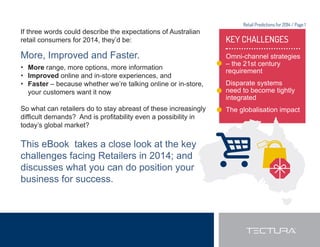
KEY CHALLENGES 
Omni-channel strategies 
– the 21st century 
requirement 
Disparate systems 
need to become tightly 
integrated 
The globalisation impact
Retail Predictions for 2014 / Page 2 
Challenge 1 
Omni-channel Strategies – 
The 21st Century Requirement 
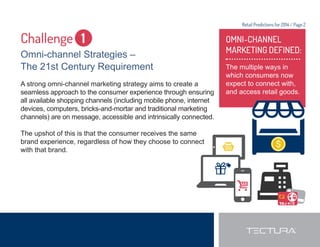
A strong omni-channel marketing strategy aims to create a 
seamless approach to the consumer experience through ensuring 
all available shopping channels (including mobile phone, internet 
devices, computers, bricks-and-mortar and traditional marketing 
channels) are on message, accessible and intrinsically connected. 
The upshot of this is that the consumer receives the same 
brand experience, regardless of how they choose to connect 
with that brand. 
OMNI-CHANNEL 
MARKETING DEFINED: 
The multiple ways in 
which consumers now 
expect to connect with, 
and access retail goods.
Retail Predictions for 2014 / Page 3 
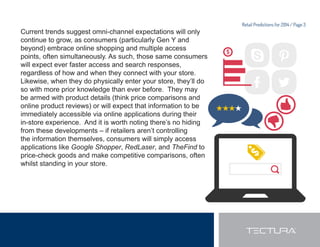
Current trends suggest omni-channel expectations will only 
continue to grow, as consumers (particularly Gen Y and 
beyond) embrace online shopping and multiple access 
points, often simultaneously. As such, those same consumers 
will expect ever faster access and search responses, 
regardless of how and when they connect with your store. 
Likewise, when they do physically enter your store, they’ll do 
so with more prior knowledge than ever before. They may 
be armed with product details (think price comparisons and 
online product reviews) or will expect that information to be 
immediately accessible via online applications during their 
in-store experience. And it is worth noting there’s no hiding 
from these developments – if retailers aren’t controlling 
the information themselves, consumers will simply access 
applications like Google Shopper, RedLaser, and TheFind to 
price-check goods and make competitive comparisons, often 
whilst standing in your store.
Retail Predictions for 2014 / Page 4 
WHAT TO DO? 
Adapt strategies to 
personalise the 
shopping experience 
and genuinely embrace 
social, local and mobile. 
What this boils down to is a previously inconceivable array of 
consumer power and choice. Your customers might choose 
to shop at home, or in any manner of mobile location. And even 
when physically in your store, the lure of your competitors will 
always be imminent. 
5HWDLOHUVIRFXVHGRQSUR¿WDELOLWZLOOQHHGWRDGDSWWKHLU 
strategies to personalise the shopping experience and 
genuinely embrace social, local and mobile (SoLoMo) 
applications by investing in the infrastructure underpinning 
them. And it goes without saying that retailers parading 
their omni-channel credentials without underlying systems 
integration are likely to cause damage to their brands as 
they slowly disappoint consumers’ increasingly sophisticated 
expectations. 
Retailers should understand how their customers “path to 
purchase” has changed, and develop their omni-channel 
strategies to leverage this.
Retail Predictions for 2014 / Page 5 
Challenge 2 
Disparate systems will need to integrate. 
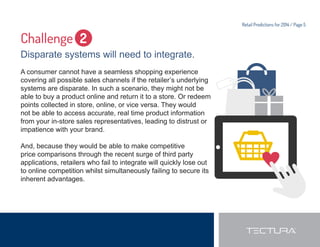
A consumer cannot have a seamless shopping experience 
covering all possible sales channels if the retailer’s underlying 
systems are disparate. In such a scenario, they might not be 
able to buy a product online and return it to a store. Or redeem 
points collected in store, online, or vice versa. They would 
not be able to access accurate, real time product information 
from your in-store sales representatives, leading to distrust or 
impatience with your brand. 
And, because they would be able to make competitive 
price comparisons through the recent surge of third party 
applications, retailers who fail to integrate will quickly lose out 
to online competition whilst simultaneously failing to secure its 
inherent advantages.
Retail Predictions for 2014 / Page 6 
,QWHJUDWHGVVWHPVSURYLGHWZRNHEHQH¿WV7KHNHHSRX 
competitive with the new players driving the retail sector; and 
WKHDOORZRXWRFUHDWHOHDQHUPRUHHI¿FLHQWRSHUDWLRQV 
through streamlining your order processing, stock controls and 
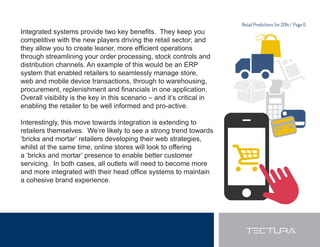
distribution channels. An example of this would be an ERP 
system that enabled retailers to seamlessly manage store, 
web and mobile device transactions, through to warehousing, 
SURFXUHPHQWUHSOHQLVKPHQWDQG¿QDQFLDOVLQRQHDSSOLFDWLRQ 
Overall visibility is the key in this scenario – and it’s critical in 
enabling the retailer to be well informed and pro-active. 
Interestingly, this move towards integration is extending to 
retailers themselves. We’re likely to see a strong trend towards 
‘bricks and mortar’ retailers developing their web strategies, 
whilst at the same time, online stores will look to offering 
a ‘bricks and mortar’ presence to enable better customer 
servicing. In both cases, all outlets will need to become more 
DQGPRUHLQWHJUDWHGZLWKWKHLUKHDGRI¿FHVVWHPVWRPDLQWDLQ 
a cohesive brand experience.
Retail Predictions for 2014 / Page 7 
Equally, loyalty programs are currently in the process of 
developing beyond simple card/ point type systems and 
savvy retailers are focussing more on gathering personalised 
details to continue the drive towards highly targeted offers and 
promotions. 
Again, whilst plenty of retailers will pay lip service to this drive; 
only those with access to accurate data on customer buying 
histories will have the ability to analyse those behaviours and 
react quickly with authentic offers and promotions. Retailers 
who’ve invested in technology and have close integration of 
their loyalty/ marketing and ERP systems will be in a strong 
position to target their best customers and encourage the 
EHKDYLRXUVRIVLPLODUOSUR¿OHGJURXSVZLWKUHOHYDQWRIIHUV,Q 
WKLVVHQVHµORDOW¶ZLOOTXLFNOPRYHEHRQGVLPSOL¿HGUHZDUG 
VVWHPVWRDORQJWHUPSHUVRQDOHQJDJHPHQWZLWKSUR¿WDEOH 
customers, regardless of where they are in the world. 
WHAT TO DO? 
Invest in ERP technology 
that seamlessly integrates 
operations with sales 
and marketing to 
personalise the 
customer experience.
Retail Predictions for 2014 / Page 8 
Challenge 3 
Globalisation 
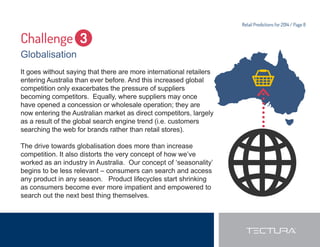
It goes without saying that there are more international retailers 
entering Australia than ever before. And this increased global 
competition only exacerbates the pressure of suppliers 
becoming competitors. Equally, where suppliers may once 
have opened a concession or wholesale operation; they are 
now entering the Australian market as direct competitors, largely 
as a result of the global search engine trend (i.e. customers 
searching the web for brands rather than retail stores). 
The drive towards globalisation does more than increase 
competition. It also distorts the very concept of how we’ve 
worked as an industry in Australia. Our concept of ‘seasonality’ 
begins to be less relevant – consumers can search and access 
any product in any season. Product lifecycles start shrinking 
as consumers become ever more impatient and empowered to 
search out the next best thing themselves.
Retail Predictions for 2014 / Page 9 
When reliance on traditional retail concepts start to shift, so too 
must the solutions. Global change can provide an excellent 
opportunity for retailers who were previously beholden to 
seasonal constraints and product lifecycles to create their own, 
more agile processes. 
As such, there’s now a growing need for accurate SKU (Stock 
.HHSLQJ8QLWV
VDOHVDVSUR¿WDELOLWDQDOVLVEHFRPHVHYHU 
more critical to providing your customers with exactly what they 
want, and in adapting your product lines quickly, in line with 
changing behaviours. 
And of course this analysis will only ever be as good as the 
data underpinning it. If you had real time, accurate data; you’d 
understand exactly what your business looks like at every given 
moment. You’d have instant reporting highlighting issues as 
they happen (be it wage percentages, margins, stock turns or 
out of stocks) and access to this information via real time feeds 
VRLVVXHVFDQEH¿[HGTXLFNODQGGHFLVLRQVPDGHLQOLQHZLWK 
changing markets and customer behaviours. 
WHAT TO DO? 
Embrace the 
opportunities provided 
by globalisation by 
being nimble, using 
real-time, accurate data 
to understand exactly 
what your business 
looks like at any given 
moment.
Retail Predictions for 2014 / Page 10 
The solution for Retailers in 2014? 
It’s all about having access to technology that you can build 
your business upon. 
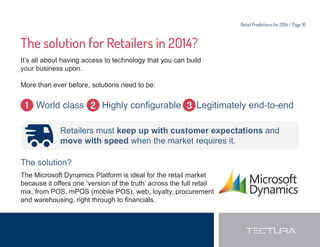
More than ever before, solutions need to be: 
 1 :RUOGFODVV2+LJKOFRQ¿JXUDEOH3/HJLWLPDWHOHQGWRHQG 
Retailers must keep up with customer expectations and 
move with speed when the market requires it. 
7KHVROXWLRQ 
The Microsoft Dynamics Platform is ideal for the retail market 
because it offers one ‘version of the truth’ across the full retail 
mix, from POS, mPOS (mobile POS), web, loyalty, procurement 
DQGZDUHKRXVLQJULJKWWKURXJKWR¿QDQFLDOV
Retail Predictions for 2014 / Page 11 
The good news is, the global consumer is accessible to 
Australian Retailers too – providing you have the means to 
attract them, and the infrastructure to support and adapt to 
growing worldwide sales. 
7KHSDUWQHU 
“Likewise, when you work with a dedicated Microsoft Partner 
like Tectura, you access local resources that have an in-depth 
understanding of the Australian Retail Market, along with 
Tectura’s global retail expertise of working with some of the 
world’s leading and most progressive retailers. It’s a winning 
combination when it comes to positioning Retailers to grow 
and develop in the 21st century global market.” 
Says Kerry Proctor; Tectura Business Development Manager 
7R¿QGRXWPRUHDERXWKRZ7HFWXUDDQGWKH0LFURVRIW'QDPLF 
Platform can help you, call 1300 TECTURA (1300 832 887) for 
a complimentary consultation with one of our dedicated retail 
consultants.

Retail predictions 2014 -

  • 1.
    Retail Predictions for2014 / Page 1 What you need to know. What you need to do. Retail Predictions for 2014 Key trends Retailers are being forced to reconcile within their retail operation.
  • 2.
    Retail Predictions for2014 / Page 1 If three words could describe the expectations of Australian retail consumers for 2014, they’d be: More, Improved and Faster. ȏ More range, more options, more information ȏ Improved online and in-store experiences, and ȏ Faster – because whether we’re talking online or in-store, your customers want it now So what can retailers do to stay abreast of these increasingly GLI¿FXOWGHPDQGV$QGLVSUR¿WDELOLWHYHQDSRVVLELOLWLQ WRGD¶VJOREDOPDUNHW This eBook takes a close look at the key challenges facing Retailers in 2014; and discusses what you can do position your business for success. KEY CHALLENGES Omni-channel strategies – the 21st century requirement Disparate systems need to become tightly integrated The globalisation impact
  • 3.
    Retail Predictions for2014 / Page 2 Challenge 1 Omni-channel Strategies – The 21st Century Requirement A strong omni-channel marketing strategy aims to create a seamless approach to the consumer experience through ensuring all available shopping channels (including mobile phone, internet devices, computers, bricks-and-mortar and traditional marketing channels) are on message, accessible and intrinsically connected. The upshot of this is that the consumer receives the same brand experience, regardless of how they choose to connect with that brand. OMNI-CHANNEL MARKETING DEFINED: The multiple ways in which consumers now expect to connect with, and access retail goods.
  • 4.
    Retail Predictions for2014 / Page 3 Current trends suggest omni-channel expectations will only continue to grow, as consumers (particularly Gen Y and beyond) embrace online shopping and multiple access points, often simultaneously. As such, those same consumers will expect ever faster access and search responses, regardless of how and when they connect with your store. Likewise, when they do physically enter your store, they’ll do so with more prior knowledge than ever before. They may be armed with product details (think price comparisons and online product reviews) or will expect that information to be immediately accessible via online applications during their in-store experience. And it is worth noting there’s no hiding from these developments – if retailers aren’t controlling the information themselves, consumers will simply access applications like Google Shopper, RedLaser, and TheFind to price-check goods and make competitive comparisons, often whilst standing in your store.
  • 5.
    Retail Predictions for2014 / Page 4 WHAT TO DO? Adapt strategies to personalise the shopping experience and genuinely embrace social, local and mobile. What this boils down to is a previously inconceivable array of consumer power and choice. Your customers might choose to shop at home, or in any manner of mobile location. And even when physically in your store, the lure of your competitors will always be imminent. 5HWDLOHUVIRFXVHGRQSUR¿WDELOLWZLOOQHHGWRDGDSWWKHLU strategies to personalise the shopping experience and genuinely embrace social, local and mobile (SoLoMo) applications by investing in the infrastructure underpinning them. And it goes without saying that retailers parading their omni-channel credentials without underlying systems integration are likely to cause damage to their brands as they slowly disappoint consumers’ increasingly sophisticated expectations. Retailers should understand how their customers “path to purchase” has changed, and develop their omni-channel strategies to leverage this.
  • 6.
    Retail Predictions for2014 / Page 5 Challenge 2 Disparate systems will need to integrate. A consumer cannot have a seamless shopping experience covering all possible sales channels if the retailer’s underlying systems are disparate. In such a scenario, they might not be able to buy a product online and return it to a store. Or redeem points collected in store, online, or vice versa. They would not be able to access accurate, real time product information from your in-store sales representatives, leading to distrust or impatience with your brand. And, because they would be able to make competitive price comparisons through the recent surge of third party applications, retailers who fail to integrate will quickly lose out to online competition whilst simultaneously failing to secure its inherent advantages.
  • 7.
    Retail Predictions for2014 / Page 6 ,QWHJUDWHGVVWHPVSURYLGHWZRNHEHQH¿WV7KHNHHSRX competitive with the new players driving the retail sector; and WKHDOORZRXWRFUHDWHOHDQHUPRUHHI¿FLHQWRSHUDWLRQV through streamlining your order processing, stock controls and distribution channels. An example of this would be an ERP system that enabled retailers to seamlessly manage store, web and mobile device transactions, through to warehousing, SURFXUHPHQWUHSOHQLVKPHQWDQG¿QDQFLDOVLQRQHDSSOLFDWLRQ Overall visibility is the key in this scenario – and it’s critical in enabling the retailer to be well informed and pro-active. Interestingly, this move towards integration is extending to retailers themselves. We’re likely to see a strong trend towards ‘bricks and mortar’ retailers developing their web strategies, whilst at the same time, online stores will look to offering a ‘bricks and mortar’ presence to enable better customer servicing. In both cases, all outlets will need to become more DQGPRUHLQWHJUDWHGZLWKWKHLUKHDGRI¿FHVVWHPVWRPDLQWDLQ a cohesive brand experience.
  • 8.
    Retail Predictions for2014 / Page 7 Equally, loyalty programs are currently in the process of developing beyond simple card/ point type systems and savvy retailers are focussing more on gathering personalised details to continue the drive towards highly targeted offers and promotions. Again, whilst plenty of retailers will pay lip service to this drive; only those with access to accurate data on customer buying histories will have the ability to analyse those behaviours and react quickly with authentic offers and promotions. Retailers who’ve invested in technology and have close integration of their loyalty/ marketing and ERP systems will be in a strong position to target their best customers and encourage the EHKDYLRXUVRIVLPLODUOSUR¿OHGJURXSVZLWKUHOHYDQWRIIHUV,Q WKLVVHQVHµORDOW¶ZLOOTXLFNOPRYHEHRQGVLPSOL¿HGUHZDUG VVWHPVWRDORQJWHUPSHUVRQDOHQJDJHPHQWZLWKSUR¿WDEOH customers, regardless of where they are in the world. WHAT TO DO? Invest in ERP technology that seamlessly integrates operations with sales and marketing to personalise the customer experience.
  • 9.
    Retail Predictions for2014 / Page 8 Challenge 3 Globalisation It goes without saying that there are more international retailers entering Australia than ever before. And this increased global competition only exacerbates the pressure of suppliers becoming competitors. Equally, where suppliers may once have opened a concession or wholesale operation; they are now entering the Australian market as direct competitors, largely as a result of the global search engine trend (i.e. customers searching the web for brands rather than retail stores). The drive towards globalisation does more than increase competition. It also distorts the very concept of how we’ve worked as an industry in Australia. Our concept of ‘seasonality’ begins to be less relevant – consumers can search and access any product in any season. Product lifecycles start shrinking as consumers become ever more impatient and empowered to search out the next best thing themselves.
  • 10.
    Retail Predictions for2014 / Page 9 When reliance on traditional retail concepts start to shift, so too must the solutions. Global change can provide an excellent opportunity for retailers who were previously beholden to seasonal constraints and product lifecycles to create their own, more agile processes. As such, there’s now a growing need for accurate SKU (Stock .HHSLQJ8QLWV
  • 11.
    VDOHVDVSUR¿WDELOLWDQDOVLVEHFRPHVHYHU more criticalto providing your customers with exactly what they want, and in adapting your product lines quickly, in line with changing behaviours. And of course this analysis will only ever be as good as the data underpinning it. If you had real time, accurate data; you’d understand exactly what your business looks like at every given moment. You’d have instant reporting highlighting issues as they happen (be it wage percentages, margins, stock turns or out of stocks) and access to this information via real time feeds VRLVVXHVFDQEH¿[HGTXLFNODQGGHFLVLRQVPDGHLQOLQHZLWK changing markets and customer behaviours. WHAT TO DO? Embrace the opportunities provided by globalisation by being nimble, using real-time, accurate data to understand exactly what your business looks like at any given moment.
  • 12.
    Retail Predictions for2014 / Page 10 The solution for Retailers in 2014? It’s all about having access to technology that you can build your business upon. More than ever before, solutions need to be: 1 :RUOGFODVV2+LJKOFRQ¿JXUDEOH3/HJLWLPDWHOHQGWRHQG Retailers must keep up with customer expectations and move with speed when the market requires it. 7KHVROXWLRQ The Microsoft Dynamics Platform is ideal for the retail market because it offers one ‘version of the truth’ across the full retail mix, from POS, mPOS (mobile POS), web, loyalty, procurement DQGZDUHKRXVLQJULJKWWKURXJKWR¿QDQFLDOV
  • 13.
    Retail Predictions for2014 / Page 11 The good news is, the global consumer is accessible to Australian Retailers too – providing you have the means to attract them, and the infrastructure to support and adapt to growing worldwide sales. 7KHSDUWQHU “Likewise, when you work with a dedicated Microsoft Partner like Tectura, you access local resources that have an in-depth understanding of the Australian Retail Market, along with Tectura’s global retail expertise of working with some of the world’s leading and most progressive retailers. It’s a winning combination when it comes to positioning Retailers to grow and develop in the 21st century global market.” Says Kerry Proctor; Tectura Business Development Manager 7R¿QGRXWPRUHDERXWKRZ7HFWXUDDQGWKH0LFURVRIW'QDPLF Platform can help you, call 1300 TECTURA (1300 832 887) for a complimentary consultation with one of our dedicated retail consultants.