Submitted By:
Naresh Sharma
Amit Sharma
A PRESENTATION ON
Management of Channels
Submitted To:
Mrs. Monika Dubey
INTRODUCTION
 Channel management involves more than just distribution,
and has been described as management of how and where a
product is used and of how the customer and the product
interact.
 Channel management covers processes for identifying key
customers, communicating with them, and continuing to
create value after the first contact.
 After a company has chosen alternative, individual
intermediaries' must be selected trained, motivated, and
evaluated.
 Channel arrangements must be modified over time.
Selecting channel members:
 recruit intermediaries
 determine what characteristics distinguish
the better intermediaries
Motivating channel members:
 provide superior value to these intermediaries
 provide training programms,
 market research programs, and other
 capability - building programs
to improve intermediaries' performance.
PROCESS
 The company and the intermediaries' are partners in the
joint efforts to satisfy end-using consumers. They can
draw on the following types of power to elicit cooperation:
 1. Coercive power: Coercive power occurs when a
manufacturer threatends to withdraw a resource or
terminate a relationship if the intermediaries' fail to
cooperate.
 2. Reward power: Reward power occurs when the
manufacturer offers intermediaries' an extra benefit for
performing specific acts or functions.
PROCESS (CONTINUE)
 3. Expert power: Expert power can be applied when
the manufacturer has special knowledge that the
intermediaries' value.
 4. Legitimate power: Legitimate power is wielded
when the manufacturer requires a behavior that is
warranted under the contact. As long as the
intermediaries' view the manufacturer as a legitimate
leader, legitimate power works.
 5. Referent point : Referent point occurs when the
manufacturer is so highly respected that
intermediaries' are proud to be associated.
Companies such as IBM, caterpillar, and Hewlett-
Packard have high referent power.
 6. Evaluating channel members: Evaluation
provides the information necessary to decide these channel
members to retain and which to drop. Evaluation criteria
include sales volume and value, profitability, levels of the
stocks etc.
WHOLESALING
 The sale and distribution of goods to users other than end
consumers.
 Wholesaling involves selling merchandise to retailers,
wholesalers and merchants, or to industrial, commercial
and institutional users.
 Wholesaling often occurs when large quantities of
merchandise are reassembled, sorted, then repackage, and
distribute in smaller lots.
 Business-to-Business (B2B).
Current trends in Wholesaling
1. The distribution between large retailers and large
wholesalers continues to blur :
 While many retailers now operate formats such as
wholesale clubs and super-centers that perform many
wholesale functions
 Many large wholesalers are setting up their own
retailing operations
 For example Walmart.
2. Wholesalers will continue to increase the services they
provide to retailers—
 retail pricing
 cooperative advertising
 marketing and management information reports
 accounting services
 online transactions.
3. However, the increased use of
 computerized,
 automated, and
 Web-based systems will help wholesalers contain the
costs of ordering, shipping, and inventory holding, thus
boosting their productivity.
 Wholesalers who do not find efficient way to deliver
value to their customers will soon drop by the wayside.
4. With the advent of the internet and E-procurement,
an increasing number of wholesalers locate nearer
manufacturing bases in China, Taiwan, and Southeast
Asia.
It is different from the traditional way that wholesalers
were closer to the markets they supplied than the source
from which they got the products.
RETAILING
 Retail is the process of selling consumer goods or
services to customers through multiple channels of
distribution to earn a profit.
 In retailing product is sell to the end consumer for
personal or non- business use.
1. Self serve :-
Serve the customers who are willing to perform their own
locate-compare-select process to save money. For Ex.
Walmart, Supermarket.
2.High speed retail :-
This is driving trends like drive-by dining, mobile banking
and it’s also killing giant malls, which take too much time
to shop.
 Equally, people are getting increasingly bored with the
same brands in the same places, which in turn is driving
‘pop-up’ retail and ‘limited time only’ products and offers.
Current trends in Retailing
3.E-retailing :-
The sale of goods and services through the Internet.
Electronic retailing, or e-tailing, can include business-to-
business and business-to-consumer sales. E-tailing
revenue can come from the sale of products and services,
through subscriptions to website content, or through
advertising.
4. Retailers will adopt and experiment with technology.
3D PRINTING
POS TECHNOLOGY
BEACONS
5.More retailers will take control of their value chain and
improve order fulfillment :-
 Retailers will realize this in 2015, which is why we’ll
likely see an increase in value chain initiatives, single
product retail, and private label merchandise.
 Additionally, more retailers will get creative with how they
fulfill orders and distribute products.
6. Multi store Retail Chain :-
here the objective of business is to expand by opening
stores across different markets and geographies and reap
economies of scale and scope.
7.Multi brand retail chain :-
in this modern retail format generally stores provide
variety of brands and product at one place.
Technology in Retailing
The new technology in Retailing is required which is
necessary for the next level of retailing:
 Technology is required to automate the Customer's
Experience.
 Consumers wants more transparency.
 More Personalize and Engaged Service to Consumers.
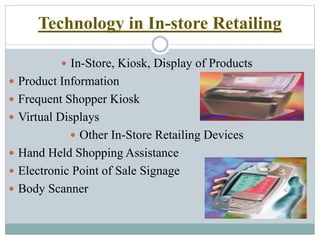
Technology in In-store Retailing
 In-Store, Kiosk, Display of Products
 Product Information
 Frequent Shopper Kiosk
 Virtual Displays
 Other In-Store Retailing Devices
 Hand Held Shopping Assistance
 Electronic Point of Sale Signage
 Body Scanner
In-Store Checkout Technologies
1.Self-Scanning
 The device is connected with a computer monitor screen
where the prices and detail of product appears.
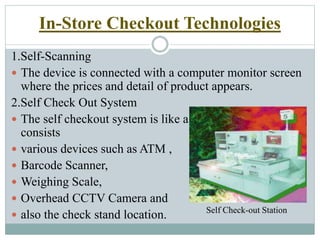
2.Self Check Out System
 The self checkout system is like a small station which
consists
 various devices such as ATM ,
 Barcode Scanner,
 Weighing Scale,
 Overhead CCTV Camera and
 also the check stand location. Self Check-out Station
Retail distribution system in India
 The Indian Retail sector has come off age and has gone
through major transformation over the last decade with a
noticeable shift towards organised retailing.
 A T Kearney, a US Based global management consulting
firm has ranked India as the fourth most attractive nation
for retail investment among 30 flourishing markets.
Current situation of Retail distribution
system in India
 The retail market is expected to reach a whooping Rs. 47
lakh crore by 2016-17, as it expands at a
compounded annual growth rate of 15 per cent,
accordingy to the ‘Yes Bank - Assocham’ study.
 The retail market, (including organised and unorganised
retail), was at Rs. 23 lakh crore in 2011-12. According to
the study, organised retail, that comprised just seven per
cent of the overall retail market in 2011-12, is expected to
grow at a CAGR of 24 per cent and attain 10.2 per cent
share of the total retail sector by 2016-17.
Emerging sectors/trends in Indian retailing
 Within retail, the emerging sectors would be food and
grocery, apparel, electronics, e-commerce, fashion and
lifestyle.
 Use of computers for merchandise planning and
management, control of inventory costs and supplies and
replenishment of goods done electronically, internal store
billing, etc has changed the face of product retailing.
Retail classification in India
 Organized retail - Organised traders/retailers, who are
licensed for trading activities and registered to pay taxes to
the government.
 Unorganized retail – It consists of unauthorized small
shops - conventional Kirana shops, general stores, corner
shops among various other small retail outlets - but remain
as the radiating force of Indian retail industry.
Market Dynamics
 In the past few years, Indian Retail sector has seen
tremendous growth in the organised segment.
 Major domestic players have stepped into the retail
arena with long term, ambitious plans to expand their
business across verticals, cities and formats.
 Companies like Tata, Reliance, Adani Enterprise and
Bharti have been investing considerably in the booming
Indian Retail market.
 Along with these giant retailers, a number of transnational
brands have also entered into the market to set up retail
chains in close association with bigger Indian companies.
Key drivers of the Indian Retail Industry
 Emergence of nuclear families
 An increase in the double-income households trend
 Large working population
 Reasonable Real estate prices
 Increase in disposable income and customer aspiration
 Demand as well as increase in expenditure for luxury
items
 Growing preference for branded products and higher
aspirations
 Growing liberalization of the FDI policy in the past
decade
 Increasing urbanisation,
 Rising affluence amid consumers
Bottlenecks
 A long way to meet international standards
 Lack of efficient supply-chain management
 Lack of required retail space
 No fixed consumption pattern
 Shortage of trained manpower
 Lack of proper infrastructure and distribution channel
The Road Ahead…
 Organised Retail is emerging as the new phenomenon in
India and despite the slump, the market is growing
exponentially.
 As economic growth brings more of India’s people into
the consuming classes and organized retail lures more and
more existing shoppers, by 2017, more than 300 million
shoppers are likely to patronize organized retail chains.
 Thus, with tremendous potential and huge population,
India is set for high growth in consumer expenditure. With
India's large ‘young’ population and high domestic
consumption, the macro trends for the sector look
favorable.
REFERENCE
 http://www.financepractitioner.com/dictionary/cha
nnel-management
 http://www.expertsmind.com/questions/channel-
management-decisions-30113335.aspx
 http://jennyxzkong.blogspot.in/2012/05/wholesalin
g-4-trends-in-wholesaling.html
 http://info.shine.com/industry/retail/7.html
 http://www.vmou.ac.in/prog?SC=129
THANK YOU !
ANY QUERY?

Marketing mgmt

  • 1.
    Submitted By: Naresh Sharma AmitSharma A PRESENTATION ON Management of Channels Submitted To: Mrs. Monika Dubey
  • 2.
    INTRODUCTION  Channel managementinvolves more than just distribution, and has been described as management of how and where a product is used and of how the customer and the product interact.  Channel management covers processes for identifying key customers, communicating with them, and continuing to create value after the first contact.  After a company has chosen alternative, individual intermediaries' must be selected trained, motivated, and evaluated.  Channel arrangements must be modified over time.
  • 3.
    Selecting channel members: recruit intermediaries  determine what characteristics distinguish the better intermediaries Motivating channel members:  provide superior value to these intermediaries  provide training programms,  market research programs, and other  capability - building programs to improve intermediaries' performance. PROCESS
  • 4.
     The companyand the intermediaries' are partners in the joint efforts to satisfy end-using consumers. They can draw on the following types of power to elicit cooperation:  1. Coercive power: Coercive power occurs when a manufacturer threatends to withdraw a resource or terminate a relationship if the intermediaries' fail to cooperate.  2. Reward power: Reward power occurs when the manufacturer offers intermediaries' an extra benefit for performing specific acts or functions. PROCESS (CONTINUE)
  • 5.
     3. Expertpower: Expert power can be applied when the manufacturer has special knowledge that the intermediaries' value.  4. Legitimate power: Legitimate power is wielded when the manufacturer requires a behavior that is warranted under the contact. As long as the intermediaries' view the manufacturer as a legitimate leader, legitimate power works.
  • 6.
     5. Referentpoint : Referent point occurs when the manufacturer is so highly respected that intermediaries' are proud to be associated. Companies such as IBM, caterpillar, and Hewlett- Packard have high referent power.  6. Evaluating channel members: Evaluation provides the information necessary to decide these channel members to retain and which to drop. Evaluation criteria include sales volume and value, profitability, levels of the stocks etc.
  • 7.
    WHOLESALING  The saleand distribution of goods to users other than end consumers.  Wholesaling involves selling merchandise to retailers, wholesalers and merchants, or to industrial, commercial and institutional users.  Wholesaling often occurs when large quantities of merchandise are reassembled, sorted, then repackage, and distribute in smaller lots.  Business-to-Business (B2B).
  • 8.
    Current trends inWholesaling 1. The distribution between large retailers and large wholesalers continues to blur :  While many retailers now operate formats such as wholesale clubs and super-centers that perform many wholesale functions  Many large wholesalers are setting up their own retailing operations  For example Walmart.
  • 9.
    2. Wholesalers willcontinue to increase the services they provide to retailers—  retail pricing  cooperative advertising  marketing and management information reports  accounting services  online transactions.
  • 10.
    3. However, theincreased use of  computerized,  automated, and  Web-based systems will help wholesalers contain the costs of ordering, shipping, and inventory holding, thus boosting their productivity.  Wholesalers who do not find efficient way to deliver value to their customers will soon drop by the wayside.
  • 11.
    4. With theadvent of the internet and E-procurement, an increasing number of wholesalers locate nearer manufacturing bases in China, Taiwan, and Southeast Asia. It is different from the traditional way that wholesalers were closer to the markets they supplied than the source from which they got the products.
  • 12.
    RETAILING  Retail isthe process of selling consumer goods or services to customers through multiple channels of distribution to earn a profit.  In retailing product is sell to the end consumer for personal or non- business use.
  • 13.
    1. Self serve:- Serve the customers who are willing to perform their own locate-compare-select process to save money. For Ex. Walmart, Supermarket. 2.High speed retail :- This is driving trends like drive-by dining, mobile banking and it’s also killing giant malls, which take too much time to shop.  Equally, people are getting increasingly bored with the same brands in the same places, which in turn is driving ‘pop-up’ retail and ‘limited time only’ products and offers. Current trends in Retailing
  • 14.
    3.E-retailing :- The saleof goods and services through the Internet. Electronic retailing, or e-tailing, can include business-to- business and business-to-consumer sales. E-tailing revenue can come from the sale of products and services, through subscriptions to website content, or through advertising. 4. Retailers will adopt and experiment with technology. 3D PRINTING POS TECHNOLOGY BEACONS
  • 15.
    5.More retailers willtake control of their value chain and improve order fulfillment :-  Retailers will realize this in 2015, which is why we’ll likely see an increase in value chain initiatives, single product retail, and private label merchandise.  Additionally, more retailers will get creative with how they fulfill orders and distribute products.
  • 16.
    6. Multi storeRetail Chain :- here the objective of business is to expand by opening stores across different markets and geographies and reap economies of scale and scope. 7.Multi brand retail chain :- in this modern retail format generally stores provide variety of brands and product at one place.
  • 17.
    Technology in Retailing Thenew technology in Retailing is required which is necessary for the next level of retailing:  Technology is required to automate the Customer's Experience.  Consumers wants more transparency.  More Personalize and Engaged Service to Consumers.
  • 18.
    Technology in In-storeRetailing  In-Store, Kiosk, Display of Products  Product Information  Frequent Shopper Kiosk  Virtual Displays  Other In-Store Retailing Devices  Hand Held Shopping Assistance  Electronic Point of Sale Signage  Body Scanner
  • 19.
    In-Store Checkout Technologies 1.Self-Scanning The device is connected with a computer monitor screen where the prices and detail of product appears. 2.Self Check Out System  The self checkout system is like a small station which consists  various devices such as ATM ,  Barcode Scanner,  Weighing Scale,  Overhead CCTV Camera and  also the check stand location. Self Check-out Station
  • 20.
    Retail distribution systemin India  The Indian Retail sector has come off age and has gone through major transformation over the last decade with a noticeable shift towards organised retailing.  A T Kearney, a US Based global management consulting firm has ranked India as the fourth most attractive nation for retail investment among 30 flourishing markets.
  • 21.
    Current situation ofRetail distribution system in India  The retail market is expected to reach a whooping Rs. 47 lakh crore by 2016-17, as it expands at a compounded annual growth rate of 15 per cent, accordingy to the ‘Yes Bank - Assocham’ study.  The retail market, (including organised and unorganised retail), was at Rs. 23 lakh crore in 2011-12. According to the study, organised retail, that comprised just seven per cent of the overall retail market in 2011-12, is expected to grow at a CAGR of 24 per cent and attain 10.2 per cent share of the total retail sector by 2016-17.
  • 22.
    Emerging sectors/trends inIndian retailing  Within retail, the emerging sectors would be food and grocery, apparel, electronics, e-commerce, fashion and lifestyle.  Use of computers for merchandise planning and management, control of inventory costs and supplies and replenishment of goods done electronically, internal store billing, etc has changed the face of product retailing.
  • 23.
    Retail classification inIndia  Organized retail - Organised traders/retailers, who are licensed for trading activities and registered to pay taxes to the government.  Unorganized retail – It consists of unauthorized small shops - conventional Kirana shops, general stores, corner shops among various other small retail outlets - but remain as the radiating force of Indian retail industry.
  • 24.
    Market Dynamics  Inthe past few years, Indian Retail sector has seen tremendous growth in the organised segment.  Major domestic players have stepped into the retail arena with long term, ambitious plans to expand their business across verticals, cities and formats.  Companies like Tata, Reliance, Adani Enterprise and Bharti have been investing considerably in the booming Indian Retail market.  Along with these giant retailers, a number of transnational brands have also entered into the market to set up retail chains in close association with bigger Indian companies.
  • 25.
    Key drivers ofthe Indian Retail Industry  Emergence of nuclear families  An increase in the double-income households trend  Large working population  Reasonable Real estate prices  Increase in disposable income and customer aspiration  Demand as well as increase in expenditure for luxury items  Growing preference for branded products and higher aspirations
  • 26.
     Growing liberalizationof the FDI policy in the past decade  Increasing urbanisation,  Rising affluence amid consumers Bottlenecks  A long way to meet international standards  Lack of efficient supply-chain management  Lack of required retail space  No fixed consumption pattern  Shortage of trained manpower  Lack of proper infrastructure and distribution channel
  • 27.
    The Road Ahead… Organised Retail is emerging as the new phenomenon in India and despite the slump, the market is growing exponentially.  As economic growth brings more of India’s people into the consuming classes and organized retail lures more and more existing shoppers, by 2017, more than 300 million shoppers are likely to patronize organized retail chains.  Thus, with tremendous potential and huge population, India is set for high growth in consumer expenditure. With India's large ‘young’ population and high domestic consumption, the macro trends for the sector look favorable.
  • 28.
    REFERENCE  http://www.financepractitioner.com/dictionary/cha nnel-management  http://www.expertsmind.com/questions/channel- management-decisions-30113335.aspx http://jennyxzkong.blogspot.in/2012/05/wholesalin g-4-trends-in-wholesaling.html  http://info.shine.com/industry/retail/7.html  http://www.vmou.ac.in/prog?SC=129
  • 29.