Retailing
Objectives To Understand the Functions of Retailers in the Marketing Channel To Identify the Major Types of Retailers To overview the Major Types of Franchising  To identify Strategic Issues in Retailing
Retailing Retailers implement and conclude the actual sale of products to the final consuming units, the ultimate user. Possession Utility Time, place, form & information utility
Importance Of Retailing Impact on the Economy …  - 18% of employment (24 mil 2005) Distribution Functions  - Time, Place   Marketing Functions  - Information & Possession Utility
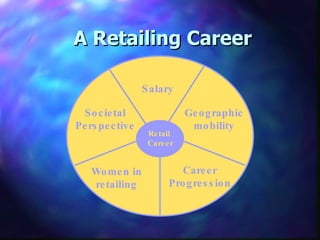
A Retailing Career Retail  Career Salary Career Progression Geographic mobility Women in retailing Societal Perspective
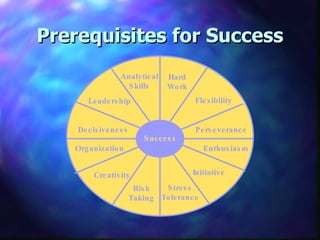
Prerequisites for Success Success Hard Work Analytical Skills Creativity Decisiveness Flexibility Initiative Leadership Organization Risk Taking Stress Tolerance Perseverance Enthusiasm
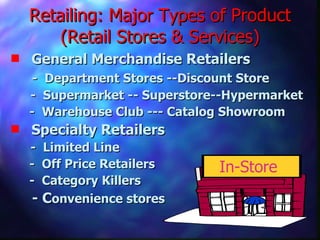
Retailing: Major Types of Product (Retail Stores & Services) General Merchandise Retailers -  Department Stores --Discount Store   -  Supermarket -- Superstore--Hypermarket -  Warehouse Club --- Catalog Showroom Specialty Retailers   -  Limited Line -  Off Price Retailers -  Category Killers - C onvenience stores  In-Store
Department Store Chain operations Wide variety & selection Full service - delivery, credit, returns, repair  Examples: Boscov’s, Macy’s Bloomingdale’s
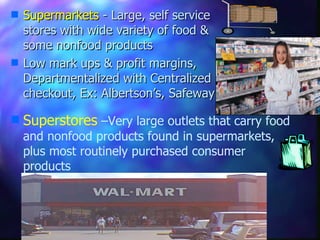
Supermarkets  - Large, self service stores with wide variety of food & some nonfood products Low mark ups & profit margins, Departmentalized with Centralized checkout, Ex: Albertson’s, Safeway Superstores  –Very large outlets that carry food and nonfood products found in supermarkets, plus most routinely purchased consumer products
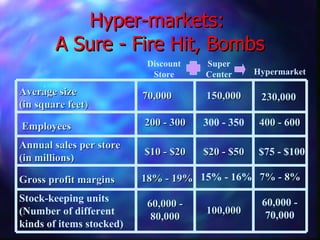
Hyper-markets:  A Sure - Fire Hit, Bombs . Average size (in square feet ) Employees Annual sales per store (in millions) Gross profit margins Stock-keeping units (Number of different kinds of items stocked) 70,000  200 - 300 $10 - $20 18% - 19% 60,000 - 80,000 150,000 300 - 350 $20 - $50 15% - 16% 100,000 230,000 400 - 600 $75 - $100 7% - 8% 60,000 - 70,000 Discount Store Super Center Hypermarket
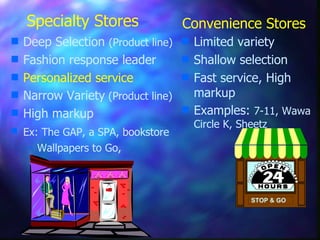
Specialty Stores Deep Selection  (Product line) Fashion response leader  Personalized service Narrow Variety  (Product line) High markup Ex: The GAP, a SPA, bookstore   Wallpapers to Go,  Convenience Stores Limited variety Shallow selection Fast service, High markup Examples:  7-11, Wawa Circle K, Sheetz STOP & GO
Other Types of In-Store Retailing General mass merchandiser Catalog showroom Warehouse club Specialty mass merchandiser Off-price retailer Category  Killer  - Ex.  Toys R US
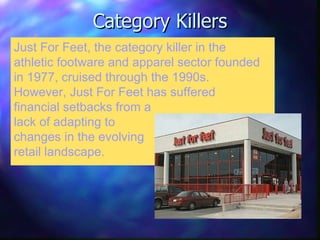
Category Killers Just For Feet, the category killer in the athletic footware and apparel sector founded in 1977, cruised through the 1990s. However, Just For Feet has suffered financial setbacks from a lack of adapting to changes in the evolving retail landscape.
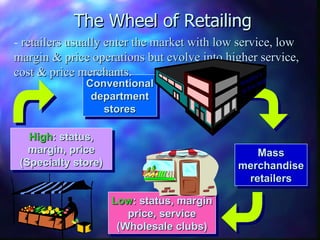
The Wheel of Retailing High : status, margin, price (Specialty store) -  retailers usually enter the market with low service, low margin & price operations but evolve into higher service, cost & price merchants. Conventional department stores Mass merchandise retailers Low : status, margin price, service (Wholesale clubs) Maybry’s at the Mall
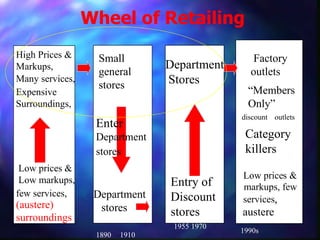
Wheel of Retailing High Prices & Markups,  Many services,  Expensive Surroundings,  Low prices & Low markups,  few services,  (austere) surroundings Small general stores  Department  stores 1890 - 1910 Entry of Discount stores  Department Stores 1955 - 1970 Factory  outlets  “ Members  Only”  discount  outlets Category killers  Low price s &  markups, few  services ,  austere 1990s Enter  Department stores
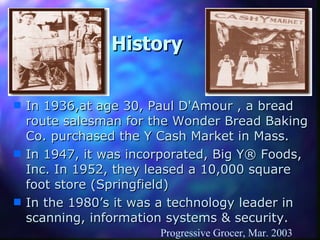
History In 1936,at age 30, Paul D'Amour , a bread route salesman for the Wonder Bread Baking Co. purchased the Y Cash Market in Mass. In 1947, it was incorporated, Big Y® Foods, Inc. In 1952, they leased a 10,000 square foot store (Springfield) In the 1980’s it was a technology leader in  scanning, information systems & security. Progressive Grocer, Mar. 2003
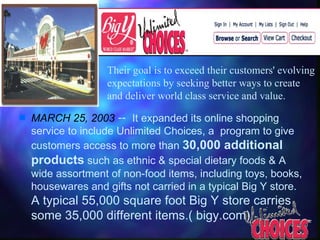
MARCH 25, 2003  --  It expanded its online shopping service to include Unlimited Choices, a  program to give  customers access to more than  30,000 additional products  such as ethnic & special dietary foods & A wide assortment of non-food items, including toys, books, housewares and gifts not carried in a typical Big Y store.  A typical 55,000 square foot Big Y store carries some 35,000 different items.( bigy.com) Their goal is to exceed their customers' evolving expectations by seeking better ways to create and deliver world class service and value.
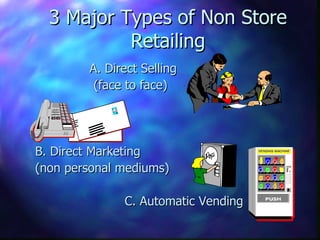
3 Major Types of Non Store Retailing A. Direct Selling (face to face) B. Direct Marketing (non personal mediums) C. Automatic Vending
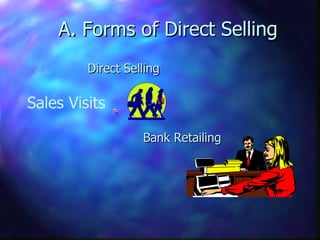
A. Forms of Direct Selling Direct Selling Bank Retailing  Sales Visits
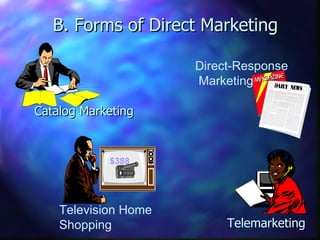
B. Forms of Direct Marketing Catalog Marketing Direct-Response  Marketing Television Home Shopping Telemarketing $388
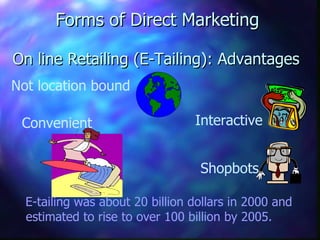
On line Retailing (E-Tailing): Advantages Not location bound Interactive Convenient Shopbots Forms of Direct Marketing E-tailing was about 20 billion dollars in 2000 and estimated to rise to over 100 billion by 2005.
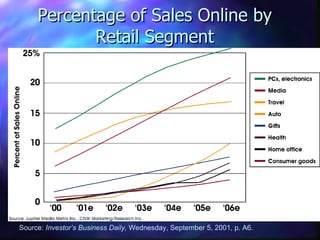
Percentage of Sales Online by Retail Segment Source:  Investor’s Business Daily,  Wednesday, September 5, 2001, p. A6.
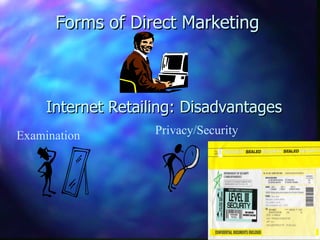
Internet Retailing: Disadvantages Forms of Direct Marketing Examination Privacy/Security
C. Forms of Automatic Vending The use of machines to dispense products includes items such as candy, chewing gum, soft drinks, cigarettes, newspapers, and coffee Advantages: small amount of space needed and no sales personnel Disadvantages: high costs of  equipment and frequent servicing
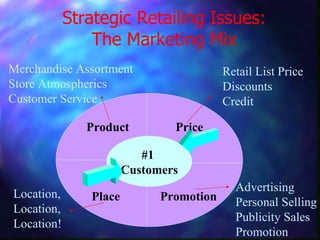
Strategic Retailing Issues: The Marketing Mix #1  Customers Product  Price Place  Promotion Merchandise Assortment Store Atmospherics Customer Service Location, Location, Location! Retail List Price Discounts Credit Advertising Personal Selling Publicity Sales Promotion
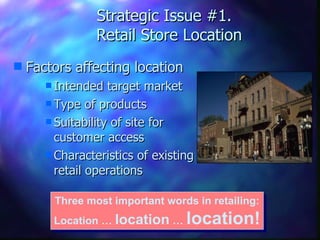
Strategic Issue #1.   Retail Store Location Factors affecting location Intended target market Type of products Suitability of site for customer access Characteristics of existing  retail operations Three most important words in retailing: Location …  location  …  location!
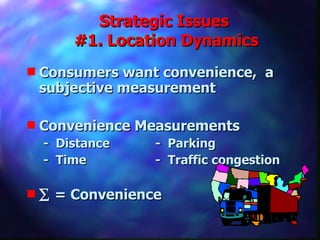
Strategic Issues  #1. Location Dynamics Consumers want convenience,  a subjective measurement Convenience Measurements  -  Distance -  Parking -  Time -  Traffic congestion    = Convenience
LOCATION sets the  trading area Free standing structure Central Business District (CBD) Shopping Malls  (avg. age 23 yrs 2002) -  Neighborhood shopping center -  Community shopping center -  Regional shopping center Non Traditional Shopping Center -  Factory Outlets -  Mini warehouse mall
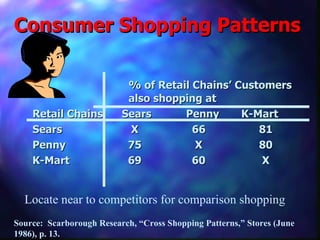
Consumer Shopping Patterns % of Retail Chains’ Customers  also shopping at Retail Chains  Sears  Penny  K-Mart Sears   X  66  81 Penny   75  X  80 K-Mart   69  60  X Source:  Scarborough Research, “Cross Shopping Patterns,” Stores (June 1986), p. 13. Locate near to competitors for comparison shopping
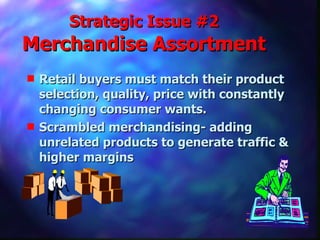
Strategic Issue #2  Merchandise Assortment Retail buyers must match their product selection, quality, price with constantly changing consumer wants. Scrambled merchandising- adding unrelated products to generate traffic & higher margins
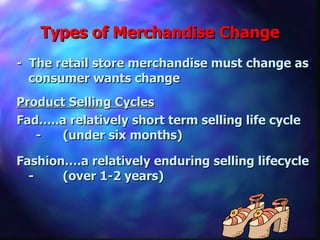
Types of Merchandise Change -  The retail store merchandise must change as consumer wants change Product Selling Cycles Fad…..a relatively short term selling life cycle  -  (under six months)  Fashion….a relatively enduring selling lifecycle -  (over 1-2 years)
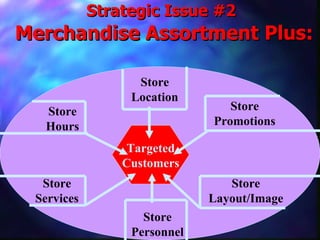
Strategic Issue #2   Merchandise Assortment Plus: Store Location Store Promotions Store Layout/Image Store Personnel Store Services Store Hours Targeted Customers
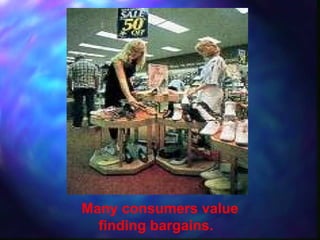
Many consumers value finding bargains.
Store Atmospherics The sum total of all store stimuli, interior & exterior physical characteristics that appeal to emotions (psychological field) Components:  Ambient factors, Design and Social Factors.  Ambient Factors  ( Perceptions) -  lighting   -  sounds -  smell
Store Atmospherics Design Factors   ( Perceptions) -  Floor covering  - Ceilings   -  Wall coverings  - Dressing Rooms -  Displays/Fixtures  - Aisles -  Color  - Layout -  Cleanliness  - Signage -  Furnishings  - windows
Social factors:  In store service   (sales personnel social & emotional labor) - Courteous     Rude behavior - Knowledgeable     Low information Service     Insincere Employee dress norms (casual ??) Make it convenient & pleasurable for customers to shop and pay for merchandise Store Atmospherics Body Scan computers:  personal service, selling & awareness?
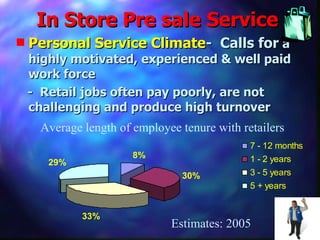
In Store Pre sale Service Personal Service Climate -  Calls for  a  highly motivated, experienced & well paid work force  -  Retail jobs often pay poorly, are not  challenging and produce high turnover Average length of employee tenure with retailers Estimates: 2005
Post-Sale Services Complaints and adjustments Credit Policies Product maintenance Product information Pick up/Delivery
Strategic Issue    Retailer Advertising Location + Merchandise + Services + Atmospherics + ?    Store Image Advertising Medium(s) Newspapers - Television - Radio - Magazine - Direct Mail - Videos-Web
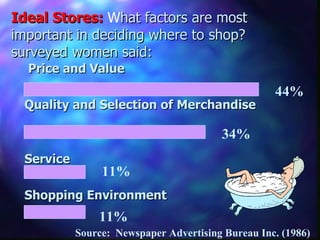
Ideal Stores:  W hat factors are most important in deciding where to shop? surveyed women said: Price and Value Quality and Selection of Merchandise Service Shopping Environment 44% 34% 11% 11% Source:  Newspaper Advertising Bureau Inc. (1986)
Retail Positioning Identifying an underserved market niche, or segment, and serving it through a strategy that distinguishes the retailer from others in the minds of consumers in that segment Target Market - Middle class family Position - Price Leadership  “ Every Day Low Prices” “ Rollback” gimmick “ Special Buys” Example : Wal-Mart
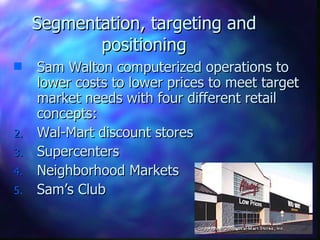
Segmentation, targeting and positioning Sam Walton computerized operations to lower costs to lower prices to meet target market needs with four different retail concepts: Wal-Mart discount stores Supercenters Neighborhood Markets Sam’s Club
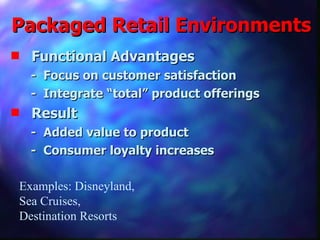
Packaged Retail Environments Functional Advantages -  Focus on customer satisfaction -  Integrate “total” product offerings Result -  Added value to product -  Consumer loyalty increases Examples: Disneyland, Sea Cruises, Destination Resorts
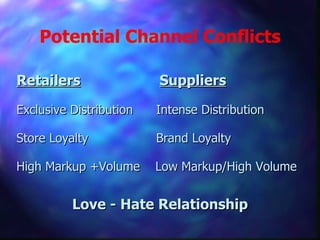
Potential Channel Conflicts Retailers   Suppliers Exclusive Distribution   Intense Distribution Store Loyalty   Brand Loyalty High Markup +Volume  Low Markup/High Volume Love - Hate Relationship
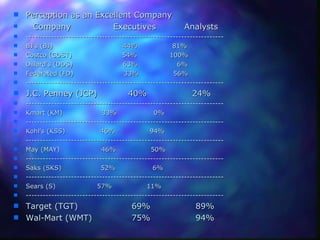
Perception as an Excellent Company      Company               Executives          Analysts ---------------------------------------------------------------------- BJ's (BJ)                    44%                81% Costco (COST)                 54%               100% Dillard's (DDS)              63%                  6% Federated (FD)               33%                56% ---------------------------------------------------------------------- J.C. Penney (JCP)           40%                24% ---------------------------------------------------------------------- Kmart (KM)                  33%                 0% ---------------------------------------------------------------------- Kohl's (KSS)                46%                94% ---------------------------------------------------------------------- May (MAY)                   46%                50% ---------------------------------------------------------------------- Saks (SKS)                  52%                 6% ---------------------------------------------------------------------- Sears (S)                   57%                11% ---------------------------------------------------------------------- Target (TGT)                  69%                89% Wal-Mart (WMT)              75%                94%
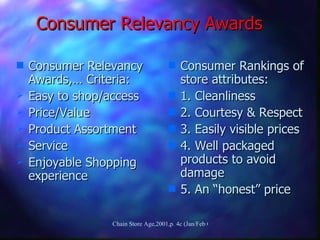
Consumer Relevancy Awards  Consumer Relevancy Awards,… Criteria: Easy to shop/access Price/Value Product Assortment Service Enjoyable Shopping experience Consumer Rankings of store attributes: 1. Cleanliness 2. Courtesy & Respect 3. Easily visible prices 4. Well packaged products to avoid damage 5. An “honest” price
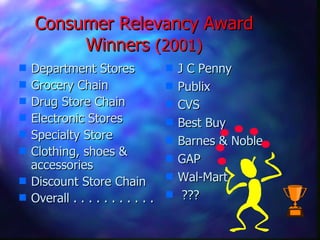
Consumer Relevancy Award Winners  (2001) Department Stores Grocery Chain Drug Store Chain Electronic Stores Specialty Store Clothing, shoes & accessories Discount Store Chain Overall . . . . . . . . . . . J C Penny Publix CVS Best Buy Barnes & Noble GAP Wal-Mart ???
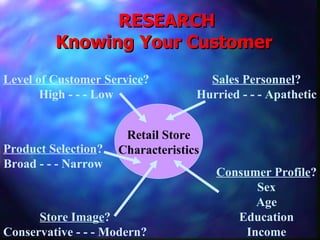
RESEARCH Knowing Your Customer Level of Customer Service ? High - - - Low Sales Personnel ? Hurried - - - Apathetic Product Selection ? Broad - - - Narrow Store Image ? Conservative - - - Modern? Consumer Profile ? Sex Age Education Income Retail Store Characteristics
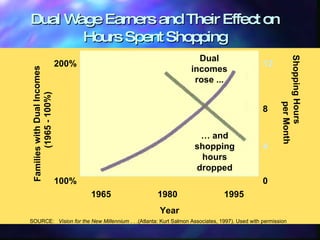
Dual Wage Earners and Their Effect on Hours Spent Shopping 1965  1980  1995 Year 200% 100% 12 8 4 0 Families with Dual Incomes  (1965 - 100%) Shopping Hours  per Month Dual incomes rose ... …  and shopping hours dropped SOURCE:  Vision for the New Millennium  . . .(Atlanta: Kurt Salmon Associates, 1997). Used with permission
Hypothesis Matching high arousal scent and high arousal music conditions will lead to enhanced (a) pleasure,(b) store environment, (c) impulse buying and (d) satisfaction, compared to mismatched conditions (ie. high/low or low/high). Matilla,A.&J.Wortz, Jrl of Retailing,Sumr2001 Congruency of scent and music as a driver of in-store behavior Applied Research In Retailing
Experiment Variables For Scents: Lavender  = low arousal scent Grapefruit = high arousal scent For Music: Slow tempo classical = low arousal music  Fast tempo classical = high arousal music                                    
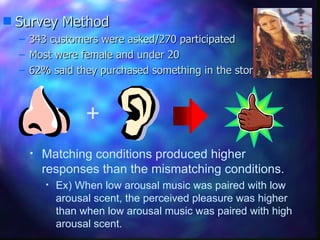
Survey Method 343 customers were asked/270 participated Most were female and under 20 62% said they purchased something in the store Matching conditions produced higher responses than the mismatching conditions. Ex) When low arousal music was paired with low arousal scent, the perceived pleasure was higher than when low arousal music was paired with high arousal scent.  +
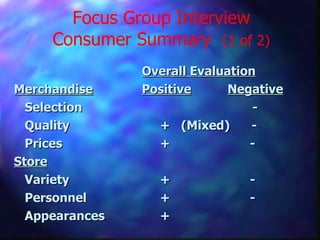
Focus Group Interview Consumer Summary  (1 of 2) Overall Evaluation Merchandise Positive   Negative Selection    - Quality    +  (Mixed)  - Prices   +  - Store Variety   +  - Personnel   +  - Appearances   +
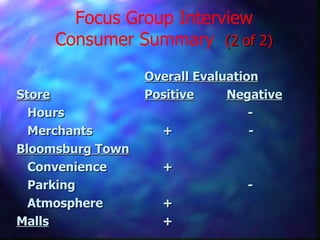
Focus Group Interview Consumer Summary   (2 of 2) Overall Evaluation Store Positive   Negative Hours   - Merchants   +   - Bloomsburg Town Convenience   + Parking   - Atmosphere   + Malls   +
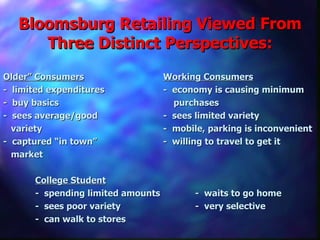
Bloomsburg Retailing Viewed From Three Distinct Perspectives: Older” Consumers Working Consumers -  limited expenditures -  economy is causing minimum -  buy basics     purchases -  sees average/good -  sees limited variety variety -  mobile, parking is inconvenient -  captured “in town” -  willing to travel to get it market College Student -  spending limited amounts -  waits to go home -  sees poor variety -  very selective -  can walk to stores
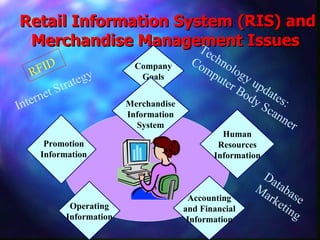
Retail Information System (RIS) and Merchandise Management Issues Company Goals Human Resources Information Accounting and Financial Information Operating Information Promotion Information Merchandise Information System Technology updates: Computer Body Scanner Internet Strategy Database Marketing RFID
Franchising A franchiser licenses (to  the franchisee) the right to distribute/sell specified products (trademark s) according to operational guide-lines (Time, place, price, supplies, etc.) Develops & controls marketing strategies
 
 
Franchising: Advantages Less Capital Required Use the Experience of Others Assurance of Customers Rapid Product Distribution Smaller Probability of Failure Advertising Assistance Highly Motivated owner/operators
Franchising:  Disadvantages Controlled by Franchiser (Power) Cost of Franchise Hard Work and Long Hours Reduced Personal Control

Retailing 1224232380049014 9

  • 1.
  • 2.
    Objectives To Understandthe Functions of Retailers in the Marketing Channel To Identify the Major Types of Retailers To overview the Major Types of Franchising To identify Strategic Issues in Retailing
  • 3.
    Retailing Retailers implementand conclude the actual sale of products to the final consuming units, the ultimate user. Possession Utility Time, place, form & information utility
  • 4.
    Importance Of RetailingImpact on the Economy … - 18% of employment (24 mil 2005) Distribution Functions - Time, Place Marketing Functions - Information & Possession Utility
  • 5.
    A Retailing CareerRetail Career Salary Career Progression Geographic mobility Women in retailing Societal Perspective
  • 6.
    Prerequisites for SuccessSuccess Hard Work Analytical Skills Creativity Decisiveness Flexibility Initiative Leadership Organization Risk Taking Stress Tolerance Perseverance Enthusiasm
  • 7.
    Retailing: Major Typesof Product (Retail Stores & Services) General Merchandise Retailers - Department Stores --Discount Store - Supermarket -- Superstore--Hypermarket - Warehouse Club --- Catalog Showroom Specialty Retailers - Limited Line - Off Price Retailers - Category Killers - C onvenience stores In-Store
  • 8.
    Department Store Chainoperations Wide variety & selection Full service - delivery, credit, returns, repair Examples: Boscov’s, Macy’s Bloomingdale’s
  • 9.
    Supermarkets -Large, self service stores with wide variety of food & some nonfood products Low mark ups & profit margins, Departmentalized with Centralized checkout, Ex: Albertson’s, Safeway Superstores –Very large outlets that carry food and nonfood products found in supermarkets, plus most routinely purchased consumer products
  • 10.
    Hyper-markets: ASure - Fire Hit, Bombs . Average size (in square feet ) Employees Annual sales per store (in millions) Gross profit margins Stock-keeping units (Number of different kinds of items stocked) 70,000 200 - 300 $10 - $20 18% - 19% 60,000 - 80,000 150,000 300 - 350 $20 - $50 15% - 16% 100,000 230,000 400 - 600 $75 - $100 7% - 8% 60,000 - 70,000 Discount Store Super Center Hypermarket
  • 11.
    Specialty Stores DeepSelection (Product line) Fashion response leader Personalized service Narrow Variety (Product line) High markup Ex: The GAP, a SPA, bookstore Wallpapers to Go, Convenience Stores Limited variety Shallow selection Fast service, High markup Examples: 7-11, Wawa Circle K, Sheetz STOP & GO
  • 12.
    Other Types ofIn-Store Retailing General mass merchandiser Catalog showroom Warehouse club Specialty mass merchandiser Off-price retailer Category Killer - Ex. Toys R US
  • 13.
    Category Killers JustFor Feet, the category killer in the athletic footware and apparel sector founded in 1977, cruised through the 1990s. However, Just For Feet has suffered financial setbacks from a lack of adapting to changes in the evolving retail landscape.
  • 14.
    The Wheel ofRetailing High : status, margin, price (Specialty store) - retailers usually enter the market with low service, low margin & price operations but evolve into higher service, cost & price merchants. Conventional department stores Mass merchandise retailers Low : status, margin price, service (Wholesale clubs) Maybry’s at the Mall
  • 15.
    Wheel of RetailingHigh Prices & Markups, Many services, Expensive Surroundings, Low prices & Low markups, few services, (austere) surroundings Small general stores Department stores 1890 - 1910 Entry of Discount stores Department Stores 1955 - 1970 Factory outlets “ Members Only” discount outlets Category killers Low price s & markups, few services , austere 1990s Enter Department stores
  • 16.
    History In 1936,atage 30, Paul D'Amour , a bread route salesman for the Wonder Bread Baking Co. purchased the Y Cash Market in Mass. In 1947, it was incorporated, Big Y® Foods, Inc. In 1952, they leased a 10,000 square foot store (Springfield) In the 1980’s it was a technology leader in scanning, information systems & security. Progressive Grocer, Mar. 2003
  • 17.
    MARCH 25, 2003 -- It expanded its online shopping service to include Unlimited Choices, a program to give customers access to more than 30,000 additional products such as ethnic & special dietary foods & A wide assortment of non-food items, including toys, books, housewares and gifts not carried in a typical Big Y store. A typical 55,000 square foot Big Y store carries some 35,000 different items.( bigy.com) Their goal is to exceed their customers' evolving expectations by seeking better ways to create and deliver world class service and value.
  • 18.
    3 Major Typesof Non Store Retailing A. Direct Selling (face to face) B. Direct Marketing (non personal mediums) C. Automatic Vending
  • 19.
    A. Forms ofDirect Selling Direct Selling Bank Retailing Sales Visits
  • 20.
    B. Forms ofDirect Marketing Catalog Marketing Direct-Response Marketing Television Home Shopping Telemarketing $388
  • 21.
    On line Retailing(E-Tailing): Advantages Not location bound Interactive Convenient Shopbots Forms of Direct Marketing E-tailing was about 20 billion dollars in 2000 and estimated to rise to over 100 billion by 2005.
  • 22.
    Percentage of SalesOnline by Retail Segment Source: Investor’s Business Daily, Wednesday, September 5, 2001, p. A6.
  • 23.
    Internet Retailing: DisadvantagesForms of Direct Marketing Examination Privacy/Security
  • 24.
    C. Forms ofAutomatic Vending The use of machines to dispense products includes items such as candy, chewing gum, soft drinks, cigarettes, newspapers, and coffee Advantages: small amount of space needed and no sales personnel Disadvantages: high costs of equipment and frequent servicing
  • 25.
    Strategic Retailing Issues:The Marketing Mix #1 Customers Product Price Place Promotion Merchandise Assortment Store Atmospherics Customer Service Location, Location, Location! Retail List Price Discounts Credit Advertising Personal Selling Publicity Sales Promotion
  • 26.
    Strategic Issue #1. Retail Store Location Factors affecting location Intended target market Type of products Suitability of site for customer access Characteristics of existing retail operations Three most important words in retailing: Location … location … location!
  • 27.
    Strategic Issues #1. Location Dynamics Consumers want convenience, a subjective measurement Convenience Measurements - Distance - Parking - Time - Traffic congestion  = Convenience
  • 28.
    LOCATION sets the trading area Free standing structure Central Business District (CBD) Shopping Malls (avg. age 23 yrs 2002) - Neighborhood shopping center - Community shopping center - Regional shopping center Non Traditional Shopping Center - Factory Outlets - Mini warehouse mall
  • 29.
    Consumer Shopping Patterns% of Retail Chains’ Customers also shopping at Retail Chains Sears Penny K-Mart Sears X 66 81 Penny 75 X 80 K-Mart 69 60 X Source: Scarborough Research, “Cross Shopping Patterns,” Stores (June 1986), p. 13. Locate near to competitors for comparison shopping
  • 30.
    Strategic Issue #2 Merchandise Assortment Retail buyers must match their product selection, quality, price with constantly changing consumer wants. Scrambled merchandising- adding unrelated products to generate traffic & higher margins
  • 31.
    Types of MerchandiseChange - The retail store merchandise must change as consumer wants change Product Selling Cycles Fad…..a relatively short term selling life cycle - (under six months) Fashion….a relatively enduring selling lifecycle - (over 1-2 years)
  • 32.
    Strategic Issue #2 Merchandise Assortment Plus: Store Location Store Promotions Store Layout/Image Store Personnel Store Services Store Hours Targeted Customers
  • 33.
    Many consumers valuefinding bargains.
  • 34.
    Store Atmospherics Thesum total of all store stimuli, interior & exterior physical characteristics that appeal to emotions (psychological field) Components: Ambient factors, Design and Social Factors. Ambient Factors ( Perceptions) - lighting - sounds - smell
  • 35.
    Store Atmospherics DesignFactors ( Perceptions) - Floor covering - Ceilings - Wall coverings - Dressing Rooms - Displays/Fixtures - Aisles - Color - Layout - Cleanliness - Signage - Furnishings - windows
  • 36.
    Social factors: In store service (sales personnel social & emotional labor) - Courteous  Rude behavior - Knowledgeable  Low information Service  Insincere Employee dress norms (casual ??) Make it convenient & pleasurable for customers to shop and pay for merchandise Store Atmospherics Body Scan computers: personal service, selling & awareness?
  • 37.
    In Store Presale Service Personal Service Climate - Calls for a highly motivated, experienced & well paid work force - Retail jobs often pay poorly, are not challenging and produce high turnover Average length of employee tenure with retailers Estimates: 2005
  • 38.
    Post-Sale Services Complaintsand adjustments Credit Policies Product maintenance Product information Pick up/Delivery
  • 39.
    Strategic Issue Retailer Advertising Location + Merchandise + Services + Atmospherics + ?  Store Image Advertising Medium(s) Newspapers - Television - Radio - Magazine - Direct Mail - Videos-Web
  • 40.
    Ideal Stores: W hat factors are most important in deciding where to shop? surveyed women said: Price and Value Quality and Selection of Merchandise Service Shopping Environment 44% 34% 11% 11% Source: Newspaper Advertising Bureau Inc. (1986)
  • 41.
    Retail Positioning Identifyingan underserved market niche, or segment, and serving it through a strategy that distinguishes the retailer from others in the minds of consumers in that segment Target Market - Middle class family Position - Price Leadership “ Every Day Low Prices” “ Rollback” gimmick “ Special Buys” Example : Wal-Mart
  • 42.
    Segmentation, targeting andpositioning Sam Walton computerized operations to lower costs to lower prices to meet target market needs with four different retail concepts: Wal-Mart discount stores Supercenters Neighborhood Markets Sam’s Club
  • 43.
    Packaged Retail EnvironmentsFunctional Advantages - Focus on customer satisfaction - Integrate “total” product offerings Result - Added value to product - Consumer loyalty increases Examples: Disneyland, Sea Cruises, Destination Resorts
  • 44.
    Potential Channel ConflictsRetailers Suppliers Exclusive Distribution Intense Distribution Store Loyalty Brand Loyalty High Markup +Volume Low Markup/High Volume Love - Hate Relationship
  • 45.
    Perception as anExcellent Company      Company               Executives          Analysts ---------------------------------------------------------------------- BJ's (BJ)                   44%                81% Costco (COST)                54%               100% Dillard's (DDS)             63%                  6% Federated (FD)              33%                56% ---------------------------------------------------------------------- J.C. Penney (JCP)           40%                24% ---------------------------------------------------------------------- Kmart (KM)                  33%                 0% ---------------------------------------------------------------------- Kohl's (KSS)                46%                94% ---------------------------------------------------------------------- May (MAY)                   46%                50% ---------------------------------------------------------------------- Saks (SKS)                  52%                 6% ---------------------------------------------------------------------- Sears (S)                   57%                11% ---------------------------------------------------------------------- Target (TGT)                 69%                89% Wal-Mart (WMT)              75%                94%
  • 46.
    Consumer Relevancy Awards Consumer Relevancy Awards,… Criteria: Easy to shop/access Price/Value Product Assortment Service Enjoyable Shopping experience Consumer Rankings of store attributes: 1. Cleanliness 2. Courtesy & Respect 3. Easily visible prices 4. Well packaged products to avoid damage 5. An “honest” price
  • 47.
    Consumer Relevancy AwardWinners (2001) Department Stores Grocery Chain Drug Store Chain Electronic Stores Specialty Store Clothing, shoes & accessories Discount Store Chain Overall . . . . . . . . . . . J C Penny Publix CVS Best Buy Barnes & Noble GAP Wal-Mart ???
  • 48.
    RESEARCH Knowing YourCustomer Level of Customer Service ? High - - - Low Sales Personnel ? Hurried - - - Apathetic Product Selection ? Broad - - - Narrow Store Image ? Conservative - - - Modern? Consumer Profile ? Sex Age Education Income Retail Store Characteristics
  • 49.
    Dual Wage Earnersand Their Effect on Hours Spent Shopping 1965 1980 1995 Year 200% 100% 12 8 4 0 Families with Dual Incomes (1965 - 100%) Shopping Hours per Month Dual incomes rose ... … and shopping hours dropped SOURCE: Vision for the New Millennium . . .(Atlanta: Kurt Salmon Associates, 1997). Used with permission
  • 50.
    Hypothesis Matching higharousal scent and high arousal music conditions will lead to enhanced (a) pleasure,(b) store environment, (c) impulse buying and (d) satisfaction, compared to mismatched conditions (ie. high/low or low/high). Matilla,A.&J.Wortz, Jrl of Retailing,Sumr2001 Congruency of scent and music as a driver of in-store behavior Applied Research In Retailing
  • 51.
    Experiment Variables ForScents: Lavender = low arousal scent Grapefruit = high arousal scent For Music: Slow tempo classical = low arousal music Fast tempo classical = high arousal music                                 
  • 52.
    Survey Method 343customers were asked/270 participated Most were female and under 20 62% said they purchased something in the store Matching conditions produced higher responses than the mismatching conditions. Ex) When low arousal music was paired with low arousal scent, the perceived pleasure was higher than when low arousal music was paired with high arousal scent. +
  • 53.
    Focus Group InterviewConsumer Summary (1 of 2) Overall Evaluation Merchandise Positive Negative Selection - Quality + (Mixed) - Prices + - Store Variety + - Personnel + - Appearances +
  • 54.
    Focus Group InterviewConsumer Summary (2 of 2) Overall Evaluation Store Positive Negative Hours - Merchants + - Bloomsburg Town Convenience + Parking - Atmosphere + Malls +
  • 55.
    Bloomsburg Retailing ViewedFrom Three Distinct Perspectives: Older” Consumers Working Consumers - limited expenditures - economy is causing minimum - buy basics purchases - sees average/good - sees limited variety variety - mobile, parking is inconvenient - captured “in town” - willing to travel to get it market College Student - spending limited amounts - waits to go home - sees poor variety - very selective - can walk to stores
  • 56.
    Retail Information System(RIS) and Merchandise Management Issues Company Goals Human Resources Information Accounting and Financial Information Operating Information Promotion Information Merchandise Information System Technology updates: Computer Body Scanner Internet Strategy Database Marketing RFID
  • 57.
    Franchising A franchiserlicenses (to the franchisee) the right to distribute/sell specified products (trademark s) according to operational guide-lines (Time, place, price, supplies, etc.) Develops & controls marketing strategies
  • 58.
  • 59.
  • 60.
    Franchising: Advantages LessCapital Required Use the Experience of Others Assurance of Customers Rapid Product Distribution Smaller Probability of Failure Advertising Assistance Highly Motivated owner/operators
  • 61.
    Franchising: DisadvantagesControlled by Franchiser (Power) Cost of Franchise Hard Work and Long Hours Reduced Personal Control

Editor's Notes

  • #3 16-2 Copyright © 2000 by Houghton Mifflin Company. All rights reserved.
  • #10 6
  • #13 9
  • #15 18
  • #19 16-9 Copyright © 2000 by Houghton Mifflin Company. All rights reserved.
  • #20 16-9 Copyright © 2000 by Houghton Mifflin Company. All rights reserved.
  • #21 16-11 Copyright © 2000 by Houghton Mifflin Company. All rights reserved.
  • #22 12
  • #24 12
  • #61 16-21 Copyright © 2000 by Houghton Mifflin Company. All rights reserved.
  • #62 16-22 Copyright © 2000 by Houghton Mifflin Company. All rights reserved.