Multi-Channel
Marketing
The way to better reach
and satisfy your customer
base.
Retail Channels
 The

way the retailer sells and delivers
merchandise and services to its customers



Internet Channel
Catalog Channel

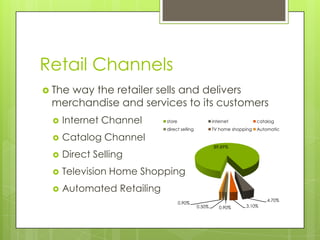
store

internet

catalog

direct selling

TV home shopping

Automatic

89.89%



Direct Selling



Television Home Shopping



Automated Retailing
0.90%

4.70%
0.50%

0.90%

3.10%
Internet Retailing
 AKA




Online retailing
Electronic retailing
E-Retailing

 Retail

channel in which the offering of
products and/or services for sale is
communicated to customers over the
internet.
 Retailers using this channel dominate
Internet Channel Info.
 Facts



Accounts for 10% of retail sales
¼ Look up Basic information about stores
 22% research
merchandise
 21% compare prices
 21% download coupons
for use in stores
Catalog Channel


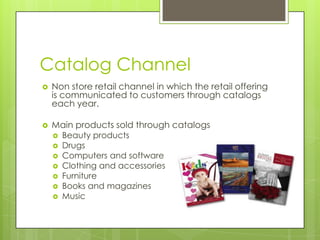
Non store retail channel in which the retail offering
is communicated to customers through catalogs
each year.



Main products sold through catalogs








Beauty products
Drugs
Computers and software
Clothing and accessories
Furniture
Books and magazines
Music
Catalog Channel Info.
 1.3%

of catalogs result in a direct sale

 3%

of 80 million tons of paper used to
produce. More than magazines or books.

 View

by many as a waste
of resources

 Declining
 Role

in market share

changing to drive
traffic to the internet
Direct Selling
A

retail channel in which sales
people interact with the
consumers face-to-face in a
convenient location, either at
the consumers home or at work.
 Sales person explains FAB of
product to consumer
 Very costly to train and maintain
information on products
Direct Selling Info.


$30 billion US; $100 billion World Wide



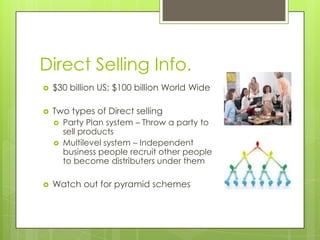
Two types of Direct selling





Party Plan system – Throw a party to
sell products
Multilevel system – Independent
business people recruit other people
to become distributers under them

Watch out for pyramid schemes
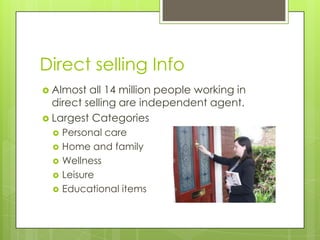
Direct selling Info
 Almost

all 14 million people working in
direct selling are independent agent.
 Largest Categories






Personal care
Home and family
Wellness
Leisure
Educational items
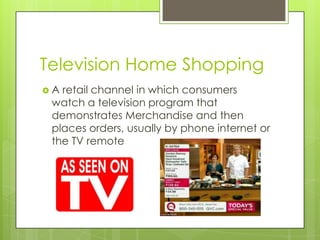
Television Home Shopping
A

retail channel in which consumers
watch a television program that
demonstrates Merchandise and then
places orders, usually by phone internet or
the TV remote
TV Home Shopping Info.
 Infomercials

- are programs dedicated
that mix entertainment with product
demonstrations then solicit orders place
by phone. 30 to 60 mins

 Direct

response advertising – one or two
min advertisements on TV or radio
offering opportunity to order.
TV Channel Info Cont.
 Top





Retailers

HSN
QVC
Shop NBC
Jewelry Television

 Majority

of viewers who actually watch
don’t do it regularly nor actually purchase
products or services
Automated Retailing


Is a retailing channel in which merchandise or
services are stored in a machine and
dispensed to customers when they deposit
cash or use credit.



Vending machines are typically placed in
convenient , high-traffic locations such as
workplaces, malls, airports, or universities.
Auto. Retailing Info.
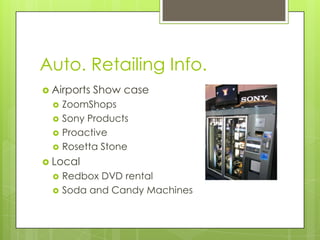
 Airports





Show case

ZoomShops
Sony Products
Proactive
Rosetta Stone

 Local



Redbox DVD rental
Soda and Candy Machines
Store Channel Benefits
 Touching
 Personal
 Risk

and feeling

service

reduction

 Immediate

gratification

 Entertainment

and social experience

 Browsing
 Cash

payment
Catalog Channel Benefits
 Safety
 Convenience



Reference off coffee table
Take it to the beach

 Internet

through cell phone provides
dipping into this channel
Internet Channel Benefits
 Broader

and deeper assortments

 More

timely information for evaluating
merchandise

 Personalization




Cookies
Memberships
Format information
Net Channel Benefits Cont.
 Side

by side comparison
 Instant alternatives
 Live chats
 Recommendations


ATG has number crunching soft ware that
recognizes characteristics of times of
day, gender location in consideration

 iShop
Net Channel Issues
 Loosing

sales to applications that find the
lowest price
 Perceived risk with electronic shopping


Credit cards and internet concerns
 CC





companies offer protection

Potential privacy exposure
Breaches kills retailers reputation
Data mining and how its used or sold
Benefits of Multi Channel
Retailing
 Overcoming

format




the limitations of an existing

Increase assortment
Low cost, consistent execution
Current information

 Increase

loyalty

customer satisfaction and
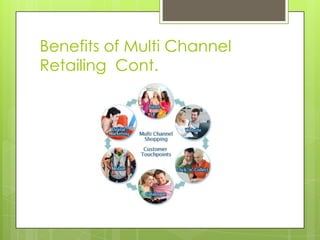
Benefits of Multi Channel
Retailing Cont.
Benefits of Multi Channel
Retailing Cont.
 Gaining

insight into customers shopping
behavior



Up-sell other products
Cookies develop patterns for
recommendation

 Expanding



market presence

Limited retail locations
Rural market access
Benefits of Multi Channel
Retailing Cont.
 Building

priority information about
consumer behavior and purchase history


Conventional cant link purchases to
purchases

 Unique

“how-to” knowledge about
coordinating operational activities


Synergistically coordinate different
channels
Other Multi-Channel Retailing
Issues
 Which



channel has the lowest cost

Typically E sells
Can be more expensive than a outlet
 Website

development maintenance
 Advertising
 Distribution System
 Dedicated warehouses
 High level of returns
Other Multi-Channel Retailing
Issues


Will manufactures bypass retailers and sell
directly




Disintermediation occurs when manufacturer
sells directly to consumers, bypassing retailers

Why wont this happen





Retailers have more experience in marking to
the end consumer
Provide a broader array of products
Timing and matching of different manufacturer
products
Loss of support of retailers
Challenges of Effective Multi
Channel Retailing (CEMCR)





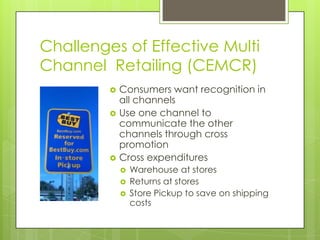
Consumers want recognition in
all channels
Use one channel to
communicate the other
channels through cross
promotion
Cross expenditures





Warehouse at stores
Returns at stores
Store Pickup to save on shipping
costs
Challenges of EMCR
Broken Down

Providing an integrated Shopping experience.
 Distribution center needs are different





DC becomes a ware house as well

Marketing plan changes
Information system integration



Store information system Product centric
Non-store information systems Customer Centric
Challenges of EMCR
Market trends


Walmart started with a separate
management concept when it started
www.walmart.com





JCPenny had everything separate when it
started its on line store.





Originally managed by network specialists
Since has realized integration is the key

Separate marketing, warehousing and
promotion.
Since has realized integration is the KEY!

Some retailers out source for online channel
management


Limits competitive advantage
Challenges of EMCR
Supporting M Commerce
The purchase of goods and services through
mobile devices
 Predicted to be $120 mil. 8% of e-commerce
 Hardware limitations




ESPN has mobile specific site

Store applications is a growing trend

Macy’s iShop browsing of 12 departments
 Scrolling wheel allows fine tuning
 Then with two click you can have it sent to a
store or your home.
 Also used as a promotional tool




Point out clearances, sales etc. to draw business
Challenges of EMCR

Organizing for Multi-Cannel Retailing


Select complete integration






Select different organization or each channel





Same product at the same prices
Same promotions and sales

Allows tailoring to the specific channel
Requires management of each market

In selecting which to deploy must consider






Customer database
Consistence
Brand image
Pricing
Merchandise assortments across channels
Challenges of EMCR

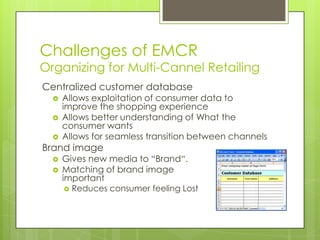
Organizing for Multi-Cannel Retailing
Centralized customer database




Allows exploitation of consumer data to
improve the shopping experience
Allows better understanding of What the
consumer wants
Allows for seamless transition between channels

Brand image



Gives new media to “Brand“.
Matching of brand image
important


Reduces consumer feeling Lost
Challenges of EMCR

Organizing for Multi-Cannel Retailing
Merchandise Assortment


Okay to have different assortment in each
channel

On line typically have a deeper and broader
selection
 Easier to carry product that doesn't have broad
appeal




Does your product or store need coverage of
the touch and feel nature of humans?




Stores

Does your product or service do better in “lookand-see”?


On-line
Challenges of EMCR

Organizing for Multi-Cannel Retailing
Pricing


Competition may require pricing
variance
 On


line VS store

Barn’s and Noble has lower prices to
compete with Amazon

 Location


vary pricing due to local market

Oriley Auto parts varies it price to cover
different shipping costs and what the market
expects
Challenges of EMCR

Organizing for Multi-Cannel Retailing
Reduction of Channel Migration






Channel migration is consumers
collecting information about products on
their channel then going to a competitor
to make the purchase.
78 % of people will check a web site then
go to a retail outlet.
8% Shop at stores then go to purchase
online
Two approaches to reduce




Offer uniquely relevant information based
on preparatory data the retailer has
collected on the consumer
Promote private label merchandise that
can only be purchased from that retailer
Multichannel Shopping in the
Future


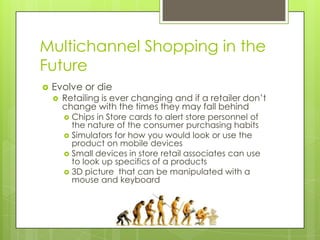
Evolve or die


Retailing is ever changing and if a retailer don’t
change with the times they may fall behind
Chips in Store cards to alert store personnel of
the nature of the consumer purchasing habits
 Simulators for how you would look or use the
product on mobile devices
 Small devices in store retail associates can use
to look up specifics of a products
 3D picture that can be manipulated with a
mouse and keyboard

KEY TERMS
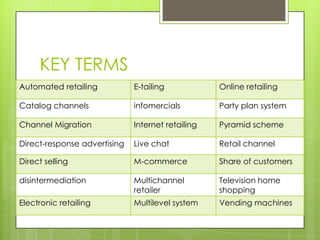
Automated retailing

E-tailing

Online retailing

Catalog channels

infomercials

Party plan system

Channel Migration

Internet retailing

Pyramid scheme

Direct-response advertising

Live chat

Retail channel

Direct selling

M-commerce

Share of customers

disintermediation

Multichannel
retailer

Television home
shopping

Electronic retailing

Multilevel system

Vending machines
Assignment 1
Retail Channels

Please make a Prezi on the different retailing
channels. You will want to provide Examples of
each not provided in the book. Please explain
why that retailer may have chosen that
particular channel. Include:







Internet channels
Catalog channels
Direct selling
Television home shopping
Automated retailing
Assignment 2

Benefits Offered By Each Retail channel
In a Blalberize or Comics Life, please chose two
retailers and compare the channels they have
chosen to utilize. You will want to include:
 Store channel
 Catalog channel
 Internet channel
 The concerns related to each channel and
how they may over shadow the benefits of
each
Assignment 3

Benefits of Multi-Channel Retailing
In Photo Peach or Prezi, create your story on the
benefits of multi-channel marketing. Choose two
examples of retailers; One that could benefit from
adding and one that utilizes multi-channel marketing
to
 Overcome the limitations of an existing format
 Increase customer Satisfaction
 Gain insight into consumer shopping behavior
 Expanding market presence
 Building a strategic advantage
In the retailer not using multi-channel
marketing, explain how it is hurting them. With the
retailer using the multi-channel marketing show how
they are stronger than the similar competition.
Assignment 4

Other Multi channel Retailing Issues


In Prezi, or a Power Point explain what
channel has the lowest cost and provide an
example of a company that uses that
channel.



In the same Prezi or Power Point, provide an
example of a retailer who has bypassed
retailers and sells directly to consumers.
Explain why they may have chosen to do so.
Assignment 5

Challenges of Effective Multi-Channel Retailing
Interview a local business that utilizes multi-channel
retailing and make a video or audio.
 You will want to cover how they are using multichannel retailing to intergrade the shopping
experience
 Has M Commerce been a positive or negative effect
on their business
 Has it created a centralized customer data base
 Has it effected their brand image
 Has their merchandise assortment grown as a result
 What kind of pricing effect has it had on them
 Have they notice a problem with channel migration
 how that affect them
Assignment 6

Multi-channel shopping in future
 Here

you will want to use Photo Peach or
Comics Life to provide six example of the
future of multi-channel marketing and
how it has altered the experience.
Include things that make you say “WOW!
I love how this allows me to understand
the product or service more.” Since the
internet is the “future. Finding those
examples on-line retailers is probably the
easiest.

Multi Channel Marketing

  • 1.
    Multi-Channel Marketing The way tobetter reach and satisfy your customer base.
  • 2.
    Retail Channels  The waythe retailer sells and delivers merchandise and services to its customers   Internet Channel Catalog Channel store internet catalog direct selling TV home shopping Automatic 89.89%  Direct Selling  Television Home Shopping  Automated Retailing 0.90% 4.70% 0.50% 0.90% 3.10%
  • 3.
    Internet Retailing  AKA    Onlineretailing Electronic retailing E-Retailing  Retail channel in which the offering of products and/or services for sale is communicated to customers over the internet.  Retailers using this channel dominate
  • 4.
    Internet Channel Info. Facts   Accounts for 10% of retail sales ¼ Look up Basic information about stores  22% research merchandise  21% compare prices  21% download coupons for use in stores
  • 5.
    Catalog Channel  Non storeretail channel in which the retail offering is communicated to customers through catalogs each year.  Main products sold through catalogs        Beauty products Drugs Computers and software Clothing and accessories Furniture Books and magazines Music
  • 6.
    Catalog Channel Info. 1.3% of catalogs result in a direct sale  3% of 80 million tons of paper used to produce. More than magazines or books.  View by many as a waste of resources  Declining  Role in market share changing to drive traffic to the internet
  • 7.
    Direct Selling A retail channelin which sales people interact with the consumers face-to-face in a convenient location, either at the consumers home or at work.  Sales person explains FAB of product to consumer  Very costly to train and maintain information on products
  • 8.
    Direct Selling Info.  $30billion US; $100 billion World Wide  Two types of Direct selling    Party Plan system – Throw a party to sell products Multilevel system – Independent business people recruit other people to become distributers under them Watch out for pyramid schemes
  • 9.
    Direct selling Info Almost all 14 million people working in direct selling are independent agent.  Largest Categories      Personal care Home and family Wellness Leisure Educational items
  • 10.
    Television Home Shopping A retailchannel in which consumers watch a television program that demonstrates Merchandise and then places orders, usually by phone internet or the TV remote
  • 11.
    TV Home ShoppingInfo.  Infomercials - are programs dedicated that mix entertainment with product demonstrations then solicit orders place by phone. 30 to 60 mins  Direct response advertising – one or two min advertisements on TV or radio offering opportunity to order.
  • 12.
    TV Channel InfoCont.  Top     Retailers HSN QVC Shop NBC Jewelry Television  Majority of viewers who actually watch don’t do it regularly nor actually purchase products or services
  • 13.
    Automated Retailing  Is aretailing channel in which merchandise or services are stored in a machine and dispensed to customers when they deposit cash or use credit.  Vending machines are typically placed in convenient , high-traffic locations such as workplaces, malls, airports, or universities.
  • 14.
    Auto. Retailing Info. Airports     Show case ZoomShops Sony Products Proactive Rosetta Stone  Local   Redbox DVD rental Soda and Candy Machines
  • 15.
    Store Channel Benefits Touching  Personal  Risk and feeling service reduction  Immediate gratification  Entertainment and social experience  Browsing  Cash payment
  • 16.
    Catalog Channel Benefits Safety  Convenience   Reference off coffee table Take it to the beach  Internet through cell phone provides dipping into this channel
  • 17.
    Internet Channel Benefits Broader and deeper assortments  More timely information for evaluating merchandise  Personalization    Cookies Memberships Format information
  • 18.
    Net Channel BenefitsCont.  Side by side comparison  Instant alternatives  Live chats  Recommendations  ATG has number crunching soft ware that recognizes characteristics of times of day, gender location in consideration  iShop
  • 19.
    Net Channel Issues Loosing sales to applications that find the lowest price  Perceived risk with electronic shopping  Credit cards and internet concerns  CC    companies offer protection Potential privacy exposure Breaches kills retailers reputation Data mining and how its used or sold
  • 20.
    Benefits of MultiChannel Retailing  Overcoming format    the limitations of an existing Increase assortment Low cost, consistent execution Current information  Increase loyalty customer satisfaction and
  • 21.
    Benefits of MultiChannel Retailing Cont.
  • 22.
    Benefits of MultiChannel Retailing Cont.  Gaining insight into customers shopping behavior   Up-sell other products Cookies develop patterns for recommendation  Expanding   market presence Limited retail locations Rural market access
  • 23.
    Benefits of MultiChannel Retailing Cont.  Building priority information about consumer behavior and purchase history  Conventional cant link purchases to purchases  Unique “how-to” knowledge about coordinating operational activities  Synergistically coordinate different channels
  • 24.
    Other Multi-Channel Retailing Issues Which   channel has the lowest cost Typically E sells Can be more expensive than a outlet  Website development maintenance  Advertising  Distribution System  Dedicated warehouses  High level of returns
  • 25.
    Other Multi-Channel Retailing Issues  Willmanufactures bypass retailers and sell directly   Disintermediation occurs when manufacturer sells directly to consumers, bypassing retailers Why wont this happen     Retailers have more experience in marking to the end consumer Provide a broader array of products Timing and matching of different manufacturer products Loss of support of retailers
  • 26.
    Challenges of EffectiveMulti Channel Retailing (CEMCR)    Consumers want recognition in all channels Use one channel to communicate the other channels through cross promotion Cross expenditures    Warehouse at stores Returns at stores Store Pickup to save on shipping costs
  • 27.
    Challenges of EMCR BrokenDown Providing an integrated Shopping experience.  Distribution center needs are different    DC becomes a ware house as well Marketing plan changes Information system integration   Store information system Product centric Non-store information systems Customer Centric
  • 28.
    Challenges of EMCR Markettrends  Walmart started with a separate management concept when it started www.walmart.com    JCPenny had everything separate when it started its on line store.    Originally managed by network specialists Since has realized integration is the key Separate marketing, warehousing and promotion. Since has realized integration is the KEY! Some retailers out source for online channel management  Limits competitive advantage
  • 29.
    Challenges of EMCR SupportingM Commerce The purchase of goods and services through mobile devices  Predicted to be $120 mil. 8% of e-commerce  Hardware limitations   ESPN has mobile specific site Store applications is a growing trend Macy’s iShop browsing of 12 departments  Scrolling wheel allows fine tuning  Then with two click you can have it sent to a store or your home.  Also used as a promotional tool   Point out clearances, sales etc. to draw business
  • 30.
    Challenges of EMCR Organizingfor Multi-Cannel Retailing  Select complete integration    Select different organization or each channel    Same product at the same prices Same promotions and sales Allows tailoring to the specific channel Requires management of each market In selecting which to deploy must consider      Customer database Consistence Brand image Pricing Merchandise assortments across channels
  • 31.
    Challenges of EMCR Organizingfor Multi-Cannel Retailing Centralized customer database    Allows exploitation of consumer data to improve the shopping experience Allows better understanding of What the consumer wants Allows for seamless transition between channels Brand image   Gives new media to “Brand“. Matching of brand image important  Reduces consumer feeling Lost
  • 32.
    Challenges of EMCR Organizingfor Multi-Cannel Retailing Merchandise Assortment  Okay to have different assortment in each channel On line typically have a deeper and broader selection  Easier to carry product that doesn't have broad appeal   Does your product or store need coverage of the touch and feel nature of humans?   Stores Does your product or service do better in “lookand-see”?  On-line
  • 33.
    Challenges of EMCR Organizingfor Multi-Cannel Retailing Pricing  Competition may require pricing variance  On  line VS store Barn’s and Noble has lower prices to compete with Amazon  Location  vary pricing due to local market Oriley Auto parts varies it price to cover different shipping costs and what the market expects
  • 34.
    Challenges of EMCR Organizingfor Multi-Cannel Retailing Reduction of Channel Migration     Channel migration is consumers collecting information about products on their channel then going to a competitor to make the purchase. 78 % of people will check a web site then go to a retail outlet. 8% Shop at stores then go to purchase online Two approaches to reduce   Offer uniquely relevant information based on preparatory data the retailer has collected on the consumer Promote private label merchandise that can only be purchased from that retailer
  • 35.
    Multichannel Shopping inthe Future  Evolve or die  Retailing is ever changing and if a retailer don’t change with the times they may fall behind Chips in Store cards to alert store personnel of the nature of the consumer purchasing habits  Simulators for how you would look or use the product on mobile devices  Small devices in store retail associates can use to look up specifics of a products  3D picture that can be manipulated with a mouse and keyboard 
  • 36.
    KEY TERMS Automated retailing E-tailing Onlineretailing Catalog channels infomercials Party plan system Channel Migration Internet retailing Pyramid scheme Direct-response advertising Live chat Retail channel Direct selling M-commerce Share of customers disintermediation Multichannel retailer Television home shopping Electronic retailing Multilevel system Vending machines
  • 37.
    Assignment 1 Retail Channels Pleasemake a Prezi on the different retailing channels. You will want to provide Examples of each not provided in the book. Please explain why that retailer may have chosen that particular channel. Include:      Internet channels Catalog channels Direct selling Television home shopping Automated retailing
  • 38.
    Assignment 2 Benefits OfferedBy Each Retail channel In a Blalberize or Comics Life, please chose two retailers and compare the channels they have chosen to utilize. You will want to include:  Store channel  Catalog channel  Internet channel  The concerns related to each channel and how they may over shadow the benefits of each
  • 39.
    Assignment 3 Benefits ofMulti-Channel Retailing In Photo Peach or Prezi, create your story on the benefits of multi-channel marketing. Choose two examples of retailers; One that could benefit from adding and one that utilizes multi-channel marketing to  Overcome the limitations of an existing format  Increase customer Satisfaction  Gain insight into consumer shopping behavior  Expanding market presence  Building a strategic advantage In the retailer not using multi-channel marketing, explain how it is hurting them. With the retailer using the multi-channel marketing show how they are stronger than the similar competition.
  • 40.
    Assignment 4 Other Multichannel Retailing Issues  In Prezi, or a Power Point explain what channel has the lowest cost and provide an example of a company that uses that channel.  In the same Prezi or Power Point, provide an example of a retailer who has bypassed retailers and sells directly to consumers. Explain why they may have chosen to do so.
  • 41.
    Assignment 5 Challenges ofEffective Multi-Channel Retailing Interview a local business that utilizes multi-channel retailing and make a video or audio.  You will want to cover how they are using multichannel retailing to intergrade the shopping experience  Has M Commerce been a positive or negative effect on their business  Has it created a centralized customer data base  Has it effected their brand image  Has their merchandise assortment grown as a result  What kind of pricing effect has it had on them  Have they notice a problem with channel migration  how that affect them
  • 42.
    Assignment 6 Multi-channel shoppingin future  Here you will want to use Photo Peach or Comics Life to provide six example of the future of multi-channel marketing and how it has altered the experience. Include things that make you say “WOW! I love how this allows me to understand the product or service more.” Since the internet is the “future. Finding those examples on-line retailers is probably the easiest.