Discovering
    Computers 2012
     Your Interactive Guide
      to the Digital World
Objectives Overview


                              Define the term,
 Explain why computer      computer, and describe                     Describe the five
   literacy is vital to       the relationship                        components of a
success in today’s world     between data and                            computer
                                information

Discuss the advantages
                              Define the term,
and disadvantages that                                              Discuss the uses of the
                            network, and identify
users experience when                                                 Internet and World
                             benefits of sharing
     working with                                                         Wide Web
                           resources on a network
      computers


See Page 3                                                                                2
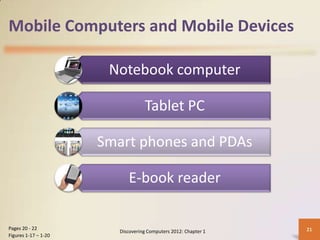
                            Discovering Computers 2012: Chapter 1
for Detailed Objectives
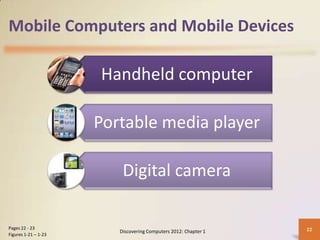
Objectives Overview


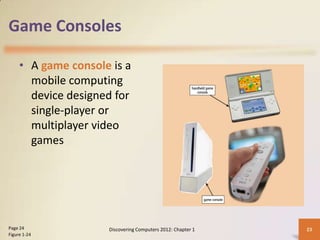
Distinguish between system                Differentiate among types,               Describe the role of each
 software and application                   sizes, and functions of                element in an information
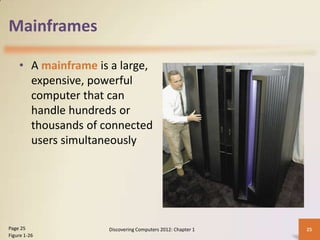
          software                        computers in each category                        system


                           Explain how home users,
                                                                  Discuss how society uses
                           small office/home office
                                                                  computers in education,
                          users, mobile users, power
                                                               finance, government, health
                          users, and enterprise users
                                                                  care, science, publishing,
                              each interact with
                                                                 travel, and manufacturing
                                  computers


See Page 3                                                                                                 3
                                           Discovering Computers 2012: Chapter 1
for Detailed Objectives
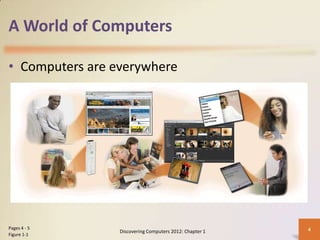
A World of Computers

• Computers are everywhere


Pages 4 - 5                                              4
                 Discovering Computers 2012: Chapter 1
Figure 1-1
What Is a Computer?

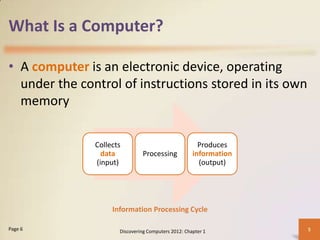
• A computer is an electronic device, operating
  under the control of instructions stored in its own
  memory

               Collects                                Produces
                 data          Processing            information
               (input)                                 (output)


                    Information Processing Cycle

Page 6                Discovering Computers 2012: Chapter 1        5
What Is a Computer?


Page 6                                               6
             Discovering Computers 2012: Chapter 1
Figure 1-2
The Components of a Computer

• A computer contains many electric, electronic, and
  mechanical components known as hardware
      Input Device   • Allows you to enter data and instructions into a computer


     Output Device   • Hardware component that conveys information to one or more people


                     • Case that contains the electronic components of the computer that
       System Unit     are used to process data

                     • Records (writes) and/or retrieves (reads) items to and from storage
    Storage Device     media

  Communications     • Enables a computer to send and receive data, instructions, and
     Device            information to and from one or more computers or mobile devices

Pages 6 - 8                   Discovering Computers 2012: Chapter 1                          7
The Components of a Computer


Page 7                                               8
             Discovering Computers 2012: Chapter 1
Figure 1-3
Advantages and Disadvantages
of Using Computers
                Advantages of                                     Disadvantages of
               Using Computers                                    Using Computers

                   Speed                                               Health Risks

                 Reliability                                   Violation of Privacy

                Consistency                                            Public Safety

                  Storage                                     Impact on Labor Force

               Communications                                Impact on Environment

Pages 9 - 10                   Discovering Computers 2012: Chapter 1                   9
Advantages and Disadvantages
of Using Computers
• Green computing involves reducing the electricity
  consumed and environmental waste generated when
  using a computer
• Strategies include:
      –   Recycling
      –   Regulating manufacturing processes
      –   Extending the life of computers
      –   Immediately donating or properly disposing of replaced computers


Page 10                         Discovering Computers 2012: Chapter 1        10
Networks and the Internet

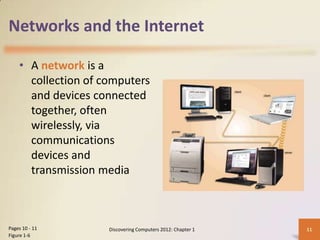
    • A network is a
      collection of computers
      and devices connected
      together, often
      wirelessly, via
      communications
      devices and
      transmission media


Pages 10 - 11        Discovering Computers 2012: Chapter 1   11
Figure 1-6
Networks and the Internet

• The Internet is a worldwide collection of networks that
  connects millions of businesses, government agencies,
  educational institutions, and individuals


Page 11                                                      12
                     Discovering Computers 2012: Chapter 1
Figure 1-7
Networks and the Internet

• People use the Internet for a variety of reasons:


   Communicate            Research and                 Shop                 Bank and Invest       Online Trading
                        Access Information


                Entertainment       Download Videos           Share Information        Web Application


Pages 12 - 13                                                                                                      13
                                         Discovering Computers 2012: Chapter 1
Figure 1-8
Networks and the Internet

• A social networking Web site encourages
  members to share their interests, ideas, stories,
  photos, music, and videos with other registered
  users


Page 14                                                    14
                   Discovering Computers 2012: Chapter 1
Figure 1-9
Computer Software

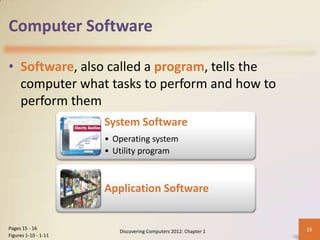
• Software, also called a program, tells the
  computer what tasks to perform and how to
  perform them
                      System Software
                      • Operating system
                      • Utility program


                      Application Software


Pages 15 - 16                                                    15
                         Discovering Computers 2012: Chapter 1
Figures 1-10 - 1-11
Computer Software

• Installing is the process of setting up software to
  work with the computer, printer, and other
  hardware


Pages 16 - 17                                               16
                    Discovering Computers 2012: Chapter 1
Figure 1-12
Computer Software

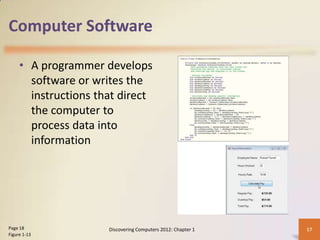
     • A programmer develops
       software or writes the
       instructions that direct
       the computer to
       process data into
       information


Page 18               Discovering Computers 2012: Chapter 1   17
Figure 1-13
Categories of Computers
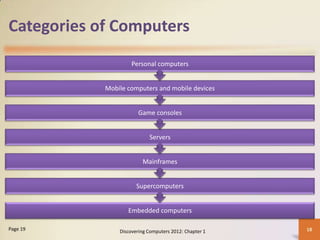
                     Personal computers


            Mobile computers and mobile devices


                       Game consoles


                            Servers


                         Mainframes


                       Supercomputers


                   Embedded computers

Page 19         Discovering Computers 2012: Chapter 1   18
Personal Computers

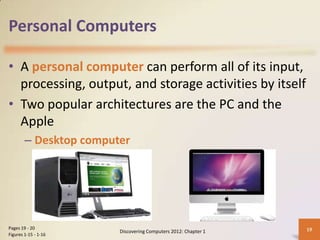
• A personal computer can perform all of its input,
  processing, output, and storage activities by itself
• Two popular architectures are the PC and the
  Apple
        – Desktop computer


Pages 19 - 20                                                   19
                        Discovering Computers 2012: Chapter 1
Figures 1-15 - 1-16
Mobile Computers and Mobile Devices


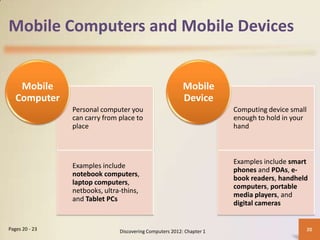
    Mobile                                                Mobile
   Computer                                               Device
                Personal computer you                                  Computing device small
                can carry from place to                                enough to hold in your
                place                                                  hand


                                                                       Examples include smart
                Examples include
                                                                       phones and PDAs, e-
                notebook computers,
                                                                       book readers, handheld
                laptop computers,
                                                                       computers, portable
                netbooks, ultra-thins,
                                                                       media players, and
                and Tablet PCs
                                                                       digital cameras


Pages 20 - 23                  Discovering Computers 2012: Chapter 1                            20
Mobile Computers and Mobile Devices

                       Notebook computer

                                   Tablet PC

                      Smart phones and PDAs

                            E-book reader

Pages 20 - 22                                                    21
                         Discovering Computers 2012: Chapter 1
Figures 1-17 – 1-20
Mobile Computers and Mobile Devices

                      Handheld computer

                      Portable media player

                          Digital camera

Pages 22 - 23                                                    22
                         Discovering Computers 2012: Chapter 1
Figures 1-21 – 1-23
Game Consoles

     • A game console is a
       mobile computing
       device designed for
       single-player or
       multiplayer video
       games


Page 24              Discovering Computers 2012: Chapter 1   23
Figure 1-24
Servers

    • A server controls access
      to the hardware,
      software, and other
      resources on a network
              – Provides a centralized
                storage area for
                programs, data, and
                information


Page 25                        Discovering Computers 2012: Chapter 1   24
Figure 1-25
Mainframes

    • A mainframe is a large,
      expensive, powerful
      computer that can
      handle hundreds or
      thousands of connected
      users simultaneously


Page 25             Discovering Computers 2012: Chapter 1   25
Figure 1-26
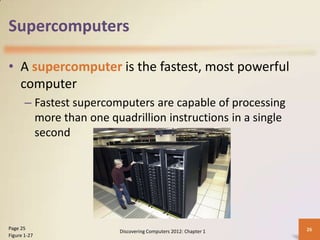
Supercomputers

• A supercomputer is the fastest, most powerful
  computer
       – Fastest supercomputers are capable of processing
         more than one quadrillion instructions in a single
         second


Page 25                                                          26
                         Discovering Computers 2012: Chapter 1
Figure 1-27
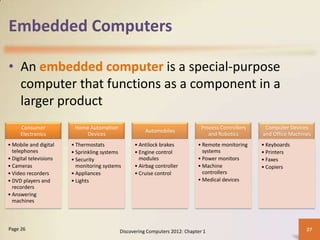
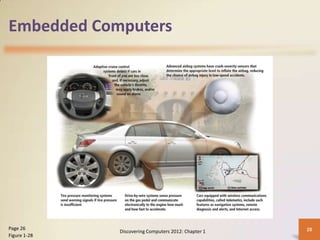
Embedded Computers

• An embedded computer is a special-purpose
  computer that functions as a component in a
  larger product
     Consumer            Home Automation                                      Process Controllers    Computer Devices
                                                     Automobiles
     Electronics             Devices                                             and Robotics       and Office Machines
• Mobile and digital    • Thermostats            • Antilock brakes          • Remote monitoring     • Keyboards
  telephones            • Sprinkling systems     • Engine control             systems               • Printers
• Digital televisions   • Security                 modules                  • Power monitors        • Faxes
• Cameras                 monitoring systems     • Airbag controller        • Machine               • Copiers
• Video recorders       • Appliances             • Cruise control             controllers
• DVD players and       • Lights                                            • Medical devices
  recorders
• Answering
  machines


Page 26                                    Discovering Computers 2012: Chapter 1                                     27
Embedded Computers


Page 26                                               28
              Discovering Computers 2012: Chapter 1
Figure 1-28
Elements of an Information System


   Hardware     Software                              Data


          People                   Procedures


Page 27       Discovering Computers 2012: Chapter 1          29
Elements of an Information System


Page 27                                               30
              Discovering Computers 2012: Chapter 1
Figure 1-29
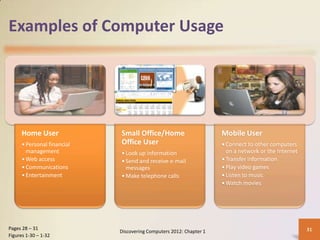
Examples of Computer Usage


      Home User              Small Office/Home                       Mobile User
      • Personal financial   Office User                             • Connect to other computers
        management           • Look up information                     on a network or the Internet
      • Web access           • Send and receive e-mail               • Transfer information
      • Communications         messages                              • Play video games
      • Entertainment        • Make telephone calls                  • Listen to music
                                                                     • Watch movies


Pages 28 – 31                                                                                         31
                             Discovering Computers 2012: Chapter 1
Figures 1-30 – 1-32
Examples of Computer Usage


                      Power User                           Enterprise User
                      • Work with multimedia               • Communicate among
                      • Use industry-specific                employees
                        software                           • Process high volumes
                                                             of transactions
                                                           • Blog


Pages 31 – 32                                                                       32
                                    Discovering Computers 2012: Chapter 1
Figures 1-33 – 1-34
Computer Applications in Society

                      Education
                      Finance
                      Government
                      Health Care
Pages 34 - 36                                                     33
                          Discovering Computers 2012: Chapter 1
Figures 1-36 – 1-39
Computer Applications in Society

                      Science
                      Publishing
                      Travel
                      Manufacturing
Pages 36 - 38                                                      34
                           Discovering Computers 2012: Chapter 1
Figures 1-40 – 1-43
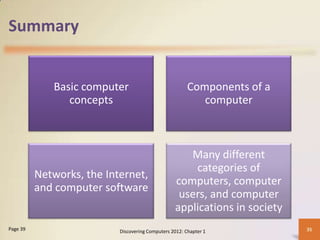
Summary


             Basic computer                             Components of a
                concepts                                   computer


                                                     Many different
                                                      categories of
          Networks, the Internet,
                                                  computers, computer
          and computer software
                                                   users, and computer
                                                  applications in society
Page 39                    Discovering Computers 2012: Chapter 1            35
Discovering
    Computers 2012
     Your Interactive Guide
      to the Digital World
    Chapter 1 Complete

Discovering Computers: Chapter 01

  • 1.
    Discovering Computers 2012 Your Interactive Guide to the Digital World
  • 2.
    Objectives Overview Define the term, Explain why computer computer, and describe Describe the five literacy is vital to the relationship components of a success in today’s world between data and computer information Discuss the advantages Define the term, and disadvantages that Discuss the uses of the network, and identify users experience when Internet and World benefits of sharing working with Wide Web resources on a network computers See Page 3 2 Discovering Computers 2012: Chapter 1 for Detailed Objectives
  • 3.
    Objectives Overview Distinguish betweensystem Differentiate among types, Describe the role of each software and application sizes, and functions of element in an information software computers in each category system Explain how home users, Discuss how society uses small office/home office computers in education, users, mobile users, power finance, government, health users, and enterprise users care, science, publishing, each interact with travel, and manufacturing computers See Page 3 3 Discovering Computers 2012: Chapter 1 for Detailed Objectives
  • 4.
    A World ofComputers • Computers are everywhere Pages 4 - 5 4 Discovering Computers 2012: Chapter 1 Figure 1-1
  • 5.
    What Is aComputer? • A computer is an electronic device, operating under the control of instructions stored in its own memory Collects Produces data Processing information (input) (output) Information Processing Cycle Page 6 Discovering Computers 2012: Chapter 1 5
  • 6.
    What Is aComputer? Page 6 6 Discovering Computers 2012: Chapter 1 Figure 1-2
  • 7.
    The Components ofa Computer • A computer contains many electric, electronic, and mechanical components known as hardware Input Device • Allows you to enter data and instructions into a computer Output Device • Hardware component that conveys information to one or more people • Case that contains the electronic components of the computer that System Unit are used to process data • Records (writes) and/or retrieves (reads) items to and from storage Storage Device media Communications • Enables a computer to send and receive data, instructions, and Device information to and from one or more computers or mobile devices Pages 6 - 8 Discovering Computers 2012: Chapter 1 7
  • 8.
    The Components ofa Computer Page 7 8 Discovering Computers 2012: Chapter 1 Figure 1-3
  • 9.
    Advantages and Disadvantages ofUsing Computers Advantages of Disadvantages of Using Computers Using Computers Speed Health Risks Reliability Violation of Privacy Consistency Public Safety Storage Impact on Labor Force Communications Impact on Environment Pages 9 - 10 Discovering Computers 2012: Chapter 1 9
  • 10.
    Advantages and Disadvantages ofUsing Computers • Green computing involves reducing the electricity consumed and environmental waste generated when using a computer • Strategies include: – Recycling – Regulating manufacturing processes – Extending the life of computers – Immediately donating or properly disposing of replaced computers Page 10 Discovering Computers 2012: Chapter 1 10
  • 11.
    Networks and theInternet • A network is a collection of computers and devices connected together, often wirelessly, via communications devices and transmission media Pages 10 - 11 Discovering Computers 2012: Chapter 1 11 Figure 1-6
  • 12.
    Networks and theInternet • The Internet is a worldwide collection of networks that connects millions of businesses, government agencies, educational institutions, and individuals Page 11 12 Discovering Computers 2012: Chapter 1 Figure 1-7
  • 13.
    Networks and theInternet • People use the Internet for a variety of reasons: Communicate Research and Shop Bank and Invest Online Trading Access Information Entertainment Download Videos Share Information Web Application Pages 12 - 13 13 Discovering Computers 2012: Chapter 1 Figure 1-8
  • 14.
    Networks and theInternet • A social networking Web site encourages members to share their interests, ideas, stories, photos, music, and videos with other registered users Page 14 14 Discovering Computers 2012: Chapter 1 Figure 1-9
  • 15.
    Computer Software • Software,also called a program, tells the computer what tasks to perform and how to perform them System Software • Operating system • Utility program Application Software Pages 15 - 16 15 Discovering Computers 2012: Chapter 1 Figures 1-10 - 1-11
  • 16.
    Computer Software • Installingis the process of setting up software to work with the computer, printer, and other hardware Pages 16 - 17 16 Discovering Computers 2012: Chapter 1 Figure 1-12
  • 17.
    Computer Software • A programmer develops software or writes the instructions that direct the computer to process data into information Page 18 Discovering Computers 2012: Chapter 1 17 Figure 1-13
  • 18.
    Categories of Computers Personal computers Mobile computers and mobile devices Game consoles Servers Mainframes Supercomputers Embedded computers Page 19 Discovering Computers 2012: Chapter 1 18
  • 19.
    Personal Computers • Apersonal computer can perform all of its input, processing, output, and storage activities by itself • Two popular architectures are the PC and the Apple – Desktop computer Pages 19 - 20 19 Discovering Computers 2012: Chapter 1 Figures 1-15 - 1-16
  • 20.
    Mobile Computers andMobile Devices Mobile Mobile Computer Device Personal computer you Computing device small can carry from place to enough to hold in your place hand Examples include smart Examples include phones and PDAs, e- notebook computers, book readers, handheld laptop computers, computers, portable netbooks, ultra-thins, media players, and and Tablet PCs digital cameras Pages 20 - 23 Discovering Computers 2012: Chapter 1 20
  • 21.
    Mobile Computers andMobile Devices Notebook computer Tablet PC Smart phones and PDAs E-book reader Pages 20 - 22 21 Discovering Computers 2012: Chapter 1 Figures 1-17 – 1-20
  • 22.
    Mobile Computers andMobile Devices Handheld computer Portable media player Digital camera Pages 22 - 23 22 Discovering Computers 2012: Chapter 1 Figures 1-21 – 1-23
  • 23.
    Game Consoles • A game console is a mobile computing device designed for single-player or multiplayer video games Page 24 Discovering Computers 2012: Chapter 1 23 Figure 1-24
  • 24.
    Servers • A server controls access to the hardware, software, and other resources on a network – Provides a centralized storage area for programs, data, and information Page 25 Discovering Computers 2012: Chapter 1 24 Figure 1-25
  • 25.
    Mainframes • A mainframe is a large, expensive, powerful computer that can handle hundreds or thousands of connected users simultaneously Page 25 Discovering Computers 2012: Chapter 1 25 Figure 1-26
  • 26.
    Supercomputers • A supercomputeris the fastest, most powerful computer – Fastest supercomputers are capable of processing more than one quadrillion instructions in a single second Page 25 26 Discovering Computers 2012: Chapter 1 Figure 1-27
  • 27.
    Embedded Computers • Anembedded computer is a special-purpose computer that functions as a component in a larger product Consumer Home Automation Process Controllers Computer Devices Automobiles Electronics Devices and Robotics and Office Machines • Mobile and digital • Thermostats • Antilock brakes • Remote monitoring • Keyboards telephones • Sprinkling systems • Engine control systems • Printers • Digital televisions • Security modules • Power monitors • Faxes • Cameras monitoring systems • Airbag controller • Machine • Copiers • Video recorders • Appliances • Cruise control controllers • DVD players and • Lights • Medical devices recorders • Answering machines Page 26 Discovering Computers 2012: Chapter 1 27
  • 28.
    Embedded Computers Page 26 28 Discovering Computers 2012: Chapter 1 Figure 1-28
  • 29.
    Elements of anInformation System Hardware Software Data People Procedures Page 27 Discovering Computers 2012: Chapter 1 29
  • 30.
    Elements of anInformation System Page 27 30 Discovering Computers 2012: Chapter 1 Figure 1-29
  • 31.
    Examples of ComputerUsage Home User Small Office/Home Mobile User • Personal financial Office User • Connect to other computers management • Look up information on a network or the Internet • Web access • Send and receive e-mail • Transfer information • Communications messages • Play video games • Entertainment • Make telephone calls • Listen to music • Watch movies Pages 28 – 31 31 Discovering Computers 2012: Chapter 1 Figures 1-30 – 1-32
  • 32.
    Examples of ComputerUsage Power User Enterprise User • Work with multimedia • Communicate among • Use industry-specific employees software • Process high volumes of transactions • Blog Pages 31 – 32 32 Discovering Computers 2012: Chapter 1 Figures 1-33 – 1-34
  • 33.
    Computer Applications inSociety Education Finance Government Health Care Pages 34 - 36 33 Discovering Computers 2012: Chapter 1 Figures 1-36 – 1-39
  • 34.
    Computer Applications inSociety Science Publishing Travel Manufacturing Pages 36 - 38 34 Discovering Computers 2012: Chapter 1 Figures 1-40 – 1-43
  • 35.
    Summary Basic computer Components of a concepts computer Many different categories of Networks, the Internet, computers, computer and computer software users, and computer applications in society Page 39 Discovering Computers 2012: Chapter 1 35
  • 36.
    Discovering Computers 2012 Your Interactive Guide to the Digital World Chapter 1 Complete