POLYVALENT BACTERIOPHAGE
BACTERIOPHAGE ?
•A bacteriophage also known as a phage, is
a virus that infects and replicates within
a bacterium.
STRUCTURE:
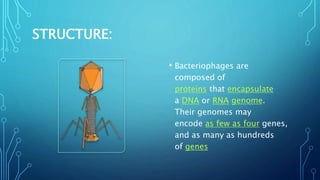
• Bacteriophages are
composed of
proteins that encapsulate
a DNA or RNA genome.
Their genomes may
encode as few as four genes,
and as many as hundreds
of genes
METHOD OF INFECTION
• The phage infection cycle seems to be simple but extremely
efficient: a single phage injects its genome into a bacterial cell,
switching the cells' programme in its favour so the host cell will
eventually die and release about 100 new phage particles.
TYPES:
• Phages are usually species-specific and even strain-specific,
however, some polyvalence is observed, predominantly among
phages of Enterobacteria and staphylococci.
• These polyvalent phages are able to infect strains from either
different genera or species.
• POLYVALENT PHAGES: SH6 , SH7
STRUCTURE OF SH6 , SH7
Electron microscopy observations of purified phage SH6 revealed
an icosahedral capsid of 62 ± 2 nm in diameter with a long
noncontractile flexible tail of 161 ± 2 nm in length by 13 ± 1 nm in
width, morphology indicative of the Siphoviridae family.
Phage SH7 had an elongated capsid of 112 ± 5 nm in length by
89 ± 3 nm in width and a long contractile tail of 116 ± 4 nm in
length by 22 ± 2 nm in width. SH7 belongs to
the Myoviridae family
IMPORTANCE
1 Phages play important roles in the ecology and evolution of bacteria.
In fact, bacteria probably wouldn't be bacteria, at least as they exist
today, without phages moving their DNA among themselves
2. Diphtheria toxin is the proximate cause of diphtheria – that is,
the bacterium without this toxin will not cause diphtheria – but, in
fact, diphtheria toxin is a expressed from a phage gene.
3.Phages have and continue to play important roles in
the identification, classification, characterization, and detection of
especially pathogenic bacteria
Bacteriophage. Polyvalent bacteriophage

Bacteriophage. Polyvalent bacteriophage

  • 1.
  • 2.
    BACTERIOPHAGE ? •A bacteriophagealso known as a phage, is a virus that infects and replicates within a bacterium.
  • 3.
    STRUCTURE: • Bacteriophages are composedof proteins that encapsulate a DNA or RNA genome. Their genomes may encode as few as four genes, and as many as hundreds of genes
  • 4.
    METHOD OF INFECTION •The phage infection cycle seems to be simple but extremely efficient: a single phage injects its genome into a bacterial cell, switching the cells' programme in its favour so the host cell will eventually die and release about 100 new phage particles.
  • 5.
    TYPES: • Phages areusually species-specific and even strain-specific, however, some polyvalence is observed, predominantly among phages of Enterobacteria and staphylococci. • These polyvalent phages are able to infect strains from either different genera or species. • POLYVALENT PHAGES: SH6 , SH7
  • 6.
    STRUCTURE OF SH6, SH7 Electron microscopy observations of purified phage SH6 revealed an icosahedral capsid of 62 ± 2 nm in diameter with a long noncontractile flexible tail of 161 ± 2 nm in length by 13 ± 1 nm in width, morphology indicative of the Siphoviridae family. Phage SH7 had an elongated capsid of 112 ± 5 nm in length by 89 ± 3 nm in width and a long contractile tail of 116 ± 4 nm in length by 22 ± 2 nm in width. SH7 belongs to the Myoviridae family
  • 7.
    IMPORTANCE 1 Phages playimportant roles in the ecology and evolution of bacteria. In fact, bacteria probably wouldn't be bacteria, at least as they exist today, without phages moving their DNA among themselves 2. Diphtheria toxin is the proximate cause of diphtheria – that is, the bacterium without this toxin will not cause diphtheria – but, in fact, diphtheria toxin is a expressed from a phage gene. 3.Phages have and continue to play important roles in the identification, classification, characterization, and detection of especially pathogenic bacteria