Bacteriophages: Structural Organization
life cycle and phages production
Submitted by
ASWINI.V
I MSC MICROBIOLOGY
Sri paramakalyani college
Alwarkurichi
Introduction to
Bacteriophages
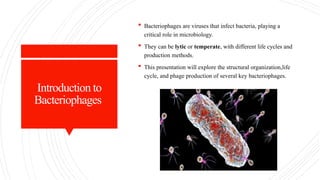
 Bacteriophages are viruses that infect bacteria, playing a
critical role in microbiology.
 They can be lytic or temperate, with different life cycles and
production methods.
 This presentation will explore the structural organization,life
cycle, and phage production of several key bacteriophages.
Structural
Organization of
Bacteriophages
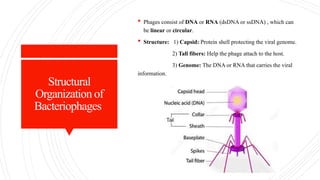
 Phages consist of DNA or RNA (dsDNA or ssDNA) , which can
be linear or circular.
 Structure: 1) Capsid: Protein shell protecting the viral genome.
2) Tall fibers: Help the phage attach to the host.
3) Genome: The DNA or RNA that carries the viral
information.
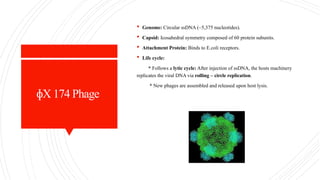
X 174 Phage
ɸ
 Genome: Circular ssDNA (~5,375 nucleotides).
 Capsid: Icosahedral symmetry composed of 60 protein subunits.
 Attachment Protein: Binds to E.coli receptors.
 Life cycle:
* Follows a lytic cycle: After injection of ssDNA, the hosts machinery
replicates the viral DNA via rolling – circle replication.
* New phages are assembled and released upon host lysis.
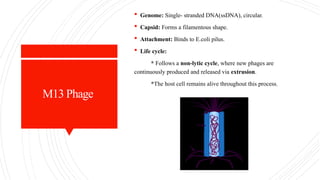
M13 Phage
 Genome: Single- stranded DNA(ssDNA), circular.
 Capsid: Forms a filamentous shape.
 Attachment: Binds to E.coli pilus.
 Life cycle:
* Follows a non-lytic cycle, where new phages are
continuously produced and released via extrusion.
*The host cell remains alive throughout this process.
MU Phage
 Genome: Double – stranded DNA (ssDNA) , integrates into the
bacteria chromosomes.
 Life cycle:
* can enter life lysogenic cycle (integrates into host
genome as a prophage).
* can shift to the lytic cycle, producing new phages by
rolling- circle replication, leading to cell lysis.
T4 Phage
 Genome: Double – stranded DNA(dsDNA).
 Capsid: Icosahedral shape with a tail structure.
 Life cycle:
* Follows a lytic cycle.
* After attaching to the bacterial cell, the phage injects
DNA, uses rolling – circle replication for genome replication,
and assembled new phages.
* The cell bursts, releasing hundreds of new virions.
Lambda Phage
 Genome: Double – stranded DNA (dsDNA ).
 Life cycle:
* Lysogenic cycle: Lambda integrates into the host
genome as a prophase and replicates with the hosts DNA.
* Lytic cycle: If induced, the prophage excises itself,
undergoes rolling- circle replication, assembles new virions, and
cause lysis.
Pi Phage
 Genome: Double – stranded DNA (dsDNA ).
 Life cycle:
* Primarily follows the lysogenic cycle, integrating into
the host genome.
* Under certain conditions, it can enter the lytic cycle,
replicating and producing new phages, leading to host cell lysis.
Comparison of
Phages
 ɸX 174: Small, ssDNA, lytic cycle.
 M13: ssDNA, non-lytic cycle.
 MU: dsDNA, temperate, lysogenic and lytic cycles.
 T4: dsDNA, lytic cycle.
 Lambda: dsDNA, temperate, lysogenic and lytic cycles.
 Pi: dsDNA, temperate, lysogenic and lytic cycles.
Phage Production
Methods
 Phages follow different Production methods based on their life
cycle:
* Lytic cycle: Phages replicate rapidly, leading to cell
lysis and release of progeny phages.
* Lysogenic cycle: Some phages integrate into the host
genome and replicate with the host, producing new phages only
when induced.
Conclusion
 Bacteriophages have diverse structural features and life cycles.
 Understanding their production methods is essential for their
application in biotechnology, phage therapy, and genetic
research.
 Each phage type offers unique insights into viral behavior and
interaction with bacterial hosts.
THANKYOU

Bacteriophage ,cycle &phages production.

  • 2.
    Bacteriophages: Structural Organization lifecycle and phages production Submitted by ASWINI.V I MSC MICROBIOLOGY Sri paramakalyani college Alwarkurichi
  • 3.
    Introduction to Bacteriophages  Bacteriophagesare viruses that infect bacteria, playing a critical role in microbiology.  They can be lytic or temperate, with different life cycles and production methods.  This presentation will explore the structural organization,life cycle, and phage production of several key bacteriophages.
  • 4.
    Structural Organization of Bacteriophages  Phagesconsist of DNA or RNA (dsDNA or ssDNA) , which can be linear or circular.  Structure: 1) Capsid: Protein shell protecting the viral genome. 2) Tall fibers: Help the phage attach to the host. 3) Genome: The DNA or RNA that carries the viral information.
  • 5.
    X 174 Phage ɸ Genome: Circular ssDNA (~5,375 nucleotides).  Capsid: Icosahedral symmetry composed of 60 protein subunits.  Attachment Protein: Binds to E.coli receptors.  Life cycle: * Follows a lytic cycle: After injection of ssDNA, the hosts machinery replicates the viral DNA via rolling – circle replication. * New phages are assembled and released upon host lysis.
  • 6.
    M13 Phage  Genome:Single- stranded DNA(ssDNA), circular.  Capsid: Forms a filamentous shape.  Attachment: Binds to E.coli pilus.  Life cycle: * Follows a non-lytic cycle, where new phages are continuously produced and released via extrusion. *The host cell remains alive throughout this process.
  • 7.
    MU Phage  Genome:Double – stranded DNA (ssDNA) , integrates into the bacteria chromosomes.  Life cycle: * can enter life lysogenic cycle (integrates into host genome as a prophage). * can shift to the lytic cycle, producing new phages by rolling- circle replication, leading to cell lysis.
  • 8.
    T4 Phage  Genome:Double – stranded DNA(dsDNA).  Capsid: Icosahedral shape with a tail structure.  Life cycle: * Follows a lytic cycle. * After attaching to the bacterial cell, the phage injects DNA, uses rolling – circle replication for genome replication, and assembled new phages. * The cell bursts, releasing hundreds of new virions.
  • 9.
    Lambda Phage  Genome:Double – stranded DNA (dsDNA ).  Life cycle: * Lysogenic cycle: Lambda integrates into the host genome as a prophase and replicates with the hosts DNA. * Lytic cycle: If induced, the prophage excises itself, undergoes rolling- circle replication, assembles new virions, and cause lysis.
  • 10.
    Pi Phage  Genome:Double – stranded DNA (dsDNA ).  Life cycle: * Primarily follows the lysogenic cycle, integrating into the host genome. * Under certain conditions, it can enter the lytic cycle, replicating and producing new phages, leading to host cell lysis.
  • 11.
    Comparison of Phages  ɸX174: Small, ssDNA, lytic cycle.  M13: ssDNA, non-lytic cycle.  MU: dsDNA, temperate, lysogenic and lytic cycles.  T4: dsDNA, lytic cycle.  Lambda: dsDNA, temperate, lysogenic and lytic cycles.  Pi: dsDNA, temperate, lysogenic and lytic cycles.
  • 12.
    Phage Production Methods  Phagesfollow different Production methods based on their life cycle: * Lytic cycle: Phages replicate rapidly, leading to cell lysis and release of progeny phages. * Lysogenic cycle: Some phages integrate into the host genome and replicate with the host, producing new phages only when induced.
  • 13.
    Conclusion  Bacteriophages havediverse structural features and life cycles.  Understanding their production methods is essential for their application in biotechnology, phage therapy, and genetic research.  Each phage type offers unique insights into viral behavior and interaction with bacterial hosts.
  • 14.