BACTERIAL DRUG RESISTANCE
Presented By- Dr. Devesh Pandey
MBBS, MD (Pharmacology)
UPUMS, Saifai, U.P.
Dr. Devesh Classes
INTRODUCTION
• Drug Resistance- Unresponsiveness of microorganisms
to an antimicrobial agent after its repeated use.
• Tolerance – Need to increase dose
• Antibiotic Tolerance-when antibiotic no longer kills the
microorganisms but merely inhibits its growth or
multiplication.
• Antibiotic Resistance – Intrinsic or acquired.
Dr. Devesh Classes
• Heteroresistance- when a subset of the total microbial
population is resistant, despite the total population being
considered susceptible on testing.
• Eg. especially for vancomycin in S. aureus and Enterococcus
faecium; colistin in Acinetobacter baumanniicalcoaceticus;
rifampin, isoniazid, and streptomycin in M. tuberculosis; and
penicillin in S. pneumoniae (Falagas et al., 2008; Rinder, 2001).
• Increased therapeutic failures and mortality reported in patients
with heteroresistant staphylococci and M. tuberculosis (Falagas
et al., 2008; Hofmann-Thiel et al., 2009).
• For fungi, heteroresistance leading to clinical failure has been
described for fluconazole in C. neoformans and Candida
albicans.
Dr. Devesh Classes
Resistance in bacterial population spread from-
• Person to person by bacteria
• From bacterium to bacterium by plasmids
• From plasmid to plasmid by transposons and
integrons.
Dr. Devesh Classes
(1) Intrinsic Resistance-
• Resistance to common antibiotics (natural).
• They lack the metabolic process or Inability to cross its
outer membrane or bind to target sites which is affected
by the particular drug.
• Does not pose a significant clinical problem.
• Proper drugs are to be selected.
 e.g. gram-negative bacilli are normally unaffected by
penicillin G;
 Aerobic organisms are not affected by metronidazole;
while anaerobic bacteria are not inhibited by
aminoglycoside antibiotics,
 M. tuberculosis is insensitive to tetracyclines.
Dr. Devesh Classes
(2) Acquired Resistance –
• Development of resistance by an organism (which was
sensitive before) subsequently at later stage due to
widespread and irrational use of antibiotics.
• Can happen with any microbe and is a major clinical
problem.
• Some bacteria are notorious for rapid acquisition of
resistance, e.g. staphylococci, coliforms, tubercle bacilli.
• Eg.Gonococci quickly developed resistance to
sulfonamides, but only slowly and low-grade resistance to
penicillin.
• Develops either by gene transfer or by mutation or by
modification in biochemical mechanisms.
Dr. Devesh Classes
(1)GENETIC METHODS OF ANTIBIOTIC
RESISTANCE-
(A)Chromosomal methods: Mutations-
• Mutation- stable and heritable genetic change in DNA
structure of a gene.
• Occurs spontaneously and randomly.
• In time it would appear that a sensitive strain has been
replaced by a resistant one (vertical transfer of resistance
• Selection of mutants – confer resistance
• Reduced pathogenicity
• Big clinical problem in infection caused by mycobacterium
and by methicillin resistant Staph.
Dr. Devesh Classes
Single step mutation:
• A single gene mutation, emerges rapidly.
• e.g. entcrococci to streptomycin.
Multistep mutation :
• A number of gene modifications
• sensitivity decreases gradually
• Eg. Resistance to erythromycin, tetracyclines
and chloramphenicol.
Dr. Devesh Classes
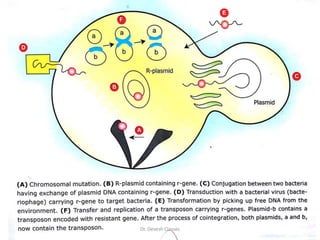
(B)Extrachromosomal Mechanism:Plasmids-
• The resistance causing gene is passed from one
organism to the other; is called horizontal transfer of
resistance.
• Plasmid- vectors serving as a carriers of DNA
molecule.
• R-plasmid- carry genes resistant to antibiotic (r-gene).
• In clinical practice common drug resistance.
Dr. Devesh Classes
(a)Methods of Transfer of r-gene from one
Bacterium to Another-
Conjugation-
• Main mechanism, even multidrug resistance
• R-gene containing plasmid via connecting tube (sex
pili), 'resistance transfer factor' (RTF)
• High density bacterial place as in gut (colon).
• Common among gram negative bacilli.
• Chloramphenicol resistance of typhoid bacilli,
streptomycin resistance of E. coli .
Dr. Devesh Classes
Transduction-
• Less common
• Bacteriophage-plasmid DNA enclosed in bacterial virus is
transferred
• In strains of staphylococci and between strains of
streptococci.
• Penicillin, erythromycin and chloramphenicol resistance.
Transformation-
• Least clinical problem
• Certain bacteria pick up free DNA from environment and
then become resistant.
Dr. Devesh Classes
(b) Transfer of r-gene between Plasmid within
Bacterium-
By Transposons-
• DNA segment,cannot self replicate , but can self-
transfer between plasmid or from plasmid to
chromosome.
• Donor plasmid(+transposon) cointegrates acceptor
plasmid, now transposon replicate.
• Some strains of staphylococcus and enterococci
acquire resistance.
• Can cause untreatable infections.
Dr. Devesh Classes
By Integrons-
• mainly multidrug resistance
• Integron-Spread by larger mobile DNA unit ,can be
located on transposon.
• Packed with multiple gene cassettes consisting
resistant gene.
• Commonly associated with and work with
transposons and conjugated plasmids.
Dr. Devesh Classes
Dr. Devesh Classes
(2)Biochemical Mehanisms of
Resistance to Antibiotics -
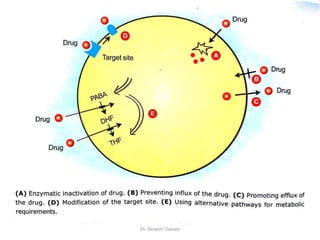
(A)By Producing an Enzyme that Inactivates the
Antibiotics –
(a) Inactivation of β-Lactum Antibiotics-
• Staphylococcus aureus, Neisseria gonorrhoea, Haemophilus
influenzae and some enteric gram-negative rods > beta-
lactamase enzyme > cleaves β-lactum ring > inactivates many
β-lactum antibiotics .
• Newer β-lactum antibiotics (monobactum, carbapenems) and
3rd/4th gen. cephalosporins resistant to β-lactamase enzymes.
Dr. Devesh Classes
(b) Inactivation of Chloramphenicol –
• Inactivated by chloramphenicol acetyltransferase by resistant
strains of gram-negative and gram-postive bacteria.
• R-gene on plasmids.
• Gram-negative bacteria (enzyme constitutive) higher
resistance compared to gram-positive bacteria (enzyme
inducible).
(c) Inactivation of Aminoglycosides –
• Inactivated by acetyl transferases, phosphotransferases and
adenylyltransferases in both gram-negative and gram-postive
organism.
• Resistant genes on plasmids and on tranposons.
Dr. Devesh Classes
(B) Prevention of Drug accumulation in the
Bacterium-
• Bacterial envelop biochemical alteration > not allowing
influx / promoting efflux of drug.
• Efflux pumps –cytoplasmic membrane transport protein
,in E.coli, P.aeruginosa, S.typhi, Staph.aureus,
Strepto.pyogens, Strepto.pneumoniae, N.gonorrhoeae,
mycobacterium, enterococci.
• There are five major systems of efflux pumps-
 • The multidrug and toxin extruder
 • The major facilitator superfamily transporters
 • The small multidrug resistance system
 • The resistance nodulation division exporters
 • ABC transporters Dr. Devesh Classes
• Eg.Tetracyclines (major), some
fluroquinolones.
• Low degree penicillin-resistant gonococci are
less permeable to penicillin G.
• Chloroquine-resistant in P. falciparum
accumulates less chloroquine, mediated by an
ABC transporter encoded by P. falciparum
multidrug resistance gene 1 (Pfmdr1) (Happi et
al., 2009).
Dr. Devesh Classes
• Some gram-negative bacteria > inhibit plasmid mediated
synthesis of porin channels > obstructs “influx” of
hydrophilic penicillins eg. Ampicillin.
• Mutations in bacterial envelop components reduces
accumulation of tetracyclins, chloramphenicol,
aminoglycosides and β-lactum antibiotics.
• Trypanosoma brucei treated with suramin and
pentamidine during early stages, but with melarsoprol
and eflornithine when CNS disease (sleeping sickness) .
Melarsoprol is actively taken up by P2 transporter. When
the parasite lacks the P2 transporter or has a mutant
form, resistance to melarsoprol and cross resistance to
pentamidine occur due to reduced drug uptake
(Ouellette, 2001).
Dr. Devesh Classes
(C) By Modification/protection of the Target sites-
• Altered target sites. Eg.
• Tetracyclins, macrolides, clindamycin – ribosomal point
mutation.
• Fluoroquinolones – altered DNA gyrase and
topoisomerase.
• Penicillin – modified penicillin binding protein(PBP) in
Strepto, Pneumoniae.
• Refampicin – change of one A.A. in β-subunit of DNA-
directed RNA-polymerase.
Dr. Devesh Classes
(D) Use of Alternative Pathways for Metabolic/
Growth Requirements –
• By developing alternative pathway that bypasses
reaction inhibited by antibiotic. Eg.
• Sulfonamide resistance –from overproduction of PABA.
• Β-lactum antibiotics – by overproducing β-lactamase in
enteric organisms.
Dr. Devesh Classes
(E) By Quorum sensing-
• Autoinducer- microbes communicate with each other and
exchange signaling chemicals.
• Quorum Sensing(QS)- allows bacterial population to
co-ordinate gene expression for virulance, conjugation,
mobility, apoptosis, antibiotic resistance etc.
• Colony of microbes > critical density (quorum) >thresold of
autoinduction > gene expression.
• Several chemical classes of QS –signal molecules identified in
Gram-negative bacteria AIP, AI-2 (in both gram-negative and
gram-positive), AI-3.
Dr. Devesh Classes
• Drugs that inhibit these signals > minimise microbial
growth as well as resistance development.
• Numbers of compound synthesised > inhibit QS-
system in different bacteria.
• Under investigation .
Dr. Devesh Classes
(F)Incorporation of Drug –
• Uncommon situation occurs when an organism not
only becomes resistant to an antimicrobial
agent(AMA) but also subsequently starts requiring it
for growth.
• Eg. Enterococcus, which easily develops vancomycin
resistance, after prolonged exposure , develop
vancomycin requiring strains.
• In 1955 Hashimoto isolated a streptomycin-
dependent mutant of M. tuberculosis.
Dr. Devesh Classes
Dr. Devesh Classes
Cross Resistance-
• Acquisition ofresistance to one AMA conferring
resistance to another AMA, to which the organism
has not been exposed.
• Seen between chemically or mechanistically related
drugs.
• e.g. resistance to one sulfonamide means resistance
to all others,same with tetracycline.
• Sometimes unrelated drugs show partial cross
resistance e.g. between tetracyclines and
chloramphenicol, between erythromycin and
lincomycin.
Dr. Devesh Classes
Prevention of Drug Resistance
(a) No indiscriminate and inadequate or unduly
prolonged use of AMAs
(b) Prefer rapidly acting and selective (narrow
spectrum) AMAs whenever possible.
(c) Use combination of AMAs whenever prolonged
therapy is undertaken, e.g. tuberculosis, SABE, HIV-
AIDS.
(d) Infection by organisms notorious for developing
resistance, e.g. Staph. aureus, E. coli, M. tuberculosis,
Proteus, etc. must be treated intensively.
Dr. Devesh Classes
CONCLUSION
• Two major factors are associated with emergence of
antibiotic resistance: evolution and
clinical/environmental practices.
• Antimicrobial resistance can develop at any one or
more of steps in the processes by which a drug
reaches and combines with its target.
• Mechanisms by which such resistance develops can
include acquisition of genetic elements that code for
the resistant mechanism, mutations that develop
under antibiotic pressure, or constitutive induction.
Dr. Devesh Classes
•THANK YOU….
Dr. Devesh Classes

BACTERIAL DRUG RESISTANCE.pptx

  • 1.
    BACTERIAL DRUG RESISTANCE PresentedBy- Dr. Devesh Pandey MBBS, MD (Pharmacology) UPUMS, Saifai, U.P. Dr. Devesh Classes
  • 2.
    INTRODUCTION • Drug Resistance-Unresponsiveness of microorganisms to an antimicrobial agent after its repeated use. • Tolerance – Need to increase dose • Antibiotic Tolerance-when antibiotic no longer kills the microorganisms but merely inhibits its growth or multiplication. • Antibiotic Resistance – Intrinsic or acquired. Dr. Devesh Classes
  • 3.
    • Heteroresistance- whena subset of the total microbial population is resistant, despite the total population being considered susceptible on testing. • Eg. especially for vancomycin in S. aureus and Enterococcus faecium; colistin in Acinetobacter baumanniicalcoaceticus; rifampin, isoniazid, and streptomycin in M. tuberculosis; and penicillin in S. pneumoniae (Falagas et al., 2008; Rinder, 2001). • Increased therapeutic failures and mortality reported in patients with heteroresistant staphylococci and M. tuberculosis (Falagas et al., 2008; Hofmann-Thiel et al., 2009). • For fungi, heteroresistance leading to clinical failure has been described for fluconazole in C. neoformans and Candida albicans. Dr. Devesh Classes
  • 4.
    Resistance in bacterialpopulation spread from- • Person to person by bacteria • From bacterium to bacterium by plasmids • From plasmid to plasmid by transposons and integrons. Dr. Devesh Classes
  • 5.
    (1) Intrinsic Resistance- •Resistance to common antibiotics (natural). • They lack the metabolic process or Inability to cross its outer membrane or bind to target sites which is affected by the particular drug. • Does not pose a significant clinical problem. • Proper drugs are to be selected.  e.g. gram-negative bacilli are normally unaffected by penicillin G;  Aerobic organisms are not affected by metronidazole; while anaerobic bacteria are not inhibited by aminoglycoside antibiotics,  M. tuberculosis is insensitive to tetracyclines. Dr. Devesh Classes
  • 6.
    (2) Acquired Resistance– • Development of resistance by an organism (which was sensitive before) subsequently at later stage due to widespread and irrational use of antibiotics. • Can happen with any microbe and is a major clinical problem. • Some bacteria are notorious for rapid acquisition of resistance, e.g. staphylococci, coliforms, tubercle bacilli. • Eg.Gonococci quickly developed resistance to sulfonamides, but only slowly and low-grade resistance to penicillin. • Develops either by gene transfer or by mutation or by modification in biochemical mechanisms. Dr. Devesh Classes
  • 7.
    (1)GENETIC METHODS OFANTIBIOTIC RESISTANCE- (A)Chromosomal methods: Mutations- • Mutation- stable and heritable genetic change in DNA structure of a gene. • Occurs spontaneously and randomly. • In time it would appear that a sensitive strain has been replaced by a resistant one (vertical transfer of resistance • Selection of mutants – confer resistance • Reduced pathogenicity • Big clinical problem in infection caused by mycobacterium and by methicillin resistant Staph. Dr. Devesh Classes
  • 8.
    Single step mutation: •A single gene mutation, emerges rapidly. • e.g. entcrococci to streptomycin. Multistep mutation : • A number of gene modifications • sensitivity decreases gradually • Eg. Resistance to erythromycin, tetracyclines and chloramphenicol. Dr. Devesh Classes
  • 9.
    (B)Extrachromosomal Mechanism:Plasmids- • Theresistance causing gene is passed from one organism to the other; is called horizontal transfer of resistance. • Plasmid- vectors serving as a carriers of DNA molecule. • R-plasmid- carry genes resistant to antibiotic (r-gene). • In clinical practice common drug resistance. Dr. Devesh Classes
  • 10.
    (a)Methods of Transferof r-gene from one Bacterium to Another- Conjugation- • Main mechanism, even multidrug resistance • R-gene containing plasmid via connecting tube (sex pili), 'resistance transfer factor' (RTF) • High density bacterial place as in gut (colon). • Common among gram negative bacilli. • Chloramphenicol resistance of typhoid bacilli, streptomycin resistance of E. coli . Dr. Devesh Classes
  • 11.
    Transduction- • Less common •Bacteriophage-plasmid DNA enclosed in bacterial virus is transferred • In strains of staphylococci and between strains of streptococci. • Penicillin, erythromycin and chloramphenicol resistance. Transformation- • Least clinical problem • Certain bacteria pick up free DNA from environment and then become resistant. Dr. Devesh Classes
  • 12.
    (b) Transfer ofr-gene between Plasmid within Bacterium- By Transposons- • DNA segment,cannot self replicate , but can self- transfer between plasmid or from plasmid to chromosome. • Donor plasmid(+transposon) cointegrates acceptor plasmid, now transposon replicate. • Some strains of staphylococcus and enterococci acquire resistance. • Can cause untreatable infections. Dr. Devesh Classes
  • 13.
    By Integrons- • mainlymultidrug resistance • Integron-Spread by larger mobile DNA unit ,can be located on transposon. • Packed with multiple gene cassettes consisting resistant gene. • Commonly associated with and work with transposons and conjugated plasmids. Dr. Devesh Classes
  • 14.
  • 15.
    (2)Biochemical Mehanisms of Resistanceto Antibiotics - (A)By Producing an Enzyme that Inactivates the Antibiotics – (a) Inactivation of β-Lactum Antibiotics- • Staphylococcus aureus, Neisseria gonorrhoea, Haemophilus influenzae and some enteric gram-negative rods > beta- lactamase enzyme > cleaves β-lactum ring > inactivates many β-lactum antibiotics . • Newer β-lactum antibiotics (monobactum, carbapenems) and 3rd/4th gen. cephalosporins resistant to β-lactamase enzymes. Dr. Devesh Classes
  • 16.
    (b) Inactivation ofChloramphenicol – • Inactivated by chloramphenicol acetyltransferase by resistant strains of gram-negative and gram-postive bacteria. • R-gene on plasmids. • Gram-negative bacteria (enzyme constitutive) higher resistance compared to gram-positive bacteria (enzyme inducible). (c) Inactivation of Aminoglycosides – • Inactivated by acetyl transferases, phosphotransferases and adenylyltransferases in both gram-negative and gram-postive organism. • Resistant genes on plasmids and on tranposons. Dr. Devesh Classes
  • 17.
    (B) Prevention ofDrug accumulation in the Bacterium- • Bacterial envelop biochemical alteration > not allowing influx / promoting efflux of drug. • Efflux pumps –cytoplasmic membrane transport protein ,in E.coli, P.aeruginosa, S.typhi, Staph.aureus, Strepto.pyogens, Strepto.pneumoniae, N.gonorrhoeae, mycobacterium, enterococci. • There are five major systems of efflux pumps-  • The multidrug and toxin extruder  • The major facilitator superfamily transporters  • The small multidrug resistance system  • The resistance nodulation division exporters  • ABC transporters Dr. Devesh Classes
  • 18.
    • Eg.Tetracyclines (major),some fluroquinolones. • Low degree penicillin-resistant gonococci are less permeable to penicillin G. • Chloroquine-resistant in P. falciparum accumulates less chloroquine, mediated by an ABC transporter encoded by P. falciparum multidrug resistance gene 1 (Pfmdr1) (Happi et al., 2009). Dr. Devesh Classes
  • 19.
    • Some gram-negativebacteria > inhibit plasmid mediated synthesis of porin channels > obstructs “influx” of hydrophilic penicillins eg. Ampicillin. • Mutations in bacterial envelop components reduces accumulation of tetracyclins, chloramphenicol, aminoglycosides and β-lactum antibiotics. • Trypanosoma brucei treated with suramin and pentamidine during early stages, but with melarsoprol and eflornithine when CNS disease (sleeping sickness) . Melarsoprol is actively taken up by P2 transporter. When the parasite lacks the P2 transporter or has a mutant form, resistance to melarsoprol and cross resistance to pentamidine occur due to reduced drug uptake (Ouellette, 2001). Dr. Devesh Classes
  • 20.
    (C) By Modification/protectionof the Target sites- • Altered target sites. Eg. • Tetracyclins, macrolides, clindamycin – ribosomal point mutation. • Fluoroquinolones – altered DNA gyrase and topoisomerase. • Penicillin – modified penicillin binding protein(PBP) in Strepto, Pneumoniae. • Refampicin – change of one A.A. in β-subunit of DNA- directed RNA-polymerase. Dr. Devesh Classes
  • 21.
    (D) Use ofAlternative Pathways for Metabolic/ Growth Requirements – • By developing alternative pathway that bypasses reaction inhibited by antibiotic. Eg. • Sulfonamide resistance –from overproduction of PABA. • Β-lactum antibiotics – by overproducing β-lactamase in enteric organisms. Dr. Devesh Classes
  • 22.
    (E) By Quorumsensing- • Autoinducer- microbes communicate with each other and exchange signaling chemicals. • Quorum Sensing(QS)- allows bacterial population to co-ordinate gene expression for virulance, conjugation, mobility, apoptosis, antibiotic resistance etc. • Colony of microbes > critical density (quorum) >thresold of autoinduction > gene expression. • Several chemical classes of QS –signal molecules identified in Gram-negative bacteria AIP, AI-2 (in both gram-negative and gram-positive), AI-3. Dr. Devesh Classes
  • 23.
    • Drugs thatinhibit these signals > minimise microbial growth as well as resistance development. • Numbers of compound synthesised > inhibit QS- system in different bacteria. • Under investigation . Dr. Devesh Classes
  • 24.
    (F)Incorporation of Drug– • Uncommon situation occurs when an organism not only becomes resistant to an antimicrobial agent(AMA) but also subsequently starts requiring it for growth. • Eg. Enterococcus, which easily develops vancomycin resistance, after prolonged exposure , develop vancomycin requiring strains. • In 1955 Hashimoto isolated a streptomycin- dependent mutant of M. tuberculosis. Dr. Devesh Classes
  • 25.
  • 26.
    Cross Resistance- • Acquisitionofresistance to one AMA conferring resistance to another AMA, to which the organism has not been exposed. • Seen between chemically or mechanistically related drugs. • e.g. resistance to one sulfonamide means resistance to all others,same with tetracycline. • Sometimes unrelated drugs show partial cross resistance e.g. between tetracyclines and chloramphenicol, between erythromycin and lincomycin. Dr. Devesh Classes
  • 27.
    Prevention of DrugResistance (a) No indiscriminate and inadequate or unduly prolonged use of AMAs (b) Prefer rapidly acting and selective (narrow spectrum) AMAs whenever possible. (c) Use combination of AMAs whenever prolonged therapy is undertaken, e.g. tuberculosis, SABE, HIV- AIDS. (d) Infection by organisms notorious for developing resistance, e.g. Staph. aureus, E. coli, M. tuberculosis, Proteus, etc. must be treated intensively. Dr. Devesh Classes
  • 28.
    CONCLUSION • Two majorfactors are associated with emergence of antibiotic resistance: evolution and clinical/environmental practices. • Antimicrobial resistance can develop at any one or more of steps in the processes by which a drug reaches and combines with its target. • Mechanisms by which such resistance develops can include acquisition of genetic elements that code for the resistant mechanism, mutations that develop under antibiotic pressure, or constitutive induction. Dr. Devesh Classes
  • 29.