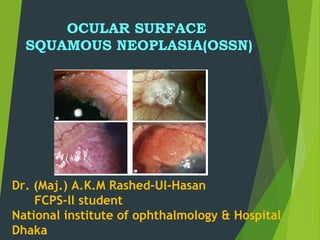
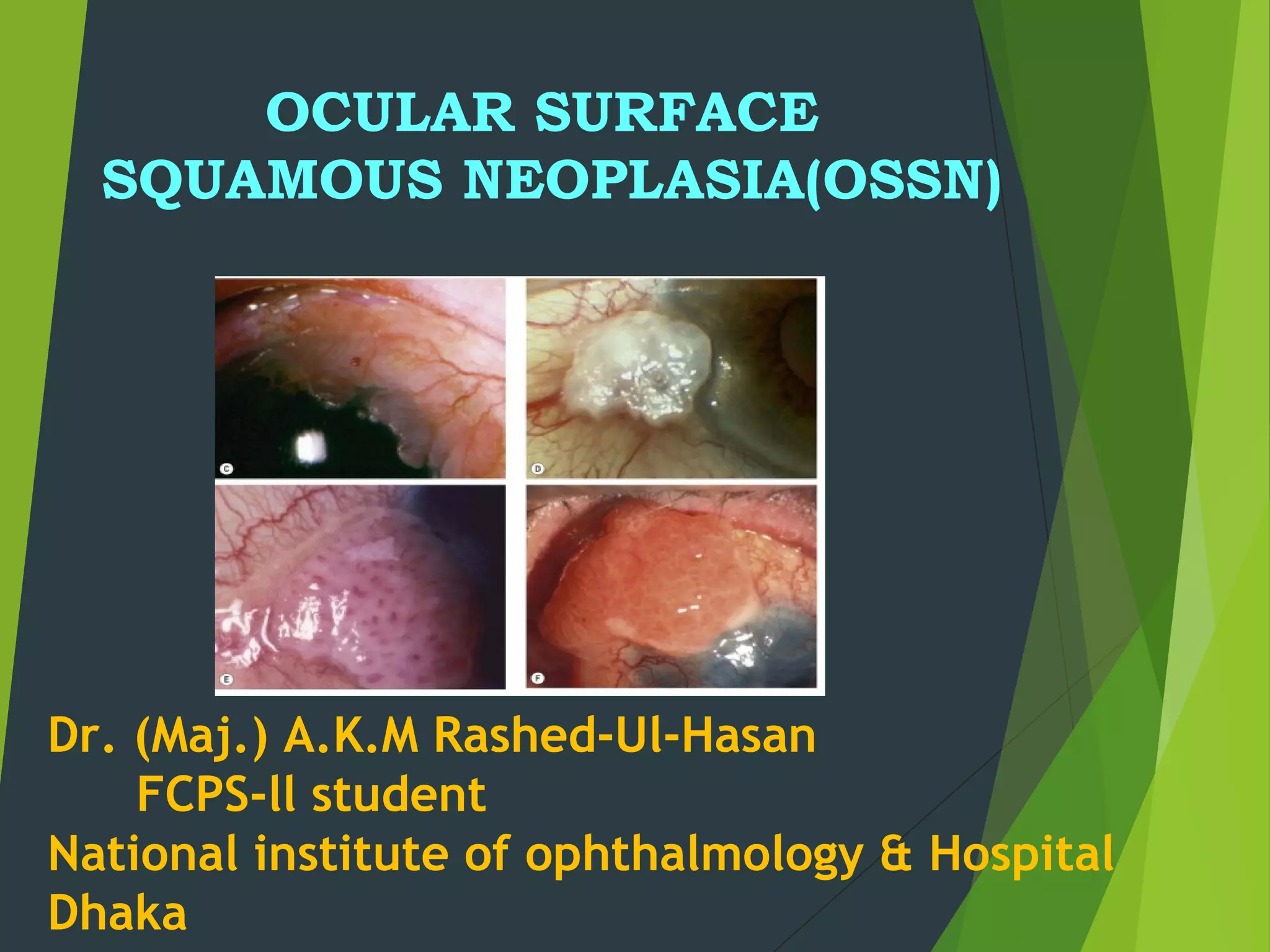
OCULAR SURFACE
SQUAMOUS NEOPLASIA(OSSN)
Dr. (Maj.) A.K.M Rashed-Ul-Hasan
FCPS-ll student
National institute of ophthalmology & Hospital
Dhaka
 OCULAR SURFACE denotes involvement
of the conjunctiva or cornea
 SQUAMOUS excludes other epithelial
cells such as basal cells and melanocytes
 NEOPLASIA includes both dysplastic and
carcinomatous lesions.
Definition
The term Ocular Surface Squamous
Neoplasia [OSSN] presently refers to the
entire spectrum of dysplastic, pre-invasive
and malignant squamous lesions of the
conjunctiva and cornea
Lee and Hirst classified OSSN as:-
I. BENIGN DYSPLASIA
• Pseudoepitheliomatous hyperplasia
• Benign hereditary intraepithelial dyskeratosis
II. PREINVASIVE OSSN
• Conjunctival/corneal carcinoma in situ
III. INVASIVE OSSN
• Squamous carcinoma
• Mucoepidermoid carcinoma – aggressive
Epidemiology
 Third most common ocular tumour after melanoma
and lymphoma
 Caucasians
 older age group(6-7 decade)
 Males >females
 Patiens with HIV and Xeroderma pigmentosum
present earlier
All young patients with OSSN should be screened for
HIV.
Risk factors
 Ultraviolet light
 Immunosuppression/ HIV
 Human papillomavirus (HPV)- Type 16 & 18
 Mutation or deletions of tumor suppressor
gene p53
Clinical Features
 Patients may be asymptomatic or present with
chronic redness and irritation of the eye.
 Visual acuity is not affected unless there is
extensive corneal involvement
 In most cases, patient has the history of
several months.
Location
 OSSN normally occurs in
Interpalpebral region arising from the
limbal stem cells, involving the bulbar
conjunctiva, the cornea or both of these
structures
Clinically :
 The lesions are described as being
slightly elevated, variably shaped,
relatively sharply demarcated from the
surrounding normal tissues.
 Accompanied by feeder blood vessels
 Color vary from pearly gray to reddish
gray depending on the vascularity of the
tumor .
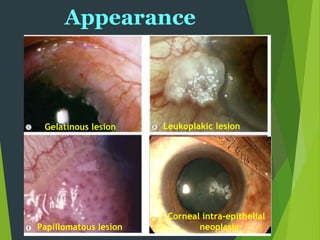
Gelatinous lesion Leukoplakic lesion
Papillomatous lesion
Corneal intra-epithelial
neoplasia
Appearance
In clinical practice, gelatinous type
is the commonest. These lesion can be
Circumscribed, which are most common
Nodular variety, which has a propensity
for rapid growth
Diffuse variety, the least common,
which can masquerade as chronic
conjunctivitis
Diagnostic Tests
Diagnosis is most often made clinically.
Fluorescein or Rose Bengal are often used to
highlight & delineating the extent the lesion.
Rose bengal stain of corneal epithelial dysplasia
a. Anterior Segment Optical Coherence
Tomography (ASOCT)
b. Impression cytology
c. Confocal microscopy
d. High frequency ultrasound
e. Histopathology
Diagnostic Tests
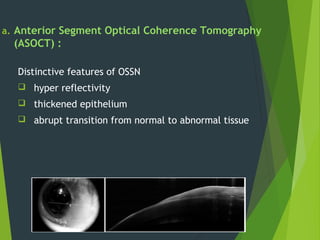
a. Anterior Segment Optical Coherence Tomography
(ASOCT) :
Distinctive features of OSSN
 hyper reflectivity
 thickened epithelium
 abrupt transition from normal to abnormal tissue
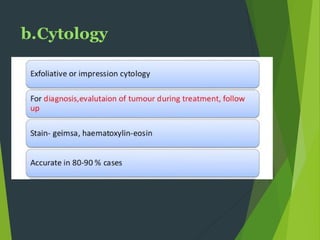
b.Cytology
c.Confocal microscopy
- helpful in guiding treatment since it is able
to reveal cellular details.
- difficulte of use and limited field of view
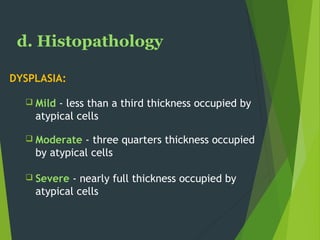
d. Histopathology
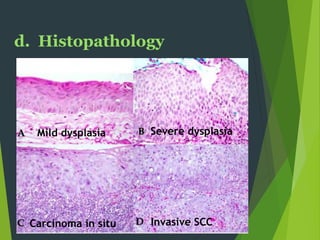
DYSPLASIA:
 Mild - less than a third thickness occupied by
atypical cells
 Moderate - three quarters thickness occupied
by atypical cells
 Severe - nearly full thickness occupied by
atypical cells
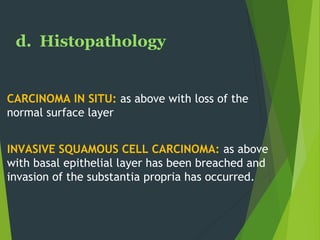
d. Histopathology
CARCINOMA IN SITU: as above with loss of the
normal surface layer
INVASIVE SQUAMOUS CELL CARCINOMA: as above
with basal epithelial layer has been breached and
invasion of the substantia propria has occurred.
d. Histopathology
d. Histopathology
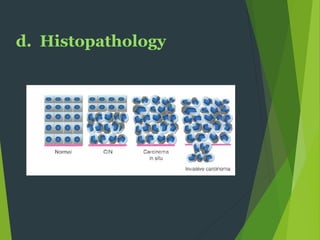
Mild dysplasia Severe dysplasia
Carcinoma in situ Invasive SCC
e) High frequency ultrasound
 extent of invasion into the eye in cases of SCC.
Differential Diagnosis
 Pterygium
 Papilloma
 Pingueculum
 Nevus
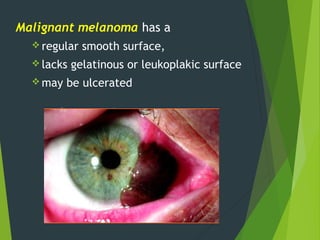
 Malignant melanoma
 Pyogenic granuloma
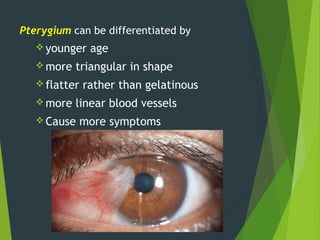
Pterygium can be differentiated by
 younger age
 more triangular in shape
 flatter rather than gelatinous
 more linear blood vessels
 Cause more symptoms
Papilloma may occur
 younger patients
 anywhere on the conjunctiva
 may be sessile or pedunculated
 has a punctate vascular pattern
Pedunculated exophytic
conjunctival papilloma
Malignant melanoma has a
 regular smooth surface,
 lacks gelatinous or leukoplakic surface
 may be ulcerated
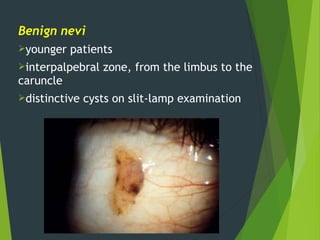
Benign nevi
younger patients
interpalpebral zone, from the limbus to the
caruncle
distinctive cysts on slit-lamp examination
Surgery
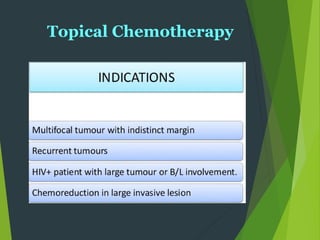
Chemotheraphy
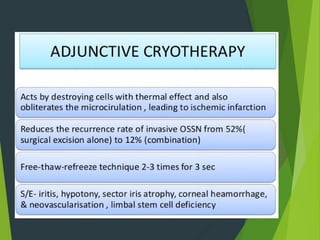
Cryotheraphy
Radiotheraphy
Treatment
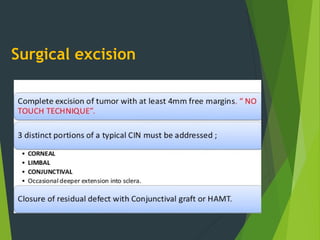
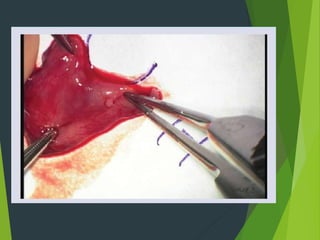
Surgical excision
Topical Chemotherapy
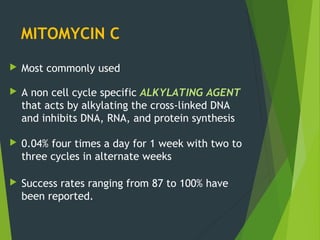
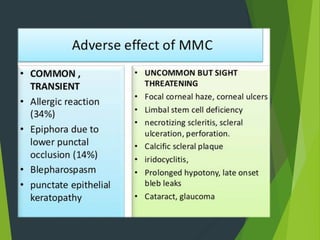
MITOMYCIN C
 Most commonly used
 A non cell cycle specific ALKYLATING AGENT
that acts by alkylating the cross-linked DNA
and inhibits DNA, RNA, and protein synthesis
 0.04% four times a day for 1 week with two to
three cycles in alternate weeks
 Success rates ranging from 87 to 100% have
been reported.
5-FU
 Pyrimidine analogue that acts by
integrating with the DNA during S phase.
It also interferes with RNA synthesis.
 It is used as 1% topical solution four times
a day for 1 week , followed by 30 days or
1–2 weeks off
 Side effects are similar to MMC
Interferons
 For OSSN: Topical IFN- α2b.
 1 million IU/ml as 4 times a day until
resolution, and a month thereafter
 More expensive than MMC and 5 FU
 Requires prolonged treatment but has a
better safety profile
Radiotherapy
Plaque brachytherapy
Radiation sources like Strontium 90,
Rhuthenium 106 or I-125 
Complications
Conjunctival scarring
Symblepharon
Dry eye
Cataract
Scleral & Corneal ulceration.
SUMMARY
[1] Suspected OSSN < 3 clock hours
Excision biopsy +
base/ edge cryotherapy +
alchohol epitheliectomy is done.
[2] Suspected OSSN 3 – 6 clock hours –
 A diagnostic biopsy is required
 Pre-invasive lesions
topical chemotherapy
 Invasive lesions
surgery + cryotherapy is done after
chemoreduction with 4 to 6 cycles of topical
chemotherapy.
[3] OSSN > 6 clock hours –
A diagnostic biopsy is
required.
 Pre-invasive lesions
Topical chemotherapy
 Invasive
Surgery + cryotherapy is done after
chemoreduction with 4 to 6 cycles of topical
chemotherapy.
 If there is no response to chemotherapy
Palliative radiotherapy or extensive surgery like
enucleation / exenteration may be required.
Metastasis
Regional and systemic metastases are also
uncommon.
Common sites of metastasis include pre-
auricular , submandibular and cervical lymph
nodes, parotid gland, lungs, and bone.
Recurrence
 Ranges from 15-52%, average 30%
 Higher in case of inadequate excision margins
 More aggressive behaviour
Conclusion
 Good clinical exam is sufficient for diagnosis.
 Excision with cryotheraphy is successful but
can be associated with recurrence rates
 Chemotherapeutic agents are usefull
alternative specially in recurrent, corneal &
annular lesion.
Ocular surface squamous neoplasia

Ocular surface squamous neoplasia

  • 1.
    OCULAR SURFACE SQUAMOUS NEOPLASIA(OSSN) Dr.(Maj.) A.K.M Rashed-Ul-Hasan FCPS-ll student National institute of ophthalmology & Hospital Dhaka
  • 3.
     OCULAR SURFACEdenotes involvement of the conjunctiva or cornea  SQUAMOUS excludes other epithelial cells such as basal cells and melanocytes  NEOPLASIA includes both dysplastic and carcinomatous lesions.
  • 4.
    Definition The term OcularSurface Squamous Neoplasia [OSSN] presently refers to the entire spectrum of dysplastic, pre-invasive and malignant squamous lesions of the conjunctiva and cornea
  • 5.
    Lee and Hirstclassified OSSN as:- I. BENIGN DYSPLASIA • Pseudoepitheliomatous hyperplasia • Benign hereditary intraepithelial dyskeratosis II. PREINVASIVE OSSN • Conjunctival/corneal carcinoma in situ III. INVASIVE OSSN • Squamous carcinoma • Mucoepidermoid carcinoma – aggressive
  • 6.
    Epidemiology  Third mostcommon ocular tumour after melanoma and lymphoma  Caucasians  older age group(6-7 decade)  Males >females  Patiens with HIV and Xeroderma pigmentosum present earlier All young patients with OSSN should be screened for HIV.
  • 7.
    Risk factors  Ultravioletlight  Immunosuppression/ HIV  Human papillomavirus (HPV)- Type 16 & 18  Mutation or deletions of tumor suppressor gene p53
  • 8.
    Clinical Features  Patientsmay be asymptomatic or present with chronic redness and irritation of the eye.  Visual acuity is not affected unless there is extensive corneal involvement  In most cases, patient has the history of several months.
  • 9.
    Location  OSSN normallyoccurs in Interpalpebral region arising from the limbal stem cells, involving the bulbar conjunctiva, the cornea or both of these structures
  • 10.
    Clinically :  Thelesions are described as being slightly elevated, variably shaped, relatively sharply demarcated from the surrounding normal tissues.  Accompanied by feeder blood vessels  Color vary from pearly gray to reddish gray depending on the vascularity of the tumor .
  • 11.
    Gelatinous lesion Leukoplakiclesion Papillomatous lesion Corneal intra-epithelial neoplasia Appearance
  • 12.
    In clinical practice,gelatinous type is the commonest. These lesion can be Circumscribed, which are most common Nodular variety, which has a propensity for rapid growth Diffuse variety, the least common, which can masquerade as chronic conjunctivitis
  • 13.
    Diagnostic Tests Diagnosis ismost often made clinically. Fluorescein or Rose Bengal are often used to highlight & delineating the extent the lesion. Rose bengal stain of corneal epithelial dysplasia
  • 14.
    a. Anterior SegmentOptical Coherence Tomography (ASOCT) b. Impression cytology c. Confocal microscopy d. High frequency ultrasound e. Histopathology Diagnostic Tests
  • 15.
    a. Anterior SegmentOptical Coherence Tomography (ASOCT) : Distinctive features of OSSN  hyper reflectivity  thickened epithelium  abrupt transition from normal to abnormal tissue
  • 16.
  • 17.
    c.Confocal microscopy - helpfulin guiding treatment since it is able to reveal cellular details. - difficulte of use and limited field of view
  • 18.
    d. Histopathology DYSPLASIA:  Mild- less than a third thickness occupied by atypical cells  Moderate - three quarters thickness occupied by atypical cells  Severe - nearly full thickness occupied by atypical cells
  • 19.
    d. Histopathology CARCINOMA INSITU: as above with loss of the normal surface layer INVASIVE SQUAMOUS CELL CARCINOMA: as above with basal epithelial layer has been breached and invasion of the substantia propria has occurred.
  • 20.
  • 21.
    d. Histopathology Mild dysplasiaSevere dysplasia Carcinoma in situ Invasive SCC
  • 22.
    e) High frequencyultrasound  extent of invasion into the eye in cases of SCC.
  • 23.
    Differential Diagnosis  Pterygium Papilloma  Pingueculum  Nevus  Malignant melanoma  Pyogenic granuloma
  • 24.
    Pterygium can bedifferentiated by  younger age  more triangular in shape  flatter rather than gelatinous  more linear blood vessels  Cause more symptoms
  • 25.
    Papilloma may occur younger patients  anywhere on the conjunctiva  may be sessile or pedunculated  has a punctate vascular pattern Pedunculated exophytic conjunctival papilloma
  • 26.
    Malignant melanoma hasa  regular smooth surface,  lacks gelatinous or leukoplakic surface  may be ulcerated
  • 27.
    Benign nevi younger patients interpalpebralzone, from the limbus to the caruncle distinctive cysts on slit-lamp examination
  • 28.
  • 29.
  • 32.
  • 33.
    MITOMYCIN C  Mostcommonly used  A non cell cycle specific ALKYLATING AGENT that acts by alkylating the cross-linked DNA and inhibits DNA, RNA, and protein synthesis  0.04% four times a day for 1 week with two to three cycles in alternate weeks  Success rates ranging from 87 to 100% have been reported.
  • 35.
    5-FU  Pyrimidine analoguethat acts by integrating with the DNA during S phase. It also interferes with RNA synthesis.  It is used as 1% topical solution four times a day for 1 week , followed by 30 days or 1–2 weeks off  Side effects are similar to MMC
  • 36.
    Interferons  For OSSN:Topical IFN- α2b.  1 million IU/ml as 4 times a day until resolution, and a month thereafter  More expensive than MMC and 5 FU  Requires prolonged treatment but has a better safety profile
  • 37.
    Radiotherapy Plaque brachytherapy Radiation sourceslike Strontium 90, Rhuthenium 106 or I-125  Complications Conjunctival scarring Symblepharon Dry eye Cataract Scleral & Corneal ulceration.
  • 38.
    SUMMARY [1] Suspected OSSN< 3 clock hours Excision biopsy + base/ edge cryotherapy + alchohol epitheliectomy is done.
  • 39.
    [2] Suspected OSSN3 – 6 clock hours –  A diagnostic biopsy is required  Pre-invasive lesions topical chemotherapy  Invasive lesions surgery + cryotherapy is done after chemoreduction with 4 to 6 cycles of topical chemotherapy.
  • 40.
    [3] OSSN >6 clock hours – A diagnostic biopsy is required.  Pre-invasive lesions Topical chemotherapy  Invasive Surgery + cryotherapy is done after chemoreduction with 4 to 6 cycles of topical chemotherapy.  If there is no response to chemotherapy Palliative radiotherapy or extensive surgery like enucleation / exenteration may be required.
  • 41.
    Metastasis Regional and systemicmetastases are also uncommon. Common sites of metastasis include pre- auricular , submandibular and cervical lymph nodes, parotid gland, lungs, and bone.
  • 42.
    Recurrence  Ranges from15-52%, average 30%  Higher in case of inadequate excision margins  More aggressive behaviour
  • 43.
    Conclusion  Good clinicalexam is sufficient for diagnosis.  Excision with cryotheraphy is successful but can be associated with recurrence rates  Chemotherapeutic agents are usefull alternative specially in recurrent, corneal & annular lesion.

Editor's Notes

  • #12 Gelatinous lesion with surface vessels ; leukoplakic lesion ; Papillomatous lesion ; extensive with corneal involvement
  • #17 first is exfoliative cytology by using spatula scrapings or a cytobrush to collect the sample, and second is impression cytology by using the collecting devices to collect the sample by contact with the surface of the lesions. cellulose acetate paper (CAP)
  • #22 Mild dysplasia; the basal cells are disordered with increased nuclear sizes and coarse nuclear chromatin. B. Severe dysplasia; the epithelial cells are varied in shapes and sizes with large pleomorphic nuclei. C. Carcinoma in situ: the entire thickness of the epithelium is composed of dysplastic cells bearing pleomorphic nuclei. D. Invasive squamous cell carcinoma; the invasive nest in the stroma is composed of bizarre cells similar to those in the epithelium. The nuclei are plemorphic with thick nuclear membranes and prominent nucleoli (Hematoxylin and Eosin stain.
  • #31 Once the lesion is removed en bloc, the specimen is marked in the proper orientation with sutures and then transferred to a piece of pencilmarked cardboard. The specimen is sent to pathology in formalin.
  • #34 MMC can be stored at room temperature (22°C) for up to 1 week; if refrigerated (4°C), it can maintain 90% of its activity for longer. the one week on, one week off regimen prevents damage to more slowly dividing epithelial cells and limbal stem cells, allowing them to repair their DNA. Allowing time for complete epithelial healing before application of MMC is important in avoiding the more serious complications such as corneal epitheliopathy, scleral ulceration, uveitis, cataract, and glaucoma
  • #36 This one week on and one week off drug regimen has the added advantage of good efficacy and better tolerance.
  • #43 More aggressive because of the tissue disruption associated with the primary excision theoretically enhancing the ability of the tumor cells to enter the eye